Hubbry Logo
HighlighterHighlighterMain
Open search
Highlighter
Community hub
Highlighter
logo
7 pages, 0 posts
0 subscribers
Be the first to start a discussion here.
Highlighter
Highlighter
from Wikipedia

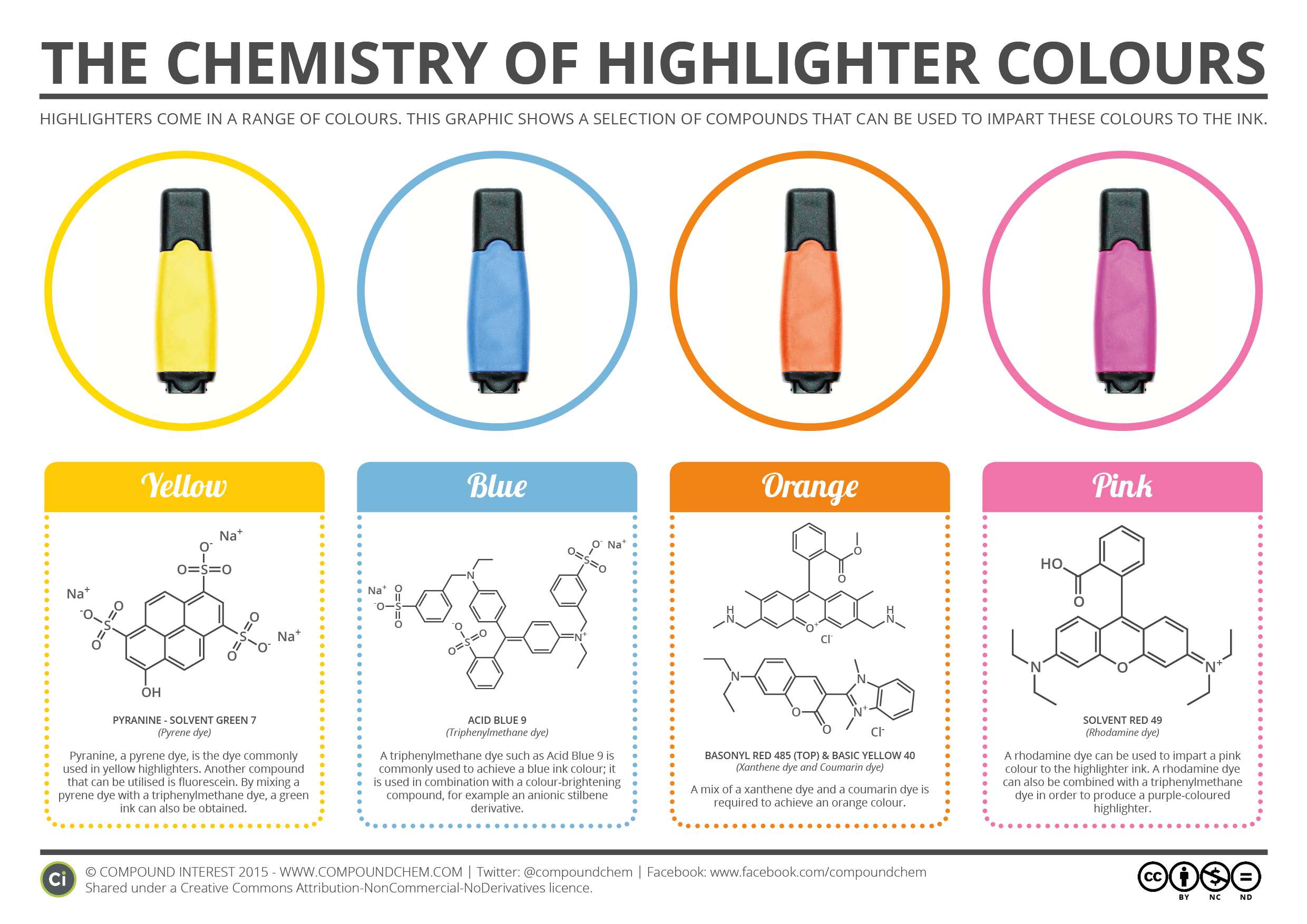
A highlighter, also called a fluorescent pen, is a type of writing device used to bring attention to sections of text by marking them with a vivid, translucent colour.[1] A typical highlighter is fluorescent yellow, with the colour coming from pyranine.[2] Different compounds, such as rhodamines (Rhodamine 6GD, Rhodamine B) are used for other colours.[3]

History

[edit]

A highlighter is a felt-tip marker filled with transparent fluorescent ink instead of black or opaque ink. The first highlighter was invented by Dr. Frank Honn in 1963 [4] and produced by Carter's Ink Company, using the trademarked name Hi-Liter. Avery Dennison Corporation now owns the brand, having acquired Carter's in 1975.[5]

Styles

[edit]
A yellow Stabilo-brand highlighter pens

Many highlighters come in bright, often fluorescent and vibrant colours. Being fluorescent, highlighter ink glows under black light.[6] The most common colour for highlighters is yellow, but they are also found in orange, red, pink, purple, blue, and green varieties. Some yellow highlighters may look greenish in colour to the naked eye. Yellow is the preferred colour to use when making a photocopy as it will not produce a shadow on the copy.

Highlighters are available in multiple forms, including some that have a retractable felt tip or an eraser on the end opposite the felt. Other types of highlighters include the trilighter, a triangularly-shaped pen with a different-coloured tip at each corner, and ones that are stackable. There are also some forms of highlighters that have a wax-like quality similar to an oil pastel.

"Dry highlighters" (occasionally called "dry line highlighters") have an applicator that applies a thin strip of highlighter tape (physically similar to audio tape or correction tape) instead of a felt tip. Unlike standard highlighters, they are easily erasable. They are different from "dry mark highlighters", which are sometimes advertised as being useful for highlighting books with thin pages.

"Gel highlighters" contain a gel stick rather than a felt tip. The gel does not bleed through paper or become dried out in the pen as other highlighters' inks may, which renders them useless.

"Liquid highlighters" in a range of colours are also available, and because they put more ink on a page when highlighting, they make words stand out more than with non-liquid types. Also the fact that more highlighting ink is put on the page with liquid highlighters means that the highlighting ink is much more resistive to fading with age.

"Pastel highlighters" use pastel dyes instead of fluorescent dyes.

In software

[edit]
Errors marked in computer code, in the style of a highlighter pen

Some word processing software can simulate highlighting by using a technique similar to reverse video on some terminals. For example, the CHAR command of Commodore 128 BASIC allows text to be displayed in reverse, which can be used to highlight text forms and selected items in menus.[7]

In HTML, text can be highlighted in yellow with the <mark> element. This is an example.

Some forms of syntax highlighting may also be displayed in the style of a highlighter pen, with a bright or pastel background to the text. Some web browser extensions also enable users to create digital highlights on websites and online PDFs.

See also

[edit]

References

[edit]
[edit]
Revisions and contributorsEdit on WikipediaRead on Wikipedia
from Grokipedia
A highlighter is a type of designed to draw attention to sections of text or documents by applying a broad line of vivid, translucent, fluorescent-colored that allows the underlying content to remain legible. Invented in 1963 by Dr. Francis Honn at Carter's Ink Company in , the highlighter originated from experiments with translucent marking inks conducted since 1959 intended for non-obstructive annotation. The product was first commercialized in 1963 under the trademark "Hi-Liter," revolutionizing and document review by providing a quick, visible method for emphasis without rewriting. Highlighters typically feature a chisel-shaped or broad-felt tip for versatile line widths and are most commonly available in fluorescent shades such as , , orange, , and , with being the predominant color due to its high visibility on . They are widely used in academic, professional, and legal settings for highlighting key information in books, articles, contracts, and study materials, enhancing and retention. Modern variants include erasable, waterproof, and gel-based formulas, reflecting ongoing innovations in office and art supplies since the product's debut. In a secondary sense, the term "highlighter" also refers to a cosmetic product used to add and accentuate facial features, a usage that emerged later in the late but is distinct from the original writing instrument.

Introduction and Basics

Definition and Purpose

A highlighter is a type of designed to highlight sections of text or documents using vivid, translucent that allows the underlying content to remain readable. This writing tool typically employs water-based , which is fluorescent or brightly to draw without obscuring the marked . The is applied through a felt or tip, such as a or style; the tip's shape enables the creation of broad highlights or fine lines, while in the porous delivers the smoothly, and the formulation helps prevent excessive bleed-through on . The primary purpose of a highlighter is to emphasize key points in various materials, facilitating quick reference and review by drawing attention to important information. It is commonly used in notes, books, legal documents, and study materials to identify critical facts, concepts, or sections, helping users process and retain information more effectively during reading or analysis. By providing a visual cue that replaces traditional underlining or marginal notations, highlighters support focused engagement with text, particularly in educational or professional settings where revisiting highlighted areas aids in comprehension and preparation. Highlighters emerged as a specialized form of felt-tip in the mid-20th century, with the first commercial version introduced in 1963. This development marked a shift toward tools optimized for non-permanent, translucent marking, building on earlier innovations in water-based during the .

Physical Characteristics

A traditional highlighter consists of a cylindrical barrel that serves as the main body, typically measuring 13-15 cm in length to provide a comfortable reach for marking text. This barrel is often designed with transparency or semi-transparency to visibly indicate remaining levels, and it includes a sturdy clip attached near the cap for secure attachment to notebooks or pockets, enhancing portability. The writing end features tip variations such as the chisel-shaped design, which offers a broad edge for wide highlighting and a fine point for precise underlining, alongside bullet tips that produce rounded, uniform lines or tapered tips for gradual width control. These tips are constructed from porous materials like felt, (such as ), or molded to facilitate smooth application without bleeding. Internally, the ink reservoir is a compact or cartridge that holds 1-5 ml of liquid , relying on to deliver a consistent flow from the reservoir to the tip, preventing leaks and ensuring reliable performance over extended use. The overall design emphasizes , with the pen weighing less than 20 g for reduced hand and incorporating textured or contoured grip sections along the barrel to support comfortable handling during prolonged highlighting sessions.

History

Early Developments

Prior to the 20th century, marking and annotation relied on opaque colored and pencils, which were used for emphasizing text in manuscripts and documents but lacked the translucent quality essential for highlighting without obscuring underlying content. In , Lee Newman patented the first felt-tip marking pen, featuring a cylindrical of connected to a felt tip via a wick system that ensured even distribution and controlled flow. This marked a significant step toward modern writing tools by enabling precise, non-smearing application on various surfaces, though it was primarily suited for industrial marking rather than everyday . The 1950s saw further advancements with Sidney Rosenthal's of the Magic Marker in 1953, a -stemmed felt-tip containing permanent that could write on diverse materials like and . This device built on earlier felt-tip designs by improving durability and versatility, establishing a foundation for subsequent non-permanent formulations that would prove crucial for highlighting applications. By the early 1960s, the post-World War II economic and educational expansion in the United States—fueled by the , which boosted college enrollment from about 1.5 million in 1940 to over 2.7 million by 1950—heightened demand for efficient office and study tools. Concurrently, Japanese companies advanced water-based ink technologies, with innovations like Pentel's development of the first water-based fiber-tipped pen (Sign Pen) in 1963, enabling smoother, less permanent writing suitable for annotation. These early markers gained commercial traction, setting the stage for specialized highlighting instruments.

Invention and Commercialization

In 1962, Japanese inventors Yukio Horie and Masao Miura, who ran an art materials business, developed the first felt-tip pen with water-based , laying foundational technology for later highlighting tools. Independently, in 1959, Dr. Francis J. Honn, vice president of technology at Carter's Company in the United States, accidentally created a fluorescent, nonpermanent formula while experimenting with improvements to inks. Carter's Ink Company quickly commercialized Honn's invention as the Hi-Liter, launching it in initially in yellow to emphasize its translucent, see-through quality on printed text. The product gained rapid adoption in educational and professional settings for highlighting without obscuring underlying content. By the 1970s, highlighters achieved widespread availability through competing brands, including Sharpie's fluorescent markers and Stabilo's BOSS line introduced in 1971, fueling a sales boom particularly in the sector where they transformed practices. Honn secured a key U.S. for his ink formula, which relied on pyrene-based fluorescent dyes like pyranine to achieve the desired translucency and vibrancy.

Design and Materials

Ink Formulation

Highlighter inks are predominantly water-based , consisting of a liquid vehicle primarily composed of combined with glycols such as or to achieve the desired flow and stability. These solvents make up the balance of the after accounting for colorants and additives, ensuring the remains fluid within the pen reservoir. Fluorescent dyes, rather than opaque pigments, are suspended or dissolved to provide translucency, allowing the underlying text to remain visible; common examples include pyranine (a derivative) for yellow, dyes for blue, and for pink, with dye concentrations typically ranging from 1% to 10% by weight. Key properties of highlighter ink are engineered for practical use, including non-toxicity certified to AP standards for safe handling in educational settings, quick-drying times under 10 seconds to minimize transfer, and smear resistance on printed or handwritten text. The ink maintains a between 3 and 6, often buffered with acids like citric or (0.5% to 10% by weight) to prevent bleeding on while preserving stability. Viscosity is controlled at approximately 2 to 5 centipoise (cP) through the balance of solvents and resins, enabling smooth flow through the pen tip without clogging. Some formulations incorporate alcohol-based solvents like monomethyl ether for faster evaporation in specialized variants. The fluorescent effect arises from the dyes' ability to absorb (UV) light, exciting electrons to a higher energy state, followed by rapid re-emission of the energy as visible in the 400-700 nm range, producing the characteristic bright glow without adding opacity to the ink layer. This property is enhanced under , where pyrene derivatives like exhibit particularly strong yellow . Additives play a crucial role in performance and longevity; humectants such as (up to 16% by weight) prevent the ink from drying out in the reservoir, while biocides inhibit microbial growth in the water-based medium. Leveling agents, like silicone-based (up to 2% by weight), ensure even application and reduce for consistent highlighting.

Tip and Barrel Construction

The tip of a highlighter pen is typically constructed from porous materials such as felt or fibers, which allow for controlled dispersion during use. These fibers are processed by pressing or cutting them into the desired shape, often using precision molding techniques to form chisel-style tips capable of producing lines ranging from 1 to 5 mm in width for versatile highlighting and underlining. In some production methods, the tip material begins as a of and , which is molded and baked to create durable, pointed or flat forms that resist fraying. The fibers are then bonded or secured with an or metal/ collar to ensure stability and even saturation. The barrel, which houses the ink reservoir, is manufactured through injection molding of plastic resins, commonly polypropylene, to achieve a lightweight yet robust structure. This process involves melting plastic pellets and injecting the molten material into precision molds under high pressure, followed by rapid cooling to form the transparent or semi-transparent body that allows users to monitor ink levels. Modern designs incorporate ergonomic features, such as contoured shapes or rubberized grip sections, molded directly into the barrel to enhance comfort during extended use. The reservoir, typically a polyester cylinder or synthetic fiber bundle, is integrated into the barrel via ultrasonic welding, a technique that fuses components without additional fasteners to prevent leaks and ensure airtight seals. Ink delivery in highlighters relies on a system, where the reservoir acts as a wick to draw from the barrel to the tip through porous channels. This mechanism ensures consistent flow without the need for pumping, with the 's properties—such as low viscosity—facilitating smooth saturation of the tip (as covered in the Ink Formulation section). In certain advanced designs, a simple regulates the flow to control release and prevent over-saturation or drying. Quality control in highlighter production emphasizes durability and performance, with each unit tested to write continuously for 100 to 350 meters or equivalent to 700–1,000 circles to verify ink longevity and even application. Assemblies undergo leak detection checks and ergonomic assessments to meet standards like EN71 for safety and non-toxicity, ensuring the final product withstands typical handling without compromising functionality.

Varieties

Color Options

Highlighters traditionally feature fluorescent inks in a limited palette of bright colors designed for optimal visibility against white or light-colored backgrounds. The most common color is , which was the original formulation introduced in the first commercial highlighter in , prized for its high contrast and minimal interference with underlying text. Other standard fluorescent options include , orange, green, and , selected for their ability to stand out vividly due to the ink's , which converts light into visible wavelengths, enhancing brightness under typical indoor lighting. These colors emerged as extensions of the initial yellow design, with pink, blue, and orange added in subsequent developments to expand highlighting versatility. In practice, these fluorescent hues leverage principles of to support cognitive tasks like , where distinct shades facilitate organization and recall by creating visual hierarchies in text. For instance, is often associated with and clarity, aiding focus on general content, while is linked to , drawing from broader on how chromatic cues enhance retention in educational settings. Highlighter sets are available in multi-color assortments, enabling users to implement coding systems—such as assigning specific shades to categories like key terms or examples—for improved information processing without overwhelming the page. Highlighters are available in single-color packs for targeted use or multi-color assortments for comprehensive sets, reflecting an from the yellow-only models of the 1960s to a broader by the 1980s as manufacturers diversified offerings to meet demands for varied needs. Lighter shades like are less prone to obscuring printed text due to their translucency. Regarding bleed-through, these inks are formulated for minimal penetration on standard 80gsm , with exhibiting the least show-through in comparative tests, preserving the integrity of double-sided writing surfaces. The fluorescent properties of the ink, which produce the vivid glow, contribute to this balanced performance by ensuring adhesion to the paper surface without excessive saturation.

Specialized Features

Highlighters have evolved to include dual-tip designs that combine a fine point, often 1-2 mm for precise underlining, with a broader tip, typically 2-5 mm wide for shading larger sections of text. These versatile tools, such as the Zebra Pen MILDLINER, allow users to switch between detailed and bold highlighting in a single marker, enhancing functionality for creative tasks like hand . Retractable highlighters incorporate a mechanism to extend and retract the tip, featuring a safety seal that prevents ink evaporation and drying when capped, thereby extending the product's lifespan compared to traditional capped versions. Brands like Sharpie emphasize this design to resist smudging and maintain integrity over time. Innovations in formulation extend to variants, which offer muted shades that minimize visual glare and relative to standard fluorescent hues, for applications in journaling and digital printouts. Erasable highlighters, exemplified by Pilot's FriXion series, employ thermo-sensitive that vanishes upon application of friction or mild heat, enabling repeated highlighting without residue or paper damage. Gel-based s provide a thicker consistency that adheres well to glossy or thin surfaces without bleeding through, as seen in Sharpie Gel Highlighters suitable for magazines and coated papers. Eco-friendly advancements include biodegradable barrels constructed from plant-based (PLA) plastics, which decompose more readily than conventional petroleum-derived materials, and refillable reservoirs that minimize waste by allowing ink replenishment. As of 2025, popular lines like Zebra Mildliner have introduced new shades, further expanding options for creative and sustainable use. Pilot's Spotliter series exemplifies refillable options, promoting in . Niche variants, such as those designed for or whiteboards, utilize wet-erasable formulations for temporary marking on non-porous surfaces like windows.

Applications

Educational and Study Uses

Highlighters play a central role in study techniques that promote active recall and organization, particularly through color-coding systems integrated into methods like the Cornell note-taking system. In this approach, students divide notes into sections for cues, main ideas, and summaries, using highlighters to visually distinguish elements such as for key definitions, for supporting examples, and for important formulas or dates. This color-coding enhances categorization and retrieval during review, aligning with principles that encourage processing information beyond passive reading. Students frequently employ highlighters to mark key passages in textbooks and novels, focusing on concepts critical for exams by underscoring main arguments, , or on a second . This practice aids in prioritizing content for later , though it is most effective when selective rather than applied indiscriminately across entire pages. For instance, highlighting topic sentences or transitional phrases helps delineate structure in dense academic texts, facilitating quicker navigation during study sessions. In group study activities, highlighters support collaborative efforts by enabling shared on printed or digital documents, where participants take turns marking insights or questions to build understanding. This method fosters discussion and consensus on important material, often extending to the creation of flashcards by transferring highlighted snippets into portable review tools. Such interactions in study groups not only reinforce individual retention but also expose learners to diverse perspectives on the same content. Cognitive research indicates that strategic use of highlighters, especially learner-generated marking, yields a small to moderate improvement in memory retention (Hedges' g = 0.36), though effects on comprehension are weaker (g = 0.20), based on a of 36 studies spanning 1938 to 2019. Visual cues from highlighting can enhance focus and by signaling importance, with benefits more pronounced among students than younger learners. However, over-highlighting—such as marking excessive portions of text—diminishes effectiveness by overwhelming the and reducing selectivity, leading to poorer compared to more targeted applications. Surveys from international assessments like digital PIRLS show highlighting prevalence varies widely, with up to 52% of students in some countries using it during reading tasks, underscoring its common yet context-dependent role in .

Professional and Office Uses

In professional environments, highlighters play a key role in document review processes, particularly within legal and sectors where they are employed to mark critical sections of , reports, and spreadsheets. Legal firms often rely on highlighters to track specific clauses and identify potential risks during contract reviews, enabling precise navigation through complex documents. In teams, color-coded highlighting facilitates efficient analysis of and compliance documents. This practice is generally permissible and serves as a visual without altering the document's legal . Highlighters also enhance meeting notes by allowing quick emphasis on agendas, action items, and key decisions during board or team sessions. Professionals frequently use color coding with highlighters to categorize information, such as distinguishing priorities or assignments, which improves note organization and follow-up efficiency. They are a standard component of supply kits, supporting in collaborative settings. For archiving purposes, highlighters provide non-permanent annotations on shared physical files, preserving document integrity by avoiding permanent marks or damage during temporary reviews. This translucent application aids in maintaining clean records for long-term storage. In addition, highlighted documents scan effectively for digital conversion, with colors like and minimizing shadows or distortions in OCR processes, thus streamlining the transition to electronic archives. Overall, these uses contribute to efficiency in audits and reviews by visually prioritizing , which accelerates retrieval and reduces search times compared to unhighlighted materials.

Digital Equivalents

Software Tools

Software tools for digital highlighting emulate the functionality of physical highlighters by allowing users to apply color overlays to text, images, or within applications, facilitating , organization, and retrieval of . These tools are integrated into various , enabling precise markup with support for multiple colors and layers of annotations. In PDF and document editors, highlighting features provide robust options for marking up files. offers a dedicated highlighter tool that allows users to select and apply color overlays to text or images by clicking and dragging, with support for multiple highlight colors and integration with tools for adding or comments directly on marked sections. Similarly, enables text highlighting through the Home tab's Text Highlight Color button, where users select text and choose from a palette of colors to apply overlays, accommodating annotations via comments or tracked changes for collaborative editing. These capabilities extend to images in some cases, though primarily focused on textual content, and allow for easy removal or modification of highlights. Note-taking applications incorporate virtual highlighter functionalities to enhance and review processes. Evernote's note editor includes a highlighter tool for applying color to text or images, accessible via the , which supports bold, italics, and multiple highlight colors to emphasize key sections; notes with highlights can be edited with /redo actions and automatically synchronized across devices via . provides a Text Highlight Color feature in its web and desktop versions, allowing selection of text followed by application of various colors from a dropdown menu, with built-in /redo for adjustments and seamless auto-sync through accounts to ensure highlights are accessible on multiple platforms. Browser extensions for web reading extend highlighting to content, enabling users to save and mark articles for later reference. Readwise's official , available for Chrome and , allows direct highlighting of web text with a simple activation tool, automatically saving marks along with the full article to a centralized for review and export. This facilitates keyboard-based navigation and integration with other apps, preserving highlights in a searchable format without disrupting the reading flow. Advanced software tools leverage to assist with highlighting, automating the identification of important content. In Notion, the 2024 update to Notion AI enables contextual suggestions when users manually highlight text, such as options to explain the selected content, improve writing, or generate summaries of key phrases, enhancing by focusing on salient . These AI-assisted highlights can be exported to searchable formats like PDFs or integrated databases, maintaining annotations for long-term retrieval and collaboration within the platform.

Digital Devices

Digital devices that serve as equivalents to traditional highlighters primarily fall into two categories: portable scanning pens that digitize printed text through (OCR), and e-ink tablets or e-readers equipped with support for annotating digital documents. These tools enable users to "highlight" text by capturing, marking, or exporting it digitally, facilitating , study, and content organization without physical . Scanning pens, often marketed as digital highlighters, function by sliding the device along a line of printed text, using built-in cameras and OCR technology to capture and convert it into editable digital format. For instance, the Scanmarker Air is a model that scans at speeds up to 10 cm (approximately 4 inches) per second, supporting text-to-speech output in over 40 languages and connectivity to computers, tablets, or smartphones for instant transfer. It handles machine-printed text with 350 DPI resolution and can process up to 3,000 characters per minute, making it suitable for quick of , articles, or reports. Similarly, the C-Pen Reader features an display and targets users with or visual impairments, scanning text sizes from 6.5 to 22 points and providing dictionary integration with Collins or references, powered by a 1200 mAh battery for extended use. These devices emphasize portability, with the IRISPen Air 7 offering offline in 45 languages and scanning, though they generally struggle with complex or mathematical formulas beyond image capture. E-ink tablets and dedicated e-readers provide a screen-based alternative for highlighting within digital files like PDFs or e-books, mimicking the tactile feel of through stylus interaction. The Scribe (2025 model) features an 11-inch, 300 ppi e-ink display with auto-adjusting front and supports -based highlighting and directly on imported documents, with battery life extending up to 12 weeks on low usage. It integrates highlights into the Kindle ecosystem for export and searchability, enhancing study workflows. The Paper Pro offers an 11.8-inch color e-ink screen at 229 ppi, allowing precise annotations and highlights on PDFs or files, with 64 GB storage and up to two weeks of battery life, designed to reduce during prolonged reading sessions. As of 2025, the reMarkable Paper Pro Move provides a portable 7.3-inch variant for on-the-go use. Devices like the Note Air series extend this functionality with Android OS support for broader app integration, enabling highlighting across various formats while maintaining a distraction-free interface; the latest Note Air5 C model runs Android 15 with enhanced color e-paper capabilities. Smart pens, such as the Neo Smartpen M1+, pair with for hybrid use, digitizing handwritten highlights via Ncode technology and app synchronization. These digital devices prioritize accessibility and efficiency, with scanning pens excelling in converting and e-ink tablets focusing on native digital . Adoption has grown among students and professionals, driven by features like multilingual support and cloud syncing, though limitations in persist across models.

References

Add your contribution
Related Hubs
User Avatar
No comments yet.