Hubbry Logo
search
logo
1778072

Highpoint I

logo
Community Hub0 Subscribers
Read side by side
from Wikipedia

Highpoint I was the first of two apartment blocks erected in the 1930s on one of the highest points in London, England, in Highgate. The architectural design was by the Georgian-British architect Berthold Lubetkin,[1] the structural design by the Anglo-Danish engineer Ove Arup and the construction by Kier.[citation needed]

Key Information

History

[edit]

Highpoint I was built in 1935 for the entrepreneur Sigmund Gestetner, but was never used for its intended purpose of housing Gestetner company staff. One of the best examples of early International style architecture in London, this block of 64 flats was very innovative in its day.

When the building was completed, it became widely renowned as the finest example of this form of construction for residential purposes. When Corbusier himself visited Highpoint in 1935 he said, "This beautiful building .... at Highgate is an achievement of the first rank." And the American critic Henry Russell Hitchcock called it, "One of the finest, if not absolutely the finest, middle-class housing projects in the world."[2] In 1970 this reputation gained official recognition when both Highpoint blocks were classified Grade I within the historic buildings listing programme.[3]

The architectural historian Dan Cruickshank selected Highpoint as one of his eight choices for the 2002 BBC book The Story of Britain's Best Buildings.[4]

In 2014, a studio on the second floor of Highpoint was listed for £400,000, a two-bedroom for £950,000 and a four-bedroom for £1,399,000.[5] In 2017, Highpoint II's penthouse, former home of Lubetkin, was listed for sale at £2,950,000 by The Modern House.[6][7]

Highpoint II

[edit]

Lubetkin lived in Highpoint I's penthouse until the completion of Highpoint II.[5] The second Lubetkin building in the same style, Highpoint II (a more luxurious version[6]), was completed on an adjoining site in 1938. This is also a Grade I Listed Building.[8]

It served as the exterior of Emma Peel’s flat in The Avengers TV series in the 1960s.

References

[edit]
[edit]
Revisions and contributorsEdit on WikipediaRead on Wikipedia
from Grokipedia
Highpoint I is a pioneering modernist apartment block situated on North Hill in Highgate, London, designed by the architect Berthold Lubetkin in collaboration with his firm Tecton and completed in 1935.[1] It comprises sixty flats arranged in a distinctive double cruciform plan, constructed using monolithic reinforced concrete techniques innovated with structural engineer Ove Arup, and was commissioned by industrialist Sigmund Gestetner as an exemplar of progressive housing.[1][2] The building's elevated site and sculptural form, featuring a Cross of Lorraine footprint with central stair and lift cores, marked it as one of the earliest and most influential expressions of International Style architecture in Britain, blending functional efficiency with aesthetic dynamism through elements like extensive balconies and a ground-floor tearoom.[2][1] Originally offering a range of rental options to attract middle-class residents, Highpoint I quickly gained international acclaim, with Le Corbusier hailing it as the world's first "vertical garden city" and its inclusion in a 1937 New York exhibition as a model of exemplary middle-class housing.[1][2] Designated a Grade I listed structure in 1974, Highpoint I remains a cornerstone of 20th-century British architecture, embodying the social aspirations of modernism while influencing subsequent residential developments through its meticulous detailing and spatial innovation.[1] Its legacy endures as a testament to Lubetkin's émigré vision, adapting continental modernism to the British context amid the interwar period's architectural shifts.[2]

Location and Context

Site Description

Highpoint I is situated at North Hill, Highgate, London N6 4BA, with geographic coordinates of 51.5749°N, 0.1507°W.[3] The site occupies one of London's highest elevations, standing at approximately 446 feet (136 meters) above sea level, which affords panoramic views across the city. Its topography consists of steeply sloped terrain falling to the west, a feature that significantly shaped the architectural response to the location.[1] The immediate surroundings encompass natural landscapes adjoining Highgate Wood to the north and Hampstead Heath to the west, providing residents with direct access to expansive wooded and open green spaces.[4] The site is also conveniently close to Highgate tube station on the Northern Line, facilitating easy connectivity to central London.[4] The land for Highpoint I was purchased by entrepreneur Sigmund Gestetner in 1934, intended initially as housing for employees of his office machinery company.[5]

Historical Context of Highgate

Highgate emerged in the 17th century as a distinct village on London's northern periphery, initially serving as a tollgate point along key routes and attracting affluent Londoners and courtiers who built grand residences like Cromwell House around 1638 for its elevated position and fresh air.[6] By the 18th century, it had solidified as a genteel suburb with a cluster of wealthy households, supported by the Lighting and Watching Act of 1774 that formalized its status as a select enclave amid expanding urban pressures.[6] The 19th century marked accelerated suburbanization following the 1867 railway connection to the City, which facilitated the development of garden estates such as Holly Lodge—initially constructed in 1809—and middle-class villas, transforming Highgate into an aspirational commuter haven preserved by its green expanses and historic charm.[6] In the interwar period between the world wars, Highgate experienced demographic shifts as large Victorian-era houses were increasingly subdivided or redeveloped into apartments to house a growing influx of professionals and artists seeking its blend of urban accessibility and rural aesthetics.[6] The suburb's garden estates, including the interwar Holly Lodge Estate developed in the 1920s in the garden suburb tradition, appealed to this demographic, reflecting broader middle-class desires for spacious, health-oriented living amid London's sprawl. This era saw Highgate retain its affluent character while adapting to modern needs, with cultural figures drawn to its hilltop views and proximity to Hampstead Heath.[7] The 1930s witnessed London's housing landscape evolve amid post-World War I shortages that had left a severe deficit in urban dwellings, prompting a national push for new construction under initiatives like the "Homes Fit for Heroes" campaign, though delivery fell short of targets.[8] Middle-class aspirations for hygienic, light-filled modern homes drove suburban expansion and a surge in apartment building, with over 2.5 million new units erected nationwide in the decade, many incorporating continental influences.[9] European émigré architects, including Berthold Lubetkin who fled Russia via Paris, introduced modernist principles to Britain, advocating collective housing solutions that prioritized communal amenities and efficient design over traditional terraced houses.[10] These trends clashed with local sensibilities in established suburbs, where the broader "houses versus flats" controversy highlighted tensions over high-density developments perceived as disruptive to traditional architecture and leafy enclaves.[11] In Highgate, these discussions underscored the suburb's transition from rural idyll to a testing ground for progressive urbanism, exemplified by commissions from figures like industrialist Sigmund Gestetner seeking forward-thinking residences.[9]

Design and Architecture

Overall Design Concept

Highpoint I was designed by Berthold Lubetkin in collaboration with the Tecton architectural group, which he founded in 1932, and structural engineer Ove Arup, marking a pivotal introduction of modernist principles to British residential architecture.[12][13] Lubetkin, a Russian émigré trained at Moscow's Vkhutemas under Constructivist pioneers like Vladimir Tatlin and influenced by Le Corbusier's early works such as the Villa Savoye, sought to adapt these avant-garde ideas to address urban housing challenges in interwar London.[12][13] The core concept envisioned Highpoint I as a "vertical garden city," a term coined by Le Corbusier in praise of the project upon its 1935 completion, aiming to provide middle-class housing through a seven-storey reinforced concrete block containing 60 flats, typically with two or three bedrooms.[12][1] This design emphasized communal living by maximizing natural light and air circulation, with spacious layouts that integrated private residences with shared outdoor spaces to foster social interaction and well-being in a dense urban setting.[13] In terms of massing and layout, the building adopts a Z-shaped plan—also described as double cruciform—allowing its wings to step down the site's sloping topography, optimizing orientation for sunlight and views while accommodating the narrow plot.[13] A penthouse level crowns the structure with a rooftop terrace dedicated to communal gardens, reinforcing the garden city ethos in a vertical form that elevates residents above the suburban sprawl.[14] Underpinning this vision were Lubetkin's socialist ideals, shaped by his Constructivist roots and revolutionary experiences in Russia, which rejected low-density suburban expansion in favor of hygienic, efficient high-density living to promote egalitarian urban communities.[12] Through Tecton's formation of the Architects’ and Technicians’ Organization in 1935, Lubetkin advocated for architecture as a tool for social reform, though Highpoint I ultimately served an affluent clientele rather than broader public housing needs.[12]

Exterior Features

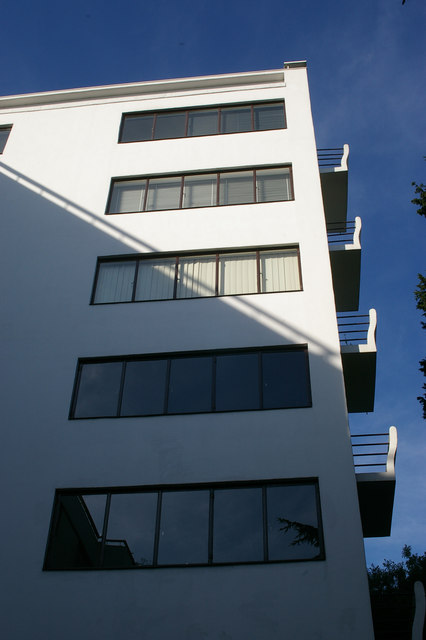
Highpoint I's exterior exemplifies the International Style's emphasis on clean lines and functional form, constructed as a monolithic reinforced concrete structure with a white rendered finish that creates a crisp, unadorned facade.[1] The building's asymmetrical composition is defined by its double cruciform plan, rising to seven storeys on a narrow hilltop site, with a height of approximately 60 feet that emphasizes horizontal massing through long, continuous glazing strips while contrasting the vertical rise of its pilotis-supported base.[13] Large steel-framed windows, featuring horizontal bands with concertina folding mechanisms, maximize natural light and integrate the structure seamlessly with its surroundings, adhering to modernist principles of minimal ornamentation.[1] The facade's most distinctive elements are the cantilevered balconies, which project as sculptural accents with cyma-curved fronts on the larger flats and shorter versions at the ends, providing a rhythmic skeletal framework that softens the building's geometric rigor.[1] These curved white concrete balconies, engineered for structural efficiency, not only enhance the aesthetic flow but also serve functional purposes like shading and ventilation, reflecting Berthold Lubetkin's Tecton practice's innovative approach to residential design.[13] Horizontal glazing strips between balconies further accentuate the building's planar quality, avoiding decorative excess in favor of pure, machine-age precision.[1] Access to the building is dramatized by a sweeping porte-cochère at the base, featuring a cantilevered curved porch under pilotis that leads via an angled front and curved driveway, creating a dynamic entry sequence.[1] External stair towers, illuminated by glass-block fenestration, act as sculptural vertical accents, their forms integrated into the overall composition without overpowering the horizontal emphasis.[15] The design extends this integration to the landscape through a curving rear ramp descending to terraced gardens and extensive grounds, blending the architecture with Highgate's natural topography for a holistic environmental experience.[1]

Interior and Amenities

The interiors of Highpoint I were designed to promote efficient, light-filled living spaces aligned with modernist principles, featuring 60 apartments across seven storeys, primarily two- and three-bedroom units arranged along the building's double cruciform plan.[13][14] Living and dining areas in the flats were oriented westward to capture panoramic views over London and maximize natural sunlight, with extensive glazing including long sliding folding windows that could retract to form balconies, enhancing ventilation and a sense of openness.[16] Bedrooms were positioned on shadier eastern and northern sides for quieter rest, while compact kitchens and bathrooms incorporated built-in wardrobes under the central spine beam and fitted appliances such as slide-away breakfast counters and ironing boards, reflecting Lubetkin's attention to practical domestic functionality.[17] Storage solutions included integrated furniture to optimize space in the modestly sized units, with no partition walls between neighboring flats except along the central spine to maintain structural integrity and unobstructed floor areas.[16] Amenities emphasized modern conveniences for communal and individual living, including central heating via ceiling-mounted hot water radiant panels throughout the apartments, a pioneering feature for British residential architecture at the time.[16] Each flat was equipped with a built-in refrigerator connected to a central basement condenser for efficient cooling, alongside electrical and gas appliances in the kitchens.[16] [17] Waste management was streamlined through chutes for dirty laundry and a central disposal system, reducing household chores, while communal facilities comprised a tearoom and terrace at the building's west end, alongside a laundry area supported by service infrastructure.[1] [16] These elements underscored the building's promotion of collective living inspired by socialist ideals of accessible, hygienic urban housing.[17] Circulation within Highpoint I was engineered for smooth flow and aesthetic appeal, with twin stair and lift cores grouped at the plan's intersection points, providing equal access from a prominent, high-ceilinged entrance hall that served as a winter garden-like foyer.[13] [16] The oblique entrance lobby led to this central hall, from which separate small service lifts facilitated discreet movement of goods, while upper landings were designed to draw natural light from enclosed drying balconies on diagonal corners, creating a dynamic progression through the spaces.[13] The penthouse, occupied by Lubetkin until Highpoint II's completion, featured a private terrace and a vaulted 40-foot living-dining room with pine louvres and glass doors opening to the outdoors, offering elevated seclusion and views. [18] Spatial qualities prioritized dynamism and illumination, with varied ceiling heights—such as the half-storey elevation of the central spine—introducing level changes that added visual interest and a sense of promenade architecturale as residents moved through the building.[13] [19] Ribbon-like horizontal windows and clerestory lighting on landings emphasized natural light penetration, contrasting the brighter communal and living areas with more subdued private zones to foster a balanced indoor environment.[13] Small tiled floors in utility spaces and partly glazed doors further enhanced the hygienic, airy feel, making Highpoint I a model of innovative residential spatial organization.[1]

Construction

Planning and Commission

Highpoint I was commissioned by Sigmund Gestetner, a prominent British industrialist and head of the Gestetner company (founded by his father David in 1881), a magnate in the duplicating machine business.[20] Gestetner envisioned the project as affordable staff housing for employees of his firm, reflecting his interest in providing modern living quarters amid the interwar housing crisis, but the exceptional quality of the design ultimately led to the flats being sold on the private market to middle-class buyers rather than reserved solely for workers.[14] In 1934, Gestetner engaged the architectural practice Tecton, led by Berthold Lubetkin, to design the building; Tecton was chosen for their emerging reputation in modernist architecture, particularly following their innovative reinforced concrete structures at London Zoo, including the Gorilla House completed in 1934.[1] The commission aligned with Lubetkin's socialist-leaning vision of collective housing inspired by European modernists like Le Corbusier, aiming to create a "vertical garden city" that integrated communal facilities with private living spaces.[14] Planning approval for the project involved debates within the Hornsey Borough Council during 1934-1935, where the radical modernist aesthetic faced opposition from local residents and groups like the Highgate Preservation Committee, who argued it clashed with the surrounding Georgian and Victorian architecture.[21] Despite these concerns, the council granted permission, influenced by the project's emphasis on height restrictions set by local by-laws and its potential to address housing needs without excessive density.[1] The scope encompassed 60 self-contained flats across seven storeys, featuring central heating, communal service facilities such as a restaurant and laundry, and landscaped grounds to promote hygienic, light-filled living for urban dwellers.[22]

Building Process and Innovations

The construction of Highpoint I was overseen by main contractor J.L. Kier & Co., specialists in reinforced concrete who handled the pouring and forming of the structure's concrete elements.[23][24] Foundation work began in 1933, adapting to the site's sloped terrain through piled foundations and pilotis to provide stable support on the falling land.[1][25] The concrete frame was completed by mid-1935, enabling the building's full occupancy later that year.[26][27] A key innovation was the pioneering use of monolithic reinforced concrete for a UK residential high-rise, creating a seamless box-frame structure without internal columns or beams, which allowed for open floor plans and architectural flexibility.[26][13] Structural engineer Ove Arup performed the load-bearing calculations, ensuring the thin slabs and walls could support the seven-storey building while integrating services such as plumbing and heating tubes directly into the concrete for efficiency.[1][26] For the curved elements, including balconies and the entrance porch, Arup developed a slip-form technique using sliding shuttering raised by jacks, enabling continuous pouring and a smooth, plastic finish without joints.[25][26] These methods addressed challenges like the site's slope by distributing loads via the central spine of columns and embedded reinforcements, while minimizing formwork costs through the moving platform system.[1][26] The approach not only accelerated construction but also demonstrated reinforced concrete's potential for modernist residential design in Britain.[13]

History

Development and Completion

Construction of Highpoint I began in late 1934 following the resolution of initial planning hurdles related to site acquisition and local authority approvals.[1] Although commissioned to provide housing for employees of the Gestetner company, the building was never used for this purpose and instead attracted middle-class residents.[13] The project progressed rapidly, enabled by the innovative use of prefabricated floor and wall components, which allowed for efficient assembly of the reinforced concrete structure under the engineering oversight of Ove Arup.[28] The building reached completion in November 1935, marking a swift timeline from design inception in 1933 to occupancy readiness.[13] Its official opening drew architectural critics, including a notable visit from Le Corbusier, who acclaimed it as "an achievement of the first rank" for its embodiment of modern housing principles.[16] Flats in Highpoint I were marketed primarily to middle-class professionals, with rents set to attract a diverse yet upscale clientele, though some subsidized units aimed for broader accessibility.[1] Berthold Lubetkin himself occupied the penthouse apartment until 1938, when he relocated to the newly completed Highpoint II.[29] Contemporary reactions highlighted the building's pioneering role in British modernism, with publications like the Architectural Review featuring it as a benchmark for innovative residential design in early 1936.[30]

Post-War Use and Changes

During World War II, Highpoint I served as an air-raid shelter for residents and locals in Highgate, which experienced 29 high explosive bombs during the Blitz from October 1940 to June 1941, though the building itself sustained minimal damage with no recorded direct hits.[31][1] In the post-war period, the building's flats, originally developed as private luxury residences, saw continued sales on the open market, with many leases privatized and transferred to individual owners by the 1950s as the property matured into a sought-after residential block. From the 1960s onward, management transitioned to the Highpoint Management Board, a resident-led body responsible for maintenance, amenities, and communal governance, ensuring the site's ongoing viability.[32][33] Alterations during the mid- to late 20th century were limited to preserve the modernist design, including the conversion of ground-floor maids' rooms into additional independent flats and the decommissioning of service lifts, alongside minor modernizations such as updated kitchens and bathrooms in the 1970s and 1980s to meet contemporary living standards. In the 2000s, focused restoration efforts revived original features, including repairs to the reinforced concrete structure using specialized materials like Margel 580 and the refurbishment of period sliding windows by specialist contractors, aligning with the building's Grade I listing granted in 1974.[1][34][35] As of 2025, Highpoint I maintains high occupancy rates, reflecting its enduring appeal as a prime modernist residence with panoramic views over London; for context, two-bedroom flats sold for approximately £950,000 in 2017, with values rising to around £975,000 by 2024 amid steady demand and inflation adjustments.[36][37]

Significance and Legacy

Architectural Importance

Highpoint I received widespread critical acclaim upon its completion in 1935, with Le Corbusier describing it as "an achievement of the first rank" during his visit to the site.[16] The American architectural historian Henry-Russell Hitchcock further praised it in the Museum of Modern Art's 1937 exhibition catalog as "one of the finest, if not absolutely the finest, middle-class housing projects in the world," highlighting its role as an exemplary model for collective urban living.[38] These endorsements underscored the building's immediate recognition as a pinnacle of interwar modernism in Britain. The structure pioneered the concept of serviced apartments in the United Kingdom, introducing a luxurious yet communal lifestyle with on-site amenities such as central heating, lifts, and landscaped grounds, which catered to an affluent middle-class clientele while redefining residential architecture.[1] This innovation influenced subsequent post-war housing projects, notably Lubetkin's own Spa Green Estate in Finsbury (1949), which adapted Highpoint I's features—like balconies, fitted kitchens, and concrete construction—for social housing aimed at working families, thereby extending modernist principles to broader societal needs.[17] In 1974, Highpoint I was designated a Grade I listed building by Historic England, celebrated as "the ultimate expression of modern movement styling in Britain" for its technical sophistication, including reinforced concrete framing and a cruciform plan that balanced functionality with elegant, sculptural massing.[1] Academically, the building is studied for its seamless integration of functionalist ideals—prioritizing light, air, and efficient spatial organization—with sculptural forms that evoke Le Corbusier's urban visions, such as the Plan Voisin.[1] It also exemplifies the contributions of Jewish émigré architects to English modernism; Lubetkin, born to a liberal Jewish family in Tbilisi and emigrating to settle in Britain in 1931, infused the project with a socialist ethos that viewed architecture as a vehicle for social renewal.[17][39]

Cultural References

Highpoint I has been highlighted in media as a landmark of British modernism, notably featured in the 2002 BBC television series Britain's Best Buildings, where architectural historian Dan Cruickshank selected it as one of eight exemplary structures representing the nation's architectural heritage. The series emphasized its innovative design and historical significance, drawing public attention to its role in introducing continental modernism to the UK.[40] In literature, Highpoint I is frequently discussed as a pivotal example of 1930s architectural innovation, particularly in works exploring the integration of modernist principles into suburban contexts. For instance, John Allan's Berthold Lubetkin: Architecture and the Tradition of Progress (1992) examines the building's influence on progressive design traditions, portraying it as a bold statement of social and aesthetic ambition amid interwar Britain. Similarly, it appears in broader studies of émigré architects, underscoring Lubetkin's contribution to reshaping London's built environment. The building has engaged the public through events like Open House London, where guided tours have showcased its interiors and communal spaces since the festival's early years in the 1990s, fostering appreciation for its enduring design legacy.[16] These annual visits highlight its status as an accessible modernist icon, attracting architecture enthusiasts to experience Lubetkin's vision firsthand. Today, Highpoint I symbolizes the optimistic ethos of 1930s modernism, embodying aspirations for healthy, communal living in a rapidly urbanizing society.[41] Its prominence in Highgate has also sparked discussions on the preservation of historic architecture amid contemporary urban development.

Highpoint II

Design and Differences from Highpoint I

Highpoint II, completed in 1938, consists of 12 larger maisonettes arranged on a rectangular plan across six storeys, featuring caryatid sculptures at the entrance as a deliberate nod to classical architecture.[42] These figurative elements, inspired by the Erechtheion on the Acropolis, support a cantilevered canopy and mark a shift toward incorporating historical references in Lubetkin's modernist vocabulary.[10] The building's reinforced concrete structure employs an egg-crate box-frame in the central bays and monolithic construction on the wings, clad in faience with brick panels and marble accents at the entrance.[42] Key architectural features include luxurious interiors with private balconies for each flat, curved facade elements that create a dynamic rhythm on the white-rendered exterior, and direct lift access to individual apartment halls via a symmetrical ramped foyer.[13] The flats comprise six central four-bedroom duplex maisonettes with double-height living rooms and six end maisonettes for larger families, all emphasizing spatial generosity through large terrace windows, travertine ramps, and sand-blasted Norwegian pine panelling.[42] A rooftop penthouse with private terrace crowns the structure, providing outdoor space integrated with the penthouse, while bronzed doors and metal windows add refined detailing to the overall composition.[42] Unlike Highpoint I, which catered to middle-class tenants with a focus on communal amenities, Highpoint II targeted wealthier residents through its upscale specifications and reduced density, fostering a more individualized experience with minimal shared facilities.[43] This evolution is evident in the less communal layout—omitting extensive public gardens in favor of private terraces—and the introduction of post-modern touches like the figurative caryatids, which contrast with the purer international style of the earlier building.[41] Although aligned north-south adjacent to Highpoint I, Highpoint II's distinct massing, with its darker brick facade and richer material palette including bronze fittings, underscores Lubetkin's dialectical progression in modernist principles.[30] The project was executed by the same Tecton team responsible for Highpoint I.[10]

History and Significance

Highpoint II was commissioned in 1936 by Sigmund Gestetner on an adjacent site to Highpoint I, with construction spanning 1936 to 1938 under Berthold Lubetkin's Tecton studio to prevent encroaching developments and expand the modernist enclave.[44] Lubetkin, who had initially resided in a penthouse at Highpoint I, relocated to a custom-designed penthouse atop Highpoint II upon its near-completion, marking a personal investment in the project.[29] The building's completion in 1938 occurred against the backdrop of escalating pre-World War II geopolitical tensions in Europe, including the rise of fascism, which held particular resonance for Lubetkin given his Russian-Jewish heritage and émigré status.[45] Following World War II, Highpoint II received Grade I listing status from Historic England on May 10, 1974, recognizing its architectural merit and ensuring strict protections for its fabric.[42] In the 1960s, the building gained cultural visibility as the exterior for Emma Peel's modernist penthouse in the British television series The Avengers, with exterior shots filmed at Highpoint II during the character's early episodes.[46] Highpoint II complements Highpoint I as a paired exemplar of 1930s British modernism, advancing the International Style through innovative concrete forms while accommodating a more affluent clientele with enhanced luxury features like superior materials and spacious layouts.[42] Its desirability is evidenced by high property values, including the 2017 sale of Lubetkin's former penthouse for approximately £3 million, reflecting sustained market premium for its historical and aesthetic qualities.[47] Preservation efforts in the 2010s, including meticulous refurbishments of individual apartments while adhering to Grade I constraints, have underscored the building's ongoing role in conserving interwar architectural heritage.[48] In legacy terms, Highpoint II represents Lubetkin's evolution toward luxury-oriented design, diverging from Highpoint I's middle-class focus by incorporating opulent elements such as curved roofs and bespoke interiors for fewer, larger units.[44] It is studied for its hybrid modern-classical motifs, including figurative caryatids at the entrance that blend modernist abstraction with traditional sculpture, signaling Lubetkin's adaptive engagement with British architectural traditions amid shifting interwar contexts.[49]

References

User Avatar
No comments yet.