Hubbry Logo
Huaqing PoolHuaqing PoolMain
Open search
Huaqing Pool
Community hub
Huaqing Pool
logo
8 pages, 0 posts
0 subscribers
Be the first to start a discussion here.
Huaqing Pool
Huaqing Pool
from Wikipedia

Key Information

Huaqing Pool
Traditional Chinese華清池
Simplified Chinese华清池
Transcriptions
Standard Mandarin
Hanyu PinyinHuáqīng chí
Wade–GilesHua2-ch'ing1 chih2
IPA[xwǎtɕʰíŋ ʈʂʰɨ̌]
Yue: Cantonese
Yale RomanizationWàah-chīng chìh
JyutpingWaa4-cing1 ci4
Southern Min
Tâi-lôHuâ-tshing tî (lit.)

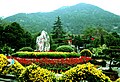
Huaqing Pool (华清池), also known as the Huaqing Hot Springs (华清宫), are a complex of hot springs located in an area characterized by mild weather and scenic views at the northern foot of Mount Li, one of the three major peaks of the Qinling. The Huaqing Hot Springs are located approximately 25 kilometers (16 mi) east of Xi'an (formerly Chang'an, the western capital of the Tang dynasty), in the province of Shaanxi, China.

History

[edit]

The spring used the locally-occurring geothermal heating and features a long documented history of almost three millennia, having served as the location for several palaces built during the reigns of past Chinese dynastic rulers, including King You of the Zhou dynasty, Qin Shi Huang of the Qin dynasty, and an expanded version by Wu Han of the Han dynasty.

Under the Tang emperors Taizong and Xuanzong, with the latter had the structure rebuilt in 723 as part of the Huaqing Palace (華清宮), and is famous as the supposed scene of Xuanzong's romance with his consort Yang Guifei.[1] However, during the events associated with the An Lushan rebellion, considerable damage was done to the site. Nevertheless, the historical legacy of the Huaqing pools has received lasting commemoration, such as in the following mention of Emperor Xuanzong and Yang in Bai Juyi's poem Song of Everlasting Regret:

春寒賜浴華清池,溫泉水滑洗凝脂。

侍兒扶起嬌無力,始是新承恩澤時。

長恨歌 (Chang hen ge)

On a cold spring day, he bestowed upon her the honor of bathing with him at the Huaqing pools,
The waters of the hot springs were smooth, and washed over her pale white skin.
The palace maids helped her to leave the pool, because she was too delicate and lacked strength.
This was when she began to receive the emperor's advances.

This site was also the scene of the 1936 Xi'an Incident, when Chiang Kai-shek was kidnapped by former warlord Zhang Xueliang and forced to participate in a United Front with the Chinese Communist Party to oppose Imperial Japan.[2]

Present

[edit]

Huaqing Pool is currently an important tourist spot, classified as a AAAAA scenic area by the China National Tourism Administration.[3]

[edit]

References

[edit]
[edit]
Revisions and contributorsEdit on WikipediaRead on Wikipedia
from Grokipedia
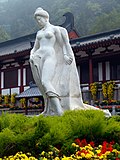
Huaqing Pool, also known as Huaqing Hot Springs, is an ancient thermal spring complex located at the northern foot of in Lintong District, approximately 30 kilometers east of central , Province, China. The site features natural hot springs with temperatures around 43°C, utilized for bathing since the dynasty (1046–771 BC), but it achieved prominence during the (618–907 AD) when Emperor Xuanzong extensively renovated and expanded the facilities into an imperial resort. The pools gained enduring fame through their association with Xuanzong's romance with his consort , for whom dedicated bathing areas like the Guifei Pool were constructed, symbolizing the era's opulence and the emperor's favoritism toward her family. This indulgence contributed to political discontent, culminating in the in 755 AD, during which the emperor fled the site amid the uprising sparked by his general . Subsequent dynasties, including the Ming and Qing, maintained and rebuilt parts of the complex, while in the , it served as a residence for Nationalist leader , site of the 1936 where he was detained by rebel generals to compel alliance against . Today, Huaqing Pool functions as a major tourist destination, preserving reconstructed Tang-era structures, murals, and statues that highlight its historical and cultural legacy.

Location and Physical Characteristics

Geographical Setting

Huaqing Pool is located in Lintong District, Province, , approximately 25 to 30 kilometers east of at the northern foot of . The site occupies a position where the rugged slopes of , which rises to a peak elevation of 1,302 meters above , meet the surrounding plains. Positioned adjacent to the to the north, Huaqing Pool offers panoramic views of the river valley, integrating the hot springs complex with the broader landscape of undulating terrain and fertile lowlands. This geographical setting, characterized by moderate elevations around 400 meters at the base and proximity to major archaeological sites such as the , underscores its role as a natural retreat amid scenic mountainous surroundings. The area's accessibility is facilitated by modern infrastructure, including highways connecting it directly to , allowing travel times of about 30 to 40 minutes by vehicle. The temperate climate of the region, influenced by its position in the valley, features mild temperatures that complement the site's environmental appeal.

Geological Features of the Hot Springs

The hot springs at Huaqing Pool arise from geothermal activity driven by tectonic processes along fault lines in the northern foothills of Mount Li, where circulating groundwater is heated by contact with hot rocks in the Earth's crust at depths exceeding several kilometers. This heating occurs via convective circulation facilitated by regional fault structures, common in the tectonically active Qinling orogenic zone, allowing ascent of mineral-rich fluids to the surface without significant magmatic input. The spring maintains a stable of approximately 43°C (109°F) year-round, a result of the and the insulating properties of overlying sedimentary layers that prevent rapid cooling during ascent. Multiple outlet springs, numbering at least four primary sources, collectively discharge around 100 tons of per hour, sustaining flow through fractured and clastic aquifers. Chemical analyses reveal a mineral composition dominated by carbonates (including lime and ), sulfates, silica, , and compounds, derived from dissolution of underlying and formations during subsurface circulation. These dissolved ions contribute to the water's mildly alkaline and reported therapeutic potential, with empirical observations from hydrological surveys noting solubility enhancements for permeation and anti-inflammatory effects in controlled bathing, though rigorous clinical trials remain sparse relative to anecdotal historical claims.

Historical Development

Ancient and Pre-Tang Usage

The hot springs at the site of Huaqing Pool, located at the northern foot of in present-day Lintong District, , Province, have been utilized since antiquity for their geothermal properties, with the earliest recorded imperial association dating to the Dynasty (c. 1046–771 BC). Tradition holds that (r. 781–771 BC) ordered the construction of a rudimentary stone pool known as Lishan Tang (Li Mountain Pool), marking the initial exploitation of the springs as a site for bathing and possibly retreat amid the dynasty's political turmoil near the end of his reign. This development reflects early recognition of the springs' consistent water temperature, averaging around 43°C (109°F), as a natural therapeutic resource, though archaeological evidence remains limited to textual accounts rather than extensive excavations confirming structures from this period. During the (221–206 BC), Emperor expanded the site's infrastructure by constructing palaces, halls, and a stone-masonry spring pool, further institutionalizing its use for imperial soaks aimed at health restoration. These additions, including pavilions to enclose the pools, underscore a pattern of utilitarian adaptation of the geothermal outflow—fed by underground fissures in the terrain of —for therapeutic purposes, such as alleviating ailments through mineral-rich waters containing sulfates and bicarbonates. No records indicate large-scale architectural grandeur at this stage, emphasizing functional enclosures over ornamental development. In the (206 BC–220 AD), usage persisted with limited but documented imperial visits, primarily for seasonal health retreats, as expansions transformed the area into a larger complex without fundamentally altering the springs' natural flow. Gazetteers and historical texts note cures for various diseases attributed to the waters' purported medicinal effects, supporting continuity as a regional resource for elites seeking relief from conditions like , though visits were sporadic compared to later eras. Overall, pre-Tang exploitation remained rudimentary, focused on basic harnessing of the perennial hot springs—outflowing at approximately 100 liters per second—without the extensive or cultural elaboration that characterized subsequent dynasties.

Tang Dynasty Expansion and Imperial Palace Construction

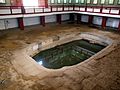
During the (618–907), the Huaqing hot springs site underwent significant expansion under Emperor Xuanzong (r. 712–756), who ordered a major reconstruction in 723 to establish it as the Huaqing Palace, a luxurious imperial complex harnessing the area's geothermal resources. This project involved channeling the natural hot springs into engineered stone-carved pools, including the Lotus Pool and Concubine Pool, with archaeological excavations from 1982 onward uncovering eight such Tang-era pools and associated architectural remains that attest to the scale of hydraulic infrastructure developed. The palace encompassed multiple halls, pavilions, and gardens, originally spanning more than 85,000 square meters, forming a self-contained retreat integrated with the mountainous terrain for aesthetic and functional purposes. Engineering feats included precise for pool linings and rudimentary drainage to manage overflow, enabling sustained use of the 43°C springs for amid landscaped settings. Tang administrative records, corroborated by later historical compilations, highlight the site's administrative oversight, with dedicated personnel maintaining the facilities and surrounding orchards that supplied the court. Huaqing Palace served primarily as a seasonal winter residence, with the imperial entourage undertaking annual migrations from the capital (modern ), approximately 30 kilometers away, to exploit the mild local climate and therapeutic waters for health and recreation. Under Xuanzong's patronage, these sojourns became routine, with the emperor residing there for extended periods—often exceeding half the year—facilitating courtly while underscoring the dynasty's emphasis on imperial indulgence supported by centralized resources. The complex's design reflected Tang engineering prowess in adapting natural features into monumental architecture, as evidenced by surviving pool foundations and inscriptions detailing construction phases.

Post-Tang to Qing Dynasty Utilization

Following the (755–763 AD), the Huaqing Pool site experienced prolonged neglect as imperial patronage waned, with the once-grand Tang structures gradually deteriorating due to lack of maintenance and repeated invasions. Local records indicate sporadic use by residents and officials for bathing, sustained by the reliable flow of geothermal springs, but without significant reconstruction until later dynasties. During the (960–1279 AD), partial restorations emerged through local initiatives, enabling occasional elite and literati access for therapeutic soaks and social gatherings, though the site remained far from its Tang-era splendor. (1368–1644 AD) efforts similarly involved local officials in managing and rebuilding pools and ancillary structures, reflecting administrative interest in harnessing the springs for regional prestige rather than imperial residence. These interventions underscore cycles of modest revival amid broader abandonment. In the (1644–1912 AD), the site saw limited imperial attention, with maintenance focused on preserving basic pools rather than expansion; by the , travel accounts described it as largely ruined, with overgrown ruins and sparse facilities. Archaeological excavations have uncovered layered constructions spanning these periods, evidencing incremental repairs overlaid on Tang foundations and highlighting the hot springs' geophysical resilience independent of dynastic stability.

Key Historical Events

Emperor Xuanzong and Yang Guifei Association

Emperor Xuanzong (reigned 712–756 AD) developed a close association with the Huaqing Pool alongside his consort Yang Guifei (719–756 AD) starting around 745 AD, following her elevation to imperial favorite after initially entering the palace as a Taoist nun in 737 AD and her marriage annulment to the emperor's son. The pair frequently retreated to the site during autumn and winter, utilizing its hot springs for bathing as part of their routine imperial leisure, with Xuanzong reportedly spending extended periods there in his later years. This personal connection underscored the pool's role as a private retreat, distinct from its earlier utilitarian expansions under Xuanzong in 723 AD. Dedicated bathing facilities symbolized Xuanzong's favoritism toward Yang, including the Haitang Pool (also known as the Lotus or Guifei Pool), constructed in 747 AD specifically for her private use, shaped like lotus petals and adjacent to her chambers. Xuanzong bathed in the adjacent Lotus Pool, while other pools served officials and princes, reflecting a hierarchical allocation of the springs' resources. These enhancements, including pavilions like Feishuang Hall, facilitated their shared indulgences, with historical records indicating the emperor's construction of gardens and palaces nearby to accommodate such visits. The favor extended at Huaqing intertwined with broader power dynamics, as Yang's relatives gained prominent administrative roles; her brother , for instance, rose to by 752 AD through her influence, exemplifying nepotistic appointments tied to the site's indulgences. Contemporary officials submitted memorials criticizing this elevation of Yang's family as fostering and administrative incompetence, arguing it undermined merit-based despite the era's earlier prosperity under Xuanzong. Such critiques, preserved in Tang historical annals, highlighted how personal attachments at the pool contributed to imbalances in imperial decision-making.

Role in the An Lushan Rebellion

The (755–763 CE) exposed the Tang dynasty's military vulnerabilities, with Huaqing Pool serving as a symbol of the imperial court's detachment and excess that indirectly facilitated the uprising. Emperor Xuanzong's favoritism toward General , appointing him military governor () of the vital northern circuits of Fanyang, Pinglu, and Hedong by 751 CE, granted the Sogdian-Turkic commander control over roughly 180,000 troops—a deliberate counterweight to the growing influence of , chancellor and kinsman to the emperor's favored consort . This policy, rooted in palace intrigues rather than strategic merit, bred resentment as An amassed wealth and autonomy, culminating in his declaration of rebellion from Fanyang on December 16, 755 CE, citing false charges against Yang Guozhong. The opulent retreats at Huaqing Pool, where Xuanzong invested heavily in expansions like the Lotus Soup and Pear Garden theater from the 740s CE, exemplified the administration's prioritization of sensory pleasures over border defense, eroding central authority amid fiscal strains from prior wars. Traditional narratives in sources like the (compiled 1084 CE by ) attribute the revolt's preconditions to the corrupting sway of , whose family monopolized offices and whose indulgences at Huaqing distracted Xuanzong from governance, fostering military discontent. These accounts, shaped by Confucian emphasis on moral decay, portray the pool as a locus of vice that weakened resolve against frontier threats. However, such interpretations warrant scrutiny for their didactic , as they simplify causal chains; An's rapid promotions reflected systemic reliance on ethnic generals to manage nomadic pressures, a holdover from earlier Tang expansions, compounded by the obsolescence of the fubing system and interference in promotions. Empirical records indicate the rebellion exploited overextended supply lines and divided loyalties, not solely palace romance, though Huaqing's symbolism amplified perceptions of elite irresponsibility among soldiery. As rebels advanced, capturing Luoyang in early 756 CE and Chang'an by July 16, 756 CE, Huaqing Pool—proximate to the capital at the foot of Mount Li—suffered direct depredation from An Lushan's forces, who looted and razed parts of the complex amid the chaos of imperial flight. Xuanzong, evacuating westward to Sichuan on June 14, 756 CE, abandoned the site without defense, its hot springs and pavilions vandalized as symbols of the regime's hubris. The mutiny en route at Mawei Station, where troops compelled Yang Guifei's strangulation on July 15, 756 CE to appease grievances linked to court favoritism, underscored the rebellion's popular military dimension, though occurring distant from Huaqing itself. Post-abdication in Chengdu on August 12, 756 CE, the damaged palace languished, its state reflecting broader devastation that halved Tang population through warfare and famine. Contemporary analyses prioritize institutional overextension—such as devolved command eroding imperial oversight—over moralistic blame on sites like Huaqing, debunking narratives of concubine-driven collapse as insufficiently causal.

The Xi'an Incident of 1936

On December 12, 1936, Chiang Kai-shek arrived at Huaqing Pool near Xi'an to inspect troops and urge generals Zhang Xueliang and Yang Hucheng to intensify the Fifth Encirclement Campaign against Communist forces in Shaanxi. That evening, troops under Zhang and Yang detained Chiang at his residence in Huaqing Pool, along with over 10 associates including Chen Cheng, confining him there initially before moving him to other locations in Xi'an. The generals presented an ultimatum demanding that Chiang cease the civil war against the Chinese Communist Party (CCP), redirect military efforts toward resisting Japanese aggression, release political prisoners, and implement democratic reforms including guarantees of civil liberties. Negotiations ensued over the following days, mediated by figures including CCP representative , who arrived in on December 17 and advocated for Chiang's release without execution to preserve national unity against . Chiang, initially resistant, verbally agreed to prioritize anti-Japanese resistance and form a on December 25, leading to his release after 13 days of captivity; Zhang Xueliang personally escorted him by plane to . The incident directly suspended the Fifth Encirclement Campaign, which had aimed to eradicate CCP bases, allowing Communist forces to consolidate in and avert immediate annihilation. Upon arrival in , Chiang's government arrested Zhang Xueliang, sentencing him to indefinite detention that lasted until his death in 2001, while faced execution in 1949 after fleeing and returning to . The event precipitated the formalization of the Second between the (KMT) and CCP in early 1937, aligning Nationalist and Communist armies nominally against following the in July 1937. From the KMT perspective, the Xi'an Incident constituted a treasonous mutiny against legitimate central authority, undermining military discipline and national stability during a critical phase of internal pacification. In contrast, CCP historiography frames it as a patriotic intervention by Zhang and Yang that compelled Chiang to abandon appeasement policies toward Japan and refocus on resistance, crediting indirect CCP influence for averting national disaster. Factually, while the incident expedited the united front and contributed to coordinated anti-Japanese efforts post-1937, it also granted the CCP political legitimacy, territorial breathing room, and recruitment opportunities that bolstered their resurgence after World War II, as evidenced by their eventual victory in the resumed civil war.

Cultural and Symbolic Significance

Depictions in Classical Literature

Bai Juyi's narrative poem "Song of Everlasting Sorrow" (長恨歌), composed around 806 CE, provides one of the earliest and most influential literary depictions of Huaqing Pool, portraying it as the site of Emperor Xuanzong's intimate bestowal upon of a bath in the hot springs during a cold spring day. The text describes the waters warming her body "as soft and tender as tender jade," emphasizing the pool's thermal allure and linking it causally to the couple's deepening romance, while imperial decline through the motif of fleeting beauty. This romanticized account ties directly to verifiable site features, such as the spring-fed pools' consistent temperatures exceeding 40°C, which enabled year-round bathing and supported the poem's imagery of luxurious indulgence. In contrast, late Tang poet Du Mu's three quatrains "Passing by Huaqing Palace" (過華清宮絕句三首), written circa 840 CE, evoke the site's ruins amid overgrown foliage, critiquing the moral decay symbolized by echoes of Yang Guifei's laughter and the emperor's revelry near the pools. One reflects: "Below the mountains, winds passed by their sounds of laughter," alluding to the begonia-shaped Guifei Pool where such indulgences occurred, and juxtaposing past opulence against present desolation to underscore causality between unchecked luxury and dynastic downfall. These verses, grounded in the author's observation of the dilapidated structures post-An Lushan era, prioritize empirical remnants like the palace foundations over idealized nostalgia, offering a satirical to Bai's by highlighting prosperity's transience without romantic embellishment. Subsequent classical references, including Tang prose records and later dramatic traditions, reinforce Huaqing Pool's emblematic role in themes of ephemeral glory, often naming specific basins like the lotus-shaped imperial pool to anchor narratives in the site's hydrological reality of multiple geothermal outlets. Positive odes, such as those praising the springs' natural purity and scenic integration with Mount Li's slopes, coexist with satires decrying excess, reflecting a balanced literary tradition that privileges observable site attributes over unsubstantiated legend.

Interpretations of Luxury, Romance, and Decline

The enduring romantic narrative surrounding Emperor Xuanzong and Yang Guifei at Huaqing Pool has been critiqued by historians for overshadowing the political favoritism and nepotism that characterized the site's imperial use, contributing to Tang vulnerabilities. While the tale of their liaison evokes poetic idealization, scholars note that Yang's elevation facilitated the rapid advancement of her relatives, including her cousin Yang Guozhong's appointment as chancellor in 752 CE, amid widespread corruption that eroded administrative efficacy. This indulgence at Huaqing, where Xuanzong retreated for leisure, exemplified a shift from early reign diligence to later hedonism, enabling such appointments over merit-based governance. Confucian moralists and subsequent historians interpreted the luxury at Huaqing as emblematic of dynastic hubris, where extravagant palace enjoyments strained resources and distracted from frontier defenses. Traditional critiques, rooted in dynastic histories, decry Xuanzong's and of the site—expanded in 723 CE for baths—as a failure to heed precedents of imperial overreach, fostering decay over fiscal . Empirical assessments link such excesses to broader revenue pressures, as palace upkeep and favor-granting diverted funds from military readiness, precipitating the Rebellion's success in 755 CE. Modern analyses further challenge romanticized portrayals by emphasizing causal realism in personal failings over systemic excuses, rejecting notions of Yang as an empowered figure in favor of evidence portraying her influence as instrumental in clan maneuvering rather than independent agency. Attributions of Tang decline to the Huaqing-era indulgences highlight how emperor-consort dynamics amplified nepotistic networks, undermining Confucian hierarchies of merit and . This perspective contrasts collectivist interpretations that diffuse blame, instead privileging the site's role as a microcosm of elite detachment from governance realities.

Modern Preservation and Usage

Republican and Early PRC Developments

During the Republican era (1912–1949), Huaqing Pool experienced limited upkeep following the of 1936, functioning primarily as a modest historical site rather than a major attraction. Facilities such as Lady Yang's Pool, a Qing-era reconstruction, were utilized by Nationalist leader after his detention there during the incident. The site's inland location in Shaanxi Province ensured it escaped direct impact from Japanese forces, as remained under Nationalist control throughout the Second Sino-Japanese War (1937–1945), with no occupation occurring in the region. This spared Huaqing Pool from wartime destruction, unlike many coastal and northern cultural sites. After the founding of the in 1949, the site passed into state ownership, marking a shift from fragmented private or local management to centralized control. In July 1959, the Provincial People's Committee authorized extensive repairs and reconstruction, rebuilding structures in architectural style to restore the complex as a key scenic and educational venue. This initiative, completed amid broader national cultural preservation efforts under Mao Zedong's administration, emphasized the site's revolutionary significance through the , framing it as a precursor to the united front against Japanese aggression and integrating ideological instruction with physical restoration. Prior to these interventions, the pools and halls had deteriorated into ruins from prior conflicts, with the 1959 project prioritizing historical reconstruction over immediate development.

Contemporary Tourism and Restoration Efforts

Huaqing Pool was officially opened to the public as a scenic area in 1996, marking a significant expansion in infrastructure following China's post-1978 economic reforms that prioritized sites for visitor access and revenue generation. The site received designation as a National 5A-Grade Tourist Attraction in 2007, reflecting investments in facilities such as pathways, exhibits, and replicas to accommodate growing domestic and international crowds. Accompanying the museum, dedicated to imperial bathing relics, underwent renovations in 2004 and 2017, incorporating displays of excavated Tang-era artifacts alongside exhibits on the 1936 to enhance educational value without altering core preservation standards. Restoration efforts have emphasized structural resilience and cultural revival, including the integration of multimedia performances like the "Song of Everlasting Sorrow" dance drama, which debuted in and has drawn over 2 million attendees through nightly stagings from to . These initiatives leverage the site's geothermal springs for sustainable features, such as maintained pool temperatures, while pursuing inclusion on UNESCO's World Heritage Tentative List to underscore its global archaeological significance. However, rapid commercialization has drawn scrutiny for diluting authenticity, with many visible structures being modern reconstructions rather than originals, leading to overcrowding that strains visitor experience and site integrity during peak seasons. Despite these challenges, the area sustains economic benefits through ticketed attractions and adjacent resorts, balancing preservation with demands.

References

Add your contribution
Related Hubs
User Avatar
No comments yet.