Hubbry Logo
IAC BuildingIAC BuildingMain
Open search
IAC Building
Community hub
IAC Building
logo
8 pages, 0 posts
0 subscribers
Be the first to start a discussion here.
IAC Building
IAC Building
from Wikipedia

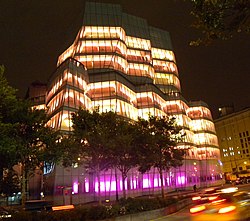
The IAC Building is the headquarters of the media company IAC at 555 West 18th Street on the northeast corner of Eleventh Avenue in the Chelsea neighborhood of Manhattan, New York City. Designed by Frank Gehry and completed in 2007, it was Gehry's first full-building design in New York City and featured the world's largest high definition screen at the time in its lobby.[2]

Key Information

Reminiscent of several other Gehry designs, the building appears to consist of two major levels: a large base of twisted tower-sections packed together like the cells of a bee hive, with a second bundle of lesser diameter sitting on top of the first. The cell units have the appearance of sails skinned over the skeleton of the building. The full-height windows fade from clear to white on the top and bottom edges of each story. The overall impression is of two very tall stories, which belies its actual 10-story structure. Vanity Fair commented that the building is perhaps one of the world's most attractive office buildings.[3] Barry Diller, the head of IAC who was intimately involved with the project, mandated that the facade be covered in smooth glass rather than wrinkling titanium, as Gehry had originally planned.[4][2] Diller said he chose Gehry to design the building because he wanted a space where workers "could collaborate and be in an open atmosphere" which he did not think could be done as easily in a typical boxy building.[2]

IAC purchased the land under the building in 2023 for $80 million.[5]

[edit]

The IAC Building is featured in the movies The Other Guys and Wall Street: Money Never Sleeps. It was featured in multiple CollegeHumor sketches, as the building served as the company's New York office.

[edit]

See also

[edit]

References

[edit]
[edit]
Revisions and contributorsEdit on WikipediaRead on Wikipedia
from Grokipedia
The IAC Building is a ten-story glass-clad office structure located at 555 West 18th Street in the Chelsea neighborhood of , , serving as the global headquarters for , a media and conglomerate. Designed by renowned architect of Gehry Partners, with Adamson Associates as executive architect, the building was completed in March 2007 following groundbreaking in June 2004, marking Gehry's first complete building commission in . Standing at approximately 160 feet tall and encompassing about 200,000 square feet of space, it accommodates around 500 employees in an open-plan layout emphasizing natural light and collaboration. The building's distinctive design features a series of undulating, white panels that evoke billowing sails or an , achieved through innovative cold-warped walls—the world's first of their kind—supported by a sloped . Constructed entirely of on a former brownfield site opposite the , it pioneered advanced fabrication techniques and received partial financing through $80 million in tax-exempt Liberty Bonds, costing $150 million in total. Inside, the lobby houses the largest high-definition video wall in the world at the time of completion, while the interiors promote a creative workspace with 100% natural illumination across all areas. As a catalyst for redevelopment in West Chelsea, the IAC Building has earned numerous architecture awards for its deconstructivist style and environmental integration, blending seamlessly with the surrounding park and waterfront. In 2023, IAC acquired the underlying land for $80 million, securing its long-term presence in the iconic structure.

History

Site Acquisition and Planning

In 2004, IAC/InterActiveCorp secured a ground lease for the development of its new on a brownfield site at 555 West 18th Street in , through an agreement with developer The Georgetown Company, which had leased the underlying land from the Resnicoff family. The site, previously used for industrial purposes, presented early planning hurdles due to its contaminated status and complex subsurface conditions, requiring before construction could proceed. Barry Diller, as chairman of IAC, played a pivotal role in initiating the project, envisioning a landmark headquarters that would embody the company's innovative and collaborative amid its growth in and media sectors. In 2003, Diller engaged during initial site scouting in West Chelsea. The effort aligned with post-9/11 redevelopment goals, where initial cost estimates pegged the project at $150 million. Financing included $80 million in tax-exempt Bonds, preliminarily approved by the City of New York in 2003 to support economic recovery, with final allocation tied to the site's brownfield redevelopment. Preliminary and permitting processes spanned 2004-2005, navigating the site's M1-5 manufacturing district regulations and integrating with the emerging West Chelsea rezoning framework to allow the office development.

Design Development

In 2003, was selected as the design architect for the IAC Building, with Adamson Associates serving as the architect of record to handle local code compliance and construction documentation. This marked Gehry's first full-building commission in , a milestone after years of smaller-scale or unbuilt projects in the city. Barry Diller, IAC's chairman and a passionate yachtsman, played a pivotal role in shaping the design's aesthetic, advocating for a smooth, curved glass facade to convey fluidity and modernity in line with the company's digital ethos. This choice diverged from Gehry's signature metallic, deconstructed forms seen in works like the , favoring instead an all-glass envelope without traditional mullions or titanium cladding to maximize transparency and light penetration. The design evolved through iterative phases led by Gehry's firm, utilizing software—a parametric modeling tool adapted from —to generate and refine the building's complex, non-rectilinear geometries. Initial sketches from 2003 explored organic forms inspired by the site's proximity, progressing to detailed models that secured final approvals in 2006, enabling construction to commence shortly thereafter. Central to these phases were conceptual decisions defining the structure as stacked towers evoking billowing sails or clustered beehive cells, creating a dynamic silhouette that appears to undulate like a yacht harnessing wind. Diller specifically endorsed the sailing motif from Gehry's array of proposals, aligning it with the waterfront context while ensuring the form supported flexible interior workspaces. Sustainability considerations were integrated early, with specifications for energy-efficient featuring ceramic fritting—white enamel dots applied to panels—to act as a passive , reducing solar heat gain and glare while promoting natural daylighting. These elements, refined during modeling, aimed to balance aesthetic innovation with operational efficiency, contributing to the building's overall environmental performance without compromising its sculptural intent.

Construction and Completion

Construction of the IAC Building began with groundbreaking in June 2004, following design approvals and site preparation on the Chelsea brownfield location. The project was managed by general contractor Turner Construction Company, which oversaw the execution of Frank Gehry's vision amid the urban constraints of Manhattan's West Side. The timeline progressed steadily, with structural work advancing through 2005 and 2006, leading to substantial completion by early 2007 despite challenges from the site's poor soil conditions that required additional foundation reinforcements and increased costs. The total project cost reached approximately $150 million, encompassing the complex assembly of the building's innovative façade system. A key technical achievement was the installation of the world's first cold-warped curtain wall, where flat double-glazed panels—measuring about 12 by 5 feet—were bent into subtle curves on-site to fit the undulating design. This process involved approximately 1,350 unique panels, each customized for shape and twist, fabricated primarily in by Permasteelisa and installed progressively to minimize disruptions on the tight urban site bounded by active streets and the waterfront. Overcoming logistical hurdles, such as precise on-site warping without heat to avoid distortion and coordinating deliveries in a densely developed area, ensured the façade's seamless integration while adhering to New York City's stringent building codes. The building reached completion in March 2007, with official opening and initial occupancy by IAC staff occurring in April of that year, marking the transition from construction phase to operational use. This milestone allowed IAC to consolidate its functions in the new facility, which spanned 10 stories and about 130,000 square feet of net usable space. In a significant post-completion development, IAC acquired outright ownership of the underlying land in April 2023 for $80 million in an all-cash transaction, terminating the prior ground lease with the Resnicoff family and fully consolidating the company's control over the 555 West 18th Street property. This purchase enhanced long-term stability for the landmark structure, which had operated under leased land terms since its inception.

Architecture

Exterior Design

The IAC Building, a 10-story structure standing approximately 155 feet (47 m) tall, features an undulating exterior form composed of twisted and stacked tower sections that evoke the sails of a ship or layered icebergs, creating a dynamic, sculptural against the New York skyline. This deconstructivist design, divided into two primary horizontal bands of five floors each that narrow at the mid-level, emphasizes fluidity and asymmetry, with the facade curving outward to maximize views of the adjacent waterfront. The building's exterior is enveloped entirely in a glass curtain wall system, comprising approximately 1,450 custom-engineered double-glazed panels, of which 1,349 are unique in shape and curvature, fabricated through an innovative cold-warping process that allows flat panels to be bent on-site into complex geometries up to 150 degrees. These panels, measuring up to 12 by 5 feet and coated with white ceramic frit for solar control and aesthetic uniformity, transition visually from more transparent lower sections to a denser, opaque "sugar-coated" appearance higher up, covering a total facade area of 8,800 square meters. The fritted glass not only reduces glare and heat gain but also imparts a shimmering, ethereal quality to the surface. Structurally, the exterior is supported by a frame with inclined columns—some angled up to 25 degrees—and thick shear walls forming , engineered to withstand seismic activity and high wind loads typical of its urban waterfront along the . This robust skeleton enables the expansive, uninterrupted glass envelope while maintaining stability across the building's approximately 200,000 square feet of total on 10 floors, complemented by 96 subsurface parking spaces. The facade's reflectivity enhances its visual impact, particularly during dusk when the glass captures and refracts ambient light from the surrounding , transforming the building into a luminous that accentuates its iconic, twisting profile and integrates it seamlessly with the evolving Chelsea neighborhood.

Interior Design

The interior architecture of the IAC Building was designed by STUDIOS Architecture to create a dynamic, adaptable environment within Frank Gehry's sculptural shell. The layout emphasizes open-plan offices with flexible workspaces configured for approximately 500 employees, consolidating operations from 60 previously separate companies into a cohesive, modular system that accommodates varying team sizes and functions. A prominent feature is the grand central staircase, constructed from raw and , which serves as both a circulatory element and a visual focal point, providing framed views of the to encourage vertical circulation and social interaction across floors. Aluminum and glass partitions define enclosed offices in more regularized zones, allowing for reconfiguration while maintaining transparency and light diffusion throughout the space. The lobby and public areas on the ground floor function as a communal "," originally featuring the world's largest high-definition rear-projection video screen installed in 2007, which spanned significant portions of the space and was visible from the street; this installation was later replaced with updated LED video walls around 2012. Today, these areas include collaborative lounges and cafes that support , product launches, and informal gatherings, enhancing the building's role as a versatile public venue. Sustainability is integrated through design choices that maximize natural light via full-height windows and translucent interior glass walls, reducing reliance on artificial lighting and promoting energy efficiency. Energy-efficient HVAC systems, including high-performance diffusers and terminal units from Titus HVAC, are seamlessly incorporated into the ceilings to support the open layout, ensuring optimal airflow, low noise, and zone-specific temperature control without compromising aesthetics. Floor configurations vary to foster interaction and environmental comfort, with ceiling heights ranging from 12 to 18 feet and strategic atriums that promote natural ventilation and cross-floor visibility, contributing to a sense of openness and fluidity in the workspace.

Location and Context

Site and Surroundings

The IAC Building occupies the northeast corner of Eleventh Avenue and 18th Street in the Chelsea neighborhood of , , at coordinates 40°44′44″N 74°00′28″W. The site was previously a brownfield industrial area adjacent to the waterfront, redeveloped through post-9/11 economic incentives that included $80 million in tax-exempt financing to support New York City's recovery efforts. Complex subsurface conditions, stemming from the site's industrial past, influenced foundation and parking design decisions. Its immediate surroundings feature the sports and entertainment complex directly across Eleventh Avenue to the south, the elevated park several blocks to the east, and the () running parallel to the west along the waterfront. The building provides subterranean parking for 96 vehicles to accommodate limited surface space in the dense urban setting, while its ground-level entrances on 18th and 19th Streets emphasize pedestrian and bicycle access, aligning with the Hudson River Greenway's network of paths for non-motorized travel. Environmentally, the location affords unobstructed views of the to the west and the skyline to the east, enhancing its waterfront prominence; traffic noise from the adjacent is addressed through existing highway barriers and elevated infrastructure that partially shield the site.

Urban Integration

The IAC Building played a pivotal role as a catalyst for the redevelopment of Chelsea's West Side in the mid-2000s, marking one of the first major office projects in an area transitioning from industrial uses to a mix of luxury residential, commercial, and cultural spaces. Completed in 2007, it helped initiate a wave of high-profile developments along the waterfront, drawing investment to previously underutilized land near the and contributing to the neighborhood's evolution into a vibrant, mixed-use district. Its waterfront location contributes to enhanced pedestrian connectivity in the area, with proximity to promoting foot traffic from nearby piers and the , integrating the structure into the broader network of public amenities that support daily urban movement and recreational use. In June 2025, Chelsea Piers opened a new quarter-mile public walkway connecting 18th to 23rd Streets along , further improving access near the site. Economically, the building has contributed to rising property values in Chelsea, where the surrounding area's assessed land values surged following the 's opening and related projects like the IAC , with nearby developments adding billions in market value. As a prominent visual visible from the , it attracts tourists exploring the elevated park, bolstering local commerce and reinforcing the neighborhood's appeal as a destination for and leisure. In the context of Chelsea's shift from industrial to mixed-use zoning, the building's design includes site remediation on a former brownfield, aligning with broader green initiatives amid the area's ; formal certification was not achieved. This integration of green considerations supports the preservation of open spaces and environmental improvements in a rapidly developing corridor. As of November 2025, the IAC Building presents opportunities for mixed-use expansion, with two floors of made available for lease for the first time in July 2025, potentially attracting new tenants to further diversify the neighborhood's commercial landscape.

Usage and Impact

Tenants and Operations

The IAC Building has served as the headquarters for since its completion in 2007, housing the company's executives and core operations for its media and internet subsidiaries. Dedicated spaces within the building support IAC's remaining subsidiaries following spin-offs of entities like in 2020, in 2021, and in April 2025, with operations for brands such as Dotdash Meredith and previously accommodated there prior to partial relocations. The building encompasses approximately 211,000 square feet, managed internally by IAC with security, maintenance, and technology infrastructure designed to support firms through features like high-speed connectivity and collaborative workspaces. As of July 2025, following these spin-offs and relocations, IAC began leasing excess space to external tenants for the first time, offering two floors at market rates of around $90 to $100 per square foot in the Chelsea submarket. As of November 2025, this space remains available. Daily operations reflect a hybrid work model adopted post-COVID, accommodating 500 to 800 occupants with amenities including a , event spaces in the 8,550-square-foot lobby, and flexible interiors that facilitate .

Cultural Significance and Recognition

The IAC Building has garnered significant architectural recognition for its innovative design, particularly its pioneering use of curved glass panels. In 2011, it received a from the AIA New York Chapter, honoring its technical innovations and contribution to . The structure also earned a Best Building from the Municipal Art Society of New York in 2008, acknowledging its role in revitalizing the Chelsea waterfront. The building has appeared prominently in media, enhancing its visibility as a modern landmark. It served as the New York headquarters for from 2006 to 2013, featuring in several of the company's parody sketches between 2008 and 2010, which often highlighted the building's distinctive facade and interior spaces. Its sail-like exterior has been photographed extensively, embodying Frank Gehry's signature deconstructivist style and symbolizing 21st-century innovation in . The lobby houses the world's largest screen at the time of installation in 2007, serving as a showcase for cutting-edge and hosting events that underscored IAC's focus. The IAC Building's cultural legacy extends to broader discussions on corporate architecture's influence on urban identity. Commissioned by IAC chairman , it exemplified a vision to blend media enterprise with bold design, elevating the company's public image and sparking conversations about how private developments can brand and transform cityscapes. In 2023, IAC's $80 million acquisition of the underlying land was widely covered in media as a milestone ensuring the building's long-term presence and stability in .

References

Add your contribution
Related Hubs
User Avatar
No comments yet.