Recent from talks
Nothing was collected or created yet.
IBM Quantum Platform
View on WikipediaIBM Quantum Platform (previously known as IBM Quantum Experience) is an online platform allowing public and premium access to cloud-based quantum computing services provided by IBM. This includes access to a set of IBM's quantum processors, a set of tutorials on quantum computation, and access to interactive courses. As of June 2025, there are 12 devices on the service, all of which are freely accessible by the public.[1] This service can be used to run algorithms and experiments, and explore tutorials and simulations around what might be possible with quantum computing.
Key Information
IBM's quantum processors are made up of superconducting transmon qubits, located in dilution refrigerators at the IBM Research headquarters at the Thomas J. Watson Research Center. Users interact with a quantum processor through the quantum circuit model of computation, typically through code written in Qiskit. This code can be compiled down to OpenQASM for execution on real quantum systems.
Circuits can be created either graphically with the Quantum Composer, or programmatically through Jupyter notebooks on IBM's approved platforms for cloud-based quantum computing: qBraid and OVHCloud.[2]
History
[edit]- The service was launched in May 2016 as the IBM Quantum Experience[3] with a five-qubit quantum processor and matching simulator connected in a star shaped pattern. At this time, users could only interact with the hardware through the quantum composer GUI. Quantum circuits were also limited to the specific two-qubit gates available on the hardware.
- In July 2016, IBM launched the IBM Quantum Experience community forum. This was subsequently replaced by a Slack workspace.
- In January 2017, IBM made a number of additions to the IBM Quantum Experience,[4] including increasing the set of two-qubit interactions available on the five-qubit quantum processor, expanding the simulator to custom topologies up to twenty qubits, and allowing users to interact with the device and simulator using quantum assembly language code.
- In March 2017, IBM released Qiskit[5] to enable users to more easily write code and run experiments on the quantum processor and simulator. A user guide for beginners was also added.
- In May 2017, IBM made an additional 16-qubit processor available on the IBM Quantum service.[6]
- In January 2018, IBM launched a quantum awards program, which it hosted on the IBM Quantum Experience.[7]
- In May 2019 a large overhaul of the service was made, including the addition of web-hosted Jupyter notebooks and integration with the online and interactive Qiskit textbook.[8]
- After a redesign in March 2021, a greater distinction was made between the composer GUI and the Jupyter notebooks. The IBM Quantum Experience name was retired in favour of the separate names IBM Quantum Composer and IBM Quantum Lab.[9] Now, it's collectively called IBM Quantum Platform.
- In May 2024, the IBM Quantum Lab was sunset in favor of a serverless model. Users were directed to approved transition providers to access cloud-based notebook environments. The two transition providers identified were qBraid and OVHCloud.[10]
IBM Quantum Composer
[edit]
The Quantum Composer is a graphic user interface (GUI) designed by IBM to allow users to construct various quantum algorithms or run other quantum experiments. Users may see the results of their quantum algorithms by either running it on a real quantum processor or by using a simulator. Algorithms developed in the Quantum Composer are referred to as a "quantum score", in reference to the Quantum Composer resembling a musical sheet.[11]
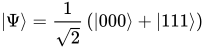
The composer can also be used in scripting mode, where the user can write programs in the OpenQASM-language instead. Below is an example of a very small program, built for IBMs 5-qubit computer. The program instructs the computer to generate a quantum state , a 3-qubit GHZ state, which can be thought of as a variant of the Bell state, but with three qubits instead of two. It then measures the state, forcing it to collapse to one of the two possible outcomes, or .
include "qelib1.inc"
qreg q[5]; // allocate 5 qubits (set automatically to |00000>)
creg c[5]; // allocate 5 classical bits
h q[0]; // Hadamard-transform qubit 0
cx q[0], q[1]; // conditional pauli X-transform (ie. "CNOT") of qubits 0 and 1
// At this point we have a 2-qubit Bell state (|00> + |11>)/sqrt(2)
cx q[1], q[2]; // this expands entanglement to the 3rd qubit
measure q[0] -> c[0]; // this measurement collapses the entire 3-qubit state
measure q[1] -> c[1]; // therefore qubit 1 and 2 read the same value as qubit 0
measure q[2] -> c[2];
Every instruction in the QASM language is the application of a quantum gate, initialization of the chips registers to zero or measurement of these registers.
Usage
[edit]- In 2025, IBM reported that there were over 400,000 users of the IBM Quantum Platform, generating over 2,800 papers with research performed on the devices.[12]
References
[edit]- ^ "IBM Quantum Devices". 2024-05-15.
- ^ "Transitioning from IBM Quantum Lab". IBM. 2024-05-15.
- ^ "IBM Makes Quantum Computing Available on IBM Cloud to Accelerate Innovation". 2016-05-04. Archived from the original on May 4, 2016.
- ^ "IBM Quantum Experience Update". Archived from the original on 2019-01-29. Retrieved 2017-04-06.
- ^ "Quantum computing gets an API and SDK". 2017-03-06.
- ^ "Beta access our upgrade to the IBM QX". Archived from the original on 2019-01-31. Retrieved 2017-05-19.
- ^ "Now Open: Get quantum ready with new scientific prizes for professors, students and developers". IBM. 2018-01-14.
- ^ "IBM Unveils Beta of Next Generation Quantum Development Platform". IBM. 2021-02-10.
- ^ "Announcement of IBM Quantum Composer and Lab". 2021-03-02.
- ^ "Transitioning from IBM Quantum Lab". IBM. 2024-05-15.
- ^ "IBM Quantum experience". Quantum Experience. IBM. Archived from the original on 25 May 2018. Retrieved 3 July 2017.
- ^ "Research at IBM Quantum". IBM. 2025-06-02.
- ^ "QX Community papers". Archived from the original on 2019-03-22. Retrieved 2018-05-24.
- ^ "Research of the IBM Quantum Hub at the University of Melbourne". 20 April 2021.
- ^ Rundle, R. P.; Tilma, T.; Samson, J. H.; Everitt, M. J. (2017). "Quantum state reconstruction made easy: a direct method for tomography". Physical Review A. 96 (2) 022117. arXiv:1605.08922. Bibcode:2017PhRvA..96b2117R. doi:10.1103/PhysRevA.96.022117.
- ^ Corbett Moran, Christine (29 June 2016). "Quintuple: a Python 5-qubit quantum computer simulator to facilitate cloud quantum computing". arXiv:1606.09225 [quant-ph].
- ^ Huffman, Emilie; Mizel, Ari (29 March 2017). "Violation of noninvasive macrorealism by a superconducting qubit: Implementation of a Leggett-Garg test that addresses the clumsiness loophole". Physical Review A. 95 (3) 032131. arXiv:1609.05957. Bibcode:2017PhRvA..95c2131H. doi:10.1103/PhysRevA.95.032131.
- ^ Deffner, Sebastian (23 September 2016). "Demonstration of entanglement assisted invariance on IBM's Quantum Experience". Heliyon. 3 (11) e00444. arXiv:1609.07459. doi:10.1016/j.heliyon.2017.e00444. PMC 5683883. PMID 29159322.
- ^ Huang, He-Liang; Zhao, You-Wei; Li, Tan; Li, Feng-Guang; Du, Yu-Tao; Fu, Xiang-Qun; Zhang, Shuo; Wang, Xiang; Bao, Wan-Su (9 December 2016). "Homomorphic Encryption Experiments on IBM's Cloud Quantum Computing Platform". Frontiers of Physics. 12 (1): 120305. arXiv:1612.02886. Bibcode:2017FrPhy..12l0305H. doi:10.1007/s11467-016-0643-9. S2CID 17770053.
- ^ Wootton, James R (1 March 2017). "Demonstrating non-Abelian braiding of surface code defects in a five qubit experiment". Quantum Science and Technology. 2 (1): 015006. arXiv:1609.07774. Bibcode:2017QS&T....2a5006W. doi:10.1088/2058-9565/aa5c73. S2CID 44370109.
- ^ Fedortchenko, Serguei (8 July 2016). "A quantum teleportation experiment for undergraduate students". arXiv:1607.02398 [quant-ph].
- ^ Berta, Mario; Wehner, Stephanie; Wilde, Mark M (6 July 2016). "Entropic uncertainty and measurement reversibility". New Journal of Physics. 18 (7) 073004. arXiv:1511.00267. Bibcode:2016NJPh...18g3004B. doi:10.1088/1367-2630/18/7/073004. S2CID 119186679.
- ^ Li, Rui; Alvarez-Rodriguez, Unai; Lamata, Lucas; Solano, Enrique (23 November 2016). "Approximate Quantum Adders with Genetic Algorithms: An IBM Quantum Experience". Quantum Measurements and Quantum Metrology. 4 (1): 1–7. arXiv:1611.07851. Bibcode:2017QMQM....4....1L. doi:10.1515/qmetro-2017-0001. S2CID 108291239.
- ^ Hebenstreit, M.; Alsina, D.; Latorre, J. I.; Kraus, B. (11 January 2017). "Compressed quantum computation using the IBM Quantum Experience". Phys. Rev. A. 95 (5) 052339. arXiv:1701.02970. doi:10.1103/PhysRevA.95.052339. S2CID 118958024.
- ^ Alsina, Daniel; Latorre, José Ignacio (11 July 2016). "Experimental test of Mermin inequalities on a five-qubit quantum computer". Physical Review A. 94 (1) 012314. arXiv:1605.04220. Bibcode:2016PhRvA..94a2314A. doi:10.1103/PhysRevA.94.012314. S2CID 119189277.
- ^ Linke, Norbert M.; Maslov, Dmitri; Roetteler, Martin; Debnath, Shantanu; Figgatt, Caroline; Landsman, Kevin A.; Wright, Kenneth; Monroe, Christopher (28 March 2017). "Experimental comparison of two quantum computing architectures". Proceedings of the National Academy of Sciences. 114 (13): 3305–3310. arXiv:1702.01852. Bibcode:2017PNAS..114.3305L. doi:10.1073/pnas.1618020114. PMC 5380037. PMID 28325879.
- ^ Devitt, Simon J. (29 September 2016). "Performing quantum computing experiments in the cloud". Physical Review A. 94 (3) 032329. arXiv:1605.05709. Bibcode:2016PhRvA..94c2329D. doi:10.1103/PhysRevA.94.032329. S2CID 119217150.
- ^ Steiger, Damian; Haner, Thomas; Troyer, Matthias (2018). "ProjectQ: An Open Source Software Framework for Quantum Computing". Quantum. 2 49. arXiv:1612.08091. Bibcode:2018Quant...2...49S. doi:10.22331/q-2018-01-31-49. S2CID 6758479.
- ^ Santos, Alan C. (2017). "O Computador Quântico da IBM e o IBM Quantum Experience". Revista Brasileira de Ensino de Física. 39 (1). arXiv:1610.06980. doi:10.1590/1806-9126-RBEF-2016-0155.
- ^ Caicedo-Ortiz, H. E.; Santiago-Cortés, E. (2017). "Construyendo compuertas cuánticas con IBM's cloud quantum computer" [Building quantum gates with IBM's cloud quantum computer] (PDF). Journal de Ciencia e Ingeniería (in Spanish). 9: 42–56. doi:10.46571/JCI.2017.1.7.
External links
[edit]IBM Quantum Platform
View on GrokipediaHistory
Launch and Early Development
The IBM Quantum Platform was launched on May 4, 2016, as the IBM Quantum Experience, providing the first public cloud-based access to a functional quantum computer.[1] This initiative featured a 5-qubit quantum processor named IBM Q 5 Tenerife, based on superconducting transmon qubits arranged in a star topology, along with a corresponding simulator that mirrored this configuration for classical validation of quantum circuits.[12][13] The platform's initial purpose was to democratize quantum computing by enabling researchers, developers, and enthusiasts to experiment with real quantum hardware without needing specialized equipment, marking IBM's pioneering open-access effort in the field.[14] Users interacted via a basic web-based API that allowed submission of quantum circuits in the OpenQASM format, with execution managed through a queue system to handle limited hardware availability and ensure fair access.[1] This setup facilitated simple quantum algorithms and measurements, fostering early exploration of quantum phenomena like superposition and entanglement on actual devices. In the months following its debut, the IBM Quantum Experience saw rapid adoption, attracting over 40,000 users who collectively ran more than 275,000 quantum experiments by early 2017.[15] This surge highlighted the platform's role in building a global quantum computing community and laid the groundwork for subsequent advancements, including the integration of more advanced processors like the Heron in later years.[16]Major Upgrades and Milestones
In 2017, IBM released the 14-qubit IBM Q 14 Melbourne processor, marking an early expansion of its quantum hardware offerings accessible via the cloud. Later that year, the company introduced a 20-qubit processor, enhancing the platform's capacity for more complex quantum experiments and simulations. Concurrently, IBM launched Qiskit as an open-source software development kit, enabling developers to create and execute quantum circuits on IBM's hardware. From 2018 to 2020, IBM advanced its processor lineup with the 27-qubit Falcon processor unveiled in 2019, which improved connectivity and coherence times for better performance in quantum algorithms. This progression culminated in the 53-qubit processor released in October 2019, the largest commercially available universal quantum computer at the time, supporting applications in chemistry and optimization. These upgrades shifted the platform toward higher-fidelity operations, with Falcon emphasizing tunable couplers for reduced error rates. Between 2021 and 2023, IBM introduced the 127-qubit Eagle processor in November 2021, a breakthrough in scaling beyond 100 qubits while maintaining connectivity for practical utility.[17] This era emphasized a transition to utility-scale quantum computing, where systems could outperform classical simulations in specific scientific tasks, as demonstrated by executing utility-scale algorithms on Eagle hardware. By late 2023, the platform had executed over 3 trillion quantum circuits, underscoring its growing adoption for research and development. From 2023 to 2025, IBM deployed the Heron processor family, starting with the 133-qubit Heron r1 on the ibm_torino system, which featured enhanced crosstalk reduction and up to five times better median error rates than prior generations.[18] In 2025, the platform underwent a major upgrade to enterprise-grade cloud services, deprecating the legacy quantum.ibm.com interface after July 1 and migrating users to the new IBM Quantum Platform at quantum.cloud.ibm.com, which offers improved scalability, security, and priority access to QPUs.[19] This rebranding enhanced QPU availability for commercial and research workloads.[6] In June 2025, IBM updated its roadmap to include demonstrations of error correction codes and integration with high-performance computing for scalable hybrid workflows, targeting fault-tolerant quantum computing by 2029.[20] On November 12, 2025, IBM announced new processors including Nighthawk with higher qubit connectivity for complex circuits and Loon for advancing fault-tolerant scaling, alongside software and algorithm breakthroughs aimed at achieving quantum advantage by the end of 2026.[7] Key milestones included the 2022 roadmap update, which outlined a path to modular quantum-centric supercomputing with over 4,000 qubits by 2025, integrating quantum processors with high-performance classical computing for quantum utility.[21]Architecture and Components
Hardware Access and Processors
The IBM Quantum Platform provides access to a range of superconducting quantum processing units (QPUs), with the Heron processor serving as the flagship offering as of 2025. The Heron features 133 fixed-frequency transmon qubits arranged in a heavy-hexagonal lattice, enabling scalable connectivity through tunable couplers that facilitate high-fidelity two-qubit operations.[22] Recent revisions, such as the r2 variant introduced in July 2024, expand this to 156 qubits while preserving the core architecture for improved error correction capabilities, followed by the r3 variant in 2025, which further improves coherence and fidelity while maintaining 156 qubits.[23][24] Legacy access remains available to the 27-qubit Falcon series and the 127-qubit Eagle series, which laid the groundwork for larger-scale systems, though they exhibit higher error rates compared to Heron.[17] These QPUs operate within advanced cryogenic infrastructure, utilizing dilution refrigerators to maintain temperatures below 15 mK, essential for minimizing thermal noise and preserving qubit coherence.[25] The coupler-based topology in Heron enhances connectivity by allowing dynamic adjustment of interactions between qubits, reducing crosstalk and supporting more complex circuit executions than the fixed coupling in earlier Falcon and Eagle designs.[22] This setup achieves median coherence times exceeding 100 μs, with T1 (energy relaxation) and T2 (dephasing) times typically ranging from 150 to 250 μs, a significant advancement over prior generations. Performance metrics underscore Heron's reliability, including single-qubit gate fidelities above 99.9% and two-qubit gate fidelities up to 99.93% on recent revisions like r3 (as of October 2025), enabling deeper circuits with reduced error accumulation.[22][26] Detailed error rates, T1/T2 values, and readout fidelities are processor-specific and updated regularly to account for drift.[27] Users access these QPUs via a cloud-based queuing system on the IBM Quantum Platform, where jobs are prioritized based on subscription tiers such as open-plan free access or premium pay-as-you-go instances.[28] Real-time calibration data, including noise characteristics and gate parameters, is accessible through the platform's API, allowing users to optimize experiments accordingly.[29] This model ensures equitable resource allocation while supporting enterprise-scale workloads.Software Tools and Interfaces
The IBM Quantum Platform provides a comprehensive software ecosystem designed to facilitate quantum programming, circuit design, and execution. Central to this ecosystem is Qiskit, an open-source software development kit (SDK) that enables users to construct, optimize, and visualize quantum circuits while integrating with the platform's hardware and services.[30] Qiskit is modular and extensible, supporting quantum research, algorithm development, and high-performance computing workflows.[30] Qiskit includes key modules for core functionalities, such as theQuantumCircuit class for building quantum circuits by adding gates and operations to qubit registers.[31] The transpiler module optimizes these circuits by mapping them to specific hardware constraints, reducing circuit depth and improving execution efficiency through techniques like gate decomposition and routing.[32] Visualization tools within Qiskit, such as circuit drawing and state representation methods, allow users to inspect and debug circuits graphically.[30] The SDK has evolved significantly, with version 1.0 released in February 2024 to stabilize its API and enhance performance, followed by updates to version 2.2.3 by October 2025, introducing improvements in transpilation speed and compatibility with emerging hybrid computing paradigms.[33]
Complementing Qiskit's code-based approach, the IBM Quantum Composer offers a graphical user interface (GUI) for quantum circuit design without requiring programming. Users can drag and drop standard and custom gates onto qubit wires from an operations catalog, supporting intuitive construction of complex circuits.[34] It accommodates custom gates through grouping existing operations or importing OpenQASM code, and provides real-time previews of circuit states via visualizations like q-spheres, histograms, and phase disks.[34] The tool also includes an Inspect mode for step-by-step simulation, aiding in verification before hardware execution.[34]
Additional interfaces enhance accessibility and flexibility. For interactive development, the platform recommends Jupyter-based environments preconfigured with Qiskit, such as qBraid Lab and OVHcloud AI Notebooks, following the deprecation of the hosted IBM Quantum Lab in 2024.[35] These environments support seamless notebook-based experimentation with quantum code. The platform's REST API allows job submission and result retrieval from any programming language, using authentication via API tokens and service CRNs to invoke primitives and monitor execution status.
The software tools emphasize integration for hybrid quantum-classical workflows, enabling classical computation within quantum circuits—such as real-time control-flow operations via typed classical variables in Qiskit—and compatibility with Python ecosystems, while the REST API extends access to other languages. Qiskit Runtime enhancements further streamline these hybrid executions on the platform.[36][37]
Features and Capabilities
Quantum Circuit Design and Simulation
The quantum circuit design process in the IBM Quantum Platform begins with defining the number of qubits and constructing operations using the Qiskit SDK's QuantumCircuit class, which supports unitary gates, measurements, and resets on quantum registers.[38] Qubits are initialized in a ground state, and single-qubit gates like the Hadamard (H) gate create superposition by rotating the qubit state to an equal combination of |0⟩ and |1⟩, enabling parallel computation across multiple basis states.[39] Multi-qubit gates, such as the controlled-NOT (CNOT), facilitate entanglement by flipping the target qubit's state conditional on the control qubit, producing correlated states like the Bell state (|00⟩ + |11⟩)/√2 that cannot be separated into individual qubit descriptions.[39] Measurements at the circuit's end collapse the quantum state to classical outcomes, with probabilities derived from the superposition and entanglement established by prior gates.[40] Simulation tools within the platform, primarily the Qiskit Aer simulator, allow virtual testing of circuits on classical hardware before hardware execution, supporting both ideal (noise-free) and noisy backends to approximate quantum processing unit (QPU) behavior.[41] Aer provides high-performance execution for circuits up to 30+ qubits using statevector methods on standard classical systems, scaling to larger simulations with specialized resources like GPUs or clusters.[42] For noisy simulations, Aer incorporates custom noise models that replicate real-device imperfections, such as gate errors and decoherence, enabling users to build and apply tailored error profiles via the NoiseModel class.[43] Key features of Aer include statevector simulation, which exactly tracks the full quantum state as a complex vector for ideal circuits, ideal for verifying small-scale algorithms without approximation.[42] Density matrix simulation extends this to noisy environments by representing mixed states, capturing effects like partial decoherence through Kraus operators or probabilistic error channels, which is essential for assessing circuit fidelity in realistic settings.[42] These simulations support GPU acceleration for statevector, density matrix, and unitary methods, improving performance for circuits involving entanglement-heavy operations.[42] Best practices for circuit design emphasize transpilation, a compilation step in Qiskit that maps abstract circuits to target hardware topologies by decomposing non-native gates into supported ones and routing qubits via swaps to minimize depth and errors.[44] Users apply transpilation with commands liketranspile(circuit, backend) to optimize for specific QPU coupling maps, reducing two-qubit gate counts—for instance, converting a linear CNOT chain to a grid-compatible layout—while preserving the circuit's logical function.[44] This process, integrated into Qiskit's workflow, ensures compatibility and efficiency during simulation and prepares circuits for seamless transition to execution.[45]
