


Community hub
Recent from talks
Contribute something
Nothing was collected or created yet.
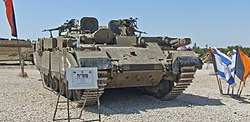
Puma armored engineering vehicle
View on WikipediaThe Puma (Hebrew: פומ"ה פורץ מכשולים הנדסי) is a heavily armored Combat engineering vehicle and armored personnel carrier that the Engineering Corps of the Israeli Defence Forces has used since the early 1990s. The vehicle can carry a crew of up to eight. The 50-ton vehicle's speed is 45 kilometers an hour.
Key Information


The Puma uses the hull of the Sho't, which is itself a modified British Centurion tank.
Some Pumas are equipped with the Carpet mine-clearing system. This consists of 20 rockets that the crew can fire singly or all together. The rockets contain a fuel-air explosive warhead which spreads a cloud of fuel fumes that are then detonated. The overpressure from the explosion destroys most mines. The Puma then advances behind a set of rollers that trigger any mines the fuel-air explosion did not destroy. There is also electronic equipment for detonating roadside bombs or jamming detonation signals.
The Puma is capable of towing a mobile bridge for deploying over trenches and enemy land obstacles during battle. Unlike the M60 AVLB launching the bridge, the Puma pulls the bridge during combat and pushes the bridge over the obstacle, allowing tanks and infantry personnel carriers to maneuver quickly in the battlefield.
Armament consists of three 7.62 mm FN MAG general-purpose machine guns, including one in a remote turret that the crew can control from within the cabin by a Rafael Overhead Weapon Station (OWS). The vehicle also has a 60 mm mortar and two launchers for smoke grenades.
Current developments
[edit]Israel is forming a fourth Combat Engineer Battalion that will specialize in dealing with roadside bombs, mines and booby traps. As part of this effort, Israel will also upgrade its Pumas. The army is adding new equipment for dealing with roadside bombs and is training the crews to cope with the growing numbers of explosive devices encountered in regions such as Gaza.[citation needed]
See also
[edit]- VIU-55 Munja – Serbian APC/Combat engineering vehicle based on T-55
References
[edit]External links
[edit]
- Puma (Israeli-Weapons)
 | This military vehicle article is a stub. You can help Wikipedia by expanding it. |
Puma armored engineering vehicle
View on GrokipediaDevelopment
Origins in IDF requirements
The Israeli Defense Forces (IDF) identified a critical need for a heavily armored combat engineering vehicle in the 1980s, driven by the requirements of its Combat Engineering Corps to conduct breaching operations in high-threat environments, particularly against minefields and fortified obstacles that could impede armored advances in desert or urban terrain.[2][1] This stemmed from Israel's strategic doctrine emphasizing rapid maneuver and defensive depth against numerically superior adversaries, where engineering assets had to survive anti-tank threats, artillery, and improvised explosives to clear paths for main battle tanks like the Merkava.[2] Prior vehicles, often lightly protected or based on aging chassis, proved vulnerable in exercises and limited conflicts, necessitating a platform that combined the robustness of the Sho't (a modified Centurion tank hull with specialized equipment for mine detonation and obstacle removal.[1] The Puma, acronym for Poretz Mokshim Handasati (Hebrew for "minefield breakthrough vehicle"), was conceived to fulfill these mandates by enabling a crew of up to eight engineers to deploy systems like rocket-launched fuel-air explosives or roller attachments while under fire, addressing gaps exposed in IDF operations since the 1973 Yom Kippur War where minefields delayed breakthroughs.[1][4] Development prioritized heavy armor—up to 50 tons—to withstand direct hits, reflecting empirical lessons from regional warfare where unarmored or inadequately protected engineering vehicles suffered high losses.[2] This requirement led Israel Military Industries to adapt surplus Sho't chassis, leveraging existing logistics for cost-effective production under IDF Ordnance oversight, with initial prototypes focusing on mobility retention (45 km/h top speed) despite added engineering tools.[2][1]Design based on Sho't chassis
The Puma armored engineering vehicle utilizes the chassis and hull of the Sho't tank, an extensively modified Israeli variant of the British Centurion main battle tank originally produced in the 1940s and upgraded through the 1970s and 1980s with improved engines, fire control systems, and armor enhancements.[1] This foundation endows the Puma with the Centurion's proven durability, including a low-pressure tracks system for enhanced cross-country mobility and a combat weight approaching 50 tons, enabling it to withstand battlefield hazards while supporting heavy engineering loads.[2][4] Adaptations to the Sho't chassis for the Puma's combat engineering role involve the removal of the original turret and main armament to create internal space for troop accommodation and specialized equipment mounting, while preserving the hull's armored structure—typically featuring sloped steel plates up to 152 mm thick in key areas—and the powertrain, often the Continental AVDS-1790 diesel engine delivering around 750 horsepower for a top road speed of 45 km/h.[1][2] The chassis's torsion bar suspension and wide tracks, inherited from the Centurion design, provide stability for dozer operations and obstacle breaching, with modifications including reinforced mounting points for hydraulic arms, winches, and explosive line charges to leverage the platform's inherent torque and traction.[4][5] These chassis-based design choices prioritize reliability in high-threat environments, drawing on the Sho't's operational history in Israeli conflicts where its robust frame demonstrated resilience against anti-tank threats, though the Puma's conversion trades offensive firepower for engineering versatility without fundamentally altering the underlying mechanical layout.[6] Developed by Israel Military Industries in the late 1980s, the Puma's integration of the Sho't chassis reflects a cost-effective reuse of surplus tank hulls, minimizing developmental risks by building on a battle-tested base rather than designing a new platform from scratch.[2]Production and entry into service
The Puma armored engineering vehicle was designed by Israel Military Industries in the 1980s and manufactured by IDF Ordnance using modified Sho't tank chassis derived from the British Centurion main battle tank.[2] Production focused on converting existing hulls into heavily armored combat engineering platforms equipped for tasks such as mine clearance, obstacle breaching, and personnel transport under fire.[1] The vehicle entered service with the Israel Defense Forces in 1984, initially supporting mechanized infantry and engineering units in the Combat Engineering Corps.[2] Approximately 700 Pumas were produced, each costing around $3 million USD, reflecting the extensive modifications including reinforced armor and specialized engineering tools.[2] Production occurred primarily in the late 1980s and 1990s, with ongoing upgrades—such as enhanced armor packages in 2010 and 2014—to address evolving threats and extend operational viability.[1] No exports were undertaken, limiting deployment exclusively to IDF formations.[1]Design features
Chassis, armor, and mobility
The Puma armored engineering vehicle is constructed on the chassis of the Sho't main battle tank, a modified version of the British Centurion tank adapted by the Israel Defense Forces for local production and upgrades.[2][7] This tracked chassis provides a stable base for mounting engineering equipment while retaining the original hull's structural integrity for operations in contested environments. The removal of the main turret allows for the integration of specialized tools without compromising the vehicle's core framework. The armor protection derives from the Sho't's hull, featuring thick cast steel plating designed to withstand impacts from small arms fire, artillery shrapnel, and older anti-tank threats.[2] As a conversion from a Cold War-era tank, it offers substantial ballistic resistance comparable to medium tanks of the 1950s, though vulnerable to modern shaped-charge warheads without add-ons.[8] Additional reactive or cage armor can be fitted to enhance defenses against rocket-propelled grenades and similar munitions.[7] Mobility is powered by a Continental AVDS-1790 series diesel engine delivering 900 horsepower, which propels the heavy vehicle to a top road speed of 45 km/h.[1] The design prioritizes traction over velocity, enabling effective traversal of rough and obstructed terrain typical of combat engineering roles, despite the limitations imposed by its mass and age.[1] This configuration supports sustained operations in forward areas, where speed is secondary to reliability and obstacle-crossing ability.Armament and defensive systems
The Puma is armed primarily for self-defense with three 7.62 mm FN MAG general-purpose machine guns, consisting of two manually operated pintle-mounted weapons and one integrated into a Rafael Overhead Weapon Station (OWS) for remote operation from inside the protected crew compartment, providing 360-degree traverse, elevation from -20° to +60°, and ammunition capacities of up to 4,000 rounds total with 200 ready to fire.[1][7] Since 2014, select units have received upgrades replacing the OWS machine gun with a 12.7 mm M2 heavy machine gun to enhance firepower against distant or hardened targets.[1] Three roof-mounted 60 mm mortars are also fitted, allowing the crew or accompanying infantry to deliver high-angle indirect fire in support of engineering operations.[7] Defensive systems emphasize survivability in contested environments, including two clusters of six TAAS IS-6 smoke grenade dischargers mounted on the hull to generate instantaneous obscuration screens against guided threats or advancing infantry.[1] Electronic countermeasures, such as jammers and remote detonation triggers, enable the vehicle to neutralize roadside bombs and improvised explosive devices before they can inflict damage.[7] The AFEDSS active fire and explosion detection suppression system detects internal blasts or penetrations and rapidly floods affected compartments with suppressant agents to limit crew casualties and secondary effects.[7] Passive defenses include optional wire cage (slat) armor arrays fitted over vulnerable rear and side areas to detonate incoming rocket-propelled grenades prematurely, supplemented by add-on reactive armor modules on hull sides for anti-tank guided missile resistance.[7] These features, introduced in incremental upgrades from the 2010s, reflect adaptations to asymmetric threats observed in IDF operations, prioritizing crew protection during prolonged exposure in mine-clearing and breaching tasks.[1]Engineering equipment and capabilities
The Puma armored engineering vehicle is fitted with a front-mounted dozer blade, manufactured by Urdan, enabling it to perform earth-moving tasks, clear obstacles, and shape terrain for operational needs.[9][1] This hydraulic blade allows the vehicle to push soil, debris, and barriers, supporting the creation of firing positions or routes through rough ground.[9] A primary engineering capability is minefield breaching, achieved through the CARPET system—a rear-mounted rocket launcher deploying up to 20 fuel-air explosive projectiles that generate overpressure to detonate anti-personnel and anti-tank mines across a 100-meter path, typically 6 meters wide.[2][1][9] Complementing this are front outriggers with steel wheels for mechanical mine detonation, a mine roller system like the Nochri kit for track-width clearance, and a mine rake such as the Magov for extracting buried threats.[2][9] The vehicle can also tow trailers equipped with line charges for explosive breaching of wider minefields.[2][9] For obstacle traversal, the Puma employs a front-mounted plough to fill or cross anti-tank ditches and a glacis-mounted ram for physically demolishing barriers.[2][9] A rear-mounted crane facilitates the handling and deployment of bridging equipment or removal of heavy debris, enhancing gap-crossing operations.[9] Advanced variants incorporate the Ritsuf rocket system for rapid path creation through dense minefields via directed explosives.[9] These tools, combined with the vehicle's 900 horsepower engine and 51-ton mass, enable it to operate under fire while supporting armored advances by clearing routes, neutralizing threats, and constructing defensive positions.[1][2] Auxiliary systems include a fire-fighting apparatus, smoke generator for concealment during breaching, and hazmat handling gear to mitigate risks from unexploded ordnance or contaminants.[9] The Puma's engineering suite thus provides the Israeli Defense Forces' combat engineers with protected, versatile means to conduct mobility enhancement and countermobility denial in contested environments.[2][9]Operational history
Initial deployment and early conflicts
The Puma entered service with the Israel Defense Forces in 1984, manufactured by Israeli Military Industries under the IDF Ordnance label.[2] Initial deployments integrated the vehicle into active-duty armored combat engineering battalions attached to tank brigades, equipping engineers to breach minefields, trenches, and other obstacles in support of armored advances against fortified defenses.[10] This configuration addressed IDF requirements for enhanced penetration capabilities in potential large-scale conflicts with Arab armies. Reserve armored engineering battalions equipped with Pumas were subsequently formed and assigned to reserve tank brigades, expanding the vehicle's operational footprint across the force structure.[10] The Engineering Corps utilized Pumas from the early 1990s onward for practical tasks in contested areas, including route clearance and engineering support amid threats from improvised explosives and anti-tank weapons.[7] Early conflict applications occurred within the framework of border security and limited incursions, where the vehicle's heavy armor and engineering tools proved essential for maintaining mobility in hostile terrain, though detailed declassified accounts of specific engagements remain sparse.Use in asymmetric warfare
The Puma combat engineering vehicle (CEV) received its initial combat deployment during the Second Lebanon War in July–August 2006, where IDF Yahalom and armored engineering units employed it to clear minefields, explosive caches, and improvised barriers set by Hezbollah militants employing guerrilla tactics, including ambushes and anti-tank guided missile (ATGM) strikes from concealed positions.[11] These operations involved breaching fortified villages and border areas, with the vehicle's dozer blade and demolition tools enabling the destruction of Hezbollah bunkers and rocket launch sites amid asymmetric threats that prioritized hit-and-run attacks over sustained conventional engagements.[12] In Gaza operations prior to 2023, the Puma supported infantry advances in urban and tunnel-heavy environments against Hamas and other militant groups, functioning both as a CEV for obstacle breaching and as a heavily armored personnel carrier for combat engineers exposed to roadside bombs, ATGMs, and close-quarters ambushes. During Operation Cast Lead (December 2008–January 2009), modified Pumas transported troops and equipment through booby-trapped neighborhoods, leveraging their reinforced Centurion-derived chassis to withstand small-arms fire and shrapnel while facilitating wall-breaching and debris clearance in house-to-house fighting.[13] Its role extended to protecting sappers during IED neutralization, a core asymmetric countermeasure, though the confined urban terrain amplified risks from short-range RPGs and Kornet ATGMs. Operation Protective Edge (July–August 2014) further demonstrated the Puma's utility and limitations in prolonged asymmetric conflict, with over 4,500 rockets fired by Hamas and extensive tunnel networks complicating IDF maneuvers. Puma crews conducted route clearance and fortification demolition in central and southern Gaza, including near refugee camps, but faced repeated ATGM hits; on July 26, 2014, a Puma was struck by a rocket near Beit Lahiya, killing Staff Sgt. Bar Rahav and wounding others, while another incident in Khan Yunis involved a missile strike on a Puma operating against tunnel entrances.[14][15] These engagements underscored the vehicle's capacity to absorb impacts from low-velocity threats—owing to up-armored hulls exceeding 100 tons in some configurations—but revealed vulnerabilities to top-attack ATGMs, prompting tactical adaptations like paired operations with drone overwatch and tank escorts to mitigate guerrilla-style standoff attacks.[16] Overall, the Puma's deployment in these conflicts highlighted its value for enabling mobility in IED- and ambush-prone settings, where engineering tasks like mine plowing and structure demolition were essential to disrupting militant infrastructure, yet incidents of penetration by advanced man-portable weapons illustrated the challenges of adapting Cold War-era chassis to modern asymmetric threats reliant on precision-guided munitions rather than massed armor.[2]2023–2025 Gaza operations
Following the Hamas attacks on October 7, 2023, Puma armored engineering vehicles were deployed by the Israel Defense Forces (IDF) Combat Engineering Corps during the ground incursion into Gaza for tasks including minefield clearance, improvised explosive device (IED) neutralization, and destruction of underground tunnels. In November 2023, Pumas equipped with the Carpet remote demining system—featuring 20 rockets armed with fuel-air explosive (FAE) thermobaric warheads—were used to rapidly clear 100-meter corridors through contaminated areas, enabling safer advances in urban terrain alongside Merkava Mk.4M tanks.[6][5] The system, operable by two crew members from inside the vehicle, targeted Hamas tunnel networks and fortified positions, enhancing engineering efficiency while minimizing exposure to threats.[6] Puma variants, including personnel carrier configurations, supported ongoing operations by transporting combat engineers to breach obstacles and clear paths amid dense urban fighting. On June 24, 2025, in Khan Yunis, southern Gaza, a Puma-style armored personnel carrier carrying seven soldiers from the 605th Combat Engineering Battalion of the 188th Brigade was struck during an evening patrol. A Hamas operative exploited critical vehicle defects—including a rear exit hatch tied shut with rope due to malfunction and non-functional cameras—to attach or throw an IED inside, igniting a fire that killed all aboard: Lt. Matan Shai Yashinovski, St.-Sgt. Ronel Ben-Moshe, St.-Sgt. Niv Radia, St.-Sgt. Alon Davidov, Sgt. Ronen Shapiro, Sgt. Shahar Manoav, and Sgt. Maayan Baruch Pearlstein.[17][18] An IDF probe confirmed commanders' awareness of the defects, attributing the fatalities to negligence in maintenance and heightened vulnerability to close-range ambushes in asymmetric urban combat.[17][18] This incident underscored limitations of older Puma platforms against agile, low-tech tactics employed by Hamas, despite their utility in specialized engineering roles, prompting scrutiny of equipment readiness in prolonged operations.[17]Variants and upgrades
Core Puma CEV configuration
The core Puma combat engineering vehicle (CEV) configuration is based on the chassis of the Sho't main battle tank, a locally modified variant of the British Centurion tank employed by the Israel Defense Forces (IDF). The original turret is removed and replaced by a heavily armored superstructure that protects the crew and houses engineering tools, enabling the vehicle to perform breaching, obstacle clearance, and support tasks in combat environments.[2][7] This design entered service with the IDF Engineering Corps in the early 1990s, providing a robust platform for combat engineers.[7] Mobility is powered by an AVDS-1790-6A or 2A Continental diesel engine producing 900 horsepower, achieving a maximum road speed of 45 km/h and an operational range of up to 450 km. The vehicle weighs 50,000 kg and measures approximately 7.55 m in length, 3.38 m in width, and 2.65 m in height, with a crew capacity of eight personnel who can also dismount for infantry roles. Armor consists of the Centurion's original heavy steel plating augmented by passive armor arrays on vulnerable areas, heavy side skirts, and optional reactive armor or wire cages for enhanced protection against anti-tank threats.[2][7] Armament in the core setup includes three 7.62 mm FN MAG machine guns—one in a remote-controlled weapon station and two on pintle mounts—along with up to three 60 mm Soltam mortars for indirect fire support, and smoke grenade launchers for concealment. Engineering capabilities feature a front-mounted plough for clearing anti-tank ditches, a carpet minefield-clearing system deploying 20 rockets with fuel-air explosive warheads, mine-rolling outriggers, and electronic systems for detecting and neutralizing improvised explosive devices. Additional tools such as a dozer blade can be fitted for earth-moving tasks, allowing the Puma to support rapid obstacle breaching during advances.[2][7]Specialized mine-clearing variants
The Puma CEV's specialized mine-clearing variants incorporate the Rafael Carpet system, a rocket-launched fuel-air explosive (FAE) breaching tool designed to neutralize minefields and improvised explosive devices (IEDs) over a 100-meter path.[2][6] The system mounts a rear launcher carrying up to 20 rockets in 265 mm caliber, arranged in configurations such as two rows of six and one of eight, which can be fired individually, in salvos, or fully automatically from inside the armored hull by a two-person crew using remote controls.[2][6] Each rocket's FAE warhead airbursts above the target area, generating a powerful shockwave and downward overpressure that detonates pressure-fused, magnetic, or acoustic mines without requiring direct physical contact, while the self-contained launcher operates on 24-28V electrical power without hydraulics and functions across varied terrain and weather conditions.[2][6] Complementing the Carpet system, these variants often deploy extendable outriggers—two 13-foot arms each fitted with four heavy steel wheels—that advance ahead of the vehicle to trigger surviving mines through mechanical pressure after rocket breaching.[2] Additional mine-defeating options include front-mounted plows and rollers for direct obstacle clearance, enabling the Puma to create safe lanes for following armored forces in contested environments.[8] Electronic countermeasures integrated into the platform can prematurely detonate roadside bombs or jam their triggering signals, enhancing overall survivability during clearance operations.[2] In operational use, Carpet-equipped Pumas proved effective in the 2023 Gaza incursion, where they cleared dense minefields and disrupted Hamas tunnel networks by propagating blast effects underground to collapse or render passages unusable.[6] This configuration allows a crew of up to eight—seven of whom can dismount as combat engineers—while the vehicle's upgraded 900 hp diesel engine and lightweight tracks support mobility over breached terrain at speeds up to 45 km/h.[2]Modernization programs
The Puma underwent a second-generation upgrade featuring add-on armor modules, reactive armor affixed to the hull sides, and wire mesh cages designed to intercept rocket-propelled grenades, enhancing protection against anti-tank threats.[7] These modifications addressed vulnerabilities observed in earlier conflicts, prioritizing layered defenses without significantly compromising the vehicle's engineering payload capacity. Operational experience prompted further enhancements to mobility and survivability, including the integration of lightweight tracks and upgraded shock absorbers to improve cross-country performance and reduce wear on the aging Centurion-derived chassis.[2] Electronic systems for remote detonation or jamming of roadside bombs were also added to select units, reflecting adaptations to improvised explosive device threats prevalent in Gaza and Lebanese border operations since the early 2000s.[4] Additional crew protection measures include the Rafael Overhead Weapons Station, allowing remote operation of 7.62 mm machine guns, which minimizes exposure during urban or asymmetric engagements.[4] These upgrades, implemented incrementally rather than through a single large-scale program, extended the Puma's service life into the 2020s despite the introduction of successors like the Nemera in 2016, enabling continued use in high-threat environments such as the 2023–2025 Gaza operations.[19]Assessment
Operational strengths and achievements
The Puma CEV's robust armor, adapted from the Sho't tank chassis, enables engineering teams to conduct obstacle breaching, mine clearance, and route preparation in contested environments, shielding against anti-tank guided missiles, improvised explosive devices, and small arms fire.[9] Its design incorporates a dozer blade, mine rake, roller kit, and rear crane, allowing versatile task execution while maintaining tank-like mobility at speeds up to 40 km/h.[9] Integration with the Rafael Carpet system equips the Puma to launch 20 fuel-air explosive rockets, clearing 100-meter paths through minefields, detonating IEDs, and collapsing Hamas tunnel networks via thermobaric effects, with operations remotely controlled by a crew of two for enhanced safety.[6][5] This capability proved effective in Gaza Strip assaults from November 2023, supporting urban advances by neutralizing subterranean threats and positions.[6] During the Givati Brigade's October 26, 2023, raid in northern Gaza, Puma vehicles cleared terrain obstacles in coordination with D9R bulldozers, enabling Merkava tanks to destroy Hamas anti-tank missile sites and infrastructure while eliminating five assailants, with no reported IDF losses.[20] The vehicle's sustained high reliability, low procurement costs around $3 million per unit, and operational economy have ensured its frontline utility for over two decades in engagements against Hamas and Hezbollah.[2]