


Community hub
Recent from talks
Contribute something
Nothing was collected or created yet.
Ibaan
View on WikipediaKey Information


.svg)

 | This section needs additional citations for verification. (November 2016) |
Ibaan, officially the Municipality of Ibaan (Tagalog: Bayan ng Ibaan), is a municipality in the province of Batangas, Philippines. According to the 2024 census, it has a population of 58,673 people.[5]
The town is known as the home of the "kulambo" (mosquito net), as its production and trading has become one of the most profitable businesses in the locality. Also known for its tamales that are wrapped in banana leaves.
Etymology
[edit]Ibaan is derived from a Tagalog word which means "the town where Iba flourishes." According to historians, the present-day municipality was greatly forested with Iba trees (Averrhoa bilimbi).[6]
History
[edit]Once part of the former town of Batangas. Its present-day barangay Matala was the first municipal seat (poblacion) of Batangas beginning in 1780. Ibaan was established as a distinct town on February 11, 1832.[6]
Geography
[edit]Ibaan is located at 13°49′03″N 121°07′59″E / 13.8176°N 121.133°E. It is 13 kilometres (8.1 mi) from Batangas City and 118 kilometres (73 mi) from Manila. It is bounded to the northwest by San Jose, to the northeast by Lipa, to the east by Rosario, to the southeast by Taysan, and to the southwest by Batangas City. It has a land area of 68.99 square kilometers (26.64 sq mi) at an altitude of 124 meters (407 ft) above sea level.
According to the Philippine Statistics Authority, the municipality has a land area of 68.99 square kilometers (26.64 sq mi) [7] constituting 2.21% of the 3,119.75-square-kilometer (1,204.54 sq mi) total area of Batangas.
Barangays
[edit]Ibaan is politically subdivided into 26 barangays, as shown in the matrix below.[8] Each barangay consists of puroks and some have sitios.
Bungahan was constituted as a barrio in 1956.[9]
| PSGC | Barangay | Population | ±% p.a. | |||
|---|---|---|---|---|---|---|
| 2024[10] | 2010[11] | |||||
| 041010001 | Bago | 3.5% | 2,047 | 1,985 | 0.21% | |
| 041010002 | Balanga | 3.2% | 1,883 | 1,781 | 0.38% | |
| 041010003 | Bungahan | 2.3% | 1,355 | 1,276 | 0.41% | |
| 041010004 | Calamias | 3.6% | 2,125 | 1,848 | 0.97% | |
| 041010005 | Catandala | 1.9% | 1,143 | 949 | 1.29% | |
| 041010006 | Coliat | 6.9% | 4,026 | 3,213 | 1.56% | |
| 041010007 | Dayapan | 1.4% | 841 | 733 | 0.95% | |
| 041010008 | Lapu‑lapu | 3.3% | 1,914 | 1,712 | 0.77% | |
| 041010009 | Lucsuhin | 2.6% | 1,508 | 1,510 | −0.01% | |
| 041010010 | Mabalor | 1.4% | 820 | 821 | −0.01% | |
| 041010011 | Malainin | 1.8% | 1,070 | 1,082 | −0.08% | |
| 041010012 | Matala | 5.4% | 3,178 | 3,083 | 0.21% | |
| 041010013 | Munting‑Tubig | 3.2% | 1,866 | 1,700 | 0.64% | |
| 041010014 | Palindan | 3.9% | 2,275 | 2,165 | 0.34% | |
| 041010015 | Pangao | 5.5% | 3,216 | 2,827 | 0.89% | |
| 041010016 | Panghayaan | 1.4% | 836 | 888 | −0.41% | |
| 041010017 | Poblacion | 4.6% | 2,711 | 2,518 | 0.51% | |
| 041010018 | Quilo | 2.9% | 1,699 | 1,556 | 0.61% | |
| 041010019 | Sabang | 3.1% | 1,820 | 1,802 | 0.07% | |
| 041010020 | Salaban I | 2.3% | 1,374 | 1,125 | 1.39% | |
| 041010022 | San Agustin | 3.9% | 2,259 | 2,070 | 0.60% | |
| 041010023 | Sandalan | 2.2% | 1,283 | 1,243 | 0.22% | |
| 041010024 | Santo Niño | 5.3% | 3,107 | 2,954 | 0.35% | |
| 041010025 | Talaibon | 6.7% | 3,902 | 3,376 | 1.00% | |
| 041010027 | Tulay na Patpat | 5.9% | 3,441 | 3,047 | 0.84% | |
| 041010028 | Salaban II | 2.2% | 1,271 | 1,218 | 0.29% | |
| Total | 58,673 | 48,482 | 1.32% | |||
Climate
[edit]Temperature is moderate both in its rainy and dry seasons, conducive to farming, agricultural and livestock production, which are the most common occupations. There are fewer farmers each year as residents switch to hog-raising, which provides better income.[citation needed]
| Climate data for Ibaan, Batangas | |||||||||||||
|---|---|---|---|---|---|---|---|---|---|---|---|---|---|
| Month | Jan | Feb | Mar | Apr | May | Jun | Jul | Aug | Sep | Oct | Nov | Dec | Year |
| Mean daily maximum °C (°F) | 28 (82) |
29 (84) |
31 (88) |
32 (90) |
31 (88) |
30 (86) |
28 (82) |
28 (82) |
28 (82) |
28 (82) |
29 (84) |
28 (82) |
29 (84) |
| Mean daily minimum °C (°F) | 19 (66) |
19 (66) |
20 (68) |
21 (70) |
23 (73) |
24 (75) |
23 (73) |
24 (75) |
23 (73) |
22 (72) |
21 (70) |
20 (68) |
22 (71) |
| Average precipitation mm (inches) | 11 (0.4) |
13 (0.5) |
14 (0.6) |
32 (1.3) |
101 (4.0) |
142 (5.6) |
208 (8.2) |
187 (7.4) |
175 (6.9) |
131 (5.2) |
68 (2.7) |
39 (1.5) |
1,121 (44.3) |
| Average rainy days | 5.2 | 5.0 | 7.4 | 11.5 | 19.8 | 23.5 | 27.0 | 25.9 | 25.2 | 23.2 | 15.5 | 8.3 | 197.5 |
| Source: Meteoblue (modeled/calculated data, not measured locally)[12] | |||||||||||||
Demographics
[edit]| Year | Pop. | ±% p.a. |
|---|---|---|
| 1903 | 7,178 | — |
| 1918 | 8,320 | +0.99% |
| 1939 | 9,788 | +0.78% |
| 1948 | 10,909 | +1.21% |
| 1960 | 15,709 | +3.08% |
| 1970 | 21,067 | +2.97% |
| 1975 | 23,019 | +1.79% |
| 1980 | 25,875 | +2.37% |
| 1990 | 31,220 | +1.90% |
| 1995 | 34,757 | +2.03% |
| 2000 | 40,165 | +3.15% |
| 2007 | 45,649 | +1.78% |
| 2010 | 48,482 | +2.22% |
| 2015 | 52,970 | +1.70% |
| 2020 | 58,507 | +2.11% |
| 2024 | 58,673 | +0.07% |
| Source: Philippine Statistics Authority[13][14][11][15][16] | ||
In the 2024 census, Ibaan had a population of 58,673.[17] The population density was 850 inhabitants per square kilometer (2,200/sq mi).
Language
[edit]Tagalog is the local language in the Batangueño dialect; however, English is included in its educational curriculum and is often used in official dealings and transactions.
Religion
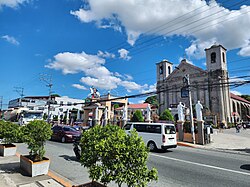
[edit]_2023-04-30.jpg)
Ibaan is home to the Archdiocesan Shrine and Parish of Saint James the Greater, the seat of the Roman Catholicism in Ibaan and the oldest church in town.
It is a predominantly Roman Catholic community, with small percentages of Protestants and members of the Iglesia ni Cristo. The indigenous Iglesia ni Cristo has several locales in the town, including the chapels in Coliat and Matala. Other than this, non-denominational full gospel churches are also established to name a few like Jesus the Anointed One Church, United Pentecostal Church and Jesus is Lord Church.
Economy
[edit]Poverty incidence of Ibaan
10
20
30
40
50
2000
44.12 2003
23.39 2006
8.70 2009
12.06 2012
8.58 2015
7.20 2018
9.27 2021
9.34 Source: Philippine Statistics Authority[18][19][20][21][22][23][24][25] |
Ibaan main products include tamales, kulambo (mosquito net), lomi, panutsa (sweet peanut), and sugarcane.
Transportation
[edit]The town is served by the Southern Tagalog Arterial Road (STAR), a toll road that leads to the capital, Manila, or neighboring Batangas City.
Culture
[edit]Festivals
[edit]
Ibaan celebrates civic and national holidays. The Ibaan Foundation Day is celebrated every December to commemorate the city's founding. Each barangay also has its own festivity guided by their patron saint. The town is host to the Feast of Saint James, held every 25 July, which draws hundreds of Catholic devotees. Another religious feasts held in Ibaan was the Procession Feast of Holy week. Non-religious holidays include the New Year's Day, National Heroes' Day, Bonifacio Day, and Rizal Day.
Sports
[edit]Most barangays have a makeshift basketball court, with court markings drawn on the roads. Larger barangays have covered courts where interbarangay leagues are held every summer (April to May).
The town has several well-known sports venues, such as the Bro. Medrano Plaza and Recto Gymnasium, the home of the now defunct Ibaan Basketball Team. The Bro. Medrano Plaza, which houses the basketball and volleyball courts, had hosted several multi-sport events and games.
Other well-known sports facilities include the Recto Gym, operated by the local government, and the Fr. Guido Colletti Gym, a private venue owned by Saint James Academy.
Education
[edit]
The Ibaan Schools District Office governs all educational institutions within the municipality. It oversees the management and operations of all private and public, from primary to secondary schools.[26]
Primary and elementary schools
[edit]- Acts Christian Academy
- Balanga Elementary School
- Bright Christian Academy
- Bungahan Elementary School
- Coliat Elementary School
- Gregorio Sison Memorial Elementary School
- Ibaan Central School
- Ibaan Nazareth School
- Ibaan Saint James Academy
- Lucsuhin Elementary School
- Mabalor-Catandala Elementary School
- Malainin Elementary School
- Maranatha Christian Academy
- Marfeben Academy
- Munting Tubig Elementary School
- Our Lady of Grace Formation School
- Palindan Elementary School
- Panghayaan Elementary School
- Quilo Elementary School
- Sabang Elementary School
- San Agustin Elementary School
- St. Jude Science and Technological School
- Sto. Nino Elementary School
- Talaibon Elementary School
- Tulay Elementary School
- Tulay-Calamias Elementary School
Secondary schools
[edit]- Dr. Juan A. Pastor Memorial National High School
- Lucsuhin Integrated School
- Mabalor-Catandala Integrated School
- Maximo T. Hernandez Memorial Integrated High School
- Procopio Mailig Memorial Integrated School
- San Agustin Integrated School
Gallery
[edit]-
 Municipal hall
 -
 Downtown Ibaan
 -
 B.R. Medrano Memorial Plaza (Demolished)
 -
 Ibaan Exit of STAR Tollway


References
[edit]- ^ Municipality of Ibaan | (DILG)
- ^ "2015 Census of Population, Report No. 3 – Population, Land Area, and Population Density" (PDF). Philippine Statistics Authority. Quezon City, Philippines. August 2016. ISSN 0117-1453. Archived (PDF) from the original on May 25, 2021. Retrieved July 16, 2021.
- ^ "2024 Census of Population (POPCEN) Population Counts Declared Official by the President". Philippine Statistics Authority. 17 July 2025. Retrieved 18 July 2025.
- ^ "PSA Releases the 2021 City and Municipal Level Poverty Estimates". Philippine Statistics Authority. 2 April 2024. Retrieved 28 April 2024.
- ^ "2024 Census of Population (POPCEN) Population Counts Declared Official by the President". Philippine Statistics Authority. 17 July 2025. Retrieved 18 July 2025.
- ^ a b "History". Retrieved July 4, 2023.
- ^ "Province:". PSGC Interactive. Quezon City, Philippines: Philippine Statistics Authority. Retrieved 25 August 2025.
- ^ "Municipal: Ibaan". PSGC Interactive. Quezon City, Philippines: Philippine Statistics Authority. Retrieved 8 January 2016.
- ^ "An Act to Create the Barrio of Bungahan in the Municipality of Ibaan, Province of Batangas". LawPH.com. Retrieved 2011-04-12.
- ^ Census of Population (2020). "Region IV-A (Calabarzon)". Total Population by Province, City, Municipality and Barangay. Philippine Statistics Authority. Retrieved 8 July 2021.
- ^ a b Census of Population and Housing (2010). "Region IV-A (Calabarzon)" (PDF). Total Population by Province, City, Municipality and Barangay. National Statistics Office. Retrieved 29 June 2016.
- ^ "Ibaan: Average Temperatures and Rainfall". Meteoblue. Retrieved 5 May 2020.
- ^ "2024 Census of Population (POPCEN) Population Counts Declared Official by the President". Philippine Statistics Authority. 17 July 2025. Retrieved 18 July 2025.
- ^ Census of Population (2015). "Region IV-A (Calabarzon)". Total Population by Province, City, Municipality and Barangay. Philippine Statistics Authority. Retrieved 20 June 2016.
- ^ Censuses of Population (1903–2007). "Region IV-A (Calabarzon)". Table 1. Population Enumerated in Various Censuses by Province/Highly Urbanized City: 1903 to 2007. National Statistics Office.
- ^ "Province of". Municipality Population Data. Local Water Utilities Administration Research Division. Retrieved 17 December 2016.
- ^ "2024 Census of Population (POPCEN) Population Counts Declared Official by the President". Philippine Statistics Authority. 17 July 2025. Retrieved 18 July 2025.
- ^ "Poverty incidence (PI):". Philippine Statistics Authority. Retrieved December 28, 2020.
- ^ "Estimation of Local Poverty in the Philippines" (PDF). Philippine Statistics Authority. 29 November 2005.
- ^ "2003 City and Municipal Level Poverty Estimates" (PDF). Philippine Statistics Authority. 23 March 2009.
- ^ "City and Municipal Level Poverty Estimates; 2006 and 2009" (PDF). Philippine Statistics Authority. 3 August 2012.
- ^ "2012 Municipal and City Level Poverty Estimates" (PDF). Philippine Statistics Authority. 31 May 2016.
- ^ "Municipal and City Level Small Area Poverty Estimates; 2009, 2012 and 2015". Philippine Statistics Authority. 10 July 2019.
- ^ "PSA Releases the 2018 Municipal and City Level Poverty Estimates". Philippine Statistics Authority. 15 December 2021. Retrieved 22 January 2022.
- ^ "PSA Releases the 2021 City and Municipal Level Poverty Estimates". Philippine Statistics Authority. 2 April 2024. Retrieved 28 April 2024.
- ^ "Masterlist of Schools" (PDF). Department of Education. January 15, 2021. Retrieved September 30, 2025.
External links
[edit]
Places adjacent to Ibaan | |
|---|---|


 Province of Batangas Province of Batangas | |
|---|---|
| Municipalities | |
| Component cities | |
Ibaan
View on GrokipediaBackground
Etymology
The name "Ibaan" derives from the Tagalog term indicating a place where "iba" abounds, reflecting the abundance of iba trees that once densely forested the area during its early settlement period.[6] Local historical records from the mid-20th century, compiling data on the town's origins, attribute this etymology to the prominence of these trees, which shaped the landscape observed by initial inhabitants.[7] The iba tree, scientifically identified as Phyllanthus acidus and commonly known in English as the Otaheite or Malay gooseberry, features a structure similar to the kamias (Averrhoa bilimbi), with small, clustered, acidic fruits that grow in rounded formations.[6] In Tagalog, it is specifically called "iba," and its widespread presence in the region's woodlands led early settlers to name the locality after this characteristic flora, emphasizing the natural environment's influence on place-naming conventions.[7] Though less common today, the tree's historical dominance underscores how environmental features informed indigenous nomenclature in pre-colonial and early colonial Batangas.[6]History
The early history of Ibaan traces back to pre-colonial settlements in the region, with the first documented poblacion of Batangas established in the barrio of Matala in 1780, where settlers began arriving before the 19th century.[8][7] This area, now a barrio of Ibaan, served as the initial municipal seat for what would become part of Batangas province under Spanish rule.[8] In 1832, following petitions from residents seeking relocation due to the site's vulnerability to flooding and remoteness, Ibaan was formally separated from the municipality of Batangas and established as an independent town on February 11.[7][8] The principalia was organized, with Don Bernardo Rafael appointed as the first gobernadorcillo, marking the beginning of local governance.[7] During the Spanish colonial era, the town expanded through the founding of barrios, such as Santo Niño in 1854 by the Litan, Macatangay, Manalo, and Patulot families, who became prominent settlers amid challenges like frequent raids by tulisanes (bandits).[9] As the Philippine Revolution unfolded in 1896, Ibaan residents contributed to the independence movement, with figures like Jose Mercado Medrano Jr. and Martin Montalbo supporting revolutionary forces from 1899 to 1901 during the Philippine-American War.[7] Local leader Mateo Illustre also led resistance against American forces in the early 1900s.[8] Under American administration starting in 1901, governance shifted to mayors, fostering infrastructure and administrative reforms. During World War II, under Japanese occupation from 1942 to 1945, Ibaan was a center of guerrilla resistance. The Ibaan Regiment, organized on January 25, 1943, by local patriots under American commission, played a key role in fighting Japanese forces and their collaborators, conducting operations across the region until liberation.[10][11] Post-independence, Ibaan experienced steady growth, with Bungahan constituted as a barrio in 1956 to accommodate expanding settlements.[12] The municipality progressed to second-class status by the late 20th century, reflecting economic advancements in agriculture and weaving industries.[13] By 2025, Ibaan has seen progressive developments, including the inauguration of the ₱270 million Catandala Bridge in June to reconnect barangays after over 40 years and the opening of a weaving and processing center in Munting Tubig in July to boost local craftsmanship and sustainable livelihoods.[14][15]Geography
Location and Topography
Ibaan is situated in the province of Batangas in the CALABARZON region of the Philippines, at geographic coordinates 13°49′03″N 121°07′59″E.[13] The municipality lies approximately 96 kilometers south of Manila and 13 kilometers northeast of Batangas City, positioning it as an inland area within the province.[13][16] As a landlocked municipality, Ibaan has a total land area of 68.99 square kilometers and an average elevation of 124 meters above sea level.[17] It is bounded by San Jose to the northwest, Lipa City to the northeast, Rosario to the east, Taysan to the southeast, and Batangas City to the southwest.[13] The topography of Ibaan features moderate terrain, with elevations ranging from about 10 meters to 223 meters, facilitating agricultural development across its landscape.[18] While no major mountains are prominent, the area includes local hills such as Soro-soro and water bodies like the Ibaan River and Himamawo Spring that support farming. The predominant soil type, Ibaan loam, consists of brown to dark brown tenacious clay loam in the subsoil and is well-suited for plantation crops, vegetables, and other farming activities.[19][20]Barangays
Ibaan is administratively subdivided into 26 barangays, comprising one urban barangay, Poblacion, and 25 rural barangays that primarily support agricultural activities such as rice and sugarcane cultivation.[17] These divisions trace their origins to the Spanish colonial period, when early settlers established communities in the mid-19th century, contributing to the town's formal separation from Batangas in 1832.[21] The complete list of barangays is as follows:- Bago
- Balanga
- Bungahan
- Calamias
- Catandala
- Coliat
- Dayapan
- Lapu-lapu
- Lucsuhin
- Mabalor
- Malainin
- Matala
- Munting Tubig
- Palindan
- Pangao
- Panghayaan
- Poblacion
- Quilo
- Sabang
- Salaban I
- Salaban II
- San Agustin
- Sandalan
- Santo Niño
- Talaibon
- Tulay na Patpat[17]
Climate
Ibaan experiences a tropical monsoon climate classified as Type I under the Philippine Atmospheric, Geophysical and Astronomical Services Administration (PAGASA) system, characterized by two distinct seasons: a dry season from December to May and a wet season from June to November. This classification applies regionally to Batangas province, where Ibaan is located, as there is no dedicated local weather station, and data are derived from nearby monitoring sites and modeled estimates.[22] Temperatures in Ibaan remain moderate year-round, with an annual average of 25.7°C, ranging from highs of 32°C in May to lows of 24°C during the cooler months of December to February.[23] Relative humidity averages 83-87%, contributing to an oppressive feel, particularly during the wet season when it often exceeds 90%.[24] Wind patterns are predominantly from the east-southeast, with average speeds of 3-13 km/h, increasing to breezy conditions (up to 21 km/h gusts) in transitional months like March and October.[25] Annual rainfall totals approximately 2,179 mm, concentrated in the wet season with peaks in October (around 239 mm) and minimal precipitation in the dry season's February (about 27 mm).[26][23] These climatic conditions support agricultural and livestock activities by providing consistent warmth and moisture, though the lack of extreme temperature fluctuations aids crop growth without excessive stress.[27] However, recent years have seen intensified impacts from tropical cyclones, with the Philippines experiencing six successive storms in late 2024 that brought heavy rainfall and flooding to Batangas, exacerbating erosion and waterlogging.[28] As of November 2025, Typhoon Fung Wong (locally named Uwan) has further highlighted climate-driven increases in storm intensity, with projections indicating up to 10% wetter typhoons due to warming trends.[29][30]Demographics
Population
As of the 2024 Census of Population and Housing by the Philippine Statistics Authority (PSA), Ibaan has a total population of 58,673 residents. This represents a modest increase from the 58,507 individuals recorded in the 2020 census. Between 2015 and 2020, the population grew from 52,970 to 58,507, reflecting an annual growth rate of approximately 2.0 percent; however, the rate slowed significantly to about 0.07 percent annually from 2020 to 2024.[31][17] Ibaan's land area measures 68.99 square kilometers, resulting in a population density of 850.5 persons per square kilometer in 2024. The municipality remains predominantly rural, with urban areas limited primarily to the Poblacion barangay, which accounted for about 3.8 percent of the 2020 population. No significant population changes have been reported following the 2025 local elections.[17][32] In 2020, Ibaan had 14,837 households, yielding an average household size of 3.94 persons. The sex distribution showed a slight male majority, with 29,644 males and 28,822 females, for a sex ratio of 102.9 males per 100 females. The age structure highlights a youthful demographic, with the largest groups in the 0-9 (7,261 persons), 10-19 (7,250), 20-29 (6,924), and 30-39 (6,968) brackets, comprising over half the total population.[13]Language
The primary language spoken in Ibaan is Tagalog, specifically the Batangueño dialect, a regional variant characterized by a distinct heavy accent, unique sentence-final particles such as "eh" and "ga," and vocabulary that preserves elements of older Tagalog forms.[33] This dialect plays a central role in local culture, fostering community ties and expressing Batangueño hospitality through idiomatic expressions like "ala eh" for casual emphasis or surprise, and words such as "yayao" meaning to leave or depart.[33] Among Ibaan's approximately 58,507 residents as of the 2020 census, the vast majority use this dialect in daily life. English serves as the secondary language in Ibaan, mandated for use in formal education, government administration, and business, aligning with its status as one of the Philippines' two official languages alongside Filipino (based on Tagalog). Due to internal migration patterns, minor influences from other Philippine languages, such as Bisaya spoken by some migrant families, appear in the community, though they do not significantly alter the dominance of Tagalog. Efforts to preserve the Batangueño dialect are evident in local literature, festivals, and oral traditions, which maintain unique phrases tied to Ibaan's agricultural heritage and social customs, ensuring the dialect's role in reinforcing regional identity.[33] No indigenous languages are documented in Ibaan, with the focus remaining on Tagalog variants shaped by historical and geographical factors in Batangas province.[33]Religion
The religious landscape of Ibaan is dominated by Roman Catholicism, aligning with provincial patterns in Batangas where Roman Catholics constitute the vast majority, numbering approximately 2.72 million individuals.[34] This affiliation shapes much of the community's spiritual and social fabric, with the Archdiocesan Shrine and Parish of Saint James the Greater—commonly known as Ibaan Church—serving as the central place of worship and a historic landmark dedicated to the town's patron saint.[35] Established in the early 19th century, with the current structure completed between 1853 and 1869, the church features Baroque architecture and hosts key liturgical events, underscoring Catholicism's enduring prominence.[36] Minority religious groups include Protestants and members of the Iglesia ni Cristo, each representing small segments of the population. Protestant communities maintain presence through congregations like the Mountaineer Baptist Church, which conducts regular services and prayer meetings.[37] Similarly, the Iglesia ni Cristo operates locales in Barangay Poblacion and Barangay Matala, facilitating worship for adherents in these areas.[38] No significant non-Christian populations, such as Muslim or indigenous faith groups, are documented in Ibaan. Catholicism's influence extends deeply into daily and communal life, exemplified by vibrant Holy Week observances that include solemn processions on Good Friday, featuring carrozas depicting the Passion of Christ and drawing residents in acts of devotion.[39] These traditions foster unity and reflection, with the Ibaan Church often at the heart of such events. The religious composition remains stable based on the 2020 census, with no notable shifts reported in affiliation patterns.Government
Local Government Structure
Ibaan is a second-class municipality in the province of Batangas, Philippines, classified based on its average annual income and other criteria under the standards set by the Department of the Interior and Local Government.[13] As a local government unit, it operates under the provisions of Republic Act No. 7160, also known as the Local Government Code of 1991, which decentralizes authority and promotes local autonomy for municipalities.[40] The municipal government follows the standard structure for Philippine municipalities, with an executive branch led by an elected mayor who serves as the chief executive, responsible for implementing local policies and managing administrative operations. The legislative body, known as the Sangguniang Bayan, is headed by an elected vice mayor as the presiding officer and includes eight elected members who enact ordinances, approve budgets, and oversee devolved services such as health, social welfare, and basic education support. At the grassroots level, governance extends to 26 barangays, each headed by an elected barangay captain who manages local affairs, maintains peace and order, and delivers basic services to residents.[40][13] The powers and functions of Ibaan's local government emphasize legislative authority, including the enactment of local laws on taxation, zoning, and public safety; fiscal management through annual budgeting and revenue generation; and administrative oversight of essential services like environmental protection and agricultural development. These responsibilities align with the Local Government Code's framework for promoting efficient delivery of public services while ensuring accountability to constituents.[40] Symbolizing its identity, the municipal seal features key elements that reflect Ibaan's historical and economic roots: a peddler representing traditional livelihoods, sugarcane stalks denoting the town's historical primary agricultural industry, which covered approximately 2,000 hectares across several barangays in the mid-2010s, and the iba tree (Averrhoa bilimbi), the namesake of the municipality due to its historical abundance in the area. The seal is encircled by the inscription "Bayan ng Ibaan, Lalawigan ng Batangas" and the founding year 1832. The municipal flag is white, matching the size of the Philippine national flag, with the seal centered to embody local pride and heritage.[41]Current Officials
As of November 2025, following the local elections held on May 12, 2025, the municipal government of Ibaan is headed by Mayor Hon. Jane A. Casas of the Padayon Rizalino Party (PRP), who secured 20,880 votes (50.56% of the total).[42] Her term, along with other elected officials, runs from July 1, 2025, to June 30, 2028, in line with the standard three-year term for Philippine local executives.[43] The Vice Mayor is Hon. Edralyn Joy A. Salvame, also of the PRP, who won with 24,656 votes (59.70%).[42] She presides over the Sangguniang Bayan and chairs committees on internal rules, education, housing, transportation, and ad hoc matters.[43] The Sangguniang Bayan is composed of eight elected councilors, along with ex-officio members: the President of the Liga ng mga Barangay and the President of the Sangguniang Kabataan Federation, elected at-large, with the top vote-getters assuming office. All but one are affiliated with the PRP, reflecting the party's strong performance in the 2025 polls. The following table lists the current elected members, their parties, and approximate vote shares based on official canvass results:| Position | Name | Party | Vote Share (%) |
|---|---|---|---|
| Councilor | Hon. Juvy M. Mendoza | PRP | 54.42 |
| Councilor | Hon. John Henry N. Cabatay | PRP | 52.96 |
| Councilor | Hon. Erwin C. Andal | PRP | 52.19 |
| Councilor | Hon. Eloise Jan S. Tejada | PRP | 48.31 |
| Councilor | Hon. Sixto I. Yabyabin | PRP | 46.98 |
| Councilor | Hon. Arsenio Ricero | PRP | 41.66 |
| Councilor | Hon. Eddie L. Pasia | PRP | 40.45 |
| Councilor | Hon. Phill Joshua G. Caringal | Independent | 39.70 |
Economy
Agriculture and Local Products
Ibaan's agricultural sector is predominantly centered on crop production suited to its fertile volcanic soils and tropical climate, which supports wet-season planting of rice in lowland areas irrigated by the Pansipit River system and nearby streams. Sugarcane cultivation has been a staple since the 19th century, with fields processed through traditional and modern mills for local and regional markets, while rice remains a key irrigated crop across 11 barangays, often grown alongside corn for household consumption and trade.[44][45][46] Livestock raising complements farming, with cattle reared for beef and draft purposes on smallholder farms, and poultry operations focusing on egg and meat production to meet local demand. These activities are integrated into mixed farming systems, where farmers rotate crops and integrate animal husbandry to enhance soil fertility through manure use and diversify income sources. Cooperatives, such as the Sabang Ibaan Multi-Purpose Cooperative established in 1993, provide technical support, credit access, and marketing assistance to improve productivity and sustainability.[47][48][49] Signature local products highlight Ibaan's culinary and artisanal traditions, including tamales ng Ibaan, a savory rice-based delicacy wrapped in banana leaves and filled with spiced meat and peanut paste, distinct for its subtle spiciness and availability at the public market. Lomi, a thick noodle soup with egg and meat toppings, is a beloved street food reflecting Batangas' fusion of Chinese and indigenous influences. Panutsa, a hardened candy of muscovado sugar and peanuts, serves as a popular sweet pasalubong (souvenir), while kulambo—handwoven mosquito nets crafted from soft cotton threads derived from abaca-like fibers—represents the town's historic weaving expertise, once earning it the title "Kulambo Capital of the Philippines." These goods are sold through community markets and fairs, such as the 2025 Agri-Fair that showcased native delicacies alongside fresh produce to promote sustainable livelihoods.[50][51][52][53][3][54] In 2025, the inauguration of the SM Sunrise Weaving and Processing Center in Barangay Munting Tubig marked a key initiative to revive artisanal crafts, offering a dedicated facility for fiber processing and weaving to empower local women weavers, preserve cultural heritage, and expand markets for products like kulambo through sustainable practices. Supported by the Philippine Fiber Industry Development Authority (PhilFIDA), the center addresses declining demand for traditional nets by promoting diversified fiber-based goods.[15]Industry and Economic Indicators
Ibaan is classified as a second-class municipality by the Bureau of Local Government Finance, reflecting its moderate fiscal capacity within Batangas province. In 2022, the municipality's annual regular revenue reached ₱289.9 million, primarily derived from local sources such as taxes and fees, alongside internal revenue allotments from the national government.[55] This revenue supports public services and infrastructure. Poverty incidence in Ibaan stood at 9.34% in 2021, lower than the provincial average but highlighting vulnerabilities in rural households. As of 2023, the provincial poverty incidence increased to 4.9% (from 4.3% in 2021), per the Philippine Statistics Authority, underscoring ongoing rural vulnerabilities despite Ibaan's lower rate.[56][57] Employment is predominantly in the services sector, which accounts for a significant portion of local jobs, followed by small-scale industries including food processing and retail. These sectors employ a majority of the workforce, with services driving commerce in the poblacion area and small industries supporting ancillary activities like garment weaving and light manufacturing.[58] Emerging economic sectors in Ibaan include agri-tourism, which integrates local agriculture with visitor experiences to diversify income sources. A key initiative is the 2025 IBAANgAgri-Tourism Trade Fair, held from February 3 to 11, showcasing farm products, tours, and cultural exhibits to attract tourists and boost sales for small producers.[59] The municipality's proximity to the Southern Tagalog Arterial Road (STAR) Tollway enhances commerce by improving access to markets in nearby Lipa City and Santo Tomas, facilitating logistics for goods and increasing business tax revenues in beneficiary areas. Ibaan's economy contributes to Batangas province's overall GDP, which expanded by 4.9% to ₱645.78 billion in 2023.[60] Local business hubs, such as the municipal trade fair grounds and roadside commercial strips, serve as focal points for small enterprises, though the municipality lacks large-scale industrial estates. Challenges from industrialization include environmental pressures like waste management and climate resilience, exacerbated by the province's rapid urban expansion and events such as the 2020 Taal eruption, which disrupted local operations and required adaptive measures for sustainable growth.[46]Infrastructure
Transportation
Ibaan's primary connection to Metro Manila and surrounding regions is facilitated by the Southern Tagalog Arterial Road (STAR) Tollway, a 41.9-kilometer expressway that passes through the municipality, linking it to the South Luzon Expressway (SLEX) and enabling efficient travel to urban centers like Lipa City and Batangas City.[61][62] Within Ibaan, transportation relies on a network of paved provincial and barangay roads, supplemented by jeepneys for inter-barangay routes and tricycles for short-distance travel in rural and urban areas, serving as the main public transit options for residents.[63][64] The nearest major port is Batangas Port, located approximately 13 kilometers away, providing access to maritime routes for cargo and passenger ferries, while Ibaan has no internal airport; the closest is Ninoy Aquino International Airport in Manila, about 78 kilometers north.[65][66] A significant recent enhancement is the Catandala Bridge, inaugurated on June 26, 2025, at a cost of ₱270 million; this 121-meter structure over the Calumpang River reconnects three barangays—Catandala, San Agustin, and Pangao-ao—after 42 years without a crossing, improving local mobility and supporting economic activities like agriculture and tourism.[14][67]Education
The educational system in Ibaan is overseen by the Ibaan Schools District Office under the Department of Education (DepEd) Division of Batangas, which manages public elementary and secondary institutions across the municipality's 26 barangays. This district ensures compliance with national standards, including the K-12 curriculum, and coordinates teacher training and resource allocation. As part of the Calabarzon region, Ibaan benefits from regional initiatives like the Basic Education Development Plan, focusing on infrastructure improvements and digital literacy enhancement.[68] Ibaan's literacy rate aligns with regional trends, with Calabarzon recording a basic literacy rate of 92.6% for individuals aged 5 and older based on the 2024 Functional Literacy, Education, and Mass Media Survey (FLEMMS). This high rate reflects effective foundational education efforts, though functional literacy stands at approximately 77% regionally, emphasizing the need for ongoing skill-building programs.[69] Public elementary education is provided through around 15-20 schools, including Ibaan Central School as the central hub and barangay-based institutions such as Balanga Elementary School, Bungahan Elementary School, Coliat Elementary School, Gregorio Sison Memorial Elementary School, Malainin Elementary School, Munting Tubig Elementary School, Panghayaan Elementary School, and Sto. Niño Elementary School.[70] These facilities serve early childhood to Grade 6, with enrollment in public elementary schools historically accommodating over 900 new Grade 1 students annually, though 2025 figures remain aligned with DepEd's national recovery targets post-pandemic.[71] Modernized classrooms and learning resource centers have been prioritized under DepEd's Last Mile Schools Program, with solar-powered facilities in remote areas to support consistent access.[72] At the secondary level, the primary public institution is Dr. Juan A. Pastor Memorial National High School in Barangay Talaibon, offering junior and senior high programs with tracks in academic, technical-vocational, and sports strands.[73] Private secondary options include St. Jude Science and Technological School and branches of institutions like Bright Christian Academy and St. Dominic Savio College, which provide alternative curricula emphasizing STEM and humanities.[74] Enrollment in secondary education follows DepEd guidelines, with 2025 data collection emphasizing inclusive access for learners with disabilities through integrated facilities. Ibaan lacks local higher education institutions, requiring residents to commute to nearby cities such as Batangas City for programs at Batangas State University or Lipa City for offerings at the University of Batangas.[75][76] Vocational training, however, is available locally through community-based initiatives; in 2025, the SM Sunrise Weaving Association launched a dedicated Weaving and Processing Center in Barangay Munting Tubig, supported by the Philippine Fiber Industry Development Authority (PhilFIDA), to provide hands-on training in abaca weaving and fiber processing for sustainable agricultural livelihoods.[15] These programs target out-of-school youth and adults, integrating traditional crafts with modern techniques to boost employability in Ibaan's agro-based economy.[77]Culture
Festivals
Ibaan hosts several annual festivals that blend cultural, historical, and religious elements, reflecting the community's heritage and local economy. The most prominent is the Foundation Day celebration on February 11, commemorating the municipality's establishment in 1832. In 2025, the 193rd anniversary featured the multi-week LesKuHLiemBo Festival, held from early February through February 11, which highlights Ibaan's traditional products—tamales (tamales), kulambo (mosquito nets), habi (weaving), liembo (grilled pork belly), and tubo (bamboo products)—through parades, cultural performances, and community events that foster civic pride and economic promotion. The name LesKuHLiemBo is an acronym derived from these key local products.[78][59][79] The Feast of Saint James the Greater, honoring Ibaan's patron saint, occurs annually on July 25 and serves as the town's primary religious fiesta. This event includes solemn masses, processions with the saint's image, and communal feasts that draw hundreds of devotees, emphasizing themes of faith and community solidarity rooted in the parish's establishment in the 19th century.[80][44] During Holy Week, particularly Good Friday and Easter Sunday, Ibaan observes traditional processions featuring life-sized religious images, such as those depicting Christ's Passion and the saints, which wind through the streets in a display of devotion and cultural continuity. These rituals, part of broader Lenten observances, conclude with joyous Easter celebrations, including the unique Sayaw ng Pagbati (Dance of Greeting), a colorful dance performance that adds vibrancy to the festivities and reinforces the community's Catholic heritage.[39] Complementing these events is the IBAANgAgri-Tourism Trade Fair, held February 3–11, 2025, in front of the municipal hall as part of the founding anniversary activities. The fair showcases local agricultural products, handicrafts, and tourism initiatives through vendor stalls and demonstrations, promoting Ibaan's economy and attracting visitors for interactive cultural experiences.[59]Sports
Basketball serves as the primary sport in Ibaan, reflecting its popularity across the Philippines and the municipality's emphasis on community-based athletic activities. Most barangays feature basketball courts, supporting local play and maintenance initiatives such as repainting projects in Barangay Malainin and material purchases for facilities in Barangay Matala.[81][82] These courts enable widespread participation, particularly among youth and residents in rural areas. Key venues include the B.R. Medrano Memorial Plaza and the Recto Gymnasium, both managed by the local government and used for hosting basketball tournaments and multi-sport events. The Medrano Plaza, for instance, served as the starting point for the 2015 Inter-Commercial Basketball League, drawing teams from various sectors of the community.[83] Similarly, the Recto Gym has been reserved for basketball exhibitions and inter-barangay competitions, underscoring its role in organized play.[84] Volleyball complements basketball as another prominent activity, with dedicated women's leagues integrated into broader community sports programs like the Palarong Bayan. These efforts promote recreational and competitive engagement, particularly for female participants. The Ibaan Municipal Physical Fitness and Sports Development Council oversees coordination of all sports and fitness initiatives, ensuring programs contribute to youth development and overall community health by supervising activities from various municipal offices and agencies.[85][86] A proposed Ibaan Cultural and Sports Center, recognized for its architectural design in 2024, is under development as of 2025 and expected to enhance facilities with a multi-purpose arena for athletic events, local performances, and youth-oriented gatherings upon completion.[87]References
- https://en.wikivoyage.org/wiki/Batangas_City