Hubbry Logo
Philippine languagesPhilippine languagesMain
Open search
Philippine languages
Community hub
Philippine languages
logo
8 pages, 0 posts
0 subscribers
Be the first to start a discussion here.
Contribute something
Philippine languages
from Wikipedia

Philippine
Philippinic
(proposed)
Geographic
distribution
Native speakers
(undated figure of 115+ million)
Linguistic classificationAustronesian
Proto-languageProto-Philippine (disputed)
Subdivisions
Language codes
ISO 639-2 / 5phi
GlottologNone
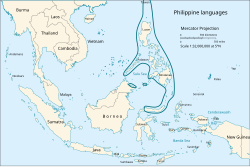
The Philippine languages, per Adelaar and Himmelmann (2005)

The Philippine languages or Philippinic are a proposed group by R. David Paul Zorc (1986) and Robert Blust (1991; 2005; 2019) that include all the languages of the Philippines and northern Sulawesi, Indonesia—except Sama–Bajaw (languages of the "Sea Gypsies") and the Molbog language (disputed)—and form a subfamily of Austronesian languages.[1][2][3][4] Although the Philippines is near the center of Austronesian expansion from Taiwan, there is relatively little linguistic diversity among the approximately 150 Philippine languages, suggesting that earlier diversity has been erased by the spread of the ancestor of the modern Philippine languages.[5][2]

Classification

[edit]

History and criticism

[edit]

One of the first explicit classifications of a "Philippine" grouping based on genetic affiliation was in 1906 by Frank Blake, who placed them as a subdivision of the "Malay branch" within Malayo-Polynesian (MP), which at that time was considered as a family. Blake however encompasses every language within the geographic boundaries of the Philippine archipelago to be under a single group.[6] Formal arguments in support of a specific "Proto-Philippines" were followed by Matthew Charles in 1974, Teodoro Llamzon in 1966 and 1975, and Llamzon and Teresita Martin in 1976.[7][8][9][10] Blust (1991) two decades later updates this based on Zorc's (1986) inclusion of Yami, and the Sangiric, Minahasan, and Gorontalo groups.[6]

The genetic unity of a Philippines group has been rejected particularly by Lawrence Reid.[11] This arose with problems in reconstructing Philippine subgroups within MP (Pawley, 1999; Ross, 2005).[12][13] In a recent state-of-the art on the classification of Philippine languages, he provides multidisciplinary arguments on the field's methodological and theoretical shortcomings since Conant's description in the early 1900s. This includes Malayo-Polynesian archeology (Spriggs, 2003; 2007; 2011),[14][15][16] and Bayesian phylogenetic analyses (Gray et al., 2009)[17] substantiating the multiplicity of historical diffusion and divergence of languages across the archipelago.[18] He suggests that the primary branches under this widely acknowledged Philippine group should instead be promoted as primary branches under Malayo-Polynesian.[19] Malcolm Ross (2005) earlier also noted that the Batanic languages, constituting Yami, Itbayat, and Ivatan, should in fact be considered as a primary MP branch.[13] In an evaluation of the lexical innovations among the Philippine languages, Alexander Smith (2017) regards the evidence for a Philippine subgroup as weak, and concludes that "they may represent more than one primary subgroup or perhaps an innovation-defined linkage".[20] Chen et al. (2022) present further arguments for the Philippine languages being a convergence area rather than a unified phylogenetic subgroup.[21]

Internal classification

[edit]

The Philippine group is proposed to have originated from Proto-Malayo-Polynesian and ultimately from Proto-Austronesian. There have been several proposals as to the composition within the group, but the most widely accepted groupings today is the consensus classifications by Blust (1991; 2005) and Reid (2017); however, both disagree on the existence of a Philippine group as a single genetic unit.

Zorc (1979)

[edit]

An earlier classification by Zorc (1979) is presented below. From approximately north to south, a Philippine group according to his analysis of previous reconstructions are divided into two main subgroups, Northern or "Cordilleran" and Southern or "Sulic".[22] Note that the groupings herein no longer reflect widely accepted classifications or naming conventions today. For example South Extension nowadays reflects the widely established Central Luzon, and North Mangyan within Cordilleran is not supported by later reconstructions; the group containing Yami, Ivatan and Itbayat is called "Bashiic" in Zorc (1977) and remains generally accepted.[23]

Blust (1991; 2005)

[edit]

From approximately north to south, the Philippine languages are divided into 12 subgroups (including unclassified languages):

Formerly classified as one of the South Mindanao languages, the Klata language is now considered to be a primary branch of the Southern Philippine languages by Zorc (2019).[24]

Map of the distribution of the major languages of the Philippines, showing their subdivisions

Vocabulary

[edit]

Comparison chart between several selected Philippine languages spoken from north to south with Proto-Austronesian first for comparison.

English 1 2 3 4 5 person house dog coconut day new we (incl.) what fire
Proto-Austronesian *əsa
*isa
*duSa *təlu *Səpat *lima *Cau *Rumaq *asu *niuR *qaləjaw *baqəRu *i-kita *n-anu *Sapuy
Batanic (Bashiic) Yami (Tao) ása dóa (raroa) tílo (tatlo) apat (ápat) lima tao vahay chito niyoy araw vayo yaten ango apoy
Ivatan asa dadowa tatdo apat lima tao vahay chito niyoy araw va-yo yaten ango apoy
Northern Luzon Ilocano maysa dua tallo uppat lima tao balay aso niog aldaw baro sitayo ania apoy
Ibanag tadday dua tallu appa' lima tolay balay kitu niuk aggaw bagu sittam anni afi
Gaddang antet addwa tallo appat lima tolay balay atu ayog aw bawu ikkanetam sanenay afuy
Pangasinan sakey dua
duara
talo
talora
apat
apatira
lima too abong aso niyog ageo balo sikatayo anto pool
Central Luzon Kapampangan métung adwá atlú ápat limá táu balé ásu ngúngut aldó báyu ítámu nánu apî
Central Philippine Tagalog isa dalawa tatlo apat lima tao bahay aso niyog araw bago tayo ano apoy
Central Bikol sarô duwa tulo apát lima tawo harong ayam
idò
niyog aldaw bâgo kitá ano kalayo
Rinconada Bikol əsad darwā tolō əpat lima tawō baləy ayam noyog aldəw bāgo kitā onō kalayō
Waray usa
sayo
duha tulo upat lima tawo balay ayam
ido
lubi adlaw bag-o kita ano kalayo
Hiligaynon isa duha tatlo apat lima tawo balay ido lubi adlaw bag-o kita ano kalayo
Bantoanon (Asi) usa ruha tuyo upat lima tawo bayay iro nidog adlaw bag-o kita ni-o kayado
Romblomanon isa duha tuyo upat lima tawo bayay ayam niyog adlaw bag-o kita ano kalayo
Onhan isya darwa tatlo ap-at lima tawo balay ayam niyog adlaw bag-o kita ano kalayo
Karay-a sara darwa tatlo apat lima taho balay ayam niyog adlaw bag-o kita
tatən
ano kalayo
Aklanon isaea
sambilog
daywa tatlo ap-at lima tawo baeay ayam niyog adlaw bag-o kita ano kaeayo
Cebuano usa duha tulo upat lima tawo balay iro lubi adlaw bag-o kita unsa kalayo
Tausug isa
hambuuk
duwa tu upat lima tau bay iru' niyug adlaw ba-gu kitaniyu unu kayu
Danao Maguindanao isa dua telu pat lima tau walay asu niyug gay bagu tanu ngin apuy
Mëranaw isa dowa t'lo phat lima taw walay aso neyog gawi'e bago tano tonaa apoy
Iranun isa dua telu pa'at lima taw walay asu niyug gawi'i bagu tanu antuna apuy
South Mindanao (Bilic) Tboli sotu lewu tlu fat lima tau gunu ohu lefo kdaw lomi tekuy tedu ofih
Minahasan Tombulu (Minahasa) esa zua
rua
telu epat lima tou walé asu po'po' endo weru kai
kita
apa api
Sangiric Sangirese sembau
esa'
darua tatelu epa' lima tau balé kapuna' bango' elo wuhu kité tawé putung
Gorontalo–Mongondow Gorontalo tuwewu duluwo totolu opato limo tawu bele 'apula bongo dulahu bohu 'ito wolo tulu
Mongondow inta' dua tolu opat lima intau baloi ungku' bango' singgai mobagu kita onu, onda tulu'

See also

[edit]

Notes

[edit]

References

[edit]

Works cited

[edit]
  • Adelaar, Alexander; Himmelmann, Nikolaus P., eds. (2005). The Austronesian Languages of Asia and Madagascar. London: Routledge.

Further reading

[edit]
[edit]
Revisions and contributorsEdit on WikipediaRead on Wikipedia
from Grokipedia
The Philippine languages refer to the diverse array of 175 living indigenous languages spoken across the archipelago nation of the , which is home to a of approximately 118 million people (2024 est.). These languages predominantly belong to the Western Malayo-Polynesian subgroup of the , reflecting a shared historical and shaped by ancient migrations from and subsequent interactions with regional influences. Filipino, a standardized form based on Tagalog, and English are the country's two official languages, with Filipino serving as the to promote unity among the ethnically and linguistically varied . Linguistic diversity in the Philippines is marked by eight major regional languages that together account for a significant portion of daily communication: Tagalog (spoken in 39.9% of households), Bisaya/Binisaya (16%), Hiligaynon/Ilonggo (7.3%), Ilocano (7.1%), Cebuano (6.5%), Bikol/Bicol (3.9%), Waray (2.6%), and Kapampangan (2.4%), alongside smaller groups like and . This multilingualism stems from the country's —comprising 7,641 islands—and historical colonization by and the , which introduced loanwords and reinforced English's role in , , and media. Despite this richness, many indigenous languages face endangerment due to , migration, and the dominance of Filipino and English, prompting efforts to preserve them through and cultural policies. The interplay of these languages underscores the Philippines' identity as one of the most linguistically complex nations in , where between Filipino, English, and local tongues is commonplace in everyday interactions.

Overview and Scope

Definition and Diversity

The Philippine languages refer to the approximately 175 living languages belonging to the Philippine subgroup of the Malayo-Polynesian branch within the , primarily spoken across the islands of the . All indigenous Philippine languages are Austronesian, reflecting shared origins within the broader , which spans from to [Easter Island](/page/Easter Island), but the Philippine subgroup is noted for its concentration in a single . In terms of numerical diversity, reports 175 indigenous living languages, with around 76 of them having more than speakers, highlighting a spectrum from widely spoken tongues like Tagalog (over 28 million native speakers) to smaller ones with fewer than 1,000. This diversity is underscored by low among major languages; for example, Tagalog (the basis of Filipino) and Cebuano (spoken by about 16 million) share lexical roots but are not mutually intelligible in spoken or written form due to phonological, morphological, and lexical divergences. Such fragmentation contributes to the being one of the most linguistically diverse nations globally, with no single language dominating native usage nationwide. Typologically, Philippine languages are predominantly agglutinative, employing prefixes, infixes, and suffixes to mark focus, tense, aspect, and voice in a highly system, though some exhibit isolating tendencies with minimal inflection. They universally feature verb-initial , either verb-subject-object (VSO) or verb-object-subject (VOS), and possess symmetric pronominal systems that distinguish inclusive and exclusive first-person plural forms. These shared traits reflect their Austronesian heritage while allowing for regional variations in syllable structure and inventory.

Geographic and Demographic Distribution

The Philippine languages, all belonging to the Austronesian family, are distributed across the archipelago's three major island groups: , , and , reflecting the country's fragmented geography and historical migrations. In , the largest island, Tagalog dominates in the southern regions, particularly around and provinces like , Laguna, and , where it serves as the primary language for over 28 million native speakers nationwide, representing about 26% of the population according to estimates. Northern features Ilocano as the predominant language in areas such as Ilocos and , spoken by approximately 9 million people or 8% of the population. The hosts minority languages among indigenous groups, including Kankanaey and Ibaloi among the Igorot peoples. In the Visayas, Cebuano is the most widely spoken language, concentrated in , , and parts of and , with around 16 million native speakers or 15% of the total. Waray prevails in , specifically and provinces, accounting for about 3.5 million speakers or 3%. Hiligaynon, also known as Ilonggo, is prominent in , including Island and parts of , with roughly 9 million speakers or 8%. exhibits greater linguistic diversity, with Cebuano extending into northern and eastern areas, Hiligaynon in the region, and indigenous languages like Maranao in (about 1.5 million speakers or 1.4%) and Maguindanao in central . Tausug is concentrated in the . Overall, nearly 109 million people in the speak Austronesian languages as their native tongues, encompassing virtually the entire population of 109 million from the 2020 census. Urban-rural patterns show a marked shift toward Tagalog in metropolitan areas due to . In and other urban centers, Tagalog has become the , with migrants from rural provinces adopting it for daily interactions, leading to higher concentrations of Tagalog speakers in cities compared to rural strongholds of regional languages. Rural areas, particularly in provincial interiors, maintain stronger retention of local languages like Ilocano in northern farmlands or Cebuano in Visayan villages, where over 90% of residents may use indigenous tongues exclusively at home. The global of , driven by overseas workers, has extended the reach of Philippine languages beyond the . An estimated 10-12 million live abroad, with Tagalog maintaining prominence in communities in the United States, where over 1.7 million speakers form vibrant enclaves in states like and , often serving as a cultural anchor for first-generation immigrants. Other languages like Cebuano and Ilocano persist in diaspora networks in the and , facilitated by remittances and family ties that reinforce linguistic heritage among overseas Filipino workers.

Historical Development

Pre-Colonial Origins

The origins of Philippine languages are rooted in the Austronesian expansion, with linguistic evidence indicating that speakers of early Austronesian languages migrated from to the northern in successive waves approximately 4,000 to 5,000 years ago. These migrations, beginning around 3000 BCE, introduced Proto-Malayo-Polynesian (PMP) speakers to the region, where they established initial settlements in areas like and the Islands by 2200 BCE. This process culminated in the divergence of the Proto-Philippine language estimated at approximately 3400 years before present (ca. 1400 BCE), with a spanning roughly 2600 to 4200 years before present (ca. 620 BCE to 2260 BCE), marking a distinct branch within the Malayo-Polynesian subgroup of Austronesian. Archaeological findings corroborate these linguistic migrations, particularly through correlations with pre-Lapita cultural complexes in the northern . Pottery assemblages from sites such as Nagsabaran in , dating to 2000–1500 BCE, exhibit stylistic and technological traits—such as dentate-stamped and red-slipped ceramics—that align with early Austronesian seafaring traditions originating from and the . These artifacts suggest that the Lapita cultural horizon, known for its role in further Pacific expansions around 1500 BCE, had precursors in Philippine settlements, reflecting the integration of migrant technologies and subsistence practices like rice cultivation and outrigger canoe use. Reconstructions of Proto-Philippine reveal shared phonological innovations that distinguish it from other , including the systematic shift of PMP *q (a uvular or glottal-like stop) to a , as seen in forms like *qaSu 'freshwater' becoming reflexes with initial or final glottal stops across Philippine languages. This innovation, along with vowel mergers and stress patterns, supports the unity of over 150 Philippine languages as a genetic , with etymological evidence from over 600 shared lexical items reinforcing the proto-language's coherence before regional diversification. Oral traditions preserved in pre-colonial epics further attest to the linguistic and cultural interconnectedness of early Philippine societies. The epic, chanted in the Sulod dialect of Hiligaynon by the people of central , narrates the adventures of brothers and incorporates mythological motifs—such as animistic cosmology and heroic quests—that parallel themes in other Philippine epics like the Ifugao Hudhud and Maranao , indicating a shared heritage predating European contact. Documented by anthropologist in the mid-20th century from elderly chanters, this 58-episode oral narrative, estimated at 28,000 lines, exemplifies how pre-colonial linguistic unity was maintained through performative transmission across ethnolinguistic groups.

Colonial and Post-Colonial Influences

The Spanish colonization of the , spanning from 1565 to 1898, profoundly shaped indigenous languages through extensive lexical borrowing, particularly in religious and administrative domains. Terms related to , such as Dios (from Spanish Dios, meaning "God"), and governance concepts like gobernador () entered languages like Tagalog and Cebuano, reflecting the imposition of Catholic doctrine and colonial bureaucracy. These loanwords, estimated at 4,000 to 6,000 in Tagalog alone, comprised up to 20% of its core vocabulary by the end of the period, often adapted phonologically to fit native sound systems. Additionally, Spanish influence extended to , replacing pre-colonial script with a Latin-based system incorporating Spanish conventions like the for nasal sounds, which standardized writing across the archipelago. The American colonial era from 1898 to 1946 accelerated linguistic shifts by prioritizing English in and governance, fostering widespread bilingualism. The establishment of a public school system under U.S. administration introduced English as the , leading to an influx of borrowings in Tagalog and other languages, particularly in , , and daily life—such as kotse (from "") and telebisyon (). By the mid-20th century, English loanwords accounted for approximately 20% of Tagalog's , reinforcing social hierarchies where English proficiency signified elite status. This period's policies not only expanded English's role but also hybridized local speech patterns, laying the groundwork for modern . Following independence in 1946, Philippine languages evolved amid competing influences, including a brief but disruptive Japanese occupation during (1942–1945). Japanese authorities attempted to promote Nihongo in schools and propaganda to counter Western dominance, introducing minor lexical items related to wartime activities, such as terms for military ranks or concepts like . However, resistance and the short duration limited its impact, with most borrowings confined to niche historical contexts rather than everyday usage. The 1987 Constitution later formalized post-colonial language policy by designating Filipino—a Tagalog-based enriched by other indigenous tongues—as the official medium for communication and , alongside English, to foster unity while preserving Austronesian roots. In the era of since the late 20th century, digital platforms have intensified English-Tagalog , blending the two in informal discourse. , particularly and , has accelerated this trend among urban youth, where users fluidly alternate languages within sentences—known as —to express identity, humor, or accessibility, as seen in datasets of over 20,000 code-switched tweets. This phenomenon builds on colonial legacies but reflects contemporary connectivity, with platforms enabling rapid dissemination of hybrid forms that challenge purist language norms.

Linguistic Classification

Position in Austronesian Family

The Austronesian language family is one of the world's largest, encompassing approximately 1,260 languages spoken by over 380 million people across a vast geographic area from Madagascar in the west to Easter Island in the east, and from Taiwan in the north to New Zealand in the south. Philippine languages form a significant subgroup within the Malayo-Polynesian branch, which constitutes all Austronesian languages outside of Taiwan and includes over 1,100 languages, making the Philippines a core region of this branch. This positioning reflects the family's historical expansion from a proposed homeland in Taiwan around 5,500 years ago, with subsequent migrations southward into the Philippines serving as a pivotal staging point. Linguist Robert Blust has proposed that the served as the primary dispersal center for , where Proto-Malayo-Polynesian diversified into multiple s before spreading further into Island , the Pacific, and beyond. According to Blust's model, this diversification occurred around 4,000–4,500 years ago, coinciding with archaeological evidence of settlements in the region, and is evidenced by the high linguistic diversity within the —over 170 languages—combined with shared innovations that unify them as a distinct . This hypothesis underscores the ' role in the family's macrohistory, positioning its languages as a bridge between Formosan (Taiwanese) Austronesian and more distant Oceanic branches. A key shared innovation defining the Malayo-Polynesian branch, including Philippine languages, is the regular of Proto-Austronesian *S to *h, which distinguishes them from that retain the original *S. For instance, Proto-Austronesian *Sepat 'four' reflexes as *epat in Proto-Philippine and modern languages like Tagalog (apat), while such as Kavalan preserve forms closer to the original, like sa-pat. Similarly, *bukeS 'hair' becomes *buhek in Philippine languages, exemplifying this phonological shift that arose after the split from Formosan branches. In comparison to Formosan languages, Philippine languages exhibit fewer retentions of certain Proto-Austronesian features, such as uvular stops (e.g., *q) and a richer inventory of prefixes, reflecting innovations and simplifications in the Malayo-Polynesian lineage. , representing nine primary branches in , maintain more complex phonological systems with up to 27 segments and distinct morphological patterns, like additional voice-marking affixes, whereas Philippine languages show streamlined inventories of 18–25 segments and predicate-initial syntax shared with other Malayo-Polynesian tongues. These distinctions highlight the divergent evolutionary paths following the initial Austronesian dispersal.

Internal Subgroupings and Models

The internal classification of Philippine languages remains a subject of ongoing research, with major proposed subgroups including Northern (e.g., Ilocano and Cordilleran languages), Central Philippine (e.g., Tagalog and Bikol), Greater Central Philippine (e.g., Cebuano and Hiligaynon), and groups (e.g., Manobo languages). These divisions reflect shared phonological, lexical, and morphological innovations, though boundaries are debated due to areal influences and contact. R. David Zorc's classification, derived primarily from lexicostatistical analysis and phonological correspondences, proposed 12 primary branches, such as Bashiic, Northern , and Central Philippine while treating varieties as distinct branches. Zorc's approach prioritized empirical data from over 1,000 basic vocabulary items, highlighting internal diversity without assuming a single for all. Robert Blust's revisions in 1991 and 2005 expanded the classification by recognizing approximately 15 microgroups, refining prior branches through identification of shared innovations, such as the merger of Proto-Austronesian *z and *d in Greater Central Philippine languages. Blust emphasized the Greater Central Philippine unit as a cohesive subgroup encompassing seven prior branches (Central Philippine, South Mangyan, Palawanic, Subanen, Danao, Manobo, and Mongondow-Gorontalo), attributing its formation to a rapid expansion around 3,500 years ago that leveled earlier diversity via contact and replacement. This model, updated in 2005 with over 1,000 lexical innovations supporting a Proto-Philippine ancestor, has been influential but criticized for over-reliance on shared retentions rather than exclusively innovative changes, potentially inflating subgroup unity (e.g., Liao 2004; Reid 2010). Recent classifications, such as those in Ethnologue's 28th edition (2025), incorporate phylogenetic analyses and genetic linguistic data to adjust subgroupings, maintaining core divisions like Northern and Southern Philippine. Debates persist on the inclusion of Bashiic languages (e.g., Ivatan, Yami), with Zorc (2021) arguing for an "axis relationship" with Northern Luzon via 17 shared lexical items indicating contact rather than genetic unity, contrasting Blust's (2019) view of them as integral to Proto-Philippines based on phonological alignments like *ʔanam "six." These discussions underscore the role of areal diffusion in challenging tree-based models.

Phonological Features

Consonant and Vowel Systems

Philippine languages generally feature consonant inventories of 15 to 20 s, with a core set of voiceless and voiced stops including /p/, /t/, /k/, /b/, /d/, and /g/, alongside nasals /m/, /n/, and /ŋ/, a lateral /l/, a rhotic /ɾ/, fricatives /s/ and /h/, glides /w/ and /j/, and the /ʔ/ as a distinct . Fricatives are limited in native vocabulary, typically to /s/ and /h/, while sounds like /f/, /ʃ/, and /tʃ/ appear primarily in loanwords from Spanish, English, or . The /ʔ/ functions phonemically, often arising historically from Proto-Malayo-Polynesian *q and occurring in initial, medial, and final positions, though its realization varies regionally—for instance, it may be lost in northern varieties with compensatory vowel lengthening. Vowel systems in Philippine languages are characteristically simple, most commonly comprising five phonemes: /i/, /e/, /a/, /o/, and /u/, derived from the Proto-Philippine four-vowel system (*i, *a, *u, *ə) through mergers or splits of the high central vowel *ə (schwa or pepet). Some languages reduce this to three or four vowels by merging *ə with adjacent vowels (e.g., with *i in Tagalog or *u in Cebuano), while others expand to six or more through innovations like the development of mid vowels /e/ and /o/ via reduction. serves as a phonemic contrast in select languages, such as Tagalog, where short baláy ("house") contrasts with long baléy in derived forms, though this is not universal. are rare, with most sequences realized as hiatus or monophthongization. Notable allophonic variations include the realization of /d/ as a flap [ɾ] in intervocalic position, a pattern widespread across Central and Southern Philippine languages (e.g., Tagalog ládlad [laɾˈlad] "unfurl"). In northern Philippine languages, such as those in the Cordilleran group, voiceless stops like /p/, /t/, and /k/ may exhibit aspiration ([pʰ], [tʰ], [kʰ]) in syllable-initial contexts, distinguishing them from southern varieties. These segmental features contribute to the overall phonological profile, interacting briefly with suprasegmental elements like stress placement. Orthographic conventions for Philippine languages draw from the Spanish-influenced Abecedario, a 20-letter script used pre-1940 that treated consonant-vowel combinations syllabically, and modern Roman-based systems. The velar nasal /ŋ/ is consistently represented as , as in Tagalog bangkay ("corpse"), reflecting its status as a single grapheme in both historical and contemporary orthographies across major languages like Cebuano and Ilokano. The glottal stop /ʔ/ is often unmarked between vowels or word-finally but indicated with an apostrophe <'> or hyphen in formal writing, varying by language standardization efforts.

Suprasegmental Elements

Suprasegmental features in Philippine languages primarily involve stress, intonation, and prosodic modifications arising from phonological processes such as , which contribute to and emphasis without altering segmental inventories. These elements help distinguish meanings and sentence types, reflecting the Austronesian heritage while showing subgroup variations. Unlike tonal languages in other Austronesian branches, Philippine languages generally rely on stress-timed or syllable-timed prosody, with Filipino classified as intermediate on rhythmic scales due to even syllable durations and moderate consonantal variation. Stress is a key suprasegmental feature, often phonemic and unpredictable, but following predictable patterns across languages. In many, including Tagalog, primary stress defaults to the penultimate , as in baˈkit 'why', where shifting stress can create minimal pairs or indicate morphological changes; exceptions occur in loanwords or specific derivations, sometimes marked by glottal stops or length. In subgroups like Ilocano, stress is lexical and frequently falls on the ultimate , especially when the penultimate is open or closed by specific consonants, resulting in patterns such as /kaˈjo/ 'you (plural)' versus /ˈka.jo/ 'wood'; suffixes can shift stress rightward, altering prosodic weight. Proto-Austronesian reconstructions suggest inherited final or penultimate stress in roots, preserved variably in Philippine reflexes, with often promoting penultimate prominence in derived forms. Intonation contours provide additional prosodic layering, signaling illocutionary force and focus. In Tagalog, yes-no questions feature rising intonation (L-H pitch accent) on the final stressed , contrasting with the falling contour (H-L) of declarative statements, which peak mid-sentence and descend at the end; question-word interrogatives maintain a steady fall from high onset. These patterns align with verb-initial syntax, where post-verbal phrases often receive L-H rises for prominence, while clause-final elements show boundary falls, enhancing discourse coherence. Subgroup differences appear in intonation registers, with some Central Cordilleran languages like Kankanaey exhibiting varied pitch levels—higher and more abrupt in northern dialects for emphasis, softer contours in southern ones—potentially involving register-like distinctions tied to stress on the final three positions. Reduplication introduces phonological prosodic effects, such as vowel lengthening or reassignment, to encode aspectual nuances without full . In Tagalog, CV of verbs like kain 'eat' yields ka-ka-in for , where the copy acquires secondary stress and may trigger or rule feeding, like glide vocalization, creating non-identical base-copy forms (e.g., /puno-puno/ 'overflowing' with /u/-/o/ alternation under prosodic conditioning). Similar effects occur in Ilocano, where heavy (C(C)V(C) copy) lengthens vowels for progressive aspect, drawing rightward and forming heavy s (e.g., dalitda:-dalit), while light CV copies maintain lighter prosody for habitual actions. These processes highlight how interacts with stress and rhythm, contributing to the -timed flow characteristic of Philippine prosody.

Grammatical Structures

Morphology and Word Formation

Philippine languages exhibit a rich morphological system characterized primarily by affixation, where prefixes, infixes, and suffixes modify words to convey , voice, and semantic nuances. Prefixes such as mag- indicate actor focus in verbs, as in Tagalog magluto ("to cook" with the actor as topic). Infixes, like -um- in Tagalog, mark actor focus in certain verb classes, for example, tumakbo ("ran," from takbo). Suffixes, including -an, denote locative focus, as seen in lutu-an ("place of cooking"). These affixation processes are agglutinative, allowing multiple affixes to stack on a single without altering its core form, a feature common across the Philippine branch of Austronesian languages. A defining morphological feature of Philippine languages is the focus system, which uses voice markers (affixes) to highlight different semantic roles in the predicate, such as actor, patient, locative, or beneficiary, distinguishing them from active-passive dichotomies in other language families. This system is unique to Philippine-type languages within Austronesian, where the focused element becomes the topic of the clause. For instance, in Tagalog, actor focus employs mag- (e.g., naglaba ang tao ng kumot, "The person laundered a blanket"); patient focus uses infix -in- (e.g., linabhan ng tao ang kumot, "The blanket was laundered by the person"); locative focus applies suffix -an (e.g., pinaglabhan ng tao ang batya ng kumot, "The person laundered a blanket in the basin"); and beneficiary focus utilizes prefix i- (e.g., ipinaglaba ng tao ang ale ng kumot, "The person laundered a blanket for the woman"). These markers derive from Proto-Austronesian reconstructions and adapt to phonological constraints, such as vowel harmony in some dialects. Compounding in Philippine languages often involves juxtaposing nouns or a noun and verb to create new lexical items, typically without additional linkers, though genitive markers like =ng may appear in noun-noun pairs for clarity. Noun-verb compounds are productive, blending a nominal element with a verbal root to denote associated actions or states; for example, in Tagalog, hanapbuhay combines hanap ("seeking") and buhay ("life") to mean "livelihood" or "occupation." Noun-noun compounds include tanod-bayan ("town watchman," from tanod "guard" and bayan "town") or bata-ng-lansangan ("street child," with linker =ng). This process expands the lexicon efficiently, reflecting cultural concepts without heavy reliance on borrowing. Derivational morphology in Philippine languages frequently employs affixes like the circumfix ka-...-an to nominalize bases, shifting them toward abstract nouns denoting states or qualities, often from adjectival or nominal roots. In Tagalog, ka-...-an derives nouns from adjectives prefixed with ma-, such as kagandahan ("beauty," from maganda "beautiful") or kamangmangan ("ignorance," from mangmang "ignorant"). Though primarily nominalizing, this affix can facilitate noun-to-verb derivations in extended uses by implying reciprocal or stative actions, as in compounds involving mutual relations (e.g., kaibigan "friendship" from ibig "love," extending to relational verbs in context). These derivations underscore the languages' flexibility in word class shifts through affixation.

Syntax and Sentence Patterns

Philippine languages characteristically display a verb-initial , with verb-subject-object (VSO) being the predominant pattern in declarative clauses, reflecting their right-branching syntactic structure. This order aligns the verb at the sentence's outset, followed by the subject marked for and the object in genitive or , as seen in Tagalog: Kumain si Juan ng mansanas ("Juan ate an apple"), where kumain (ate) precedes the subject si Juan and the object ng mansanas. This VSO configuration facilitates pragmatic flexibility, allowing to shift elements without altering core predicate placement, a feature shared across the Austronesian family but pronounced in Philippine subgroups. A defining syntactic trait is topic prominence, where sentences prioritize the pragmatic role of the topic over a strict subject-object hierarchy, often marked by the particle ang for definite or specific referents in languages like Tagalog. The ang-marked noun functions as the focused topic, influencing voice selection and argument alignment to highlight it, as in Ang mansanas ay kinain ni Juan ("As for the apple, Juan ate it"), contrasting with non-topic uses like Kinain ni Juan ang mansanas for neutral focus. This system underscores referential prominence, tying ang to definiteness and discourse salience rather than pure grammatical subjecthood, enabling versatile clause structures that adapt to contextual emphasis. Clause embedding employs gap strategies for relative clauses, primarily targeting the nominative (topic) position by omitting the head noun within the dependent clause, connected via a ligature like na or ay. In Tagalog, this yields constructions such as Ang babaeng [na] bumili ng libro ("The woman who bought a book"), where the gap corresponds to the relativized nominative argument in the embedded verb bumili (bought). Southern Philippine languages, including those like Manobo, also feature serial verb constructions, where multiple independent verbs chain monoclausally to express complex events with shared arguments and no overt linkage, enhancing expressive compounding in narratives. Negation typically involves pre-verbal particles that scope over the predicate, altering the clause's polarity without disrupting overall word order. In Tagalog, the particle precedes the verb to deny assertions, as in Hindi kumain si Juan ("Juan did not eat"), positioning before clitics and to maintain syntactic cohesion across verbal and non-verbal predicates. This strategy extends to other Philippine languages, where similar particles integrate seamlessly with topic-comment structures, ensuring targets the core efficiently.

Lexical Characteristics

Core Vocabulary and Cognates

The core vocabulary of Philippine languages, drawn from indigenous lexical stock, reveals a high degree of retention from Proto-Malayo-Polynesian (PMP) roots, as evidenced by shared terms in basic Swadesh lists across major subgroups. For instance, the word for "five," reconstructed as PMP *lima, appears consistently as in Tagalog, Cebuano, and Ilocano, reflecting a decimal counting system inherited from earlier Austronesian stages. Similarly, "eye" derives from PMP *maCa, manifesting as mata in Tagalog, mata in Cebuano, and mata in Ilocano, with reflexes distributed widely among Northern, Central, and Southern Philippine branches. These cognates underscore the unity of the Philippine subgroup within the Austronesian family, where basic numerals and body parts form stable semantic cores resistant to external influence. Cognate sets from reconstructed Proto-Philippine (PPh) further illustrate inherited spatial and relational terms, such as PPh *baba 'below, under,' which evolves into baba in Tagalog and Cebuano, contrasting with derived forms like Tagalog ibabaw 'above' incorporating the prefix i- for oppositional meaning. This pattern of antonymic pairs highlights innovative yet systematic derivations from proto-forms, with *baba retaining its positional sense across dialects. PMP *babaq 'lower part, below' serves as the ancestral root, evidenced in over 50 Philippine languages including Ilocano babā. Such reconstructions, based on across 300+ Austronesian languages, demonstrate how core spatial vocabulary maintains phonological and semantic integrity. In semantic fields like , Philippine languages preserve a bilateral system with terms tracing to PMP vocatives and descriptors. The term for "," PMP *ama, appears as ama in Tagalog and Ilocano, and amá in Cebuano, often used affectionately alongside innovations like the informal Tagalog tatay, borrowed from tahtli '' via historical trade contacts. "Mother" reflects PMP *ina as ina in all three, emphasizing direct descent lines. These cognates, reconstructed from reflexes in 150+ languages, indicate a proto-kinship terminology focused on parental and relations, with elder/younger distinctions emerging in subgroups (e.g., PPh *kaka '' yielding Tagalog kuya). Numerals follow a base-10 system, with PMP *duha 'two' as duhá (Tagalog), duha (Cebuano), and (Ilocano), and *pitu 'seven' as pitó, pito, and pito, respectively, showing minor vowel shifts but core stability across the . Dialectal variations within groups reveal synonyms for everyday concepts while preserving proto-cognates, as in the Northern (Ilocano) term bisin 'hunger' contrasting with the Central/Southern form gutom in Tagalog and Cebuano, with gutom descending from PMP *kuTam 'thirsty' via semantic shift to 'hunger', while Ilocano bisin derives from a distinct root. Such variations enrich the lexical diversity while affirming the shared Austronesian heritage.

Borrowings and Semantic Shifts

Philippine languages, particularly Tagalog (the basis of Filipino), have incorporated a substantial number of Spanish loanwords due to over three centuries of colonial contact. Examples include mesa ('table' from Spanish mesa) and silya ('' from Spanish silla), which entered as direct borrowings for introduced objects and furniture. These loans often undergo phonological adaptation to fit native patterns, such as shifting Spanish /θ/ to /s/ in mesa. Some exhibit semantic shifts, where the original meaning broadens or specializes; for instance, barako (from Spanish verraco 'male boar') now denotes 'manly' or 'strong' in Tagalog, extending beyond its zoological sense. Similarly, barkada (from Spanish barcada 'boatload') has shifted to mean 'group of friends' or 'gang'. In southern Philippine languages, and Persian loanwords introduced via Islamic trade include terms like salapi 'money' (from sālif). English loanwords have become prominent in modern Philippine languages, especially in urban and technical contexts, reflecting American colonial and contemporary global influences. Terms like kompyuter ('computer' from English computer) are nativized through spelling adjustments and integration into Tagalog morphology, such as in affixed forms like magkompyuter ('to use a computer'). Calques, or loan translations, further demonstrate semantic borrowing, where English phrases are rendered literally using native elements; for example, agham-panlipunan translates '' as 'science-for-society,' and doble-talim renders 'double-edged' as 'double-sharpened.' Idiomatic influences include semantic extensions inspired by English expressions, such as shifts in phrases akin to '' affecting notions of youth or inexperience in contemporary Tagalog idioms. Pre-colonial interactions with Malay-speaking traders introduced indigenous borrowings and shifts, layering onto the Austronesian core vocabulary of Philippine languages. Words like bahay ('house'), derived from Proto-Malayo-Polynesian balay and with Malay balai ('hall' or 'house'), reflect shared regional through networks, with no major semantic alteration in Tagalog. Other examples include ganda ('beauty' from Malay ganda) and diwa ('spirit' or 'essence' from Malay dewa 'god'), which integrated seamlessly into daily use. Postcolonial expansions continue this pattern, as seen in demokrasya ('' from English/Spanish via Malay influences), which adopts political concepts without shifting core meanings but expands abstract terminology. Code-mixing, particularly (Tagalog-English hybrid), is prevalent in urban speech, blending elements for fluency, emphasis, or social signaling. In casual discourse, speakers might say, “Mommy, I don’t want. It’s so hirap eh” ('difficult'), inserting Tagalog for precision where English falls short. More fluid examples include “Pag nagsalita ka, they’d say ‘Ay naku, she’s trying to be holier than thou,’” switching mid-sentence to convey nuance in media interviews. This practice highlights how borrowings evolve dynamically in multilingual settings, contrasting with the more stable inherited core terms from earlier Austronesian roots.

Sociolinguistic Context

Language Use and

In the , a diglossic pattern prevails where regional languages serve as the informal, everyday , particularly in familial and community settings, while Filipino functions as the formal national for broader communication, and English dominates official and professional domains. This dynamic reflects the country's linguistic diversity, with over 170 languages spoken, yet Filipino and English are positioned as high-prestige varieties that often overshadow local ones in structured contexts. Urban areas exhibit widespread trilingualism, where individuals fluidly navigate their mother tongue (such as Cebuano or Ilocano), Filipino, and English to accommodate social and economic interactions. Language use varies distinctly across domains, reinforcing multilingual practices. At home, regional languages predominate; for instance, the 2020 Census of Population and Housing reports that Tagalog is spoken in 39.9% of households, while others favor local varieties like Cebuano (spoken in 6.5% of households) or Bikol. In media and , Filipino and English prevail, often intertwined through —for example, television advertisements frequently mix the two, with 100% of sampled ads employing intrasentential switches like "Spray, dapat mag-spray ka ng Colgate" to enhance accessibility and appeal. Markets and informal social exchanges highlight as a norm, blending local languages with Filipino and English for efficiency, such as using English terms for modern goods amid regional dialects, which facilitates communication in diverse, transient settings. Generational shifts underscore evolving multilingualism, with younger Filipinos increasingly favoring English-Filipino hybrids known as , incorporating English loanwords and structures into casual speech to reflect global influences and exposure. A 2024 study of Bataeño speakers found that youth under 30 prefer innovative English-derived terms over traditional local vocabulary, signaling a tilt toward bilingual proficiency in Filipino and English. National surveys indicate high bilingualism rates, with approximately 47% of adults competent in English, alongside near-universal familiarity with Filipino, though transmission weakens among urban youth. Cultural events play a vital role in sustaining oral traditions in regional languages, countering urban shifts. Festivals like the Ati-Atihan in exemplify this, where participants use Aklanon (a Visayan language closely related to Cebuano) in chants, songs, and communal storytelling during the week-long celebration honoring the , thereby preserving linguistic heritage amid multilingual dominance. These gatherings foster intergenerational transmission, with elders guiding youth in performing rituals that embed local dialects, highlighting as a marker of .

Official Status and Education Policy

The 1987 establishes the foundational legal framework for language policy in Article XIV. Section 6 designates Filipino as the national language, evolving from Tagalog and to be further developed and enriched based on existing Philippine and other languages. Section 7 specifies Filipino and English as the official languages for communication and instruction, while allowing to designate additional official languages drawn from locally spoken Philippine languages. This constitutional provision reflects a commitment to linguistic unity while acknowledging the country's multilingual diversity. A key implementation of this framework was the Mother Tongue-Based Multilingual Education (MTB-MLE) policy, integrated into the 2012 Enhanced Basic Education Act (K-12 Program). Under Department of Education Order No. 16, s. 2012, MTB-MLE mandated the use of the learner's mother tongue or a locally dominant language as the primary medium of instruction from kindergarten through Grade 3, transitioning gradually to Filipino and English thereafter. The policy aimed to enhance comprehension, cognitive development, and cultural relevance in early education by leveraging familiar languages. However, implementation encountered significant challenges, including shortages of teaching materials in local languages, insufficient teacher training in orthography and pedagogy for non-dominant tongues, and the complexity of linguistic diversity in multilingual classrooms. In 2024, Republic Act No. 12027 amended this framework, making mother tongue use optional and establishing Filipino and English as the primary media of instruction for K-3 starting School Year 2025-2026, while DepEd Order No. 020, s. 2025 provides guidelines for flexible implementation to support linguistic diversity. Regional autonomy further shapes language policy, particularly in the Autonomous Region in Muslim Mindanao (BARMM), created by Republic Act No. 11054 in 2019. The and subsequent Administrative Code recognize eight local languages—Chavacano, Ilonggo, Iranun, Maguindanaon, Maranao, Sama-Bajaw, Tausug, and Yakan—as official alongside Filipino, English, and for governance and . This multilingual approach supports culturally responsive instruction in BARMM schools, promoting the preservation and use of indigenous and Moro languages in official contexts. Recent reforms in 2023, aligned with the MATATAG Agenda and the proposed Indigenous Peoples' Education enhancements, emphasize greater inclusion of indigenous languages in national curricula. These initiatives, advocated by education leaders including , seek to integrate and languages into teaching materials and teacher training to address equity gaps for indigenous learners, without altering the core bilingual framework.

Preservation and Challenges

Endangered Languages

The , with its rich linguistic diversity encompassing over 170 indigenous languages, faces significant threats to many of these tongues, as assessed by international vitality scales. The Atlas of the World's Languages in Danger classifies languages into categories such as vulnerable (most children speak the language but it may be restricted in domains), definitely endangered (children no longer learn it as a mother tongue), severely endangered (spoken only by grandparents and older generations), and critically endangered (few speakers remain, mostly elderly). According to (2023), 35 Philippine languages are classified as endangered, with 11 more nearly extinct, representing a substantial portion of the nation's Austronesian linguistic heritage. Several Agta varieties, spoken by Aeta and other groups, exemplify severe endangerment, with speaker numbers often below 1,000; for instance, Dupaninan Agta has approximately 800 speakers, primarily elderly, while Agta counts around 500. The primary causes of this decline include rapid , which draws speakers to cities where dominant s like Filipino and English prevail in daily interactions and employment; intermarriage between ethnic groups, leading to children adopting the father's or a more prestigious ; and the overwhelming influence of major regional s such as Ilocano and Cebuano, which suppress minority usage through media, , and . In the case of Ibaloi, a Cordilleran with about 120,000 speakers, there is active toward Ilocano due to historical Ilocano migration into Ibaloi territories and socioeconomic pressures favoring the former in business and governance. Case studies highlight varying degrees of risk among larger languages. , with roughly 1.2 million speakers, remains stable in absolute numbers but is declining in vitality as younger generations increasingly adopt Ilocano—brought by migrants—or Filipino for , resulting in reduced intergenerational transmission and domain loss in homes and communities. Aeta languages face even graver threats, with many nearing ; Isarog Agta, for example, has only five documented speakers, all over 50, while Arta has 11 and Ata just three, driven by tiny population sizes, historical marginalization, and assimilation into lowland societies. Documentation efforts reveal critical gaps, particularly for isolated minority languages in regions like , where small-group tongues such as (with about 300 speakers) and certain varieties lack comprehensive grammars, dictionaries, or audio archives, exacerbating risks as fluent speakers pass away without records. These gaps stem from remote geographies, limited funding for fieldwork, and prioritization of more widely spoken languages, leaving vital cultural knowledge—encoded in unique vocabularies for , rituals, and —unpreserved.

Revitalization Initiatives

The Komisyon sa Wikang Filipino (KWF) has spearheaded dictionary projects to standardize and preserve Filipino and regional , including the development of the Diksiyonaryo ng Wikang Filipino, an online monolingual dictionary that incorporates indigenous terms and promotes linguistic homogeneity through orthographic guidelines. Additionally, KWF coordinates research initiatives for , such as software tools to combat misspelling in Filipino, enhancing accessibility for educational and daily use. Complementing these efforts, the Education (IPEd) Program, administered by the Department of since 2011, integrates culturally responsive curricula into formal, non-formal, and for indigenous communities, aiming to foster maintenance alongside rights. This program emphasizes localized materials and teacher training to support over 100 indigenous , addressing gaps in mainstream schooling. Community-driven initiatives play a vital role in sustaining regional languages through cultural events and digital tools. The annual in , held every third Sunday of January, preserves Cebuano heritage by featuring traditional dances and performances that incorporate Cebuano vocabulary and narratives, derived from the word "sulog" meaning water current, symbolizing rhythmic cultural continuity. Digital platforms have also emerged, with launching an English course tailored for native Tagalog speakers in 2022, providing interactive lessons that reinforce Tagalog proficiency while building bilingual skills for over 45 million speakers. Academic institutions contribute through corpus development and global partnerships. At the , the Department of has built online corpora for multiple Philippine languages, including the Philippine Languages Database, a multilingual speech corpus covering Filipino, Cebuano, Hiligaynon, Ilokano, and others, totaling hours of audio data for research and applications. These efforts support and teaching resources, with UP Diliman hosting conferences on and corpus-building to advance language studies. Internationally, SIL International collaborates with Philippine universities and communities on language development, having worked in 94 of the country's 184 languages over 70 years, including workshops on identity and literacy to document and revitalize endangered varieties. Notable successes include broadcasts in indigenous languages to transmit oral traditions and daily vocabulary to younger generations, helping stabilize speaker numbers in regions with declining indigenous usage. However, post-2020 challenges, exacerbated by the , include reduced funding for revitalization projects, with resource shortages hindering curriculum development and community programs amid competing national priorities. In 2024, the repeal of the Mother Tongue-Based policy posed new challenges to school-based revitalization, while innovative projects like the AI-assisted Bisaya emerged to support and learning. These efforts respond to the of over 50 Philippine languages, where proactive measures like radio and have shown potential to halt further decline.

References

Add your contribution
Related Hubs
Contribute something
User Avatar
No comments yet.