Hubbry Logo
PeddlerPeddlerMain
Open search
Peddler
Community hub
Peddler
logo
8 pages, 0 posts
0 subscribers
Be the first to start a discussion here.
Peddler
Peddler
from Wikipedia
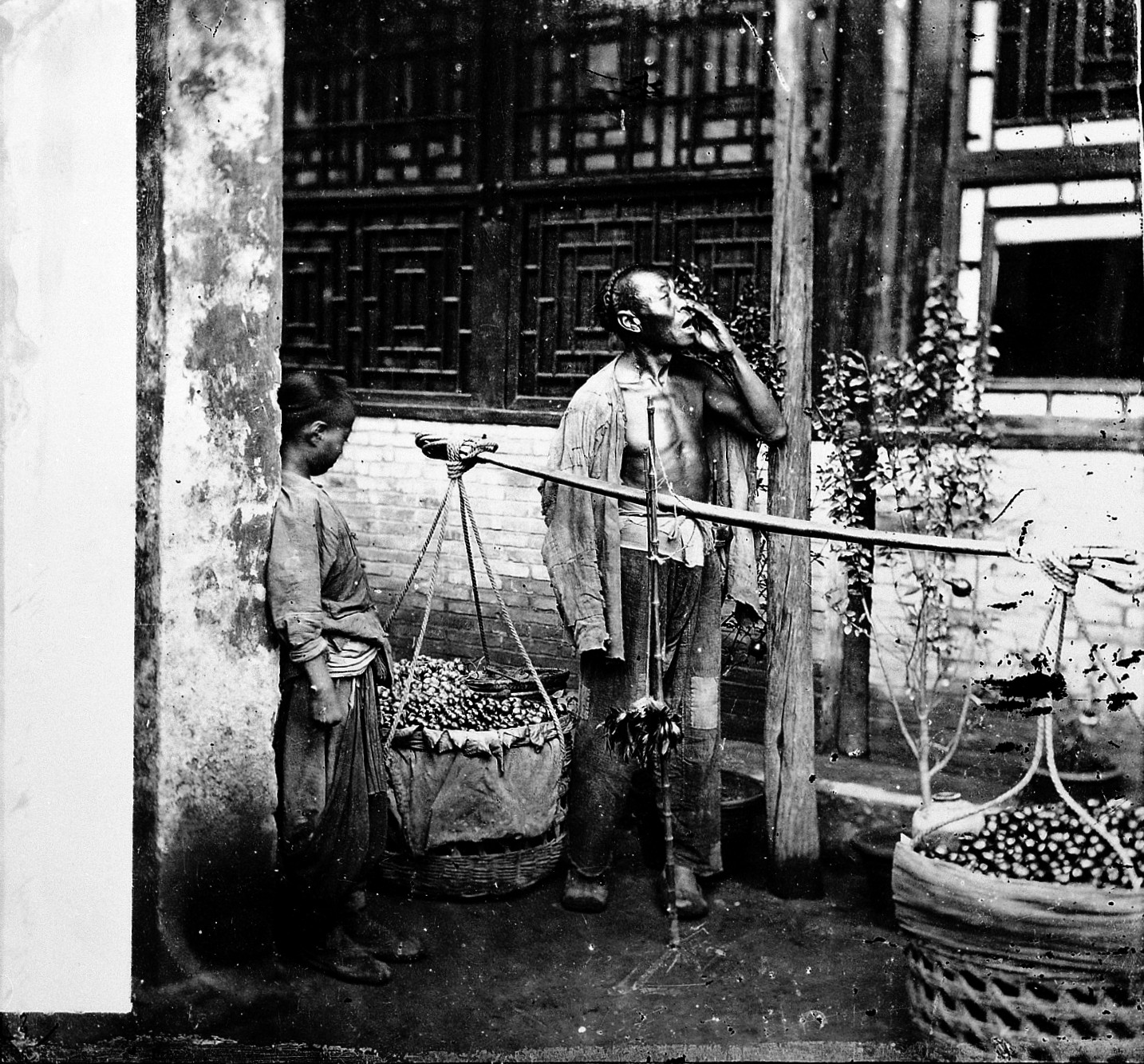
A Peking fruit seller, c. 1869
Peddler in Ho Chi Minh City, Vietnam

A peddler (American English) or pedlar (British English)[a] is a door-to-door and/or travelling vendor of goods. In 19th-century United States the word "drummer" was often used to refer to a peddler or traveling salesman; as exemplified in the popular play Sam'l of Posen; or, The Commercial Drummer by George H. Jessop.[2]

In England, the term was mostly used for travellers hawking goods in the countryside to small towns and villages.

From antiquity, peddlers filled the gaps in the formal market economy by providing consumers with the convenience of door-to-door service. They operated alongside town markets and fairs where they often purchased surplus stocks which were subsequently resold to consumers. Peddlers were able to distribute goods to the more geographically-isolated communities such as those who lived in mountainous regions of Europe. They also called on consumers who, for whatever reason, found it difficult to attend town markets. Thus, peddlers played an important role in linking these consumers and regions to wider trade routes. Some peddlers worked as agents or travelling salesmen for larger manufacturers and so were the precursor to the modern travelling salesman.

Images of peddlers feature in literature and art from as early as the 12th century. Such images were very popular with the genre and Orientalist painters and photographers of the 18th and the 19th centuries. Some imagery depicts peddlers in a pejorative manner, and others portray idealised romantic visions of peddlers at work.

Etymology and definitions

[edit]
Three East Karelian "laukkuryssä"[3] peddlers from Kestenga, Russia in Lohja, Finland in the late 19th century.

The origin of the word, known in English since 1225, is uncertain, but is possibly an Anglicised version of the French pied, Latin pes, pedis "foot", referring to a petty trader travelling on foot.

A peddler, under English law, is defined as: "any hawker, pedlar, petty chapman, tinker, caster of metals, mender of chairs, or other person who, without any horse or other beast bearing or drawing burden, travels and trades on foot and goes from town to town or to other men's houses, carrying to sell or exposing for sale any goods, wares, or merchandise immediately to be delivered, or selling or offering for sale his skill in handicraft."[4][5] The main distinction between peddlers and other types of street vendor is that peddlers travel as they trade, rather than travel to a fixed place of trade. Peddlers travel around and approach potential customers directly whereas street traders set up a pitch or a stall and wait for customers to approach them. When not actually engaged in selling, peddlers are required to keep moving. Although peddlers may stop to make a sale, they are precluded from setting up a pitch or remaining in the same place for lengthy periods. Although peddlers normally travel by foot, there is no reason why they cannot use some means of assistance, such as a cart or a trolley, to assist in the transportation of goods.

History

[edit]
Ribbon seller at the entrance to the Butter Market, engraving by J.J. Eeckhout, 1884

Peddlers have been known since antiquity. They were known by a variety of names throughout the ages, including Arabber, hawker, chapman (medieval English), huckster, itinerant[7] vendor or street vendor. According to marketing historian, Eric Shaw, the peddler is "perhaps the only substantiated type of retail marketing practice that evolved from Neolithic times to the present."[8] The political philosopher John Stuart Mill wrote that "even before the resources of society permitted the establishment of shops, the supply of [consumer] wants fell universally into the hands of itinerant dealers, the pedlars who might appear once a month, being preferred to the fair, which only returned once a year."[9]

Typically, peddlers operated door-to-door, plied the streets or stationed themselves at the fringes of formal trade venues such as open air markets or fairs. In the Greco-Roman world, open-air markets served urban customers, while peddlers filled in the gaps in distribution by selling to rural or geographically distant customers.[10]

At Khan Al-Tujjar: At the Arab fair, the peddlers open their packages of tempting fabrics; the jeweler is there with his trinkets; the tailor with his ready-made garments; the shoe-maker with his stock, from rough, hairy sandals to yellow and red morocco boots; the farrier is there with his tools, nails, and flat iron shoes, and drives a prosperous business for a few hours; and so does the saddler, with his coarsesacks and his gayly-trimmed cloths.

In the Bible the term 'peddler' was used to describe those who spread the word of God for profit. The book of Corinthians has the following phrase, "For we are not as so many, peddling the word of God" (Corinthians 2:17). The Greek term translated "peddling" referred to small-scale merchants who profited from acting as middlemen between others.[11] The Apocrypha has the following, "A merchant shall hardly keep himself from doing wrong; and an huckster shall not be freed from sin" (Ecclesiasticus 26:29).

In some economies the work of itinerant selling was left to a greater or lesser extent to nomadic minorities, such as gypsies, travellers, or Yeniche who offered a varied assortment of goods and services, both evergreens and (notoriously suspicious) novelties. In 19th-century USA, peddling was often the occupation of immigrant communities including Italians, Greeks and Jews.[12] The more colourful peddlers were those who doubled as performers, healers, or fortune-tellers.[13]

Historically, peddlers used a variety of different transport modes: they travelled by foot, carrying their wares; by means of a person or animal-drawn cart or wagon or used improvised carrying devices. Abram Goodman, who took to peddling in the US in the 1840s, reports that he travelled by foot, used a sleigh when roads were snowbound and also travelled, with his pack, by boat when traversing longer distances.[14]

As market towns flourished in medieval Europe, peddlers found a role operating on the fringes of the formal economy. During this time it was common to see long-distance peddlers, who sold remedies, potions and elixirs.[15] They called directly on homes, delivering produce to the door thereby saving customers time travelling to markets or fairs. However, customers paid a higher price for this convenience. Some peddlers operated out of inns or taverns, where they often acted as an agent rather than a reseller.

Peddlers played an important role providing services to geographically isolated districts, such as in the mountainous regions of Europe, thereby linking these districts with wider trading routes.[16]

A 16th-century commentator wrote of the:

many pedlars and chapmen, that from fair to fair, from markett to markett, carieth it to sell in horspakks and fote pakks, in basketts and budgelts, sitting on holydays and sondais in chirche porchis and abbeys dayly to sell all such trifells.[17]

By the 18th-century, some peddlers worked for industrial producers, where they acted as a type of travelling sales representative. In England, these peddlers were known as "Manchester men." Employed by a factory or entrepreneur, they sold goods from shop to shop rather than door to door and were thus operating as a type of wholesaler or distribution intermediary.[18] They were the precursors to the modern sales representative. An attempt by Pitt the Younger in 1785 to buy off opposition to a tax on shopkeepers almost led to peddlers in England being banned. Moreover, anti-semitism in eighteenth and nineteenth century England led to negative images of Jewish peddlers. [19]

Fruit peddlers with draft horses and covered wagon, Saint Paul, Minnesota, c. 1928
Fanciful drawing by Marguerite Martyn in the St. Louis Post-Dispatch of October 21, 1906, featuring the image of a travelling salesman of lightning rods, in the striped suit

In the United States, there was an upsurge in the number of peddlers in the late 18th century and this may have peaked in the decades just before the American Civil War.[20] However, their numbers began to decline by the 19th century. Advances in industrial mass production and freight transportation as a result of the war laid the groundwork for the beginnings of modern retail and distribution networks, which gradually eroded much of the need for travelling salesmen. The rise of popular Mail order catalogues (e.g. Montgomery Ward began in 1872) offered another way for people in rural or other remote areas to obtain items not readily available in local stores or markets. A relatively short-lived upsurge in the number of peddlers was witnessed in the period following the Second World War, when the wartime manufacturing boom came to an abrupt end, and returning soldiers finding themselves unable to secure suitable work, turned to peddling which generally offered a decent income.[21]

In the United States the travelling salesman became a stock character in countless jokes. Such jokes are typically bawdy, and usually feature small town rubes, farmers and other country folk, and frequently another stock character, the farmer's daughter.[22]

Throughout much of Europe, suspicions of dishonest or petty criminal activity was long associated with peddlers and travellers.[23][24] Regulations to discourage small-scale retailing by hawkers and peddlers, promulgated by English authorities in the 15th and 16th centuries and reinforced by the Church, did much to encourage stereotypical and negative attitudes towards peddlers. From the 16th century, peddlers were often associated with pejorative perceptions, many of which persisted until well into the 19th and 20th centuries.[25]

In the modern economy a new breed of peddler, generally encouraged to dress respectably to inspire confidence with the general public, has been sent into the field as an aggressive form of direct marketing by companies pushing their specific products, sometimes to help launch novelties, sometimes on a permanent basis. In a few cases this has even been used as the core of a business.

Life of a peddler

[edit]
Belgian milk peddlers with a dog-drawn cart, c. 1890–1900

Very few peddlers left written records. Many were illiterate and diaries are rare.[26] Most peddlers handled cash transactions leaving behind few or no accounting records such as receipts, invoices or day-books. However, a very small number of peddlers kept diaries and these can be used to provide an insight into the daily life of a peddler. Ephraim Lisitzky (1885–1962), an immigrant from Russia, arrived in the US in 1900 and took up peddling for a brief period following his arrival. His autobiography, published in 1959 under the title, In the Grip of the Cross-Currents, describes his various encounters with householders and the difficulties he experienced making a sale as door after door was slammed in his face.[27]

After arriving in America in 1842, Abram Vossen Goodman also maintained a diary of his experiences, which has been published by the American Jewish Archives.[14] Excerpts from the diary detail his experiences and thoughts about the life of a peddler. When Goodman's initial attempts to find employment as a clerk were unsuccessful, he wrote on September 29, "I had to do as all the others; with a bundle on my back I had to go out into the country, peddling various articles." (p. 95) In the first few weeks, he found the lifestyle onerous, uncertain and solitary.

"Can a man, in fact, be said to be "living" as he plods through the vast, remote country, uncertain even as to which farmer will provide him shelter for the coming night? In such an existence the single man gets along far better than the father of a family. Such fools as are married not only suffer themselves, but bring suffering to their women. How must an educated woman feel when, after a brief stay at home, her supporter and shelterer leaves with his pack on his back, not knowing where he will find lodging on the next night or the night after?" (p.96)
"Last week in the vicinity of Plymouth I met two peddlers, Lehman and Marx. Marx knew me from Furth, and that night we stayed together at a farmer's house. After supper we started singing, and I sat at the fireplace, thinking of all my past and of my family." (p.100)
[By October,1842 Goodman is travelling with a brother] "Not far from [Lunenburg] we were forced to stop on Wednesday because of the heavy snow. We sought to spend the night with a cooper, a Mr. Spaulding, but his wife did not wish to take us in. She was afraid of strangers, she might not sleep well; we should go our way. And outside there raged the worst blizzard I have ever seen... After we had talked to this woman for half an hour, after repeatedly pointing out that to turn us forth into the blizzard would be sinful, we were allowed to stay." (p.101)
"On Monday morning, December 5th, we set out for Groton in a sleigh and at night stayed with an old farmer, about two miles from that place. It was a very satisfactory business day, and we took in about fifteen dollars... After spending Wednesday in Milford, we traveled beyond on Thursday and Friday, spending Saturday at Amherst and Sunday at the home of Mr. Kendall in Mount Vernon. Business, thanks be to God, is satisfactory, and this week we took in more than forty-five dollars. (p. 103)
"It is hard, very hard indeed, to make a living this way. Sweat runs down my body in great drops and my back seems to be breaking, but I cannot stop; I must go on and on, however far my way lies...Times are bad; everywhere there is no money. This increases the hardship of life so that I am sometimes tempted to return to New York and to start all over again. (pp 107-108)

Modes of transport

[edit]

Today, peddlers continue to travel by foot. However, they also use bicycle, hand-held carts, horse-drawn carts or drays and motorized vehicles such as motor-bikes as transport modes. To carry their wares, peddlers use purpose-built back-packs, barrows, hand-carts or improvised carrying baskets. Rickshaw peddlers are a relatively common sight across Asia.

Legislation and regulation

[edit]

A number of countries have enacted laws to protect the rights of peddlers, and also to protect the public from the sale of inferior goods. In many states of the US, peddlers are required to apply for a license.[28] India has special laws enacted by the efforts of planners which give mongers more rights than other businessmen. For example, mongers have a right of way over motorized vehicles.

In Britain, peddling is still governed by the Pedlars Act 1871, which provides for a "pedlar's certificate". Application is usually made to the police. In the late 20th century, the use of such certificates became rare as other civic legislation including the Civic Government (Scotland) Act 1982 and the Local Government (Miscellaneous Provisions) Act, 1982 for England and Wales introduced a street trader's licence. As of 2008, the pedlar's certificates remain legal and in use, although several local councils have sought to eradicate peddlers by way of local bylaws or enforcement mechanisms such as making them apply for a street trader's licence.

Types and names

[edit]
A typical door-to-door vendor in rural Zhangpu County, Fujian, China.
A peddler woman in Nishapur.
Peddlers in the street, Boston, c. 1915
Peddling fruit, Turkey, 1872-1885

Literal compounds formed from these synonyms are:

Metaphoric compounds, since the 16th century mostly pejorative, formed from these synonyms are:

Names, most archaic, of product- or industry-specific types of peddlers include:

Names, some pejorative, of other sub- or supertypes or close relatives of peddlers include:

Individual peddlers (of myth and history)

Although there are basic similarities between the activities in the Old World and the New World, there are also significant differences. In Britain, the word was more specific to an individual selling small items of household goods from door to door. It was not usually applied to Gypsies.

  • Food traders were normally badgers
  • Sellers of chapbooks were chapmen; compare the term stationer which described a bookseller (usually near a university) whose shop was fixed and permanent.
  • In Russia a Khodebshchik (Russian: ходебщик) was a person carrying a billboard advertising a product or service, a street hawker or peddler of wares, or house-to-house salesman in the 16th–19th centuries.

In literature and art

[edit]
The Wayfarer by Hieronymous Bosch, c. 1500

Peddlers have been the subject of numerous paintings, sketches and watercolours in both Western art and in the Orient, where they depict familiar scenes of everyday life. Some of the earliest paintings of peddlers were made in China. The 12th-century Chinese artist, Su Hanchen made several paintings of peddlers as did one of his contemporaries, Li Song, both of whom painted The Knick knack Peddler.

The Wayfarer by Hieronymous Bosch is perhaps the most iconic image of a peddler. Painted in about 1500, the peddler in this painting wears a costume almost identical to thieves in other Bosch paintings.[31] From the 18th-century, engravings featuring peddlers and street vendors featured in numerous volumes dedicated to representations of street life.[32] One of the first of such publications was a French publication, Etudes Prises Dans let Bas Peuple, Ou Les Cris de Paris (1737) (roughly translated as Studies Taken of the Lower People, Or The Cries of Paris).[33] In 1757, the first English publication in this genre was The Cries of London Calculated to Entertain the Minds of Old and Young; illustrated in variety of copper plates neatly engrav'd with an emblematical description of each subject, was published.[34] and followed by Cries of London (1775)[35] These were followed by numerous illustrated works which continued into the 20th century.

Bonnie Young has pointed out that the theme of the monkey and the peddler was relatively common in Medieval art across Europe. These scenes, which appear in books and on silverware, often depict bands of monkeys robbing the peddler while he sleeps. Such images may have been popular in medieval society because the peddler shared many of the same vices as a monkey; he was seen as "a showman, a bit of a trickster and not always acquiring his wares by honest means and plying them without too much regard for the quality of the merchandise."[36]

The Cheap Jack stereotype appears often in 19th-century literature. The most famous example is probably Charles Dickens' "Doctor Marigold". It is a short story originally written for one of his Christmas editions of All the Year Round. In collected editions of Dickens' works, it appears in the volume Christmas Stories.

Russian lubok prints (popular prints) also feature peddlers along with other popular stereotypes. Some scholars suggest that the origin of the term, lubok, may have come from the word lubki - a type of basket typically carried by peddlers as they carried a myriad of different wares into villages in old Russia.[37] Korobeiniki is a Russian folk song that describes a meeting between a peddler and a girl. Their haggling is a metaphor for their courtship.

The Lady and the Peddler, (1947) is an American play by Yosefa Even Shoshan and adapted from a story by S.Y. Agnon. The plot concerns a Jewish peddler who takes up residence with a mysterious gentile woman. Residing in a forest setting, the situation is idyllic for the travelling salesman, as the woman provides for all his needs and never asks for anything in return. Soon, however, he comes to realise that the woman is an evil spirit in disguise. The story is thought to be a metaphor for the dislocation and destruction of European Jews.[38] St Patrick and the Peddler by Margaret Hodges is a novel about a peddler who is visited by St Patrick in his dreams and through a circuitous route uncovers great riches.

Death of a Salesman (1949) is a 1949 stage play written by the American playwright Arthur Miller. Set in late 1940s Brooklyn, a traveling salesman, Willy Loman realizes he has been a failure as a father and a husband. His sons, Happy and Biff, are not successful, on his terms (being "well-liked") or any others. His career fading, Willy escapes into dreamy reminiscences of an idealized past.[39]

Robin Hood and the Peddler is a ballad that now forms part of the collection at the American Folklife Center, Library of Congress.[40]

The Merchant of Four Seasons (1972) is a critically acclaimed film about a German fruit-peddler, directed by Rainer Werner Fassbinder.[41]

The Tin Men (1987), a feature film directed by Barry Levinson and starring Richard Dreyfuss and Danny De Vito, is a comedy set in 1963, concerning two aluminium salesmen and the dirty tricks they use to make a sale as they try to out-compete each other.

See also

[edit]

Notes

[edit]

References

[edit]

Bibliography

[edit]

Further reading

[edit]
Revisions and contributorsEdit on WikipediaRead on Wikipedia
from Grokipedia
A is an itinerant who sells small goods or merchandise directly to consumers by traveling , along streets, or to rural households, typically without a permanent retail location. The term derives from pedlere, an alteration of peddere, likely linked to Latin pes ("foot"), reflecting the practice of going on foot to hawk wares. Historically, peddlers emerged in antiquity as essential intermediaries in economies lacking widespread fixed markets, transporting goods like tools, fabrics, and to isolated consumers and buying local surplus for resale. In pre-industrial settings, they bridged urban production centers and rural demand, fostering commerce through mobility and personal negotiation, often using packs, carts, or animals for transport. This trade form persisted into the 19th and early 20th centuries, particularly in rural America and , where peddlers distributed notions such as tinware and clocks, laying groundwork for larger merchandising enterprises. Peddling's economic significance lay in its adaptability to sparse populations and underdeveloped , enabling where formal retail was infeasible, though it faced periodic regulations to curb perceived or with settled traders. Many successful industrialists, including founders, began as peddlers, underscoring the profession's role as an entry point for entrepreneurial ascent in capitalist systems. In modern contexts, peddling evolved into regulated street vending and informal markets, retaining vitality in developing economies for affordable goods distribution.

Terminology and Origins

Etymology

The English term "peddler," also spelled "pedlar" or "pedler" in historical variants, first appears in as "pedlere" or "peddere" around the late 14th century, denoting an itinerant seller of small wares who travels on foot. This derives primarily from pedarius, meaning "one who goes on foot," itself from the Latin pes (genitive pedis), "foot," highlighting the pedestrian nature of the in an era before widespread mechanized . An influencing or parallel etymological strand traces to pedde or ped, referring to a or used for carrying goods, which by the reinforced the of a "basket-bearer" hawking items or at markets. The "to peddle," emerging around 1530 as a from the noun, similarly evokes retailing in small quantities while traveling. While the foot-derived origin predominates in linguistic scholarship, the association underscores the practical tools of the , with no consensus on a single definitive root due to the term's amid regional dialects and . A peddler is an itinerant seller who travels from to , carrying small or merchandise for direct sale to consumers, typically approaching potential buyers or in public spaces without establishing a fixed pitch or . This mobility distinguishes peddlers from stationary merchants or shopkeepers, who operate from permanent premises and rely on customers visiting them rather than the seller seeking out sales opportunities. Peddlers historically transported wares via foot, pack animals, carts, or early vehicles, emphasizing personal solicitation and immediate transactions over advertised displays. Peddlers differ from hawkers, who also sell mobile goods but primarily attract customers through loud vocal announcements or calls while moving through streets or markets, often without the same emphasis on individual approaches. In contrast, vendors encompass a broader category of sellers, including those with semi-fixed street stalls or carts who wait for passersby rather than actively pursuing itinerant sales. Street sellers, a of vendors, typically maintain a consistent on thoroughfares, such as sidewalks or markets, and do not traverse territories to initiate sales. Further distinctions arise with transient merchants, who set up temporary booths or displays for short-term vending at events or fairs but lack the ongoing peripatetic nature of peddlers, who prioritize continuous travel without fixed setups. Unlike solicitors, who may canvass to promote future orders or services without immediate delivery of physical goods, peddlers focus on on-the-spot exchanges of tangible items. These boundaries, while sometimes overlapping in practice, reflect peddlers' core reliance on personal mobility and direct as a low-capital entry to , often in underserved rural or remote areas.

Historical Evolution

Ancient and Medieval Foundations

In ancient during the Old Babylonian Period (c. 1894–1595 BCE), peddlers served as itinerant traders who transported goods between rural areas and urban centers, facilitating the exchange of domestic foodstuffs and foreign items such as metals and textiles, thereby laying the groundwork for a broader commercial system. Legal records indicate interest in their transactions, reflecting their integration into economic activities despite societal suspicion arising from their mobility and indeterminate origins. Evidence from , dating back to the 8th century BCE as attested in Homeric and Hesiodic texts, shows small-scale peddlers engaging in house-to-house sales of wares, supplementing fixed markets and enabling retail access in less centralized settings. In , traders—functionally akin to peddlers—carried high-value goods like and across regions, leveraging the country's wealth to connect local producers with distant consumers via riverine and overland routes. By the Roman era, hawkers and pedlars formed an essential component of urban retail, operating alongside monumental shops to distribute everyday goods through street vending, as evidenced by literary descriptions, archaeological finds from sites like Pompeii, and pictorial representations. These itinerants hawked food and small items or in public spaces, persisting despite regulatory efforts to organize commerce and filling distributional gaps in densely populated cities where fixed outlets could not fully serve transient or low-mobility populations. In medieval Europe, following the fragmentation of Roman trade networks after the CE, itinerant peddlers reemerged as key distributors of minor goods such as pins, needles, and secondhand items, traveling between villages and markets to supply rural households isolated by feudal manorial systems. Prior to the rise of urban s in the 11th–12th centuries, which monopolized staple goods in towns, these peddlers personally handled transactions across regions, bridging local surpluses with deficiencies and stimulating micro-level exchange where fixed was sparse. Their role extended to circulating used and tools from the 13th century onward, coexisting with emerging secondhand dealers and adapting to periodic fairs while evading restrictions through mobility. This decentralized approach ensured consumer access in agrarian economies, though peddlers often faced suspicion as outsiders, mirroring ancient patterns of wariness toward transients.

Early Modern Expansion and Innovations

During the , peddlers and hawkers expanded significantly across , filling gaps in retail networks amid growing populations, , and . Street sellers became ubiquitous in cities and rural areas, distributing foodstuffs, textiles, accessories, wooden utensils, and to consumers underserved by fixed shops, particularly the urban poor and countryside households. In , chapmen— itinerant dealers carrying packs—proliferated from the , traveling routes to sell small wares and stimulate local commerce, often operating semi-independently from controls.) This growth accelerated after economic disruptions, such as the (1618–1648), which increased vending in places like , and further in the with seasonal migrations by family networks from regions like the and Sauerland. A key innovation emerged with the dissemination of printed materials, as peddlers adapted the new technology of the to hawk cheap pamphlets, broadsides, and images. In , where printing began in the 1460s, and in the 1470s, itinerant sellers operated from the late , peaking in the 1560s–1580s by combining sales with oral performances and street theater to reach illiterate audiences, thus bridging oral traditions and emerging . This not only expanded access to literature and news beyond urban elites but also evaded some restrictions by avoiding fixed premises, though authorities imposed regulations post-Counter-Reformation to curb unlicensed dissemination. Chapmen across similarly peddled books and ballads, channeling cultural and commercial exchanges along trade routes from to . The expansion extended to the Atlantic world through colonial trade, where itinerant peddlers facilitated the flow of goods in nascent markets. In 18th-century , Yankee peddlers from , such as those trading tinware from , traversed rural frontiers and southern regions, selling "Yankee notions" like pins, ribbons, and hardware directly to households, bypassing local merchants and fostering early consumer habits. These traders, often young and enterprising, operated from the late onward, leveraging family ties and pack transport to distribute imported and domestic items, contributing to despite legal challenges from established retailers. Overall, peddlers' adaptability—through diversified goods, informal networks, and hybrid sales methods—underpinned their role in pre-industrial distribution, even as guilds and licenses, like those eased in mid-18th-century , sought to formalize their operations.

Industrial and 19th-Century Transformations

The Industrial Revolution, commencing in the late 18th century and accelerating into the 19th, significantly expanded manufacturing capacity in regions like New England, enabling peddlers to distribute a wider array of factory-produced goods such as tinware, clocks, and brass items to rural and southern markets previously underserved by fixed retail outlets. In the United States, Yankee peddlers—often young men from Connecticut—emerged as pivotal agents in this market expansion, carrying packs initially but transitioning to wagons by the early 1800s to transport heavier loads over improved roads and into frontier areas, thereby fostering consumer access and capitalist integration in isolated communities. This shift reflected causal dynamics of increased production outpacing local distribution infrastructure, with peddlers serving as intermediaries who accepted barter and demonstrated products in homes, adapting sales practices to build demand for industrialized wares. By the mid-19th century, peddling transformed further amid and infrastructural advancements like canals and early railroads, which indirectly supported peddlers by facilitating bulk supply to urban depots from which they restocked, while from emerging stores began eroding their dominance in accessible areas. In Britain and , Victorian-era hawkers and costermongers persisted in urban streets, vending perishable goods from barrows amid factory-driven abundance, but faced regulatory scrutiny and displacement by formalized markets as industrial output favored wholesale channels over itinerant trade. Empirical records indicate that in the American South, peddlers' annual circuits—spanning thousands of miles—introduced novelty items like graters, peaking around 1820-1840 before rail networks reduced their necessity in some locales, yet their role in cultural exchange and economic penetration endured. These adaptations underscored peddlers' resilience, as they specialized in personalization and extension—practices less viable for static retailers—while innovations in portable goods packaging allowed for diversified inventories including textiles and hardware, bridging the gap between and fragmented consumer bases until late-century retail consolidation. In quantitative terms, Connecticut's clock and sectors relied on peddler networks to achieve national penetration, with estimates suggesting thousands of such itinerants active by , transforming sporadic rural trade into a proto-modern distribution .

20th-Century Decline in Industrialized Nations and Persistence Elsewhere

In the United States, itinerant peddling, particularly pushcart vending, reached its zenith in urban centers like New York City during the early 20th century, with licensed pushcart peddlers numbering around 6,747 in 1904 and approximately 9,000 by 1903, concentrated heavily on the Lower East Side. This form of trade began to wane amid rising municipal regulations aimed at alleviating traffic congestion, improving sanitation, and favoring fixed retail establishments. By the 1930s, Mayor Fiorello La Guardia's administration aggressively curtailed street vending, culminating in the 1940 establishment of indoor markets such as Essex Street Market to consolidate and control what had been dispersed open-air operations. Comparable declines manifested in other American locales; in , peddler licenses issued plummeted from 383 in 1893 to 62 by 1908, with urban peddling effectively eradicated by the 1940s. Contributing factors included escalating local ordinances restricting vending zones and permit issuance, alongside shifts in consumer behavior driven by mail-order catalogs, household refrigeration enabling bulk purchases, and the proliferation of chain stores offering greater variety and stability. The advent of , exemplified by the opening of the first grocery in 1916 and widespread adoption post-1930, further eroded demand for door-to-door and ambulatory sellers by centralizing distribution and undercutting prices through . European industrialized nations experienced parallel trajectories, where post-World War I , automotive diffusion, and laws supplanted ambulatory with structured retail infrastructures. Fixed merchants and guilds historically opposed peddlers, but 20th-century advancements in and decisively marginalized them, rendering peddling vestigial by mid-century in favor of department stores and hypermarkets. Conversely, in developing regions across , , and , peddling endured as a resilient economic mainstay throughout the , accommodating rural-to-urban migrants amid persistent , limited formal , and inadequate retail penetration. Street vending's informality provided low-barrier entry for the underemployed, filling voids left by infrastructural deficits and supporting urban ; for instance, in , traditional markets retained dominance despite supermarket incursions, sustaining vendor livelihoods through localized supply chains. By the late , such trades comprised significant shares of non-agricultural informal economies, exemplified by Thailand's 42% informal rate in 2010, reflective of broader patterns originating earlier in the century. Regulatory tolerance, often pragmatic given pressures, perpetuated this persistence, contrasting sharply with the formalized economies of the industrialized West.

Economic Functions

Filling Market Gaps and Entrepreneurial Role

Peddlers address market gaps in regions characterized by low population densities, underdeveloped transportation, and sparse fixed retail , delivering goods directly to isolated households and thereby reducing search and travel costs for buyers. In such environments, fixed stores often prove unviable due to insufficient volume to cover overheads, whereas peddlers leverage mobility to aggregate dispersed small-scale demands, effectively lowering distribution inefficiencies. This function proved critical in and colonial frontiers, where peddlers supplied rural areas with essentials like textiles and tools, connecting peripheral economies to urban supply chains. In the antebellum , peddlers exemplified this role by penetrating Southern markets underserved by formal trade networks hampered by poor roads and banking systems, distributing New England-manufactured items such as clocks and tinware from the onward. For instance, in 1838, clockmaker Seth Wheeler dispatched six peddlers to , where they sold 468 units, capitalizing on local demand for affordable timepieces amid limited local production. Such operations extracted significant value—Southern counties like those in reportedly lost $300,000 in cash outflows to peddlers by 1806—highlighting how itinerant trade funneled goods and capital across regional divides. Entrepreneurially, peddlers embody low-barrier entry into , requiring minimal and enabling rapid pivots to local preferences through on-the-ground assessment of needs, akin to modern market testing. They innovated sales practices, such as extending to build and achieving markups of up to 2,000% on items like clocks (production cost $2.50–$5, resale $100–$144), while training young agents—often in their mid-20s—fostered scalable operations that prefigured mass-marketing techniques. This risk-taking agility allowed peddlers to thrive amid uncertainty, serving as de facto market makers who validated product viability before larger firms could establish dominance.

Contributions to Innovation and Consumer Access

Peddlers enhanced consumer access by bridging urban production centers with rural and remote populations, delivering goods directly to households where fixed retail infrastructure was absent or impractical. In early America, peddlers from , active from the mid-18th century through the early , transported manufactured items such as tinware and textiles southward to the Appalachian frontier and plantation districts, enabling farm families to acquire products without long-distance travel. This itinerant model filled distributional gaps in underdeveloped economies, where sparse populations and poor roads limited store-based trade, thereby stimulating demand and integrating isolated markets into national commerce. Their role extended to introducing novel consumer goods, such as affordable wooden clocks in the early , which rural buyers encountered for the first time through peddler demonstrations, shifting household routines toward regimented timekeeping and fostering broader adoption of manufactured items. Peddlers acted as informal market testers, gauging preferences for emerging products like patented clockworks from factories, which provided manufacturers with real-time feedback to refine designs and scale production. In , itinerant sellers from at least the conveyed urban specialties—ranging from textiles to tools—to countryside dwellers, expanding product variety beyond local systems and accelerating the diffusion of trade goods. Innovations in peddling practices further advanced commercial efficiency, including adaptive pricing, verbal persuasion techniques, and rudimentary credit extensions tailored to buyers' cash flows, which prefigured elements of modern and installment sales. Numerous peddlers ascended to mercantile prominence—such as those who established wholesale networks—transferring into formalized retail operations that supported industrial expansion. By circumventing guild restrictions and local monopolies, they promoted competitive distribution, ultimately contributing to the transition from subsistence economies to consumer-driven markets in regions like the American South and rural .

Empirical Advantages and Real-World Impacts

Peddlers and analogous street vendors deliver empirical economic benefits by enabling low-capital entrepreneurship and absorbing labor in informal markets, particularly where formal employment is scarce. In low- and middle-income countries, the informal economy encompassing vending constitutes 35% of GDP on average, versus 15% in advanced economies, underscoring its role in sustaining output amid structural constraints. Globally, informal activities contribute roughly 40% to world GDP and account for two-thirds of employment, providing essential income stability for vulnerable populations including migrants and the unskilled. A primary advantage lies in enhanced access to affordable for underserved consumers, filling gaps left by fixed retail in remote or impoverished areas. Vendors supply low-priced essentials to millions in developing regions who cannot afford formal stores, acting as a vital conduit for daily necessities and averting reliance on costlier alternatives. This mechanism supports alleviation by maintaining economic and spatial availability of items, including nutritious foods, where elimination of vending would impose hardships on dependent households. Real-world impacts include unemployment mitigation and social inclusion, with vending's flexibility fostering for marginalized groups like women and youth in emerging markets. In urban contexts such as as of 2024, vendors function as independent small enterprises, generating significant local economic activity and livelihoods for immigrant communities otherwise excluded from regulated sectors. Historically, in underdeveloped settings, itinerant peddling has driven regional growth by disseminating goods to isolated locales, reducing transaction costs and stimulating demand without prerequisites.

Operational Realities

Goods Traded and Sales Practices

Peddlers traded a diverse array of portable consumer goods, prioritizing items that were lightweight, durable, and in demand among rural or underserved populations. In early America from the mid-1600s to the late 1800s, common wares included , textiles, tools, and domestic necessities sourced from urban wholesalers. Yankee peddlers in the often transported , hats, boots, shoes, clocks, firearms, hardware, and even furniture via large wagons to reach remote southern consumers. Specialized tin peddlers carried items such as candlesticks, pans, and lamps, which they sold or traded while scrap metal from customers. Perishable goods like fruits, , and fresh were prevalent among urban or short-route peddlers, who sourced surplus from markets and resold it or from barrows to exploit daily demand. In regions like 19th-century Britain and colonial America, additional offerings encompassed spices, pins, buttons, cloth, , ironware, glassware, and books, often imported from and adapted to local needs. This assortment reflected peddlers' role in bridging supply chains, carrying high-value, low-bulk items that fixed retailers overlooked due to transportation costs. Sales practices centered on direct, personal engagement, with peddlers traversing routes on foot—packs slung over front and back—or by , calling at households to pitch wares. They demonstrated products through informal shows, bartered for eggs, , or scrap, and occasionally extended to build repeat , fostering trust in isolated areas. Encounters were opportunistic, with peddlers adapting pitches to responses and altering paths based on demand signals, though some accounts note occasional deceptions like inferior , heightening buyer caution. In , this itinerant model undercut stationary merchants by delivering variety without fixed overhead, though it invited regulatory scrutiny over quality and competition.

Transportation and Logistics Evolution

Peddlers initially transported goods on foot, using packs or baskets to carry limited quantities over short distances, as seen in early colonial American practices where sellers like the Pattinson brothers in Connecticut walked to nearby settlements in the late 18th century. This method constrained inventory to lightweight, high-value items and restricted routes to pedestrian-accessible paths, often within a day's travel. By the early 19th century, the introduction of pack animals marked a significant advancement, enabling peddlers in to affix baskets to horses for extended reach into rural interiors, expanding from local to regional circuits of dozens of villages. Horse-drawn carts and wagons further revolutionized logistics in the mid-19th century, allowing carriers of bulkier wares like tinware and hardware to remote homesteads, with stocked for multi-week itineraries and capable of navigating unpaved roads. These evolutions supported seasonal migration patterns, where peddlers synchronized travel with fairs and harvest cycles to optimize supply chains from urban manufacturers to isolated consumers. The late 19th century saw bicycles emerge as a efficient alternative, particularly for European itinerants; Breton Onion Johnnies, starting in the 1820s on foot, adopted cycles by the 1890s to haul strings of onions across Britain, replacing handcarts and extending daily ranges while reducing animal maintenance costs. In the 20th century, motorized vehicles briefly augmented peddling in industrialized regions before fixed retail dominance curtailed it, though bicycles and hand-pushed carts persisted in developing economies for agile, low-overhead distribution. Logistically, these transport shifts facilitated tighter integration with wholesale networks, as wagons permitted larger upfront purchases on from suppliers, mitigating risks through diversified routes and return in farm goods, a practice evident in 19th-century American peddling operations. Overall, progression from human-powered to animal- and mechanized means enhanced peddlers' role in bridging urban production with rural demand, adapting to infrastructural improvements like improved roads while preserving flexibility absent in stationary commerce.

Daily Routines, Risks, and Adaptations

Peddlers typically commenced their days early, loading packs, carts, or wagons with goods such as textiles, tinware, and trinkets before embarking on established routes covering thousands of miles annually across rural and areas. They traversed short, recurrent paths on foot, often carrying loads exceeding 100 pounds through varied terrains and conditions, calling at households to demonstrate wares and negotiate sales. In urban settings like Republican-era , itinerant sellers followed alleys from dawn—sometimes as early as 4 a.m.—using vocal calls, songs, or instruments to announce offerings like almond or seasonal fruits until late evening. Sales practices involved transforming customers' front rooms into temporary showrooms, accepting or installment payments to accommodate cash-poor rural buyers, and providing news or entertainment to build rapport. Peddlers encountered substantial risks inherent to their mobile occupation, including and on highways due to carrying cash and valuables, as exemplified by the 1892 killing of Jewish peddler Samuel Tucker in . Physical hazards encompassed exhaustion from heavy loads and long walks in , isolation leading to mental strain or , and early colonial threats like wild animals or hostile encounters on crude roads. Additional dangers included accidents in denser areas and business disruptions from snow or floods, compounded by suspicions of that tarnished the trade's reputation. To mitigate these challenges and economic shifts, peddlers adapted by transitioning from backpacks to horse-drawn wagons by the early , enabling larger inventories and safer transport over improving roads. They specialized in niches like clocks or wholesale supply to emerging shops, diversified seasonally—offering winter or summer repairs—and adhered to religious practices via portable kosher provisions during travels. In response to needs, they fostered trust through repeated visits and respectful interactions across social divides, often evolving into fixed merchants after initial itinerant phases lasting 1-5 years.

Regulatory Landscape

Historical Controls and Guild Conflicts

In medieval Europe, merchant and craft guilds established monopolistic control over urban trade by restricting sales to guild members operating from fixed shops or stalls, often prohibiting itinerant peddling as a form of unfair competition that bypassed membership dues, quality inspections, and price regulations. These guilds, emerging prominently from the 12th century in towns across England, France, and the Low Countries, petitioned local authorities to enforce bans on hawking and door-to-door sales within city limits, arguing that peddlers undercut fixed prices and introduced substandard goods without accountability. Conflicts intensified as guilds leveraged their influence to prosecute violators through internal courts or municipal edicts; for example, in 13th- and 14th-century , statutes against forestalling (intercepting goods before official markets), regrating (reselling in the same market at a markup), and engrossing (cornering supplies for resale) were invoked against peddlers disrupting -managed fairs, with penalties including fines, of wares, or banishment from towns. Such measures, rooted in royal assizes like the Assize of Cloth in 1180 and reinforced by the Statute of in 1285, prioritized stability over broader market access, though enforcement varied by region and economic pressure. By the early modern era, guild opposition persisted amid growing itinerant trade; in 18th-century Dutch cities like The Hague and Arnhem, shopkeepers' guilds documented fines against unauthorized street vendors, including peddlers, totaling hundreds of guilders annually to defend shop-based retail against mobile sellers who evaded overhead costs. In France, guilds until their abolition in March 1791 during the Revolution lobbied against colporteurs (itinerant chapmen), securing royal edicts like those under Louis XIV that required licenses and restricted routes, framing peddlers as economic disruptors despite their role in rural distribution. These regulatory battles highlighted causal tensions between guild-enforced cartels, which stabilized urban crafts but stifled and access, and peddlers' adaptive practices, often sustained by migrants or the impoverished; empirical records from ledgers show prosecutions peaking during slumps, underscoring over consumer welfare.

Contemporary Licensing and Enforcement

In the United States, peddlers and street vendors typically require local or municipal licenses to operate, with requirements varying by jurisdiction to address public safety, zoning compliance, and tax collection. For instance, in cities like Chicago, applicants must submit a full license application accompanied by government-issued photo identification and proof of residential address, while Denver mandates a criminal history form and two forms of identification for non-food peddlers. These licenses often prohibit sales from fixed locations without additional permits and may exclude food vending, which falls under separate health regulations. Enforcement is handled by local agencies, such as the New York City Department of Sanitation, which assumed primary responsibility for street vending violations in April 2023, focusing on sidewalk cleanliness and issuing fines or seizures for unlicensed activity. License caps exacerbate enforcement challenges in high-demand urban areas; New York City, for example, limits food vendor permits, resulting in long waiting lists and thousands of unlicensed operators who face periodic crackdowns by police or sanitation teams, often leading to equipment confiscation and fines up to $1,000. Recent reforms in some locales, such as Washington, D.C.'s 2023 regulations, have lowered permit fees from $200 to $50 annually, decriminalized minor vending offenses, and shifted enforcement from police to licensing departments to reduce barriers for informal vendors. Nationally, peddlers must also comply with state-level rules, like Wisconsin's requirement to carry proof of license issuance while operating, with exemptions sometimes for blind vendors. Globally, licensing frameworks emphasize health standards and urban order, with enforcement often stringent against unlicensed hawking. In , the Food and Environmental Hygiene Department maintains dedicated Hawker Control Teams that target prohibited or cooked food sales by unlicensed operators, contributing to an 84% decline in such activities over the 24 years ending in 2025 through fines and prosecutions. introduced a "Hawker " effective March 1, 2025, mandating license holders to adhere to supervision and sanction protocols for fixed-pitch operations. In , hawker s are restricted to citizens, barring foreigners and prompting enforcement against informal immigrant vending. Developing regions frequently see uneven application, where high licensing costs and bureaucratic hurdles drive vendors underground, resulting in bribery or evictions rather than formal compliance, though policies in places like require registrars to issue certificates only after verifying and location standards.

Debates on Over-Regulation vs. Public Order

Critics of street vending regulations argue that stringent licensing and permit caps impose undue , stifling particularly among low-income and immigrant populations who rely on peddling for initial economic footholds. In , for instance, food vendor permits have been capped at approximately 3,000 since 1981, resulting in waitlists exceeding 20,000 applicants and fostering a for licenses that can cost up to $30,000, far beyond the official fee of $200. This scarcity drives many vendors underground, exacerbating evasion of oversight rather than enhancing public order, as unlicensed operators face fines averaging $1,000 or more per violation without resolving underlying access issues. Proponents of contend that such caps protect brick-and-mortar retailers from perceived unfair —vendors allegedly avoid full taxation and fixed costs—but empirical analyses indicate vendors often incur informal fees to authorities and contribute significantly to urban economies, generating an estimated $3 billion annually in New York alone through sales and employment for over 20,000 individuals. Conversely, advocates for tighter regulation emphasize public order concerns, including , sidewalk overcrowding, and hygiene risks from unregulated food handling, which can undermine urban livability and strain municipal resources. In densely populated areas like New York City's Myrtle-Wyckoff Plaza, unchecked vending has led to complaints of blocked pedestrian access and safety hazards, prompting calls for supervisory licenses costing $500 annually to ensure on-site compliance. Historical precedents echo these tensions: medieval European guilds monopolized retail trades, prosecuting itinerant peddlers as threats to fixed-shop stability and local control, often under pretexts of that masked . Modern studies on informal economies reveal that overly punitive enforcement displaces vendors to less visible areas without curbing activity, potentially increasing risks like foodborne illnesses due to lack of formal training access, though data from global South cities suggest legalized vending zones improve compliance without eliminating the sector. Empirical evidence leans toward moderated regulation yielding net benefits, as blanket prohibitions fail to account for vending's role in filling market gaps in underserved neighborhoods, where fixed establishments are scarce. Research from organizations tracking informal labor indicates that vendors in regulated yet accessible systems—such as designated markets—generate higher tax revenues and reduce enforcement costs compared to prohibitionist approaches, which cities spend disproportionately on policing without proportional public safety gains. For example, proposals to eliminate New York's permit caps project minimal fiscal strain, with added vendors potentially boosting city revenue through fees and sales taxes while alleviating black-market distortions. However, source biases must be noted: advocacy groups like the Street Vendor Project, while data-driven, represent vendor interests and may underplay order disruptions, whereas municipal reports from bodies like Budget Office provide more neutral fiscal projections grounded in administrative data. Ultimately, suggests over-regulation perpetuates inequality by favoring capital-intensive businesses, whereas targeted rules—focusing on verifiable hazards like —better balance order with economic vitality.

Variations and Typologies

Regional and Cultural Differences

In , peddling emerged as part of extensive itinerant trade networks from the , but by the 17th and 18th centuries, these fragmented into regional operations due to internal market pressures and opposition from sedentary guilds seeking to protect fixed retail monopolies. Northern European peddlers in the late often drew from diverse ethnic groups, supplying rural and urban households with consumer goods while navigating marginal and from established shops. In , Dalkullor—unmarried women from Dalecarlia—capitalized on regional by donning traditional costumes during late-19th-century peddling tours, enhancing marketability through cultural branding. Asian peddling contrasted with European models through its decentralization and integration into everyday urban rhythms, as Asian merchants along pre-colonial Routes operated as small-scale itinerants rather than large chartered entities, fostering flexible, high-volume exchanges of commodities like silk and spices. In Republican-era (1912–1949), peddlers' calls and tunes created distinctive acoustic markers of city neighborhoods, signaling wares like fruits or repairs and embedding the practice in communal soundscapes akin to but distinct from European hawking traditions. Contemporary examples persist in Vietnam's northern hillstations, where ethnic minority women peddle handicrafts to tourists, adapting traditional mobility to modern economies while maintaining reciprocal ethnic-tourist dynamics. In the , peddling facilitated immigrant and prefigured mass distribution; antebellum U.S. itinerants, often from marginalized groups, bridged rural isolation by hawking notions and , evolving into structured sales networks by the mid-. Arab American Syrians, arriving from the late , relied on peddling of textiles and notions, leveraging ties to build retail empires amid cultural challenges. In Colombia's Pacific territories, Afro-descendant Palenquera women have historically peddled sweets via mobile circuits, sustaining livelihoods in underdeveloped frontiers through seasonal migration and informal bartering. These variations reflect broader causal factors: Europe's guild-driven centralization curtailed itinerancy earlier than Asia's persistent decentralized systems, while contexts emphasized peddling's role in frontier expansion and immigrant bootstrapping, often with less entrenched regulatory barriers until intensified enforcement. In underdeveloped regions globally, peddling remains vital for in low-infrastructure areas, underscoring its adaptability to local scarcities over formal retail dominance.

Specialized Peddler Types

Tinkers were itinerant craftsmen specializing in the repair and fabrication of tin and vessels, often traveling with tools to mend pots, pans, and kettles through or riveting. This trade, prominent in Britain and from the medieval period through the , filled a niche for rural households lacking access to fixed smithies, with tinkers typically operating on foot or with pack animals. Knife grinders, also known as scissor or sharpeners, provided mobile sharpening services using portable foot-powered grinding wheels mounted on carts or bicycles, calling out to households in urban and suburban areas. In 19th- and early 20th-century , particularly in Britain and , these peddlers restored edges on , , and tools, a vital service before widespread electric grinders, often working in neighborhoods where housewives summoned them for domestic blades. Rag-and-bone men collected discarded rags, bones, , and other refuse from households, reselling them to industrial processors; rags were pulped for production, while bones were rendered for glue, , or buttons. Originating in medieval and persisting into the , these peddlers typically pushed hand carts through alleys, surviving on marginal daily earnings amid , as bones fetched about 4-6 pence per in the 1850s. In colonial and early American contexts, specialized peddlers included tinware sellers who hawked manufactured goods like lanterns and buckets from packs or wagons, clock peddlers distributing timepieces to homes, and chair makers offering handcrafted wooden seats. These variants, active from the late 18th to mid-19th century, extended market reach into remote areas, bartering goods for farm produce or cash. Chapmen, medieval and early modern itinerants, focused on distributing printed materials such as chapbooks—affordable pamphlets of ballads, almanacs, and tales—alongside small hardware like needles and ribbons, bridging gaps in rural before fixed bookstores dominated. Their role declined with 19th-century advancements and rail distribution, though similar book peddlers persisted in isolated regions into the 1800s.

Cultural Representations

Depictions in Literature and Folklore

In , the "Pedlar of Swaffham" tale, first recorded in 1699, portrays the peddler John Chapman as a humble trader whose dream of beneath leads him on a journey where he overhears a counterpart dreaming of riches in ; returning home, he unearths gold under his own shop, symbolizing fortune's capricious reversal through persistence and . This , rooted in traditions, recurs in variants emphasizing the peddler's itinerant life as a conduit for providence or trickery, with the figure often depicted as unassuming yet rewarded for heeding omens. American folklore casts the Yankee peddler—typically a New Englander hawking tinware, spices, or notions—as a resourceful blending ingenuity with suspicion, evoking both economic opportunity and potential deceit in rural encounters. Washington Irving's 1819 short story "Rip Van Winkle" references such peddlers amid colonial market scenes, portraying them as harbingers of trade and transience in a pre-industrial landscape. These depictions arose from 18th- and 19th-century realities, where peddlers bridged isolated communities but fueled tales of sharp bargaining or swindles, as in games and songs mimicking their haggling patter. In literature, 's 1867 Paul the Peddler exemplifies the rags-to-riches trope, featuring a newsboy and street vendor who rises through honest toil and moral fortitude, reflecting post-Civil War ideals of amid urban poverty. Margaret Hodges' 1993 children's St. Patrick and the Peddler draws on Irish legend, depicting a 5th-century peddler guided by saintly visions to aid famine-struck villagers, underscoring themes of divine intervention in the wanderer's precarious existence. Esphyr Slobodkina's 1938 Caps for Sale humorously anthropomorphizes a cap peddler outwitted by monkeys, illustrating the vulnerabilities of mobile trade in a lighthearted, repetitive suited for young readers. Such portrayals often romanticize the peddler's while acknowledging risks like isolation or , contrasting with guild-era European views of itinerants as disruptive outsiders.

Portrayals in Art, Media, and Modern Narratives

In 19th-century American genre painting, peddlers were frequently portrayed as symbols of itinerant commerce and rural exchange, as seen in Asher B. Durand's The Peddler Displaying his Wares (), which depicts a seller unpacking goods to engage potential buyers in a naturalistic outdoor setting. Similarly, the peddler archetype appeared in works like those evoking salesmanship, often rendered with humorous sympathy to reflect the artist's own experiences of mobility and trade. European art echoed this, with Sir David Wilkie's The Pedlar capturing a bustling 19th-century British street scene where the vendor hawks items amid everyday crowds, emphasizing rather than isolation. Earlier symbolic treatments appear in Hieronymus Bosch's allegorical paintings, where the peddler serves as a for the soul's detachment from material temptations, laden with wares that represent earthly burdens. In 20th-century works, such as the detailed The Knickknack Peddler at the , artists focused on meticulous inventories of trinkets and lively interactions between the and children, highlighting the peddler's role in disseminating novelty . Film and television depictions of peddlers or analogous itinerant sellers tend to emphasize cunning or precarious , aligning with broader portrayals of salespeople as silver-tongued anti-heroes rather than outright villains, though often skeptical of their . Historical cinema, such as period dramas of immigrant life, occasionally features peddlers as entry points to urban economies, but specific examples remain sparse compared to static figures. Contemporary narratives, particularly in journalism and ethnographic accounts, frame street vendors—modern peddler equivalents—as resilient figures in informal economies, navigating climate vulnerabilities and regulatory hurdles while sustaining communities, as in New York City's vendor workforce adapting to environmental shifts. These stories often highlight immigrant determination and entrepreneurial agency amid precarity, countering stigmatization by portraying vendors as essential to urban vitality rather than mere disruptors. Scholarly analyses underscore their role in neoliberal cities, where vendors embody marginalized yet adaptive practices, though media sometimes reinforces moralizing views of disorder.

References

Add your contribution
Related Hubs
User Avatar
No comments yet.