
Immigration Enforcement
View on Wikipedia | This article needs more citations. (August 2016) |
| Immigration Enforcement | |
|---|---|
 | |
| Agency overview | |
| Formed | 1 April, 2012 |
| Preceding agency | |
| Jurisdictional structure | |
| Operations jurisdiction | United Kingdom |
| Specialist jurisdiction | |
| Operational structure | |
| Elected officer responsible |
|
| Agency executive |
|
| Parent agency | Home Office |
| Website | |
| gov | |
Immigration Enforcement (IE) is a law enforcement command within the Home Office, responsible for enforcing immigration law across the United Kingdom.[1] The force was part of the now defunct UK Border Agency from its establishment in 2008 until Home Secretary Theresa May demerged it in March 2012 after severe criticism of the senior management.[2] Immigration Enforcement was formed on 1 March 2012, becoming accountable directly to ministers.
The force's responsibilities include preventing abuse, tracking immigration offenders and increasing compliance with immigration law.[1] Its officers are warranted as immigration officers, holding various powers of arrest and detention. Officers work in the UK and overseas, including inland and at air and sea ports, often in partnership with Border Force.[1]
The work of Immigration Enforcement is monitored by the Independent Chief Inspector of Borders and Immigration.
History
[edit]Former Home Secretary Theresa May announced the abolition of the UK Border Agency on 26 March 2013, with the intention that its work would be returned to the Home Office.[3] The agency's executive agency status was removed and internally it was split into two, with one division responsible for the visa system and other for immigration law enforcement. This was eventually split further into Border Force and Immigration Enforcement, with the two agencies forming two separate commands within the Home Office.[4][5]
Departments
[edit]Immigration Enforcement has a number of internal departments, including Criminal & Financial Investigation (CFI) which is a non-uniformed, investigatory unit much like the Criminal Investigation Department within territorial police forces, responsible for investigating criminality surrounding immigration, such as the production of false documents. IE also has its own Intelligence Department, which is responsible for gathering and disseminating information, as well as other functions. Immigration Enforcement has signed up to the Professionalising Investigations Programme (PIP).
The organisation works closely with other bodies including the police, National Crime Agency, Border Force, UK Visas and Immigration, and the National Document Fraud Unit.
Immigration Compliance and Enforcement (ICE)
[edit]
ICE teams ensure compliance with immigration laws and carry out enforcement where necessary, including tracking down illegal migrants and targeting companies employing workers illegally.[6]
Officers utilise their powers to execute warrants, identify offenders and take them into custody to facilitate their removal from the UK. The majority of raids target commercial premises, where workers can be employed illegally holding no status in the UK. As such, companies found to be employing workers illegally are referred to the CFI and other agencies.
There are 19 ICE teams across the UK.[6]
Criminal and Financial Investigation (CFI)
[edit]The primary role of the unit is to investigate and disrupt serious organised crime groups who are seeking to undermine the UK's immigration controls at the border and inland via various criminal means. These teams are regionally based and are made up of immigration officers and seconded police officers who work in joint investigation teams as part of the Home Office.
CFI Teams originally started in the UK Border Agency as the agency's own investigation teams, covering both immigration investigations and customs investigations, mainly drug seizures, that were not undertaken by the National Crime Agency
Criminal and Financial Investigations (CFI) teams focus on investigating eight main categories of crime which support other work streams. Those categories include:
- Trafficking in human beings (THB) and Modern Slavery Act 2015 offences, this could be trafficking for:
- sexual exploitation
- organ harvesting
- forced labour
- other forms of involuntary servitude
- Facilitation through:
- lorry drops (clandestine entrants)
- marriage abuse
- college abuse
- rogue employers
- producing or supplying counterfeit or forged documents
- other means
- Cash seizures of over £1,000 referred from Immigration Compliance and Enforcement (ICE) teams and others, under the Proceeds of Crime Act 2002.[7]
Officers in CFI, who have the same arrest powers as a police constable under Section 24 of the Police and Criminal Evidence Act, are required to pass the Immigration Enforcement Investigators Exam, similar to the National Investigators Exam in policing but which has been amended to remove some of the policing syllabus and additionally test immigration knowledge, before completing the Initial Crime Investigators Development Programme (ICIDP) [PIP 2]. Once officers have completed their portfolio, they are added to the IE criminal investigators register.
Defunct Units
[edit]Rapid Response Team (RRT)
[edit] |

The RRT was originally set up as a temporary role in 2019 (officers seconded from ICE teams) but was made a substantive department in August 2020 - the team is a nationwide taskforce (covering the whole of the UK) and has no physical office. The team was established to provide IE with a mobile taskforce that was capable of responding to a wide array of incidents and taskings, with a large focus placed on counter-terrorism and detecting immigration offences that would otherwise go unnoticed.
This is a multi-function team of specialist immigration officers that have received additional training and can be sent on a multitude of deployments, including:
- seaport deployments to assist Border Force and police with landing foot/car passengers and checking freight
- airport taskings to assist Border Force and police with security/counter-terrorism operations
- urgent response to critical incidents
- assisting with police / NCA-led operations
- bolstering ICE and CFI teams on residential / business visits
- conducting street operations to intercept high-harm offenders
- executing maritime operations at unmanned small ports
- deploying on cutters / coastal patrol vessels and patrolling the coastline
Officers can be deployed at a moments notice and have been frequently seen in Dover during the "Small Boats Crisis" of 2020/21, alongside the permanently deployed CORT team (see below).
RRT has a PIP1 capacity, allowing the team to prosecute for low-level immigration offences (e.g. entering in breach of a deportation order, possession of false identity documents, etc).
Officers are generally recruited to the RRT from local ICE teams, but can also be recruited from Border Force and other Home Office departments.
Clandestine Operational Response Team (CORT)
[edit]CORT was originally established in early 2020 in response to the increased arrival of small boats (RHIBs) that were setting off from France to the UK, through the English Channel. This team was directly responsible for the operations at both Western Jetfoil in Dover and Manston arrivals and processing centre. Previously, it was also based at Tug Haven but this site closed in January 2022.[8] The team was in charge of processing arrivals, conducting basic checks and arranging for migrants to be transported onwards. CORT also responded to reports of beach landings around the southeast coast, working with Kent Police to intercept those who had landed and fled. In fulfilling their frontline duties, CORT officers received assistance from other areas of Immigration Enforcement, such as Crime and Financial Investigation.[9]
The team was in direct command of all the Border Force and Immigration Enforcement officers deployed to assist them; the Clandestine Threat Command (CTC) was the parent department that was responsible for deploying CORT and other teams such as RRT, GA/GM and ICE.
CORT was disbanded in January 2023 when Border Force took full command of the Small Boats Crisis - the team was replaced with the Small Boats Operational Command (SBOC) which falls under Border Force branding, as there is no longer any Immigration Enforcement involvement.
Powers
[edit] |

Arrest officers are warranted and derive the majority of their powers from the Immigration Act 1971, although some powers are acquired from the Immigration and Asylum Act 1999 and the UK Borders Act 2007, as well as others.
In the vast majority of cases, Immigration Officers will use "administrative powers" under Schedule 2 of the Immigration Act 1971. Said powers include the execution of warrants and the power of arrest, as well as powers to search arrested persons and to search premises for evidence relating to a person's immigration status (passports, visas or plane tickets). These powers are used to start a process of "removing" a person administratively - this is often confused with "deportation", which is a different process entirely. Once an IO has arrested a subject, they must seek authority to detain them and serve paperwork upon them. If and when this is granted, the authority must then be sought to remove the subject back to their country of origin, possibly through an EU nation or via another transit point. This process ensures that no single officer can remove an individual from the United Kingdom without question - the arresting IO must explain and account for their actions before a CIO / HMI will approve detention and removal. In the event of a senior officer making an arrest, he/she must still obtain authority from another senior officer to detain and serve paperwork.
Others include "28" powers (sections 28A, 28B, 28C, etc.) of the Immigration Act 1971, which are similar to those in Schedule 2, but are criminal powers and not administrative. These are rarely used by standard arrest officers, but still form a large part of an IO's powers. These powers are more likely to be used in cases of "high harm" offenders (individuals involved in criminality) and other cases where a subject is likely to face prosecution (repeat offenders, use of forged documents, etc.).
It is an offence to obstruct or assault an IO. Officers can arrest anyone (including British nationals and EU citizens) if they suspect them of committing such an offence. The powers of arrest are contained within Section 28A(5) of the Immigration Act 1971 and Section 23(1) of the UK Borders Act 2007 respectively.
Since 2013, CFI officers were designated with additional powers to a typical Immigration Officer. These were introduced to increase accountability, and reduce confusion during multi-agency working. These powers were added under Police and Criminal Evidence Order (Application to Immigration Officers) 2013. These powers can only be executed for criminal investigations, and by specially trained and designated officers. The PACE order 2013 affords Criminal Investigators the same powers as a constable in relation to arrest, entry and search.
Uniform and rank insignia
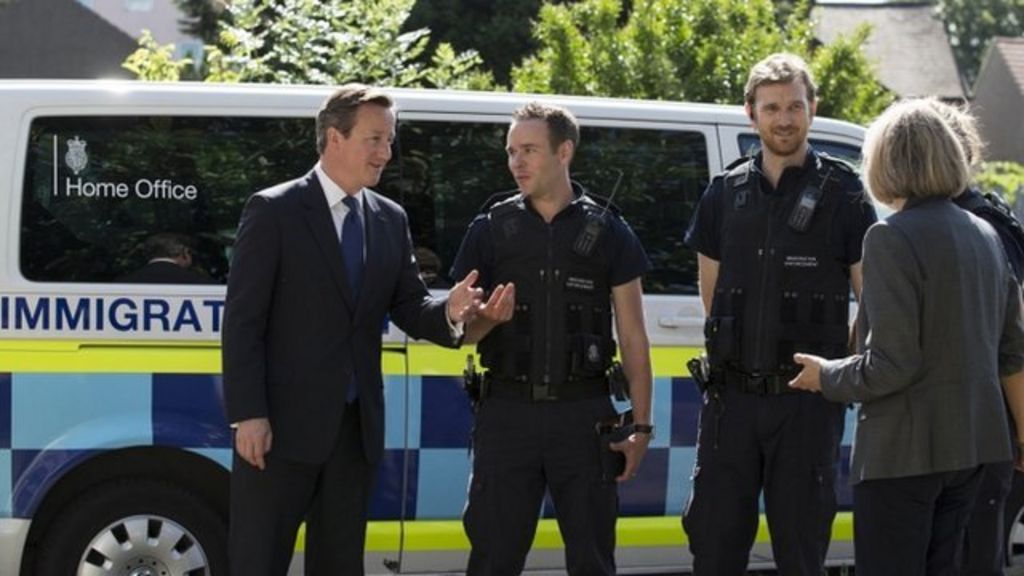
[edit]Uniformed immigration officers have their rank displayed on shoulder epaulettes, attached to their wicking shirt, jumper, jacket and stab vest. Officers below HM inspector rank will usually have their warrant/identification number displayed.
Officers possess a warrant card with a crest/badge (akin to police officers), which they may sometimes display in their uniform or plain clothes, if for instance, conducting a raid.[10][11]
The uniform of ICE officers who conduct raids and arrest persons is all dark blue or black. It is informal and operational, but ICE officers always have "immigration enforcement" in capital letters written on their garments.
The uniform includes:
- t-shirt
- cargo trousers
- jumper/jacket
- stab vest
- equipment vest (black or yellow)
- boots
- baseball cap
The rank structure adopted within Home Office Immigration Enforcement is as follows:
| Immigration Enforcement Ranks | ||||||||||
|---|---|---|---|---|---|---|---|---|---|---|
| Rank | Director General | Director | Deputy Director | Grade 6 | Grade 7 | His Majesty's Inspector | Chief Immigration Officer | Immigration Officer | Assistant Immigration Officer | Administrative Assistant |
| Epaulette Insignia | 
|

|

|

|

|

|

|

|

|

|
There are equivalent grades that mirror the rest of the Civil Service.
The PACE order 2013 introduced that a chief immigration officer is the equivalent to a police inspector in relation to lawful authorities. A CIO is also a designated senior officer under the Proceeds of Crime Act 2002.
As far as legislation is concerned, there is no difference between an assistant immigration officer and an immigration officer. The Home Office has introduced procedural differences. There are differences between the two ranks within Border Force, as only an immigration officer has the power to authorise a person's entry to the United Kingdom.
Political issues, confrontations and controversy
[edit] |
In 2014, a number of Immigration Enforcement intelligence documents forming part of the "Operation Centurion" campaign were leaked to campaign groups and the media. The information revealed caused controversy, particularly as they gave the impression that operations were widely based on "racial profiling" targeting particular ethnic groups. The then chairman of the House of Commons Home Affairs Committee, Keith Vaz MP, stated that "judging by what I've heard from this document it seems very clear that this is not based on intelligence, but they refer to particular nationalities and particular industries that they are involved in".[12]
A report published in August 2016 by Corporate Watch highlighted a number of areas of controversy surrounding Immigration Enforcement operations against "illegal working".[13] The main points included:
- Racial bias. Workplace raids are massively skewed towards certain ethnic groups; people from India, Pakistan and Bangladesh account for 75% of all those arrested.
- "Low grade" intelligence. While claiming to be "intelligence-led", the majority of operations are based on "low grade" tip-offs from "members of the public", classified as "uncorroborated" information from "untested sources" in the official intelligence rating system.
- Entry without warrants. In the majority of raids, Immigration Enforcement teams do not in fact have court-issued warrants. A sample carried out by the Independent Chief Inspector of Borders and Immigration in December 2015 found that teams had warrants in only 43% of cases. In many other raids, Immigration Officers claimed they had "informed consent" to enter the premises. But the Inspector noted numerous irregularities in Immigration Officers' understanding of "consent", and that there was no record keeping to actually demonstrate whether or how consent had been given.[14]
- Independent Chief Inspector's criticisms. An earlier 2014 report by the Independent Chief Inspector of Borders and Immigration strongly criticised Immigration Enforcement for entering premises without warrants, including doing so unlawfully, and widely abusing the system of "Assistant Directors' Letters" to enter without due legal process.[15]
- Abuse of "consensual questioning". The Independent Chief Inspector found that, contrary to legal guidance, raid teams routinely round up and interrogate everyone on premises, whether or not they are a named suspect. They are only supposed to ask "consensual questions" of people who are not named suspects. However, according to the Inspector, “In the 184 files we sampled, there was no record of anyone being ‘invited’ to answer ‘consensual questions’. The files showed that officers typically gathered everyone on the premises together, regardless of the information known or people's actions.”[14]
The Corporate Watch report followed the high profile "Byron Burgers Case", where the hamburger restaurant chain collaborated with Immigration Enforcement to set up a "sting operation", calling in workers for early morning meetings where they were met by Immigration Enforcement arrest teams. The Corporate Watch report found that this case was part of a wider pattern in which "Immigration Officers seek to follow up tip-offs by contacting employers and asking them to collaborate ahead of raids. This collaboration may include: handing over staff lists; handing over personal details including home addresses, which are then raided; helping arrange “arrests by appointment”, as in Byron's case and also mentioned in the leaked “Operation Centurion” files."
Immigration is a very political issue within the United Kingdom; a Statista-backed survey revealed that 50 percent of respondents believed immigration to be the biggest issue the UK is facing as of January 2026,[16] which has put Immigration Enforcement at the forefront of issues surrounding migration, refugees and those opposed to immigration law. Many groups, such as the "No Border network" and "Anti Raids" are vehemently opposed to the organisation and the way it operates. In some instances, IOs have had their vehicles damaged, with tyres slashed and windows broken. An instance of this was an attack on IOs in Shadwell, East London in September 2015.[17] Whilst IOs conducted a visit to a shop in the area, a number of people attacked their vehicles, resulting in damage to a number of vans and an unmarked car.
Public Accounts Committee report
[edit]In September 2020, the Public Accounts Committee published a report that was highly critical of the IE. The Committee found that Home Office had "no idea" what the IE unit had achieved since being established. The Committee also found that officials were reliant on "disturbingly weak evidence" when assessing the efficacy of immigration enforcement policies. The report warned that there was a risk that the IE's policy decision were based purely on "assumption and prejudice" and concluded that a lack of diversity among senior management risked a repeat of the Windrush scandal.[18]
References
[edit]- ^ a b c "About us". GOV.UK. Retrieved 13 March 2021.
- ^ "Theresa May to split up UK Border Agency". BBC News. 20 February 2012. Retrieved 4 August 2016.
- ^ "UK Border Agency 'not good enough' and being scrapped". BBC News. 26 March 2013. Retrieved 19 March 2014.
- ^ "UK Border Agency's transition to Home Office". UK Border Agency. 3 May 2013. Archived from the original on 16 June 2013. Retrieved 12 May 2013.
- ^ "UK Border Agency to split into two new groups". GOV.UK.
- ^ a b "Contact details for immigration compliance and enforcement teams". GOV.UK. Retrieved 16 March 2021.
- ^ https://www.gov.uk/government/uploads/system/uploads/attachment_data/file/584221/Criminal-investigationsv1_0_ext.pdf[permanent dead link]
- ^ "A response to the ICIBI's report on the initial processing of migrants arriving via small boats at Tug Haven and Western Jetfoil (December 2021 to January 2022)".
- ^ "An inspection of the initial processing of migrants arriving via small boats at Tug Haven and Western Jet Foil" (PDF). GOV.UK. Independent Chief Inspector of Borders and Immigration.
- ^ "David Cameron with policemen". Archived from the original on 11 November 2023.
- ^ "Policewoman for immigration enforcement". Archived from the original on 26 January 2017.
- ^ "Migrants Rights Network Operation Centurion Keith Vaz". Archived from the original on 22 February 2015.
- ^ "Snitches, Stings & Leaks: how Immigration Enforcement works | Corporate Watch". corporatewatch.org. Archived from the original on 6 December 2016. Retrieved 1 October 2016.
- ^ a b "Inspection report on illegal working, December 2015". GOV.UK.
- ^ "Inspection report on the power to enter business premises without a search warrant, March 2014". GOV.UK.
- ^ "Which of the following do you think are the most important issues facing the country at this time?". statista.com. Statista. Retrieved 28 March 2024.
- ^ "Home Office immigration vans 'had tyres slashed in east London'". Evening Standard. 26 July 2015. Retrieved 21 January 2020.
- ^ Casciani, Dominic (18 September 2020). "Home Office immigration unit has 'no idea' - MPs". BBC News. Retrieved 18 September 2020.
External links
[edit]




Immigration Enforcement
View on GrokipediaHistory
Origins and Formation
Prior to the establishment of Immigration Enforcement, immigration enforcement responsibilities in the United Kingdom were primarily handled by the UK Border Agency (UKBA), which was created on April 1, 2008, through the merger of the Border and Immigration Agency, the Immigration and Nationality Directorate, and UK Visas.[7] This consolidation aimed to streamline border control, visa processing, and interior enforcement but resulted in significant operational inefficiencies, as the UKBA struggled with divided priorities, mounting backlogs in asylum and enforcement cases, and inadequate performance in removing individuals without legal right to remain.[8] By 2012, these issues were compounded by the agency's failure to effectively address rising irregular migration, including an estimated 50,000-100,000 visa overstayers annually in the late 2000s and early 2010s, alongside increased illegal employment following EU enlargement in 2004, which fueled public concerns over uncontrolled inflows and strained enforcement resources.[9][10] In response to these deficiencies and growing political pressure to prioritize interior enforcement amid net migration peaking at over 300,000 annually by 2010, the Home Office initiated restructuring.[11] In April 2012, the border control functions were separated into the independent Border Force to focus on frontier security, leaving UKBA with immigration and enforcement duties.[12] On March 26, 2013, Home Secretary Theresa May announced the dissolution of UKBA due to its "not good enough" performance, reallocating its functions directly under the Home Office.[13] This led to the formation of Immigration Enforcement as a dedicated directorate, alongside UK Visas and Immigration, to concentrate solely on law enforcement aspects without the distractions of visa processing or border operations.[10] Immigration Enforcement's initial mandate, effective from the 2013 restructuring, centered on detecting and disrupting illegal immigration within the UK's interior, including operations against overstayers—who comprised a significant portion of the estimated 400,000-700,000 irregular migrants by the mid-2010s—illegal workers employing unauthorized labor, and failed asylum seekers pending removal.[13] The directorate was tasked with increasing removals, which had lagged under UKBA at around 50,000 enforced returns per year, and targeting organized crime facilitating sham marriages and human smuggling, driven by the causal link between lax enforcement and persistent incentives for irregular entry and stay.[14] This shift reflected empirical recognition that fragmented structures had undermined deterrence, necessitating a specialized entity to restore credibility in immigration controls amid sustained public demands for accountability.[7]Evolution and Key Reforms
The Immigration Act 2014 marked a pivotal reform for Immigration Enforcement, enhancing powers to remove individuals with no valid leave to remain and restricting appeals for certain deportation cases, in response to empirical evidence of enforcement gaps such as persistent overstaying and low removal rates during the early 2010s.[15] [16] This legislation also doubled maximum penalties for employing illegal workers to £20,000 per worker, facilitating expanded raid capabilities targeting illegal employment amid rising irregular migration pressures, including the onset of small boat crossings that escalated from fewer than 300 arrivals in 2018.[17] [3] To address coordination deficiencies with local law enforcement, Immigration Enforcement deepened data-sharing protocols through the expansion of Operation Nexus in 2014, embedding officers in police custody suites to screen for immigration offenders, including foreign national offenders (FNOs), thereby increasing identifications and referrals for removal despite overall declines in returns during the decade due to reduced upstream detections.[18] [3] These measures responded to strains from EU free movement, which contributed to higher volumes of unauthorized EU nationals, prompting structural shifts toward proactive intelligence-led operations by the late 2010s. Post-Brexit adjustments in 2020 realigned enforcement priorities to encompass EU nationals under domestic controls, emphasizing returns of those ineligible for settled status and FNOs, with the latter accounting for 98% of EU returns that year as transitional protections lapsed.[19] [3] Concurrently, integration of biometric tools, such as mandatory fingerprinting for immigration enforcement and digital identity verification, bolstered tracking of absconders, correlating with persistently low absconding rates of around 1% from bail conditions.[20] [21] This technological evolution addressed causal factors in prior evasion, including reliance on paper documents prone to forgery, though overall efficacy in reducing unauthorized presence remained constrained by broader systemic referral shortfalls.[3]Recent Developments (Post-2020)
In the wake of the COVID-19 pandemic, UK Immigration Enforcement (IE) adapted operations to address surging irregular migration, including a focus on disrupting organized immigration crime networks. Collaborating with the National Crime Agency (NCA), IE contributed to 345 NCA-led disruptions of such activities in the 2024-2025 financial year, marking a 40% increase from the prior year and targeting facilitators of clandestine entries and exploitation.[22] This uptick followed a 1.6% rise in detected irregular migrant entries via clandestine means, with organized crime groups adapting to enforcement pressures by enhancing concealment tactics.[23] The May 2025 white paper Restoring Control over the Immigration System outlined reforms to bolster IE's compliance monitoring, including escalated penalties for employers hiring undocumented workers and stricter oversight of visa sponsors to curb overstays and illegal employment.[24] These measures built on post-2020 data-driven enhancements, such as expanded use of intelligence-led raids, which disrupted over 25% more small boat-related operations in 2024 compared to 2023, amid a 25% increase in Channel crossings to 36,816 arrivals.[25][26] Responses to small boat arrivals—constituting less than 2% of total migrant inflows in 2024 despite high visibility—emphasized rapid detention and returns, with voluntary and enforced removals totaling 34,000 that year, the highest since 2017 and a 25% rise from 2023.[27][3] By mid-2025, IE integrated new Border Security, Asylum and Immigration Bill provisions for enhanced powers against smuggling, including roadside checks and seizures, amid detections of 43,309 small boat arrivals in the year to June 2025, 38% above pre-2022 levels but with improved interception rates.[28][29]Mandate and Responsibilities
Core Objectives
The core objective of UK Immigration Enforcement (IE) is to remove individuals with no legal right to remain in the country, encompassing illegal entrants who bypass border controls, visa overstayers who exceed authorized durations, and foreign national offenders posing public safety risks. This mandate stems from statutory requirements under the Immigration Act 1971 and Immigration and Asylum Act 1999, prioritizing the expulsion of high-harm cases to restore compliance with immigration rules and affirm sovereign control over territorial access.[1][30][9] A secondary foundational goal involves deterring unlawful migration through systematic pursuit of non-compliant individuals, thereby reinforcing the credibility of legal immigration pathways and discouraging attempts to circumvent them. Visible commitment to enforcement serves as a causal mechanism to reduce irregular entries, contrasting with permissive policies that empirical government assessments link to escalated public resource demands, including per-person accommodation costs estimated at £106,000 over four years for unauthorized arrivals absent removal.[1][31] IE further aims to safeguard the domestic economy by curbing illegal employment and associated abuses, which undermine fair competition in the labor market and impose unentitled demands on welfare provisions. By targeting unauthorized work in the shadow economy—where participants evade taxes yet access services—enforcement mitigates downward pressure on native wages in low-skilled sectors and averts fiscal burdens, as evidenced by Home Office pressures exceeding £6.4 billion in 2023-2024 tied to irregular migration management.[1][32][33]Scope of Enforcement Activities
Immigration Enforcement (IE) operates primarily in the UK interior, enforcing compliance with immigration laws away from ports of entry, in contrast to Border Force responsibilities at borders.[1] This interior focus addresses overstayers, illegal entrants already present, and abuses of legal status, such as unauthorized work or residence, rather than initial arrivals.[1] Non-enforcement in these areas sustains networks exploiting undocumented migrants for labor and other crimes, as lax interior controls enable organized groups to embed operations like people smuggling extensions and forced labor schemes without immediate disruption.[34][35] Core activities target illegal employment, including workplace raids and employer audits to deter hiring of unauthorized workers, which undermines wage standards and public services without deterring entry-level migration. IE also combats sham marriages—arranged unions solely for immigration gain—through investigations into registrars and applicants, as these facilitate residency for ineligible individuals and erode marriage visa integrity.[36] Document fraud, such as forging passports or biometric residence permits, falls under IE purview, with probes into suppliers and users to prevent systemic circumvention of controls.[37] IE coordinates with Her Majesty's Prison and Probation Service to screen foreign national offenders (FNOs) for deportation eligibility post-sentence, prioritizing removal of those convicted of serious crimes to reduce recidivism risks and prison costs.[38] In fiscal year 2023-2024, over 3,500 FNOs were deported, though backlogs persist due to appeals and documentation hurdles.[39] Public engagement includes hotlines like the 0300 123 7000 line for anonymous tips on violations, enabling community-sourced intelligence on illegal work or fraud.[40] Visa adjudication and initial grants remain outside IE scope, delegated to UK Visas and Immigration to separate enforcement from processing. Failure to enforce interior rules causally amplifies crime networks, as evidenced by resilient smuggling adaptations that exploit enforcement gaps for inland distribution of undocumented labor.[41][42]Organizational Structure
Main Directorates and Teams
Immigration Enforcement (IE) functions as a directorate within the UK Home Office, headed by a Director General who reports to the Permanent Secretary and oversees all enforcement activities aimed at tackling illegal migration and immigration abuse.[43] The hierarchical structure emphasizes specialized senior directorates that coordinate proactive operations, including intelligence gathering, compliance checks, and removals, to ensure comprehensive coverage of enforcement priorities.[1] This setup evolved significantly after the 2013 disbandment of the UK Border Agency, which restructured immigration functions into distinct entities—IE, UK Visas and Immigration, and Border Force—shifting from fragmented, ad-hoc teams to a more professionalized model with dedicated operational commands focused on measurable outcomes like increased arrests and disruptions of organized immigration crime.[44][12] At the senior level, IE is led by the Director General, supported by key figures such as the Senior Director for Strategy and Transformation, who drives organizational improvements and policy alignment; the Senior Director for Returns and Detention Operations, responsible for managing enforced removals and detention processes; and the Senior Director of Enforcement, Compliance and Crime, who integrates compliance monitoring with criminal investigations to address illegal working and immigration offenses.[43] These directorates interlink through shared intelligence and tasking mechanisms, where data from intelligence officers informs frontline compliance teams and escalates complex cases to investigative units, enabling seamless transitions from detection to enforcement action without operational silos.[1] Regional and operational teams under these directorates further operationalize this integration, drawing on a workforce of frontline officers, caseworkers, and specialists to execute coordinated visits, reporting requirements, and threat disruptions across the UK.[1] This professionalized framework post-2013 has prioritized capability-building in areas like intelligence-led policing, with directorates collaborating to target organized crime groups and foreign national offenders, as evidenced by structured increases in local enforcement outputs following the restructuring.[45] The command structure avoids overlap by delineating roles—such as compliance-focused teams handling routine checks versus crime directorates pursuing prosecutions—while maintaining unified reporting to the Director General for accountability and resource allocation.[46]Immigration Compliance and Enforcement
Immigration Compliance and Enforcement teams within UK Immigration Enforcement conduct unannounced visits to business premises to verify employees' right to work, targeting sectors prone to illegal employment such as construction, hospitality, and food processing.[47] These operations involve on-site document checks and immigration status assessments, enabling immediate action against detected violations.[48] In the year from 5 July 2024 to 31 May 2025, these visits led to 6,410 arrests of individuals suspected of illegal working, reflecting a 51% increase compared to the prior equivalent period.[49] [50] Quarterly arrests typically number in the thousands, with over 3,900 detentions recorded from 5 July 2024 to 31 January 2025 alone across 5,424 visits.[51] Employers found hiring illegal workers face civil penalties up to £60,000 per unauthorized employee, alongside potential asset seizures through prosecution under the Proceeds of Crime Act for gains from illegal activity.[52] [53] These financial deterrents reduce employer demand for undocumented labor, as evidenced by sustained enforcement yielding higher compliance rates and fewer repeat violations in inspected sectors.[48] Operations also promote voluntary returns for eligible individuals encountered during checks, streamlining departures without recourse to detention or enforced removal while barring re-entry for specified periods. This approach enhances overall deterrence by signaling swift consequences for illegal work, contributing to a net reduction in unauthorized employment opportunities.[51]Criminal and Financial Investigations
Immigration Enforcement's Criminal and Financial Investigation teams specialize in probing organised immigration crime, targeting networks involved in people smuggling, the supply of forged documents, and money laundering linked to irregular migration.[35] These units lead reactive investigations triggered by intelligence on criminal enterprises profiting from facilitating unlawful entry or residence, employing forensic accounting and digital evidence extraction to map financial trails and operational structures.[54] By focusing on the economic underpinnings of these activities, investigators aim to disrupt profitability, which sustains smuggling operations and endangers migrants through risky crossings.[55] Collaboration with the National Crime Agency (NCA) and other law enforcement bodies enables joint operations under the Proceeds of Crime Act 2002, facilitating asset seizures, confiscations, and prosecutions that target illicit gains.[56] Financial investigators accredited by the NCA's Proceeds of Crime Centre trace funds from smuggling fees to bank accounts, properties, or cryptocurrencies, often resulting in restraint orders to prevent dissipation.[56] This approach has supported broader asset recovery efforts, with UK law enforcement seizing over £3.3 million in cash and £1.1 million in listed assets across immigration-related cases in recent financial years.[57] Notable cases demonstrate effectiveness in network dismantlement; for instance, in June 2025, Immigration Enforcement coordinated dawn raids arresting six suspects accused of using fake identities to enable illegal entry of over 200 migrants, yielding evidence for financial tracing and potential POCA applications.[58] Similarly, NCA-linked probes in July 2025 recovered cash from money laundering tied to illegal immigration facilitation, contributing to convictions that deprive criminals of operational funds.[59] Such seizures not only fund enforcement indirectly through recovered assets but also deter reinvestment in smuggling by eroding financial incentives, as evidenced by disrupted international networks reliant on laundered proceeds.[55]Rapid Response Team
The Rapid Response Team (RRT) within UK Immigration Enforcement operates as a national tactical unit designed for swift deployment to high-priority enforcement operations, prioritizing officer safety through specialized readiness for volatile situations. Based primarily in northern England, the RRT functions as a flexible resource capable of bolstering regional teams nationwide during surges in illegal working detections or urgent compliance actions.[48] RRT deployments focus on immediate interventions such as supporting arrests in illegal employment sites and assisting in the processing of irregular migrant arrivals, including those via small boats, where rapid scaling of personnel is essential to manage influxes and maintain control. For instance, between 5 July 2024 and 31 May 2025, the RRT contributed to 67 arrests linked to illegal working, demonstrating its role in amplifying enforcement capacity during operational peaks.[60] In high-risk scenarios involving potential resistance or large groups, such as mass roundups of visa overstayers or evictions from non-compliant premises, the team coordinates with local police to ensure procedural integrity and mitigate threats, though Immigration Enforcement officers do not carry firearms and rely on de-escalation tactics supplemented by law enforcement support.[61][62] Team members receive targeted training in use-of-force principles, personal safety, and restraint techniques, aligned with broader Immigration Enforcement protocols that emphasize proportionality and necessity to facilitate arrests or detentions without undue escalation. This preparation enables effective handling of crisis situations, including coordination with regional constabularies for joint operations where heightened risks, such as confrontations during large-scale evictions, necessitate integrated tactical responses.[61] Following Brexit, the RRT's involvement intensified amid heightened scrutiny of post-transition irregular migration, including increased detections of EU nationals in illegal work—over 50% of border refusals in 2024 involved EU citizens—prompting more frequent deployments to address enforcement backlogs and sustain deterrence against overstays and unauthorized employment.[63] This adaptation underscores the unit's operational necessity in sustaining enforcement efficacy amid evolving migration pressures, with flexible mobilization proving critical for rapid containment of localized spikes in non-compliance.[48]Defunct Units
The UK Border Agency (UKBA), which encompassed immigration enforcement functions until its disbandment in March 2013, featured specialized teams that were subsequently integrated into the newly established Immigration Enforcement (IE) directorate within the Home Office. This restructuring followed efficiency reviews highlighting operational silos, accountability failures, and resource duplication within UKBA, which had faced criticism for inefficiencies in handling enforcement tasks such as illegal working and overstays.[64][65] Certain clandestine-focused operational teams from the UKBA era, including those precursor to modern rapid response capabilities, were discontinued as standalone entities and folded into mainstream IE units to streamline command structures and achieve cost savings estimated in the millions through reduced administrative overhead. The rationale emphasized maintaining enforcement efficacy while eliminating overlaps, such as duplicated intelligence and deployment functions, without evidence of capability loss post-integration.[44][66]Uniform and Rank Insignia
Immigration Enforcement officers wear operational uniforms consisting of tactical clothing suitable for fieldwork, including combat-style trousers, steel-toe boots, and moisture-wicking shirts or jackets, often supplemented with high-visibility elements and body armor for safety during enforcement activities.[67] The uniform prominently features "Immigration Enforcement" branding and warrant numbers visible on sleeves or chests to clearly identify authority and deter non-compliance, distinguishing it from police attire while maintaining a professional, authoritative appearance akin to other Home Office operational units.[47] Rank insignia are displayed on shoulder epaulettes attached to shirts, jumpers, jackets, and protective vests, reflecting a hybrid civil service and operational structure that signals hierarchy and expertise to both internal teams and the public. This system promotes discipline and public trust by visually communicating command levels during visible operations. The structure spans from executive leadership to frontline roles, with designs incorporating chevrons, pips, or bars tailored to each grade. The senior-most rank is Director General, overseeing the entire command, followed by Operations Directors responsible for national coordination. Regional Directors manage area-specific enforcement, while Deputy and Assistant Directors handle tactical oversight. Inspector-level roles supervise teams, Chief Immigration Officers lead investigations, and Immigration Officers execute visits, with Assistant Officers providing support.[68]| Rank | Description | Insignia Example |
|---|---|---|
| Director General | Head of Immigration Enforcement | |
| Operations Director | National operations leadership | |
| Regional Director | Area command | |
| Deputy Director | Deputy area oversight | |
| Assistant Director | Assistant operational management | |
| Inspector | Team supervision | |
| Chief Officer | Senior field leadership | |
| Officer | Core enforcement duties | |
| Assistant Officer | Entry-level operational support | |
| Assistant | Administrative and basic assistance |