
Hubbry Logo
Inductive sensorInductive sensorMain
Open search
Inductive sensor
Community hub
Inductive sensor
logo
7 pages, 0 posts
0 subscribers
Be the first to start a discussion here.
Contribute something
Inductive sensor
Inductive sensor
from Wikipedia
Elements of a simple inductive proximity sensor.
1. Field sensor
2. Oscillator
3. Demodulator
4. Shmitt Trigger
5. Output

An inductive sensor is an electronic device that operates based on the principle of electromagnetic induction to detect or measure nearby metallic objects. An inductor develops a magnetic field when an electric current flows through it; alternatively, a current will flow through a circuit containing an inductor when the magnetic field through it changes. This effect can be used to detect metallic objects that interact with a magnetic field. Non-metallic substances, such as liquids or some kinds of dirt, do not interact with the magnetic field, so an inductive sensor can operate in wet or dirty conditions.[1]

Principle

[edit]

The inductive sensor is based on Faraday's law of induction. The temporal variations of the magnetic flux Φ through a coil with N turns will induce a voltage e which follows:

which can be expressed in a simpler way:
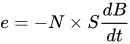
by assuming that the induced magnetic field B is homogeneous over a section S (the magnetic flux will be expressed ).

One form of inductive sensor drives a coil with an oscillator. A metallic object approaching the coil will alter the inductance of the coil, producing a change in frequency or a change in the current in the coil. These changes can be detected, amplified, compared to a threshold and used to switch an external circuit. The coil may have a ferromagnetic core to make the magnetic field more intense and to increase the sensitivity of the device.[1] A coil with no ferromagnetic core ("air core") can also be used, especially if the oscillator coil must cover a large area.

Another form of inductive sensor uses one coil to produce a changing magnetic field, and a second coil (or other device) to sense the changes in the magnetic field produced by an object, for example, due to eddy currents induced in a metal object.[1]

Applications

[edit]

Search coil magnetometer

[edit]

Inductive sensors constitute the main element to build a search coil magnetometer, also known as a search coil. These are used in many fields of research: magnetotellurics, electromagnetic waves measurement, space magnetometers to investigate electromagnetic waves in space plasma as well as natural electromagnetic waves observations on Earth.

Inductive proximity sensor (proximity switch)

[edit]

An inductive proximity sensor is a non-contact electronic proximity sensor. It is used for positioning and detection of metal objects. The sensing range of an inductive switch is dependent on the type of metal being detected. Ferrous metals, such as iron and steel, allow for a longer sensing range, while nonferrous metals, such as aluminum and copper, may reduce the sensing range by up to 60 percent.[2]

Since the output of an inductive sensor has two possible states, an inductive sensor is sometimes referred to as an inductive proximity switch.[2][3]

The sensor consists of an induction loop or detector coil. Most often this is physically a number of turns of insulated magnet wire wound around a high magnetic permeability core, such as a ferrite ceramic rod or coil form, and the winding may or may not have a feedback tap some number of turns from one end of the total winding. It is connected to a capacitance to form a tuned frequency oscillator tank circuit. In conjunction with a voltage or current gain device like a transistor or operational amplifier, this forms a tuned frequency oscillator. When power is applied, the resulting oscillation is a high frequency alternating electric current in the coil that has a constantly changing magnetic field able to induce eddy currents in proximal (target) conductors. The closer the target is and the greater its conductivity (metals are good conductors, for example), the greater the induced eddy currents are and the more effect their resulting opposing magnetic fields have on the magnitude and frequency of the oscillation. Its magnitude is reduced as the load is increased in a non-magnetic conductor like aluminum because the induced field in the target opposes the source induction field, lowering net inductive impedance and therefore simultaneously tuning the oscillation frequency higher. But that magnitude is less affected if the target is a highly magnetically permeable material, like iron, as that high permeability increases the coil inductance, lowering the frequency of oscillation.

A change in oscillation magnitude may be detected with a simple amplitude modulation detector like a diode that passes the peak voltage value to a small filter to produce a reflective DC voltage value, while a frequency change may be detected by one of several kinds frequency discriminator circuits, like a phase lock loop detector, to see in what direction and how much the frequency shifts. Either the magnitude change or the amount of frequency change can serve to define a proximity distance at which the sensors go from on to off, or vice versa.

Common applications of inductive sensors include metal detectors, traffic lights, car washes, and a host of automated industrial processes. Because the sensor does not require physical contact it is particularly useful for applications where access presents challenges or where dirt is prevalent.

Traffic sensor

[edit]

To control traffic signals at an intersection of roads, an induction loop can be buried in the pavement. A circuit connected to the loop can detect the change in its inductance when a vehicle passes over or stops on the loop. This can be used to detect vehicles and adjust the timing of traffic signals or provide a turning signal at a busy intersection.[4]

Nuclear magnetic resonance

[edit]

Inductive sensors, also referred (in this area) as "NMR coils" or "radiofrequency coils", are used to detect the magnetic component of the electromagnetic field associated to the nuclear spin precession in Nuclear magnetic resonance.

See also

[edit]

References

[edit]
Revisions and contributorsEdit on WikipediaRead on Wikipedia
from Grokipedia
An inductive sensor is a non-contact electronic device designed to detect the presence, position, or distance of metallic objects by generating and monitoring changes in an electromagnetic field. It operates on the principle of electromagnetic induction, specifically Faraday's law, where variations in magnetic flux through a coil produce a measurable electrical signal. These sensors are widely used in industrial automation for their reliability in detecting ferromagnetic and non-ferromagnetic metals without physical interaction. At the core of an inductive sensor is an LC oscillator circuit featuring a coil wound around a , which produces a high-frequency alternating . When a metallic target enters this field, eddy currents are induced in the object, extracting energy from the field and causing a detectable effect that alters the coil's or the oscillator's . This change is processed by the sensor's to produce a binary switching output for proximity detection or an for distance measurement, with sensing ranges typically from millimeters to several centimeters depending on the design and target material. The detection is influenced by factors such as the target's conductivity, permeability, and size, as well as environmental conditions like , which can affect the nominal sensing distance by up to 10%. Inductive sensors are categorized into proximity types for simple on/off detection and distance-measuring variants for precise positioning, with designs including shielded (flush-mountable) and unshielded (extended range) models to suit installation needs. Common applications span , , and process control, such as monitoring positions, speeds, and object presence in assembly lines or harsh environments like nuclear facilities and turbines. Their non-contact nature ensures durability against mechanical wear, vibration, and contaminants, making them ideal for automated systems requiring consistent performance over wide temperature ranges.

History and Development

Early Foundations

The foundational principles of inductive sensing trace back to the early , particularly to the work of , who in 1831 discovered through a series of experiments at the Royal Institution in . Faraday observed that moving a permanent magnet into or out of a coil of wire connected to a produced a momentary deflection of the needle, indicating an induced ; conversely, keeping the magnet stationary produced no effect, demonstrating that relative motion or change was essential. This breakthrough revealed the principle that a changing induces an (EMF) in a nearby conductor, even without direct contact between them. Faraday formalized this observation as , which quantitatively relates the induced EMF to the rate of change of through the circuit. E=dΦBdt\mathcal{E} = -\frac{d\Phi_B}{dt} Here, E\mathcal{E} represents the induced EMF, ΦB\Phi_B is the , and the negative sign indicates the direction of the induced current opposes the change in flux, as later clarified by . This law encapsulated Faraday's experimental findings and provided the theoretical cornerstone for all subsequent developments in inductive technologies. Building on this, early 19th-century experiments extensively explored the phenomena of mutual and self- using coils and magnets. In demonstrations of mutual inductance, Faraday and contemporaries like arranged two separate coils: current in the primary coil generated a that linked with the secondary coil, inducing a voltage upon changes in the primary current; this mutual coupling quantified how energy transfer occurs without physical connection. Self-inductance was similarly demonstrated when altering current in a single coil induced a back-EMF within itself, resisting the change and highlighting the coil's inherent opposition to flux variations. These experiments, conducted primarily in the 1830s, relied on simple setups with iron cores to amplify effects and galvanometers for detection, establishing as a measurable property. By the mid-1800s, these principles found initial applications in , where induced currents enabled reliable signal transmission over wires using electromagnets in relays, and in basic , such as sensitive galvanometers and early voltmeters that detected flux changes for precise quantification of currents and potentials. These developments laid the groundwork for broader technological advancements in the .

Commercial Evolution

The development of linear variable differential transformers (LVDTs) in the early 1940s marked an early commercial milestone for inductive sensing technology, initially applied in military contexts during for precise displacement measurements in laboratory and field equipment. Herman Schaevitz pioneered these devices by winding prototypes in his basement workshop to meet wartime demands for reliable, non-contact position sensing in applications like assembly alignment. Building on these foundations, the first inductive proximity sensor emerged in 1958 through the efforts of Walter Pepperl, Ludwig Fuchs, and Wilfried Gehl at , developed for the , particularly for , as a non-contact, intrinsically safe alternative to mechanical switches in explosion-hazardous production environments. This addressed the need for contactless metallic , using an oscillator circuit to generate an altered by nearby metals. The device was initially a custom solution but quickly gained traction for industrial automation. Subsequent patents advanced oscillator-based proximity detection, enabling more stable and sensitive operation by refining the high-frequency oscillation principles to detect changes in coil impedance caused by metallic targets. These patents solidified the technology's viability for broader commercial use, transitioning inductive sensors from niche and industrial tools to standard components in lines. In subsequent decades, inductive sensors evolved from primarily analog outputs—providing continuous voltage or current signals proportional to target proximity—to digital outputs like switching signals (e.g., PNP/NPN), which facilitated easier integration with programmable logic controllers (PLCs) and early systems. This shift improved noise immunity and simplified interfacing in factory environments, driving widespread adoption in assembly, , and conveyor systems. A notable advancement was the development of shielded inductive sensors, which incorporated metal housings or ferrules to confine the sensing field to the front face, minimizing side detection and enabling flush mounting in metallic fixtures without interference. This design enhanced reliability in confined or harsh industrial settings, such as automotive assembly and , where space constraints and environmental factors previously limited deployment.

Operating Principles

Electromagnetic Induction

Electromagnetic induction forms the foundational physical principle for inductive sensors, enabling the detection of metallic objects through changes in magnetic fields. This phenomenon, originally discovered by Michael Faraday in 1831, involves the generation of an electromotive force (EMF) in a conductor due to a time-varying magnetic field. In the context of inductive sensors, a coil carrying alternating current (AC) produces an oscillating magnetic field that interacts with nearby conductive materials. Central to this process are the concepts of self-inductance and mutual inductance in coils. Self-inductance LL quantifies the EMF induced in a coil by the changing current within itself, given by V=LdidtV = L \frac{di}{dt}, where VV is the induced voltage and didt\frac{di}{dt} is the rate of change of current. Mutual inductance MM describes the EMF induced in a second coil due to changing current in the first, expressed as V2=Mdi1dtV_2 = M \frac{di_1}{dt}. These inductances arise from the linkage within or between coils, governed by . When an AC current flows through the sensor's coil, it generates an alternating magnetic field that extends into the surrounding space. The presence of a nearby conductive metallic object within this field induces eddy currents—circulating currents within the object—according to Lenz's law, which opposes the change in magnetic flux. These eddy currents produce their own magnetic field, distorting the original field and causing energy losses through resistive heating in the target material, thereby altering the effective inductance of the sensor coil. The strength of the induction effect depends on several key factors. Coil geometry, including the number of turns, , and , determines the intensity and spatial distribution. The frequency of the AC oscillation, typically in the range of 100 kHz to 1 MHz, influences the penetration and the magnitude of induced currents, with higher frequencies enhancing sensitivity for thinner or less conductive targets. Additionally, the magnetic permeability of the target material affects how the external field interacts with the object; ferromagnetic materials with high permeability concentrate the field lines, amplifying the distortion, while non-ferromagnetic conductors rely primarily on effects.

Detection Mechanisms

Inductive sensors process changes in the induced by a nearby metallic target to generate a detectable output signal. When a conductive target enters the sensor's alternating , it induces currents within the target, which in turn create an opposing that alters the sensor's coil inductance, denoted as ΔL. This change in inductance, ΔL, increases with decreasing distance to the target and depends on its , such as conductivity and magnetic permeability, with closer proximity resulting in a greater ΔL due to stronger interactions. Common detection methods exploit this ΔL to produce measurable variations in the sensor's electrical characteristics. In amplitude-based detection, the proximity of the target reduces the of the oscillation in the sensor's by loading the coil, allowing the circuit to compare this against a reference threshold to determine target presence. Alternatively, phase shift methods in resonant circuits detect the shift in the phase angle between the driving voltage and the coil current caused by ΔL, which detunes the and enables precise for output generation. The output can be configured as binary or analog depending on the application requirements. Threshold detection compares the processed signal—such as or phase shift—to a predefined level, producing a simple on/off binary output when the target crosses the sensor's nominal operating , ideal for proximity switching. In contrast, analog scales the output voltage or current proportionally to the degree of ΔL, providing continuous position over a range of distances. The detection mechanism varies significantly between ferrous and non-ferrous metals due to differences in their interaction with the . metals, with high magnetic permeability, concentrate the field lines and enhance density, achieving full sensing ranges with correction factors of 1 relative to standard steel calibration. Non-ferrous metals, lacking this permeability, permit deeper penetration of the but generate weaker signals from s alone, with lower effective losses leading to reduced sensing distances—often 30-70% shorter—and requiring material-specific correction factors (e.g., 0.25-0.45 for ).

Components and Construction

Core Physical Elements

The core physical elements of an inductive sensor form the foundational sensing mechanism, centered around generating and concentrating a to detect metallic targets through . At the heart of the sensor is the primary coil, an inductor typically constructed from enameled copper wire wound into multiple turns to create an oscillating . This coil is mounted on a core to optimize and directionality. The core material is usually ferrite, a high-permeability ferromagnetic substance that concentrates the and enhances sensitivity, particularly in proximity detection applications; air cores are less common due to their lower efficiency in field focusing. The housing encases these elements, with non-metallic materials used for unshielded sensors to allow an unrestricted for extended detection ranges, while metallic housings in shielded designs confine the field to the sensing face for flush mounting and reduced interference. The sensing face, often flat or threaded for secure mounting, is the active surface where the magnetic field emanates, with typical detection ranges of 1–50 mm influenced by sensor size and target properties.

Electronic Circuitry

The electronic circuitry of an inductive sensor consists of interconnected subsystems that generate an , detect perturbations caused by metallic targets, condition the resulting signals, and deliver usable outputs for control systems. This circuitry typically operates on a DC power supply ranging from 10 to 30 to ensure compatibility with industrial automation environments. Key elements include an oscillator for signal generation, a demodulator for variation extraction, amplification and triggering for processing, and output stages for interfacing. The oscillator circuit produces an AC signal to energize the sensing coil and establish a resonant , commonly implemented as an LC tank configuration. In designs like the , the coil acts as the inductor, with a forming the resonant network, and a transistor-based providing to sustain at frequencies typically in the range of 100 kHz to 1 MHz. Proximity to a metallic target dampens the amplitude or shifts the frequency by altering the coil's effective , which serves as the basis for detection. The demodulator processes the oscillator's output to isolate changes in or induced by the target. It often uses a circuit, such as a half-bridge configuration, to convert the AC signal into a pulsating DC voltage, followed by a to yield a stable level proportional to the effect from currents in the target. In precision setups, dual current mirrors compare currents before and after perturbation to accurately measure impedance variations without external references. An boosts the demodulated signal for reliable processing, frequently incorporating logarithmic amplification in balanced bridge oscillators to linearize non-linear responses from target position changes. This is followed by a circuit, which applies —typically with distinct thresholds—to convert the into a clean binary switch, mitigating noise-induced oscillations and ensuring stable toggling. Output stages translate the triggered signal into formats suitable for integration, such as NPN or PNP transistor drivers for digital on/off switching in proximity detection. Analog variants employ current loops delivering 4–20 mA or voltage signals like 0–10 V, scaled to reflect target distance or presence, with built-in protections like diodes and resistors to handle inductive loads up to several hundred milliamps.

Types of Inductive Sensors

Inductive Proximity Sensors

Inductive proximity sensors operate using a single coil connected to an oscillator circuit that generates an alternating . When a metallic target enters this field, eddy currents are induced on the target's surface, creating an opposing that reduces the in the sensor's coil. This change is detected by the circuitry, which triggers a switch output when the amplitude falls below a threshold, enabling non-contact detection of the target's presence. These sensors are available in shielded and unshielded designs, each suited to different mounting requirements. Shielded models incorporate a metal around the coil except at the sensing face, allowing flush installation into metallic surfaces without interference, though they concentrate the field on one side for shorter detection ranges. Unshielded designs lack this full enclosure, providing a broader sensing field and extended range but requiring clearance from surrounding metal to avoid false triggering. The switching distance, or the maximum range at which reliable detection occurs, typically reaches up to 40 for larger rectangular sensors, influenced by factors such as target size, material conductivity, and sensor dimensions. For instance, targets like yield stronger responses than non-ferrous ones like aluminum, and larger targets enhance sensitivity within the rated range. Inductive proximity sensors commonly adhere to IP67 ingress protection standards, ensuring dust-tight and water-resistant operation in harsh industrial environments. They primarily function in binary on/off mode, outputting a simple to indicate target detection without measuring distance.

Displacement and Position Sensors

Inductive displacement and position sensors measure linear or angular movements by exploiting variations in , offering high precision for applications requiring accurate position feedback. These sensors operate on principles of mutual , where changes in the position of a ferromagnetic element alter the between coils. A key example is the (LVDT), which features a structure comprising a primary coil flanked by two identical secondary coils wound on a non-magnetic former, forming a assembly. A movable ferromagnetic core, typically made of nickel-iron alloy, is positioned within the coils and linked to the object whose displacement is being measured. In operation, an (typically 1-10 kHz) excites the primary coil, inducing equal but opposite voltages in the secondary coils when the core is at the null position, yielding a zero differential output. Displacement of the core along the axis unbalances the to each secondary coil, generating a differential AC voltage whose magnitude is linearly proportional to the core's position and whose phase indicates the direction of movement. This output is commonly demodulated and rectified to produce a DC signal for further processing by signal conditioners or systems. LVDTs achieve linear measurement ranges extending up to ±250 mm (500 mm total span) with resolutions finer than 1 μm, depending on the model and excitation frequency, enabling submicron precision in controlled environments. For angular position sensing, inductive resolvers extend similar principles to rotary configurations, providing full 360° coverage through a rotating core or that modulates the between windings, producing sinusoidal outputs proportional to the . These devices maintain high resolution, often exceeding 12 bits (about 0.09°), and are valued for their robustness in harsh conditions. Variable reluctance inductive sensors represent another category, employing a single coil wound around a ferromagnetic core with a movable armature or element that varies the magnetic path. In these designs, a toothed or linear modulates the effective air gap between the core and armature, altering the reluctance and thus the coil's or induced voltage in response to position changes. For instance, as the slider moves, it progressively overlaps or separates from the core, directly correlating reluctance variation to displacement for analog position output.

Specialized Detection Sensors

Specialized inductive sensors extend the principles of to niche applications, such as detecting weak magnetic fields, monitoring large areas for perturbations, or capturing subtle scientific signals, where standard proximity or position sensing is insufficient. These variants leverage changes in or induced currents to identify environmental or material anomalies without direct contact. Search coil magnetometers employ a multi-turn coil, often wound around a high-permeability core, to measure the rate of change of linkage, enabling detection of low-frequency geomagnetic fields or weak fluctuations in space plasma environments. The induced voltage in the coil is proportional to the time derivative of the strength, following , which allows sensitivity down to tens of femtotesla per square root hertz at frequencies up to kilohertz. This design is particularly suited for scientific in satellites or ground-based observatories, where robustness and simplicity facilitate long-term monitoring of variations or ionospheric waves. Inductive loop detectors consist of wire loops embedded in conductive surfaces like roadways, forming part of an oscillator circuit that operates at frequencies between 10 kHz and 200 kHz to establish a stable . When a conductive object, such as a , passes over the loop, it induces eddy currents that reduce the loop's overall by typically 0.1% to 5% (e.g., 0.1–5 μH for a standard loop), causing a detectable shift in the oscillator . This inductance change is processed by to generate a detection signal, enabling reliable large-area sensing without precision positioning requirements. Eddy current probes utilize an in a coil to generate a primary , which induces circulating s in nearby conductive materials, altering the probe's impedance based on the material's conductivity or presence of subsurface flaws. For non-destructive testing, variations in conductivity—such as in metals like aluminum or —modify the secondary opposing the primary, while defects like cracks disrupt paths, increasing the probe's inductive reactance and decreasing resistive components. Probe configurations, including surface-scanning types or encircling designs, operate at frequencies from 100 Hz to 10 MHz, allowing detection of flaws up to several millimeters deep depending on limitations. In (NMR) systems, radiofrequency (RF) coils function as inductive pickups to detect the precessing transverse magnetization of nuclear spins, which generates a time-varying at the Larmor frequency and induces a measurable in the coil. This voltage, typically in the millivolt range, arises from Faraday induction as the spins relax after excitation by a separate transmit coil, enabling high-sensitivity signal acquisition for spectroscopic analysis. Coil designs are tuned to specific nuclei (e.g., 128 MHz for protons at 3 Tesla) and optimized for proximity to the sample to maximize in scientific instrumentation like MRI scanners.

Applications

Industrial Automation

Inductive sensors play a pivotal role in industrial automation by providing reliable, non-contact detection of metallic objects in environments. Commonly employing proximity types, these sensors enable precise position feedback in robotic arms, where they confirm the presence and alignment of metal components during assembly tasks, ensuring accurate manipulation and reducing errors in automated processes. In conveyor systems, they detect parts at workstations or stops, facilitating seamless material flow and preventing jams by verifying the positioning of metallic items as they move along production lines. For end-of-travel sensing, inductive sensors are embedded in pneumatic cylinders to monitor positions, delivering real-time feedback on extension and retraction to optimize cycle times without added complexity. In machine tools, such as CNC systems, they ensure precise positioning of metallic workpieces, enhancing machining accuracy and operational safety by signaling completion of travel paths. In welding applications, weld-immune inductive sensors withstand electromagnetic interference and spatter, detecting the position of metal sheets or components to ensure proper alignment before joining, thereby maintaining high uptime in resistance welding setups. On assembly lines, these sensors verify the presence of metal parts like gears, bolts, or engine components, confirming correct placement and enabling error-proofing to uphold quality standards. Integration with programmable logic controllers (PLCs) allows inductive sensors to feed detection signals into systems, triggering actions like conveyor stops or machine activations. In food packaging, they detect metal lids or foil seals on containers, ensuring seal integrity and preventing defective products from advancing, as demonstrated in lines processing jars or bottles. In stamping presses, inductive sensors monitor presence and alignment within dies, signaling the PLC to initiate or halt presses, which minimizes scrap and avoids die crashes in metal forming operations.

Transportation Systems

Inductive loop detectors are widely employed in roadway to monitor and manage . These systems embed wire loops in the pavement that detect through a decrease in caused by the metallic mass of passing automobiles, enabling accurate vehicle counting at intersections and . By analyzing the timing between multiple loops, they measure vehicle speeds, with typical setups using pairs spaced several meters apart (e.g., 6 to 15 m) to calculate velocities up to highway limits. Additionally, the detectors interface with traffic signal controllers to adjust light timings based on real-time occupancy, reducing congestion and improving safety at urban signals. In automotive applications, inductive sensors play a critical role in engine and braking systems. position sensors, typically inductive types, generate alternating voltage signals as gear teeth on the rotate past a magnetic coil, providing the with precise timing for and ignition across speeds from idle to over 6,000 RPM. For anti-lock braking systems (ABS), wheel speed sensors use inductive principles to detect rotations of toothed rings on wheel hubs, producing pulse trains that allow the ABS module to monitor slip and prevent wheel lockup during emergency stops. Inductive sensors also facilitate vehicle presence detection in toll collection and parking facilities. At toll booths, embedded loops sense the approach and stop of vehicles, triggering barriers or payment gates without requiring driver interaction, ensuring efficient throughput at high-traffic plazas. In parking systems, similar loops under lots or garages detect occupied spaces by monitoring changes, integrating with guidance displays to direct drivers to available spots and optimize space utilization. In railway operations, inductive axle counters provide reliable train detection for signaling and track vacancy monitoring. These systems use pairs of inductive sensors placed along the rail to count axles entering and exiting track sections, confirming when a train has fully cleared for safe routing of subsequent services. By employing specialized double-sensor configurations, they achieve high accuracy in adverse weather, minimizing false detections compared to traditional track circuits.

Scientific Instrumentation

Inductive sensors play a crucial role in scientific instrumentation by enabling precise detection of electromagnetic phenomena in controlled research environments. In (NMR) , radiofrequency (RF) inductive coils serve as the primary detectors for magnetic resonance signals emitted by atomic nuclei. These coils, typically designed as solenoids or surface loops, capture the weak radiofrequency signals generated by the precession of nuclear spins in a , converting them into measurable electrical voltages via . The sensitivity of these coils is enhanced by tuning them to the Larmor frequency of the nuclei under study, allowing for high-resolution spectral analysis in chemical and biological research. In , search coil magnetometers, a type of inductive sensor, are employed to measure variations in with high . These devices consist of multi-turn coils wound around a high-permeability core, which induce a voltage proportional to the rate of change of the from geomagnetic fluctuations caused by ionospheric currents, crustal anomalies, or seismic activity. Widely used in simulations and field-calibrated setups, search coils provide data essential for studying geomagnetic storms and subsurface structures, often integrated with fluxgate sensors for broadband coverage from DC to several kHz. For non-destructive testing (NDT) in laboratory settings, inductive sensors detect material flaws by inducing alternating currents in conductive samples and monitoring perturbations in the sensor's impedance. These sensors, often featuring a probe with an exciting coil and a receiving coil, identify cracks, voids, or through changes in the , which alter the mutual between coils. This technique is particularly valuable in labs for inspecting metallic components without surface preparation, offering quantitative flaw sizing via phase analysis and supporting standards like those from ASTM for defect characterization. In and analytical equipment, inductive sensors facilitate position tracking in MRI-compatible devices and serve as implantable monitors for physiological parameters. For MRI applications, wireless inductive position sensors use resonant coils to track tool or motion in real-time without ferromagnetic components, ensuring compatibility with strong and minimizing artifacts in imaging. Implantable inductive sensors, such as those for vascular monitoring, employ passive LC resonators powered remotely via to continuously measure or flow, transmitting data through frequency shifts in the , which supports long-term studies in without batteries.

Advantages and Limitations

Key Benefits

Inductive sensors operate on a non-contact , detecting metallic objects through without physical interaction, which eliminates mechanical wear and tear. This feature makes them ideal for high-speed applications and environments contaminated with dust, oil, or other non-metallic debris, as the sensing mechanism remains unaffected by such interferences. Their robustness extends to a wide range, typically from -25°C to +70°C, with extended models from -40°C to +100°C, allowing reliable performance in extreme industrial conditions without degradation. Additionally, inductive sensors exhibit immunity to non-metallic contaminants, ensuring consistent detection even in harsh settings like manufacturing floors or outdoor installations. In terms of reliability, these sensors boast an exceptionally long lifespan, often exceeding 100 million cycles, far surpassing mechanical switches that require frequent replacement due to contact wear. This translates to low needs, reducing and operational costs in continuous-use scenarios. Cost-effectiveness is another key advantage, stemming from their simple coil-based design that facilitates easy integration into existing systems and provides high in detection accuracy, often within micrometer ranges for position sensing. This simplicity lowers manufacturing and installation expenses while maintaining precision over time.

Principal Drawbacks

Inductive sensors are inherently limited to detecting metallic targets, as they rely on the induction of eddy currents in conductive s to generate a detectable signal; non-conductive substances such as plastics, wood, or liquids produce no response, restricting their use in applications involving diverse material types. Furthermore, among metals, materials like yield the strongest signals and longest detection ranges, while non-ferrous metals such as aluminum or result in reduced sensitivity—often by factors of 0.3 to 0.7 depending on the —necessitating adjustments in sensor positioning or selection for optimal performance. However, advanced Factor 1 sensors mitigate this by providing consistent sensing distances for both and non-ferrous metals. The detection range of inductive sensors is typically short, generally limited to less than 50 mm, with most standard models operating effectively up to 20-30 mm for typical targets; this constraint arises from the rapid decay of the generated and is further influenced by the target's , , and orientation, where smaller or misaligned objects may fall below the sensing threshold. In scenarios involving multiple nearby metallic targets, the sensor's field can become distorted, potentially leading to false triggers or unreliable detection as overlapping influences alter the overall without a single dominant object. Environmental factors pose significant challenges to inductive sensor accuracy. Temperature variations can cause drift in the sensor's output, with typical models exhibiting up to ±10% change in operating distance over a 50°C rise, due to of internal components and shifts in coil resistance. Additionally, electromagnetic interference from nearby sources, such as motors or power lines, can disrupt the sensor's oscillating field, leading to erratic readings or reduced sensitivity in electrically noisy industrial settings. Analog inductive sensors, which provide continuous output proportional to target position, require periodic calibration to maintain precision, often involving reference targets of known materials like aluminum or to account for variations in gain and offset; failure to calibrate can result in measurement errors accumulating over time or across different operating conditions.

References

Add your contribution
Related Hubs
Contribute something
User Avatar
No comments yet.