Hubbry Logo
Insein PrisonInsein PrisonMain
Open search
Insein Prison
Community hub
Insein Prison
logo
8 pages, 0 posts
0 subscribers
Be the first to start a discussion here.
Insein Prison
Insein Prison
from Wikipedia

Insein Prison (Burmese: အင်းစိန်ထောင်) is located in Yangon Division, near Yangon (Rangoon), the old capital of Myanmar (formerly Burma). From 1988 to 2011 it was run by the military junta of Myanmar, named the State Law and Order Restoration Council from 1988 to 2003 and the State Peace and Development Council (SPDC) from 2003 to 2011, and was used largely to repress political dissidents.

Key Information

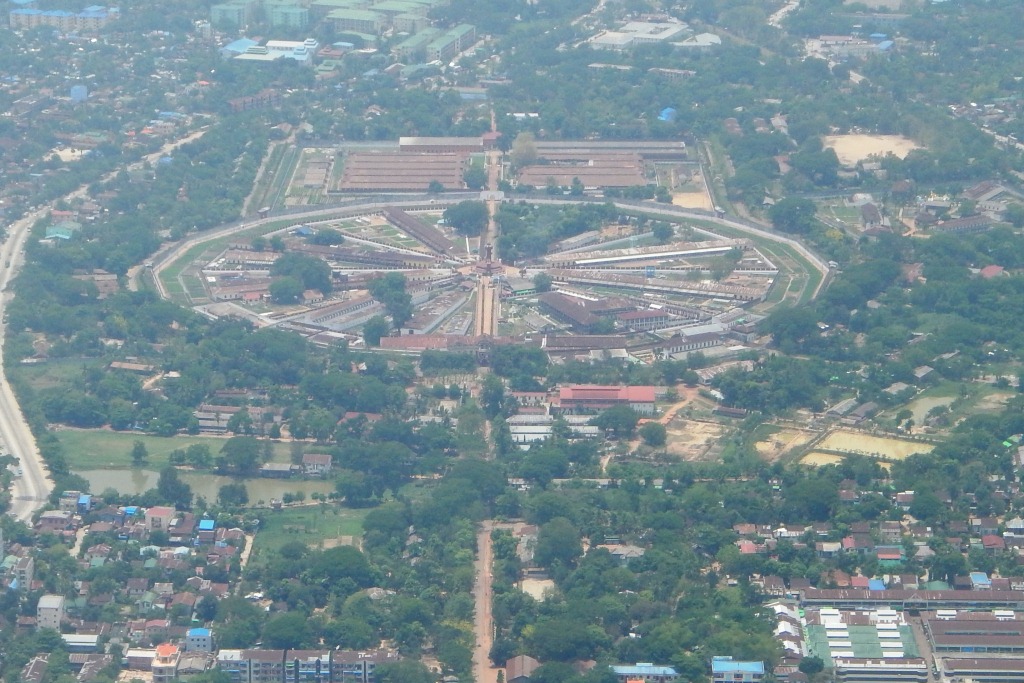
The prison is notorious worldwide for its inhumane conditions, corruption, abuse of inmates, and use of mental and physical torture.[2][3] The facility is closed to the public, but its distinctive radial design is visible from the air when departing Yangon by plane.[4]

History

[edit]

Insein Prison was established in 1887 during British colonial rule, approximately 15 kilometres (9.3 mi) north of downtown Rangoon (now Yangon).[4] The facility was constructed to relieve overcrowding at the Rangoon Central Gaol, located on Commissioner's Road (now Bogyoke Aung San Road) near Downtown Yangon.[5][4] By 1908, both Insein and Rangoon jails each held over 2,000 inmates, making them the largest prisons in British Burma.[4] Prison population statistics were seen by colonial authorities as a sign of effective law enforcement, despite growing concerns about prison overcrowding and harsh conditions.[4]

During the 1920s, Burma had developed a reputation as one of the most violent provinces of British India.[4] With a population of around 13 million, nearly 20,000 individuals—mostly men—were imprisoned annually.[4] Overcrowding led to expansions of existing prisons, including Insein.[4]

Architecturally, Insein Prison was modelled on the Pentonville panopticon system, inspired by 18th-century penal theorist Jeremy Bentham.[4] This design featured radial wings extending from a central observation tower, allowing maximum surveillance and minimal interaction among inmates.[4] It emphasized reform through labor and strict discipline, reflecting evolving penal philosophies of the British Empire.[4]

Following the demolition of Rangoon Central Gaol after World War II (its former site is now occupied by the New General Hospital), Insein became the principal prison serving the Rangoon region.[4] Its reputation for brutality intensified during the military dictatorship of General Ne Win (1962–1988), when it was used to imprison political opponents.[4] Conditions were described as inhumane, with reports of torture, prolonged solitary confinement, and medical neglect.[4]

The prison gained international notoriety after the crackdown on the 1988 pro-democracy uprising.[4] Thousands of activists, students, and intellectuals were detained at Insein under harsh conditions.[4] Among its most well-known former inmates is Dr. Ma Thida, a writer and physician imprisoned from 1993 to 1999.[4] Her memoir, Sanchaung, Insein, Harvard, recounts her experiences and eventual academic journey.[4]

By 2009, Insein had a theoretical capacity of 5,000 to 6,000 inmates, but was believed to be housing up to 10,000.[4] Despite government claims in the 2010s that all political prisoners had been released, independent organizations, including the United Nations and the Thailand-based Assistance Association for Political Prisoners (Burma) (AAPP), reported continued arrests and detentions of political dissidents.[4] The AAPP operates a replica of an Insein prison cell to raise awareness of prison conditions and honor those imprisoned for their beliefs.[4] As of 2015, the AAPP estimated that around 160 political prisoners remained behind its walls, underscoring its ongoing role in Myanmar’s human rights challenges.[4]

Conditions

[edit]

Sanitation and healthcare

[edit]
Insein Prison main gate

At Insein, diseases and injuries usually go untreated. A former prisoner at Insein recalls that "When we had fever they never gave us any medicine. If it gets very bad then they send you to the prison hospital, where many people die. The sick prisoners want to go to the hospital, but the guards never send them there until it's already too late, so many die once they get to the hospital. I got fever but I didn't want to go to their hospital, because I was afraid of their dirty needles and contagious diseases. At the hospital they have doctors, but not enough medicines." The same prisoner continued, "They allowed us to have a bath once a day. We had to line up in rows of five men at a time, and we were allowed five bowls of water, then soap, then seven more bowls of water. But there were many problems – sometimes there was no water supply, so they wouldn't let us take a bath and we could hardly even get water to drink. There were latrines in two places – outside of the room for the daytime, and in the room at night. The latrines always had guards, and to use them you had to bribe the guard with two cheroots. The latrine was just a bucket, with no water. You could use paper if you could get some, but we used to beg scraps of cloth from the men who worked in the sewing workshop out in the compound."[6]

Tortures

[edit]

Prisoners have reportedly been beaten with a rubber pipe filled with sand and chased by dogs, forcing them to crawl on their hands and knees across a gravel path.[6]

Protests within the prison

[edit]

1991 prisoner hunger strike

[edit]

According to a former prisoner's account, in 1991 several prisoners held a hunger strike, demanding proper healthcare and the right to read newspapers. However, their demands were not met, and the prisoners were tortured using the gravel path method.[6]

2008 mass shooting of inmates

[edit]

On 3 May 2008, over 100 prisoners were shot by guards at the prison resulting in the deaths of 36 inmates. A further four inmates were later tortured and killed by the prison guards who believed they had been the ringleaders of the initial protest that culminated in the mass shooting.[7]

2011 prisoner hunger strike

[edit]

On 24 May 2011, the Myanmar government retaliated against a hunger strike by about 30 political prisoners in the prison by forcing the ringleaders into solitary confinement. The hunger strike began when seven female prisoners protested against a government prisoner amnesty program that failed to include most political detainees. On 23 May, 22 male prisoners, including three Buddhist monks, joined the protest, demanding better prison living conditions and improved family visiting rights. According to Aung Din, the executive director of the Washington-based U.S. Campaign for Burma, "The latest information we have received is that six of the ‘leaders’ of the strike from the male group have been moved to what is known as the 'dog cell'—a small cell block where they could be tortured and family visits are not allowed." One of the prisoners moved was an editor of The Kantaryawaddy Times, Nyi Nyi Htun.[8]

2022 prison explosion

[edit]

In October 2022, a blast occurred at the prison in which eight persons died,[9] including guards,[10] and 18 visitors were injured.[11] The incident occurred at 9:40 AM Myanmar Standard Time.[12] According to local witnesses, two parcel bombs detonated in the morning.[13][9][10] but the cause of explosion is yet unknown[14]

Notable prisoners

[edit]

Most famous illegally held prisoners in Insein prison from 1988 to 2017:

  • Intellectual and democracy activist Win Tin, and a host of others who were elected to parliament as members of the National League for Democracy (NLD) in 1990 but not allowed to serve their term in parliament.
  • Aung San Suu Kyi the Nobel Peace Prize-winner human-rights activist was confined to Insein in 2003, 2007 and 2009[15]).
  • Video-journalist Sithu Zeya who was arrested in April 2010 for photographing the aftermath of an attack on civilians by the military junta as a reporter for the Democratic Voice of Burma.[16]
  • Video-journalist Ngwe Soe Lin who was arrested in an internet cafe in Rangoon on April 14, 2010, for his video coverage of Burmese children orphaned by Cyclone Nargis in 2008.[17][18] Democracy activist Aye Yung was held for trial at Insein Prison for distribution of leaflets at Dagon University.
  • Reuters journalists Wa Lone and Kyaw Soe Oo were held for more than 500 days following their arrest on 12 December 2017, due to their investigation of the Inn Din massacre. Amid international outcry over their imprisonment, both were released on 7 May 2019, following a pardon from President of Myanmar Win Myint. While imprisoned in Insein Prison, Wa Lone wrote a children's book, Jay Jay the Journalist.[19]

References

[edit]
[edit]
Revisions and contributorsEdit on WikipediaRead on Wikipedia
from Grokipedia
Insein Prison, officially known as Insein Central Prison, is a maximum-security facility located in Insein Township, Division, . Constructed in 1887 under British colonial administration, it features a distinctive radial design typical of 19th-century penitentiaries. As 's largest prison, it has long served as a primary detention site for political dissidents, with documented overcrowding exceeding three times its intended capacity even before the 2021 military coup. The prison's notoriety stems from persistent reports of severe human rights violations, including torture, inadequate medical care, and deaths in custody, particularly affecting political prisoners held under authoritarian regimes. Following independence in 1948 and through successive military juntas, Insein has functioned as a tool of repression, housing thousands during crackdowns on pro-democracy movements, such as after the 1988 uprisings and the 2021 coup that detained elected leaders, journalists, and activists. Empirical accounts from former inmates and international observers highlight systemic brutality, including forced labor and malnutrition, underscoring causal links between state control mechanisms and prisoner mistreatment rather than incidental failures. Despite occasional amnesties, the facility's expansion and operations reflect ongoing authoritarian legacies, with recent satellite evidence revealing secretive enlargements amid heightened post-coup detentions.

Overview

Location and Establishment

Insein Prison is located in Insein Township on the northern outskirts of , , approximately 15 kilometers from the city center in what was formerly known as Rangoon during British colonial times. This positioning provided strategic isolation from urban populations, aiding in the containment of potential unrest and facilitating administrative control over the facility. The prison was constructed in under British colonial administration as a high-security penitentiary to detain both common criminals and political dissidents during the period of expanding imperial governance in Burma after the Second Anglo-Burmese War. Its establishment reflected the colonial need for a centralized to enforce order amid growing resistance to British rule. Designed with a distinctive radial layout modeled after the prison system, Insein emphasized deterrence through , constant , and compulsory labor, aligning with 19th-century British penal theories aimed at moral reformation and via psychological and physical separation from society.

Capacity and Role in Myanmar's Penal System

Insein Prison, Myanmar's largest detention facility, has an official capacity of approximately 10,000 following judicial reforms aimed at expansion. Despite this, empirical reports from monitors and government assessments indicate routine at two to three times the designed limit, driven by periodic surges in arrests related to security threats and political unrest. For instance, prior to the 2021 military coup, occupancy reached nearly three times intended levels, with conditions exacerbated by inadequate space allocation, such as 220 confined to a 1,200-square-foot room as reported in 2023. This reflects systemic pressures within Myanmar's penal infrastructure, where Insein absorbs excess from national arrest waves without proportional resource scaling. The prison functions as a central hub in Myanmar's penal system, primarily housing high-risk categories including political dissidents, violent offenders, and common criminals, thereby concentrating threats to state authority under centralized control. Under military rule, it has been integral to the junta's containment strategy, processing inflows tied to ethnic insurgencies, pro-democracy protests, and post-coup crackdowns, with thousands of additional detainees added since February 2021. Its role extends beyond routine incarceration to suppressing rebellions, as evidenced by historical spikes in population during periods of , aligning with the broader use of prisons as tools of repression rather than rehabilitation. This positioning underscores Insein's prominence in a penal network marked by colonial legacies and post-independence adaptations for authoritarian control.

Historical Development

Colonial Origins (1890s–1948)

Insein Prison was established in 1887 by British colonial authorities in Burma as a central facility for incarceration amid efforts to consolidate control over expanding territories following the Second Anglo-Burmese War. Designed to enforce order and deter resistance, it became one of the largest prisons in British Burma, incorporating a panopticon-inspired layout modeled after the system, with a central hub and radiating cell wings to facilitate constant surveillance of inmates in individual cells. The structure featured thick stone walls, double gates, and segregated blocks for different prisoner categories, reflecting broader imperial penal reforms emphasizing isolation and reform through confinement. The prison primarily housed common criminals alongside Burmese nationalists opposing colonial rule, serving as a tool for pacification by detaining figures involved in early agitation. Operations relied heavily on labor, with inmates compelled to work on projects such as roads, irrigation systems, and stone quarries; in , for instance, 1,523 from the Burma Jail Labour Corps were deployed to for wartime support. Long-term prisoners often served as officers—overseers and night watchmen—due to their familiarity with local languages and customs, a practice that centralized informal authority within the inmate hierarchy while maintaining British oversight through detailed annual reports on prison administration. Many serious offenders were exiled to the , reducing overcrowding and extending punitive reach beyond Burma's borders. By the 1930s and early 1940s, Insein increasingly detained leaders of the Burmese independence movement, including and Thakin Soe, who co-authored the Insein Manifesto in July 1941 while imprisoned there, critiquing alliances amid rising anti-colonial tensions. The facility's role shifted during with the Japanese invasion in 1942, as occupying forces repurposed it to hold wartime detainees, including Allied prisoners of war, amid broader occupation policies that sometimes involved releasing or conscripting Burmese nationalists against the British. Escapes and internal disruptions occurred as colonial control waned, though the prison's infrastructure endured, facilitating its handover back to British administration by 1945 before Burma's independence in 1948.

Post-Independence Conflicts and Military Rule (1948–2011)

Following on January 4, 1948, Insein Prison adapted to Myanmar's protracted , accommodating detainees from ethnic insurgencies—such as those led by Karen, Shan, and Kachin forces—and communist rebels under the Burma Communist Party, who controlled significant territories and challenged central authority. The facility, inherited from colonial infrastructure, housed prisoners captured during military operations to reclaim insurgent-held areas, contributing to the gradual rise in national prison populations amid efforts to restore order in a fragmented state. Ne Win's 1962 coup and subsequent socialist regime intensified Insein's role in detaining political opponents, including members of the '62 generation who resisted policies and one-party rule. An initial in 1962 released all prisoners, asserting executive control over the system, but reemerged as a tool against dissidents, with Insein serving as a primary site for interrogations and long-term confinement to suppress internal threats. By the late 1980s, overcrowding from accumulated detainees strained the prison, prompting reliance on existing structures without major recorded expansions. The 1988 Uprising, triggered by economic collapse and demanding democratic reforms, saw Insein flooded with arrests; the regime reported 822 individuals jailed by August 9, 1988, many transported there in overcrowded vehicles, resulting in at least 41 student deaths from suffocation during transit from earlier protests. Under the State Law and Order Restoration Council (SLORC, later or SPDC) from 1988 to 2011, Insein functioned as a linchpin in countering urban unrest perceived as destabilizing, holding waves of political prisoners from the '88 generation onward. During the 2007 —monk-led protests against fuel price hikes and —over 100 activists were detained by August 25, with hundreds more monks and civilians transferred to Insein for following raids on monasteries. Military tribunals inside the prison imposed severe sentences, including 20 to 28 years for six labor activists linked to protest organization, underscoring its adaptation for rapid processing of threats to regime stability. These detentions, per government actions, aimed to neutralize coordinated challenges that echoed earlier insurgencies, maintaining cohesion against fragmentation risks documented in official suppression tallies.

Post-2011 Transition and 2021 Military Coup Era

Following the initiation of Myanmar's quasi-democratic reforms in under President , Insein Prison experienced a relative decline in high-profile political detentions as part of broader amnesties that released hundreds of activists to facilitate international re-engagement and ease overcrowding. This trend continued during the (NLD) governance from 2015 to 2021, with political prisoner numbers remaining low—typically under 300 annually—prioritizing criminal over security-related incarcerations amid efforts. The February 1, 2021 military coup reversed this pattern, markedly increasing Insein Prison's usage for detaining anti-junta protesters and dissidents reclassified as threats amid mass . By mid-2024, the Assistance Association for Political Prisoners (AAPP) recorded over 25,000 political arrests nationwide since the coup, with Insein serving as a primary facility for Yangon-based detainees, including organizers of urban resistance networks. These incarcerations targeted individuals accused of and under expanded junta laws, correlating with spikes in detentions during protest waves in 2021-2022. From 2021 to 2025, the junta balanced escalating arrests with periodic amnesties, releasing nearly 4,900 prisoners on April 17, 2025, to mark the New Year, including from Insein Prison via coordinated bus transports, though only 22 were confirmed political prisoners. Similar releases occurred earlier, such as over 6,000 in January 2025 for Day, reflecting pragmatic measures to alleviate capacity strains amid intensification involving ethnic armed groups and People's Defense Forces. Insein played a key role in holding affiliates of the shadow National Unity Government (NUG) and armed resistance figures, with detentions disrupting coordination that junta authorities linked to sabotage operations and territorial losses, thereby contributing to regime efforts to avert broader state fragmentation during the escalating conflict. Empirical data from AAPP tracking shows net political prisoner growth despite amnesties, underscoring the facility's function in containing threats amid documented civil war casualties exceeding 5,000 combatants by 2025.

Physical Infrastructure and Operations

Facility Layout and Expansions

Insein Prison features a radial design modeled after the 19th-century system, constructed by British colonial authorities in 1887 to enable centralized surveillance. The facility centers on an —often described as clock-shaped—surrounded by radiating wings containing cell blocks intended to isolate inmates and prevent communication through high walls between cells. Additional structures include "dog cells," small punishment enclosures historically used for , measuring approximately 1 meter by 1.5 meters and associated with disciplinary measures. An execution area, potentially involving , exists within the perimeter, though internal details remain obscured. Due to strict protocols, verifiable internal maps or diagrams are scarce, with access restricted even to architectural researchers. The prison incorporates physical adaptations for segregating political prisoners from common criminals, such as designated wings or blocks to limit interactions and mitigate internal threats like organized resistance. This separation aligns with operational policies observed since the colonial era, reinforced in modern usage to manage heightened risks from ideologically motivated inmates. Post-2021 military coup expansions addressed surging detainee numbers from anti-junta insurgency arrests, with satellite imagery documenting infrastructure growth. From December 2020 to January 2023, alterations at Insein included upgrading a small internal structure—initially roofless in March 2022—with a blue roof, possibly to conceal execution-related modifications following public hangings in July 2022. Broader Myanmar prison system changes, including 33 new inmate structures outside perimeters and 53 rural labor camps for quarrying and agriculture, supplemented Insein's capacity to hold over 25,900 political detainees arrested since February 2021. These buildouts, verified through commercial satellite analysis up to 2024, prioritized rapid accommodation without public disclosure.

Administration, Security, and Daily Protocols

Insein Prison is administered by the Myanmar Prisons Department (also known as the Correctional Department), which falls under the Ministry of Home Affairs and oversees central prisons including Insein as a primary facility for high-profile detainees. Following the 2021 military coup, administrative control has incorporated direct junta oversight, aligning prison operations with national security priorities amid heightened political detentions. The region's prison director, as of 2019, coordinated with international bodies like the ICRC on improvements, though core remains centralized under departmental protocols inherited from colonial-era manuals. Security protocols emphasize containment in a high-threat setting, featuring a radial perimeter design fortified with watchtowers and, post-2021, expanded external structures to house overflow and deter intrusions or escapes. maintains a permanent on-site presence for interrogations and , particularly targeting political . Due to staffing constraints—exacerbated by overcrowding ratios exceeding 2:1 against designed capacity—internal control relies heavily on officers, long-serving appointed as proxies (e.g., "Thansee" cell leaders) to enforce discipline and report infractions, a practice continuing from pre-independence systems despite reform attempts. Warders, trained under departmental guidelines, prioritize suppression capabilities given the facility's history of unrest. Daily protocols structure routines around order maintenance, beginning with morning roll calls to account for the inmate population, which reached 13,000 in 2019 against a 5,000 capacity. Visitations are tightly regulated, limited to approved family members multiple times weekly under supervised conditions; pre-coup averages saw 900 visitors daily via a 2019-upgraded facility with registration systems, but these were halted post-February 2021 for security reasons and partially reinstated in October 2023 with enhanced screening. Perimeter patrols and internal checks occur at fixed intervals to mitigate risks from external attacks, as evidenced by 2022 bombings targeting visitors.

Prisoner Demographics and Management

Insein Prison accommodates a range of inmates, encompassing individuals convicted of ordinary crimes such as , trafficking, and other non-political offenses, alongside violent criminals and those held for security-related charges including and . Political detainees, charged under laws targeting , opposition activities, or protest participation, have comprised a significant portion, particularly since the 1988 uprisings and 2007 . This mix reflects the facility's role as Yangon's primary high-security prison, though official sources emphasize rehabilitation for common offenders while monitors highlight disproportionate political detentions. The February 1, 2021 military coup precipitated a pronounced shift, with arrests of protesters, participants, and perceived junta opponents swelling the political inmate category; by mid-2021, such cases dominated new intakes, including non-violent actors alongside those linked to armed resistance groups like the People's Defense Force. Verifiable security threats, such as bombing perpetrators executed in July 2022, contrast with bulk detentions for posts or rallies, per data from the Assistance Association for Political Prisoners (AAPP), which documents over 25,900 total political arrests nationwide since the coup, many routed to Insein. AAPP's methodology relies on cross-verified reports from families and releases, though junta claims attribute many to criminal or terrorist acts warranting incarceration. Pre-coup population levels already evidenced severe overcrowding, with occupancy at nearly three times intended capacity as of early , blending steady common criminal inflows with residual political cases from prior eras. Post-coup, numbers more than doubled amid mass detentions peaking in 2021-2022, prompting satellite-observed expansions and temporary structures by 2023. Periodic amnesties, such as the June 30, 2021 release of over 2,000 from Insein—many low-risk detainees—served to alleviate pressure, though re-arrests and ongoing intakes sustained elevated levels into 2025, with AAPP verifying persistent political holdings amid total prison system strains. These trends underscore causal links between political instability and incarceration surges, independent of baseline criminality rates.

Labor, Routines, and Resource Allocation

Inmates at Insein Prison engage in mandatory labor as a core component of incarceration, a practice tracing back to British colonial policies that utilized work for development, such as the formation of the 148th (Burma) Jail Labour in 1918 for projects. Following independence and the 1962 military coup, these programs expanded systematically, with prisoners compelled to perform agricultural tasks in "New Life Camps" involving field plowing, factory production quotas like 3,500 cheroots daily or joss stick manufacturing, and including highway construction, dam building, irrigation canals, and rock quarrying. Such labor serves dual purposes of purported rehabilitation and economic offset for the facility, enabling prison authorities to generate revenue— for instance, approximately 600,000 kyats monthly from incense production in comparable facilities—while minimizing external dependencies in a resource-constrained system. Daily routines center on these work assignments, with inmates, including those in , allocated to manual tasks such as gardening or human waste disposal to maintain operations. Labor extraction occurs amid broader prison logistics, where detainees from police stations arrive routinely at dusk for processing and integration into the workforce pool, sustaining a population of 1,200 to 1,500 at Insein as of early assessments. Meals form another fixed element, with allocations increased from 600 kyats to 975 kyats per inmate daily in the post-2011 reform period to cover basic provisions, though shortfalls persist. Resource allocation emphasizes self-sufficiency through inmate labor outputs, directing proceeds from factory goods and agricultural yields toward facility upkeep amid Myanmar's economic isolation from imposed since the 1990s. This approach, inherited from colonial-era efficiencies, channels prisoners to external labor camps or military fields when internal capacities are exceeded, prioritizing cost recovery over welfare in a system where external funding remains limited.

Conditions and Treatment

Sanitation, Healthcare, and Overcrowding Data

Insein Prison, designed with a capacity of approximately 5,000 inmates during its colonial-era construction, operated at nearly three times that level prior to the February 2021 military coup, according to data from the Assistance Association for Political Prisoners (AAPP). This resulted in multiple inmates sharing small cells, heightening vulnerability to communicable diseases such as , with shared sleeping arrangements on floors reported in rooms housing several hundred prisoners. Post-coup, the inmate population more than doubled from pre-coup figures, reaching around 9,000 by August 2021, prompting the construction of additional temporary barracks to address spatial constraints. Healthcare provisions remain confined to rudimentary on-site clinics offering substandard care, with limited access to specialized treatment or external hospitals for beyond those with acute emergencies. Mortality data indicate heightened risks tied to and inadequate monitoring, including a surge in 2021 where only about 600 of the 9,000 at Insein had received vaccinations by mid-August, correlating with outbreaks and subsequent deaths from respiratory complications among those with underlying conditions. U.S. State Department assessments for 2023 noted instances of 220 confined to 1,200-square-foot spaces, where poor ventilation and hygiene amplified disease transmission without commensurate medical interventions. Sanitation infrastructure, reliant on outdated piping and systems from the prison's 1890s origins, has deteriorated under pressures, leading to inconsistent water access and . Expansions since 2021, including new cell blocks documented via , aimed to mitigate these issues by increasing housing but have not fully resolved foundational deficiencies in and cleaning protocols, as evidenced by persistent reports of floor-based sleeping and minimal hygiene measures like basic handwashing stations.

Disciplinary Measures and Abuse Allegations

Prison authorities at Insein have employed as a routine disciplinary measure for infractions such as participation in protests or strikes, with political prisoners often held in isolation cells for periods exceeding 40 days. Beatings with batons or fists have been reported by former inmates for violations like refusing labor or organizing hunger strikes, including instances where up to 100 prisoners were assaulted following collective actions. These accounts, drawn from testimonies of released detainees, indicate such punishments are applied selectively to political inmates to suppress dissent, though self-reported narratives may include incentives for amplification amid advocacy efforts. Allegations of intensified abuse during interrogations, particularly for security-related cases, include and electric shocks to genitals, as described in survivor testimonies compiled by investigative outlets and monitors. Former prisoners have detailed prolonged sessions of physical torment, such as repeated beatings until evening without sustenance, concentrated on extracting confessions or information from opposition figures. reports have documented signs of among Insein detainees, including in cases of executed prisoners exhibiting trauma marks, yet persistent denial of independent monitoring by authorities hinders empirical verification beyond testimonial evidence. Such practices appear disproportionately targeted at political and security prisoners, with noting group ill-treatment episodes like collective beatings followed by isolation in the 1990s and persisting patterns into recent years. While these claims align across multiple detainee accounts and align with broader detention patterns verified by investigations involving over 100 interviewees, the absence of on-site forensic access limits causal attribution to state policy versus isolated guard actions. Reports from advocacy groups, potentially influenced by opposition affiliations, underscore the challenges in distinguishing verified systemic abuse from anecdotal escalation.

Official Justifications and Empirical Realities

The maintains that rigorous protocols at Insein Prison are indispensable for deterring terrorist activities and preserving order amid protracted multi-ethnic insurgencies and post-2021 resistance operations, which it classifies under counter-terrorism imperatives. Such measures, including heightened security and disciplinary enforcement, are positioned as causal necessities to prevent the escalation of violence in a nation facing armed challenges from groups designated as terrorist organizations by the junta. Empirical indicators of operational efficacy include verified infrastructure developments, with documenting the addition of new cell blocks and perimeter enhancements at Insein Prison between July 2022 and late 2023, effectively doubling segments of the facility to mitigate capacity strains from detainee influxes exceeding 10,000 by mid-2023. These expansions, corroborated by independent geospatial analysis, counter assertions of unaddressed by demonstrating adaptive responses to empirical pressures rather than neglect. Further substantiating restraint within security frameworks, the administration has executed multiple amnesties since the coup, liberating approximately 8,873 political prisoners nationwide—including hundreds from Insein—across 18 releases by April 2025, with notable instances in October 2021 (hundreds freed) and January 2025 (600 political detainees). These actions, tied to national holidays and totaling over 106,000 overall releases, empirically reflect periodic mercy integrated with deterrence strategies, diverging from narratives of unmitigated severity.

Major Incidents

Protests and Hunger Strikes (1991, 2011)

In September 1990, dozens of political prisoners, including students and members of the (NLD), staged a mass at Insein Prison to demand the military government's to the NLD following its landslide victory in the May 1990 . The action highlighted grievances over the junta's refusal to honor the electoral results, amid broader post-election repression that saw elected representatives detained en masse. Prison authorities eventually suppressed the strike through unspecified measures, though participant Aye Lwin reported subsequent beatings that deteriorated his health. These protests stemmed from causal factors rooted in the junta's invalidation of democratic outcomes, exacerbating perceived injustices in prisoner treatment during a period of stalled political transition. While exact participant numbers varied in reports—described as "dozens" by and a "mass" action by academic analyses—no verified accounts confirm claims exceeding 500 inmates, and demands centered on political recognition rather than solely material conditions. In May 2011, at least 22 political prisoners, including women dissidents, launched a protesting inadequate nutrition, substandard living conditions, and transfers to remote facilities despite President Thein Sein's announced for some detainees. The action, starting around May 17, involved figures linked to prior unrest such as the 2007 protests led by monks, reflecting ongoing resistance among Buddhist clergy and activists held for . Authorities responded by isolating leaders in "dog cells" and denying water, leading to reported ill-treatment, though the strike underscored frustrations with partial reforms under the new semi-civilian government. Additional hunger strikes followed in October and November 2011, with 15 prisoners protesting denial of remission rights on October 26 and six in the prison hospital joining on November 10, driven by similar demands for equitable treatment amid Myanmar's tentative political liberalization. These events were triggered by perceived inconsistencies in the post-junta transition, where amnesties released select high-profile figures but left many dissidents facing transfers or neglect, fueling organized resistance without immediate policy concessions. Outcomes included punitive isolations but no verified releases tied directly to the actions, as reported by human rights monitors.

Violent Suppressions and Shootings (2008)

In the immediate aftermath of , which struck on May 2, 2008, severe structural damage at Insein Prison—including torn zinc roofs on cell blocks—prompted guards to herd approximately 1,000 inmates into a single for shelter, exacerbating and sparking among prisoners. This confinement reportedly ignited unrest, with inmates attempting to break out amid the chaos of smoke and structural instability, though the precise trigger—whether pure from the storm's effects or broader frustrations—remains disputed in accounts from survivors and observers. On May 3, 2008, guards, reinforced by soldiers and , responded to the disturbance by opening fire on the inmates, killing at least 36 prisoners in what was described as an effort to prevent a mass escape during the national emergency. Reports from the Assistance Association for Political Prisoners (AAPP), drawing on testimonies from former inmates, corroborated the shooting death toll at 36, attributing the action to firing directly into the crowd. Independent estimates varied slightly, with some appeals citing up to 40 deaths, including injuries from the suppression. authorities denied any fatalities, asserting that security remained intact with no shootings or injuries occurring, a claim consistent with the junta's broader control over information amid the cyclone crisis. The government's stated rationale framed the response as necessary to avert a large-scale breakout that could destabilize Rangoon further, given Insein Prison's proximity to the city center and its housing of both common criminals and political detainees at a time when national resources were stretched by the disaster's toll of over 138,000 deaths. Following the incident, four additional inmates died during subsequent interrogations related to the unrest, reportedly from beatings and , as documented by Democratic Voice of sources citing prison insiders. No independent on-site investigations were permitted, though UN Special Rapporteur Pinheiro urged a probe into the alleged killings, highlighting discrepancies between official denials and eyewitness reports from ex-ers. These events underscored the prison's role in maintaining order under the military regime, with suppression prioritized over amid external pressures from the .

Sabotage Events and Explosions (2022)

On October 19, 2022, two explosions rocked the parcel reception area near the main entrance gate of Insein Prison in , , killing eight people and injuring at least 18 others. The victims included five visitors delivering food parcels to inmates and three prison staff members, with reports noting a 10-year-old girl among the deceased. The blasts occurred around 9:00 a.m. at the facility's mail counter, where packages are screened before entry, prompting immediate gunfire from in response to the attack. The devices were improvised explosive devices concealed within parcels disguised as routine food deliveries for prisoners, exploiting the prison's visitor protocols during Myanmar's ongoing . An armed anti-junta resistance group, part of the broader People's Defense Force network opposing the military regime since the February 2021 coup, publicly claimed responsibility via , framing the operation as a targeted strike against prison personnel involved in detaining political opponents. The junta-affiliated media described the perpetrators as "terrorists," emphasizing the indiscriminate nature of the casualties among civilians and staff, while independent reports corroborated the parcel-based delivery method as a tactic to bypass external perimeter security. Forensic examination by junta authorities revealed the bombs consisted of explosives packed into standard delivery containers, detonating upon handling or proximity at the screening point, which exposed procedural gaps in inspecting inbound materials amid heightened resistance activities. No immediate arrests were reported in the aftermath, but the incident prompted tightened parcel inspection protocols and restricted visitor access at Insein and other facilities, underscoring the prison's exposure to asymmetric in the protracted . This event highlighted Insein Prison's strategic role as a detention center for thousands of regime critics, rendering it a focal point for resistance efforts to disrupt custodial operations through covert infiltration rather than direct assault.

Recent Disturbances and Custody Deaths (2021–2025)

Following the military coup in February 2021, Insein Prison experienced heightened unrest linked to the junta's suppression of anti-regime activities, including protests against the regime's use of . In July 2022, after the execution of four pro-democracy activists—Kyaw Min Yu, Hla Myo Aung, Aung Thura Zaw, and Zayar Thaw—on July 23 inside the facility, prisoners initiated hunger strikes and demonstrations decrying the hangings, marking the first such executions in in over three decades. These actions spread to other prisons, reflecting broader resistance amid the ongoing , though the junta maintained tight control with limited independent verification of the scale. A significant escalation occurred on February 14, 2023——when guards at Insein Prison reportedly shot and killed seven political prisoners during an unspecified disturbance, with details emerging only in from sources connected to the victims' families. The incident, described as occurring under "murky circumstances," underscored tensions from and resistance to junta authority, as the prison housed thousands arrested for opposing the regime. No official junta confirmation was issued, but the killings aligned with patterns of lethal force against detainees amid post-coup arrests exceeding capacity. Custody deaths surged in 2025, with at least 17 political prisoners succumbing to medical neglect across Myanmar facilities, including several at Insein, amid severe overcrowding from mass detentions of anti-junta activists. For instance, Ma Wut Yi Aung died on or around July 19, 2025, from untreated head injuries sustained in custody, while others perished from denied healthcare in conditions where occupancy had ballooned to nearly three times intended levels post-coup. These fatalities, documented by groups like the Assistance Association for Political Prisoners (AAPP) and Political Prisoners Network-Myanmar (PPNM), were attributed to systematic denial of treatment rather than isolated incidents, exacerbating the prison's role in the broader conflict. In partial counterbalance, the junta conducted amnesties, releasing around 6,000 prisoners including approximately 600 political detainees in January 2025 and nearly 4,900 more in April, though these gestures did not address underlying overcrowding or healthcare failures.

Notable Detainees

Domestic Political Figures

Min Ko Naing, whose real name is Maung Aye, emerged as a student leader during the 1988 pro-democracy uprising and co-founded the 88 Generation Students' Group, which organized protests against military rule. Arrested on September 27, 2007, amid the , he was tried inside Insein Prison and sentenced on November 18, 2008, to 65 years and 6 months' imprisonment on charges including high treason for leading demonstrations deemed subversive by authorities. He remained detained there intermittently until his release on January 13, 2012, under a presidential , though he faced rearrest in March 2021 following the military coup for alleged opposition activities. U Gambira, a Buddhist monk and vocal critic of the junta born as Nyi Nyi Lwin, played a central role in coordinating the 2007 protests against fuel price hikes and authoritarian governance. Captured in November 2007, he was convicted in a trial within Insein Prison on November 19, 2008, receiving an initial 12.5-year sentence under laws prohibiting public assembly and state subversion, contributing to a cumulative term approaching 68 years across consolidated charges. Released in 2012 as part of reforms, he was rearrested in 2015 on immigration violations, serving six months in Insein before his unconditional release on July 1, 2016, after additional charges were dropped. Mya Aye, another founding member of the 88 Generation Students' Group and veteran of the 1988 uprising, has been targeted for persistent activism against military dominance. Detained on February 1, 2021—the day of the coup—he was held in Insein Prison and sentenced multiple times, including a third term in March 2022 under Section 505(a) of the penal code for incitement via posts criticizing the regime. His imprisonments highlight the junta's strategy of isolating movement leaders, with prior detentions from 1990 onward totaling over 20 years before the 2021 events.

Journalists, Foreigners, and Other Prominent Cases

American journalist , managing editor of Frontier Myanmar, was arrested on May 24, 2021, at while attempting to leave the country following the military coup. He was charged with under Section 505(a) of the Penal Code, incitement, and violations of the Immigration Act, and held without bail in Insein Prison. On November 12, 2021, a closed-door trial inside the prison sentenced him to 11 years' imprisonment, though he faced potential additional charges carrying life sentences. Fenster was released on November 15, 2021, after diplomatic negotiations involving U.S. special envoy , who met junta leader hours before the release; he departed the following day without serving the full sentence. Japanese freelance journalist Yuki Kitazumi was detained on April 7, 2021, in for filming protests and coverage of the post-coup unrest, charged with spreading false news under Section 505(a). Held in Insein Prison alongside political detainees, he described separations between political and common prisoners but reported harsh conditions including limited access to medical care. Kitazumi was released after approximately three weeks on April 28, 2021, following intervention by Japanese officials and international pressure from groups like . Australian economist , an advisor to ousted State Counsellor on economic reforms, was arrested on the night of the February 1, 2021, coup and initially detained in Insein Prison for several months under charges of treason and espionage under the . Relocated to a military facility in Naypyitaw, he faced a marked by coerced confessions and consular access before being sentenced to three years' hard labor on September 28, 2022. Turnell was freed on November 17, 2022, as part of a junta releasing over 5,000 prisoners, amid Australian diplomatic efforts including high-level appeals to the junta. He later detailed enduring 650 days of and unsanitary conditions in Insein, attributing survival to mental resilience rather than physical mistreatment. These cases reflect the junta's use of vague penal provisions like Section 505(a) to target foreign media personnel for documenting civil unrest, often resolved through quiet diplomatic channels rather than judicial appeal, highlighting tensions between Myanmar's sovereignty claims and international norms on press freedoms.

Controversies and Broader Impact

Human Rights Claims Versus Security Imperatives

Organizations such as and have documented allegations of systematic abuses in Insein Prison, including , denial of medical care, and severe , with reports citing detainee testimonies of beatings, forced labor, and deaths in custody exceeding 1,800 since the 2021 coup. These accounts, often gathered from released prisoners or opposition sources without on-site verification, describe conditions like 220 inmates confined to a 1,200-square-foot space, contributing to disease outbreaks and . Critics contend these practices amount to cruel and inhuman treatment, yet the reliance on potentially biased or unconfirmed narratives from politically aligned detainees raises questions about the completeness of evidence, as independent access to the facility remains restricted. In Myanmar's context of persistent ethnic insurgencies and post-2021 armed resistance involving guerrilla attacks and bombings, Insein serves as a key facility for detaining individuals charged under counter-terrorism and laws, many linked to violent acts such as coordinating explosives or joining People's Defense Forces militias. The junta maintains that stringent incarceration, including harsh regimes, is essential for isolating threats and deterring further destabilization, drawing on historical precedents like the 1988 uprisings, where lax prior governance under civilian rule escalated into widespread riots killing thousands and necessitating military intervention with mass detentions to restore order. Empirical outcomes support this rationale: post-1988 consolidation via facilities like Insein correlated with decades of relative urban stability despite ongoing peripheral conflicts, whereas periods of or leniency, such as partial releases in 2011, coincided with renewed protests and insurgent gains. Quantitative data underscores that political detainees, estimated at around to nationwide as of 2022–2024 amid a total prison exceeding 100,000, represent a targeted subset rather than the majority, with many cases involving documented affiliations to violent groups per junta prosecutions—though opposition monitors classify broader supporters as "political" without always distinguishing non-violent actors. Insein, designed for 5,000–6,000 but housing over 12,000 pre-coup due to common criminal influxes like offenses, illustrates driven partly by security imperatives to preempt coordinated threats, as alternatives emphasizing rehabilitation have historically failed to curb in high-risk profiles amid active civil strife. This tension highlights a causal : while abuses erode legitimacy, deterrence through credible incarceration threats has empirically contained urban insurgencies, preventing the total state fragmentation seen in laxer eras.

International Scrutiny and Junta Responses

The on , Tomás Ojea Quintana, visited Insein Prison in August 2008, conducting private meetings with detainees such as U Gambira amid reports of and inadequate care, which fueled broader calls for access and reforms. Similar limited-access visits by subsequent rapporteurs, including in 2011 and 2013, documented persistent concerns over and health neglect, contributing to international pressure that intensified after the 2021 military coup. Post-coup, entities like the imposed targeted sanctions on Insein Prison's warden, U Zaw Lin Aung, for alleged roles in undermining through detainee mistreatment, while U.S. and U.K. measures addressed protest-related deaths and arbitrary detentions linked to facilities including Insein. These actions reflect scrutiny from bodies privileging dissident accounts, though rapporteurs have noted ongoing restrictions on unmonitored inspections. Myanmar's military administration has rebutted abuse allegations by emphasizing internal disciplinary measures against errant staff and large-scale prisoner releases as evidence of operational improvements. In January 2025, the junta announced the of about 6,000 inmates nationwide, including reductions in sentences for others, followed by nearly 4,900 pardons in April—among them 891 from Insein Prison, comprising locals and foreigners—to coincide with traditional observances. portrayed these as humanitarian gestures reducing overcrowding, countering narratives of systemic cruelty with data on releases totaling over 10,000 in early 2025, though independent verification of political prisoner inclusions remains contested. Western-dominated organizations and media outlets, often aligned with pro-democracy and exhibiting institutional preferences for instability-favoring interpretations over imperatives, have amplified detainee death reports—such as those in Insein during 2024–2025—while seldom contextualizing junta claims of isolated incidents amid anti-regime violence. The junta maintains that such scrutiny ignores causal links between post-coup unrest and necessary detentions, with serving as pragmatic responses to rather than concessions to biased external demands.

Role in National Stability and Criticisms of Narratives

In Myanmar's volatile security landscape, marked by persistent ethnic insurgencies and escalated post-2021 coup violence including over 120 bomb blasts in alone, Insein Prison serves as a primary site for suspects accused of , , and armed subversion, aiding the military's efforts to mitigate urban threats and prevent broader state collapse. The (SAC) has positioned such detentions as indispensable for restoring order in a nation where opposition forces, including People's Defense Forces affiliated with the shadow , have conducted attacks contributing to a deadly . While empirical data linking specific Insein arrests to verifiable reductions in bombings remains limited amid ongoing conflict, the facility's role aligns with causal necessities in failed-state-risk environments, where unchecked release of charged insurgents correlates with heightened , as evidenced by the proliferation of improvised explosive devices post-coup. Critiques of dominant narratives underscore how left-leaning international portrayals, prevalent in outlets like and reports, often frame Insein detainees en masse as innocent "political prisoners" while systematically underemphasizing criminal elements—such as charges tied to documented blasts and assassinations—among them. This selective outrage, rooted in biases favoring pro-democracy over security realism in and NGOs, neglects the reality that many opposition figures transitioned from protests to armed resistance, blurring lines between dissent and threats; for instance, SAC tribunals have convicted individuals under anti- laws for acts that opposition sources deny but which align with verified attack patterns. Such narratives, by privileging unsubstantiated victimhood claims from groups like the Assistance Association for Political Prisoners (AAPP), obscure the junta's security rationale without independent verification of detainee innocence, perpetuating a distorted view that ignores Myanmar's historical cycles of ethnic violence and weak governance. Long-term, Insein Prison's integration into a stable penal system hinges on endogenous capacity-building—enhancing , training, and —rather than exogenous pressures like sanctions, which have empirically failed to catalyze reform in Myanmar's entrenched patronage politics and deepened insurgent entrenchment. Think tanks like the advocate for pragmatic internal dialogues over punitive isolation, noting that external interventions exacerbate divisions without addressing root causal factors like territorial fragmentation. Prioritizing verifiable threat neutralization over ideologically driven releases could foster gradual institutionalization, though persistent biases in global scrutiny hinder balanced assessments of such pathways.

References

Add your contribution
Related Hubs
User Avatar
No comments yet.