Hubbry Logo
Kumbhakarna MountainKumbhakarna MountainMain
Open search
Kumbhakarna Mountain
Community hub
Kumbhakarna Mountain
logo
8 pages, 0 posts
0 subscribers
Be the first to start a discussion here.
Kumbhakarna Mountain
from Wikipedia

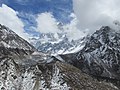
Mount Kumbhakarna or Jannu (Limbu: ᤑᤥᤰᤋᤠᤱᤗᤢᤱᤔᤠ, Phaaktanglungma; in Limbu) is the 32nd-highest mountain in the world. It is an important western outlier of Kangchenjunga, the world's third-highest peak. Kumbhakarna is a large and steep peak in its own right, and has numerous challenging climbing routes. A subsidiary peak, found on the east face of the mountain, Jannu East was known until 2025 as one of the last unclimbed peaks in the Himalayas.

Key Information

The official name of this peak is Kumbhakarna, but the designation Jannu is still better known. It is called Phoktanglungma by the native population, literally "mountain with shoulders" (phoktang means "shoulder" and lungma means "mountain"), in the Limbu language, and is sacred in the yuma religion.

Location

[edit]

Kumbhakarna is the highest peak of the Kumbhakarna Section of the Kangchenjunga Himal (using H. Adams Carter's classification[3]), which straddles the border between Nepal and Sikkim, and lies entirely within Nepal. A long ridge connects it with Kangchenjunga to the east.

Notable features

[edit]

Kumbhakarna is the 32nd highest peak in the world (using a cutoff of 500m prominence, or re-ascent). It is more notable for its climbing challenge, and is one of the hardest peaks in the world in terms of technical difficulty because of its complex structure, its vertical relief, and the particularly steep climbing near the summit. The north face, in particular, has been the scene of some of the most technical (and controversial) climbing achieved at altitudes over 7000m.

Climbing history

[edit]

Kumbhakarna Jannu was first reconnoitered in 1957 by Guido Magnone, and first attempted in 1959 by a French team led by Jean Franco. It was first climbed in 1962 by a team led by the French alpinist Lionel Terray. Those reaching the summit were René Desmaison, Paul Keller, Robert Paragot and Gyalzen Mitchung Sherpa (April 27) and Lionel Terray, André Bertraud, Jean Bouvier, Pierre Leroux, Yves Pollet-Villard, Jean Ravier and Wangdi Sherpa (April 28).[4][5][6]

Their route started from the Yamatari Glacier south of the peak and followed a circuitous route to the large plateau known as the Throne (a hanging glacier south of the summit), continuing to the summit via the southeast ridge.

The huge, steep north face (the so-called "Wall of Shadows") was first climbed in 1976 by a Japanese team led by Masatsugu Konishi (ja:小西政継, by a route that starts on the left side of the face and then meets the east ridge, avoiding the steep headwall at the top of the face (though a New Zealand team had climbed the north face the previous year without proceeding to the summit). A Dutch team ascended the north face in 1987, three men reached the summit but only one made it down. A Slovenian climber, Tomo Česen, claimed a solo ascent of a more direct route on the face in 1989, but this claim is considered suspect by many in the climbing community.[5]

In 2004, after a failed attempt the previous year, a Russian team led by Alexander Odintsov succeeded in climbing the direct north face route through the headwall. This required big-wall aid techniques in a sustained, committing setting at over 7500m, a major achievement. However some in the climbing community were upset to learn that the Russians left a good deal of equipment on the wall, provoking a debate over what constitutes appropriate modern style on such a route.[7] Despite the controversy, the team won the Piolet d'Or for the ascent.

On October 12th 2023, three American climbers, Alan Rousseau, Matt Cornell and Jackson Marvell reached the summit. They climbed with no supplemental oxygen, no ropes fixed in advance, and no porters beyond base camp, using only what they could carry on their backs.[8]

The Himalayan Index lists over a dozen ascents of Jannu; there may be others that have not been written up in climbing literature.

Jannu East
Jannu Est
Jannu East is located in Nepal
Jannu East
Jannu East
Nepal
Highest point
Elevation7,468 m (24,501 ft)
Prominence50 m (160 ft)
Parent peakJannu
Geography
LocationNepal
Parent rangeHimalaya
Climbing
First ascentOctober 15th 2025 by Benjamin Vedrines and Nicolas Jean.

Jannu East

[edit]

The east face of Jannu rises to 7,468 m (24,501 ft).[9] The north face of this subsidiary peak had been described as "arguably amongst the hardest unclimbed, unattempted walls worldwide".[10] In 1991, the mountain was first attempted by a Slovenian team, but the climbers declined their summit bid at 7,050 m (23,130 ft).[11] Several other attempts over the years by Slovenian teams have been unsuccessful.[12]

In 2022, a Spanish team attempted the East face alpine style. They were ultimately unsuccessful.[13]

In 2023, Michael Gardner and Sam Hennessey reached 7,010 m (23,000 ft) via the North face before descending due to high winds.[12] The next year, Gardner and Hennessey returned to the mountain. On October 7, 2024, American climber Michael Gardner died when he fell from Jannu East when attempting a new route up the mountain's north face.[14][15] French climbers Léo Billon, Nicolas Jean and Benjamin Védrines who were also attempting the peak, came to Gardner's climbing partner Sam Hennessey's aid and aborted their attempt on the peak.[16]

French climbers Benjamin Védrines and Nicolas Jean completed the first ascent of Jannu East on October 15, 2025 via a 2,300 m (7,500 ft) alpine style route.[17]

[edit]

References

[edit]
[edit]
Revisions and contributorsEdit on WikipediaRead on Wikipedia
from Grokipedia
Kumbhakarna Mountain, also known as Jannu or Phoktanglungma in the Limbu language (meaning "mountain with shoulders"), is a majestic peak in the eastern Himalayas of Nepal, rising to an elevation of 7,710 meters (25,295 feet) and ranking as the 32nd-highest mountain in the world. Located in Taplejung District, Koshi Province, within the Kanchenjunga Himalayan range at coordinates 27°40'56"N 88°02'47"E, it forms a significant western outlier of Kangchenjunga, the world's third-highest peak, approximately 11 kilometers to its east. The name Kumbhakarna originates from Hindu mythology in the epic Ramayana, where it refers to the enormous demon brother of Ravana. This symbolizes the mountain's colossal and formidable presence that evokes the giant's sleeping form. The mountain's climbing history is marked by extreme technical difficulty, with its first ascent achieved on April 27, 1962, by a French expedition comprising René Desmaison, Paul Keller, Robert Paragot, and Sherpa Gyalzen Mitchung, who summited via the challenging south ridge after a in 1957 and a prior attempt reaching 7,400 meters in 1960. The full , led by Lionel Terray and including members like Jean Ravier and Yvon Léon, completed the ascent over the following days, establishing what was then considered one of the most arduous Himalayan climbs due to the peak's steep faces and walls. Subsequent notable ascents include a Japanese 's climb of the south ridge in 1974, a Czech expedition's of the southwest spur in the 1970s, the 2023 ascent of awarded the Piolet d'Or in 2024 by an American via Roundtrip Ticket (AI5+ M7, 2,700 meters), and in October 2025, French alpinists achieving the of nearby Jannu East (7,468 m). Renowned for its dramatic —a near-vertical 3,000-meter wall of rock and ice that demands elite technical skills— offers breathtaking panoramic views of and surrounding peaks from its summit, making it a coveted objective for advanced mountaineers. Culturally sacred to local Limbu communities, the peak holds spiritual significance tied to regional folklore and the , while its remote location in the Kanchenjunga Conservation Area underscores its role in Nepal's biodiversity and trekking heritage, accessible via a 67-kilometer trek route from Taplejung that typically requires 10-14 days to reach base camp. Despite fewer ascents compared to more famous eight-thousanders, its imposing pyramid summit and unpredictable weather continue to attract climbers seeking high-risk, high-reward adventures in one of the Himalaya's most pristine regions.

Geography

Location

Kumbhakarna Mountain is situated at coordinates 27°40′57″N 88°02′38″E in the of . It serves as a prominent western outlier of the massif within the Kumbhakarna Himal. The peak lies approximately 11 km west of the main summit. Administratively, it falls within in , the northeasternmost province of , where it is part of the Phaktanglung rural municipality. Access to Kumbhakarna Mountain typically begins from Taplejung, the district headquarters, often involving a short flight or drive to Suketar Airport, followed by trekking southward through villages and ridges. Common routes proceed via settlements such as Yamphudin, Chittre, and Tortong, leading to base camps near Ramche or Okwa Glacier at elevations around 4,500–5,000 meters. These paths traverse diverse terrain, including forests and river valleys, before ascending toward the mountain's southern approaches.

Topography and geology

Kumbhakarna Mountain, also known as Jannu, rises to an elevation of 7,711 meters (25,299 feet) above , making it a prominent feature in the Himal range. Its measures 1,035 meters (3,396 feet), which qualifies it as an independent peak and ranks it as the 32nd-highest mountain in the world based on standard criteria of at least 500 meters of prominence. The mountain exhibits a distinctive pyramidal shape, characterized by sharp ridges and steep faces that contribute to its imposing profile in the eastern . The topography of Kumbhakarna is defined by several key features, including its formidable north face, a sheer 3,000-meter wall often referred to as the "Wall of Shadows" due to its persistent shading and extreme steepness, which has long challenged mountaineers. To the south, a prominent ridge extends from the main summit, providing one of the primary access routes for ascents and offering a more defined but still technically demanding path compared to the north face. The mountain supports multiple subsidiary peaks, such as Jannu East at 7,468 meters, which form part of its broader massif and add complexity to its overall structure. Geologically, formed as a result of the ongoing tectonic collision between the Indian and Eurasian plates, which began approximately 50 million years ago and continues to uplift the Himalayan range at rates of several millimeters per year. It lies within the Greater Himalayan Sequence (GHS), a high-grade metamorphic belt spanning the central , primarily composed of , , paragneiss, and migmatites resulting from intense deformation and under amphibolite-facies conditions. These rocks exhibit no unique formations specific to the peak but reflect the broader tectonic evolution of the orogen, with evidence of ductile extrusion and during the .

Etymology and cultural significance

Names and etymology

The official name of the mountain is Kumbhakarna, derived from the Hindu epic Ramayana, where Kumbhakarna is depicted as the giant younger brother of the demon king Ravana, renowned for his immense physical strength and stature that symbolize the peak's formidable presence. This mythological association underscores the name's cultural resonance in Nepal, where the mountain is viewed as embodying epic proportions and power. In Western literature and surveys, the peak has long been known as Jannu, a designation originating from British explorers during the 19th-century of , which mapped the Himalayan region systematically. The term Jannu, unfamiliar to many local high-valley residents, gained prominence through these early cartographic efforts and subsequent expedition accounts, contrasting with the indigenous Nepalese preference for . Among the Limbu people native to the region, the mountain is called Phoktanglungma, a name in the that translates to "mountain with shoulders," alluding to its broad and imposing silhouette as observed from surrounding valleys. This local nomenclature reflects the peak's distinctive and holds spiritual significance in Limbu traditions, where it is regarded as a sacred site. The government has officially adopted as the peak's name to emphasize its ties to Hindu , while Jannu persists as the more familiar appellation in international climbing contexts dating back to 19th-century explorations. This dual naming convention highlights the interplay between local mythology, indigenous , and colonial-era mapping in the Himalayan .

Religious and cultural role

In the Yuma religion, a form of Limbu central to the indigenous Yakthung (Limbu) communities of eastern , Kumbhakarna Mountain—known locally as Phoktanglungma or Faktanglung—is revered as a sacred site embodying the dwelling of protective spirits and deities. This spiritual significance stems from the mountain's integration into the Limbu Mundhum, the oral scriptures that describe nature's elements, including mountains, as animated by souls and ancestral forces requiring respect through rituals and offerings. Local beliefs emphasize prohibitions against fully summiting the peak to avoid disturbing these resident deities, with pilgrims instead conducting worship at base sites like Pânglâng and Yuma Yakna to seek blessings for protection and fulfillment of wishes. Annual pilgrimages organized by Kirat religious groups draw thousands to these areas, reinforcing the mountain's role as a site of communal spiritual renewal. The mountain features prominently in regional as a symbol of immense strength and invincibility, drawing from its etymological ties to the figure , the giant warrior whose legendary sleep and battles mirror the peak's imposing, unyielding presence in Limbu oral narratives. These stories, preserved in the Mundhum, portray Phoktanglungma as a guardian of territory, embodying resilience against external threats and woven into tales of ancestral heroes and cosmic balance. Such manifests in local festivals and rituals, where songs and dances invoke the mountain's protective essence during harvest celebrations and shamanic ceremonies led by phedangma (shamans), fostering intergenerational transmission of cultural values. Interactions between local communities and outsiders have highlighted tensions over the conservation of sacred sites amid permits, particularly in the 20th century when early expeditions navigated Limbu concerns about desecrating spiritual abodes. These dynamics underscore ongoing negotiations between cultural preservation and external access in . Kumbhakarna Mountain profoundly shapes the of Taplejung communities, serving as a in Limbu , , and collective heritage. Expressed in Mundhum recitations and folk songs—such as those likening Limbu pride to the mountain's towering height—it symbolizes and , influencing modern expressions like community murals and literary works that reclaim indigenous narratives against historical marginalization. This enduring role bolsters ethnic solidarity, with organizations like the Kirat Yakthung Chumlung promoting its veneration to sustain Limbu amid .

Ecology

Flora and fauna

The ecosystems surrounding Kumbhakarna Mountain, part of the Kanchenjunga Conservation Area in eastern , exhibit distinct vegetation zones adapted to the Himalayan altitudinal gradient. On the lower slopes up to 3,000 meters, temperate mixed broadleaf forests prevail, featuring rhododendrons (such as ), oaks (Quercus spp.), and ferns in moist understories. Between 3,000 and 5,000 meters, subalpine and alpine meadows dominate, supporting grasses, wildflowers like primulas and gentians, and scattered shrubs including junipers and stunted rhododendrons. Above 5,000 meters, near the mountain's upper reaches, vegetation is limited to resilient lichens and mosses that tolerate extreme cold and low oxygen levels. Notable among the flora are endemic Himalayan species such as the blue poppy (Meconopsis spp.), which blooms in alpine meadows, and diverse orchids found in forested undergrowth. Other significant plants include Nardostachys jatamansi (spikenard) and Taxus wallichiana (Himalayan yew), both of which are harvested for traditional medicines used by local communities to treat ailments like inflammation and respiratory issues. These species contribute to the area's status as a global plant diversity hotspot, with over 2,000 flowering plants recorded in the conservation area. The fauna reflects the rugged alpine habitat, with elusive mammals like snow leopards (Panthera uncia, vulnerable), red pandas (Ailurus fulgens, endangered), Himalayan black bears (Ursus thibetanus), and (Moschus chrysogaster, vulnerable) occupying lower to mid-elevation forests and meadows. High-altitude birds, including the colorful (Lophophorus impejanus) and (Ithaginis cruentus), frequent the shrublands and rocky slopes. In glacial and upper zones, small mammals such as Royle's pikas (Ochotona roylei) and Himalayan marmots (Marmota himalayana), along with cold-adapted insects, sustain the sparse . The region supports over 250 bird species, some of which are migratory, enhancing its role as an eastern Himalayan biodiversity corridor. Climate change exacerbates pressures on these habitats, driving upward shifts in distributions and altering alpine meadow compositions, which threatens the long-term viability of endemic and .

Conservation status

Kumbhakarna Mountain lies entirely within the Kanchenjunga Conservation Area (KCA), a protected region in eastern Nepal's established in 1997 and spanning 2,035 km². The KCA is managed as Nepal's first community-owned conservation area since 2006, overseen by the Department of National Parks and Wildlife Conservation (DNPWC) through the Kanchenjunga Conservation Area Management Council (KCAMC), which promotes community-based tourism and conducts patrols to safeguard and habitats. The area faces significant environmental threats, including climate change-driven glacial retreat, which has lowered glaciers in the vicinity of Kumbhakarna's by up to 200 meters in recent decades due to melting and instability. Human-wildlife conflicts arise from and encroachment, while from expeditions contributes to accumulation and ecosystem pressure. Conservation efforts include programs that engage local Limbu and Rai communities in practices, such as and , to reduce resource dependency and support habitat protection. The World Wildlife Fund (WWF) has provided international funding since 1998, including for monitoring initiatives like camera-trap surveys covering nearly 800 km² to track such as snow leopards. In September 2025, initiated a project to promote transformational change in conservation through enhanced governance and management practices in the KCA. These programs emphasize to address threats while preserving the region's rich .

Climbing history

Early exploration

The earliest recorded Western observation of Kumbhakarna Mountain, also known as Jannu, occurred during British explorer Douglas Freshfield's 1899 expedition to circumnavigate , when he and photographer Vittorio Sella became the first Europeans to sight the peak from the north. This survey, detailed in Freshfield's 1903 publication Round : A Narrative of Mountain Travel and , mapped the broader and noted Jannu's imposing presence as a satellite peak rising to approximately 7,710 meters, though no direct approach was attempted due to logistical constraints and the era's limited focus on rather than ascent. Interest in Jannu intensified in the mid-20th century amid post-World War II Himalayan expeditions. In autumn 1957, French alpinist Guido Magnone led a small team, including Jean Bouvier and Pierre Tordjmann, to assess the mountain's feasibility for climbing. This effort produced the first detailed photographic survey of Jannu's faces and ridges, identifying the north and west aspects as particularly challenging due to steep ice and rock features, while establishing base camp logistics in the remote Taplejung region of . Magnone's report, published in the , emphasized the peak's technical demands and risks, laying groundwork for subsequent attempts without attempting high-altitude advances. Building on this, a larger French expedition in spring 1959, led by Jean Franco—who had previously summited in 1955—attempted the west face, establishing camps up to approximately 7,000 meters, before shifting to the south ridge and reaching about 7,200 meters amid and objective hazards. The team, comprising 11 climbers including Lionel Terray, Robert Paragot, René Desmaison, and Claude Pollet-Villard, retreated due to storms, a massive , and exhaustion, underscoring the route's extreme difficulties, such as unstable seracs and cornices, and highlighting the need for improved equipment and timing in future efforts. This expedition's journal, later compiled in Franco's At Grips with Jannu, provided critical insights into the mountain's alpine challenges. Throughout these early ventures, interactions with local Limbu communities were essential for navigation and support, as indigenous guides shared knowledge of traditional routes through the dense forests and glacial valleys surrounding the peak. These Limbu porters and scouts, familiar with the terrain from cultural pilgrimages, facilitated access to base areas despite occasional tensions arising from the mountain's sacred status in Limbu traditions, which imposed restrictions on certain approaches.

First ascents and major routes

The of Mountain, also known as Jannu, was accomplished on April 27–28, 1962, by a French expedition led by Lionel Terray via the southeast . The 11-member team, which included Jean Couzy, Robert Paragot, Paul Keller, René Desmaison, and Sherpa Gyalzen, completed the climb without supplemental oxygen after establishing multiple camps along the technically demanding route rated at French grade V. This achievement marked one of the earliest successful summits of a major Himalayan peak in the post-war era, highlighting the expedition-style approach prevalent at the time. The imposing , dubbed the "Wall of Shadows" for its shadowy granite and ice features rising over 3,000 meters, saw its in 1976 by a large Japanese expedition led by Masatsugu Konishi. The team employed fixed ropes and siege tactics to navigate the mixed rock and ice terrain, traversing from the left side of the face to the east to bypass the steepest headwall sections, in a climb that combined technical mixed with high-altitude endurance. A landmark direct ascent of followed in 2004 by a Russian team led by Alexander Odintsov, establishing a bold new line rated at WI5 M6 over 2,100 meters. Comprising Mikhail Pershin, Nikolai Totmyanin, and others, the 11-member group spent 50 days at base camp, using a combination of (A3+) and free mixed techniques to overcome the face's overhanging granite buttresses and icy gullies, earning the prestigious Piolet d'Or award for its technical innovation and commitment. In October 2023, an American team of Matt Cornell, Jackson Marvell, and Alan Rousseau completed the first alpine-style ascent of a new route on , named "Round Trip Ticket" (M7 AI5+), in just seven days without supplemental oxygen or fixed ropes. The climbers documented their effort through and , emphasizing lightweight tactics and by minimizing waste and avoiding bolts, which underscored a shift toward sustainable high-altitude alpinism. By 2025, Jannu had attracted over 50 expeditions since the , reflecting its reputation as a testing ground for elite climbers, with a growing emphasis on alpine-style ascents that prioritize speed and minimal impact over traditional siege methods. has required permits for expeditions to peaks like Jannu since the early , regulated by the Department of Tourism to manage access and ensure safety in the remote region.

Jannu East

Jannu East, at 7,468 meters, forms the eastern prominence of the (Jannu) massif in eastern Nepal's region. This subsidiary peak features an imposing north face rising over 2,300 meters, characterized by steep ice, mixed rock and snow terrain, and precarious seracs that pose constant threats of avalanches and rockfall. The face's exposure to extreme Himalayan weather, including high winds and subzero temperatures, combined with its technical demands—requiring advanced big-wall techniques above 7,000 meters—has long marked it as one of the most formidable unclimbed objectives in the range. For over three decades, Jannu East resisted numerous expeditions, with at least 12 documented attempts, many led by Slovenian climbers in the and . Early efforts, such as the 1991 spring expedition by Tone Škarja, Vanja Furlan, and Andrej Štremfelj, were halted by in the fields. Subsequent international teams, including Slovenian groups in the mid- and mixed efforts through the , repeatedly faced similar setbacks from unstable ice and sudden storms, failing to reach the summit despite establishing high points on the face. A tragic incident occurred on October 7, 2024, when American alpinist Michael Gardner fell to his death during a preparation climb on the with partner Sam Hennessey; this was their fourth visit to the peak and third direct attempt on the wall. The of Jannu East was achieved on October 15, 2025, by French alpinists Benjamin Védrines and Nicolas Jean via a new route on the 2,300-meter north face, followed by the narrow east to the summit. Departing base camp on October 12 in alpine style, the pair completed the climb in a four-day single push without fixed ropes or supplemental oxygen, navigating mixed terrain graded up to M6 and WI5. Out of respect for Gardner's memory, they intentionally avoided the more he and Hennessey had attempted, instead pioneering "Le Sommet des Pieux" (The Summit of the Pickets), emphasizing lightweight, ethical fast-and-light tactics in high-altitude . This milestone complements the climbing legacy of the main Jannu peak, reinforcing the massif's status as a crucible for extreme big-wall ascents in the Himalaya and inspiring future generations of alpinists to tackle its remaining challenges.

References

Add your contribution
Related Hubs
User Avatar
No comments yet.