Recent from talks
Nothing was collected or created yet.
Nanda Devi
View on Wikipedia
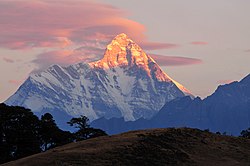
Nanda Devi is the second-highest mountain in India, after Kangchenjunga, and the highest located entirely within the country. (Kangchenjunga is on the border of India and Nepal.[6]) Nanda Devi is the 23rd-highest peak in the world and ranked 74th by prominence in Chamoli Garhwal district of Uttarakhand, in northern India.
Key Information
Nanda Devi was considered the highest mountain in the world before computations in 1808 proved Dhaulagiri to be higher. It was also the highest mountain in India until 1975, when Sikkim, an independent kingdom until 1948 and a protectorate of India thereafter, became a state of India. It is located in the Chamoli district of Uttarakhand, between the Rishiganga valley on the west and the Goriganga valley on the east.
The peak, whose name means "Bliss-Giving Goddess",[5] is regarded as the patron goddess of the Garhwal and Kumaon Himalayas. In acknowledgment of its religious significance and for the protection of its fragile ecosystem, the Government of India declared the peak as well as the circle of high mountains surrounding it—the Nanda Devi sanctuary—off-limits to both locals and climbers in 1983. The surrounding Nanda Devi National Park was declared a UNESCO World Heritage Site in 1988.
Description and notable features
[edit]Nanda Devi is a two-peaked massif, forming a 2-kilometre-long (1.2 mi) high ridge, oriented east–west. The western summit is higher than the eastern summit, which is called Nanda Devi East, (locally known as Sunanda Devi). The main summit stands guarded by a barrier ring comprising some of the highest mountains in the Indian Himalayas, twelve of which exceed 6,400 metres (21,000 ft) in height, further elevating its sacred status as the daughter of the Himalaya in Indian folklore. The interior of this almost insurmountable ring is known as the Nanda Devi Sanctuary, and is protected as the Nanda Devi National Park. Nanda Devi East lies on the eastern edge of the ring (and of the park), at the border of Chamoli, Pithoragarh and Bageshwar districts in India's Uttarakhand state.
In addition to being the 23rd highest mountain in the world, Nanda Devi is also notable for its large, steep rise above local terrain. It rises over 3,300 metres (10,800 ft) above its immediate southwestern base on the Dakshini Nanda Devi Glacier in about 4.2 kilometres (2.6 mi), and its rise above the glaciers to the north is similar. This makes it among the steepest peaks in the world at this scale, closely comparable, for example, to the local profile of K2, in Pakistan. Nanda Devi is also impressive when considering terrain that is a bit further away, as it is surrounded by relatively deep valleys. For example, it rises over 6,500 metres (21,300 ft) above the valley of the Goriganga in only 50 km (30 mi).[7]
On the northern side of the massif lies the Uttari Nanda Devi Glacier, flowing into the Uttari Rishi Glacier. To the southwest, one finds the Dakkhini Nanda Devi Glacier, flowing into the Dakkhini Rishi Glacier. All of these glaciers are located within the Sanctuary, and drain west into the Rishiganga. To the east lies the Pachu Glacier, and to the southeast lie the Nandaghunti and Lawan Glaciers, feeding the Lawan Gad; all of these drain into the Milam Valley. To the south is the Pindari Glacier, draining into the Pindar River. Just to the south of Sunanda Devi, dividing the Lawan Gad drainage from the Dakkhini Nanda Devi Glacier, is Longstaff Col, 5,910 m (19,390 ft), one of the high passes that guard access to the Nanda Devi Sanctuary.[8] For a list of notable peaks of the Sanctuary and its environs, see Nanda Devi National Park.
Exploration and climbing history
[edit]
The ascent of Nanda Devi necessitated fifty years of arduous exploration in search of a passage into the Sanctuary. The outlet is the Rishi Gorge, a deep, narrow canyon which is very difficult to traverse safely, and is the biggest hindrance to entering the Sanctuary; any other route involves difficult passes, the lowest of which is 5,180 m (16,990 ft). The first recorded attempt to explore the sanctuary was in 1883 by W. W. Graham, who could proceed only up to Rishi Ganga.[9] Hugh Ruttledge attempted to reach the peak three times in the 1930s and failed each time. In a letter to The Times he wrote that 'Nanda Devi imposes on her votaries an admission test as yet beyond their skill and endurance', adding that gaining entry to the Nanda Devi Sanctuary alone was more difficult than reaching the North Pole.[1] In 1934, the British explorers Eric Shipton and H. W. Tilman, with three Sherpa companions, Angtharkay, Pasang and Kusang, finally discovered a way through the Rishi Gorge into the Sanctuary. In 1939, the area was declared as a game sanctuary.[10]

When the mountain was later climbed in 1936 by a British-American expedition, it became the highest peak climbed by man until the 1950 ascent of Annapurna, 8,091 metres (26,545 ft). (However, higher non-summit elevations had already been reached by the British on Mount Everest in the 1920s, and it is possible that George Mallory may have reached Everest's summit in 1924.) It also involved steeper and more sustained terrain than had been previously attempted at such a high altitude.[5] The expedition climbed the south ridge, also known as the Coxcomb Ridge, which leads relatively directly to the main summit.[4] The summit pair were H. W. Tilman and Noel Odell; Charles Houston was to be in place of Tilman, but he contracted severe food poisoning. Noted mountaineer and mountain writer H. Adams Carter was also on the expedition, which was notable for its small scale and lightweight ethic: it included only seven climbers, and used no fixed ropes, nor any Sherpa support above 6,200 m (20,300 ft). Eric Shipton, who was not involved in the climb itself, called it "the finest mountaineering achievement ever performed in the Himalaya."[5]
After abortive attempts by Indian expeditions in 1957 and 1961, the second ascent of Nanda Devi was accomplished by an Indian team led by N. Kumar in 1964, following the Coxcomb route.
CIA mission
[edit]From 1965 to 1968, attempts were made by the Central Intelligence Agency (CIA), in co-operation with the Intelligence Bureau (IB), to place a nuclear-powered (SNAP-19C RTG) telemetry relay listening device on the summit of Nanda Devi.[11][12] This device was designed to intercept telemetry signals from missile test launches conducted in the Xinjiang Province, at a time of relative infancy in China's missile program.[13] The expedition retreated due to dangerous weather conditions, leaving the device near the summit of Nanda Devi. They returned the next spring to search for the device, which ended without success.[12] As a result of this activity by the CIA, the Sanctuary was closed to foreign expeditions throughout much of the 1960s. In 1974 the Sanctuary re-opened.
Subsequent climbs
[edit]A difficult new route, the northwest buttress, was climbed by a 13-person team in 1976. Three Americans, John Roskelley, Jim States and Louis Reichardt, summited on 1 September. The expedition was co-led by Reichardt, H. Adams Carter (who was on the 1936 climb,) and Willi Unsoeld, who climbed the West Ridge of Everest in 1963. Unsoeld's daughter, Nanda Devi Unsoeld, who was named after the peak, died on this expedition.[14][15] She had been suffering from "diarrhea and flare-up of an inguinal hernia, which had shown up originally on the second day of the approach march", and had been at 7,200 metres (23,600 ft) for nearly five days.[16]
In 1980, the Indian Army Corps of Engineers made an unsuccessful attempt.[citation needed]
This was followed in 1981 by another Indian Army expedition of the Parachute Regiment, which attempted both main and eastern peaks simultaneously. The expedition had placed a memorial to Nanda Devi Unsoeld at the high altitude meadow of Sarson Patal prior to the attempt. The successful attempt lost all its summiteers.[citation needed]
In 1993, a 40-member team of the Indian Army from the Corps of Engineers was given special permission. The aim of the expedition was multifold: to carry out an ecological survey, clean up the refuse left behind by previous expeditions, and scale the summit. The team led by Lt Col V.K. Bhatt included a number of wildlife scientists and ecologists from Wildlife Institute of India, Salim Ali Centre for Ornithology and Natural History, World Wide Fund for Nature and Govind Ballabh Pant Institute for Himalayan Environment and Development amongst others. The expedition carried out a comprehensive ecological survey and removed from the park, by porter and helicopter, over 1,000 kilogrammes of litter. Additionally, five summiteers reached the summit: Amin Naik, Anand Swaroop, G. K. Sharma, Didar Singh and S. P. Bhatt.[17]
Recent history and conservation
[edit]
After the re-opening of the sanctuary in 1974 to foreign climbers, trekkers and locals, the fragile ecosystem was soon compromised by firewood cutting, littering and grazing. Serious environmental problems were noted as early as 1977, and the sanctuary was closed again in 1983.[4] Currently, Nanda Devi forms the core of the Nanda Devi Biosphere Reserve (which includes Nanda Devi National Park), declared by the Indian government in 1982. In 1988, Nanda Devi National Park was declared a UNESCO World Heritage Site, "of outstanding cultural or natural importance to the common heritage of humankind."[18] The entire sanctuary, and hence the main summit (and interior approaches to the nearby peaks), are off-limits to locals and to climbing expeditions, although a one-time exception was made in 1993 for a 40-member team from the Indian Army Corps of Engineers to check the state of recovery and to remove garbage left by prior expeditions.[17] Sunanda Devi remains open from the east side, leading to the standard south ridge route. After a sustained campaign by the local community as reflected in the Nanda Devi Declaration[19] of 2001, the core zone of the Nanda Devi was opened for limited eco-tourism activity in 2003. In 2006, the campaign invited women trekkers from 4 countries during the inaugural trek inside the National Park. As a follow-up, the Campaign for Cultural Survival and Sustainable Livelihoods has now designed an Interpretive Trek to the Nanda Devi National Park.[20] An Interpretation Centre on Bio Cultural Diversity of the Nanda Devi National Park is under development in the village of Lata, the gateway to the Nanda Devi National Park. A maximum number of 500 trekkers are now allowed to enter the core zone until Dharansi between May and October. The trek to Nanda Devi National Park starts from the village of Lata, located 25 kilometres upstream from the town of Joshimath on Niti-Malari highway.
In June 2019, a group of eight climbers were killed in an avalanche while attempting to climb a previously unclimbed subpeak of Nanda Devi.[21][22]
2021 flood
[edit]On 7 February 2021 it was reported that a portion of the Nanda Devi glacier broke away, causing the Dhauliganga and the Rishiganga rivers to flood. One dam at the Dhauliganga hydropower project at Reni village was destroyed and another suffered a partial collapse. Initial reports said nine people were dead and 140 missing. Water levels on the Alaknanda also rose.[23][24]
Gallery
[edit]-
Nanda Devi peak view from the west near Deodi camp in Rishi Ganga gorge
-
Nanda Devi peak view from outer Sanctuary near Bujgara
-
Nanda Devi peak view from outer Sanctuary near Bujgara closeup
-
Nanda Devi peaks wide view SE from slopes of Kalanka in Changabang Gal
-
Nanda Devi peak N face view from slopes of Deo Damla
-
Nanda Devi north face viewed from Deo Damla approach valley
See also
[edit]References
[edit]- ^ a b c "High Asia I: The Karakoram, Pakistan Himalaya and India Himalaya (north of Nepal)". Peaklist.org. Retrieved 28 May 2014.
- ^ The Himalayan Index gives the coordinates of Nanda Devi as 30°22′12″N 79°58′12″E / 30.37000°N 79.97000°E.
- ^ "Peak Bagger:Himalaya, Central Nepal Himalaya, Khumbu, Ghurka Himal, Annapurna Himal, Xishapangma Area, Sikkim-Eastern Nepal Himalaya, Western Nepal Himalaya, Assam Himalaya, Punjab Himalaya, Bhutan Himalaya, Garwhal Himalaya, Ganesh Himal". Retrieved 22 October 2024.
- ^ a b c Harish Kapadia, "Nanda Devi", in World Mountaineering, Audrey Salkeld, editor, Bulfinch Press, 1998, ISBN 0-8212-2502-2, pp. 254–257.
- ^ a b c d Andy Fanshawe and Stephen Venables, Himalaya Alpine-Style, Hodder and Stoughton, 1995, ISBN 0-340-64931-3.
- ^ "Kanchenjunga", Encyclopedia Britannica, 17 April 2023, retrieved 13 May 2023,
Kanchenjunga, also spelled Kangchenjunga or Kinchinjunga, Nepali Kumbhkaran Lungur, world's third highest mountain, with an elevation of 28,169 feet (8,586 metres). It is situated in the eastern Himalayas on the border between Sikkim state, northeastern India, and eastern Nepal, 46 miles (74 km) north-northwest of Darjiling
- ^ Kumaoun -Himalaya-Ost, 1:150,000 scale topographic map, prepared in 1992 by Ernst Huber for the Swiss Foundation for Alpine Research, based on maps of the Survey of India.
- ^ Garhwal-Himalaya-Ost, 1:150,000 scale topographic map, prepared in 1992 by Ernst Huber for the Swiss Foundation for Alpine Research, based on maps of the Survey of India.
- ^ Centre, UNESCO World Heritage. "Nanda Devi and Valley of Flowers National Parks". UNESCO World Heritage Centre.
- ^ Desai, Shail (7 May 2017). "1965 Nanda Devi spy mission, the movie". mint. Archived from the original on 18 April 2025. Retrieved 23 May 2025.
- ^ a b Ranvijay Singh Hada (18 September 2020). "Nanda Devi's Nuclear Secret and a Botched CIA Operation". Retrieved 22 February 2021.
- ^ Jose, Vinod K. (1 December 2010). "River Deep Mountain High". Caravan Magazine. Retrieved 20 May 2013.
- ^ J. Roskelley, Nanda Devi: The Tragic Expedition (The Mountaineers Books, 2000) ISBN 0-89886-739-8
- ^ Reichardt, Louis F.; Unsoeld, William F. (1977). "Nanda Devi from the North". American Alpine Journal. American Alpine Club. Retrieved 2 January 2025.
- ^ Unsoeld, Willie (1977). "Darkness at Noon: The life and death of Nanda Devi Unsoeld". THE AMERICAN ALPINE JOURNAL.
- ^ a b Sanan, Deepak (1995) Nandadevi – Restoring Glory Sapper Adventure Foundation & Wiley Eastern Limited ISBN 81-224-0752-8
- ^ Nanda Devi and Valley of Flowers National Parks – UNESCO World Heritage Centre
- ^ "Nanda Devi Bio Diversity Conservation and Ecotourism Declaration" (PDF). icimod.org/. 14 October 2001. Retrieved 22 December 2018.
- ^ Misra, Neelesh (15 September 2006). "Nanda Devi opens door". Hindustan Times. Retrieved 22 December 2018.
- ^ Scarr, Simon; Bhandari, Aditi (12 June 2019). "The challenges of retrieving the bodies near Nanda Devi". Reuters. Retrieved 15 August 2025.
- ^ "Nanda Devi: Video reveals last moments of Himalayan climbers". BBC. 8 July 2019. Retrieved 15 August 2025.
- ^ "Uttarakhand glacier burst brings back memory of 2013 flash floods". The Hindu. PTI. 7 February 2021. ISSN 0971-751X. Retrieved 8 February 2021.
- ^ Ellis-Petersen, Hannah (7 February 2021). "Scores feared dead as glacier causes dams to burst in north India". The Guardian. ISSN 0261-3077. Retrieved 8 February 2021.
Books
[edit]- Aitken, Bill. (reprinted 1994). The Nanda Devi Affair, Penguin Books India. ISBN 0-14-024045-4.
- Kohli, M.S. & Conboy, K. (2003). Spies in the Himalayas: Secret Missions and Perilous Climbs, University Press of Kansas. ISBN 0-7006-1223-8.
- Jose, Vinod (2010). River Deep, Mountain High, The Caravan Magazine.
- Malhotra, Ashok (2011) Nude Besides the Lake, Createspace ISBN 978-1463529390
- Roskelley, John. (2000). Nanda Devi: The Tragic Expedition, The Mountaineers Books. ISBN 0-89886-739-8 .
- Sanan, Deepak. (1995) Nandadevi – Restoring Glory – New Age International (Wiley Eastern Ltd), New Delhi. ISBN 81-224-0752-8.
- Shipton, E., Tilman, H.W. & Houston, C. (Reprinted 2000). Nanda Devi:Exploration and Ascent, The Mountaineers Books. ISBN 0-89886-721-5.
- Sircar, J. (1979) Himalayan Handbook, (private pub., Calcutta).
- Takeda, Peter. (2006) An Eye at the Top of the World: The Terrifying Legacy of the Cold War's Most Daring C.I.A. Operation, Thunder's Mouth Press. ISBN 1-56025-845-4.
- Thomson, Hugh (2004) Nanda Devi: A Journey to the Last Sanctuary, Weidenfeld & Nicolson ISBN 0-297-60753-7
- Tilman, H. W., The Ascent of Nanda Devi, Cambridge University Press. 1937.
External links
[edit]- "Kargil war hero missing in Nanda Devi snowstorm" Indianexpress.com
- Nanda Devi Campaign – web site of the local inhabitants
- "Nanda Devi". Peakware.com. Archived from the original on 4 March 2016. – photos
- Unesco World Heritage Site on Nanda Devi
- GMVN – Uttarakhand Tourism page on Nanda Devi National Park
- 'High heaven: a trek to the top of the world' The Independent- article describing the Nanda Devi Sanctuary
Nanda Devi
View on GrokipediaGeography and Physical Features
Location and Topography
Nanda Devi is situated in the Chamoli district of Uttarakhand state in northern India, within the Garhwal Himalayas.[8] Its summit coordinates are 30°22′33″N 79°58′15″E.[8] The mountain rises to an elevation of 7,816 meters (25,643 feet), making it the highest peak located entirely within India's borders.[8] [9] The topography of Nanda Devi features a prominent, isolated massif with steep, sheer faces that contribute to its striking profile.[10] It exhibits a topographic prominence of 3,139 meters (10,299 feet), ranking it among the world's most prominent peaks.[8] The peak forms part of a twin summit structure, with Nanda Devi East at 7,434 meters connected via a rocky ridge.[10] Nanda Devi occupies the center of the Nanda Devi Sanctuary, a high-altitude glacial basin encircled by a formidable ring of subsidiary peaks and ridges, many exceeding 6,000 meters in height.[10] This natural amphitheater creates a pronounced topographic isolation, with access limited to narrow, glacier-choked passes such as the Rishi Nala gorge.[10] The surrounding terrain includes deeply incised valleys, alpine meadows at lower elevations, and extensive snow and ice fields that feed tributaries of the Ganges River system.[10]Geology and Glaciation
The Nanda Devi massif forms part of the Higher Himalayan Crystalline sequence in the Garhwal-Kumaon sector, dominated by granitic gneisses, augen gneisses, and calc-silicate rocks within the Main Central Thrust zone.[11][12] These lithologies reflect high-grade metamorphism during the Miocene, resulting from crustal thickening and anatexis amid the ongoing India-Eurasia collision, which initiated around 50 million years ago and continues to drive uplift rates exceeding 5 mm per year in the region.[13][14] The peak's steep topography arises from differential erosion of these sheared, banded metamorphic units, with tectonic fabrics like foliation and lineations oriented northeast-southwest, parallel to the Himalayan arc.[15] Glaciation on Nanda Devi is pronounced above 4,300 meters, where perennial snowfields and valley glaciers mantle the slopes, contributing to the mountain's isolation within a ring of peaks via the Nanda Devi Sanctuary's glacial cirque.[16] The Dakshini Nanda Devi Glacier descends southwest from the west summit, while the Nanda Devi group encompasses seven interconnected glaciers—Bartoli, Kururntoli, Nanda Devi North, Nanda Devi South, Nandakna, and others—covering an aggregate area of several square kilometers and feeding tributaries of the Ganges system, including the Rishi Ganga and Dhauliganga rivers.[17][18] Observational data from satellite imagery and field surveys indicate glacier snout retreat in the Nanda Devi region, with eight monitored glaciers in the upper Rishi Ganga catchment showing an average recession of 10-20 meters per year from the 1990s to 2010s, varying by aspect and debris cover; northern aspects exhibit slower retreat due to shading and avalanche nourishment.[19][20] This differential response correlates with localized warming of 0.1-0.2°C per decade and reduced winter precipitation, though some supraglacial lakes have expanded, heightening outburst flood risks.[21] A notable glacio-tectonic event occurred on February 7, 2021, when a rock-ice avalanche from a hanging glacier near Rauntholi, upstream of the Uttari Nanda Devi Glacier, dislodged approximately 27 million cubic meters of material, propagating a debris flow down the Rishi Ganga valley and destroying infrastructure.[22] The failure plane involved fractured gneissic bedrock weakened by progressive shearing, underscoring interactions between glacial undercutting and tectonic instability.[23]Cultural and Religious Significance
Role in Hindu Mythology
In Hindu tradition, Nanda Devi is revered as a manifestation of the goddess Parvati, the consort of Shiva and daughter of the Himalayas (Himavan), embodying the sacred feminine energy (Shakti) associated with the mountain's peak.[24][25] Local legends portray her as a princess of divine origin who, pursued by an unwanted suitor—often depicted as an Afghan prince or foreign king—fled into the Garhwal Himalayas and merged her form with the summit to evade capture, thereby sanctifying the mountain as her eternal abode.[26][27] This union symbolizes her protective role over the region, where she is invoked as the patron deity of Uttarakhand's Kumaon and Garhwal divisions, granting bliss (nanda) to devotees while wielding fierce aspects akin to Durga against threats.[28][4] Mythological narratives further describe Nanda Devi as a benevolent force of renewal, credited in ancient tales with mitigating a great flood that submerged the earth by providing refuge and fertility to the Himalayan valleys below.[28] Her iconography often links her to Shiva, portraying the mountain as a site of their cosmic play (lila), where the deity's presence ensures ecological and spiritual harmony, though her wrath is feared for natural calamities like avalanches if desecrated.[29] These stories, rooted in regional oral traditions rather than canonical Puranas, underscore her as a localized avatar emphasizing the Himalayas' sanctity, distinct from broader pan-Hindu depictions of Parvati but aligned with Devi's multifaceted nature as nurturer and warrior.[26][30]Local Worship and Pilgrimages
The goddess Nanda Devi is revered as the kuldevi (clan deity) and patron protector of local communities in the Garhwal and Kumaon regions of Uttarakhand, particularly among the Bhotiya tribe, an ethnic Tibetan group historically engaged in trans-Himalayan trade.[31][32] Worship practices include annual rituals such as the Bikhoti festival in Lata village, where Bhotiya performers don ritual dance masks to honor the goddess during the month of Baisakh (April-May), invoking her blessings for prosperity and protection.[33] Temples dedicated to Nanda Devi, such as those in Almora and scattered across the central Himalayas, host fervent observances during Navratri, featuring processions, offerings, and communal feasts to affirm her role in safeguarding the mountainous terrain and its inhabitants.[34][35] The preeminent expression of devotion is the Nanda Devi Raj Jat Yatra, a cyclical pilgrimage conducted every 12 years, symbolizing the goddess's symbolic departure from her maternal Garhwali home to unite with Shiva at Kailash.[36][37] Originating over 500 years ago in Garhwal folklore, the yatra commences from Nauti village in Tehri Garhwal district and spans approximately 280 kilometers through high-altitude meadows and passes, culminating at Hom Kund near the Roopkund Lake, a site linked to sacrificial rituals.[38][39] The procession, led by a sacred four-horned ram and a silver palanquin carrying the goddess's idol, involves thousands of pilgrims, priests, and performers traversing treacherous terrain over three weeks, typically in August or September, with rituals including animal sacrifices, folk dances, and forest dedications to divine entities for ecological stewardship.[40][41] Local participation underscores communal bonds, with Bhotiya and other hill tribes contributing hereditary roles like pallbearers and musicians, while the event reinforces cultural continuity amid environmental challenges in the Nanda Devi region.[42] The most recent yatra occurred in 2014, with the next scheduled for 2026, drawing participants who view it as the "Himalayan Kumbh Mela" for its scale and spiritual intensity.[37][43] These practices persist as vital to indigenous identity, integrating devotion with seasonal migration patterns historically tied to alpine pastures.[41]Early Exploration and First Ascent
Pre-20th Century Surveys
The Great Trigonometrical Survey of India, commenced in 1802 under British auspices, encompassed early systematic measurements of Himalayan peaks, including Nanda Devi, through triangulation from distant baseline stations. Initially regarded as the world's highest mountain based on preliminary observations, Nanda Devi's preeminence was challenged by 1808 computations establishing Dhaulagiri's superior elevation. Surveyors employed theodolites and angular observations across vast distances, accounting for atmospheric refraction and curvature of the Earth, to compute heights without proximate access, which was impeded by the peak's remote Garhwal location and encircling topography.[44] From 1816 to 1820, William Webb conducted detailed surveys in the Kumaon region, yielding a height for Nanda Devi—locally termed Peak XIV—of 25,669 feet (7,824 m), an estimate deviating by merely 7 meters from contemporary GPS-derived figures of 7,817 m. This precision stemmed from chained triangulation series linking coastal baselines to Himalayan vistas, corroborated by multiple observation points. The GTS also delineated a formidable ring of subsidiary peaks, such as Nanda Kot and Changuch, forming an impassable barrier around the central summit, a feature first mapped in these efforts and later termed the Nanda Devi Sanctuary.[45] Subsequent refinements occurred under Surveyor Generals like George Everest (1830–1843), who oversaw observations from stations in the Dun Valley and Dehradun between 1808 and 1840, adjusting for barometric variations and refining the peak's prominence at approximately 25,643 feet. These surveys prioritized empirical geodesy over exploratory forays, though incidental reconnaissance by officials like G.W. Traill in 1830 provided ethnographic notes on local Garhwali access routes, which remained culturally restricted. Direct approaches, such as W.W. Graham's 1883 attempt via the Rishi Ganga Valley, yielded partial sketches but failed to breach the inner ring, underscoring the surveys' reliance on remote methods for verifiable data.[4][46]1936 Expedition and Success
The 1936 British-American Himalayan Expedition aimed to achieve the first ascent of Nanda Devi, the highest peak in the Garhwal Himalayas at 7,816 meters. Organized jointly by climbers from the United Kingdom and the United States, the team was led by H. W. Tilman and comprised Noel E. Odell and T. Graham Brown from Britain, along with Americans Charles S. Houston, Adrian G. Carter, Peter R. Lloyd, W. F. Loomis, and A. B. Emmons III.[47] The group assembled at Ranikhet, Uttarakhand, on July 6, 1936, with extensive gear transported by lorries to the trailhead at Garur, where local Dotial porters were engaged for the march to base camp.[2][48] Access to the mountain required navigating the formidable Rishi Ganga gorge, a narrow canyon first penetrated by Eric Shipton and Tilman in 1934, leading into the isolated Nanda Devi Sanctuary. The expedition established a base camp at approximately 3,700 meters in the Sanctuary, followed by advanced camps along the southwest ridge route, which featured steep snow, ice cliffs, and mixed rock terrain.[49][2] Challenges included heavy monsoon rains delaying progress, logistical strains with Sherpa and local porters carrying loads up to 25 kilograms each, and technical difficulties in fixing ropes on vertical ice sections rising over 100 feet.[48] Support teams, including Houston and Carter, managed lower camps to ferry supplies, enabling the summit push.[50] On August 29, 1936, Tilman and Odell departed from Camp VI at around 7,200 meters, traversing the final ridge under clear conditions to reach the summit at approximately 3 p.m.[50][51] The pair spent about an hour on top, confirming no higher human achievement prior, as Nanda Devi surpassed previous records like those from Kamet in 1931.[2] Descent to Camp VI followed immediately, with the full team evacuating the mountain by early September amid worsening weather. Tilman's detailed account in the Himalayan Journal emphasized the route's viability for future climbs while noting the peak's isolation and technical demands.[49] The success elevated mountaineering standards, demonstrating effective international collaboration and high-altitude logistics in the pre-oxygen era.[48]Geopolitical Expeditions and Nuclear Incident
1965 CIA-India Mission Objectives
The 1965 CIA-India mission, conducted under the auspices of Project 397, sought to install a covert nuclear-powered surveillance station on the summit of Nanda Devi to intercept intelligence on China's burgeoning nuclear and missile programs. Prompted by China's inaugural atomic test on October 16, 1964, at the Lop Nor facility, the operation addressed U.S. needs for reliable ground-based monitoring after aerial options like U-2 overflights proved vulnerable following shoot-downs over Soviet and Chinese territory.[52] [53] The primary objective centered on deploying a compact device weighing approximately 35 kilograms, powered by a plutonium-238 radioisotope thermoelectric generator (RTG) known as a SNAP unit, equipped with sensitive antennas and receivers to capture radio telemetry signals from Chinese missile tests conducted roughly 300 miles northward. These signals would disclose critical parameters such as missile trajectories, payload capacities, and compatibility with nuclear warheads, enabling evaluations of China's progress toward intercontinental ballistic capabilities and overall nuclear arsenal sophistication.[52] [54] Nanda Devi's selection stemmed from its unparalleled height of 7,816 meters within undisputed Indian borders, offering unobstructed line-of-sight reconnaissance while minimizing risks of detection or incursion by Chinese forces. The joint effort with India's Intelligence Bureau facilitated transport via Indian mountaineering experts, driven by New Delhi's post-1962 border war incentives to counter shared threats from Beijing through reciprocal data access, though the mission's secrecy precluded broader governmental acknowledgment at the time.[52] [55][5]Mission Failures and Lost Device
In October 1965, a joint team of Indian mountaineers from the Intelligence Bureau, supported by the CIA, attempted to install a plutonium-powered radioisotope thermoelectric generator (RTG) atop Nanda Devi to establish a remote telemetry station for monitoring Chinese nuclear tests at Lop Nur.[52][5] The device, weighing approximately 80 pounds and designed for long-term operation without battery replacement, was transported via a multi-stage ascent involving fixed ropes and camps up to 22,000 feet.[52][56] A severe blizzard struck during the push toward the summit, halting progress at around 25,000 feet and preventing further advancement; the team secured the RTG to the mountain face with ropes before descending for safety.[52][5] Upon return, the climbers discovered that an avalanche, likely triggered by the storm's heavy snowfall, had severed the securing lines, sending the device tumbling into a deep crevasse or down the glacier-covered slope, rendering it irretrievable at that location.[52][56] No immediate human casualties were reported from the incident, but the loss compromised the mission's core objective of establishing high-altitude surveillance overlooking Chinese territory.[5] Recovery operations commenced in 1966, involving multiple expeditions equipped with radiation detectors, such as neutron counters, and metal detectors to probe crevasses, scan for radiation signatures, and detect metallic objects, but all efforts yielded no results amid the unstable terrain and persistent weather hazards.[52][57] Further searches through the late 1960s, including seismic monitoring and climber teams, similarly failed to locate the RTG, which declassified assessments indicate remains lost within the Nanda Devi glacier system, potentially encased in ice with gradual movement toward lower elevations over decades.[6][5] The device's plutonium-238 core, estimated at several kilograms, was engineered for heat generation rather than fission, but its unrecovered status has prompted ongoing concerns about environmental containment in the fragile Himalayan ecosystem.[52][56]Mountaineering Achievements and Challenges
Post-1936 Climbs and Records
The second successful ascent of Nanda Devi's main summit (7,816 m) occurred on August 27, 1964, by an Indian expedition organized by the Indian Mountaineering Foundation and led by Captain Narinder Kumar, following unsuccessful attempts by Indian teams in 1957 and 1961.[58] The team followed the original 1936 route via the south ridge, establishing multiple camps in the Nanda Devi Sanctuary, and marked the first ascent by an all-Indian party, with several Sherpas including Nawang Gombu among the summiteers.[59] Subsequent climbs in the 1970s included an Indo-French expedition in 1975, which achieved the third official ascent of the main summit via the south ridge, with Indian Army officer Colonel Prem Chand among the summiteers; this effort also contributed to the second recorded ascent of the adjacent Nanda Devi East (7,434 m) summit by Tenzing Norgay and Louis Dubost during related traverses.[60] A notable record was set in 1976 by an American team led by Albert Reichardt, who completed the fifth ascent via a new route on the northwest face and north ridge, reaching the summit on September 1; climbers Jim States, Galen Rowell, and John Roskelley pioneered this technically demanding line, bypassing the traditional southern approach and highlighting the peak's northern aspects for the first time.[61] Between 1974 and 1982, following the reopening of access to the Sanctuary, at least 15 expeditions targeted Nanda Devi and its east peak, resulting in additional successful summits primarily via established southern routes, though exact numbers remain limited due to variable reporting and the peak's remoteness.[62] These efforts underscored Nanda Devi's status as India's highest entirely domestic peak, with ascents challenging due to its steep rock faces, seracs, and weather, but no further route records were established before the 1983 ban on climbing, which halted all permitted expeditions to protect the fragile Sanctuary ecosystem.[10]Factors Leading to 1983 Climbing Ban
The 1983 ban on mountaineering expeditions to Nanda Devi stemmed primarily from extensive ecological damage inflicted by unregulated climbing activities in the preceding decades. Prior to the prohibition, numerous expeditions—often involving large teams and prolonged stays—resulted in deforestation, soil erosion, waste accumulation, and disruption of fragile alpine flora and fauna within the Nanda Devi Sanctuary. A study documented heavy destruction of biological resources, including rare endemic species, due to uncontrolled human interference that exceeded the ecosystem's carrying capacity.[63] Indian authorities cited this environmental degradation as the core rationale, with excessive expeditions before 1983 having irreparably harmed the biosphere's integrity.[64] Contributing to the decision were lingering security concerns tied to a 1965 joint U.S.-India intelligence operation, during which a nuclear-powered surveillance device fueled by approximately 5 kg of plutonium-238 was lost in an avalanche while being transported toward Nanda Devi's summit for monitoring Chinese nuclear activities. Follow-up recovery efforts in 1966 failed, leaving the device unrecovered at high altitude, and its existence was declassified in 1978, heightening fears of radioactive contamination if climbers disturbed the site.[5][65] While not the sole factor, this incident amplified calls for closure to mitigate risks of environmental and health hazards from potential device breach.[66] The sanctuary's inherent ecological fragility, characterized by steep terrain, thin soils, and biodiversity hotspots including snow leopards and blue sheep, underscored the need for total restriction to allow recovery. Post-ban assessments confirmed that prior commercialization of tourism had polluted water sources and accelerated habitat loss, justifying the indefinite prohibition on access to both locals and outsiders except for limited scientific or military purposes.[67] This measure aligned with broader conservation priorities, though it later drew scrutiny for socioeconomic impacts on dependent communities.[63]Conservation Measures and Ecological Outcomes
Establishment of Protected Areas
The Nanda Devi Sanctuary was established in 1939 as India's first Himalayan game sanctuary, covering the inner basin around the peak to safeguard wildlife populations such as snow leopards and Himalayan tahr, prompted by observations of habitat disturbance during early 20th-century expeditions.[68] This initial protection, spanning roughly 200 square kilometers, restricted hunting and grazing to mitigate threats from unregulated human activity in the high-altitude alpine meadows.[32] In 1982, under the Wildlife (Protection) Act of 1972, the sanctuary was expanded and redesignated as Nanda Devi National Park, encompassing 630.33 square kilometers in Chamoli and Pithoragarh districts of Uttarakhand, with the objective of conserving endemic flora like the endangered Saussurea costus and subalpine forests while prohibiting resource extraction and permanent settlements.[32] The park's core, known as the Inner Sanctuary, remained largely inaccessible, building on prior closures to prevent ecological degradation from trekking waste and livestock overgrazing documented in surveys.[68] The Nanda Devi Biosphere Reserve was notified in 1988 by the Indian government, integrating the national park as its core zone within a total area of 2,236.74 square kilometers that includes buffer and transition zones for sustainable land use and research.[69] UNESCO recognized it as part of the World Network of Biosphere Reserves that year, citing its role in preserving trans-Himalayan biodiversity hotspots with over 300 bird species and rare mammals, though implementation faced challenges from limited local involvement in planning.[70][32] The reserve's structure emphasized scientific monitoring over tourism, extending protections to adjacent areas like the Valley of Flowers to address watershed integrity and genetic diversity conservation.[69]Biodiversity Recovery and Scientific Value
The 1983 ban on mountaineering, grazing, hunting, and resource extraction within Nanda Devi National Park, enforced as part of broader conservation measures, facilitated marked biodiversity recovery by minimizing anthropogenic pressures. Forest cover and density improved substantially in the decades following the restrictions, as documented in ecological assessments attributing the gains to halted livestock browsing and wood collection.[71] [72] This recovery extended to wildlife populations, with blue sheep (Pseudois nayaur), a primary prey species for snow leopards, exhibiting increased abundance in the protected core zone compared to adjacent grazed areas.[73] Himalayan musk deer (Moschus chrysogaster), classified as endangered, have shown slow but steady population stabilization, benefiting from reduced poaching and habitat disturbance.[74] [75] The park's core zone, designated a strict no-entry area except for periodic scientific access, has preserved a largely undisturbed habitat supporting seven of India's 18 endangered large mammal species, including snow leopards (Panthera uncia), brown bears (Ursus arctos isabellinus), and serow (Capricornis thar).[76] Avian and invertebrate diversity, encompassing threatened birds and the endemic snow Apollo butterfly (Parnassius hardwickii), has likewise benefited, with overall biodiversity demonstrating "phenomenal improvement" over 20 years of stringent protection post-1988 World Heritage listing.[76] Floral richness, including rare alpine species like aconite (Aconitum spp.) and blue poppy (Meconopsis), has been bolstered by natural regeneration in the absence of overexploitation.[76] Nanda Devi's scientific value lies in its role as a baseline control site for Himalayan ecological research, enabling long-term monitoring of high-altitude biodiversity dynamics. Decadal expeditions, such as the 1993 Nanda Devi Scientific and Ecological Expedition, surveyed over 620 plant species across 400 genera and assessed faunal habitats, establishing benchmarks for subsequent evaluations.[32] [70] These efforts, conducted by institutions like the Wildlife Institute of India, track flagship species (e.g., snow leopards, blue sheep) and indicators of ecosystem health, informing broader conservation strategies amid climate pressures.[76] The reserve's isolation has also supported studies on threatened medicinal plants, identifying 34 high-value species and their habitat suitability, underscoring its contributions to ethnobotany and pharmaceutical research.[77]Criticisms of Restrictions on Human Activity
Local communities in the buffer zones of Nanda Devi Biosphere Reserve have criticized conservation restrictions for curtailing traditional resource use, including grazing, fuelwood collection, and harvesting of non-timber forest products such as medicinal plants, without providing sufficient alternative livelihoods.[78] These limitations, imposed after the area's designation as a national park in 1982 and biosphere reserve in 1988, led to estimated annual household losses of approximately Rs. 1,587 from restricted medicinal plant collection and Rs. 7,904 from bans on other activities like pastoralism.[79] Critics argue that park authorities failed to integrate local knowledge or involve communities in management planning, fostering resentment and conflicts over exclusionary policies that prioritized biodiversity over human needs.[80] The 1983 ban on mountaineering and adventure tourism, intended to halt ecological degradation from unregulated expeditions, has drawn particular ire for eliminating income from guiding, portering, and related services that previously supported thousands of households.[63] Studies document socio-economic fallout, including reduced employment opportunities in the 45 buffer zone villages home to over 15,000 residents, many reliant on seasonal tourism prior to the closure.[71] Local opposition stems from the perception that the ban, while aiding biodiversity recovery, ignored the subsistence economy, leading to poaching, illegal resource extraction, and outmigration as unaddressed tensions between conservation goals and community rights persisted.[3] Despite broad local support for conservation efforts—reported at 85% in surveys—negative attitudes toward restrictions arise from inadequate access to resources and wildlife-related damages, such as crop raiding, which exacerbated economic strains without compensatory mechanisms.[81] Mean annual losses per household from such damages reached Rs. 1,285 for food crops, Rs. 1,195 for fruit trees, and Rs. 156 for livestock, underscoring critiques that strict human activity bans inadvertently amplified vulnerabilities for resource-dependent populations. Proponents of reform advocate for participatory models, including regulated ecotourism in buffer areas, to balance ecological protection with sustainable development, though implementation gaps have prolonged grievances.[83]The 2021 Chamoli Disaster
Sequence of Events and Immediate Causes
On February 7, 2021, at approximately 10:21 IST, a massive rock and ice avalanche initiated the Chamoli disaster when roughly 27 million cubic meters of material detached from an unstable cliff face at around 5,600 meters elevation on the north flank of the Trisul massif, above the Ronti Gad valley in the Chamoli district of Uttarakhand, India.[22] This failure involved fractured bedrock and a small overlying glacieret, with satellite observations indicating pre-event deformation and motion of the rock mass dating back months, suggesting progressive instability rather than a sudden glacial lake outburst flood (GLOF).[84] [85] The avalanche accelerated downslope at speeds exceeding 70 meters per second, scouring the narrow Ronti Gad channel and entraining additional loose sediment, ice, and supraglacial debris from a hanging glacier below, which transformed the flow into a hyperconcentrated debris surge by approximately 10:25 IST.[22] This surge breached into the main Rishiganga River valley around 10:30 IST, generating a destructive flash flood that overtopped and obliterated the Rishiganga hydropower plant (13.5 MW capacity) located about 10 kilometers downstream, with eyewitness accounts and video footage capturing the event's onset near the plant.[86] [87] The debris-laden flood propagated further, reaching the confluence of the Rishiganga and Dhauliganga rivers by roughly 10:45 IST, where it inundated the under-construction Tapovan-Vishnugad hydroelectric project tunnel and associated infrastructure, depositing thick layers of boulders, mud, and ice across the valley floor before partially attenuating in the wider Alaknanda River channel downstream.[22] [86] Immediate causes centered on the geological failure of the overhanging rock spur, likely exacerbated by undercutting from prior erosional events, freeze-thaw cycles, and permafrost degradation, though analyses ruled out a primary GLOF mechanism—initial speculations of a Nanda Devi glacier burst were refuted by post-event modeling and remote sensing data showing no significant supraglacial lake drainage.[22] [85] [88] The event's rapidity stemmed from the steep Himalayan topography, which amplified flow velocity and entrainment, with no evidence of anthropogenic triggers like nearby construction directly precipitating the detachment.[87]Casualties, Damage, and Attribution Debates
The flash flood resulting from the February 7, 2021, rock-ice avalanche in Chamoli district claimed the lives of over 200 people, with official counts reporting 204 individuals killed or missing, including workers at hydropower sites and local residents.[89] Recovery efforts yielded 83 bodies and 36 additional human remains by May 2021, though many victims remained unrecovered due to the remote terrain and ongoing debris flows.[90][91] Infrastructure damage was extensive, with the flood obliterating the 13.5 MW Rishi Ganga hydropower plant and its barrage, while inflicting severe destruction on the under-construction 520 MW Tapovan-Vishnugad hydropower project, including tunnels, worker camps, and access roads.[87] Direct economic losses from the two hydropower facilities exceeded $223 million USD, encompassing reconstruction costs and lost generation capacity, alongside widespread scouring of roads, bridges, and villages like Raini.[22] The event also triggered secondary landslides and sediment remobilization, exacerbating long-term erosion in the Rishi Ganga and Dhauliganga valleys, with total estimated losses approaching Rs. 20,000 million (approximately $240 million USD at contemporary exchange rates).[92][93] Attribution debates initially focused on a glacial lake outburst flood (GLOF) or pure glacier burst, but satellite imagery, seismic data, and modeling confirmed the primary trigger as a ~27 million cubic meter rock-ice avalanche detaching from the Raunthi saddle at ~5,800 meters elevation, which entrained water and debris to form a high-velocity flow.[22][89] Scientific analyses identify natural drivers, including gravitational instability from steep topography, loose fractured rock exacerbated by heavy snowfall accumulation in headwall cracks, and permafrost degradation linked to rising temperatures, rather than direct human causation.[84][94] Critics, including environmental advocates, contend that prolific hydropower development in the seismically active and ecologically fragile Himalayan region amplified vulnerability by placing infrastructure in debris-flow paths and potentially destabilizing slopes through tunneling and blasting, though no peer-reviewed evidence substantiates these activities as the avalanche's proximate cause.[95] Proponents of expanded projects argue the disaster underscores the need for resilient engineering in inherently hazardous zones, with the avalanche's scale—equivalent to kinetic energy of multiple atomic bombs—overwhelming any localized human influence.[96] These debates highlight tensions between empirical geological assessments prioritizing endogenous Himalayan instability and broader concerns over cumulative anthropogenic pressures like climate-induced thaw and unchecked development.[22][87]Contemporary Issues and Access Reopening
Socio-Economic Impacts of Long-Term Closure
The imposition of restrictions on access to the Nanda Devi core zone following the establishment of the national park in 1982 and subsequent biosphere reserve designation in 1988 led to substantial economic losses for adjacent Bhotiya communities, who historically relied on mountaineering expeditions for porterage, guiding, and supply services.[97] In villages such as Lata, Reni, and Tolma, tourism-related income constituted a primary livelihood source prior to the closures, with the ban on adventure activities representing the most severe economic disruption.[97] Approximately 80% of households in these areas reported acute financial distress, as alternative employment options were limited in the high-altitude, resource-scarce environment.[97] Restrictions on traditional resource use compounded these effects, including bans on commercial collection of medicinal plants and limitations on grazing in buffer zones, which households estimated caused annual losses of Rs. 1,587 from nontimber forest products and Rs. 7,904 from curtailed pastoral activities.[98] These measures curtailed subsistence practices integral to local agro-pastoral economies, without effective provision of compensatory development programs or skill training for non-tourism sectors.[99] The resulting income deficits accelerated out-migration, particularly of younger males, to urban centers like Dehradun and Delhi, depopulating villages and eroding social structures such as joint family systems and cultural knowledge transmission.[63] Human-wildlife conflicts intensified as protected area policies facilitated wildlife population rebounds, leading to uncompensated crop depredation and livestock losses that further strained household budgets in the absence of viable insurance or relief mechanisms.[100] Local surveys indicated that such conflicts affected most buffer zone villages, with wildlife incursions displacing agricultural productivity and reinforcing perceptions of inequitable conservation burdens borne disproportionately by marginalized highland residents.[101] Overall, the long-term closures prioritized ecological preservation over socioeconomic integration, fostering resentment and unsustainable dependence on sporadic government aid rather than fostering resilient local economies.[102]2025 Reopening Plans and Balancing Debates
In July 2025, the Uttarakhand state government announced intentions to reopen Nanda Devi peak—the highest mountain entirely within India at 7,816 meters—for regulated mountaineering expeditions, ending a ban in place since 1983 that restricted access to the inner sanctuary to protect its fragile alpine ecosystem.[7][103] The proposed framework includes limited annual permits, mandatory environmental impact assessments, and strict protocols such as waste management and group size caps to minimize human footprint, with approvals required from both state tourism authorities and national bodies like the Ministry of Environment, Forest and Climate Change.[104][7] As of October 2025, implementation details remain under review, with no expeditions confirmed for the peak's main west summit, though adjacent Nanda Devi East (7,434 meters) has seen permitted treks and climbs in prior years.[105] The reopening plans have ignited debates over balancing conservation imperatives with socio-economic opportunities. Proponents, including state tourism officials, emphasize potential revenue for local communities in Chamoli and Pithoragarh districts, where restricted access has limited livelihoods dependent on guiding, portering, and related services; they cite successful regulated models on peaks like Everest as evidence that controlled access can generate funds for park maintenance without irreversible harm.[104][106] Critics, including ecologists and indigenous Bhotiya representatives, counter that the 1983 ban enabled measurable biodiversity gains—such as population rebounds in snow leopards and blue sheep— and warn that even limited climbing could introduce microplastics, human waste, and trail erosion in an area with thin soils and high seismic activity, as evidenced by the 2021 Chamoli glacial burst linked to upstream fragility.[74] They also highlight the peak's sacred status in Hindu tradition as the abode of Goddess Nanda, arguing that commercial expeditions profane its cultural sanctity, a view echoed in petitions from local priestly groups opposing any non-pilgrimage access.[103] Resolution of these tensions hinges on empirical monitoring; preliminary studies commissioned by the state in 2025 aim to assess carrying capacity using data from satellite imagery and ground surveys, but skeptics question the impartiality of tourism-driven assessments, given Uttarakhand's reliance on adventure revenue amid post-pandemic economic pressures.[7] If approved, initial expeditions could commence in the 2026 pre-monsoon season, pending clearance, with ongoing debates underscoring the challenge of quantifying ecological thresholds against verifiable economic uplift in remote Himalayan regions.[105]References
- https://www.[researchgate](/page/ResearchGate).net/publication/223195437_Conservation_policy-people_conflicts_A_case_study_from_Nanda_Devi_Biosphere_Reserve_a_World_Heritage_Site_India
