Hubbry Logo
Joe ProfaciJoe ProfaciMain
Open search
Joe Profaci
Community hub
Joe Profaci
logo
8 pages, 0 posts
0 subscribers
Be the first to start a discussion here.
Joe Profaci
Joe Profaci
from Wikipedia

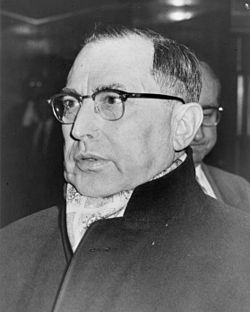
Giuseppe "Joe" Profaci (Italian: [dʒuˈzɛppe proˈfaːtʃi]; October 2, 1897 – June 6, 1962) was an Italian-American Cosa Nostra boss who was the founder of what became the Colombo crime family of New York City. Established in 1928, this was the last of the Five Families to be organized. He was the family's boss for over three decades.

Key Information

Biography

[edit]

Early life

[edit]

Giuseppe Profaci was born in Villabate, in the Province of Palermo, Sicily, on October 2, 1897. In 1920, Profaci spent one year in prison in Palermo on theft charges.[1][2]

Family ties

[edit]

Profaci's sons were Frank Profaci and John Profaci Sr. Frank eventually joined the Profaci crime family while John Sr. followed legitimate pursuits.[3] Two of Profaci's daughters married the sons of Detroit Partnership mobsters William Tocco and Joseph Zerilli.[4]

Profaci's brother was Salvatore Profaci, who served as his consigliere for years, and is known to have been heavily into dealing of pornographic materials. One of Profaci's brothers-in-law was Joseph Magliocco, who would eventually become Profaci's underboss. Profaci's niece Rosalie Profaci was married to Salvatore Bonanno, the son of Bonanno crime family boss Joseph Bonanno. Profaci was the uncle of Salvatore Profaci Jr., also a member of the Profaci crime family.[4]

Rosalie Profaci offered the following description of her uncle:

He was a flamboyant man who smoked big cigars, drove big black Cadillacs, and did things like buy tickets to a Broadway play for us cousins. But he didn't buy two or three or even four seats, he bought a whole row.[5]

Released from prison in 1921, Profaci emigrated to the United States, arriving in New York City on September 4. Profaci settled in Chicago, where he opened a grocery store and bakery. However, the business was unsuccessful, and in 1925, Profaci relocated to New York, where he entered the olive oil import business.[1] On September 27, 1927, Profaci became a United States citizen.[2] At some point after his move to Brooklyn, Profaci became involved with local gangs.

Rise to family boss

[edit]

On December 5, 1928, Profaci attended a mob meeting in Cleveland, Ohio. The agenda of the meeting included resolving conflicts arising from assassinations, and a vote on recognition of the Profaci crime family in Brooklyn. The 1963 McClellan hearings introduced some erroneous facts about the origins of the Profaci family, one being that it was an offshoot of Maranzano's crime family.[1] His brother-in-law, Joe Magliocco, was Profaci's second-in-command.

Given Profaci's lack of experience in organized crime, it is unclear why the New York gangs gave him power in Brooklyn. Some speculated that Profaci received this position due to his family's status in Sicily, where they may have belonged to the Villabate Mafia. Profaci may have also benefited from contacts made through his olive oil business.[1] Cleveland police eventually raided the meeting and expelled the mobsters from Cleveland, but Profaci's business was accomplished.

By 1930, Profaci was controlling numbers, prostitution, loansharking, and narcotics trafficking in Brooklyn. In 1930, the Castellammarese War broke out in New York City. Some sources say that Profaci remained neutral, while others say that Profaci was firmly aligned with Castellammarese boss Salvatore Maranzano.[2] When the war finally ended in 1931, top mobster Charles "Lucky" Luciano reorganized the New York gangs into five organized crime families. At this point, Profaci was recognized as boss of what was now the Profaci crime family, with Magliocco as underboss and Salvatore Profaci as consigliere.

When Luciano created the National Crime Syndicate, also known as the Mafia Commission, he gave Profaci a seat on the governing board. Profaci's closest ally on the board was Bonanno, who would cooperate with Profaci over the next 30 years. Profaci was also allied with Stefano Magaddino, the boss of the Buffalo crime family.

Business and faith

[edit]

Profaci obtained most of his wealth through traditional illegal enterprises such as protection rackets and extortion. However, to protect himself from federal tax evasion charges, Profaci still maintained his original olive oil business, known as Mamma Mia Importing Company, leading to his nickname as "Olive Oil King".[6] As the demand for olive oil skyrocketed after World War II, his business thrived. Profaci owned 20 other businesses that employed hundreds of workers in New York.[4]

Profaci owned a large house in Bensonhurst, Brooklyn, a home in Miami Beach, Florida, and a 328-acre (1.33 km2) estate near Hightstown, New Jersey, which previously belonged to President Theodore Roosevelt. Profaci's estate had its own airstrip and a chapel with an altar that replicated one in St. Peter's Basilica in Rome.[5]

Profaci was a devout Catholic who made generous cash donations to Catholic charities. A member of the Knights of Columbus, Profaci would invite priests to his estate to celebrate Mass. In May 1952, a thief stole valuable jeweled crowns from the Regina Pacis Votive shrine in Brooklyn. Profaci sent his men to recover the crowns and reportedly kill the thief. However, accounts of the thief being strangled with a rosary are unfounded.[5][7]

In 1949, the Vatican received a petition from a group of New York Catholics to confer a knighthood on Profaci. However, when the Brooklyn District Attorney complained about the move, the Vatican denied the petition.[8]

[edit]

In 1953, the U.S. Internal Revenue Service sued Profaci for over $1.5 million in unpaid income taxes.[4] The taxes were still unpaid when Profaci died nine years later.[6]

In 1954, the US Department of Justice moved to revoke Profaci's citizenship. The government claimed that when Profaci entered the United States in 1921, he lied to immigration officials about having no arrest record in Italy. In 1960, a U.S. Court of Appeals reversed Profaci's deportation order, ending the legal action.[9]

In 1956, law enforcement recorded a phone conversation between Profaci and Antonio Cottone, a Sicilian mafioso, about exporting Sicilian oranges to the United States. In 1959, US Customs agents intercepted one of those orange crates in New York. The crate contained 90 wax oranges containing a total 110 pounds (50 kg) of pure heroin. Smugglers in Sicily had filled the hollow oranges with heroin until they weighed as much as real oranges, then packed them in the crate.[10] Profaci was never prosecuted for this crime.

In 1957, Profaci attended the Apalachin Conference, a national mob meeting, at the farm of mobster Joseph Barbara in Apalachin, New York. While the conference was in progress, New York State Troopers surrounded the farm and raided it. Profaci was one of over 60 mobsters arrested that day. On January 13, 1960, Profaci and 21 others were convicted of conspiracy and he was sentenced to five years in prison. However, on November 28, 1960, a United States Court of Appeals overturned the verdicts.[11]

First Colombo war

[edit]

In contrast to Profaci's generosity to his relatives and the church, many of his men considered him miserly and mean with money. One reason for their rancor was that Profaci required each family member to pay him a $25 a month tithe, an old Sicilian gang custom. The money, which amounted to approximately $50,000 a month, was meant to support the families of mobsters in prison. However, most of this money stayed with Profaci. In addition, Profaci did not tolerate any dissent from his policies, and people who expressed discontent were murdered.[2]

On February 27, 1961, the Gallos, led by Joe Gallo, kidnapped four of Profaci's top men: underboss Magliocco, Frank Profaci (Joe Profaci's brother), capo Salvatore Musacchia and soldier John Scimone.[12] Profaci himself eluded capture and flew to sanctuary in Florida.[12] While holding the hostages, Larry and Albert Gallo sent Joe Gallo to California. The Gallos demanded a more favorable financial scheme for the hostages' release. Gallo wanted to kill one hostage and demand $100,000 before negotiations, but his brother Larry overruled him. After a few weeks of negotiation, Profaci made a deal with the Gallos.[13] Profaci's consigliere Charles "the Sidge" LoCicero negotiated with the Gallos and all the hostages were released peacefully.[14] However, Profaci had no intention of honoring this peace agreement. On August 20, 1961, Joseph Profaci ordered the murder of Gallo members Joseph "Joe Jelly" Gioielli and Larry Gallo. Gunmen allegedly murdered Gioielli after inviting him to go fishing.[12] Larry Gallo survived a strangulation attempt in the Sahara club of East Flatbush by Carmine Persico and Salvatore "Sally" D'Ambrosio after a police officer intervened.[12][15] The Gallo brothers had been previously aligned with Persico against Profaci and his loyalists;[12][15] The Gallos then began calling Persico "The Snake" after he had betrayed them.[15] the war continued on resulting in nine murders and three disappearances.[15] With the start of the gang war, the Gallo crew retreated to the Dormitory.[16]

Mob standoff

[edit]

By 1962, Profaci's health was failing. In early 1962, Carlo Gambino and Lucchese crime family boss Tommy Lucchese tried to convince Profaci to resign to end the gang war. However, Profaci strongly suspected that the two bosses were secretly supporting the Gallo brothers and wanted to take control of his family. Profaci vehemently refused to resign; furthermore, he warned that any attempt to remove him would spark a wider gang war. Gambino and Lucchese did not pursue their efforts.[17]

Death

[edit]

On June 6, 1962, Profaci died in South Side Hospital in Bay Shore, New York of liver cancer.[6] He is buried at Saint John Cemetery in the Middle Village section of Queens, in one of the largest mausoleums in the cemetery.[18]

After Profaci's death, Magliocco succeeded him as head of the family.[17] In late 1963, the Mafia Commission forced Magliocco out of office and installed Joseph Colombo as family boss.[19] At this point, the Profaci crime family became the Colombo crime family.

References

[edit]

Further reading

[edit]
[edit]
Revisions and contributorsEdit on WikipediaRead on Wikipedia
from Grokipedia
Giuseppe "Joe" Profaci (October 2, 1897 – June 6, 1962) was an Italian-born mobster who founded and led the Profaci crime family, one of New York City's Five Families, from 1928 until his death from liver cancer. Born in Villabate, Sicily, Profaci immigrated to the United States in the early 1920s, where he established a prosperous olive oil importation business that provided a legitimate facade for his criminal operations, including bootlegging during Prohibition and later extortion, gambling, and loan-sharking rackets. As an original member of the American Mafia's governing Commission, Profaci forged key alliances, notably with Joseph Bonanno, while amassing significant wealth without ever serving prison time in the U.S., though his greedy tribute demands sparked internal rebellions, culminating in the First Colombo War.

Early Life and Background

Origins in Sicily and Immigration

Giuseppe Profaci was born on October 2, 1897, in , a municipality in the , , to Salvatore Profaci. Little documented information exists regarding his childhood or family circumstances beyond his father's name, though historical accounts suggest early exposure to Sicilian criminal networks, common among individuals from Province who later rose in American . In 1920, Profaci faced legal troubles in Sicily, receiving a one-year prison sentence in Palermo for theft. Released in 1921, he departed Sicily shortly thereafter, emigrating to the and arriving at on September 4, 1921, amid a broader wave of Sicilian migration that included other figures with ties to Mafia clans. This move positioned him to leverage familial and regional connections in the burgeoning Italian-American underworld.

Initial Settlement and Activities in the United States

Giuseppe Profaci immigrated to the in 1921 after serving a one-year prison sentence in , , for theft. Upon arrival, he initially settled in , , where he opened a grocery store and bakery using savings accumulated from his earlier work in . These early business endeavors in failed to generate sustainable profits, prompting Profaci to relocate to in 1925. In New York, he shifted focus to the importation of , establishing a that imported products from and laid the foundation for his expanding commercial interests. During this period, Profaci's activities remained primarily legitimate, centered on these import operations, though he navigated the competitive landscape of Italian-American immigrant communities in both cities. He became a naturalized U.S. citizen around , further integrating into American society while building connections within Sicilian expatriate networks. No documented criminal involvement is recorded from his Chicago or immediate New York years, distinguishing this phase from his later associations.

Entry into Organized Crime

Associations with Early Bootleggers

Upon immigrating to the in 1921 and initially settling in , Profaci entered the underworld during the peak of , a period when bootlegging generated vast illicit wealth through alcohol smuggling and distribution. While specific operations remain sparsely documented, his subsequent activities indicate early immersion in these rackets, aligning with the era's Sicilian-American networks controlling liquor importation from and . Relocating to in , Profaci expanded into bootlegging alongside and counterfeiting, forming a dedicated bootlegging by late 1928 that served as the nucleus of his emerging organization. This group capitalized on New York's demand for illegal alcohol, importing and distributing spirits while evading federal enforcement under the . By this point, Profaci's operations had positioned him among Brooklyn's influential Sicilian factions, blending importation as a legitimate cover with underground liquor trafficking. A pivotal association occurred on December 5, 1928, when Profaci attended a clandestine meeting of bootleggers at Cleveland's Hotel Statler, involving representatives from seven major cities to coordinate national alcohol production and distribution, particularly the corn-sugar trade critical for fermenting illicit whiskey. Among the 23 detained figures were (future Gambino family boss) and emissaries Joseph Giunta and Pasquale Lolordo, linked to Al Capone's vast bootlegging empire, which by 1928 controlled thousands of speakeasies and breweries nationwide. raided the gathering on bootlegging suspicions; Profaci, claiming the meeting concerned sales, was released after local leader Joseph Porello—who dominated Ohio's corn-sugar supply for —posted his , forging a direct tie to one of Prohibition's most powerful regional bootleggers. Charges against all were ultimately dismissed, but the incident underscored Profaci's rising stature in interstate bootlegging alliances.

Involvement in Prohibition-Era Rackets

Upon arriving in the United States in 1921, Giuseppe Profaci initially settled in , where he operated an unsuccessful grocery store amid the early years of . By 1925, he relocated to , New York, establishing an olive oil import and export business that served as a legitimate front while providing cover for illicit operations. In 1927, influenced by local Mafia figure , Profaci assembled his own gang, focusing on and the highly profitable bootlegging of alcohol, which dominated revenues during the national ban from 1920 to 1933. Profaci's group specialized in smuggling and distributing untaxed liquor through Brooklyn networks, capitalizing on demand in New York City's immigrant communities and speakeasies. His olive oil enterprise facilitated the concealment and importation of alcohol from Sicilian contacts, blending legal produce shipments with contraband to evade federal enforcement. This racket not only generated substantial profits—estimated in the millions annually for similar operations across Mafia factions—but also positioned Profaci as a rising player in the pre-Castellammarese War underworld alliances. A pivotal event underscoring his bootlegging ties occurred on , 1928, when Profaci attended an interstate conference at Cleveland's Statler Hotel, organized by local bootlegger Joseph Porello to coordinate sugar and liquor distribution amid inter-family rivalries. Cleveland raided the gathering of over 20 mobsters from multiple cities, arresting Profaci and 22 others on bootlegging charges related to interstate alcohol trafficking. Though the charges against Profaci were dismissed for insufficient evidence, the incident exposed his role in regional syndicates and prompted postings exceeding $10,000 from associates like Porello. These Prohibition-era activities solidified Profaci's control over a nascent by the late , transitioning from small-scale to structured rackets that laid the groundwork for post-1933 diversification into and labor schemes. Unlike flashier contemporaries in , Profaci's operations emphasized discreet integration of legitimate commerce with , minimizing high-profile violence while maximizing territorial gains in South Brooklyn.

Ascension to Family Leadership

Succession Following Key Predecessors

Following the murder of Salvatore D'Aquila, a dominant New York mob boss known as the "boss of bosses," in October 1928, a reorganization of criminal territories ensued among Italian-American underworld figures. D'Aquila had controlled extensive operations spanning Brooklyn and parts of Manhattan, building on earlier networks from the Morello-Lupo gang active in the 1900s through World War I. His assassination, attributed to rivals amid escalating tensions, created a vacuum that prompted a pivotal gathering of mob leaders from across the United States. On December 5, 1928, Giuseppe "Joe" Profaci attended the Conference at the Hotel Statler in , , a meeting that included prominent figures such as from and other regional bosses. During this conclave, aimed at resolving disputes and allocating rackets post-D'Aquila's death, Profaci was designated as the boss of the Brooklyn-based , absorbing key territories previously under D'Aquila's influence, including bootlegging and networks. This appointment, facilitated by Profaci's emerging alliances and his control over a nascent bootlegging operation he had established earlier that year, positioned him as the unchallenged leader without immediate violent contest. Profaci's underboss, , a trusted associate and brother-in-law through ties, supported this transition, helping to stabilize the family's structure amid the looming . Unlike predecessors entangled in factional bloodshed, Profaci's ascension relied on negotiated consensus at the rather than direct elimination of rivals, reflecting a shift toward formalized power-sharing among emerging families. This foundation enabled Profaci to maintain control for over three decades, navigating subsequent conflicts through strategic neutrality and external pacts.

Consolidation of Power in the 1930s

Following the resolution of the and the establishment of the National Crime Syndicate's Commission in late 1931, Joseph Profaci was recognized as boss of the Profaci crime family, one of New York's , with operations centered in . This recognition stemmed from his prior alignment with Salvatore Maranzano's faction and his control over a bootlegging network dating to 1928, which he expanded into post-Prohibition rackets such as gambling, extortion, and loansharking. Profaci solidified internal control by appointing his brother-in-law as , a move that leveraged familial ties to minimize challenges to his authority. Under this structure, the family maintained operational stability throughout , avoiding the violent successions and infighting that destabilized other syndicates like the Lucchese and Genovese families during the decade. Profaci directed resources toward dominating Brooklyn's illicit markets, reportedly overseeing numbers games, , and early narcotics distribution by the mid-1930s, while using emerging legitimate fronts like importation to launder proceeds and project respectability. Strategic external alliances further entrenched Profaci's power; his closest partnership was with Commission member , fostering joint ventures in rackets and mutual defense against threats, a collaboration that endured for decades. Ties to Buffalo boss and shared interests with the Gambino family also buffered the Profaci operation, enabling territorial security without major conflicts until the late 1950s. This network of loyalties, combined with Profaci's personal oversight from his Brooklyn base, ensured the family's unchallenged dominance in South Brooklyn and adjacent areas through the decade.

Criminal Operations and Business Empire

Legitimate Enterprises as Fronts

Profaci established himself as a prominent importer of from shortly after relocating to in 1925, founding the Mamma Mia Importing Company and becoming one of the largest such operators in the United States, which earned him the moniker "Olive Oil King." This enterprise, centered on blending and distributing , served as his primary legitimate front, masking the laundering of proceeds from , , and loan-sharking rackets while facilitating connections with Sicilian suppliers who doubled as criminal associates. Beyond , Profaci diversified into garment manufacturing, including dress factories and clothing retail outlets in New York, which provided additional layers of legitimacy and opportunities to infiltrate labor unions for purposes. He also invested in and sectors, owning or controlling hotels, restaurants, and venues that generated visible revenue streams while enabling discreet meetings and money placement away from scrutiny. These operations, often registered under family members or proxies like his brother Salvatore, were scrutinized in federal probes during the , revealing how they commingled legal imports with smuggled goods and unreported cash flows. By the late 1940s, as boss of the Profaci family, he expanded real estate holdings in and , including apartment buildings and commercial properties, which not only appreciated in value but also housed fronts for numbers games and narcotics distribution. Government investigations, such as those by the Kefauver Committee in 1950–1951, highlighted how these ventures—profitable on paper through documented sales and leases—systematically underreported income to evade taxes, with shipments occasionally concealing from overseas contacts. Despite their outward success, these enterprises were inherently tied to the family's coercive control over 's Italian-American markets, underscoring Profaci's strategy of blending commerce with crime to sustain his power.

Illicit Revenue Streams and Rackets

The Profaci crime family generated revenue through a range of illicit rackets centered in Brooklyn and extending to parts of Staten Island, including gambling operations such as bookmaking and numbers games, which capitalized on widespread underground betting among Italian-American communities. Loan-sharking provided high-interest loans to gamblers, small business owners, and individuals in financial distress, with repayment enforced via threats of physical harm or property damage, yielding profits through exorbitant usurious rates often exceeding 100 percent annually. Extortion schemes, including rackets, compelled payments from restaurants, firms, and other vulnerable enterprises under the guise of safeguarding against rival interference or , with non-compliance met by vandalism or assaults. Labor racketeering involved infiltrating trade unions in industries like garments and , where family associates secured no-show jobs, demanded kickbacks from wage packets, and manipulated awards to favor compliant employers, diverting millions in union funds to mob coffers by the . Hijacking targeted cargo shipments, particularly food products and textiles transported via or rail, allowing quick of stolen goods through black-market fences and generating sporadic but high-margin returns. Narcotics trafficking, initiated in the early with distribution of various drugs and expanding to importation by the late 1940s, involved smuggling from and distribution networks in New York, providing a lucrative stream despite internal debates over the risks of federal scrutiny. These activities, overseen directly by Profaci from the through his death in 1962, formed the core of the family's economic engine, often layered with legitimate fronts to launder proceeds.

Religious Piety and Public Facade

Devotion to Catholicism

Joseph Profaci maintained a public image of profound Catholic devotion, regularly attending Mass at St. Bernadette's Catholic Church in Brooklyn, New York, where he and his family worshipped. He constructed a private chapel at his New Jersey estate, complete with an altar modeled after one in St. Peter's Basilica in Rome, and frequently invited priests there to celebrate Mass. As a member of the Knights of Columbus, Profaci integrated religious observance into his daily life, including hosting clergy at his properties for private services. Profaci channeled significant funds from his enterprises into , earning a reputation for generous cash donations to church-affiliated causes. These contributions extended to specific parishes, such as Regina Pacis in , where his sons and wife were parishioners; he reportedly reacted with fury to a 1952 theft of jeweled crowns from the church's statues, leading to their recovery through his associates' intervention. Some Italian-American priests petitioned to knight him for his piety and benefactions, though the request was denied following objections from authorities aware of his criminal activities. Upon his death from cancer on June 6, 1962, Profaci received a full at St. Bernadette's, followed by burial in St. John's Cemetery, reflecting the church's accommodation of his religious persona despite his role in . This outward piety contrasted sharply with his enforcement of brutal rackets, suggesting it served partly as a veneer of respectability amid underworld operations.

Philanthropic Efforts and Church Ties

Profaci maintained close ties to the , constructing a private chapel on his estate where he regularly invited priests to celebrate . He was a member of the Knights of Columbus, a Catholic fraternal organization, and reportedly made generous cash donations to various , though specific amounts and recipients remain undocumented in public records. These contributions aligned with his public persona as a pious businessman, potentially serving to cultivate influence and legitimacy amid his criminal enterprises. A notable example of his church involvement was his in the construction of the Votive Shrine in , where he participated in the groundbreaking ceremony on an unspecified date in 1948, as photographed in the Brooklyn Eagle. Profaci and his attended services there, and he positioned himself as a benefactor to the parish. In May 1952, when jeweled crowns valued at thousands of dollars were stolen from the shrine, Profaci intervened through his associates to secure their return, demonstrating the depth of his personal stake in the institution's welfare. In 1949, a group of prominent New York Catholics, including several priests, petitioned to confer a papal knighthood upon Profaci in recognition of his charitable works and devotion. The request was ultimately denied following a letter from Miles McDonald to the Vatican, which detailed Profaci's leadership of activities, highlighting tensions between his philanthropic facade and underlying criminal reality. Despite such setbacks, Profaci's efforts fostered reciprocal relationships with clergy, who occasionally overlooked or downplayed his illicit pursuits in favor of his financial support.

Greed, Internal Dissension, and the First Family War

Imposition of Tribute Systems

Profaci enforced a rigorous system within his , requiring capos and soldiers to remit a of earnings from illicit rackets—typically 10 to 15 percent—along with fixed monthly contributions directly to him, exceeding customary practices. This structure included an additional "tax" on all criminal activities beyond standard boss entitlements, ensuring Profaci's personal wealth accumulation while providing minimal reciprocal support to subordinates. By the late 1950s, he mandated a $25 monthly from every family member, a policy that intensified perceptions of exploitation among capos controlling profitable operations like and loansharking. These demands particularly strained relations with the Gallo brothers—Joseph, Lawrence, and Albert—who oversaw South Brooklyn rackets generating substantial revenue from numbers betting. Capo Frank Abbatemarco, whose crew collaborated with the Gallos on a lucrative policy bank, withheld tributes to Profaci starting in , accruing a $50,000 debt as a protest against the escalating kickbacks. Profaci responded by ordering Abbatemarco's execution, which occurred on November 4, , outside a barbershop in ; the hit, allegedly assigned to Larry Gallo, eliminated the immediate defiance but ignited broader rebellion, as the Gallos viewed it as tyrannical overreach. The tribute regime's oppressiveness eroded loyalty, with underboss and other loyalists initially backing Profaci's enforcement, yet fostering covert alliances against him among aggrieved factions. Weekly remittances, described as "larger than normal," funneled resources toward Profaci's legitimate business and personal , leaving soldiers and capos resentful of the disproportionate burden without adequate protection or shares during federal scrutiny. This system, while bolstering Profaci's estimated annual intake equivalent to hundreds of thousands in contemporary dollars from tributes alone, sowed the seeds for the family's first major internal war by prioritizing extraction over equilibrium.

Rebellion by Gallo Faction and Key Clashes

The rebellion against Joseph Profaci's leadership crystallized in late 1960, when Joseph "Crazy Joe" Gallo and his brothers Lawrence and began openly challenging the boss's imposition of excessive tributes—reportedly 10 to 25 percent of all crew earnings—on members of the family's South Brooklyn faction. This opposition stemmed from longstanding grievances over Profaci's greed, which Gallo viewed as exploitative and contrary to traditional profit-sharing norms. The Gallo crew, including associates like Joseph Gioielli and enforcers such as "Joe Kelly," rallied against Profaci's regime, marking the onset of the First Profaci War, an internal conflict that would claim at least nine lives by its resolution. Escalation peaked on February 27, 1961, when the Gallo brothers orchestrated the kidnapping of four high-ranking Profaci loyalists: , Profaci's brothers Frank and Salvatore Profaci, and Joseph Parrino. The captives were held in a hideout and ransomed for $65,000 plus a cessation of tribute demands, with the Gallos reportedly using the leverage to demand reforms in family governance. The hostages were released after negotiations, but the act inflamed the feud, prompting Profaci to ally with , who had initially aligned with the rebels before defecting. Persico's betrayal enabled targeted reprisals, including the May 1961 murder of Gallo enforcer "Joe Kelly" (identified in accounts as a key crew member), as Profaci sought to dismantle the insurgent faction. Further clashes intensified in August 1961, with Profaci gunmen killing Gallo associate Joseph Gioielli, whose body was found beaten and shot in a wooded area near . Days later, on August 30, 1961, an assassination attempt targeted Lawrence Gallo at a Flatbush bar meeting intended as a truce ; assailants, allegedly including Persico operatives, tried to him, but a police officer's intervention disrupted the attack, leading the gunmen to flee after wounding Officer Melvin Blei in the face. Lawrence Gallo survived with rope burns on his neck, but the incident, tied directly to racket disputes, underscored the war's brutality and Profaci's determination to eliminate dissenters. These events weakened the Gallo faction, particularly after Joseph Gallo's May 1961 imprisonment on federal extortion charges, which sidelined him until 1971 and allowed Profaci loyalists to consolidate control amid ongoing skirmishes.

Federal Investigations and Tax Probes

In the early 1950s, Profaci came under federal scrutiny through the Kefauver Committee, a U.S. Senate investigation into chaired by Senator . During hearings in 1951, Profaci testified regarding his attendance at a 1928 gathering of underworld figures at Cleveland's Hotel Statler, claiming he was present solely to conduct legitimate sales rather than discuss illicit activities. The committee's reports highlighted Profaci's associations with operations and vending rackets in areas like Saratoga, though he denied direct involvement in criminal enterprises. The 1957 Apalachin Conference, a gathering of Mafia leaders raided by law enforcement in upstate New York, intensified federal investigations into Profaci's role in national networks. Profaci, who attended the meeting, faced subsequent probes by federal grand juries examining the event's purpose, which authorities linked to discussions on narcotics trafficking and syndicate structure. In October 1959, he was among 23 individuals indicted in the U.S. District Court for the Southern District of New York on charges of to obstruct justice and commit by providing false and evasive testimony to those grand juries. Convicted on January 13, 1960, alongside co-defendants including , Profaci received a five-year prison sentence, though appeals delayed enforcement until after his death. Parallel tax investigations by the targeted Profaci's finances amid suspicions of unreported illicit income funneled through his olive oil importation business. On September 11, , a federal in indicted him on two counts of attempting to evade $88,547 in income taxes for 1948, alleging he underreported earnings from his Mamma Mia Importing Company. Profaci pleaded not guilty, maintaining the legitimacy of his operations, but the case underscored ongoing IRS efforts to dismantle mob financial fronts via tax liens and receiverships appointed in to seize assets. Additionally, in a separate federal proceeding, Profaci was convicted in 1960 under 18 U.S.C. § 1001 for making a to an inspector in 1953, denying any prior arrests despite a documented 1920 narcotics-related arrest in . The Second of Appeals upheld the conviction, rejecting claims that the question was ambiguous or the denial unintentional. These probes collectively exposed Profaci's efforts to shield criminal proceeds under legitimate veneers, though many cases lingered unresolved due to jurisdictional challenges and his deteriorating health.

Court Cases and Evasion Tactics

In 1951, Profaci faced federal scrutiny from the over alleged involving approximately $1.5 million in unreported income, stemming from discrepancies in his dealings; however, he avoided conviction by demonstrating legitimate revenue streams from his olive oil importation enterprises, which prosecutors could not disprove as the primary source of his wealth. This approach insulated him from the era's common prosecutorial strategy of using tax violations to dismantle figures lacking documented earnings. A more significant legal challenge arose in 1960, when Profaci and 21 associates were convicted on January 13 of conspiracy to embezzle funds from the Society of the Friendly Sons of , a mutual loan association, with the scheme involving fraudulent loans and diversions totaling over $100,000; Profaci received a five-year sentence. The U.S. of Appeals for the Second Circuit overturned the verdicts on November 28, 1960, citing including inflammatory remarks that prejudiced the jury against the defendants' Italian heritage and alleged ties, thereby nullifying the convictions without retrial. Profaci also faced a separate federal indictment for on a application by denying prior arrests, a case adjudicated in United States v. Profaci (274 F.2d 289, 2d Cir. 1960), where the government argued intentional to conceal his criminal history dating back to the ; the upheld the lower court's finding of willfulness based on of Profaci's awareness of his record, though no extended incarceration resulted before his . To evade convictions and scrutiny, Profaci systematically maintained visible legitimate operations, such as the Mamma Mia Importing Company for and cheese distribution, which generated verifiable and deflected IRS probes by accounting for his affluent without reliance on illicit funds alone. He layered criminal proceeds through family-run fronts and cash-based rackets less traceable via paper trails, while leveraging appellate reversals through skilled legal representation that exploited procedural errors. These tactics, combined with his avoidance of direct involvement in street-level crimes, ensured Profaci remained free despite multiple indictments, contrasting with contemporaries like who fell to tax enforcement.

Final Years, Death, and Succession

Battle with Cancer

In the spring of 1962, Joseph Profaci underwent surgery to address , though the procedure failed to halt the disease's progression. On June 5, 1962, the 64-year-old mob leader, residing at 8863 Fifteenth Avenue in , was readmitted to South Side Hospital in Bay Shore, New York, in critical condition from the advanced malignancy. Profaci died the following day, June 6, 1962, succumbing to after a brief but terminal decline that did not abate despite medical intervention. His illness unfolded amid the ongoing internal strife within his crime family, known as the First Profaci War, yet available accounts indicate Profaci retained authority over operations until his final days, with the conflict persisting through his hospitalization. He was interred at Saint John Cemetery in , marking the end of his quarter-century tenure as boss.

Power Transition Amid Ongoing Conflict

Joseph Profaci died of cancer on June 6, 1962, at South Side Hospital in Bay Shore, New York, after a prolonged illness that had not prompted him to relinquish control of the family. His and brother-in-law, , immediately succeeded him as boss of the Profaci crime family, stepping into leadership without formal endorsement from the Mafia Commission at the outset. This transition unfolded amid the intensifying internal conflict known as the First Profaci War, which had begun in late 1960 when caporegimes Larry Gallo, , and rebelled against Profaci's imposition of a 10-25% tribute on all family rackets, leading to kidnappings of Magliocco and other loyalists in February 1961. Under Magliocco's direction, the family's loyalist faction escalated efforts to eliminate the Gallo rebels, resulting in the murders of at least seven Profaci associates and continued heavy losses on both sides through 1962 and into 1963, including the killing of Larry Gallo in April 1961 prior to Profaci's death but emblematic of the unresolved violence. Magliocco, who had been targeted in the Gallos' kidnapping plot, prioritized suppressing the to consolidate power, but the Commission's reluctance to fully ratify his position reflected concerns over the family's instability and ongoing bloodshed. The war's persistence undermined Magliocco's authority, contributing to his eventual ouster by the Commission in late 1963, after which was installed as boss to negotiate a truce with the surviving Gallo faction.

Enduring Legacy and Assessments

Contributions to Mafia Structure and Wealth

Joseph Profaci established the Profaci crime family in 1927, initially as a bootlegging gang that evolved into one of New York City's Five Families following the , thereby contributing to the consolidation of hierarchies in the early . His role as an intermediary for during the 1930-1931 conflict helped facilitate post-war reorganization, promoting stability in the emerging Commission structure, on which Profaci secured a seat as one of the original bosses in 1931. This participation in the Commission's governing framework, established to oversee national mob operations and resolve disputes, exemplified Profaci's alignment with centralized authority that reduced inter-family violence and enabled coordinated expansion. Profaci's wealth-building strategies emphasized blending legitimate enterprises with illicit rackets, starting with his olive oil import business launched in 1925 on , which grew to become the largest in New York by the late and served as a primary front for laundering proceeds. By 1931, under his leadership, the family diversified into , , loansharking, narcotics trafficking, bootlegging, , labor , , hijacking, and , generating substantial revenue streams that funded organizational growth. He operated at least 20 legal businesses alongside these activities, employing hundreds during the , which not only masked criminal income but also provided a veneer of economic legitimacy to evade scrutiny. These approaches laid a foundational model for Mafia sustainability, demonstrating how bosses could amass personal fortunes—Profaci earning the moniker "Olive Oil King" from his import monopoly—while institutionalizing tribute-like systems to centralize family funds, though this later fueled internal tensions. His tenure from the to 1962 established operational precedents for the family, emphasizing calculated risk and diversified revenue to weather economic pressures and .

Criticisms of Ruthlessness and Long-Term Weaknesses

Profaci's tenure drew sharp rebukes for its brutal suppression of dissent, particularly through targeted killings of those challenging his authority. In 1959, he ordered the murder of a numbers racket operator who withheld tributes, signaling his intolerance for financial noncompliance. This pattern intensified during the 1961 Gallo rebellion, when Profaci authorized the assassination of Joseph "Joe Jelly" Gioielli, a prominent Gallo crew member, on August 20; Gioielli's body was later found compressed in a trash compactor, underscoring the visceral enforcement of loyalty. Such directives, aimed at quelling the uprising sparked by tribute disputes, highlighted a leadership style prioritizing elimination over negotiation, which contemporaries in organized crime deemed excessively harsh and counterproductive to internal cohesion. The root of these criticisms lay in Profaci's voracious imposition of tributes—often exceeding 10-15% of members' earnings—which fueled resentment among capos and soldiers alike, eroding the familial bonds essential to stability. The Gallo brothers' faction, feeling shortchanged on promised rackets after assassinating a rival at Profaci's behest, openly defied these levies, Joseph and Frank Profaci in February 1961 to demand reforms. Profaci's response, rather than addressing grievances through , escalated into open warfare, with at least nine murders attributed to the conflict by 1963; insiders faulted this intransigence for transforming manageable discord into existential threat. Over the longer arc, Profaci's ruthlessness masked structural frailties, as his greed-driven model incentivized betrayal and fragmentation rather than sustainable hierarchy. The ensuing Profaci-Gallo war necessitated rare Commission intervention, forcing Profaci's abdication in favor of Magliocco in 1962, yet violence persisted post his death from cancer on June 6, 1962, prolonging instability and culminating in the family's first full-scale . Assessments from observers portrayed this as a cautionary : unchecked extraction without reciprocal in loyalty weakened enforcement mechanisms and invited external scrutiny, rendering the family more vulnerable to federal probes and rival encroachments than under bosses emphasizing balanced power-sharing.

References

Add your contribution
Related Hubs
User Avatar
No comments yet.