Hubbry Logo
Kolmogorov–Arnold–Moser theoremKolmogorov–Arnold–Moser theoremMain
Open search
Kolmogorov–Arnold–Moser theorem
Community hub
Kolmogorov–Arnold–Moser theorem
logo
7 pages, 0 posts
0 subscribers
Be the first to start a discussion here.
Kolmogorov–Arnold–Moser theorem
from Wikipedia

The Kolmogorov–Arnold–Moser (KAM) theorem is a result in dynamical systems about the persistence of quasiperiodic motions under small perturbations. The theorem partly resolves the small-divisor problem that arises in the perturbation theory of classical mechanics.

The problem is whether or not a small perturbation of a conservative dynamical system results in a lasting quasiperiodic orbit. The original breakthrough to this problem was given by Andrey Kolmogorov in 1954.[1] This was rigorously proved and extended by Jürgen Moser in 1962[2] (for smooth twist maps) and Vladimir Arnold in 1963[3] (for analytic Hamiltonian systems), and the general result is known as the KAM theorem.

Arnold originally thought that this theorem could apply to the motions of the Solar System or other instances of the n-body problem, but it turned out to work only for the three-body problem because of a degeneracy in his formulation of the problem for larger numbers of bodies. Later, Gabriella Pinzari showed how to eliminate this degeneracy by developing a rotation-invariant version of the theorem.[4]

Statement

[edit]

Integrable Hamiltonian systems

[edit]

The KAM theorem is usually stated in terms of trajectories in phase space of an integrable Hamiltonian system. The motion of an integrable system is confined to an invariant torus (a doughnut-shaped surface). Different initial conditions of the integrable Hamiltonian system will trace different invariant tori in phase space. Plotting the coordinates of an integrable system would show that they are quasiperiodic.

Perturbations

[edit]

The KAM theorem states that if the system is subjected to a weak nonlinear perturbation, some of the invariant tori are deformed and survive, i.e. there is a map from the original manifold to the deformed one that is continuous in the perturbation. Conversely, other invariant tori are destroyed: even arbitrarily small perturbations cause the manifold to no longer be invariant and there exists no such map to nearby manifolds. Surviving tori meet the non-resonance condition, i.e., they have “sufficiently irrational” frequencies. This implies that the motion on the deformed torus continues to be quasiperiodic, with the independent periods changed (as a consequence of the non-degeneracy condition). The KAM theorem quantifies the level of perturbation that can be applied for this to be true.

Those KAM tori that are destroyed by perturbation become invariant Cantor sets, named Cantori by Ian C. Percival in 1979.[5]

The non-resonance and non-degeneracy conditions of the KAM theorem become increasingly difficult to satisfy for systems with more degrees of freedom. As the number of dimensions of the system increases, the volume occupied by the tori decreases.

As the perturbation increases and the smooth curves disintegrate we move from KAM theory to Aubry–Mather theory which requires less stringent hypotheses and works with the Cantor-like sets.

The existence of a KAM theorem for perturbations of quantum many-body integrable systems is still an open question, although it is believed that arbitrarily small perturbations will destroy integrability in the infinite size limit.

Consequences

[edit]

An important consequence of the KAM theorem is that for a large set of initial conditions the motion remains perpetually quasiperiodic.[which?]

KAM theory

[edit]

The methods introduced by Kolmogorov, Arnold, and Moser have developed into a large body of results related to quasiperiodic motions, now known as KAM theory. Notably, it has been extended to non-Hamiltonian systems (starting with Moser), to non-perturbative situations (as in the work of Michael Herman) and to systems with fast and slow frequencies (as in the work of Mikhail B. Sevryuk).

KAM torus

[edit]

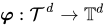
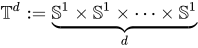
A manifold invariant under the action of a flow is called an invariant -torus, if there exists a diffeomorphism into the standard -torus such that the resulting motion on is uniform linear but not static, i.e. ,where is a non-zero constant vector, called the frequency vector.

If the frequency vector is:

  • rationally independent (a.k.a. incommensurable, that is for all )
  • and "badly" approximated by rationals, typically in a Diophantine sense: ,

then the invariant -torus () is called a KAM torus. The case is normally excluded in classical KAM theory because it does not involve small divisors.

See also

[edit]

Notes

[edit]

References

[edit]
Revisions and contributorsEdit on WikipediaRead on Wikipedia
from Grokipedia
The Kolmogorov–Arnold–Moser (KAM) theorem is a cornerstone result in the theory of dynamical systems, establishing that, for nearly integrable Hamiltonian systems subject to sufficiently small analytic perturbations, a large measure set of invariant tori carrying quasi-periodic motions persists in the phase space. Specifically, in an nn-dimensional system with Hamiltonian H(p,q)=h(p)+ϵf(p,q)H(p, q) = h(p) + \epsilon f(p, q), where hh is integrable and non-degenerate (with det(2h/p2)0\det(\partial^2 h / \partial p^2) \neq 0), and ϵ\epsilon is small, the theorem guarantees the survival of Lagrangian tori corresponding to Diophantine frequencies ω\omega satisfying k,ωαkτ|\langle k, \omega \rangle| \geq \frac{\alpha}{\|k\|^\tau} for integers kZn{0}k \in \mathbb{Z}^n \setminus \{0\}, α>0\alpha > 0, and τ>n\tau > n, with the surviving tori forming a Cantor-like set of positive measure close to 1. These motions remain quasi-periodic with the same frequencies, up to a smooth symplectic coordinate change. The theorem originated with Andrey Kolmogorov's 1954 announcement at the in , where he outlined a method to overcome small divisor problems in for Hamiltonian systems, proving the existence of a coordinate transformation that conjugates the perturbed flow to the unperturbed one near generic tori. provided a rigorous proof in 1961 of Kolmogorov's theorem for analytic multidimensional Hamiltonian systems. Moser provided the first proof in 1962 for the case of area-preserving twist maps on the annulus (corresponding to two ), demonstrating the persistence of invariant curves for Diophantine numbers. Kolmogorov's approach was rigorously established by Arnold in 1961 (published in Russian, with English in 1963) for the full multidimensional setting, resolving longstanding issues in dating back to Newton's . The KAM theorem has profound implications for understanding stability and chaos in conservative systems, showing that small perturbations do not lead to full but instead preserve a robust skeletal structure of quasi-periodic orbits, while resonant zones may exhibit behavior. It overturned earlier conjectures, such as Fermi's claim of instability in planetary systems, by proving probabilistic stability: the measure of surviving tori approaches that of the unperturbed case as ϵ0\epsilon \to 0. Applications extend to , where it explains the long-term ; plasma physics, for magnetic confinement; and nonlinear optics, among other fields involving nearly integrable dynamics. Subsequent developments, including computer-assisted proofs and extensions to infinite-dimensional or degenerate systems, have further broadened its scope.

Background Concepts

Hamiltonian Mechanics

Hamiltonian mechanics provides a reformulation of in terms of a Hamiltonian function HH, which typically represents the total energy of the system, defined on a that serves as the configuration space for both positions and momenta. The is modeled as a (M,ω)(M, \omega), a 2n2n-dimensional smooth manifold equipped with a closed, non-degenerate 2-form ω\omega, known as the symplectic form. For a system with nn , consist of generalized positions qiq_i and conjugate momenta pip_i, with the standard symplectic form given by ω=i=1ndqidpi\omega = \sum_{i=1}^n dq_i \wedge dp_i. The dynamics are governed by Hamilton's equations: q˙i=Hpi,p˙i=Hqi,\dot{q}_i = \frac{\partial H}{\partial p_i}, \quad \dot{p}_i = -\frac{\partial H}{\partial q_i}, which describe the of the system along integral curves in the phase space. A key in is the , which encodes the and facilitates the description of and conserved quantities. For smooth functions f,g:MRf, g: M \to \mathbb{R} on the , the is defined as {f,g}=i=1n(fqigpifpigqi).\{f, g\} = \sum_{i=1}^n \left( \frac{\partial f}{\partial q_i} \frac{\partial g}{\partial p_i} - \frac{\partial f}{\partial p_i} \frac{\partial g}{\partial q_i} \right). This operation satisfies bilinearity, antisymmetry {f,g}={g,f}\{f, g\} = -\{g, f\}, and the , forming a on the space of functions. The time derivative of any function ff along the flow is given by dfdt={f,H}+ft\frac{df}{dt} = \{f, H\} + \frac{\partial f}{\partial t}, highlighting the bracket's role in dynamics; if {f,H}=0\{f, H\} = 0, then ff is a constant of motion. Illustrative examples demonstrate the framework's application. For a simple harmonic oscillator, the Hamiltonian is H=p22m+12kx2H = \frac{p^2}{2m} + \frac{1}{2} k x^2, where mm is the mass, kk the spring constant, xx the position, and pp the momentum; Hamilton's equations yield x˙=p/m\dot{x} = p/m and p˙=kx\dot{p} = -k x, reproducing the familiar oscillatory motion x¨+(k/m)x=0\ddot{x} + (k/m) x = 0. In the two-body problem, such as planetary motion under gravity, the system reduces to an effective one-body problem using center-of-mass and relative coordinates, with reduced mass μ=m1m2/(m1+m2)\mu = m_1 m_2 / (m_1 + m_2) and relative position r=r1r2\mathbf{r} = \mathbf{r}_1 - \mathbf{r}_2; the Hamiltonian becomes H=p22μGm1m2rH = \frac{|\mathbf{p}|^2}{2\mu} - \frac{G m_1 m_2}{|\mathbf{r}|}, where p=μr˙\mathbf{p} = \mu \dot{\mathbf{r}} and GG is the gravitational constant, capturing the elliptical orbits predicted by Kepler's laws. A fundamental consequence of the symplectic structure is , which asserts that the phase-space volume occupied by an ensemble of systems evolving under Hamilton's equations remains invariant over time. This conservation arises because the phase flow is incompressible, with the divergence of the vanishing: i(q˙iqi+p˙ipi)=0\sum_i \left( \frac{\partial \dot{q}_i}{\partial q_i} + \frac{\partial \dot{p}_i}{\partial p_i} \right) = 0. Consequently, the of the is unity, preserving volumes and enabling statistical interpretations of dynamics, such as in . In perturbed systems, this volume preservation underpins the persistence of invariant structures like tori.

Integrable Hamiltonian Systems

In a Hamiltonian system with nn degrees of freedom, integrability in the Liouville sense requires the existence of nn independent integrals of motion IjI_j (with j=1,,nj = 1, \dots, n), one of which is the Hamiltonian H=I1H = I_1, such that these integrals Poisson-commute, i.e., {Ij,Ik}=0\{I_j, I_k\} = 0 for all j,kj, k. This condition confines the phase space trajectories to the common level sets of these integrals, which form nn-dimensional tori, resulting in quasi-periodic motion with frequencies determined by the gradients of HH. For such systems, a exists to action-angle coordinates (I,θ)(I, \theta), where I=(I1,,In)I = (I_1, \dots, I_n) are the action variables coinciding with the integrals, and θ=(θ1,,θn)\theta = (\theta_1, \dots, \theta_n) are the angle variables on the . In these coordinates, the Hamiltonian depends solely on the actions, H=H(I)H = H(I), decoupling the : the actions are conserved, I˙=0\dot{I} = 0, while the angles evolve linearly as θ˙=ω(I)\dot{\theta} = \omega(I), with the frequency vector ω(I)=IH=(H/I1,,H/In)\omega(I) = \nabla_I H = (\partial H / \partial I_1, \dots, \partial H / \partial I_n). \begin{equation*} \dot{I} = 0, \quad \dot{\theta} = \omega(I) \end{equation*} This transformation preserves the symplectic structure of the phase space, enabling the explicit integration of the dynamics. The Arnold–Liouville theorem guarantees that, provided the Hamiltonian is non-degenerate—meaning the Hessian matrix 2H/IjIk\partial^2 H / \partial I_j \partial I_k is invertible, or equivalently the frequency map ω(I)\omega(I) has full rank—the phase space is completely foliated by these invariant nn-tori, each labeled by a value of II in a neighborhood of the origin (excluding critical points). On each torus, the flow is quasi-periodic, densely filling the torus if the frequencies ω(I)\omega(I) are incommensurate. This theorem provides the foundational structure for understanding the regular dynamics of integrable systems. Classic examples illustrate this framework. The free rotor, a particle constrained to a circle with Hamiltonian H=pθ2/(2I)H = p_\theta^2 / (2I) (where II is the and pθp_\theta the ), is a one-degree-of-freedom ; here, I1=pθI_1 = p_\theta is conserved, and the action-angle form yields uniform angular motion θ(t)=θ0+(pθ/I)t\theta(t) = \theta_0 + (p_\theta / I) t on the one-torus (the circle itself). The Kepler problem, describing bound planetary motion in a 1/r1/r potential with Hamiltonian H=p2/(2m)k/rH = p^2 / (2m) - k / r in two dimensions, admits action variables including the total energy, LL, and the radial action IrI_r; in action-angle coordinates, H=(mk2)/(2(Ir+L))H = - (m k^2) / (2 (I_r + L)), leading to motion on two-tori with degenerate frequencies (due to the Runge–Lenz vector), but still quasi-periodic elliptic orbits filling the tori.

Theorem Statement

Formal Statement

The Kolmogorov–Arnold–Moser (KAM) theorem provides a precise condition for the persistence of invariant tori in nearly integrable Hamiltonian systems under small perturbations. Consider an nn-degree-of-freedom system with Hamiltonian H(I,θ,ε)=H0(I)+εH1(I,θ),H(I, \theta, \varepsilon) = H_0(I) + \varepsilon H_1(I, \theta), where IDRnI \in D \subset \mathbb{R}^n are action variables, θTn=(R/2πZ)n\theta \in \mathbb{T}^n = (\mathbb{R}/2\pi\mathbb{Z})^n are angle variables, DD is a bounded domain with piecewise smooth boundary, H0:DRH_0: D \to \mathbb{R} is real analytic and strictly convex with ω(I)=H0(I)\omega(I) = \nabla H_0(I) denoting the map, and H1:D×TnRH_1: D \times \mathbb{T}^n \to \mathbb{R} is a real analytic perturbation with εR\varepsilon \in \mathbb{R} sufficiently small. The unperturbed system (ε=0\varepsilon = 0) is integrable, with foliated by invariant nn-tori on which the motion is quasi-periodic with frequencies ω(I)\omega(I). A key assumption is the non-degeneracy of the frequency map, requiring that the 2H0/I2\partial^2 H_0 / \partial I^2 is positive definite and that det(ω/I)0\det(\partial \omega / \partial I) \neq 0 on DD, ensuring the frequency map is locally a . The main existence result asserts that for ε|\varepsilon| small enough depending on the Diophantine constants γ>0\gamma > 0 and τ>n1\tau > n-1, the set of initial actions II such that ω(I)\omega(I) satisfies the Diophantine condition ω(I)kmγkτ|\omega(I) \cdot k - m| \geq \frac{\gamma}{|k|^\tau} for all kZn{0}k \in \mathbb{Z}^n \setminus \{0\} and mZm \in \mathbb{Z} admits a corresponding CD\mathcal{C} \subset D of full in the class of Diophantine frequencies, on which there persist invariant Lagrangian tori supporting quasi-periodic motions with the original frequencies ω(I)\omega(I). In the quantitative version, the of the complement DCD \setminus \mathcal{C} (the "gaps" without surviving tori) satisfies meas(DC)=O(ε1/2)\mathrm{meas}(D \setminus \mathcal{C}) = O(\varepsilon^{1/2}), an estimate that is sharp and cannot be improved in general for typical systems. Kolmogorov's original formulation in , presented for real analytic Hamiltonians, established this persistence for a set of Diophantine frequencies of full measure, resolving the small divisor problem through an iterative linearization scheme.

Perturbation Assumptions

The perturbation assumptions in the Kolmogorov–Arnold–Moser (KAM) theorem specify the conditions on the nearly integrable Hamiltonian system under which invariant tori persist. Consider a Hamiltonian of the form H(I,θ)=H0(I)+εP(I,θ)H(I, \theta) = H_0(I) + \varepsilon P(I, \theta), where H0H_0 is the integrable part depending only on the action variables IDRnI \in D \subset \mathbb{R}^n, θTn\theta \in \mathbb{T}^n are the angle variables on the n-torus, PP is the perturbation, and ε\varepsilon is a small parameter. A key assumption is the analyticity of the Hamiltonian components. Both H0H_0 and PP must be real analytic functions on the domain D×Tn\overline{D} \times \mathbb{T}^n, and they extend analytically to a uniform complex neighborhood of this set, such as θ<δ| \Im \theta | < \delta for some δ>0\delta > 0. This ensures that the expansions of PP in the angles θ\theta, given by P(I,θ)=kZnpk(I)eikθP(I, \theta) = \sum_{k \in \mathbb{Z}^n} p_k(I) e^{i k \cdot \theta}, converge uniformly, which is essential for the iterative convergence in the KAM proof. The frequencies ω(I)=H0(I)\omega(I) = \nabla H_0(I) at the actions II must satisfy a Diophantine condition to avoid resonances that could destroy the tori. Specifically, there exist constants γ>0\gamma > 0 and τ>n1\tau > n-1 such that kωmγkτ| k \cdot \omega - m | \geq \frac{\gamma}{|k|^\tau} for all integers kZn{0}k \in \mathbb{Z}^n \setminus \{0\}, mZm \in \mathbb{Z}, where k=maxkj|k| = \max |k_j|. This condition ensures that the frequencies are sufficiently , preventing good rational approximations that would lead to resonant instabilities. Additionally, a non-resonance condition is imposed to exclude low-order resonances, requiring kωm0| k \cdot \omega - m | \neq 0 for all mZm \in \mathbb{Z} and kZnk \in \mathbb{Z}^n with kN0|k| \leq N_0 for some fixed order N0N_0. This is often subsumed by the stronger Diophantine condition but is stated separately in some formulations to emphasize the avoidance of primary resonances. Finally, the perturbation parameter ε\varepsilon must be sufficiently small, satisfying ε<ε0(γ,τ)|\varepsilon| < \varepsilon_0(\gamma, \tau), where ε0>0\varepsilon_0 > 0 depends on the Diophantine constants and the analyticity domain. In the original Kolmogorov formulation, the smallness was quite restrictive, with ε=O(γO(n))\varepsilon = O(\gamma^{O(n)}), but Arnold's proof improved this to quadratic dependence, ε=O(γ2)\varepsilon = O(\gamma^2), while Moser's version for area-preserving maps achieved near-optimal exponents, such as ε=O(logγτ)\varepsilon = O(|\log \gamma|^{- \tau}), enhancing applicability.

Non-Perturbative Conditions

The Moser twist theorem provides a extension of KAM theory to area-preserving twist maps on an annulus, establishing the persistence of invariant curves without requiring the perturbation parameter to be small. Specifically, for a twist map close to an integrable , Moser proved the existence of a conjugacy to an integrable map that preserves the invariant curves, ensuring their stability under finite perturbations as long as the map remains sufficiently smooth. This result relies on a Diophantine condition on the rotation number and applies to s in CC^\ell with >2τ+2\ell > 2\tau + 2, where τ>n1\tau > n-1 is the Diophantine exponent, yielding invariant curves diffeomorphic to those of the unperturbed . Rüssmann's non-degeneracy condition relaxes the standard Kolmogorov non-degeneracy assumption in KAM theory, allowing persistence of invariant tori for analytic perturbations even when the frequency map is not fully non-degenerate. The condition requires that the span of partial derivatives of the frequency map ω(y)\omega(y) up to order L2L \geq 2 generates Rn\mathbb{R}^n, i.e., ω/yL=Rn\langle \partial^{|\ell|} \omega / \partial y^\ell \mid |\ell| \leq L \rangle = \mathbb{R}^n, which permits nonlinear dependencies and applies to cases where the map is not locally submersive. Under this condition, combined with a Diophantine frequency requirement τ>nL1\tau > nL - 1, a Cantor family of invariant tori persists with slightly shifted frequencies, though the measure of surviving tori is reduced compared to the full non-degeneracy case, with excluded frequencies having relative measure O(γ1/L)O(\gamma^{1/L}). Kolmogorov's original approach incorporates via majorant series to extend KAM results to larger perturbation sizes ε\varepsilon, albeit with a diminished measure of persistent tori. By employing rapidly converging majorant in the iterative normal form procedure, the proof handles small divisors through Diophantine conditions k,ωmαkτ|\langle k, \omega \rangle - m| \geq \frac{\alpha}{|k|^\tau} with τ>n1\tau > n-1, ensuring convergence for ε<δα2|\varepsilon| < \delta \alpha^2 where δ\delta depends on dimension nn, τ\tau, and the unperturbed Hamiltonian. This method preserves quasi-periodic motions on a set of positive measure, but the analytic domain shrinks with increasing ε\varepsilon, limiting the tori to a smaller Cantor set. When the Diophantine condition fails, particularly near rational frequencies, KAM tori break down, leading to thresholds beyond which global stability is lost and Arnold diffusion emerges. At these breakdown thresholds, resonant tori are destroyed, creating gaps in the phase space of width μ\sim \sqrt{\mu}
Add your contribution
Related Hubs
User Avatar
No comments yet.