Hubbry Logo
A-91A-91Main
Open search
A-91
Community hub
A-91
logo
8 pages, 0 posts
0 subscribers
Be the first to start a discussion here.
A-91
A-91
from Wikipedia

The A-91 is a Russian bullpup assault rifle developed by the KBP Instrument Design Bureau during the 1990s. It is an evolution of the earlier 9A-91 carbine, primarily designed to be compact, reliable, and versatile in urban combat scenarios. The rifle is notable for its integrated 40mm grenade launcher and the use of a bullpup configuration, which positions the magazine behind the trigger, allowing for a more compact design without sacrificing barrel length.

Key Information

Design and Features

[edit]

The A-91 uses a gas-operated system with a rotating bolt, similar to the AK-47 and other Kalashnikov designs. However, unlike most Russian rifles, it adopts a bullpup layout, which reduces the overall length while maintaining a full-length barrel, improving handling in confined spaces.[1]

The rifle can be chambered in multiple calibers, including the standard Russian 5.45×39mm and 7.62×39mm rounds, as well as the NATO- standard 5.56×45mm NATO cartridge. Its rate of fire is approximately 600 rounds per minute, with a muzzle velocity of 880 m/s.[1]

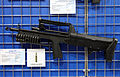
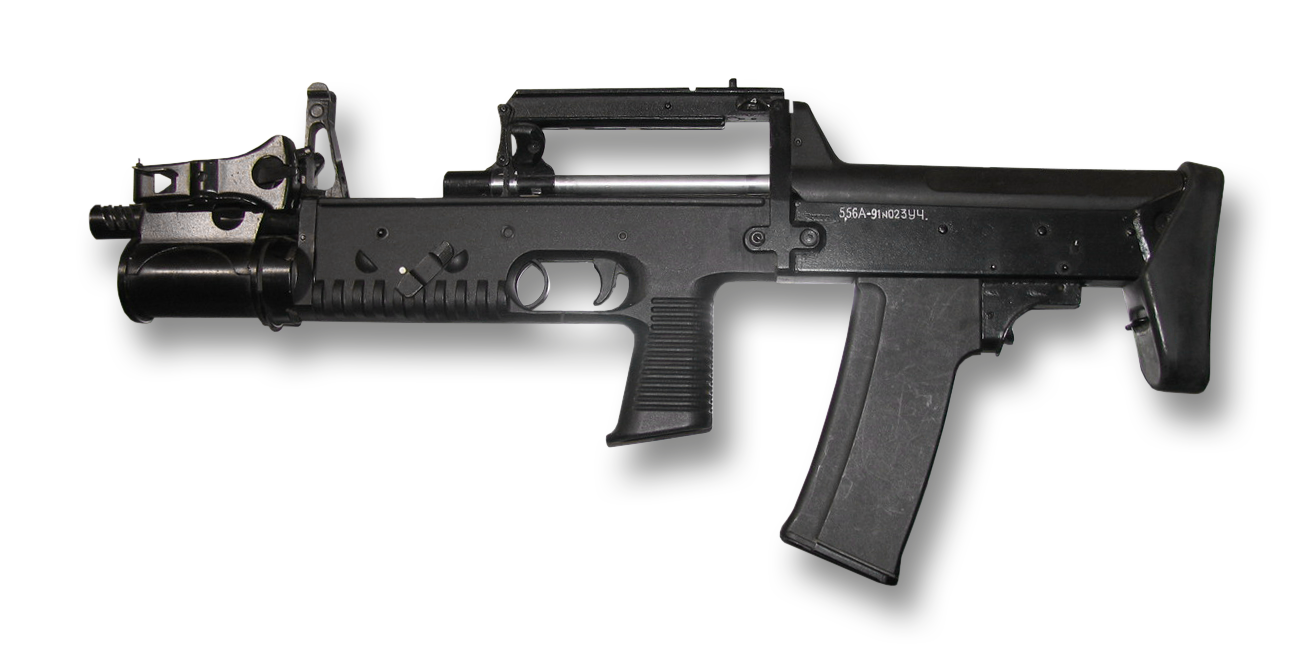
A-91 displayed
A-91 displayed with its grenade launcher, below the front barrel.

One of the most notable features of the A-91 is its integrated under-barrel grenade launcher, designed to fire standard 40mm grenades such as the VOG-25. The launcher has a range of up to 400 meters. The rifle also has a spent-case ejection system that ejects casings forward, preventing interference with the user's face or arms when firing from the left shoulder.[1]

Development

[edit]

The A-91 was designed by the KBP Instrument Design Bureau as a successor to the 9A-91 carbine, with a focus on creating a weapon suited for both conventional and special operations forces. The bullpup design was chosen for its compact size and ease of handling in close-quarter combat (CQB). Initial production began in the 1990s, and the rifle has since been used in various roles within the Russian military.

Variants

[edit]

There are several variants of the A-91, including different configurations for different calibers and missions:

  • A-91M[2]: The most modern variant, featuring updated materials and improved ergonomic features. Chambered in both 5.45×39mm and 7.62×39mm.

Usage

[edit]

The A-91 is in limited service with the Russian Armed Forces and various special forces units. Its compact design and versatility make it suitable for urban combat and special operations, although it has not seen widespread adoption compared to more traditional Kalashnikov designs like the AK-74 and its variants.

See also

[edit]

References

[edit]
[edit]
[edit]

See also

[edit]
[edit]
Revisions and contributorsEdit on WikipediaRead on Wikipedia
from Grokipedia
The A-91 is a compact with an integrated , developed by the Russian in the early 1990s as an evolution of the , featuring a forward ejection system for ambidextrous operation and limited production for select Russian and police units. Designed for close-quarters combat and applications, the A-91 employs a gas-operated, long-stroke mechanism with rotary bolt locking, housed in a stamped receiver and furniture for reduced weight and improved . It is chambered primarily in ammunition, with a variant in for export markets (discontinued around 2015), and includes a detachable 30-round box magazine, selective fire modes (semi-automatic and full-automatic) at a rate of 600-800 rounds per minute, and an effective range of approximately 300 meters. The rifle measures 660 mm in overall length with a 415 mm barrel, weighs approximately 4.3 kg loaded, and achieves a of 715 m/s. A distinctive feature is its integrated 40 mm GP-25-style grenade launcher (VOG-25 series); the prototype had it positioned above the barrel, but production models integrated it under the barrel, with the refined A-91M variant introduced in 1998 making it detachable for replacement with a standard foregrip to enhance balance and usability. Sights include adjustable iron or dioptric options, and the design prioritizes modularity, though it saw limited adoption due to competition from established rifles like the AK-74M and has not achieved widespread export success. Variants include the base A-91, the A-91M with improved grenade integration, the 5.56A-91 for NATO compatibility (discontinued around 2015), and a short-lived 5.45×39mm prototype tested for Russia's Ratnik program in 2012 but ultimately withdrawn. Despite its innovative bullpup layout—one of the earliest production examples with forward ejection—the A-91 remains a niche weapon primarily associated with Russian special operations.

Development

Origins and Design Initiation

The development of the A-91 bullpup assault rifle began in 1990 at the in , with Vasily Gryazev serving as the primary designer. This initiative was part of broader efforts by KBP to modernize small arms for post-Soviet military needs, including a brief relation to projects like the compact rifle. The primary motivation for the A-91's design stemmed from the requirement for a highly compact tailored to units engaged in urban and close-quarters combat scenarios. Conventional rifles such as the , while reliable, suffered from excessive length that hindered maneuverability in confined spaces, prompting the need for an innovative solution that maintained ballistic performance without sacrificing portability. Initial prototypes of the A-91 emphasized a configuration, which positioned the action behind the trigger to allow a full-length barrel within a significantly shorter overall frame, enhancing handling for . These early models were tested to validate the layout's efficacy in achieving compactness while preserving accuracy and controllability. The design focused on the caliber from the outset to ensure compatibility with abundant existing Soviet-era ammunition stocks. First production models of the A-91 were manufactured in , marking the transition from prototyping to limited-series output at KBP facilities.

Evolution from 9A-91 Carbine

The A-91 was developed by the same design bureau as the carbine, which was developed in the early 1990s by the in Tula for roles. The , chambered in , served as a compact, cost-effective alternative to more complex designs like the , emphasizing rapid deployment for personal defense in close-quarters scenarios. The A-91 incorporated a configuration to enhance maneuverability in confined spaces, relocating the action behind the trigger for a shorter overall length without sacrificing barrel size, though it shares few common features with the conventional-layout . Post-Soviet adaptations in the early refined the design for broader applicability amid economic constraints and shifting military priorities. Key enhancements included the integration of underbarrel grenade launcher compatibility, such as with the , allowing for versatile fire support options in a single platform; earlier prototypes featured an above-barrel GP-97 launcher, but subsequent iterations moved it below for improved balance and . Additionally, the forward ejection system was improved to eject spent casings through a dedicated port ahead of the magazine well, significantly reducing gas blowback and debris ingress in enclosed environments, which was critical for use. These modifications addressed limitations in earlier compact designs, aiming to meet initial design goals for a modular weapon adaptable to various calibers like . Testing phases in the early 1990s involved evaluations by Russian special forces units, including MVD and police SWAT teams, to assess reliability and performance in demanding scenarios. These trials led to adjustments for operational robustness, with the design demonstrating resilience in varied conditions through its closed ejection mechanism and gas-operated rotary bolt system. By the mid-1990s, production ramped up in small batches at the Tula Arms Factory, but remained limited due to the in 1991 and ongoing debates over standardizing to the cartridge, which favored established AK platforms over new entrants like the A-91. Despite these challenges, the rifle achieved limited adoption starting around 1998, primarily for export and select domestic special units.

Design and Features

Operating Mechanism

The A-91 rifle utilizes a gas-operated action with a long-stroke and locking system. The gas , positioned above the barrel, drives the bolt carrier rearward upon firing, similar to the AK-series rifles but reconfigured for the layout where the action and magazine are placed behind the trigger group. This adaptation maintains reliable cycling while accommodating the compact design. The employs four radial lugs that engage corresponding recesses in the barrel extension to lock the breech, ensuring secure containment of pressure during firing. A key feature of the A-91's operating mechanism is its forward-spent-case ejection system, which directs empty cartridges away from the shooter via a deflector located ahead of the well. Extracted cases are channeled from the bolt face through a short tube parallel to the barrel and ejected forward through an oval on the upper receiver, near the gas rod. This configuration, covered by a spring-loaded dust cover when not in use, eliminates interference with left-handed operation or prone firing positions, enhancing and user safety compared to traditional side-ejection designs. The rifle achieves a cyclic between 600 and 800 rounds per minute, providing controllable full-automatic fire suitable for close to medium-range engagements. In the variant, the fixed 415 mm barrel delivers a of 715 m/s, contributing to an effective firing range of 300 meters against point targets. For the variant, is approximately 910 m/s.

Ergonomics and Accessories

The A-91's configuration contributes to its ergonomic design, positioning the action behind the trigger group to achieve an overall length of 660 mm while maintaining a 415 mm barrel for effective in close-quarters scenarios. This compact form factor, combined with a weight of 3.97 kg unloaded without the , facilitates rapid handling and reduced fatigue during extended . When fitted with the integrated , the weight increases to approximately 4.4 kg, still allowing for agile deployment. Controls emphasize ambidextrous usability, including a /selector switch operable from either side and a non-reciprocating charging handle housed within the carrying handle, configurable to the left or right for user preference. The is ergonomically shaped and integrated into the and forend assembly, promoting a natural hold and quick magazine changes despite the magazine's rearward placement. The fixed includes a rubber buttpad to absorb , particularly from launches, enhancing shooter comfort and control. Modularity is supported through a Picatinny-compatible rail on the carrying handle in later models, enabling attachment of such as night sights or red dot systems for improved targeting in low-light conditions. An optional 40 mm underbarrel , compatible with or GP-30 models, provides an effective range of 400 m for VOG-25 grenades and is triggered separately via a dedicated mechanism near the forward grip. The feeds from a 30-round detachable box magazine constructed primarily of , which reduces overall weight and offers resistance to in harsh environments.

Variants

Standard A-91

The standard A-91 represents the baseline configuration of the developed by the in . Introduced in 1991, it serves as a compact tailored for internal security and applications, providing enhanced maneuverability in confined spaces without sacrificing . It features an integrated 40 mm (VOG-25 series) mounted above the barrel in early models. Chambered primarily in the cartridge, the standard A-91 leverages this intermediate round for its superior in close-range engagements, where the heavier bullet delivers greater energy transfer compared to lighter calibers. This choice aligns with the rifle's design emphasis on reliability in urban or room-clearing scenarios, drawing from the evolution of the earlier but reconfigured into a layout for reduced overall length. Key performance specifications for the include a of approximately 715 m/s and an of up to 1,000 meters, achieved through a 415 mm barrel that matches the ballistics of traditional platforms. Unlike its 9x39mm predecessor, the A-91 lacks an integral suppressor, prioritizing simplicity and compatibility with standard ammunition over specialized subsonic operations. Production of the standard A-91 has been limited, focusing on high-quality construction with stamped steel receivers and polymer components to ensure durability in demanding conditions rather than enabling widespread issuance. This approach has confined its deployment primarily to select Russian units, underscoring its role as a specialized tool over a mass-produced service rifle.

A-91M and Caliber Adaptations

The A-91M represents a modernized iteration of the A-91 bullpup assault rifle, developed by the KBP Instrument Design Bureau in Tula, Russia, during the 1990s and publicly introduced in 1998. This variant incorporates design enhancements over the baseline A-91, including a detachable 40 mm GP-25 grenade launcher mounted below the barrel rather than above, a polymer stock for reduced weight and improved handling, and the addition of Picatinny rails to facilitate mounting of optics and other accessories. These modifications aimed to enhance modularity and user ergonomics while maintaining the compact bullpup configuration, with an overall length of 660 mm and a barrel length of 415 mm. Caliber adaptations for the A-91M expanded its versatility, starting with the standard 7.62×39mm chambering to leverage existing Soviet-era ammunition supplies. It was also configurable for 5.45×39mm, aligning with Russian military standards, though this version remained a prototype and was later withdrawn from evaluations such as the 2012 Ratnik program trials. The design's modular receiver allowed for straightforward caliber conversions, emphasizing its potential for specialized roles. A key export-oriented adaptation is the 5.56A-91 variant, chambered in to appeal to international markets and -compatible forces. This version achieves a of 910 m/s from its 415 mm barrel, with an overall length of 660 mm and a weight of approximately 4 kg when including the integrated . Ergonomic refinements, such as ambidextrous controls and forward ejection, were tailored for Western users, promoting compatibility with standard accessories and magazines. Further modifications to the A-91M included a reinforced receiver to better accommodate the stresses from grenade launcher operation, ensuring structural integrity during sustained fire. Despite these advancements, the variant lineup remained limited to prevent design proliferation and simplify production. Ultimately, the A-91M failed to secure widespread adoption or significant export sales, competing unsuccessfully against established designs like the AS Val and broader market preferences for conventional layouts.

Operational Use

Adoption by Russian Forces

The A-91 bullpup assault rifle was adopted in limited numbers by the Russian Ministry of Internal Affairs (MVD) and select units including since the 1990s, primarily for specialized roles within and internal security. These procurements focused on equipping elite formations rather than widespread issuance across the armed forces. Primary users include tasked with urban counter-terrorism operations, where the A-91's compact configuration enhances maneuverability during vehicle-borne insertions and close-quarters engagements. Its integration into these units reflects a targeted strategy emphasizing portability over general needs. Overall production by the has remained limited, attributable to the entrenched preference for proven AK-platform weapons within the Russian military structure. Efforts to export the A-91, including variants adapted for NATO-standard calibers, have not resulted in confirmed sales to former Soviet states or other international partners as of 2025, leaving as the sole operator.

Combat and Training Applications

The A-91 has experienced limited exposure owing to its restricted production run, primarily serving select units within the Russian Army and police forces for specialized operations. Its compact lends itself to close-quarters battle, where the integrated enhances capabilities in urban settings. Adopted by Russian special forces such as , the A-91 is employed in training exercises focused on , emphasizing maneuverability for room-clearing and the grenade launcher's role in breaching simulations. Performance evaluations indicate an of up to 1,000 meters, though practical limitations in open terrain arise from the shorter overall length despite a standard barrel; the demonstrates reliable operation without significant issues in humid or dusty conditions. The A-91 has appeared in Russian military promotional materials and video games, notably the series, but lacks broader cultural resonance.
Add your contribution
Related Hubs
User Avatar
No comments yet.