Recent from talks
Nothing was collected or created yet.
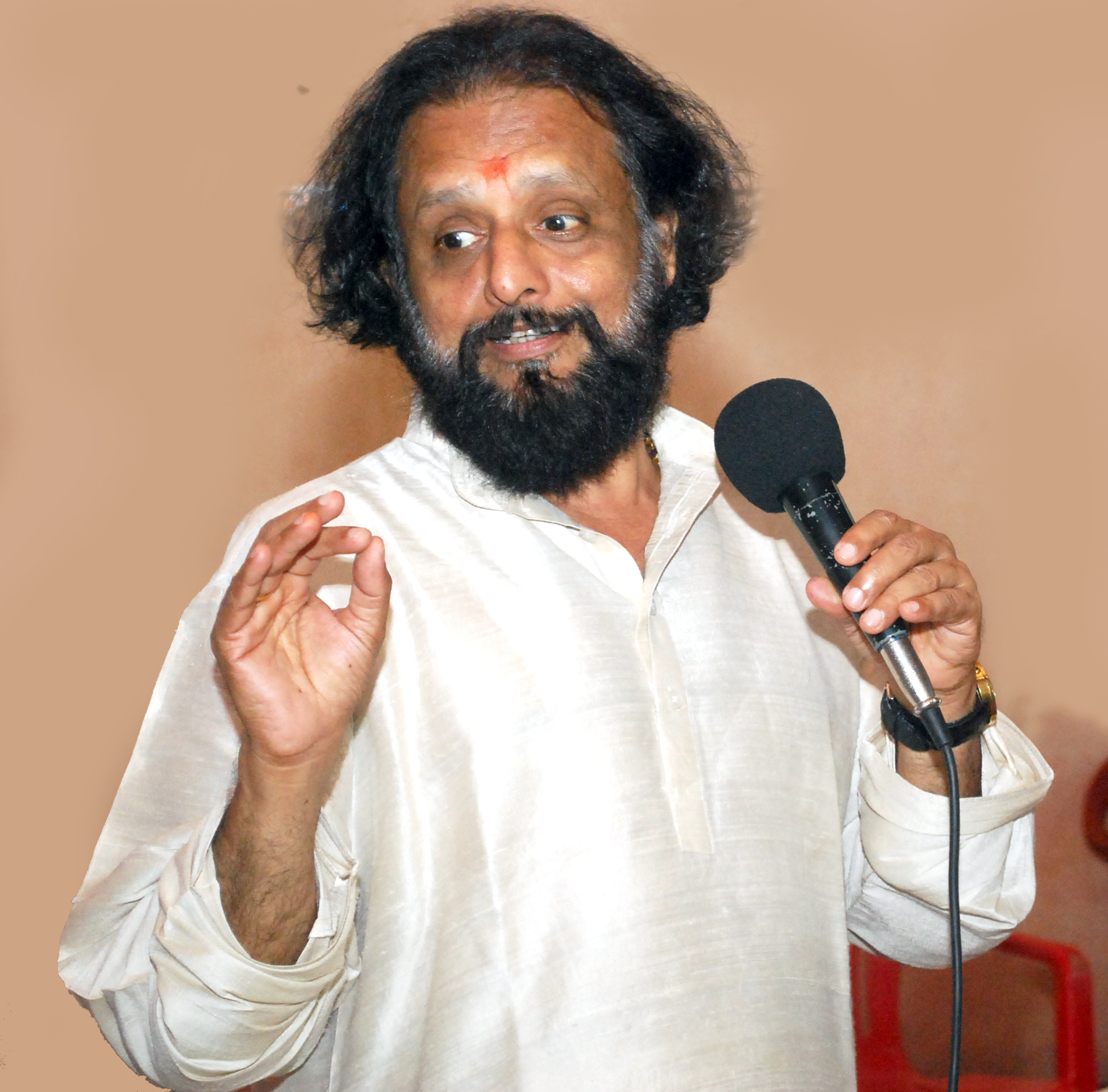
Kaithapram Damodaran Namboothiri
View on Wikipedia
Kaithapram Damodaran Namboothiri, simply known as Kaithapram, is a Malayalam lyricist, poet, music director, actor, singer, screenwriter, music therapist and performer of Carnatic music. He debuted with the movie Ennennum Kannettante in 1986. He won the Kerala State Film Award for Best Lyricist two times. He was awarded India's fourth-highest civilian honour Padma Shri in 2021 by the Government of India for his contribution to the field of art.[1][2]
Key Information
Life and career
[edit]Kaithapram Damodaran Namboothiri was born as the eldest son of Keshavan Namboothiri (popularly known as Kannadi Bhagavathar, a disciple of Chembai Vaidyanatha Bhagavatar) and Aditi Antharjanam in Kaithapram village in Payyanur Taluk of Kannur district of Kerala, on 4 August 1950[3] and he is currently residing in Thiruvannur in Kozhikode District. He has four siblings, among whom the youngest, Kaithapram Viswanathan, was also a popular Carnatic musician and music director. Kaithapram village is famous for maintaining old vedic traditions.[4][5] He got his Veda education from his grandfather. Later on he continued his education under well-known gurus (teachers) including Pazhassi Thamburan (a descendant of Pazhassi Raja) and SVS Narayanan. He pursued his studies in acting and music at Natyagruha.
He is married to Devi Antharjanam who is the daughter of actor Unnikrishnan Namboothiri; they have two children, Deepankuran and Devadarshan. His elder son Deepankuran is a Music composer as well as singer who has composed Music for various films. Kaithapram Damodaran's youngest brother, Kaithapram Viswanathan, is a Malayalam cinema music director who runs the Sruthilaya Music School at Payyanur.
Kaithapram made his entry into Malayalam cinema as a lyricist for the song Devadundubhi Sandralayam in the film Ennennum Kannettante which was directed by Fazil and music composed by Jerry Amaldev and all of the songs become popular Since then he has written lyrics for more than 346 films. He has also acted in many films, including Swathithirunal, Aryan, His Highness Abdulla, and the film Theerthadanam, based on the story of famous Malayalam writer M.T. Vasudevan Nair. He has played the character of a classical or semi-classical singer in most of the films. The songs from Desadanam, his first film as a music composer, were a hit. The film Sopanam, directed by Shri Jayaraj, was based on a story and screenplay written by Kaithapram.
Kaithapram has established a cherished position in the Malayali heart with his beautiful yet simple artistic renderings. He has written both prose and poems and his books are also widely accepted. His appeal is closer to younger hearts and the success of Kanner Poovinte has brought this aspect into fresh focus. His lyrics often express the deep love and regard that make the average Malayali home sick. He sings in public concerts and for various causes. He has won several awards as a lyricist. His charming and helpful attitude, readiness to help and ability to be one among the music lovers, have made him a legend in his own time.
As a lyricist, Kaithapram made songs with almost all major music composers of his time. But, most of his popular songs were composed by Johnson. The duo made songs for around 35 films, and most of them have superhit songs. He also made numerous songs with Mohan Sithara, Raveendran, Ouseppachan, S. P. Venkatesh, Vidyasagar, Jassie Gift and so on.
Shri Kaithapram is also the Managing Trustee of Swathithirunal Kala Kendram (Music School) at Kozhikode, which caters to more than 400 music students. He has received numerous awards from various government and cultural organisations in Kerala. He has popularised and promoted the application of music for therapeutic purposes through the Music Therapy Foundation. Many have benefited from the systematic music therapy sessions conducted all over Kerala.
Discography
[edit]Awards
[edit]- Civilian honours
- 2021 – Padma Shri[6]
- 1993 – Best Lyricist: Paithrukam
- 1996 – Best Lyricist: Azhakiya Ravanan
- 1997 – Best Music Director: Karunyam
- 1990 – Best Lyricist: Innale
- 1992 – Best Lyricist: Kudumbasametham, Kamaladalam, Savidham
- 1996 – Best Lyricist: Sallapam, Desadanam
- 1997 – Best Music Director: Ennu Swantham Janakikutty, Kaliyattam
- 1998 – Best Lyricist: Agnisakshi, Ormacheppu
- 2002 – Best Lyricist: Yathrakarude Sradhakku
- 2010 – Best Lyricist: Holidays
- 1996 – Best Music Director: Desadanam
- 1997 – Best Music Director: Kaliyattam[8]
- 2005 – Best Lyricist Award: Anandabhadram
References
[edit]- Ear to a cure Archived 22 November 2007 at the Wayback Machine
- The website of Kaithapram Damodaran Namboothiri Archived 30 November 2020 at the Wayback Machine
- The healing touch of music(The Hindu)
- The Hindu Friday, Aug 12, 2005
- Kaithapram Archived 27 September 2007 at the Wayback Machine
- Hits of Kaithapram Archived 27 September 2007 at the Wayback Machine
- Kaithapram Damodaran Namboothiri Archived 18 September 2009 at the Wayback Machine
- ^ "KS Chithra gets Padma Bhushan, Kaithapram awarded Padma Shri". The News Minute. 25 January 2021. Retrieved 25 January 2021.
- ^ Daily, Keralakaumudi. "Padma awards declared: Padma Vibhushan for SPB, Shinzo Abe, Padma Bhushan for KS Chitra". Keralakaumudi Daily. Retrieved 25 January 2021.
- ^ "രോഗം മാറ്റിയ കവിത | mangalam.com". Archived from the original on 3 November 2013. Retrieved 11 December 2013.
- ^ "Kaithapram D. Nampoothiri". IMDb. Retrieved 21 December 2020.
- ^ "Kaithapram music therapy News | Latest News on Kaithapram music therapy - Times of India". The Times of India. Retrieved 21 December 2020.
- ^ "Padma Awards 2021 announced: Shinzo Abe, SP Balasubramaniam to be awarded Padma Vibhushan – Full list". www.timesnownews.com. 25 January 2021. Retrieved 25 January 2021.
- ^ "കേരള ഫിലിം ക്രിട്ടിക്സ് അവാര്ഡ് 1977 - 2012" (in Malayalam). Kerala Film Critics Association. Retrieved 22 April 2024.
- ^ "45th Filmfare South Best Music Directors : Santosh : Free Download & …". Archived from the original on 5 February 2017.
External links
[edit]Kaithapram Damodaran Namboothiri
View on GrokipediaEarly life and education
Family background
Kaithapram Damodaran Namboothiri was born on August 4, 1950, in the village of Kaithapram, located in Kannur district, Kerala, India.[8] He was the eldest son of Keshavan Namboothiri, popularly known as Kannadi Bhagavathar and a devoted disciple of the eminent Carnatic musician Chembai Vaidyanatha Bhagavathar, and Aditi Antharjanam.[3][9][10] The family hailed from the Namboothiri Brahmin community, an aristocratic lineage of Malayali Brahmins who trace their origins to ancient Aryan settlers from North India and have long served as custodians of Kerala's Vedic heritage, including the oral transmission of the Vedas, elaborate rituals, and classical performing arts.[11][12][13] Namboothiri's upbringing occurred in the serene, rural environs of Kaithapram, a traditional village celebrated for its preservation of ancient Vedic customs and dotted with historic illams—ancestral homes of Namboothiri families.[14][15] Within this culturally rich setting, he was immersed from childhood in the family's adherence to Vedic traditions, such as ritual chants and recitations, alongside exposure to local arts through his father's musical pursuits in the Carnatic tradition.[16][3] This foundational environment subtly shaped his early inclinations toward music and poetry.Education and training
Kaithapram Damodaran Namboothiri received his early Vedic education from his grandfather, immersing him in the rich traditions of Sanskrit scriptures and rituals central to Namboothiri heritage. This informal yet rigorous training during his formative years provided a strong foundation in classical knowledge, influencing his lifelong interest in literature and performing arts.[17] He advanced his learning under prominent gurus such as Pazhassi Thamburan and S.V.S. Narayanan, who guided him in classical music and literature. These mentors offered specialized instruction that bridged traditional scholarship with artistic expression, preparing him for contributions in poetry, composition, and performance without immediate professional entry.[17] At Natyagruha, Namboothiri undertook formal studies in acting and music, acquiring key skills in Carnatic music traditions and stage performance techniques. This phase of training emphasized practical application, including vocal rendition and dramatic presentation, further refining his multifaceted talents in the performing arts.[17]Literary and film career
Poetry and literary works
Kaithapram Damodaran Namboothiri began his poetic career in the 1970s, entering the field of poetry and song through local Malayalam publications and journals in Kerala. His debut works appeared in regional literary outlets, marking his initial foray into standalone verse outside cinematic contexts.[18] Namboothiri's poetry often explores themes of music, society, and Kerala's cultural heritage, reflecting his deep roots in Namboothiri traditions and the spiritual essence of the region's landscapes and rituals. Notable among his collections is Deva Dhundhubhi, a song anthology that captures these motifs through lyrical expressions of cultural continuity and social introspection, published by Lipi Publications. Another significant work is a poetry collection featuring an introduction by acclaimed author M.T. Vasudevan Nair, highlighting Namboothiri's evocative style rooted in tradition. He has also authored prose pieces, including the book Sneha Ramayanam, which reinterprets classical narratives with contemporary emotional depth, and short stories such as Oru Lolakkinte Kadha. Additionally, his essays address music's societal role and cultural preservation, drawing from his experiences in theater groups like Thiruvarangu during the 1970s.[18][19][20][21] Over his career, Namboothiri has produced an estimated half-dozen poetry collections and prose works, exerting influence on contemporary Malayalam poetry by merging classical Namboothiri spiritualism with accessible, empathetic portrayals of everyday Kerala life. His literary output emphasizes conceptual depth over volume, prioritizing the fusion of heritage and modernity to resonate with younger readers. This poetic foundation later informed his transition to film lyrics, where his thematic style found broader expression.[22]Film lyricist and screenwriter
Kaithapram Damodaran Namboothiri made his debut as a lyricist in the 1986 Malayalam film Ennennum Kannettante, directed by Fazil, where he penned all the songs, including the popular "Devadundhubhi Sandralayam" composed by Jerry Amaldev and sung by K. J. Yesudas.[3] This marked his entry into cinema, drawing from his poetic background to infuse lyrics with vivid imagery and rhythm.[3] Over his career, he wrote lyrics for more than 370 films, contributing over 1,000 songs that often blended emotional depth with poetic subtlety.[3] His collaborations were particularly prolific with composers such as Johnson, with whom he worked on numerous projects, including 29 films in 1991 alone, yielding superhit tracks; Mohan Sithara, for melodic explorations in films like Ishtam; and Raveendran, on songs like "Aakaashathaamara Pole" from Ayal Kadha Ezhthukayanu.[3][23] Notable examples of his work include "Nee Manimukilaadakal" from Vellithira (2003), a duet evoking tender romance, and "Kadamizhiyil" from Thenkasipattanam (2000), which captures poignant longing through metaphors of nature and emotion.[24][25] These lyrics highlight his signature style, prioritizing heartfelt narratives over literalism to enhance the films' emotional resonance.[3] In addition to lyrics, Namboothiri received credits as a dialogue writer and contributor to narratives in select films, particularly those centered on music and cultural themes, though his primary focus remained songwriting.[26] His output evolved across decades, starting modestly in the 1980s with a handful of films post-debut; peaking in the 1990s with over 200 contributions amid the Johnson partnership; and sustaining into the 2000s with around 100 films, adapting to diverse genres while maintaining poetic integrity.[3][27]Musical and performing arts contributions
Music composition and direction
Kaithapram Damodaran Namboothiri debuted as a music director with the 1996 Malayalam film Desadanam, directed by Jayaraj, where he crafted a soundtrack that integrated Carnatic musical elements into the cinematic score, drawing from his background in classical traditions.[3] The film's songs, such as "Engane Njaan" and "Kaliveedurangiyallo," became popular for their melodic depth and emotional resonance, earning widespread acclaim.[28] He frequently employed specific ragas, like Sahana in tracks from subsequent works, to evoke thematic moods while balancing narrative needs with musical purity.[29] Namboothiri went on to compose for approximately 27 films, fusing classical Carnatic structures with Kerala folk influences to create layered soundscapes that enhanced storytelling.[3] Notable examples include Karunyam (1997), for which he won the Kerala State Film Award for Best Music Director; Kaliyattam (1997), directed by Jayaraj, featuring rhythmic explorations of traditional percussion; and Kottapurathe Koottukudumbam (1997), where folk motifs underscored familial themes.[30] Other key compositions encompass Ennu Swantham Janakikutty (1998), Udayapuram Sulthan (1999), and Kaikkudanna Nilavu (2000), each showcasing his technique of adapting kritis and ragas to contemporary film contexts without overpowering the visuals.[31] Throughout these works, Namboothiri often penned the lyrics for his own compositions, ensuring a seamless synergy between text and melody.[3] His total output as a composer includes soundtracks for approximately 27 films, prioritizing conceptual harmony over prolific volume.[32]Singing and acting roles
Kaithapram Damodaran Namboothiri entered the realm of singing and acting with his debut in the 1987 biographical film Swathithirunal, where he portrayed a classical singer and rendered compositions inspired by the life of Maharaja Swathi Thirunal Rama Varma, blending intricate ragas with devotional undertones. His vocal contributions in the film highlighted a style deeply rooted in Carnatic music traditions, characterized by precise swara patterns and emotive bhava expression, influenced by his family's musical heritage, including his father's training under masters like Chembai Vaidyanatha Bhagavathar.[33][3] Beyond this, he contributed vocals to select devotional tracks in films such as Theerthadanam (2001), emphasizing themes of spirituality and cultural heritage through soulful renditions that evoked Kerala's temple music ethos.[33][3] In acting, Namboothiri portrayed the role of a classical singer in Swathithirunal, marking his on-screen debut and allowing him to embody characters intertwined with artistic and historical narratives. He reprised similar culturally resonant roles in films like His Highness Abdulla (1990), where he depicted a scholarly figure, and Theerthadanam, playing a devotee on a pilgrimage that underscored themes of faith and introspection. These performances, often limited to supporting parts, showcased his natural affinity for roles drawing from Kerala's Namboothiri heritage and philosophical depth, appearing in over a dozen films across his career.[33][4] Namboothiri's stage presence extended to live performances, beginning with appearances at Natyagruha in Thrissur during his formative years in acting and music, where he honed his skills through dramatic recitals. Later, he delivered Carnatic music concerts at venues like Poornachandra Hall in Prasanthi Nilayam, presenting kritis such as "Pahimam Sri Rajarajeswari" in 2002, and continued with therapeutic music sessions at institutions like the Different Art Centre in 2024, focusing on healing ragas for audiences.[34][35][1] His stage vocal style retained the classical purity of Carnatic renditions, marked by gamakas and vilambit tempos that reflected his lifelong devotion to traditional South Indian music forms.Awards and honors
Film awards
Kaithapram Damodaran Namboothiri's contributions to Malayalam cinema as a lyricist and music director have been recognized with several prestigious film awards, highlighting his ability to blend poetic depth with melodic innovation. He received the Kerala State Film Award for Best Lyricist twice in the 1990s, first in 1993 for his work on Paithrukam, where his lyrics captured the film's emotional core, and again in 1996 for Azhakiya Ravanan, praised for their lyrical elegance and thematic resonance.[36] These awards underscored his early impact on film songwriting during a pivotal era for Malayalam music. In addition to lyrics, Namboothiri was honored with the Kerala State Film Award for Best Music Director in 1997 for Karunyam, a film whose soundtrack he composed, earning acclaim for its soulful orchestration and integration of classical elements.[3] His debut as a music director, Desadanam (1996), also garnered the Filmfare Award South for Best Music Director the same year, noted for its innovative fusion of traditional and contemporary sounds that elevated the film's narrative.[36] He repeated this success with another Filmfare Award South for Best Music Director in 1997 for Kaliyattam, where his compositions complemented the adaptation's dramatic intensity.[36] Namboothiri's lyrical prowess continued to be celebrated in the 2000s through the Asianet Film Award for Best Lyricist in 2005 for Anandabhadram, recognizing his enduring influence on cinematic poetry.[36] He also secured multiple Kerala Film Critics Association Awards for Best Lyricist, including in 1990 for Innale, 1992 for Kudumbasametham, Kamaladalam, and Savidham, and 2002 for Yathrakarude Sradhakku, with his verses lauded for their philosophical depth and cultural authenticity across these films.[17] These honors reflect his selective yet high-impact role in shaping award-winning soundtracks.| Award | Year | Category | Film(s) |
|---|---|---|---|
| Kerala State Film Award | 1993 | Best Lyricist | Paithrukam |
| Kerala State Film Award | 1996 | Best Lyricist | Azhakiya Ravanan |
| Kerala State Film Award | 1997 | Best Music Director | Karunyam |
| Filmfare Awards South | 1996 | Best Music Director | Desadanam |
| Filmfare Awards South | 1997 | Best Music Director | Kaliyattam |
| Asianet Film Award | 2005 | Best Lyricist | Anandabhadram |
| Kerala Film Critics Association Award | 1990 | Best Lyricist | Innale |
| Kerala Film Critics Association Award | 1992 | Best Lyricist | Kudumbasametham, Kamaladalam, Savidham |
| Kerala Film Critics Association Award | 2002 | Best Lyricist | [Yathrakarude Sradhakku](/page/Y appropriate slug) |
