Hubbry Logo
KāluaKāluaMain
Open search
Kālua
Community hub
Kālua
logo
8 pages, 0 posts
0 subscribers
Be the first to start a discussion here.
Kālua
Kālua
from Wikipedia
Kālua puaʻa (kālua pig)

Kālua (Hawaiian: [kaːˈlu.a]) is a traditional Hawaiian cooking method that utilizes an imu, a type of underground oven. The word "kālua" ("to cook in an underground oven" in the Hawaiian language) may also be used to describe the food cooked in this manner, such as kālua pig or kālua turkey, which are commonly served at lūʻau feasts. The word lūʻau is the Hawaiian name for the taro leaf, which, when young and small resembles cooked spinach after being steamed for a few hours. The traditional lūʻau was eaten on the floor over lauhala mats (leaves of the hala tree woven together).

Cooking method

[edit]

Traditionally, a hardwood fire is built inside a pit large enough to contain the food to be cooked, the stones, and the vegetation used to cover the food. Stones are placed on top of the fire in the pit, taking around two to three hours to reach their maximum temperature. Most important is the selection of stones that contain very little moisture to avoid stones exploding from the steam generated by the heat. Once the stones have become extremely hot, they are spread out over the coals and the pit is lined with vegetation, such as banana trees, that have been pounded to make them pliable. A layer of ti leaves (Cordyline fruticosa) is then spread over the layer of pounded vegetation and the food to be cooked placed on top. The meat to be cooked is salted and, if cooking a whole pig, some hot stones are placed inside the body cavity to ensure the meat is fully cooked.

To maintain even heating and to retain the meat's natural moisture, the meat is covered with more layers of vegetation such as ti and banana leaves, then covered with a layer of soil at least several inches deep ensuring that no steam escapes. The layers of vegetation covering the food must extend past the edges of the pit to ensure the food is not contaminated by the soil it is buried under. The meat is then left to cook in the pit for several hours. When the meat is fully cooked, it is removed from the imu and shredded.

Modern variations

[edit]

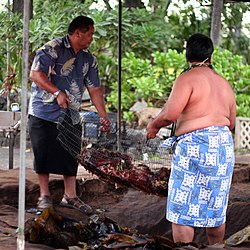
Modern adaptations to the traditional cooking method include the use of wet burlap material as a substitute for the vegetation or to reduce the amount of vegetation needed, and also the use of non-galvanized steel chicken wire or mesh wrapped around the food to aid in its removal when cooked. The characteristic flavor of kālua pig is imparted by the smoke from the hardwood but more importantly the use of ti leaves to wrap the meat. The flavor of the ti leaf is what differentiates kālua pig from other methods of cooking a whole hog slowly using a hardwood fire.

Kālua pig

[edit]
Preparing Hawaiian imu, to cook pig overnight, on Oahu, Hawaii

Kālua pig is a main tourist attraction at many lūʻau, though it is sometimes made using a gas or electric stove with artificial mesquite or kiawe liquid smoke. Other tourist businesses use substitutes instead of vegetation or use an imu pao, an above ground variation of the imu. The term "kālua pork" has been used by Hawaiian cook Sam Choy to describe pork shoulder butt which is rubbed with sea salt, wrapped in ti leaves, and slowly cooked in an oven using liquid mesquite smoke rather than an imu.[1]

The dish is similar to vuaka vavi in Fiji, as well as puaʻa faunaʻa in Tahiti and the Marquesas Islands.[2]

See also

[edit]

References

[edit]
[edit]
Revisions and contributorsEdit on WikipediaRead on Wikipedia
from Grokipedia
Kālua (Hawaiian for "to cook in an ") is a traditional Hawaiian cooking technique that employs an underground oven, known as an imu, to slow-cook meats, fish, and by combining and , resulting in tender, smoky-flavored dishes. This method, brought to the by Polynesian voyagers centuries ago, preserves the natural juices of the food through wrapping in or leaves and sealing the pit with to trap heat and steam. It is most emblematic in the preparation of kalua pig, where a whole pig or shoulder is salted, wrapped, and buried for several hours, yielding shredded infused with earthy, aromatic notes from the surrounding and heated rocks. The origins of kālua trace back to ancient Polynesian practices, where the imu—a pit typically lined with volcanic rocks and fueled by hardwoods like —served as a communal cooking vessel for feasts and ceremonies. Historically, the process begins by digging a pit, heating rocks over a , and layering the imu with green leaves, the seasoned , and additional foliage before covering it to cook for 6 to 24 hours, depending on the quantity. This labor-intensive ritual underscores Hawaiian values of , using local, indigenous materials such as ti leaves for wrapping and river rocks for heat retention, reflecting a deep connection to the land and sea. In contemporary Hawaiian culture, kālua remains central to luaus and community gatherings, symbolizing hospitality and , though modern adaptations often employ above-ground ovens or slow cookers to replicate the traditional flavors for home or smaller-scale use. Beyond pork, the technique applies to items like , , or root vegetables, maintaining its role as a cornerstone of that honors ancestral knowledge while adapting to present-day needs.

Etymology and Overview

Definition and Meaning

Kālua is a traditional Hawaiian cooking technique derived from the , where the term "kālua" literally means "to bake in the ground oven" or "to cook in an underground oven." The word combines the prefix "kā-" with "," referring to a pit, emphasizing the method's reliance on an earthen enclosure for cooking. This linguistic root highlights the technique's ancient Polynesian heritage, adapted in for preparing meats and other foods through slow, enclosed heating. As a cooking method, kālua involves slow-cooking in an underground oven known as an imu, which functions as a hybrid of and . The process utilizes heated stones and insulating layers of or vegetation to create a sealed environment where is enveloped in leaves, allowing and to tenderize it gradually without direct exposure. This results in a distinctive flavor profile characterized by subtle smokiness from the wood and , distinguishing kālua from open-flame or above-ground methods. Key features of kālua include its use of low, sustained heat—typically reaching internal temperatures around 212°F (100°C) through generation—and extended cooking durations of 6 to 24 hours, depending on the food's size and type. The minimal , often limited to Hawaiian sea salt rubbed onto the food before wrapping, preserves the natural taste while enhancing tenderness and yielding juicy, fall-apart textures in meats like . This simplicity underscores kālua's emphasis on the oven's thermal properties rather than added flavors.

Role in Hawaiian Cuisine

Kālua occupies a central role in native Hawaiian cuisine as a versatile cooking technique that highlights the islands' abundant natural resources and communal feasting traditions. It integrates seamlessly with local staples such as , which is steamed or pounded into poi, and fresh fish caught from surrounding waters, creating balanced meals that sustain daily life and celebrations. , introduced by Polynesian voyagers around AD 1200, became a key protein in kālua preparations, transforming the method into a symbol of abundance after its adoption in larger feasts. In comparison to other Hawaiian cooking methods, kālua's use of the underground imu distinguishes it for large-scale preparations, such as whole pigs for luaus, allowing slow that yields tender, smoky results ideal for sharing among extended families. By contrast, laulau involves smaller portions of , , or chicken wrapped in and ti leaves directly in the imu or steamers, emphasizing individual bundling for milder, leaf-infused flavors suited to everyday meals. The simplicity of kālua underscores its cultural essence, relying primarily on Hawaiian sea salt to draw out natural flavors, with optional wrapping in ti or banana leaves to impart subtle earthiness and moisture—no elaborate marinades or spices are needed, preserving the purity of the ingredients.

History

Polynesian Origins

The origins of kālua cooking lie in the ancient Polynesian tradition of earth-oven preparation, introduced to the Hawaiian Islands by voyagers who settled the archipelago between approximately 1000 and 1200 CE. These skilled navigators, originating from central Polynesian regions such as the Society Islands (including Tahiti) and the Marquesas Islands, transported cultural knowledge via double-hulled sailing canoes, including the technique of pit cooking in underground ovens referred to as umu across much of Polynesia. This method, essential for communal meals during voyages and settlements, laid the foundational practice for what would become known as kālua in Hawaiian contexts. Archaeological investigations across Pacific sites provide robust evidence of these pit-cooking methods in Polynesian cultures, underscoring their role in communal feasts. In the Marquesas Islands, for example, excavations in Anaho Valley on Nuku Hiva Island reveal multiple earth ovens dating from AD 1450 to 1650, constructed with heated stones and used to steam starchy foods like breadfruit and taro, as well as meats for large social gatherings such as the feikai mei pa‘a. Further west, in Samoa, specialized umu ti ovens—large pits dedicated to cooking the Cordyline fruticosa (ti) plant—date to 900–1250 CE, featuring heat-altered sediments and substantial fuel layers that indicate high-status, community-wide events overseen by chiefs. These findings illustrate the technique's deep integration into Polynesian social structures. The development of earth-oven cooking was profoundly shaped by the demands of Polynesian voyaging and the scarcity of resources on isolated , promoting efficient underground methods that conserved fuel. Long journeys required portable, low-fuel techniques to prepare sustaining meals from limited provisions, while island ecosystems with sparse timber necessitated insulated pits that retained for extended periods, minimizing wood consumption. Evidence from Marquesan sites shows a shift over time to alternative fuels like monocot plants, likely due to depletion of preferred hardwoods such as , reflecting adaptive strategies to environmental constraints in these remote settings.

Evolution in Hawaiian Culture

Prior to European contact in , kālua cooking using the imu underground oven was integral to Hawaiian sustenance and social hierarchy, particularly for preparing native birds and during ali'i (chiefly) feasts and everyday meals. Native birds, such as the Hawaiian petrel and honeycreepers, were often snared or trapped and cooked in the imu to preserve their delicate flavors, a method reserved for special occasions that underscored the ali'i's access to upland resources. , including oily varieties like aku (), were wrapped in ti leaves and slow-cooked in the imu, providing a staple protein that complemented coastal practices and supported communal gatherings. These preparations highlighted the kapu system, where elite households controlled premium foods, distinguishing them from commoners' simpler roasting techniques. The arrival of Captain in 1778 introduced European breeds of , which interbred with the smaller Polynesian varieties already present, leading to larger animals that transformed kālua practices. These introduced proliferated rapidly, becoming a primary focus for imu cooking and elevating kālua as a centerpiece for post-kapu luaus after King abolished the eating restrictions in 1819. This shift marked a departure from the pre-contact emphasis on birds and , as ' abundance and size made them ideal for large-scale feasts, symbolizing abundance and hospitality in evolving Hawaiian social events. By the 19th and early 20th centuries, traditional kālua declined amid rapid and Western influences following the overthrow of the Hawaiian and 1898 . Population shifts to urban centers like disrupted rural subsistence systems, reducing access to imu-building resources and time-intensive preparations, while imported foods gained prominence in daily diets. Hawaiian self-sufficiency in local foods fell dramatically, from near 100% pre-1778 to heavy reliance on imports by the mid-20th century. However, the of the 1970s sparked a revival, with cultural activists reclaiming kālua through community luaus and educational programs to preserve ancestral practices amid ongoing .

Traditional Preparation and Cooking

Building the Imu Oven

The construction of the imu, the traditional underground essential for kālua cooking, begins with careful to ensure safety and practicality. A suitable location is chosen on stable ground, away from buildings, trees, or flammable materials, with the excavated soil retained nearby for later use in sealing the . The pit is then dug to dimensions that accommodate the quantity of being prepared; typically, it measures 2 to 4 feet deep with sloping sides for structural integrity, and a or width of 4 to 8 feet, adjusted based on the scale—for instance, a larger pit for a whole serving dozens. Key materials for the imu include volcanic rocks selected for their heat retention and safety. The pit is lined with fist-sized or volleyball-sized vesicular stones, which are porous and non-explosive, preventing dangerous steam bursts during heating; these rocks are placed at the bottom and around the sides to form a stable bed. Hardwoods such as kiawe (a Hawaiian mesquite) are used for the fire, as they burn hot and clean without imparting off-flavors. For insulation and steam generation, green vegetation like stumps or leaves, ti leaves, or wet burlap sacks are prepared, with the latter sometimes layered over the food for moisture retention. The -building process transforms the pit into a functional . Kindling and small branches are arranged at the base, surrounded by larger pieces, and topped with the volcanic rocks. The is ignited and allowed to burn vigorously for 1 to 3 hours—sometimes up to 5 hours for larger setups—until the rocks reach maximum heat, often appearing red hot as an indicator of readiness. Ashes and remaining are then raked away, and the hot rocks are leveled to create an even cooking surface.

Food Preparation and Seasoning

In traditional Hawaiian kālua preparation, the primary focus is on selecting fresh, whole animals to preserve natural flavors through minimal intervention. For kālua pig, a whole hog typically weighing 50 to 100 pounds () is chosen, ensuring it is young and tender to achieve the desired tenderness after slow cooking. Similarly, whole chickens are selected for their intact form, allowing even without prior . Seasoning is deliberately simple, relying on Hawaiian sea salt, often infused with red volcanic clay, to enhance moisture retention and impart an earthy taste. The salt is applied generously by rubbing it over the entire surface and into any cavities, at a rate of approximately 1 to 2 percent of the animal's body weight—equivalent to about ¾ to 1 per pound—to draw out impurities while sealing in juices. No additional spices, , or chopping are used, as the method emphasizes the pure, smoky essence derived from the imu cooking process. Wrapping techniques are essential for containing the animal's natural juices and infusing subtle flavors from the leaves. The prepared or is encased in layers of ti leaves, banana leaves, or sometimes taro leaves, which are cleaned, wilted over heat for pliability, and tied securely with natural fibers like cordage from coconut husk. These leaves create a steamy barrier that prevents drying and adds mild, vegetal notes without overpowering the . For non-meat items, preparation follows a parallel approach to maintain simplicity and integrity. Whole fish, such as mullet or snapper, are gutted if necessary but left intact, salted lightly with Hawaiian , and bundled in ti or banana leaves to protect the flesh during cooking. Vegetables like roots or are similarly salted and wrapped in bundles of taro or ti leaves, ensuring they steam cohesively without fragmentation. This ready-to-place preparation allows the items to be positioned directly in the heated imu for steaming.

Cooking Process and Timing

Once the imu oven is prepared with hot rocks and the food—typically a whole seasoned with —is readied, the cooking process begins with careful placement to ensure even distribution and generation. The is positioned directly on the heated rocks, often layered over shredded trunks or stumps that release moisture as they heat, creating essential for tenderizing the without drying it out. Additional hot rocks may be placed inside the 's cavity to promote uniform cooking from within. This setup allows the to sear initially on the hot surfaces while the surrounding permeates the flesh. To seal in the heat, steam, and smoke, the food is then insulated with multiple layers of natural materials. Fresh or leaves are arranged in a crisscross pattern over the , providing both insulation and additional as they wilt. These are followed by wet burlap sacks, blankets, or more leaves to trap the vapors, and the entire imu is finally covered with a tarp or to create an airtight seal, preventing heat escape and maintaining a consistent internal environment akin to a . This multi-layered covering ensures the low, moist heat breaks down connective tissues gradually, resulting in the signature smoky, tender texture of kālua pork. The cooking duration typically ranges from 6 to 12 hours, depending on the size of the and the imu's insulation efficiency, with larger animals requiring closer to 10-12 hours for full tenderness. Heat management relies on the initial rock and the sealed pit's retention properties, where the maintains a steady low of around 200-250°F without direct flame; the process is monitored periodically by checking the surface or indicators like tarp inflation, ensuring the internal meat reaches 195-205°F, at which point breaks down for optimal shreddability. Overcooking is avoided by experience-based timing, as excessive duration can lead to dryness despite the . Upon completion, the imu is allowed to cool slightly before uncovering to preserve the juices, after which the or tarp is removed carefully to avoid . The leaves and wrappings are lifted, revealing the fully cooked , which is then extracted using tools like hooks or forks. The , now infused with earthy flavors, is lightly shredded or portioned as needed for serving, often resting briefly to enhance tenderness. This final step marks the transition from cooking to presentation, with the ready to absorb any additional accompaniments.

Signature Dishes

Kālua Pig

Kālua pig, or kālua puaʻa, has been a central element of Hawaiian luaus since the early 19th century, following the abolition of the kapu system by King in 1819, which previously forbade women from eating pork and limited its consumption among commoners to special occasions. This dish symbolizes abundance and communal hospitality, with an entire pig typically roasted to serve over 100 people at large gatherings, reflecting its roots in ancient Polynesian sacrificial ceremonies honoring deities like Pele. Preparation begins with gutting and cleaning a whole carcass, which is then heavily salted inside the cavities and body to enhance flavor and preservation during cooking. The is wrapped in ti or banana leaves to infuse a subtle earthy aroma, often secured in a wire enclosure, and placed into a preheated imu for slow . This process, lasting 7 to 8 hours amid heated lava rocks and hardwood embers, results in meat that is exceptionally tender, smoky, and fall-apart soft, with the fat rendering into juicy, flavorful bites. At feasts, the imu is carefully unearthed, and the pig is unwrapped amid to reveal the steaming, aromatic roast, often served shredded and paired with poi for its starchy contrast and as a creamy . This presentation underscores the dish's role in fostering social bonds during luaus. Nutritionally, kālua pig is high in protein—providing up to 43 grams per 200 g serving—while remaining low in carbohydrates at approximately 1 gram per 200 g serving, making it a protein-dense option in traditional Hawaiian meals.

Other Kālua Foods

Kālua cooking extends beyond to include various proteins such as , where whole birds are rubbed with Hawaiian and placed in the imu to for several hours until tender, yielding smoky meat infused with earthy flavors from the heated lava rocks and vegetation layers. butt roasts serve as a practical alternative to whole pigs, seasoned simply with salt and cooked in the same underground oven for 6 to 8 hours to achieve the characteristic fall-apart texture and subtle smokiness. Turkey, particularly popular for holidays like , is prepared similarly by salting the bird and burying it in the imu, taking approximately 12 hours to cook thoroughly while absorbing the and for a moist, flavorful result that blends Hawaiian tradition with festive meals. Vegetables and seafood also benefit from kālua methods, with staples like and placed directly on leaves or in the imu, where they for several hours until soft, enhancing natural without additional seasonings. Whole , such as kampachi, are wrapped in leaves to protect and them in the underground oven for several hours until flaky, resulting in flesh with a gentle smoky essence that highlights the fresh oceanic taste. For smaller-scale preparations, kālua adapts through individual portions wrapped in ti leaf packets, which are then placed in the imu to maintain the signature smoky profile while allowing for easier handling and portion control in home or communal settings. This technique, akin to laulau bundling, ensures even cooking and flavor infusion for items like pieces or fillets in limited quantities.

Modern Adaptations

Home and Alternative Methods

In home settings, kālua pork can be adapted using a conventional to mimic the earthy, smoky flavors of the traditional imu without requiring an underground pit. The pork butt is typically seasoned with Hawaiian sea salt and , then wrapped in banana leaves or foil and placed in a covered with a small amount of for . It is slow-roasted at 325°F for approximately 4 to 6 hours, until the meat is tender and easily shredded, achieving a fall-apart texture similar to the authentic method. For even greater convenience, s or pressure cookers like the offer accessible alternatives that significantly reduce preparation time while preserving the dish's signature smokiness. In a , the seasoned pork is placed directly in the crock with and salt, cooked on low for 8 to 10 hours, allowing the meat to braise gently in its own juices. Alternatively, in an , the pork is cubed, rubbed with salt and smoke essence, and pressure-cooked on high for 45 to 90 minutes with added water, followed by a natural release, yielding tender results in under 2 hours total. Outdoor adaptations for backyard gatherings often involve portable fire pits or grills lined with heated rocks to approximate the imu experience on a smaller scale. The is prepared similarly—salted and wrapped—then placed over the rocks in the pit or grill, covered with leaves and foil, and cooked low and slow for several hours, commonly used for casual luaus where digging a full pit is impractical.

Cultural and Commercial Uses

In contemporary Hawaiian society, kālua remains a central element of luaus and cultural festivals, symbolizing communal harmony and tradition. At the annual Merrie Monarch Festival in Hilo, dedicated to hula and Hawaiian arts, kālua pork is prominently featured in Hawaiian plates served during associated events, such as craft fairs and pop-up meals at community venues like the Ka ʻUhane Hemolele o Ka Mālamalama Church, where it has been offered for over three decades to support local initiatives. Similarly, in modern weddings, kālua pig often anchors the reception luau, with the ceremonial uncovering of the imu oven marking the transition to festivities and underscoring themes of abundance and family unity. The commercialization of kālua has expanded its reach through restaurants and services, adapting traditional methods for broader accessibility while maintaining authenticity. Helena's Hawaiian Food, established in 1946 by Helen Chock in , exemplifies this by specializing in kālua pig prepared in an imu, earning the Foundation's Regional Classic Award in 2000 for its role in preserving an cuisine. companies across , such as Marujyu Market, frequently incorporate kālua pork into menus for events ranging from corporate gatherings to private celebrations, offering on-site imu cooking or pre-prepared portions to meet demand. Kālua also plays a vital role in Native Hawaiian revitalization efforts, particularly through community workshops that revive imu-building practices following the cultural awakening of the 1970s Hawaiian Renaissance, which spurred renewed interest in ancestral traditions. Programs like Imu Mea ʻAi, organized by Men of PAʻA on Hawaiʻi Island since the 2020s, host hands-on imu construction sessions that engage locals and visitors in traditional techniques, fostering intergenerational knowledge transfer and supporting the reintegration of Native Hawaiian men into community life. These initiatives, backed by organizations like the Hawaiʻi Tourism Authority's Kūkulu Ola program, emphasize kālua's contribution to cultural preservation by redirecting tourism benefits toward sustainable community practices.

References

Add your contribution
Related Hubs
User Avatar
No comments yet.