Hubbry Logo
KarnabharamKarnabharamMain
Open search
Karnabharam
Community hub
Karnabharam
logo
8 pages, 0 posts
0 subscribers
Be the first to start a discussion here.
Karnabharam
Karnabharam
from Wikipedia
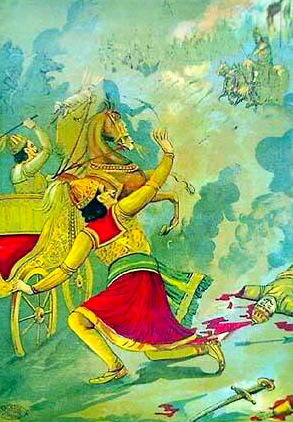
The death of Karna
Karna at Kurukshetra
The war between Arjuna and Karna
Kunti Devi, Karna's mother with her husband Pandu

Karṇabhāram or The Anguish of Karna (literally: The Burden of Karna) [1] is a Sanskrit one-act play written by the Indian dramatist Bhasa, an Indian playwright complimented even by the Kalidasa in the beginning of his play Malavikagnimitram.[2] The play describes the mental pain of Karna on the previous day of the Kurukshetra War.[3] Karṇabhāram is essentially the retelling of an episode of the Indian epic Mahabharata but the story is presented in a different perspective in the play. It is perhaps the only potential tragedy in the classic Sanskrit literature, presented in a form that comes closest to the "Vyayoga" (Sanskrit: व्यायोग) form of one-act play.[4] That is so perhaps because the Natya Shastra ordains the playwrights to create plays for recreation, and essentially create happy endings.[5] In Karnabharam, the tragedy does not occur on-stage (Unlike Urubhanga, a tragedy that shows Duryodhana dying - again, written by Bhasa). Karnabharam shows the valiant, generous, righteous Karna riding out towards the battle-ground, where his death under heart-wrenching circumstances is certain. The basic plot of this play is inspired by Mahabharata.

Karnabharam is known today as one of the 13 manuscripts of plays which are generally attributed to Bhasa with some dissent.[6] The Malayalam script of these plays was found on 105 palm leaves, believed to be about 300 years old when found. Mahamahopadhyaya T. Ganapati Sastri made this discovery as part of his field research at the site called Manalikkar located in Kanyakumari district, which is now within the city of Trivandrum (now Thiruvananthapuram).[7] The discovery of these manuscripts was made over a period starting from 1909 when ten plays and some parts of the eleventh play were found. None were carrying the name of their author.[8] Soon after, two more were found and lastly, another intact play, ascertained as Dootavakyam was found - thus bringing the number of plays to 13.[9]

Synopsis

[edit]

Karnabharam is the shortest and the least action-oriented among the plays written by Bhasa.[10]

Major elements of this play are the Mangala Shloka, Prologue, Entry of the soldier, Anguish of Karna, Curse of Parashurama, Finding of inner brilliance by Karna, Donation of Kavacha and Kundala, Receiving of Vimala power and Bharat Vakya.[11]

The play begins with a scene in which, a soldier sent by Duryodhana informs Karna that the time to go to the battlefield had arrived. Karna finds himself filled with extreme agony and grief that manifest themselves from his whole demeanor, which was ironic given that it was a day of great battle for him (Shloka-6). But, Karna cannot shake off his recent discovery of the fact that he was the eldest son of Kunti (Shloka-7), who did not want him to kill his arch enemy - and now also his younger brother - Arjuna (Shloka-8). Karna also remembers the event involving his Guru's curse. As he narrates these things to Shalya, the king of Madra and Karna's charioteer, Indra approaches Karna with a request for a great favor. Indra is in the attire of a Brahmin, and he does not reveal his identity. Karna offers him many things, all of which were refused by Indra, until the time when Karna offers his armor and earrings. Indra accepts and goes away. "Indra cheated you!", cries Shalya. "No, it was Indra who was cheated by me", responds Karna. This is a thought-provoking response, as the reader wonders how exactly did Karna cheat Indra. It is true that Indra was obliged, favored and even dwarfed, but how Karna thinks that Indra was cheated, is a question that does not have a ready answer.[12]

When Karna promises Indra to give him whatever he wants, Indra blesses him with 'undying glory'. Karna wonders why, as it was customary, the receiver did not give the usual blessing of 'live long' (Sanskrit: दीर्घायु भव). Karna is suspicious but goes ahead with the gracious act of giving unconditionally and with unshaken faith. A little while later, a messenger sent by Indra arrives and gives him what Indra sent in reciprocation - a weapon named Vimla, which never failed in killing the target. Karna again responds valiantly that "I never seek the return on what I have gifted." (Sanskrit: दत्तस्य न प्रतिगृह्णामि) But, the messenger insists that he keep it "because of the request from a Brahmin." (Sanskrit: ननु ब्राह्मणवचनात् गृह्यताम्) Karna accepts and asks Shalya once again to take his chariot to where stands Arjuna (Sanskrit: यत्रासावर्जुनस्तत्रैव चोध्यतां मम रथ:).

Thus, the play starts with a messenger of Duryodhana and ends with a scene involving the messenger from Indra.

Karna

[edit]

Karna was the Grey Character warrior of ancient India as given in the Mahabharatha. He was the king of Anga kingdom. According to Mahabharatha, Karna, along with Arjuna, were the only warriors who had the capacity to conquer the entire world.

Depiction of Karna

[edit]

The play depicts Karna's mental agony a day before the Kurukshetra War, as he thinks about his past and his faith. The play projects the mortal anguish of a man unsure of his identity. Karna, the protagonist is heroic and pathetic at the same time as he tries to find his place between the mocking and adulation of social forces on one side and the taunting challenges of fate on the other.

The treatment of the play takes it beyond reality, beyond the caricature of farce into a realm that transcends the space and time and gets related to the social realities of today. Karna lingers in one’s consciousness as the symbol of Universal man in search of his own self-the ultimate dilemma of existence.

Plot

[edit]

The time and space of action is from the eleventh day in the war-field of Mahabharata.

The great warrior Karna, the son of Surya is seen disturbed and depressed in the war-field instead of being mighty and powerful. The play analyses the reasons.

He is worried of his birth, his caste and his social status. Whether he is the son of Kunti and Surya, or Radha and Adhiratha? The mockery and adulation of the society moulds his person and fate. For a while he is moved by the meaninglessness of the war where men kill each other. He says that irrespective of his victory or defeat, war is a real waste. This vision adds to his turbulence.

Karna tells Shalya about the curse given by his Guru, Parashurama. This episode is enacted by correlating the narration of the present with the enacting of the past. The astra advised by Parashurama is found powerless at the needed hour.

The entry of Indra disguised as a Brahmin, follows, who cunningly takes away the divine Kavacha and Kundala from Karna. He understands that the whole plot is masterminded by the shrewd Krishna and accepts his fate. The messenger from Indra offers a powerful weapon Vimala which can destroy one among the Pandavas.

Accepting the challenge from Arjuna and Krishna the revitalized Karna proceed to this ultimate fate heroically. Thus ends Bhasa’s play Karnabharam.

Sources of the play

[edit]

Jay bharata by Vyasa

  1. Shanti Parva. Chapter 3. The story of Karna learning the 'Astravidya' (art of warfare) and divyastras (divine weapons) from Parasuram. The curse of the guru.
  2. Vana Parva. Chapter. 310. The visit of Indra and the giving away of the armour and the ear rings in exchange for a magic power.
  3. Udyogaparva. Chapter 146. Kunti’s request that her children may be spared. Karna’s promise (exception Arjuna)
  4. Karna Parva: Karna’s march to the battlefield with Salya as the charioteer.

Title of the play

[edit]

'Bhara' or burden is the central theme. The word 'bhara' in the title may refer to

  • The weight of the armour and the ear rings
  • The thought of killing his own brothers.
  • The thought of the three curses.
  • The thought of his weapons becoming useless at the crucial time.
  • The loss of the ear rings and the armour at the crucial time which increased his bhara or responsibility as the commander of the army.

Deviation from Vyasa's Mahabharata

[edit]

The play has many deviations from the original Mahabharata and all deviations are purposeful. Three major changes are:

First, the play is characterized by a friendly dialogue between Karna and Shalya, his Charioteer.[13] Shalya is consistently empathetic towards Karna, and even concerned about his interests - he warns Karna not to give away his armor and earrings to the brahmin-looking stranger. In the original story, Shalya was the king of Madra, and sympathetic towards the Pandavas. Karna had accepted to be a General of the Kaurava army provided Shalya drove his chariot. Shalya could not deny Duryodhana's request, but keeps a condition of his own - that Karna would say or do nothing in response to whatever he said to him. Karna accepts, and on the battlefield Shalya continually criticizes Karna, reminding him of his low birth and other failures in life. The Karna of the Mahabharata (in Karnaparva) fights bravely in spite of nagging criticism of Shalya. The Karna of Karnabharam finds an ally in Shalya.

Second, in the original, Surya - Karna's father visits him in his dream and warns him of a possible cheating by Indra (Vanaparva). Karna of Karnabharam is not aided or supported by anyone from his family, and it appears ironic that Indra, Arjun's biological father goes to Karna to protect his son, while Surya, the biological father of Karna, watches on from the sky. In the original, Indra feigning as a brahmin asks for the armor and earrings, and Karna obliges. In Karnabharam, Karna offers one thing after another, refused by Indra and in the end, offers on his own, his armor and earrings. Karna of Karnabharam is a compulsive giver. Also, in the original, when asked by Indra to get something in return for a great act of charity, Karna asks for the ability to kill the enemy. In Karnabharam, a guilty Indra sends the weapon, which Karna refuses to accept, saying that he does not seek the return on charity. Bhasa's Karna is gallant and very, very generous.

Third, the mental agony experienced by Karna is an exploration and presentation by Bhasa. Although Karna's story appears in various parts of Mahabharata, all of them appearing together and serving the backdrop for Karna's intense stress, feeling of being let down in life and un-auspicious omens pointing at impending fate, Bhasa's Karna tells Shalya,

"हतोSपि लभते स्वर्गं जित्वा तु लभते यश: उभे बहुमते लोके नास्ति निष्फलता रणे ॥ १२॥

[Meaning: If killed, one attains heaven and if victorious, gains glory. Both are highly esteemed in this world - there is nothing like failure in war.]

Fourth, in the original, when Karna goes to Parashurama, he identifies himself as a brahmin. In Karnabhara, he simply tells him "नाहं क्षत्रिय:" (meaning: I am not a Kshatriya). It makes sense, because, if Karna did not know that Kunti was his mother until the announcement of war, then he only knew that his foster parents were Sutas - the charioteers of Duryodhana. In that case, Karna's statement that he was not a Kshatriya was probably not a lie. Again, in Mahabharata, Parashurama's curse is limited to use of Brahmastra by Karna. But in Karnabhara, the curse of Parashurama is, "Your weapons will be powerless at the moment of need (Shloka 10)." - this Karna of Bhasa faces a much more ominous threat.

Further, the time of Indra’s appearance in the play happens on the 17th day of the battle. In the Vyasa version, it happens much earlier.

Major scenes

[edit]

An interesting discussion around the major scenes of this play is found in Pusalkar.[14] Selected parts appear below:

Mangala shloka (Sanskrit: मंगलश्लोक)

[edit]

It is noticeable that the shloka seeking blessings from a deity is presented by the Sutradhara, who is introduced as "नान्द्यन्ते तत: प्रविशति सूत्रधार:।" (meaning: Sutradhara enters after Nandi). The Nandi occurs first, but we do not know how it was being performed in Bhasa's plays. After Nandi, the Sutradhara presents the auspicious shloka, a seeking blessing or wishing well for the audience.

It is also worth noting that the Mangala Shloka of Karnabharam seeks blessings of the Narasimha avatar of Vishnu. In this avatar, Vishnu is a furious and ferocious half-lion and half-man, who kills the demon Hiranyakashipu with his bare hands using the nails. Invocation of Narasimha may stir the emotions of fear and cast the dark shadows of killing and death, which is also indicative of the nature of the plot of the play.[15]

Karna's anguish

[edit]

Karna's memories of his mother's request not to kill his own brothers and the curse of his Guru are fresh in this scene.[16] The battle of his life awaits him, as he is now the General of the Kaurava army. Yet, he knows that none of his expertise and his weapons will serve his will. Death is imminent in this case, as his adversary is none other than Arjuna, one of the greatest warriors of that time. As if reflecting this inner shadows, his horses and elephants also appear dull, weak and frightened. From Karna's narration to Shalya, one cannot help but sense Karna's distress: What was he being punished for? Was it his fault that he was the first son of unmarried Kunti? Was it his fault that a Shudra Charioteer adopted him? Was he really lying when he told his Guru that he was not a Kshatriya? In fact, rather than countering to the unfairness of the world by unfairness, Karna turned himself out as a great warrior and a philanthropist, a gracious giver, who gave unconditionally, without any expectations of returned favors. Yet, why did his enemy's father cheat him and robbed him of the only protection that was left with him? When the world was unapproving of him, refusing to recognize his true identity, only Duryodhana had helped him. Was it not a Dharma to act kindly towards someone who had been kind?

And yet, valiant Karna, the hero of Karnabharam, manages to retain his composure while telling the story of Parashurama's curse. Soon, cheating by Indra follows and Karna lives up to his reputation of the supreme donor - Daneshvari ((Sanskrit: दानेश्वरी). With unshaken valor, he asks Shalya to find Arjuna for him.

Vimala power

[edit]

Indra seems curiously happy to have accomplished his goal of robbing Karna of his life-protecting armor and earrings with which he was born. He is now eager to watch the battle between Arjuna and Karna from the heavens by sitting on the back of his elephant Airavata. But, he also feels guilty of his own deceit, and so sends his messenger with an unfailing, deadly, single-use weapon called Vimala. Karna refuses it but accepts it only because he has never before refused a word of a Brahmin.

Challenge in performing Karnabharam

[edit]

Awasthi and Schechner (1988)[17] note that the length of "Karnabharam" should be given its due importance. Karnabharam is a one-act play, and its reading time is short. However, the play contains a multitude of staging signs, and their variety increases its performance time greatly (p. 51). So much so, that according to the authors, Bhasa's Madhyama Vyagoga, Urubhanga and Karnabharam take four times as long as it takes to read.

Staging

[edit]

Karnabharam, the Sanskrit language play was staged at the Siri Fort Auditorium in New Delhi on 29 March 2001. The play was performed as part of the National Theatre Festival of National School of Drama. It was designed and directed by Kavalam Narayana Panicker. The play had a duration of 55 minutes. Indian film actor Mohanlal portrayed Karna in the play.[18][19]

Stories from Mahabharata forming the base of Karnabharam

[edit]

Karnabharam is created by weaving together several instances and situations that have been mentioned in different parts of Mahabharata, but as it was customary, Bhasa made his own modifications [20] discussed above. In the background is the story that identifies Karna as the son of Kunti, born of Surya (Sanskrit: सूर्य) at the time when she was still unmarried. Kunti felt ashamed of it, put Karna in a basket and floated him across the river. He was rescued and reared by a charioteer family.

The Sun God is the father of Karna

As the legend goes, Karna was born with a chest-armor (Sanskrit: कवच)and earrings (Sanskrit: कुण्डल) of Gold. Of course, after Kunti married the king Pandu (Sanskrit: पाण्डु), who was cursed to die if and when he attempted to make love, Kunti had three more sons (Yudhisthira, Arjuna and Bhima) by three different Gods. Kunti had a boon, given by Rishi Durvasa, which empowered her to invoke a god by chanting a mantra for obtaining a son. The mantra could be used five times. Because she had Karna at a very young age before her marriage as she used the mantra out of curiosity, Kunti abandoned Karna by putting him in a box and leaving the box afloat in the river. Now, before the great battle of Mahabharata, when Kunti knew that Karna had vowed to kill Arjuna in battle, she went to Karna, identified herself as his mother, and asked him to spare his brothers. Generous Karna, rather than asking her why she had remembered him after all these years, and asking if her sons won't kill him if he did not kill them, assured her that she will remain the mother of five Pandavas as always - either he or Arjun would die.

The second story is that of Karna's sojourn with his Guru, Parashurama. Parashurama was a sworn enemy of Kshatriyas and he taught archery (Dhanurvidya) only to the Brahmins. Karna, however, had decided to learn from Parashurama only, so at the time of admission, when Parashurama asked for his Jati, Karna said he was a Brahmin - which was a lie. Then, once upon a time, when Parashurama had taken his disciples in the forest, Parashurama slept with his head on Karna's lap during siesta. A bug sat on Karna's thigh and began to bite so viciously that Karna started bleeding. Not wanting to disturb his Guru's sleep, Karna did not move or even make a sound. But the stream of warm blood touched Parashurama, who woke up and realized that such fortitude was beyond a Brahmin. When confronted by the Guru, Karna admitted that he had lied about his Jati. Angered by this treachery, Parashurama cursed Karna that he would forget all his lie-begotten vidya in the moment of true need.

The third story is about Karna's generosity and the vow of charity that remained unbroken even at the cost of his own life. Every morning, Karna performed puja of Surya, followed by a session of charity wherein he granted all the favors requested by the people who came to him for help. His reputation spread far and wide, and people lined up waiting for Karna's Surya-puja to be over, so that they could request for Karna's charity. Just before the day of battle when Karna took part in it (he had abstained initially as he did not accept the generalship of Bhishma), Indra, who fathered Arjuna, approached Karna in the form of a Brahmin and asked for Karna's gold chest-armour and earrings. Karna suspected treachery, but since he did not want to break his vow of granting every wish made after his puja, he gave those two objects away. However, he knew that without those two divine objects on his body, he was vulnerable to death. Indra felt guilty at his own treachery and reciprocated by giving to Karna a single-use weapon that could never fail and caused certain death of the enemy for whom it was used.

See also

[edit]

Further reading

[edit]

References

[edit]
Revisions and contributorsEdit on WikipediaRead on Wikipedia
from Grokipedia
(Sanskrit: karṇabhāram, "Karna's Burden") is a one-act play attributed to the ancient Indian dramatist , dramatizing the moral and emotional burdens borne by the Mahabharata warrior amid his loyalties and fate in the . The narrative centers on 's internal turmoil as he commands Duryodhana's forces, torn between unwavering friendship to the Kaurava king—who elevated him despite his low birth—and revelations of his true parentage as Kunti's firstborn son, making him a half-brother to the he opposes. employs concise dramatic structure to depict 's generosity, valor, and fatalistic resolve, culminating in his procession toward a duel with where curses and divine interventions seal his doom, underscoring themes of , identity, and tragic inevitability drawn from Vyasa's epic. This work exemplifies 's psychological insight and deviation from epic conventions, prioritizing character introspection over extended battle scenes, which distinguishes it among nataka traditions.

Authorship and Historical Context

Bhasa as Playwright

Bhasa is attributed as the author of Karnabharam, one of thirteen plays discovered in palm-leaf manuscripts at the royal library between 1909 and 1912 by T. Ganapati Sastri, published as the Trivandrum Sanskrit Series. These manuscripts, over 300 years old at the time of discovery, consistently ascribe the works to Bhasa through colophons and internal stylistic consistencies, such as recurring structural elements like the "nandyante tatah pravisati sutradharah" stage direction and techniques including akasabhasita monologues. Scholars estimate Bhasa's active period from the 4th century BCE to around 200 BCE, positioning him as predating Kalidasa (c. 4th–5th century CE) and potentially contemporary with or preceding the Natyasastra (c. 200 BCE). This dating draws from linguistic analysis showing pre-Paninian grammar features, references to historical figures like King Rajasimha, and the absence of later doctrinal elements such as Buddha as Vishnu's incarnation; ancient attestations include citations in Kalidasa's Malavikagnimitram, Bana's Harshacharita, Rajashekhara's Kavyamimamsa, and Abhinavagupta's commentaries, which quote verses from plays like Svapnavasavadattam. Bhasa's dramatic style, evident across the Trivandrum plays, emphasizes conciseness through short, succinct dialogues and strategic silences to heighten tension, alongside adaptations of epic tales that introduce original subplots and prioritize character psychology over strict narrative fidelity. Departing from later conventions, his works incorporate on-stage , diverse rasas like karuna () and vira (heroism), and a blend of natyadharmi (stylized) and lokadharmi (naturalistic) modes, fostering realistic explorations of motivations and causal sequences in conflict. Such innovations, including disregard for Natyasastra prohibitions on tragic resolutions or deaths in view, underscore his role in early theatre's evolution. Due to these pioneering techniques and his status as the earliest extant Sanskrit dramatist venerated by subsequent authors, Bhasa is termed the "father of Sanskrit drama" in scholarly assessments, with empirical support from the Trivandrum corpus's influence on later and practice.

Manuscript Discovery and Authorship Debate

The manuscripts containing Karnabharam and twelve other plays were discovered between 1909 and 1914 by the Sanskrit scholar T. Ganapati Sastri while cataloging palm-leaf texts in the Oriental Manuscripts Library of the kingdom in Trivandrum (present-day ), . These texts, inscribed in an archaic , had lain unstudied in the royal collection, and Sastri identified a consistent stylistic unity among them, prompting their publication in the Trivandrum Sanskrit Series from 1912 onward. Sastri attributed the plays, including Karnabharam, to the ancient dramatist Bhasa primarily through internal colophons—such as concluding verses naming "Bhasa" or his disciples—and correspondences in language, meter, and dramatic technique that echoed references to Bhasa in medieval commentaries. This ascription drew on ancient attestations, like Bhatti's 7th-century Ravণauḍa praising Bhasa's concise and innovative approach, aligning with the plays' abbreviated narratives and unconventional tragic emphases over extended spectacle. Publication sparked scholarly controversy from the 1910s to the 1930s, with critics like questioning authenticity due to apparent deviations from Nāṭyaśāstra norms, such as abrupt tragic conclusions and minimal choral elements, which some viewed as anachronistic or indicative of later interpolation. Skeptics argued the manuscripts' condition and script suggested medieval fabrication, dismissing them as inconsistent with presumed classical rigidity. However, philological examinations by scholars including Sten Konow and M. Winternitz resolved the debate through evidence of pre-Kālidāsa linguistic archaisms—such as rare forms and metrical irregularities—and thematic parallels to early epic adaptations, confirming the plays' antiquity and Bhasa's authorship by the mid-20th century. The manuscripts' terse structure and bold innovations, far from markers, corroborated ancient critiques of Bhasa's praised brevity, undermining claims of post-classical origin.

Title and Significance

Etymology and Symbolic Meaning

Karnabharam derives from the Sanskrit compound karṇabhāram, wherein karṇa denotes the protagonist from the and bhāram signifies burden, weight, or load, collectively translating to "The Burden of Karna" or "Karna's Anguish." This etymology highlights the play's concentration on Karna's internal psychological strain, distinct from the epic's broader narrative arcs, and reflects Bhasa's intent to isolate the causal weight of personal oaths and revelations. Symbolically, the title embodies Karna's existential load, arising from conflicts between loyalty to his benefactor and the imperatives of individual , exacerbated by curses that undermine his martial prowess and the forfeiture of his divine armor. This burden manifests as a deliberate chain of choices—rooted in prior commitments rather than inescapable destiny—culminating in self-determined resolve amid impending doom, evoking karuṇa rasa () intertwined with heroic valor. By foregrounding such introspective causality, the nomenclature departs from Mahabharata's episode-based conventions, prioritizing the protagonist's and tragic self-imposed fate over heroic external triumphs.

Relation to Mahabharata

Source Stories from the Epic

Karna's origins in the trace to 's invocation of Deva using a granted by sage , resulting in his birth with natural divine armor (kavacha) and earrings (kundala) that rendered him invulnerable. Fearing social repercussions as an unwed mother, placed the infant in a basket and set it afloat on the Asva River, where it was discovered and adopted by Adhiratha, a charioteer (suta) in the service of , and his wife , who raised him as their own son Vasusena, later known as Radheya. This low-caste upbringing fueled Karna's lifelong quest for recognition as a , despite his innate skills rivaling those of from early demonstrations. In the epic's tournament episode, arrives unannounced at Hastinapura and matches Arjuna's feats, igniting a personal rivalry that exploits by crowning king of to legitimize his challenge and secure his allegiance against the . This alliance binds irrevocably to the Kauravas, as he pledges lifelong loyalty to for elevating him from perceived obscurity, even as his prowess—honed under , whom he deceived about his caste—establishes him as a peerless archer capable of wielding divine astras. The details Indra's pre-war deception, where the king of gods, foreseeing threats to his son , disguises himself as a and requests 's kavacha-kundala as ; true to his danaveer reputation, slices them off and donates them, forsaking his invincibility, in exchange for Indra's vasavi missile, a one-use weapon later deployed against . Earlier in the same parva, reveals 's true parentage to him privately, urging defection to the with promises of co-heirship, but he declines, vowing fidelity to while agreeing to spare her other sons in battle. Karna Parva narrates his elevation to Kaurava commander-in-chief following Dronacharya's death on the 15th day of the , where he leads assaults inflicting heavy losses, including the slaying of with the , before confronting on the 17th day. Despite Krishna's prior disclosure of his inevitable defeat and divine interventions—such as the from causing lapses in memory of astras, a Brahmin's immobilizing his wheel, and Shalya's reluctant role as charioteer—Karna persists in combat until his wheel sinks in mud, his invocations falter, and 's anjalika arrow decapitates him, ending the duel amid the epic's causal progression of loyalty overriding foreknowledge.

Deviations from Vyasa's Mahabharata

In Bhasa's Karnabharam, the episode of , disguised as a , soliciting Karna's divine (armor) and kundala (earrings) is chronologically repositioned to the eve of Karna's fateful battle on the seventeenth day of the , in contrast to Vyasa's , where it transpires years prior during the ' forest exile as detailed in the . This alteration compresses the timeline to foreground Karna's acute pre-battle vulnerability, rendering his divestment not as a distant youthful act but as an immediate causal precipitant of his downfall, thereby emphasizing self-imposed sacrifice over epic-scale inevitability. The play's rendition of the -Karna exchange amplifies dharma-centric absent in the epic's more transactional depiction; Karna explicitly grapples with the tension between his pledged fealty to and the moral imperative of universal welfare, voicing anguish over Kunti's entreaty to defect and Parashurama's curse, which heighten his psychological isolation. Bhasa omits Surya's forewarning dream to Indra, introducing an element of unanticipated deception that underscores Karna's unyielding generosity as a volitional choice rather than divinely mitigated folly. A pivotal lies in the aftermath of the donation: whereas Vyasa's shrewdly barters for Indra's Vasavi spear as compensation, Bhasa's version portrays rejecting the proffered weapon—sent by a remorseful —insisting that true dana (gift-giving) precludes reciprocity, thus stripping away compensatory power and intensifying the raw burden of loss. Salya's role shifts from the epic's sardonic critic to a sympathetic who cautions against the gift yet respects Karna's resolve, further humanizing the protagonist's tragic . These omissions of subsequent events, such as the spear's deployment against , confine the narrative to anticipatory torment, cultivating a rooted in Karna's deliberate fidelity over the Mahabharata's expansive .

Plot Summary

Synopsis and Key Events

The Karnabharam by Bhasa centers on , the army commander following Dronacharya's death, as he prepares for battle on the seventeenth day of the . Haunted by Kunti's revelation of his parentage and her plea to spare his brothers, alongside Parasurama's curse that his knowledge would fail him at a critical moment, Karna grapples with despair and resolve to confront , vowing either victory or death. Indra, disguised as a , approaches begging for his innate divine armor (kavacha) and earrings (kundala) as an act of charity (dana). Despite warnings from his charioteer against the request and foreknowledge of the consequences, deliberates internally and generously donates the protective items, rendering himself vulnerable. Indra reveals his identity, bestowing a of undying fame rather than , and subsequently, through an emissary, grants an infallible spear capable of slaying one formidable foe. The play culminates in 's steadfast determination to advance into battle upon hearing Arjuna's shell, bearing the burden (bharam) of his diminished defenses.

Major Scenes

The play opens with the mangala śloka, a traditional invocatory verse that establishes the tone of burdened heroism, portraying Karna as a figure destined for tragic valor amid inevitable downfall. This auspicious opening, common in Bhasa's works, precedes the dramatic action and underscores the psychological weight (bhāra) central to the narrative. Karna's entrance features a poignant on the seventeenth day of the , where he grapples with despair encroaching on his resolve to confront . Informed by a of Kunti's to spare her other sons—revealing his fraternal ties to the —Karna debates his unyielding loyalty to against the moral toll of , weighing dharma's demands with personal indebtedness and the war's ethical costs. He reflects on curses, including Parashurama's pronouncement that his skills will falter in dire need, amplifying his premonitions of doom while affirming battle's dual outcomes of heavenly reward or earthly glory. The confrontation with , disguised as a , forms a climactic exchange that condenses the epic's motifs into a test of principle. On the same fateful day, begs for 's protective kavacha and kundala; , suspecting divine guile yet prioritizing dana (charity), relinquishes them without , declaring alms' eternal value over temporal possessions. Upon 's revelation, rejects any restitution, framing his gift as an autonomous act of rather than transaction, though he accepts a compensatory spear (śakti) destined for , highlighting Bhasa's emphasis on 's uncompromised generosity amid deception. This scene propels the structural brevity, transitioning from introspection to fatal resolve as proceeds to battle.

Themes and Characterization

Karna's Internal Conflict and Dharma

In Karnabharam, Bhasa portrays Karna's as a profound psychological burden arising on the seventeenth day of the , when he assumes command of the forces following Dronacharya's death. Aware of his divine birth as Kunti's firstborn son and thus half-brother to the , Karna confronts the tension between his sworn loyalty to —who elevated him to royal status despite his low-born samskara—and the familial revelations that could justify . This samskara, shaped by his upbringing as Adhiratha's son and subsequent adoption into roles through personal valor and alliance, reinforces his commitment to varna-specific duties of warfare and alliance, even as implores him to spare her other sons except . Karna's explicit rejection of retreat underscores a causal realism in : prior oaths and acts of generosity, such as donating his protective armor and earrings to despite foreknowledge of , precipitate inevitable consequences that override opportunistic shifts in allegiance. Central to this portrayal is Karna's adherence to kshatriya dharma, where martial honor and promise-keeping supersede self-preservation or egalitarian appeals to shared blood. He articulates this in soliloquy-like reflection to , his charioteer: "If killed in battle, one goes to and if victorious, he wins fame. Both are good. So fighting is never fruitless," prioritizing empirical outcomes of combat—glory or celestial reward—over evasion. This stance critiques deterministic interpretations of fate by highlighting agency: curses from (failure of weapons at critical moments) and amplify his distress, yet Karna musters resolve to advance toward , embodying vira rasa (heroic sentiment) intertwined with . His decision not to disclose his lineage publicly or join the exemplifies how chosen loyalties, rooted in reciprocal bonds rather than birth, dictate tragic trajectories, countering modern narratives framing him solely as an "oppressed underdog" victimized by varna hierarchies without accounting for his volitional elevation through Duryodhana's patronage and his own unyielding commitments. Bhasa's psychological insight reveals Karna's turmoil through mounting dejection—"How is it that in this very hour of battle, despair creeps into my heart?"—yet his ultimate march to doom affirms dharma's first principles: cosmic order demands consistency in warrior conduct, where personal vows to benefactors like hold precedence over belated familial claims. This fidelity, verifiable in the play's structure culminating in Karna's armored departure despite vulnerability, privileges causal chains of action—early alliances forging unbreakable duties—over pity-driven reinterpretations that might recast as mere . Scholarly analyses affirm this as tragic heroism, not victimhood, emphasizing how Karna's varna-duty realism sustains efforts amid foreknown defeat, yielding honor amid loss rather than survival through betrayal.

Loyalty, Fate, and Tragic Heroism

Karna's loyalty to exemplifies a rooted in reciprocal obligation, where the prince's conferral of the kingdom elevated Karna from social obscurity to royal status, forging an unbreakable bond that propelled him into the conflict despite revelations of his true lineage. This allegiance is depicted as a deliberate ethical stance, causally tied to Duryodhana's past patronage, which Karna honors through unwavering military support, rejecting overtures from the that would absolve him of prior commitments. Such portrayals underscore Karna's agency in upholding personal codes over opportunistic shifts, countering interpretations that frame his path as mere victimhood dictated by birth circumstances rather than volitional reciprocity. The interplay of fate and in the play intensifies Karna's tragic dimension, as his foreknowledge—imparted by figures akin to Krishna—of impending curses and battlefield demise does not paralyze action but amplifies the nobility of his self-determined resolve to proceed. Curses from a (for harming his cow) and (for deception in learning archery) represent deterministic elements, yet Karna's choice to donate his protective kavacha-kundala armor, fulfilling a warrior's dana vow, directly precipitates his vulnerability, illustrating as the foreseeable consequence of principled decisions rather than inscrutable destiny. This tension posits that while fate delineates boundaries, Karna's agency within them—opting for loyalty and honor over survival—defines his heroism, heightening without excusing flaws as external impositions. As a tragic , Karnabharam aligns with nataka conventions by centering a flawed yet valiant whose downfall evokes and , but innovates through Karna's unheroic and , revealing doubts about identity and before heroic recommitment. Unlike idealized epics, the play humanizes Karna's optimism amid doom, portraying him as neither invincible nor pitiable pawn, but a figure whose choices immortalize unromanticized virtues like and , influencing subsequent literary treatments to emphasize rational over sentimental redemption. This structure affirms causal realism in heroism: downfall ensues from integrated actions—loyalty sustained, vows kept—yielding a legacy of tragic authenticity unbound by narrative sanitization.

Dramatic Structure and Style

One-Act Format and Poetic Elements

Karnabharam employs a compact one-act structure, distilling the expansive Mahabharata episode into a focused sequence set on the eve of the Kurukshetra war, centering Karna's encounter with Indra disguised as a Brahmin and the subsequent donation of his invulnerable kavacha (armor) and kundala (earrings). This compression eschews the epic's chronological sprawl, heightening dramatic intensity through a linear causal progression from Karna's resolve to his irreversible act of generosity, thereby emphasizing immediate psychological stakes over protracted narrative threads. The play integrates slokas (verses) for elevated, introspective monologues and prose for conversational exchanges, fostering rhythmic tension that evokes (emotional states) as per Natyashastra guidelines on dramatic rasa, while Bhasa departs from rigid conventions—such as permitting the disguised to use for naturalistic effect—to prioritize character-driven authenticity. Poetic elements feature anuprasa () in depictions of Karna's torment, amplifying auditory resonance in an oral performative context, alongside symbolic layering where the embodies Karna's core identity and solar heritage, its surrender marking a pivotal causal pivot toward fate. With a minimal cast—primarily , (as ), and brief aides like the charioteer—the format channels causality inward to the protagonist's psyche, contrasting the Mahabharata's multi-perspective epic scope and enabling unadorned realism in decision-making dynamics.

Challenges in Performance and Interpretation

The performance of Karnabharam demands mastery of classical Sanskrit's archaic forms, where subtle phonetic precision and rhythmic intonation are essential to layering emotional resonance in Karna's dialogues and monologues. , rehearsing for a production directed by , revealed he had only eight days to prepare and initially doubted his ability to execute the role effectively, underscoring the linguistic and preparatory intensity required even for seasoned performers. Staging the play's one-act structure, dominated by Karna's introspective soliloquies, imposes rigorous demands on —the traditional Indian theatrical mode of embodying rasas (aesthetic emotions) through gesture, voice, and facial nuance—to render internal conflicts visible without reliance on ensemble interplay or props. This focus challenges actors to sustain prolonged inward-facing expression, often clashing with contemporary acting paradigms favoring sparse naturalism, as the text's contemplative pacing risks alienating audiences unaccustomed to such unadorned psychological depth. Interpretationally, pitfalls emerge when contemporary lenses impose narratives of caste-based victimhood on Karna's arc, recasting his struggles as systemic rather than outcomes of svadharma—personal duty bound by causal adherence to oaths and alliances despite known truths. Such readings, prevalent in some modern retellings, diverge from the play's rooted depiction of as self-inflicted through misaligned loyalties, neglecting dharma's framework where character evaluation hinges on over birth circumstances. Preserving the original causal realism requires prioritizing textual to Bhasa's emphasis on fate as consequence of choices, unfiltered by anachronistic equity constructs that obscure the epic's empirical lessons on and consequence.

Reception and Adaptations

Scholarly Analyses and Criticisms

Scholars have commended Bhasa's Karnabharam for its innovative focus on Karna's internal psychological burden, portraying him as a multifaceted tragic figure burdened by , identity, and impending doom, which elevates the play beyond a mere episodic retelling of the . This depth in character exploration, emphasizing Karna's emotional turmoil on the eve of battle, demonstrates Bhasa's dramatic skill in compressing epic elements into a one-act format while heightening through monologues and interactions. Critics, including A.B. Keith in his analysis of Bhasa's oeuvre, highlight the play's stylistic departures from later conventions, such as prioritizing realistic over ornate , which aligns empirically with Natyashastra principles of evoking vira (heroic) and karuna (pathetic) rasas through concise dialogue and minimalistic staging cues. This prefigures tragic innovations akin to Shakespearean soliloquies, as 20th-century Indologists noted Bhasa's emphasis on individual agency amid fate, fostering audience empathy for Karna's dilemmas. However, some analyses critique the play's heavy condensation and deviations from Vyasa's —such as altering timelines for Karna's armor donation and emphasizing his solitude—which risk diluting the epic's polyphonic narrative scale and ensemble dynamics in favor of mono-character realism, potentially oversimplifying broader conflicts. Defenders argue these changes are intentional for dramatic intensity, transforming Karna from a one-dimensional antagonist into a sympathetic , though this selective focus may impose a modern interpretive lens on ancient material. Authorship attribution to Bhasa, while contested in early 20th-century debates following the manuscript discovery by T. Ganapati Sastri in , is supported by colophon evidence across thirteen plays, minimizing dissent through paleographic and stylistic consistency absent in later dramatists. Comprehensive evaluations balance these praises for tragic innovation against the loss of epic grandeur, noting the play's enduring influence on regional forms like for its rasa-driven monologues, without resolving interpretive biases in source traditions.

Historical and Modern Stagings

Kavalam Narayana Panikkar directed Karnabharam through his theatre group Lokadharmi starting in the 1990s, blending elements of Kutiyattam—the ancient tradition of theatre—with stylized gestures and rhythmic footwork to evoke classical natyadharmi conventions of expression through abstraction rather than realism. A landmark production featured actor portraying , with the performer undergoing an intensive eight-day preparation to memorize the dialogue and master the demanding physical and emotional demands of the role, resulting in critical praise for its intensity and authenticity. Lokadharmi continued staging the play under director Chandradasan, using Panikkar's translation of Bhasa's text while retaining core verses in performance; this version earned the Mahindra Excellence in Theatre Awards in for best play, best design, and best , highlighting innovative sets that symbolized Karna's inner turmoil through minimalistic, evocative props. These adaptations maintained fidelity to the one-act structure and poetic intensity, touring festivals like the Bhasa Mahotsavam, but encountered practical hurdles in engaging audiences preferring vernacular dramas, prompting hybrid linguistic approaches to bridge classical with regional accessibility. No significant controversies have marred these productions, which prioritize textual integrity amid evolving theatrical norms, though sustaining interest in amid dominant vernacular and multimedia entertainment remains a noted challenge for directors balancing tradition with contemporary relevance.

References

Add your contribution
Related Hubs
User Avatar
No comments yet.