Hubbry Logo
ChashitsuChashitsuMain
Open search
Chashitsu
Community hub
Chashitsu
logo
8 pages, 0 posts
0 subscribers
Be the first to start a discussion here.
Contribute something
Chashitsu
Chashitsu
from Wikipedia

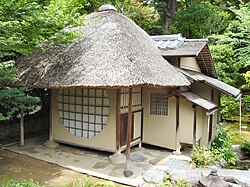
Jo-an is a chashitsu (tea house) and inscribed as a National Treasure.
Chashitsu in its garden setting, Itsuku-shima, c. 1900

Chashitsu (茶室, "tea room") in Japanese tradition is an architectural space designed to be used for tea ceremony (chanoyu) gatherings.[1]

The architectural style that developed for chashitsu is referred to as the sukiya style (sukiya-zukuri), and the term sukiya (数奇屋) may be used as a synonym for chashitsu.[2] Related Japanese terms are chaseki (茶席), broadly meaning "place for tea", and implying any sort of space where people are seated to participate in tea ceremony,[3] and chabana, "tea flowers", the style of flower arrangement associated with the tea ceremony.

Typical features of chashitsu are shōji windows and sliding doors made of wooden lattice covered in a translucent Japanese paper; tatami mat floors; a tokonoma alcove; and simple, subdued colours and style. The most typical floor size of a chashitsu is 4.5 tatami mats (7.4 m2; 80 sq ft).[4]

Definition

[edit]
Interior view of a tea room
Tai-an (待庵), the only extant chashitsu designed by Sen no Rikyū, representing his concept of wabi-cha. Located in Myōki-an in Ōyamazaki, Kyoto (National Treasure)

In Japanese, free-standing structures specifically designed for exclusive tea ceremony use, as well as individual rooms intended for tea ceremony, are both referred to as chashitsu. The term may be used to indicate the tea room itself where the guests are received, or that room and its attached facilities, even extending to the roji garden path leading to it.[5] In English, a distinction is often made between free-standing structures for tea, referred to as tea houses, and rooms used for tea ceremony incorporated within other structures.

Tea houses are usually small, simple wooden buildings. They are located in the gardens or grounds of private homes. Other common sites are the grounds of temples, museums, and parks. The smallest tea house will have two rooms: the main room where the host and guests gather and tea is served, and a mizuya, where the host prepares the sweets and equipment. The entire structure may have a total floor area of only three tatami mats.

Very large tea houses may have several tea rooms of different sizes; a large, well-equipped mizuya resembling a modern kitchen; a large waiting room for guests; a welcoming area where guests are greeted and can remove and store their shoes; separate toilets for men and women; a changing room; a storage room; and possibly several anterooms as well as a garden with a roji path, an outdoor waiting area for guests and one or more privies.

Tea rooms are purpose-built spaces for holding tea gatherings. They may be located within larger tea houses, or within private homes or other structures not intended for tea ceremony. A tea room may have a floor area as small as 1.75 tatami mats (one full tatami mat for the guests plus a tatami mat called a daime (台目), about 3/4 the length of a full tatami mat, for the portable brazier (furo) or sunken hearth (ro) to be situated and the host to sit and prepare the tea); or as large as 10 tatami mats or more; 4.5 mats is generally considered the ideal in modern tea rooms. A tea room will usually contain a tokonoma and a sunken hearth for preparing tea in the winter.

History

[edit]

The term chashitsu came into use after the start of the Edo period (c. 1600). In earlier times, various terms were used for spaces used for tea ceremony, such as chanoyu zashiki (茶湯座敷, "sitting room for chanoyu"), sukiya (place for poetically inclined aesthetic pursuits [fūryū, 風流]) such as chanoyu), and kakoi (, "partitioned-off space").[4] An account stated that it was the shogun Ashikaga Yoshimasa who built the first chashitsu at his Higashiyama villa in Kyoto.[6] It was described as a small room of four-and-a-half tatami and was separated from the main residence.[6]

According to Japanese historian Moriya Takeshi in his article "The Mountain Dwelling Within the City", the ideal of wabi-style tea ceremony (wabi-cha) had its roots in the urban society of the Muromachi period (1336 to 1573), and took form in the tea houses that townspeople built at their residences and which affected the appearance of thatched huts in mountain villages.[7] Before this, tea ceremony was generally enjoyed in rooms built in the shoin-zukuri architectural style, a style still frequently employed today.[8]

Tea houses first appeared in the Sengoku period (mid-15th century to early 17th century), a time in which the central government had almost no practical power, the country was in chaos, and wars and uprisings were commonplace. Seeking to reclaim Japan, samurai were busy acquiring and defending territories, promoting trade and overseeing the output of farms, mills and mines as de facto rulers, and many of the poor were eager to seek the salvation of the afterlife as taught by Buddhism. Tea houses were built mostly by Zen monks or by daimyōs, samurai, and merchants who practiced tea ceremony. They sought simplicity and tranquility – central tenets of Zen philosophy. The acknowledgment of simplicity and plainness, which is a central motivation of the tea house, continued to remain as a distinct Japanese tradition in the later periods.

The Golden Tea Room (MOA Museum of Art)

The Golden Tea Room (黄金の茶室, Ōgon no chashitsu) was a portable gilded chashitsu constructed during the 16th century Azuchi–Momoyama period for the Japanese regent Lord Toyotomi Hideyoshi's tea ceremonies. The original room is lost, but a number of reconstructions have been made. The Golden Tea Room was constructed to impress guests with the might and power of the regent. This was in contrast to the rustic aesthetics codified under his tea master Sen no Rikyū, although it is speculated that Rikyū might have helped in the design.[9][10] The room's opulence was highly unusual and may have also been against wabi-sabi norms.[11] At the same time, the simplicity of the overall design with its clean lines could be seen as within the canon. The extent of teamaster Rikyū's involvement in the design of the room is not known, however he was in attendance on a number of occasions when tea was being served to guests in the room.[11]

Architecture

[edit]
Nijiriguchi entrance of a tea house

The ideal free-standing tea house is surrounded by a small garden having a path leading to the tea room. This garden is called roji (露地, "dewy ground") and is divided into two parts by a gate called chumon.[6] Along the path is a waiting bench for guests and a privy. Aside from its own garden, the chashitsu is arranged – along with other pavilions such as the zashiki, oku no zashiki, and hanare zashiki – around a larger primary garden.[12]

There is a stone water-basin near the tea house, where the guests rinse their hands and mouths before entering the tea room through a low, square door called nijiriguchi,[6] or "crawling-in entrance", which requires bending low to pass through and symbolically separates the small, simple, quiet inside from the crowded, overwhelming outside world. The nijiriguchi leads directly into the tea room.

The tea room has a low ceiling and no furniture: the guests and host sit seiza-style on the floor. All materials used are intentionally simple and rustic. Besides the guests' entrance, there may be several more entrances; at minimum there is an entrance for the host known as the sadōguchi, which allows access to the mizuya. Windows are generally small and covered with shōji, which allows natural light to filter in. The windows are not intended to provide a view to the outside, which would detract from the participants' concentration. There is a sunken hearth ( ro) located in the tatami adjacent to the host's tatami, for use in the cold months; this hearth is covered with a plain tatami and is not visible in the warm months, when a portable brazier (風炉 furo) is used instead.

There will be a tokonoma (scroll alcove) holding a scroll of calligraphy or brush painting, and perhaps a small, simple, flower arrangement called a chabana (茶花), but no other decoration.

Layout of an ideal 4.5 tearoom with tokonoma and mizuya dōko
View of a similar interior, with some utensils

Chashitsu are broadly classified according to whether they have a floor area larger or smaller than 4.5 tatami, a differentiation which affects the style of ceremony that can be conducted, the specific type of equipment and decoration that can be used, the placement of various architectural features and the hearth, and the number of guests that can be accommodated. Chashitsu which are larger than 4.5 mats are called hiroma ("big room"), while those that are smaller are called koma ("small room"). Hiroma often are shoin style rooms, and for the most part are not limited to use for chanoyu.

Other factors that affect the tea room are architectural constraints such as the location of windows, entrances, the sunken hearth and the tokonoma, particularly when the tea room is not located within a purpose-built structure. The other factors that influence the construction of the chashitsu as a space in the iemoto are the iconography of the past and the memory of particular individuals.[13]

Not all tea rooms can be made to conform to the ideal seen in the image.

Typical names

[edit]

It is usual for chashitsu to be given a name after their owners or benefactors. Names usually include the character for "hut", "hall", or "arbour", and reflect the spirit of rustic simplicity of the tea ceremony and the teachings of Zen Buddhism. Characteristic names include:

  • Mugai-an (無外庵, Introvert Hut)
  • Mokurai-an (黙雷庵, Silent Thunder Hut)
  • Tōkyū-dō (東求堂, East-Seeking Hall) (note: the 東求堂 at Ginkaku-ji is pronounced Tōgu-dō, and is a private Buddhist hall, not a chashitsu)
  • Shō-an (松庵, Pine Hut)
  • Ichimoku-an (一木庵, One Tree Hut)
  • Rokusō-an (六窓庵, Six Window Hut)
  • Bōji-tei (忘路亭, Forgotten Path Arbour)

Notable chashitsu

[edit]

See also

[edit]

References

[edit]

Further reading

[edit]
[edit]
Revisions and contributorsEdit on WikipediaRead on Wikipedia
from Grokipedia
A chashitsu (茶室), or Japanese tea room, is a dedicated architectural space designed for the performance of the traditional tea ceremony, known as chanoyu or sado, where participants engage in a of preparing and serving to foster and social harmony. Rooted in Buddhist principles, the chashitsu emphasizes , , and a deep connection to nature, often serving as a serene or room within a larger or temple setting. Tea was introduced to Japan in the 9th century from by Buddhist monks, evolving into a cultural practice among practitioners by the 12th century. The dedicated chashitsu emerged during the (1336–1573) and was refined during the 16th century, amid the (1467–1598), by influential tea masters, particularly (1522–1591), who developed the sukiya style—a modest, rustic aesthetic that rejected opulence in favor of imperfection and transience, influenced by philosophy. This evolution transformed informal tea spaces in private homes into specialized structures, used initially by monks and later adopted by elites for philosophical and diplomatic gatherings. Architecturally, the chashitsu is typically a small, enclosed space measuring around 4.5 mats (approximately 9 square meters), constructed with natural materials like wood, clay, and thatch to evoke rusticity and impermanence. Key features include the nijiriguchi (a low, crawling entrance to instill ), tokonoma (an alcove displaying a scroll or flower arrangement), flooring, screens for diffused light, and a ro (sunken ) for boiling water, all arranged to guide the flow of the while harmonizing with the surrounding roji garden path. The adheres to modular ken proportions (roughly 1.8 meters) and asymmetrical layouts that disrupt perfect symmetry, reinforcing ideals of balance through irregularity. In Japanese culture, the chashitsu holds profound significance as a microcosm for spiritual practice, where the tea ceremony ritual—embodying the principles of wa (harmony), kei (respect), sei (purity), and jaku (tranquility)—cultivates discipline, introspection, and interpersonal connection. Beyond its ritual function, it represents one of Japan's most innovative architectural traditions, influencing modern design by contemporary architects who reinterpret its minimalist ethos for urban and global contexts.

Overview

Definition

A chashitsu (茶室), literally meaning "tea room," is a dedicated architectural space in , either as a free-standing building or an enclosed , purposefully constructed for the of the traditional tea ceremony known as chanoyu or sadō. This space serves as an intimate venue where the host prepares and serves tea to guests, fostering a ritualized interaction that emphasizes , , and the transient beauty of the moment. Unlike multipurpose rooms in traditional Japanese residences, the chashitsu is reserved exclusively for tea-related activities, reinforcing its role in cultivating and detachment from everyday concerns. The ideal dimensions of a chashitsu are standardized at 4.5 mats, equivalent to approximately 7.4 m², allowing space for one to five participants in a compact, enclosed environment that encourages closeness and attentiveness. However, sizes vary to suit different scales, ranging from minimal configurations of 1.75 tatami mats for solitary or highly intimate gatherings to larger setups exceeding 10 mats for group settings accommodating up to seven individuals. These variations maintain the core principle of modesty, ensuring the space remains unpretentious and focused on the ceremony's essence rather than grandeur. Essential features of the chashitsu include woven mat flooring, which provides a soft, uniform surface for seated participants; shōji screens made of translucent over wooden lattices, diffusing to create a serene, ethereal atmosphere; and the characteristic nijiriguchi, a low, narrow doorway that compels entrants to crouch or crawl, symbolizing humility and shedding of social status upon arrival. These elements collectively distinguish the chashitsu from ordinary living spaces by prioritizing impermanence—through natural, unfinished materials—and a deliberate restraint that heightens concentration on the tea ritual itself.

Cultural Significance

The chashitsu embodies the aesthetic, which celebrates imperfection, transience, and rustic simplicity as profound expressions of beauty, drawing from philosophy to prioritize humble, natural forms over ornate displays. This is evident in the tea house's use of unrefined materials like and clay, creating an atmosphere of quiet impermanence that invites contemplation of life's fleeting nature. In stark contrast, historical opulent examples such as the Golden Tea Room, constructed in the 16th century by , highlighted extravagance with its gilded walls and luxurious fittings, serving diplomatic purposes and underscoring power rather than , though it remains an outlier in the tradition's evolution toward restraint. Deeply influenced by Zen Buddhism, the chashitsu promotes and harmony with nature, transforming the tea ceremony into a meditative practice that encourages participants to be fully present in the moment. The enclosed space fosters a sense of detachment from worldly distractions, aligning with Zen's emphasis on non-duality and acceptance of impermanence (mujō), where every element—from the flooring to the subtle light filtering through screens—reinforces spiritual awareness. Central to this is the principle of , or "one time, one meeting," which underscores the uniqueness of each gathering, urging guests to cherish the irreplaceable encounter and cultivate gratitude for transience. Socially, the chashitsu levels hierarchies by design, with its low entrance compelling all participants—regardless of status—to enter humbly on , symbolizing equality and stripping away social pretensions to foster genuine connection. This intimate enclosure, often limited to a few mats, encourages focused interaction and mutual , turning the tea ceremony into a communal that transcends class distinctions. Within the broader chanoyu tradition, the chashitsu serves as a stage for seasonal appreciation, where elements like chabana (tea flowers) and carefully selected utensils evoke the passage of time and nature's cycles, enhancing the ceremony's themes of harmony and purity. Chabana arrangements, placed in the alcove, mimic wild, natural growth rather than elaborate , using seasonal blooms such as camellias in winter or wildflowers in autumn to subtly connect participants with the environment's rhythms. Utensils, chosen for their rustic imperfection, further this appreciation, reinforcing by highlighting everyday beauty in the ritual's mindful progression.

History

Origins in Muromachi Period

The origins of the chashitsu, or Japanese tea house, trace back to the (1336–1573), where they emerged from the practices of monks who favored simple, rustic huts for contemplative tea rituals. Influenced by Buddhism's emphasis on and impermanence, these early spaces evolved in the as modest thatched structures known as soan, designed to foster introspection away from worldly distractions. Monks like Murata Jukō (1423–1502), a , pioneered the style, which prioritized humility and natural simplicity over opulent displays, hosting tea gatherings in humble 4.5-mat rooms that embodied desolation (wabi) and aesthetic restraint. A pivotal development occurred under Shogun Ashikaga Yoshimasa (1436–1490), whose Higashiyama villa—later the site of Ginkaku-ji (Silver Pavilion) in Kyoto—featured the Dojinsai room around the 1480s, recognized as the prototype for the chashitsu. This 4.5-tatami (yojōhan) space, equipped with an open hearth and arranged in an L-shape without a tokonoma alcove, marked a shift toward intimate, dedicated tea environments separated from main residences. Yoshimasa, an avid practitioner of tea, used it to host gatherings that blended Zen principles with emerging wabi aesthetics, influencing subsequent designs by simplifying traditional layouts. Murata Jukō played a crucial role in promoting these small, intimate spaces as alternatives to lavish aristocratic gatherings, drawing from his experiences in merchant-hosted soan huts to advocate for personal, unpretentious tea preparation. His teachings emphasized pairing rustic Japanese utensils with select Chinese items in grass-hut settings, laying the groundwork for wabi-cha's focus on sufficiency and tranquility. This transition from shoin-style rooms in elite homes—formal spaces for displaying imported Chinese artifacts—to standalone chashitsu was accelerated by the era's civil unrest, particularly the (1467–1477) and ensuing turmoil. Amid widespread conflict and social upheaval, tea practitioners sought private refuges for serene rituals, favoring modest, enclosed huts that symbolized escape and harmony. The dispersal of Ashikaga collections further encouraged merchants and to repurpose aesthetics in simpler venues, solidifying the chashitsu as a distinct architectural form.

Development in Edo Period

The term "chashitsu" became standardized around 1600 at the onset of the (1603–1868), supplanting earlier designations such as "chanoyu zashiki" (sitting room for tea) that had been used for dedicated tea spaces in prior eras. This shift reflected the growing institutionalization of chanoyu (the way of tea) as a formalized practice, with chashitsu evolving from incidental rooms within larger residences to purpose-built structures emphasizing and . Sen no Rikyū (1522–1591), though active just before the Edo period, played a pivotal role in refining chashitsu designs through his advocacy for the wabi aesthetic—prioritizing rustic simplicity, humility, and impermanence in architecture. He pioneered the soan (grass-thatched hut) style, using humble materials like clay, bamboo, and untreated wood to create intimate spaces that evoked natural tranquility, as exemplified by his Tai-an chashitsu (built 1582), a compact 2-mat room that became a model for later constructions. Rikyū's disciples, including his grandsons who founded the Omotesenke, Urasenke, and Mushakōjisenke schools, fully implemented and disseminated these principles during the Edo period, establishing the Sen family lineages as central to chanoyu's propagation and ensuring wabi ideals permeated tea architecture across Japan. During the , chashitsu proliferated widely among daimyō (feudal lords), merchants, , and monks, as the era's relative peace and social stability fostered a cultural boom in chanoyu that transcended elite circles. These structures were constructed in urban residences, castle compounds, and temple gardens, often adhering to standardized sizes like the 4.5-tatami-mat layout to accommodate intimate gatherings of host and up to three guests. This expansion highlighted chanoyu's role in social bonding and self-cultivation. A notable to wabi principles appeared in the opulent Golden Tea Room (Ōgon no Chashitsu), commissioned by in 1585 and occasionally referenced in Edo-era discussions of tea aesthetics. This portable, gold-leafed structure, lavishly adorned to symbolize imperial power, starkly contrasted Rikyū's emphasis on , underscoring evolving tastes where extravagance occasionally challenged even as wabi dominated mainstream practice. Such examples illustrated the dynamic tensions in chashitsu development, balancing philosophical ideals with the period's material ambitions among the elite.

Design and Architecture

Architectural Styles

The architectural styles of chashitsu primarily encompass sukiya-zukuri, soan, and shoin, each reflecting distinct philosophical and aesthetic principles rooted in traditions. Sukiya-zukuri, which originated specifically for chashitsu in the late 16th century under the influence of tea master , emphasizes an asymmetrical, rustic aesthetic that integrates natural elements to evoke simplicity and impermanence. This style features low ceilings, sliding screens, and a alcove for displaying modest artifacts, creating an intimate space typically measuring 4.5 mats. Its evolution during the Azuchi-Momoyama period (1568–1600) marked a shift toward ideals, prioritizing understated elegance over opulence. The soan style, often translated as "grass-hut," represents the most humble iteration of chashitsu , designed to mimic a rustic mountain hermitage and underscore transience. Characterized by thatched roofs, irregular wooden beams, and minimal ornamentation, soan chashitsu are compact structures accessed through a low nijiriguchi entrance to promote humility among guests. Formalized by in the Momoyama period, this style drew from Zen Buddhist influences and medieval tea practices, evolving as a to more elaborate residential forms by stripping away excess to focus on essential tranquility. In contrast, the shoin style adapts elements from traditional Japanese residential for larger chashitsu, particularly hiroma rooms accommodating multiple guests in semi-formal settings. Originating in the (794–1185) and refined through influences, it incorporates built-in shelves (shoin) for displaying tea utensils and scrolls, alongside structured layouts with uniform ceilings and flooring. This style's evolution integrated aristocratic tea practices like tocha games, providing a bridge between domestic spaces and dedicated tea houses while maintaining a sense of refined rusticity. Across these styles, chashitsu construction prioritizes natural, impermanent materials to harmonize with the surrounding environment and philosophical ethos. Woods such as sugi (Japanese cedar) and hinoki (Japanese cypress) form the primary framing and paneling, valued for their aromatic qualities and flexibility, while provides lightweight structural accents and latticework for screens. Translucent paper covers panels to diffuse light softly, and all elements are left unfinished to avoid connotations of permanence, aligning with the tea ceremony's emphasis on .

Key Structural Features

The chashitsu, or Japanese tea room, incorporates specific internal structural elements designed to foster , , and aesthetic during the tea ceremony (chanoyu). These features emphasize and functionality, creating an intimate that encourages participants to shed worldly concerns upon entry. Central to this are the entryway, display alcove, heating apparatus, and spatial proportions that guide movement and perception. The nijiriguchi serves as the primary entrance, a low, square aperture measuring approximately 70 cm in height and 66 cm in width, requiring guests to crouch or crawl through to enter. This constricted passage, innovated by in the late , symbolizes purification and equality, compelling participants to adopt a humble posture that aligns with principles of imperfection and transience, while physically separating the mundane exterior from the sacred interior of the tea room. Positioned at the rear wall, the tokonoma is a shallow alcove, typically aligned with one corner and offset from the room's center, coated in rough clay to evoke a natural cavern. It displays a hanging scroll (often ), seasonal flowers in a chabana , or other modest artifacts that set the thematic tone for the gathering, drawing the guests' initial gaze upon entry and reinforcing the ceremony's contemplative focus. Heating is provided by the ro, a sunken square (about 36 cm per side) embedded in the floor near the host's preparation area, typically in one corner between host and guests, used from to April to boil water over . In warmer months (May to ), a portable replaces the ro, placed centrally on the host's side of the room for similar functionality, allowing seasonal adaptation while maintaining the room's compact layout. Ceilings in traditional chashitsu are low, often 1.7 to 1.8 meters high in small rooms like the , with divided designs: a board-and-batten section above the host contrasting with exposed rafters or higher pitch over guests to create subtle spatial hierarchy and intimacy. Flooring features irregular transitions, such as from uniform mats to wooden borders around the ro or entry, heightening awareness of the environment and promoting deliberate movement within the confined space.

Associated Gardens

The roji, or dewy path, serves as the essential garden space associated with the chashitsu, functioning as a transitional area that psychologically prepares guests for the tea ceremony by shifting their focus from the mundane world to a contemplative state. This pathway garden embodies a deliberate simplicity, guiding visitors through a serene, that evokes and before entering the tea house. Key design elements of the roji include irregularly placed (tobi-ishi or fumi-ishi), which create a meandering, rustic path that encourages slow, deliberate steps, and stone lanterns (tōrō), positioned near entry points to provide subtle illumination and aesthetic harmony during evening ceremonies. Clipped greenery, such as thinned evergreens like hinoki and maples, forms low hedges and borders that avoid ornate , fostering an atmosphere of unpretentious naturalness and establishing the roji as a "middle realm" between everyday life and the sacred interior of the chashitsu. A central feature is the chozubachi, or —a low stone water basin typically placed in the outer section, where guests kneel to ritually wash their hands and rinse their mouths, symbolizing purification and the shedding of worldly concerns. Roji gardens generally fall into three basic types based on layout complexity: a single undivided path encircling the chashitsu for intimate settings; a divided design known as nijūroji, featuring an outer section (sotoroji) for initial approach and an inner section (uchiroji) closer to the entrance; or a more elaborate multi-tiered tajūroji, incorporating an additional middle area (nakaroji) for larger or institutional spaces, such as those at traditional tea school . These variations maintain the roji's core purpose while adapting to spatial constraints. Seasonal elements enhance the roji's evocative quality, with (such as sugigoke) carpeting ground areas in damp seasons to suggest quiet impermanence, and autumn maples (momiji) casting fleeting foliage that heightens a of anticipation and transience as guests proceed to the chashitsu. This integration of natural cycles underscores the tea ceremony's philosophical emphasis on , the beauty found in simplicity and ephemerality.

Classifications

By Size

Chashitsu are classified by their size in terms of mats, a measurement that directly influences the scale of the tea ceremony, the number of participants, and the overall atmosphere of intimacy or formality. The standard size is 4.5 mats, which provides sufficient space for the host, up to three guests, and the necessary utensils while adhering to the principles of and restraint central to chanoyu. This configuration, often arranged in a specific layout to avoid a central pillar, balances functionality and aesthetic humility without excess. Smaller chashitsu, known as koma, measure under 4.5 mats and accommodate 1 to 3 guests, fostering a profound sense of wabi intimacy through their compact design. Examples include 2-mat rooms, where the close proximity of participants emphasizes personal connection and the rustic elegance of wabi aesthetics. These spaces promote equality among host and guests by minimizing physical and social distances, encouraging a shared experience unencumbered by hierarchical distinctions. In contrast, larger chashitsu, called hiroma, of 4.5 mats or more and can extend to 10 or more, suitable for formal gatherings with multiple guests. Often influenced by shoin-style architecture, hiroma incorporate elements like utensil stands and attached study areas, allowing for more elaborate ceremonies. The increased space in hiroma facilitates hierarchical seating arrangements, where positions relative to features like the alcove reflect social order and ritual precedence.

By Construction Type

Chashitsu can be classified by their construction as either free-standing structures or integrated rooms within larger . Free-standing chashitsu, often referred to as soan-style huts, are detached wooden pavilions typically situated in gardens to create an immersive, isolated environment for the tea ceremony. These independent emphasize simplicity and harmony with nature, featuring low ceilings, flooring, and a small, crawling entrance known as nijiriguchi to humble participants. In contrast, integrated chashitsu are rooms incorporated into existing residences, temples, or larger complexes, sharing walls with surrounding spaces but partitioned by sliding screens for acoustic and visual seclusion during ceremonies. This type allows for more elaborate setups within established architecture, such as shoin-style estates, while maintaining the ritual's exclusivity through dedicated access points. Supporting facilities are essential to chashitsu functionality, with the mizuya serving as an attached preparation area for boiling water, storing utensils, and cleaning equipment, often comprising 2 to 4.5 mats and accessible via a side to avoid disrupting the main space. The tsuginoma, or adjacent room, functions as a waiting or transitional area next to the main chashitsu, typically with a wood-floored section for guests to gather or for minor preparations, enhancing the flow of the ceremony without intruding on the core ritual area. Portable variants of chashitsu, though rare and primarily historical, were designed for temporary assembly and transport, exemplified by the Golden Tea Room constructed in the late for the warlord . This opulent, gold-leaf-covered structure, first documented in 1586, could be dismantled and reassembled for diplomatic tea gatherings, contrasting sharply with the austere norms of traditional chashitsu by prioritizing display over subtlety.

Naming Practices

Historical Naming Conventions

Historical naming conventions for chashitsu drew heavily from Zen Buddhist terminology, emphasizing poetic simplicity and spiritual retreat. Terms such as an (庵), meaning "hermitage," and (草), denoting "grass hut," were commonly incorporated to evoke modest, secluded spaces akin to monastic dwellings, a practice particularly favored among Zen monks. These suffixes reflected the tea room's role as a humble sanctuary for contemplation, aligning with the broader aesthetic of wabi, which prioritized unadorned rusticity over opulence. Names often referenced the owner, benefactor, or tea master, personalizing the space while underscoring its intimate purpose; for instance, structures like Tai-an (Great Peace), designed by , incorporated such elements to honor the creator's vision of tranquility. Similarly, Mugai-an (No Ego Hermitage) exemplified the use of Zen-inspired phrasing to convey impermanence and humility, avoiding any suggestion of grandeur in favor of themes drawn from nature or enlightenment. Poetic influences, such as allusions to classical collections like the Kokinshū, further shaped these conventions, integrating seasonal or aesthetic motifs to enhance the room's evocative quality. During the , naming trends intensified the focus on seclusion, with numerous documented instances featuring descriptors that highlighted isolation and introspection, such as references to natural enclosures or transient beauty. This evolution reinforced wabi principles, ensuring names served as subtle invitations to rather than displays of status, a continuity from earlier Muromachi developments. In the 20th and 21st centuries, naming conventions for chashitsu have evolved to retain core Zen-inspired motifs while integrating contemporary influences, often appending descriptive terms that highlight innovative materials or concepts. Traditional suffixes like "-an" (meaning "" or "hermitage") persist, evoking and impermanence, as seen in Kengo Kuma's Fuan (Floating Tea House), where "Fuan" directly translates to "floating ," symbolizing a transient, ethereal space detached from earthly permanence. Similarly, Terunobu Fujimori's Takasugi-an employs the "-an" suffix in its name, which literally means "tea house built too high," underscoring a playful elevation of the traditional form into a tree-perched structure. Global projects frequently blend Japanese terms with English descriptors or abstract concepts to appeal to international audiences, fostering hybrid names that bridge cultural contexts. Tokujin Yoshioka's Kou-an Glass Tea House, for instance, combines the traditional "Kou-an" (evoking "light" or "fragrant hut") with "Glass Tea House" to emphasize its transparent, modern materiality, reinterpreting the chashitsu as a luminous pavilion at Kyoto's Shoren-in Temple. Kengo Kuma's international works, such as the Vancouver Tea Room and Beijing Tea House, further illustrate this trend by pairing location-specific identifiers with straightforward English phrasing, adapting the chashitsu for urban, cross-cultural settings without fully abandoning poetic undertones. Functional descriptors have gained prominence in names, particularly those underscoring , location, or experiential qualities, reflecting chashitsu's adaptation to environmental and architectural priorities. Vincent Callebaut's *Chashitsu: A Floating in , (expected completion 2028), explicitly highlights eco-design through its elevated, lightweight structure on white enameled , merging the term "chashitsu" with "Floating to evoke harmony between and modern engineering. Since the early , this shift has reduced reliance on owner-specific nomenclature—common in historical precedents—in favor of thematic labels that promote fusion styles and ecological , as evidenced in Kuma's Oribe House (2015), which nods to heritage while prioritizing mobility and light permeability.

Notable Examples

Historical Chashitsu

The Tai-an, constructed around 1582 in at the Myōki-an temple, stands as the oldest extant chashitsu in and a quintessential example of 's architectural vision. Designed by the renowned tea master , this compact 2-mat koma-style room embodies the principles of , emphasizing rustic simplicity, austerity, and spiritual introspection through its minimalistic layout and natural materials like unprocessed wood and plaster. Designated a in 1951, Tai-an's low nijiriguchi entrance, sloping ceiling, and subtle window placements create an intimate space that fosters humility and mindfulness during tea ceremonies, reflecting Rikyū's influence on transforming chashitsu from ornate venues to humble retreats amid the late Muromachi and early Azuchi-Momoyama periods. The Jo-an, built in 1618 originally within the Kennin-ji temple complex in , represents a pivotal evolution in soan-style chashitsu under the patronage of Oda Uraku. Commissioned by Oda Uraku, the younger brother of and a prominent disciple of , this incorporates rustic elements, such as the closely fitted mat in its signature Uraku-mado window, which allows diffused light to enhance the serene atmosphere. Relocated multiple times, including to its current site in Inuyama's Urakuen garden in 1972, Jo-an's design departs slightly from Rikyū's strict minimalism by favoring slightly larger proportions and innovative window arrangements, yet retains the soan aesthetic of clay walls, low ceilings, and natural integration to promote contemplative practice during the early . Its designation as a underscores its masterful craftsmanship and role in disseminating ideals among and cultural elites. Yugao-tei, erected in 1774 within Kanazawa's Garden, exemplifies a chashitsu adapted for landscape integration during the late . Constructed under the direction of Maeda Harunaga, the 11th daimyō of the , this 4.5-mat tea house features multiple armchair-style windows on two sides overlooking Hisago-ike Pond, creating an immersive, boat-like vista that harmonizes the interior with the surrounding strolling garden. As one of four historic pavilions in the garden, Yugao-tei's design prioritizes expansive views and seasonal appreciation over seclusion, aligning with the Maeda clan's patronage of while incorporating thatched roofing and subtle alcoves for utensil display. Its preservation highlights the evolution of chashitsu toward more communal and scenic orientations in daimyō estates. In stark contrast to the rustic norms of , the Golden Tea Room, created circa 1585 by , was an opulent, portable gilded structure that symbolized imperial ambition during the Azuchi-Momoyama period. Entirely covered in , including walls, ceiling, and even utensils like the and door fittings, this mobile chashitsu was disassembled and transported for high-profile gatherings, such as those at and the 1592 Korean campaign base. Hideyoshi, leveraging Japan's gold mines to assert dominance after Oda Nobunaga's death, used the room to host dignitaries like , blending tea ceremony with political theater to display wealth and power, though it ultimately highlighted tensions with Rikyū's austere philosophy. No original survives, but historical records and replicas affirm its role as a lavish outlier in chashitsu history.

Contemporary Interpretations

Contemporary interpretations of chashitsu in the 20th and 21st centuries have pushed beyond traditional wooden enclosures, incorporating innovative materials, sustainable practices, and global influences while preserving the introspective essence of the tea ceremony. Architects have experimented with , transparency, and environmental integration to create spaces that dialogue with , often blending whimsy, , and cultural symbolism. These designs, emerging post-2000, reflect a evolution toward accessibility and experimentation, adapting the chashitsu to urban contexts and international settings. One seminal example is Terunobu Fujimori's Takasugi-an, completed in 2003 in Chino, Nagano Prefecture, Japan. This elevated tea house, perched approximately 6 meters above ground on two chestnut trees sourced from a nearby mountain, embodies a treehouse aesthetic that infuses traditional chashitsu simplicity with playful elevation. The structure, self-built by Fujimori following tea master customs, features a compact interior of plastered walls, bamboo reed ceilings, and tatami mats, accessible only by detached ladders to emphasize seclusion. Its name, meaning "a tea house too high to build," highlights the whimsical challenge of construction, yet it maintains ritual purity through a large window framing panoramic views of the surrounding landscape, fostering contemplation during ceremonies. Kengo Kuma's post-2010 teahouse designs exemplify sustainable innovation through layered wood elements, often integrated into museum and urban environments. A notable instance is the teahouse on a rooftop terrace overlooking , , , realized in 2017. Constructed with local in place of traditional cedar to minimize transport emissions, the employs screens—translucent lattice panels covered in Japanese paper—for diffused natural light, evoking the permeable boundaries of classic chashitsu while prioritizing . Handmade mats and a low-ceilinged interior support authentic rituals, with the steel-and-glass frame opening views to the harbor, thus adapting the form to a North American context and demonstrating wood's role in "breathing" architecture that harmonizes with nature. Similar lattice motifs appear in Kuma's temporary installations, such as the 2011 Modern Tea House at the Museum für Angewandte Kunst in , where interlocking timber grids create shaded, modular spaces for cultural exchange. Tokujin Yoshioka's Kou-an Glass Tea House, first conceptualized in 2011, reimagines the chashitsu's enclosure through radical transparency, using glass to dissolve physical barriers and invite external nature into the ritual space. Debuting at the Glasstress exhibition during the 54th , the structure features walls, floors, and roof entirely of glass, creating an ethereal pavilion that captures light and reflections from its surroundings. A permanent installation followed in 2015 at Shoren-in Temple in , , where the transparent form contrasts the historic wooden temple, allowing views of gardens and mountains while preserving the ceremony's intimacy through subtle optical distortions. This design, rooted in Yoshioka's 2002 "" proposal, challenges the opacity of traditional chashitsu, symbolizing openness in contemporary and enabling practitioners to experience seasonal changes as integral to the space. A recent advancement is ' Chashitsu, a floating tea pavilion project in , , with design development ongoing as of 2025 and expected completion by 2028. Elevated on slender over a reflective , the multi-level rises fluidly like waves, clad in white enameled ceramic tiles that shimmer with seasonal light, promoting through integrated green elements. Spanning 2,150 square meters, it serves as a certified under ZEB standards, dedicated to tea ceremonies, , , and teachings, thus fusing historical chanoyu practices with forward-looking . The minimalist form, evoking traditional while embracing aquatic immersion, positions the chashitsu as a serene urban oasis amid Osaka's dynamism.

References

Add your contribution
Related Hubs
Contribute something
User Avatar
No comments yet.