Hubbry Logo
MinkaMinkaMain
Open search
Minka
Community hub
Minka
logo
8 pages, 0 posts
0 subscribers
Be the first to start a discussion here.
Minka
Minka
from Wikipedia

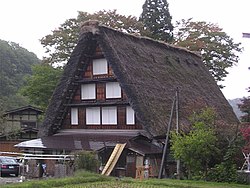
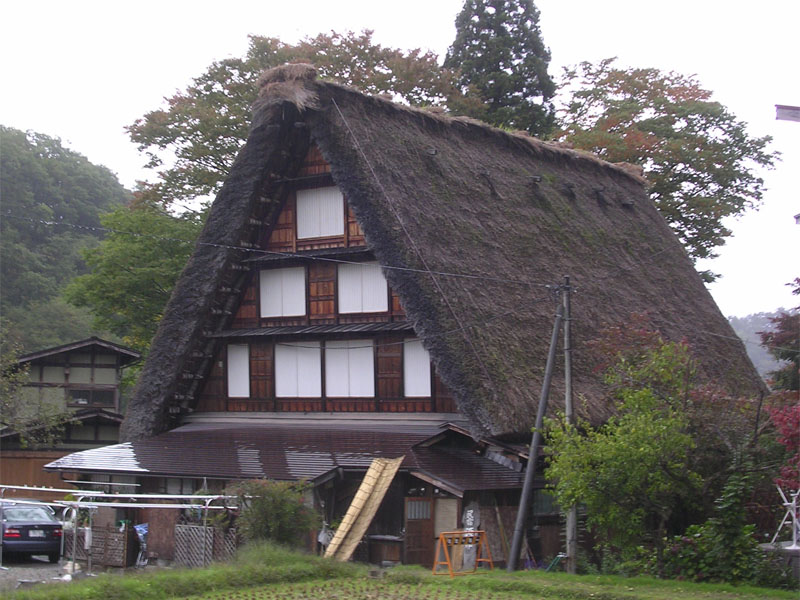
A gasshō-zukuri-styled minka home in Shirakawa village, Gifu Prefecture

Minka (Japanese: 民家; lit. "folk houses") are vernacular houses constructed in any one of several traditional Japanese building styles. In the context of the four divisions of society, Minka were the dwellings of farmers, artisans, and merchants (i.e., the three non-samurai castes).[1] This connotation no longer exists in the modern Japanese language, and any traditional Japanese-style residence of appropriate age could be referred to as Minka.

Okugame minka farmhouse

Minka are characterized by their basic structure, their roof structure, and their roof shape. Minka developed through history with distinctive styles emerging in the Edo period.

Types

[edit]
Gasshō-style roof
Gasshō-zukuri under repair
Looking around a preserved old minka in Tokyo

Minka come in a wide range of styles and sizes, largely as a result of differing geographic and climatic conditions as well as the lifestyle of the inhabitants. They generally fall into one of four classifications: farmhouses nōka (農家) town houses machiya (町屋), fishermen's dwellings gyoka (漁家) and mountain dwellings sanka (山家).[2]

Unlike other forms of Japanese architecture (such as those of the sukiya (数寄屋) style), it is the structure rather than the plan that is of primary importance to the minka.[3] Minka are divided up with primary posts that form the basic framework and bear the structural load of the building; secondary posts are arranged to suit the functional arrangements of the plan.[4]

Despite the wide variety of minka, there are eight basic forms:

  • The 'inverted U' consists of two vertical posts fixed at the top with a horizontal beam; these units can then be joined with side girders. The beam can be fixed to the top of the post either by resting upon it or via a mortise and tenon joint. This latter method is often found in minka on the island of Shikoku.[3]
  • The 'ladder' has post and beam units connected with larger beams including beams that are closer to the foundation level. This form of structure originated in townhouses of the Edo period. The system allows the irregular placement of posts and, therefore, allows flexibility in the plan.[3]
  • With the 'umbrella' style, four beams radiate out from a central post. These posts sit at the centre of the square rather than the corners. Minka of this type are often found in Shiga Prefecture.[5]
  • The 'cross' has two beams at right angles to one another with the posts in the centre of the sides. It is often used for very small minka that have no other posts erected in the space or for large minka in the earth-floored area. The style is most often found in Shiga and Fukui prefectures.
  • 'Parallel crosses' are found in Shizuoka Prefecture and cover an area 5 metres by 10 metres. This system doubles up the 'cross' structure with two crosses and eight posts.
  • The 'box' structure connects four or more post and beam units to create a box-like structure. It was devised in the Edo period and can be found in Toyama and Ishikawa prefectures.[6]
  • The 'interconnected box' can be found in Kyoto and Osaka.
  • 'Rising beams' is a form that enables better use of the second storey. It uses beams that rise from the posts to a secondary ridge that is below the one formed by the rafters.[7]
    • Thatched roof farmhouses based upon the 'rising beam' structure can be further classified into four major types. The yojiro-gumi and the wagoya (和小屋) are rare. The latter of these, the wagoya, is popular for machiya houses. Far more common are the sasu (扠首) (also known as gasshou (合掌)) and the odachi types.[8][9]

The odachi style has rafters, crossbeams and short vertical posts to support the ridge. Historically, these posts would have extended to the ground resulting in a row of posts extending down the centre of the house and dividing it. Although these could be accommodated in the layout of the main house, they were impractical in the earth-floored entrance area—so they were omitted and a special beam structure used instead.[10] This style was in wide use until the Edo period when a shift was made to the sasu style (although both types had been used since historic times).[11]

The sasu style is a simpler triangular shape with a pair of rafters joined at the top to support the ridge pole. The ends of these rafters were sharpened to fit into mortice holes at either end of crossbeam.[9] As this system does not rely on central posts it leaves a more unobstructed plan than the odachi style.[10]

Design of the floor plan

[edit]
Decorative roof projections on the ridge of a thatched roof

There were two main methods for setting out the floor plan of the minka. The kyoma (京間) method uses a standard size of tatami () mat, whereas the inakama (田舎間) method is based upon column spacing.[12]

The kyoma method works well for minka without central columns as the mats and the sliding partitions (fusuma () and shōji (障子)) can be based on a standard size. It was mainly used in minka in western Japan.[13] The method has its disadvantages if used with posts because variations in post width can make the prefabrication of the sliding partitions difficult.[12]

The inakama method is based upon the distance between centre of one post and centre of the post adjacent to it and it was mainly used on the eastern side of Japan.[13]

Overall construction

[edit]
Tiled udatsu projecting above the roof

The size, construction and decoration of a minka was dependent upon its location, climate, and social status of its owner.[14]

Minka were influenced by local building techniques and were built with materials that were abundant in the immediate locality. For example, minka in Shizuoka used abundant bamboo for roofs, eaves, doors and floors. When miscanthus reeds were difficult to obtain for thatched roofs, shingles were used instead; in volcanic areas rushes or boards were used instead of clay for the walls.[15]

Climate had a bearing on construction: In Kyoto in the late Heian and Muromachi periods, roofs were clad in thin wooden shingles so owners would put stones on top to prevent the shingles from flying away in the wind.[16]

The social status of the minka owner was indicated by the size and complexity of the building. For thatched roof minka the number of crossed wooden members (umanori (馬乗り)) or bundles of miscanthus reeds along the ridge are a good indicator of the importance of the owner's status in the village.[17] For machiya, the presence and elaborateness of an udatsu (卯立)—a wall that projects above the roof line—has a similar status. The udatsu inherited the function of a fire break, but initially it was a method of establishing the extent of ownership in long terraces of row houses.[18]

During the evolution of minka, the machiya townhouses gradually changed its construction away from perishable and flammable materials to those of a more durable nature. Thatched roofs were replaced with tiles and exposed timbers were covered up with layers of clay plastering.[19]

Minka owned by people of a higher social status began to incorporate elements of the shoin style, particularly in living rooms. The types of elements incorporated were limited by sumptuary laws to preserve strict class distinctions.[1]

Roofing

[edit]
Gasshō-zukuri minka homes in Gokayama surrounded by snow

There are four types of roof shape that can be differentiated for minka. Most machiya have gabled kirizuma (切妻) roofs, covered in shingles or tiles, and slanting down on either side of the house. The majority of nōka have either thatched yosemune (寄せ棟)-style hipped roofs, which slant down on four sides, or the more elaborate irimoya (入母屋) roof with multiple gables and a combination of thatched sections and shingled sections. Finally, the hogyo (方形) also slopes in four directions but is more pyramidal in shape.[20]

The primary purpose of shaping minka roofs was to accommodate the extensive precipitation experienced in many parts of Japan. A steeply peaked roof allows rain and snow to fall straight off, preventing water from getting through the roof into the home and, to a lesser extent, preventing the thatch from getting too wet and beginning to rot.[20][21]

At the peak and other places where roof sections came together decorations were added. Thatched roofs would have trimmed or transverse layers of straw, bamboo poles or planks of wood.[20] Tiled roofs have a variety of decorative plates to the ends of the ridge, for example, shachi () (fish).[22] They also had circular plates to the ends of the tiles at the eaves called gatou (瓦当) that helped to deflect rain.[23]

Farmhouse interior

[edit]
(Irori (囲炉裏)
A jizai kagi hearth hook with fish-shaped counterbalance

The deep eaves of the farmhouse roof helped to protect the interior from driving rain. They stop the sun from entering the interior during the summer, and they allow the low rays of sun to warm the house during the winter. Often there is a timber-floored veranda (engawa (縁側 or 掾側)) around the house under the eaves and protected on the outside by storm shutters. In areas where there is heavy snow there may be a lowered earth-floored area outside the veranda further protected by shutters which helps to stop snow from blowing inside.[24]

The interior of a minka was generally divided into two sections: a floor of compacted earth, called a doma (土間) (the precursor to a Genkan) and a raised floor (generally around 20 inches (50 cm) above the level of the doma), called a hiroma (広間), and, in larger, richer houses, an area or set of rooms covered in tatami or mushiro mats, called a zashiki (座敷).[25] Large farmhouses sometimes had a raised, timber-floored internal veranda (hiroshiki (広敷)) that separated the doma and the tatami areas.[1] In older houses, like the 17th century Yoshimura house, this separating zone was up to 2.5 m wide and servants apparently slept there.[26]

The raised floor often included a built-in hearth, called an irori (囲炉裏). Above the ash-filled hearth would hang a kettle suspended from the ceiling by an adjustable hearth hook made of wood, metal and bamboo. This jizai kagi (自在鈎) could be raised or lowered depending on the amount of heat required and was often shaped into decorative fish or blade shapes.[27] There was no chimney in the farmhouse and the smoke from the irori would rise through the roof drying the reeds and deterring insects. The irori was the centre of communication for the house where the family gathered to chat and eat, and it was a cozy place around which to sleep.[28]

Though there were many possible arrangements of the rooms in a home, one of the most common, called yomadori (四間取り), comprised four rooms in the raised floor portion of the house, adjacent to the doma.[25] The arrangement and size of these rooms was made more flexible with the use of sliding fusuma and shōji partitions.[29]

The social status of the owner of house governed the conventions of their social relationships in the house. For example, the lowliest ranked people would sit on the earth floor whilst those above them would sit on the hiroshiki and those above them on the tatami floored inner rooms. Honoured guests would sit next with their back to the tokonoma (床の間).[30] The requirements for social etiquette extended to the family and there were particular seating positions (yokoza (横座)) positioned around the hearth.[31]

Typical Edo period farmhouses

[edit]
Honmune-style house with birdlike decoration on the gable

A number of styles of farmhouses came to maturity during the Edo period; some typical examples follow.

Gasshou

[edit]

The gasshō-zukuri (合掌造)-style minka have vast roofs that are a large form of the sasu structural system. Their name derives from the similarity of the roof shape to two hands in prayer. They are frequently found in Gifu Prefecture.[32] The upper floors of the two- and three-story houses are used for sericulture, with storage space for trays of silkworms and mulberry leaves.[33]

Honmune

[edit]

Honmune-zukuri (本棟造) literally means "true ridge": The style has a nearly square plan with a gabled roof that is board covered. The gable end of the house is particularly impressive with its composition of beams, eaves and braces. The gable is topped by a birdlike ornament called a suzume-odori (雀踊り).[32] Houses of this type can be found in Gunma, Nara, Yamaguchi and Kouchi prefectures.[34]

Preservation

[edit]
Gasshō-zukuri, Ogimachi village

Minka are generally treated as historic landmarks, and many have been designated for preservation by municipalities or the national government. The tremendous regional variation of minka has also been preserved in open-air museums such as Nihon Minka-en in Kawasaki, where examples from around Japan are on display.[35] Minka have also been used as hotels and restaurants to be preserved.

Of particular note is the gasshō-zukuri (合掌造り, literally "clasped-hands" style), which is preserved in two villages in central Japan — Shirakawa in Gifu Prefecture and Gokayama in Toyama Prefecture — that together have been designated a World Heritage Site by UNESCO.[36]

In 1997, the Japan Minka Reuse and Recycle Association (JMRA) was established to promote the benefits and conservation of minka. One minka that belonged to the Yonezu family was acquired by the JMRA and donated to Kew Gardens as part of the Japan 2001 Festival. The wooden structure was dismantled, shipped and re-assembled in Kew with new walls and a thatched roof.[37]

See also

[edit]

Footnotes

[edit]

References

[edit]

Further reading

[edit]
[edit]
Revisions and contributorsEdit on WikipediaRead on Wikipedia
from Grokipedia
A minka (民家, "house of the people") is a traditional Japanese vernacular dwelling built for commoners such as farmers and merchants, utilizing local materials and construction techniques adapted to regional climates, geography, and lifestyles. These structures, with basic forms predating this era but with distinctive styles emerging during the (1603–1868), emphasize functionality and harmony with nature, featuring wooden post-and-beam frameworks without nails, steeply pitched roofs for shedding snow or rain, and earthen or wood floors that integrate living, working, and storage spaces. Distinct from elite residences or temples, minka represent the everyday of rural and urban common people, with designs analyzed through floor plans (madori), structural forms (tsukuri), and aesthetic shapes (katachi) that prioritize practicality and longevity. Minka construction, known as fushin, involved collaborative efforts between professional carpenters and community members, often as a form of labor or charity rooted in Buddhist traditions. Regional variations abound: in mountainous or snowy areas like Tohoku, houses feature thick thatched roofs (kayabuki) for insulation; in coastal Kanto plains, clustered layouts (shusongata) with hedges provided security; while sparse arrangements (sansongata) in wind-prone regions like Hokuriku incorporated protective forests. Common materials included timber from nearby forests, clay for walls, and reeds or cedar bark for roofing, allowing minka to withstand centuries of use despite their modest scale—typically 100–200 square meters. In the , rapid has threatened minka survival, leading to preservation initiatives such as the relocation of around 25 historic examples to open-air museums like Nihon Minka-en in Kawasaki City, established in 1967 to showcase Edo-period buildings from across . These efforts highlight minka's cultural value, with ongoing restorations demonstrating intricate techniques that interlock beams without metal fasteners, preserving not only but also insights into pre-industrial Japanese , , and craftsmanship. Today, some minka are repurposed as guesthouses or cultural venues, blending heritage with contemporary use while facing challenges like maintenance costs and seismic retrofitting.

Historical Context

Etymology and Definition

The term minka (民家) derives from the Japanese words min (民), meaning "" or "folk," and ka (家), meaning "," collectively signifying the residences of ordinary individuals as distinct from elite structures like dwellings or temples. The word is believed to have originated in and was first recorded in Japanese texts during the mid-12th century, evolving to encompass for non-aristocratic use. Minka refers to traditional vernacular houses built in pre-modern Japanese styles, free from Western architectural influences, and primarily intended for farmers, artisans, merchants, and lower-ranking during the (1603–1868). These dwellings served the everyday needs of commoners within Japan's stratified society, which divided people into four main classes—samurai, farmers, artisans, and merchants—while adhering to sumptuary laws that restricted opulent designs to the upper echelons. In contrast to aristocratic forms like , which featured expansive, symmetrical layouts for Heian-period , or temple architectures such as zassha with their ritualistic and ornate elements, minka prioritized unadorned simplicity and practical functionality tailored to the socioeconomic realities of non-elite groups. Key characteristics of minka include the use of locally sourced materials, post-and-beam construction methods, and designs adapted flexibly to rural agricultural settings or urban merchant districts. The prevalence of minka during the reflected the era's rigid social hierarchy, where such houses provided essential, modest shelter for the majority of the population.

Development and Evolution

The origins of minka can be traced to the around 500 BCE, when wet rice farming necessitated simple pit dwellings (tateana jūkyo), flat-land structures (heichi jūkyo), and raised wooden-floored houses (takayuka jūkyo) with thatched roofs and earthen floors, reflecting the agrarian society's reliance on adaptable, resource-efficient construction. By the (794–1185), these evolved into two-room plans with raised floors, while the (1336–1573) introduced three-room hiroma-type layouts featuring guest reception areas, often using and earth-rendered walls due to timber shortages caused by ongoing wars. This era's designs were shaped by Japan's agrarian economy, which demanded multifunctional spaces for farming activities, and by frequent such as earthquakes, prompting the use of flexible wooden frameworks to absorb seismic shocks. During the (1603–1868), minka reached a peak of standardization and sophistication, driven by the Tokugawa shogunate's prolonged peace, which fostered , , and rural prosperity through trade and agriculture. Sumptuary laws enforced by the regime restricted opulent architectural elements—such as elaborate irimoya roofs—to the elite, confining commoners, farmers, artisans, and merchants to simpler, modular minka styles that emphasized functionality over ostentation, thereby preserving class distinctions while allowing regional variations. Influences from local climates and resources further refined these structures; for instance, in mountainous , minka incorporated steep roofs and narrow windows to withstand heavy snowfall up to 7 meters deep, while timber availability in forested areas like Akita supported robust post-and-beam frameworks suited to agricultural storage and processing needs. The of 1868 initiated a sharp decline in minka construction, as rapid industrialization, urbanization, and the adoption of Western architectural principles—such as and buildings—shifted preferences toward modern, low-maintenance housing that prioritized efficiency over traditional materials like wood and thatch. This transition marginalized minka in growing cities, where agrarian lifestyles waned, though some rural examples persisted for specialized uses like . The exacerbated this decline, devastating Tokyo and surrounding areas by collapsing numerous wooden structures, including many minka, and accelerating the replacement of vulnerable traditional homes with earthquake-resistant Western-inspired designs amid post-disaster reconstruction.

Classification and Types

General Categories of Minka

Minka, traditional Japanese dwellings of the , are broadly classified into four primary categories based on their and primary function: nōka (farmhouses), (townhouses), gyoka (fishermen's dwellings), and (mountain dwellings). Nōka served agricultural communities, typically featuring expansive layouts to accommodate living spaces alongside storage for farming tools, harvested crops, and , reflecting the rural centered on cultivation and seasonal labor. In contrast, were designed for urban merchants and artisans in towns, integrating ground-floor shopfronts or workshops with upper living quarters to support commercial activities within densely populated areas. Gyoka, adapted for coastal villages, emphasized durability against saltwater exposure and included provisions for drying nets and storing catches, while in mountainous regions prioritized steep roofs to shed heavy snow and compact forms suited to rugged terrain. These categories emerged within the socioeconomic framework of the (1603–1868), where minka were reserved for the non- classes—farmers, artisans, and merchants—comprising the majority of society and prohibited by sumptuary laws from adopting the ornate designs of elite shoin-style residences. This rigid class system, known as shinōkōshō, placed at the top, followed by farmers, artisans, and merchants at the bottom, ensuring minka reflected the practical needs of commoners rather than aristocratic aesthetics. During the , minka-style housing dominated pre-modern Japan due to the overwhelming proportion of commoners in the population.

Regional and Functional Variants

Minka exhibit significant regional and functional variations, adapted to Japan's diverse climates, terrains, and livelihoods, primarily within the broader categories of nōka (farmhouses) and (townhouses). These subtypes reflect local environmental challenges, such as heavy snowfall in mountainous areas or humidity in coastal and southern regions, while supporting agricultural activities like and livestock rearing. The gasshō-zukuri style, prevalent in mountainous regions like the Shogawa River Valley in , features steeply slanted, triangular thatched roofs resembling praying hands, designed to shed heavy snow accumulation with a slope of approximately 60 degrees. These roofs, constructed without nails using logs, beams, rafters, and straw ropes, span vast areas and support multi-level attics—up to three to five stories—utilized for silkworm rearing (), a key industry in the area due to the dark, spacious under-roof environment ideal for mulberry leaf storage and cocoon production. The ends typically face north-south to minimize wind exposure, with diagonal bracing for resistance, and the entire structure is elevated on stone foundations driven deep into the ground. In contrast, honmune-zukuri, common in eastern such as central and southern around areas like Matsumoto and Suwa, employs a nearly square plan with a (kirizuma) roof parallel to the front, often thatched. This single-story design integrates living quarters on a (takayuka) above ground-level spaces for stabling or storage, suited to flat farmlands where space efficiency supports and ; the gable walls are finished with board and for durability. Other functional variants include adaptations for coastal and southern environments. In humid coastal areas, minka often incorporate overlapping plank walls (similar to ) using salt-resistant woods to combat moisture and corrosion, paired with elevated structures to enhance airflow. In southern regions like , raised-floor (takayuka) designs predominate, lifting living spaces above ground to protect against flooding, pests, and high humidity while promoting natural ventilation through open layouts and high ceilings. Kominka, smaller-scale folk houses, represent compact versions of these variants, typically found in rural settings for modest family use without extensive agricultural integrations. Regional differences further highlight these adaptations: in the Tohoku region, minka like chūmon-zukuri incorporate attached stables (umaya) with thick, insulated walls to withstand harsh winters, whereas Kyushu's favors ventilated, open-plan structures with deep for shade and to mitigate and .

Architectural Design

Floor Plan and Layout

The of traditional minka centers around the irori, a sunken that functions as the primary cooking and , typically positioned in the main living area to facilitate communal activities. This core feature divides the interior into distinct zones: the doma, an earthen-floored space at ground level used for daily work, storage, and sometimes housing , contrasts with elevated tatami-matted rooms reserved for sleeping, dining, and family gatherings. The post-and-beam framework supports this open arrangement, allowing flexible spatial use without fixed interior walls. Functional zoning emphasizes practicality and environmental harmony, starting with the genkan, a lowered entrance area for removing shoes and transitioning from outside to inside. Living quarters are often oriented south-facing to capture optimal sunlight through shoji screens, promoting natural ventilation and illumination. Overhead storage lofts, accessible via ladders, accommodate tools, harvested crops, and , integrating agricultural needs into the domestic layout. Minka designs incorporate adaptations like the modular , a semi-outdoor corridor that encircles the house, blurring boundaries between interior and exterior for seasonal use and garden access. Privacy gradations progress from public-facing spaces, such as the zashiki guest room near the entrance, to more intimate family areas deeper within, controlled by sliding or doors that can reconfigure room sizes as needed. Size variations reflect socioeconomic factors, with typical farmhouses spanning 100-200 square meters in total , adjusted by family size and wealth to include additional rooms or extensions.

Structural Framework and Materials

The structural framework of minka houses relies on a post-and-beam system, known as jikugumi, which forms the core skeleton using vertical posts (hashira), horizontal beams (nuki or hari), and roof trusses without the use of nails or metal fasteners. This system employs intricate wooden techniques, such as mortise-and-tenon joints and interlocking braces (kigumi), allowing the structure to flex during earthquakes and distribute loads effectively across the framework. Posts, often square or round and varying in finish from rough-hewn to dressed, are strategically placed on a modular grid based on the ken unit (approximately 1.82 meters), integrating seamlessly with floor plans to define spatial divisions. Materials for minka construction are predominantly locally sourced to ensure availability and harmony with the environment, with cedar (sugi) and (hinoki) serving as primary woods for posts and beams due to their , straight , and resistance to decay. is utilized for lacing and reinforcing elements like rafters and wall infills, while clay (tsuchi) mixed with straw forms the tsuchikabe walls, providing a breathable barrier that regulates . These choices emphasize , as the woods are harvested from native forests, and the materials' natural properties contribute to the house's longevity, with frameworks often enduring for centuries through periodic maintenance. The construction process typically involves communal labor, referred to as yui or mutual aid, where villagers collaborate under the guidance of skilled carpenters to assemble the framework rapidly using hand tools and pre-cut joints. Foundations consist of raised stone bases (soseki) or simple footings that elevate the wooden posts above the ground, promoting ventilation, preventing moisture ingress, and isolating the structure from seismic forces. This modular approach facilitates disassembly and relocation of the house, a common practice for farmers adapting to new land. Durability is enhanced by the framework's inherent flexibility and the insulating qualities of thick clay walls, which maintain in varying climates while the post-and-beam design allows for easy replacement of non-structural elements. Some minka structures have been documented to last up to 1,000 years with regular upkeep, underscoring the robustness of these earthquake-resistant techniques.

Roofing and Exterior Features

Roofing Techniques

Minka roofs primarily served to protect the wooden structures from Japan's diverse climates, ranging from heavy snowfall in mountainous regions to typhoon-prone coastal areas. These roofs were constructed using locally available materials and techniques adapted to environmental demands, emphasizing , insulation, and ease of repair. The two predominant types were thatched roofs, known as kaya, and tiled roofs, referred to as kawara, each with distinct construction methods that integrated seamlessly with the post-and-beam framework of minka houses. Thatched roofs, the hallmark of rural minka, were built from layers of miscanthus grass (kaya), often bundled with straw or reeds and tied securely using ropes made from fern roots or similar natural fibers. These layers, sometimes reaching up to one meter thick, were applied over a skeletal framework to provide excellent insulation against cold winters and summer heat. In regions with heavy snowfall, such as the gasshō-zukuri style minka of central Japan, roofs featured steep pitches—often around 45 degrees—to facilitate snow shedding and prevent structural collapse. Annual maintenance was essential, involving inspections and partial re-thatching to address wear from weather and pests, with full replacements typically required every 20-25 years. A key preservation technique for thatched roofs involved the smoke rising from the central irori , which permeated the interior and roof structure, drying the thatch and coating it with a protective layer that deterred and fungi. The 's support system relied on ridge beams—such as umanori types—and horizontal purlins spaced to bear the weight while allowing the steep incline. This method not only enhanced longevity but also contributed to the overall aesthetic of sweeping, organic lines characteristic of minka. The typical lifespan of a well-maintained thatched ranged from 20 to 30 years, influenced by local and care. Tiled roofs, using durable ceramic kawara tiles, were more common in wealthier or urban minka, offering greater resistance to wind and fire compared to thatch. These roofs employed gabled (honmune or kirizuma) or hipped (yosemune or irimoya) configurations, with pitches of 22 to 32 degrees to balance weight distribution and weatherproofing. Tiles were laid over purlins and battens, secured without mortar to allow flexibility during earthquakes, and were particularly suited to typhoon-vulnerable areas. Unlike thatch, tiled roofs demanded less frequent maintenance but required robust structural reinforcement due to their heavier load. Regional variations reflected socioeconomic and climatic differences: thatched roofs predominated in rural northern areas like Akita and Niigata, where abundant grass and snowy conditions favored their insulating properties, while tiled roofs were typical in southern urban settings such as and , aligning with higher economic status and milder weather. These adaptations ensured minka roofs effectively integrated with the broader architectural framework, supporting the flexible, modular layouts of traditional farmhouses.

Wall and Facade Elements

The walls of traditional minka houses primarily consist of tsuchikabe, a multi-layered earthen system employing wattle-and-daub construction with laths woven into a framework, coated in mud, and finished with (shikkui) for durability and breathability. In regions with harsher weather, board-and-batten walls using vertical wooden boards fixed over horizontal battens, or overlapping horizontal wooden planks secured with vertical rails, provide additional weather resistance while allowing for natural ventilation. Amado, or sliding shutters made of solid wood panels, serve as removable exterior walls, sealing the structure against rain and wind during inclement weather and storing compactly when not in use. Facade designs in minka emphasize functionality and integration with the environment, featuring verandas—raised wooden corridors that wrap around the exterior to provide shaded circulation, buffer against direct , and facilitate easy access to outdoor spaces. These verandas often connect seamlessly to the main walls via sliding interfaces, enhancing the fluid boundary between interior and exterior. Lattice screens known as renji, constructed from wooden grids, are incorporated into windows or doors on facades to permit and diffused light while maintaining and deterring . Overhanging from the system extend to shield these facade elements from prolonged rain exposure, preventing erosion of or wood. The aesthetic of minka walls and facades reflects a deliberate simplicity, with natural wood finishes left exposed or lightly treated to age gracefully, embodying principles of imperfection and transience. Ornamentation was minimal or absent, as sumptuary laws during the restricted commoners from elaborate decorations reserved for higher classes, ensuring facades remained unadorned and harmonious with rural landscapes. This restrained approach not only complied with social regulations but also prioritized practical weatherproofing over visual excess.

Interior and Usage

Interior Spaces and Furnishings

The interiors of traditional minka houses emphasized functionality and simplicity, with spaces designed to accommodate the daily needs of rural families while adapting to Japan's variable climate. Central to most minka was the irori, a sunken hearth in the main living area that functioned as both a cooking and heating source, surrounded by built-in wooden benches for seating during meals or gatherings. This hearth not only provided warmth but also served as a communal focal point, with smoke escaping through roof vents to maintain air circulation. Loft areas, often accessible via ladders, were commonly used for storage of tools, grains, or extra bedding, and in some cases doubled as sleeping quarters for children or extended family members to maximize vertical space in compact layouts. In wealthier variants of minka, particularly those influenced by urban styles, a alcove appeared in principal rooms, offering a recessed niche for displaying seasonal flowers, calligraphy scrolls, or small art pieces, adding a touch of aesthetic refinement without compromising practicality. Furnishings remained sparse to facilitate easy reconfiguration of spaces; bedding was rolled out on the floor at night and stored away during the day, while low tables—typically under 40 cm in height—were used for eating or working, paired with mats woven from rice straw for comfortable, insulating flooring. Built-in storage solutions, such as wall-mounted cabinets or shelves (known as oshiire), housed kitchen utensils, , and , minimizing clutter and promoting efficient use of limited square footage. Minka rooms were inherently multi-purpose, fluidly transitioning between workspaces for crafts or farming preparation and living areas for dining and relaxation, reflecting the integrated nature of rural life. In larger homes, subtle divisions—such as partial screens or raised thresholds—allowed for separation by family needs, with earth-floored doma areas used for work while raised wooden sections accommodated domestic activities. was addressed through elevated living platforms on the hiroma, typically 45–100 cm above the ground, which distanced from soil moisture, combined with openable screens and underfloor vents that promoted natural airflow to combat dampness in humid regions. These features ensured durability and comfort without relying on elaborate fixtures. In mountainous regions, such as those with gasshō-zukuri minka, lofts were adapted for , integrating rearing into living spaces.

Lifestyle and Cultural Role

In traditional minka houses, daily activities revolved around multifunctional spaces that integrated work, rest, and social interaction, particularly centered on the irori, a sunken in the main living area known as the hiroma. Families used the irori for cooking meals, boiling water, and providing warmth during harsh winters, while the adjacent doma, an earthen-floored work area, facilitated indoor tasks such as food preparation, storage, and even housing . These designs seamlessly incorporated seasonal farming routines, with expansive layouts allowing residents to transition between agricultural labor in attached work spaces and communal meals, reflecting the rural economy's demands on commoner households. Community gatherings often occurred in these shared areas, fostering village solidarity through events like collective roof rethatching or informal social exchanges on the veranda. Minka supported multi-generational structures, large extended households, sometimes numbering dozens of members, hired laborers, and even domesticated animals under one roof. Sleeping arrangements in rooms like the nando emphasized collective living, with flexible partitions enabling privacy for elders and children while maintaining communal access to core spaces. This setup reinforced familial interdependence and the transmission of agricultural knowledge across generations. Culturally, minka embodied aesthetics, celebrating imperfection and transience through humble, natural materials like wood, thatch, and that aged gracefully over time. Their design promoted via features such as verandas and integrated gardens, blurring indoor-outdoor boundaries to align daily life with seasonal rhythms and environmental cycles. Socially, these houses symbolized class humility among non-samurai commoners, with basic, functional forms underscoring egalitarian rural values, though affluent variants occasionally featured rare personalizations like family emblems carved on beams or roofs to denote lineage.

Preservation and Legacy

Notable Examples

One of the most prominent examples of gasshō-style minka is found in the Historic Villages of Shirakawa-gō and Gokayama, designated a in 1995 for their well-preserved clusters of traditional farmhouses. These structures, primarily from the , feature steep thatched roofs resembling clasped hands in prayer, with some dating back over 250 years and the oldest examples originating in the 17th century. The roofs typically span 10 to 11 meters in width and extend up to 30 meters in length, supported by robust timber frameworks spaced at intervals of about 1.8 meters to endure heavy snowfall in the mountainous regions. Inside these gasshō farmhouses, multi-level interiors facilitated on upper floors while providing living spaces for large extended families, often including spaces for communal activities and storage that could accommodate dozens of inhabitants alongside rearing operations. The village of Ogimachi in Shirakawa-gō alone preserves over 100 such houses in their original settings, exemplifying the adaptive suited to the local agrarian lifestyle. Honmune-style minka, common in the Kanto region, are represented at the Nihon Minka-en Open-Air Folk House Museum in Kawasaki, which houses 25 relocated Edo-period structures, including several thatched-roof farmhouses from eastern built between the 17th and 19th centuries. These examples typically incorporate roofs (honmune) and integrated ground-level stalls for livestock, reflecting the multifunctional needs of rural households where living quarters adjoined animal pens and work areas. The museum's Kanto Regional Village section highlights these features, showcasing how such designs supported self-sufficient farming communities. Among other notable minka, 17th-century examples persist in rural areas like Miyama and Hanase Village, where preserved farmhouses demonstrate early post-medieval construction techniques amid forested landscapes. In urban contexts, 's Higashi Chaya District preserves numerous Edo-period —narrow, wooden townhouses classified as minka—that combine storefronts with rear living spaces, often featuring latticed facades and compact inner gardens for light and ventilation. These Kanazawa , some over 200 years old, illustrate the adaptation of minka principles to dense merchant districts.

Modern Preservation and Adaptations

Efforts to preserve minka structures have gained momentum through open-air museums and nonprofit organizations dedicated to relocation and restoration. The in Kawasaki, established in 1967, houses 25 traditional minka buildings from the , carefully disassembled and relocated from various regions across to protect them from demolition due to . Similarly, the Gassho-zukuri Minka-en in Shirakawa-go serves as an outdoor exhibit of 25 thatched-roof farmhouses and other structures, showcasing regional variations while educating visitors on historical construction techniques. The Japan Minka Revival Association, a nonprofit founded in 1997, facilitates the preservation of minka by connecting owners with restorers and promoting , having supported hundreds of projects nationwide. Government support has played a key role in these initiatives, particularly through subsidies for renovating traditional homes. Since the post-World War II era, Japanese authorities have provided financial aid for cultural heritage restoration, evolving into modern programs that cover 30-50% of renovation costs for eligible minka, with grants up to ¥1,000,000 per project aimed at preventing abandonment. Local governments, such as those in rural prefectures, offer additional incentives like one-third subsidies for reusing vacant minka as community facilities rather than demolishing them, addressing the national issue of over 211,000 empty traditional houses reported in 2015. As of 2023, Japan had approximately 9 million vacant homes overall, with traditional minka facing similar abandonment pressures. However, preservation faces significant challenges, including rapid urbanization that has led to widespread demolition, scarcity of traditional materials like thatch and aged timber, and intensified 21st-century climate effects such as stronger typhoons and rising humidity, which accelerate decay; as a result, only a small fraction of original minka structures survive intact today. In contemporary adaptations, many surviving minka have been repurposed to ensure their viability, transforming them into inns, cafes, and eco-friendly residences. For instance, the 160-year-old Wanosato in was renovated from a traditional minka, retaining its gassho-zukuri thatched roof while adding modern amenities like hot springs to attract tourists. Other examples include minka converted into rural cafes and restaurants, such as those in former villages now operating as guesthouses, blending historical aesthetics with contemporary hospitality. These adaptations also influence , with minka-inspired designs incorporating natural ventilation and in new eco-homes to reduce energy use. Global recognition has further bolstered preservation through designations and . The Historic Villages of Shirakawa-go and Gokayama, featuring gassho-zukuri minka farmhouses, were inscribed on the World Heritage List in 1995 for their outstanding representation of traditional Japanese rural life sustained since the . This status has driven a surge in tourism, generating revenue that funds ongoing maintenance and community-led restoration efforts, ensuring the cultural legacy of minka endures amid modern pressures.

References

Add your contribution
Related Hubs
User Avatar
No comments yet.