Hubbry Logo
Kerei KhanKerei KhanMain
Open search
Kerei Khan
Community hub
Kerei Khan
logo
8 pages, 0 posts
0 subscribers
Be the first to start a discussion here.
Kerei Khan
Kerei Khan
from Wikipedia

Kerei Khan (Kazakh: کرای خان, Керей хан, Kerei han; 1424, White Horde – 1473/1474, Kazakh Khanate) was a co-founder and the first Khan of the Kazakh Khanate from c. 1465 to 1473.

Key Information

History

[edit]

There are currently two versions of how the first dynasty of the Kazakh khans originated. According to one of them they were from the House of Orda Ichen. On the other version, they were descendants of the thirteenth son of Jochi - Tuqa-Timur.

In the late 1450s, part of the nomadic population, headed by Janibek and Kerei, separated themselves from the rule of Uzbek Khan Abu'l-Khayr. They migrated to Moghulistan and settled in the valleys of the Chu and Talas rivers. Khan of Moghulistan united with them, offering them support against their opponents. Around 200,000 nomads joined Janibek Khan and Kerei Khan's movement, which had had a huge power and influence that it sparked fear in Abu'l-Khayr. As a response he undertook a military campaign in Moghulistan in 1468, but died suddenly on his way. After the death of Abu'l-Khayr, his son Sheikh Haidar succeeded him. All the opponents of Abu'l-Khayr teamed up and began an active struggle against him. The reign of Sheikh Haidar Khan was short-lived and he was eventually murdered by the Siberian Khan Ibak. Kerei received supreme power in eastern Dasht, who appointed his brother Janibek as the ruler of the west wing. Despite Kerei Khan and Janibek Khan possessing a significant military force, they fought against Shaybanids for power over the eastern steppe. Kerei Khan and his followers fought for the creation of an independent state which developed in political, cultural and economic terms. In the course of this conflict, Kerei Khan was killed. His name in the sources was last time mentioned in the events of winter 1473.[1] The secession led by Kerei and Janibek was an important link in the chain of events that led to the formation of the Kazakh Khanate and the creation of the Kazakh nationality itself.

Legacy

[edit]

Since the end of the 15th century the term "Kazakh" acquired a political character, which was being used to designate individual feudal estates that were created by Kerei and Janibek, and from the beginning of the 16th century, after part of the tribes moved from the modern territory of Kazakhstan headed by Shaibani Khan in Maverannahr, the term began to acquire an ethnic character. It is unknown to what made Kerei and Janybek separate, and which location did the Kazakh Khanate originate. A number of authors wrote that the Khanate was formed at the turn of the 15th-16th centuries and that the migration of Kerei and Janibek was only the start of the formation of the Kazakh Khanate.[2]

Memorial

[edit]

On June 1, 2010, in Astana near the Museum of the First President of Kazakhstan, with the participation of Nursultan Nazarbayev, a monument to Kerei and Janibek was opened by the sculptor Renat Abenov.[3]

References

[edit]
Revisions and contributorsEdit on WikipediaRead on Wikipedia
from Grokipedia

Kerei Khan (died c. 1473/74), great-grandson of , was a nomadic leader who co-founded the around 1465–1466 with , establishing the first independent Kazakh state by guiding dissatisfied tribes away from the rule of Abulkhair Khan in the east Dasht-i Kipchak.
In the 1450s–1460s, Kerei and Janibek migrated with their followers to western Zhetisu (Semirechye), where they secured lands near the Shu River from the khan of , Esen-Bug, amassing around 200,000 adherents and laying the political foundations for Kazakh statehood as successors to the Ulus lineage. As the initial khan, Kerei regained ancestral territories and fostered the emergence of a distinct Kazakh ethnic identity through political unification and expansion, though he perished amid conflicts with the Shibanid . His descendants, including son Buryndyk who ruled until 1510, continued to shape the khanate's early development, marking Kerei's legacy in enabling cultural, economic, and territorial independence for Kazakh nomads.

Origins and Early Career

Clan Background and Ancestry

Kerei Khan belonged to the Töre dynasty, the Chinggisid lineage tracing descent from Jochi Khan, the eldest son of , through the Ordaidov branch associated with the . This dynastic clan formed the core of nomadic Turkic-Mongol aristocracy in the eastern , where authority derived from genealogical claims to sovereignty over Jochid territories. As a great-grandson of (r. c. 1360–1378), who consolidated power in the after the fragmentation of the , Kerei represented a continuation of this ruling stratum. Urus Khan's domain encompassed the Dasht-i Qipchaq and regions, where his descendants vied for influence amid rivalries with the . Historical records, including the Tavarih-i guzida-yi Nusrat-name, identify Kerei's father as Bolat Sultan, the sole son of Toktakiya, positioning him as a direct patrilineal heir in the Ordaidov genealogy. The clan's nomadic heritage emphasized tribal confederations, with the Töre maintaining elite status through intermarriage and alliances among steppe groups, distinct from subordinate tribes like the Kerey, whose name may reflect later ethnonymic associations but not Kerei's primary lineage. This background equipped Kerei with legitimacy to challenge , drawing on ancestral precedents of Jochid .

Rise Within the Uzbek Khanate

Kerei Khan, son of Sultan Bolat and grandson of Toktakiya, traced his descent from the Ordaidov branch of the Jochids as the great-grandson of (r. c. 1378–1380), ruler of the . This lineage positioned him within the elite stratum of nomadic aristocracy in the eastern Dasht-i Qipchaq, where Jochid claims to sovereignty persisted amid the fragmentation following the Golden Horde's collapse. Under , who unified disparate Uzbek uluses into a by 1428 through conquests and alliances among Shaybanid, Jochid, and other tribes, Kerei served as a tribal leading the Kerei clan and affiliated groups near the and Tau mountains. His authority derived from commanding nomadic contingents in the khanate's military structure, where tribal leaders like him provided and logistical support for campaigns against Timurid remnants and internal rivals. Kerei's ascent accelerated in the 1440s–1450s as Abu'l-Khayr's expansions strained tribal autonomies, fostering discontent among Jochid factions marginalized by Shaybanid dominance. Leveraging his genealogical prestige—directly linking to via Urus—Kerei forged coalitions with figures like , amassing followers estimated at tens of thousands through kinship networks, bride exchanges, and patronage. This period saw him transition from clan chieftain to regional power broker, evident in early migrations of supporters from core Uzbek territories to peripheral zones, prefiguring broader dissent without yet rupturing allegiance. External pressures, including the Oirat defeat of Abu'l-Khayr's forces near in 1457, further elevated Kerei's stature as a defender of tribal interests, allowing him to recruit from clans wary of the khan's vulnerabilities and fiscal impositions. By the early 1460s, his ulus encompassed diverse elements from the "forty tribes," solidifying his role as a to central authority while remaining nominally within the khanate's fold.

Founding of the Kazakh Khanate

Rebellion Against Abu'l-Khayr Khan

In the mid-15th century, Kerei and his kinsman Janibek, both descendants of Orda (the eldest son of Jochi), grew dissatisfied with the rule of Abulkhair Khan, a Shibanid prince who had consolidated power over the eastern Dasht-i Kipchak as ruler of the Uzbek Khanate since the 1420s. Abulkhair's harsh policies, including the subjugation of rival Jochid lineages, marginalized Ordaid sultans like Kerei and Janibek, fostering resentment among nomadic tribes seeking greater autonomy from his centralized authority. This tension was exacerbated by Abulkhair's military setbacks, notably his defeat by Oirat (Kalmyk) forces under Uch-Temür Taishi near Sighnaq in 1457, which weakened his grip and encouraged dissent. The decisive break occurred in late autumn 1457, when Kerei and Janibek, fearing reprisals, led their Orda-Ezhen tribes in a mass migration westward from Abulkhair's domains to the Chu Valley in western (modern Semirechye or ). With approximately 200,000 households in tow, they sought refuge under Esen-Buqa II of , who granted them lands in the Moyunkum and Kozybasy areas to evade pursuit. This secession constituted a direct rebellion against Abulkhair's , as the migrants rejected his overlordship and preserved their Jochid legitimacy, drawing initial support from clans opposed to Shibanid dominance. By spring 1458, the exiles formalized their by electing Kerei as khan, marking the embryonic stage of a new tribal that challenged Abulkhair's remnants in eastern Dasht-i Kipchak. Skirmishes ensued as Abulkhair sought to reassert control, but his death in 1468–1469—likely during a campaign against dissidents or —prevented decisive reconquest, allowing Kerei and Janibek's followers to expand and solidify their breakaway state around 1465–1466. The rebellion thus transitioned from flight to consolidation, redistributing loyalties among nomadic and laying the groundwork for the Kazakh Khanate's distinction from the Uzbek polity.

Migration and Establishment of the New State

In the mid-15th century, political fragmentation within the , exacerbated by the weakening of Jochid authority after the death of Barak Khan and the ascendance of Abulkhair Khan, prompted sultans Kerei and Janibek—descendants of in the senior Ordaid branch—to lead a of nomadic tribes seeking greater . This migration, initiated around 1456–1460 amid Abulkhair's favoritism toward Shibanid factions and unstable governance, involved several Kazakh tribes dissatisfied with centralized control and resource allocation. The migrants, numbering in the tens of thousands of households from primarily Kypchak and other Turkic nomadic groups, relocated eastward to the western Zhetysu (Semirechye) region, then under the influence of Moghulistan's Chagatai rulers. There, Esen Buqa II granted them pasturelands near the Shu River as vassals, providing temporary stability while allowing consolidation of tribal loyalties under Kerei and Janibek's leadership. This strategic move positioned them as a buffer against rival powers, leveraging the area's fertile valleys for essential to their nomadic . Esen Buqa's death in 1462 shifted dynamics, enabling Kerei and Janibek to assert dominance over local clans without Chagatai oversight, culminating in the formal proclamation of the circa 1465–1466. Kerei, as the senior figure, assumed the role of first khan, restoring Jochid legitimacy in the eastern Dasht-i Kipchak and establishing a new polity distinct from the , with its core territories spanning the and river basins. This establishment unified disparate tribes under a shared identity, initially termed "Uzbek-Kazakh" before evolving to emphasize "Kazakh" independence, setting the stage for expansion against Abulkhair, whose death in 1468 during a punitive campaign further secured their sovereignty.

Reign as Khan

Governance Structure and Tribal Unification

Kerei Khan and initiated tribal unification by seceding from the under , leading a migration of their followers—primarily nomadic groups of Turkic and Mongol origin—to the Semirechye (Zhetysu) region starting around 1456. This exodus attracted other dissatisfied clans seeking independence from centralized control, forming a of ethnically akin tribes that coalesced into the core Kazakh polity. By 1465, having secured lands along the and Tau rivers and received territory near the Shu River from Moghulistan's Esen-Buqa circa 1462, they proclaimed the , extending authority over Zhetysu clans and eastern Dasht-i Kipchak. The early governance structure adhered to Jochi Ulus precedents, mandating rule by Chinggisid descendants per Genghis Khan's code established in 1206, with Kerei—as a great-grandson of —embodying this legitimacy. Co-rulership between Kerei and Janibek emphasized the khan's role as commander and arbiter, taxing tribes mainly for campaigns and relying on personal authority rather than bureaucratic institutions. Decisions involved kurultais, assemblies of sultans (Chinggisid nobles) and beks (tribal chiefs), which elected or ratified khans and coordinated unification efforts. Absent codified succession rules, power hinged on charisma and alliances, fostering initial cohesion but vulnerability to rival claims. Administratively, the khanate divided into left (Alash myngy) and right (Katagan) wings, mirroring Turkic-Mongol nomadic federations to integrate diverse tribes under dual oversight. The left wing governed eastern territories, laying groundwork for later zhuz (horde) formations, while the right handled western flanks; this bipartite system enabled scalable unification by delegating local to clan leaders under khanly . Judicial traditions drew from enforced by biys (judges), blending tribal consensus with khanly decrees to resolve inter-clan disputes during expansion. Kerei's death in winter 1473/74 transitioned sole rule to Janibek, underscoring the structure's dependence on leading figures for sustained tribal loyalty.

Military Campaigns and Territorial Expansion

Kerei Khan's tenure as the inaugural ruler of the Kazakh Khanate, approximately from 1465 to 1473, emphasized military consolidation over extensive conquests, focusing on securing independence and unifying nomadic tribes against Uzbek reprisals. The khanate's formation stemmed from the 1458 migration of dissident tribes from Abu'l-Khayr Khan's domain to the Chu River valley in Semirechye (Jetisu), initially under the nominal overlordship of Moghulistan's Esen Buqa II. This strategic relocation, involving Kerei and Janibek as military leaders, established a defensible territorial core amid the fragmenting post-Golden Horde landscape. The death of Esen Buqa II around 1462 enabled Kerei and Janibek to assert , transitioning from vassalage to control over eastern pastures. Concurrently, Abu'l-Khayr's demise in 1468 precipitated opportunistic advances, as Kazakh forces exploited Uzbek internal strife to reclaim grazing lands westward toward the River, initiating what would evolve into the protracted Kazakh-Uzbek conflicts. These early maneuvers prioritized tribal integration—the nascent unification of the Great, Middle, and Little Zhuz confederations—over large-scale offensives, with relying on nomadic cavalry tactics suited to warfare. Territorial expansion under Kerei remained modest, confined largely to consolidating Semirechye and adjacent central zones between the and Talas rivers, setting precedents for subsequent khans' broader ambitions. Lacking detailed chronicles of pitched battles, historical accounts portray Kerei's campaigns as defensive raids and skirmishes repelling Uzbek scouts and securing alliances with local Kyrgyz and Uyghur groups. By the end of the , these efforts had positioned the to dominate the Qipchaq , though major accretions to and western occurred in the through wars with Shibanid Uzbeks and .

Diplomatic Relations with Neighbors

Following the migration of tribes under Kerei and Janibek in the mid-1460s, the nascent established cooperative relations with , securing permission to settle in the Zhetysu region along the and Talas river valleys. This arrangement, granted by the Moghul khan (likely , r. 1462–1487), provided territorial refuge and mutual support against shared threats, positioning the Kazakh groups as a buffer between and the while fostering initially peaceful neighborly ties. Relations with the , however, deteriorated into open hostility after the split from Abu'l-Khayr Khan's rule. No formal diplomatic channels existed; instead, Abu'l-Khayr pursued the rebels militarily, culminating in his 1468 campaign against Kazakh holdings in Zhetysu. Abu'l-Khayr was slain en route by discontented subordinates—possibly Oirat allies or internal dissenters—averting immediate conquest but igniting the Kazakh War of Independence (1468–1500), a series of conflicts over border territories like and Sauran that continued under Kazakh successors. Limited evidence exists of engagements with other neighbors, such as the Timurids in , during Kerei's brief reign (ca. 1465–1473); priorities centered on internal tribal unification and defense rather than broader alliances. The khanate's position amid fragmented polities precluded extensive formal diplomacy, with survival hinging on arrangements like the Moghul settlement pact.

Death and Immediate Aftermath

Cause of Death and Succession

Kerei Khan died in late 1473 or early 1474 during ongoing military conflicts associated with the Kazakh Khanate's expansion and defense against rival nomadic groups. His final recorded appearance in historical sources coincides with events in the winter of 1473–1474, amid struggles for territorial control in the regions. While specific details of the battle or skirmish are sparse in primary accounts, contemporary chronicles indicate he perished in combat rather than from natural causes or . Following Kerei's death, , his co-founder and fellow ruler, assumed sole authority over the , transitioning from joint leadership to unified command. This succession maintained continuity in the khanate's early governance, as Janibek continued military campaigns and tribal unification efforts initiated under their dual rule. Kerei's son, Burunduk Khan, did not immediately succeed but later emerged as a prominent leader in the subsequent generation. The lack of recorded disputes over the transition suggests strong prior alignment between Kerei and Janibek, rooted in their shared descent from the Tore lineage and mutual rebellion against the .

Challenges Faced by Successors

Janibek Khan, who became the sole ruler following Kerei Khan's death around 1473–1474, contended with ongoing military pressures from the , a formidable nomadic that threatened the Kazakh Khanate's eastern flanks and stability. These incursions tested the khanate's nascent military cohesion, as the recently unified tribes under Janibek struggled to mount effective defenses amid resource constraints typical of steppe nomadic polities. Concurrently, Janibek maintained opposition against the Uzbek Khanate's Abulkhairid faction, leveraging alliances and raids to counter attempts at reincorporation, though this rivalry diverted resources from internal consolidation. Upon Janibek's death circa 1480, possibly in conflict with Oirat forces, Burunduk Khan—Kerei's son—ascended, ruling until 1511 amid escalating external invasions. In 1509–1510, Shaybani Khan of the Uzbek Shaybanid dynasty launched a major incursion into Kazakh territories, exploiting Burunduk's divided loyalties among tribal elites, where actual authority often rested with influential sultans rather than the nominal khan. This campaign forced defensive retreats and highlighted vulnerabilities in the khanate's decentralized structure, as Burunduk's forces proved insufficient to repel the more centralized Uzbek assault. Internal succession disputes intensified these pressures, culminating in a 1511 political crisis that ousted Burunduk, who fled to Maverannahr with a small , paving the way for Kasym Khan—Janibek's son—to seize power. This shift underscored tensions between the Kerei and Janibek lineages, both Chinggisid descendants claiming legitimacy, exacerbated by the absence of codified succession rules in the khanate's tribal confederation. Such rivalries fragmented elite support, hindering unified responses to threats and fostering a pattern of short reigns prone to intrigue among ambitious sultans. By the early , these combined external aggressions and endogenous power struggles delayed the khanate's full territorial stabilization, though Kasym's subsequent rule marked a temporary consolidation.

Historical Assessment

Role in Kazakh State Formation

![500 tenge note depicting the Kazakh Khanate][float-right] Kerei Khan, alongside , initiated the formation of the through a strategic from the under around 1459–1465. Dissatisfied with Abu'l-Khayr's centralizing policies and favoritism toward certain tribes, Kerei led a of nomadic groups, primarily from the Kerey and other Jochid lineages, in migrating eastward to the Semirechye (Zhetysu) region. This movement, involving tens of thousands of households, established a new political entity independent of Uzbek overlordship, with Kerei proclaimed as the first khan by 1465. The establishment of the khanate under Kerei's leadership facilitated the initial unification of disparate Turkic-Mongol tribes into a that would define Kazakh . By securing alliances with local clans and descendants of earlier Jochid rulers like —Kerei being his great-grandson—he consolidated authority over groups such as the , Kerey, and Uak, fostering a shared "Kazakh" identity denoting "free wanderers" distinct from sedentary or subservient polities. This tribal amalgamation, estimated at 200,000 people by contemporary accounts, provided the demographic and military base for statehood, emphasizing decentralized nomadic governance over rigid hierarchies. Kerei's role extended to institutionalizing through the proclamation of khanal rule in 1465/1466, as recorded in Persian chronicles referring to them as "Kazakh khans." This act not only rejected nominal ties to the successors but also preempted Uzbek expansion, setting precedents for bi-khanate co-rule and merit-based sultani appointments that sustained the khanate's resilience against invasions. While Janibek often handled affairs, Kerei's diplomatic acumen in tribe rallying ensured the khanate's survival as a power, transitioning from refugee polity to expansive state by the late .

Criticisms and Limitations of Rule

The early under Kerei Khan (c. 1465–1473) struggled with inherent structural fragilities, controlling only a narrow territory along the Chu River basin in Semirechye after the 1465 migration from Abulkhair Khan's Uzbek domain. This limited domain, encompassing perhaps a few dozen tribes initially, exposed the state to constant raids from khans like Yunus and Khaqnazar, as well as Uzbek remnants, forcing reliance on alliances with Yesen Buga Khan for survival rather than independent expansion. The nomadic confederative model, while enabling mobility, precluded the development of fixed administrative centers or taxation systems, resulting in governance dependent on ad hoc tribal assemblies () and personal loyalties that proved volatile amid feuds. Internally, unification efforts faltered due to incomplete integration of uluses; many nomadic groups remained tethered to Uzbek suzerains until Abulkhair's in 1468 triggered further defections, but this influx exacerbated power-sharing tensions between Kerei and , with the latter often exercising de facto primacy. Historians assess this as a failure to impose hierarchical order, as the khanate's bi-khanate co-rulership—unprecedented in Jochid tradition—fostered ambiguity in command, contributing to inconsistent policy execution. The absence of codified succession norms, rooted in Chinggisid elective practices but lacking , manifested early, priming the state for post-Kerei under successors like Burunduk Khan. Militarily, Kerei's campaigns yielded defensive victories, such as repelling Shaybanid incursions in the eastern , but achieved no decisive conquests; forces, though numbering in the tens of thousands by some accounts, prioritized survival over consolidation, highlighting logistical weaknesses in sustaining prolonged offensives across vast steppes. Diplomatic overtures to neighbors, including temporary pacts with Moghuls, provided short-term respite but underscored the khanate's subordinate position, unable to deter opportunistic coalitions against it. These limitations, compounded by the era's inter-khanate fragmentation, delayed the Kazakh ethnos' full coalescence until later rulers, with contemporary chronicles like Tarikh-i Rashidi attributing regional chaos to unresolved ulus rivalries. Modern assessments, drawing from Central Asian sources, caution against overemphasizing foundational heroism, noting of a precarious vulnerable to collapse without ongoing migrations and kin networks.

Legacy

Cultural and National Symbolism

Kerei Khan holds a central place in Kazakh cultural narratives as a co-founder of the , embodying the unification of disparate tribes into a cohesive nomadic confederation that laid the groundwork for Kazakh ethnogenesis. His leadership in the 1465 establishment of the , alongside , symbolizes resistance to external overlordship, particularly the departure from Abulkhair Khan's Uzbek domain around 1459–1465, which is depicted in historical accounts as a pivotal act of . This event is invoked in Kazakh historiography to represent the birth of independent statehood, fostering a collective memory of tribal and . In national symbolism, Kerei Khan exemplifies the archetype of the steppe leader who prioritized consensus among tribes, as reflected in traditions like the ritual elevation of khans on white felt with popular approval, underscoring democratic elements in nomadic governance. Modern Kazakh identity narratives position him as a of state continuity, linking the medieval to the post-Soviet republic's emphasis on and cultural preservation. His figure appears in educational and commemorative contexts to reinforce themes of resilience and unity, though interpretations vary, with some sources highlighting the khanate's role in ethnic consolidation over imperial fragmentation. Culturally, Kerei Khan influences and , where he serves as a motif for national rebirth and tribal harmony; for instance, poems titled after him evoke the founding to address modern identity challenges. While not a dominant character in traditional epics like those of the jır tradition, his historical persona informs broader lore on khans as unifiers, distinct from more mythic figures. This symbolism persists in public discourse, prioritizing empirical tribal migrations and alliances over romanticized conquests.

Memorials and Modern Commemoration

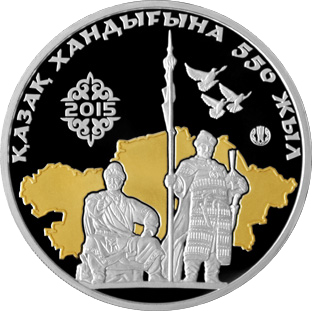
A monument depicting Kerei Khan seated and his co-founder Zhanibek Khan standing was unveiled on June 1, 2010, in (now Nur-Sultan), , in the square adjacent to the Museum of the First President. The 12-meter-tall composition, crafted from elements weighing approximately 10 tons, symbolizes the establishment of Kazakh independence and statehood, with Kerei's figure measuring about 4 meters in height and Zhanibek's around 5.25 meters. The unveiling ceremony was attended by then-President , underscoring Kerei's role as a foundational figure in Kazakh national identity. ![500 tenge commemorative banknote depicting the Kazakh Khanate founding][center] Kazakhstan has issued numismatic items honoring Kerei, including commemorative coins featuring his monument alongside Zhanibek's, as part of series celebrating Kazakh historical figures and state formation. In 2015, to mark the 550th anniversary of the Kazakh Khanate's founding—attributed to Kerei and Zhanibek—a 500 tenge polymer banknote was released, incorporating motifs of the khans and their legacy in establishing the polity around 1465. Modern commemorations extend to state-sponsored anniversary events, such as the extensive 2015 celebrations of the Khanate's 550th year, which included cultural programs, exhibitions, and publications highlighting Kerei's contributions to Kazakh ethnogenesis and from Uzbek . In 2025, observances for the 560th anniversary continued this tradition, with public and official recognitions emphasizing Kerei's enduring symbolism in Kazakh historiography as a unifier of tribes. These efforts, often initiated by governmental decree, integrate Kerei into narratives of national resilience, though historical assessments note the Khanate's early fragility under his rule.

References

Add your contribution
Related Hubs
User Avatar
No comments yet.