Hubbry Logo
Kia ConcordKia ConcordMain
Open search
Kia Concord
Community hub
Kia Concord
logo
8 pages, 0 posts
0 subscribers
Be the first to start a discussion here.
Kia Concord
Kia Concord
from Wikipedia

Kia Concord
Overview
ManufacturerKia Motors
Also calledKia Capital (SWB Version)
ProductionOctober 1987 – June 1995 (Concord)
March 1989 – December 1996 (Capital)
AssemblySouth Korea: Hwasung Plant, Hwasung
Body and chassis
ClassCompact Sedan (Capital)
Mid-size Sedan (Concord)
LayoutFR layout
Doors4
RelatedMazda Capella (GC)
Powertrain
Engine
Transmission5-speed manual
3/4-speed automatic
Dimensions
Wheelbase2,520 mm (99.2 in)
Length4,550-4,570 mm (179.1-179.9 in) (Concord)
4,430-4,480 mm (174.4-176.3 in) (Capital)
Width1,705-1,720 mm (67.1-67.7 in) (Concord)
1,705 (67.1 in) (Capital)
Height1,405 mm (55.3 in)
Curb weight1,140-1,180 kg (2,513-2,601 lb) (Concord)
990-1,100 kg (2,183-2,426 lb) (Capital)
Chronology
SuccessorKia Credos (Concord)
Kia Sephia (Capital)

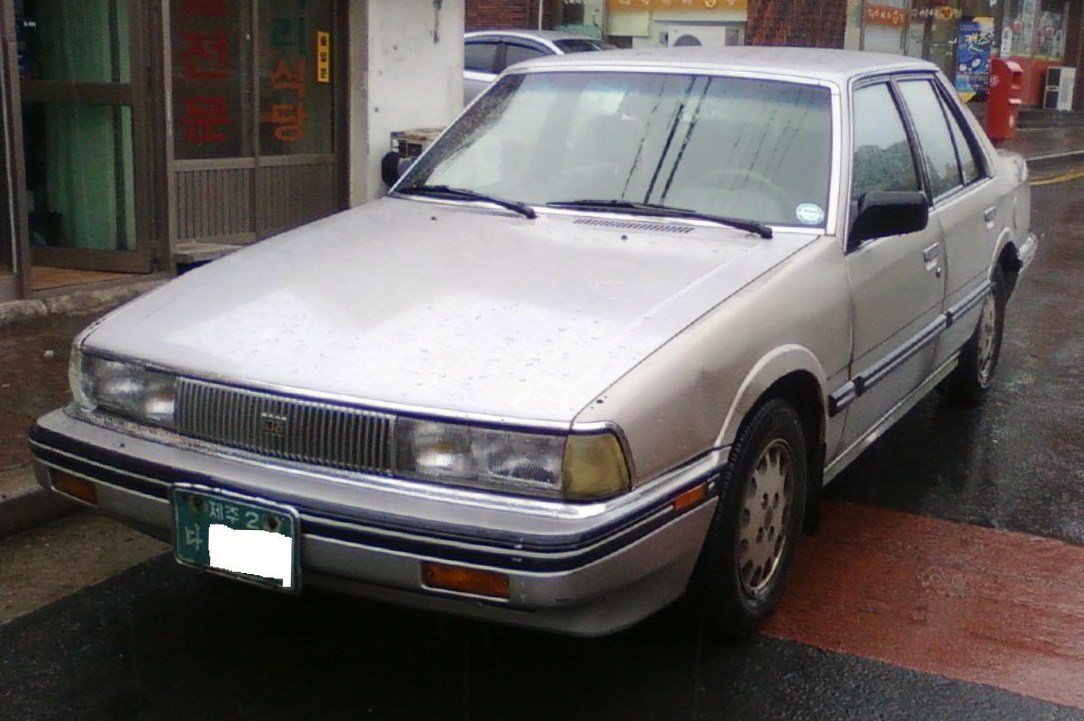
The Kia Concord is a four-door sedan produced by South Korea's Kia from 1987.[2] It is a license-built version of the 1982 Mazda Capella, and all versions accordingly used Mazda four-cylinder engines.[3] The Capital/Concord lineup underwent a series of facelifts, eventually becoming the "New Capital" and "New Concord" in marketing material. Production of the Concord ended in 1995, while the cheaper Capital continued until late 1996. In 1996, Kia replaced the car with the Kia Credos, which they based on the Mazda GE Platform.[4]

History

[edit]
1991-1995 Kia New Concord 1.8i GTX
1989 Kia Concord 2.0i DGT rear
1991-1995 Kia New Concord 1.8i GTX rear

First introduced in April 1987, the Concord received the carburetted 99 PS (73 kW) 2-litre petrol FE engine.[5] During 1988, the engine programme was expanded considerably, with the 72 PS (53 kW) 2-litre diesel "RF" added in April, a 95 PS (70 kW) 1.8-litre (F8) in May, a 110 PS (81 kW) fuel-injected version (called the 2.0i DGT)[6] added in July, and finally an LPG powered 1.8 for taxi usage added in August.[7] This expansion allowed the Concord to better compete with the Hyundai Sonata. The DGT's name was a reference to the digital dashboard with which it was fitted.[8]

After the 1991 facelift the engine programme was somewhat restricted, but in March 1992 a comparatively powerful DOHC version of the 2.0 was added, with 139 PS (102 kW) at 6000 rpm.[9]

With the 1995 introduction of the Kia Credos, production of the Concord came to an end. The smaller and simpler Capital continued a little while longer as a low-priced alternative.[10]

Kia Capital

[edit]
Pre-facelift Kia Capital DOHC 16V
Kia "New Capital" LS Di
Pre-facelift Kia Capital DOHC 16V
Kia "New Capital" LS Di

The lower end Capital (K930-series) was added in February 1989 with a carburetted two-valve SOHC version of the Mazda 1.5-litre B5 engine.[11] Power was 80 PS (59 kW) at 6000 rpm.[6] There was also a 1.5 MPFi version with a claimed 95 PS (70 kW), the same output as that of the fuel-injected 1.8-litre GLX version available until the facelift.[12]

After a change in legislation meaning that cars were now taxed based on displacement, with a major threshold at 1.5 litres, the Capital was available with a Twin Cam, 16-valve B5 engine in May 1990.[6] This surprising development had 115 PS (85 kW) on tap at 6,500 rpm. Top speed was 170 km/h (106 mph), the same as for the fuel-injected 1.5, but 0–100 km/h acceleration time dropped from 13.5 to 10.0 seconds. After the 1990 introductions of stronger competitors such as the Daewoo Espero and Hyundai Elantra, the Capital received a facelift in November 1991.[13] The facelift was not very deep, the most obvious difference being the relocation of the rear license plate to the bumper rather than between the taillights. The facelift version offered the 1.5 engine as well as a downgraded version of the 1.8, now to carburetted specifications and producing a mere 82 PS (60 kW) at 5000 rpm. This was mainly intended for taxi usage. There was also an export version with the carburetted two-valve 1.5 for Kia's very few export markets, with 73 PS (54 kW).[14]

In June 1994 the Capital received another facelift, featuring more rounded headlights and a new grille with new Kia logo, replacing the old one with chimney-based design.[15] This was called the "New Capital" in the marketing, although the badging on the car remained plain "Capital". The New Capital was only sold with the 16-valve B5 engine, in GS or higher LS equipment levels. Production of the Capital finally ended in December 1996, overlapping a few years with the Sephia that would eventually replace it.[16]

Kia continued its line of mid-size sedans with Credos (1995), Optima (2000), Lotze (2005) and K5 (2010).[17]

References

[edit]
[edit]
Revisions and contributorsEdit on WikipediaRead on Wikipedia
from Grokipedia
The Kia Concord is a mid-size four-door sedan manufactured by the South Korean automaker Kia Motors from 1987 to 1995. Developed under a licensing agreement as a rebadged and slightly modified version of the third-generation (also known as the second-generation Mazda 626), it marked Kia's initial foray into the competitive midsize sedan market, targeting domestic buyers with an emphasis on affordability and reliability. The Concord was powered by a front-wheel-drive layout with a 2.0-liter inline-four (designated the FE series), delivering 99 horsepower and 123 lb-ft (167 Nm) of torque, paired with either a five-speed manual or four-speed . Measuring approximately 4.57 meters in , it offered seating for five passengers and a trunk capacity suited for use, positioning it as a practical in the "" class. Primarily sold in , the model saw limited exports and was assembled at Kia's facilities in Sohari, with production emphasizing cost-effective components sourced from the partnership. In March 1991, the Concord underwent a significant facelift, rebranded as the New Concord, which featured revised front and rear styling—including rounder headlights and a redesigned taillight assembly—to modernize its appearance while retaining the core platform. This update also introduced a more powerful DOHC variant of the 2.0-liter engine in 1992, boosting output to 139 horsepower for higher trims like the GTX, enhancing its appeal as an upscale option. Production concluded in 1995, paving the way for Kia's next-generation midsize sedan, the Credos, as the company shifted toward more independent designs.

Development and History

Origins

In the early 1980s, Kia entered into a deepened collaboration with , building on an existing partnership that included Mazda's acquisition of an 8% equity stake in Kia in 1981, to license and produce mid-size sedans. This agreement enabled Kia to manufacture a version of the 1987 (third generation, known as the Mazda 626 in export markets and based on the GC platform) under the Kia Concord name, marking Kia's initial foray into the mid-size sedan segment. Kia's motivations for developing the Concord stemmed from the need to expand its product lineup beyond compact cars and light commercial vehicles like the Bongo, aiming to compete more effectively in the domestic South Korean market against rivals such as the Hyundai Sonata while positioning the brand for potential exports. At the time, Kia's research and development resources were constrained by South Korea's government policies under the military dictatorship of Chun Doo-hwan, which from 1981 had restricted Kia primarily to trucks and vans as part of an industry consolidation effort to foster a few key automakers. By licensing Mazda's proven front-wheel-drive architecture, Kia could efficiently enter the upscale sedan market without the full burden of independent platform development amid these economic pressures. The initial engineering adaptations focused on badge engineering to align the vehicle with Kia's branding, including a redesigned front grille and emblems distinct from the original, while retaining the core GC platform structure. The FE-series inline-four engines were integrated with minor adjustments to suit local manufacturing and market needs, though specific details on standard modifications or suspension tuning for South Korean roads were not extensively documented in contemporary records. Development accelerated following the Korean government's relaxation of passenger car production restrictions in , leading to production approval and the Concord's debut in April 1987 at Kia's Sohari plant.

Launch and Facelifts

The Kia Concord was introduced in April 1987 as Kia's entry into the midsize sedan segment, debuting with a carbureted 2.0-liter inline-four producing 99 PS (73 kW). Positioned as the company's upscale model, it targeted executive and buyers seeking a premium front-wheel-drive sedan in the South Korean market. In March 1991, the model received its first major facelift, rebranded as the New Concord, which featured revised exterior styling including a more rounded front with updated headlights and bumpers to enhance . Interior updates included a redesigned for improved , while minor reinforcements were added to the for better structural integrity. In 1992, a more powerful DOHC variant of the 2.0-liter engine was introduced, boosting output to 139 horsepower for higher trims. Production of the Concord concluded in June 1995, marking the end of its front-wheel-drive platform as Kia transitioned toward front-wheel-drive architectures with successors like the Credos.

Models

Concord

The Kia Concord served as the standard mid-size variant in Kia's lineup, featuring a four-door mid-size sedan body style with a 2,520 mm that prioritized comfort-oriented family transport and executive use across urban and highway environments. Positioned primarily for the South Korean , the model saw very limited exports, where it was marketed as Kia's inaugural "premium" sedan, offering leather-trim options and generous rear seating space to appeal to upscale consumers. Key attributes included standard analog instrumentation, with higher trims providing an optional and for enhanced luxury; post-facelift dimensions comprised a of 4,550–4,570 and width of 1,705–1,720 to balance maneuverability and presence. Available in base, deluxe, and topline configurations, the Concord catered to varying preferences, with the base emphasizing suitability, the deluxe incorporating chrome accents for visual appeal, and the topline standardizing and for refined daily driving. A shorter-bodied Capital variant addressed more compact needs, such as applications, sharing the same and platform.

Capital

The Capital was introduced in March 1989 as a shorter-bodied variant of the Concord, featuring a reduced overall length of 4,430–4,480 mm to qualify under Korea's tax classifications and accommodate urban parking constraints while sharing the 2,520 mm and underlying platform. This design positioned the Capital as a more affordable, downsized alternative to the larger Concord, incorporating independent styling modifications that rendered most exterior parts incompatible except for . Primarily targeted at taxi operators and budget-conscious buyers, the Capital emphasized practicality with durable features suited to high-mileage commercial applications, including easy-to-clean vinyl upholstery in fleet models and a reinforced suspension setup for enhanced longevity under demanding conditions. Taxi variants were equipped exclusively with a carbureted 1.8-liter engine adapted for LPG fuel and manual transmission, prioritizing reliability and cost-efficiency for South Korea's taxi fleets. The model underwent a minor facelift in November 1991, which relocated the rear license plate from the bumper to the trunk lid to improve visibility and updated the bumpers and grille for a more rounded aesthetic. A more significant refresh arrived in June 1994 with the New Capital, introducing a double-overhead-camshaft (DOHC) 1.5-liter option delivering up to 115 PS, clearer elements, and revised bumpers tailored to meet taxi fleet regulations. Production of the Capital ceased in December 1996, after a run that achieved higher output volumes compared to the Concord, driven largely by strong demand from the sector.

Technical Specifications

Powertrain

The Kia Concord lineup featured a range of inline-four engines derived from technology, reflecting the model's origins as a licensed production of the platform. These engines were tuned for reliability in the South Korean market, with petrol variants dominating sales and a diesel option for commercial applications. All models maintained a front-wheel-drive configuration, providing balanced handling for the era's midsize sedan segment. Petrol engines included a base 1.5-liter B5 unit producing 72 horsepower, primarily fitted to the entry-level Capital variant for economical urban use. The 1.8-liter F8 , available in single overhead (SOHC) form at 95 horsepower and a dual overhead (DOHC) variant reaching up to 115 horsepower, offered improved mid-range for daily driving. Higher trims featured the 2.0-liter FE , with the SOHC version delivering 99–110 horsepower and the DOHC iteration boosting output to 139 horsepower for enhanced performance in top models like the GTX. A 2.0-liter RF provided 72 horsepower, emphasizing for and fleet operators. Additionally, a (LPG) adaptation of the 1.8-liter F8 was developed for fleet use, allowing dual-fuel capability to reduce operating costs in regulated markets. Performance varied by engine, with top speeds ranging from 160 km/h for the 1.5-liter and diesel models to 180 km/h for the 2.0-liter DOHC variant. Acceleration from 0 to 100 km/h took approximately 12–15 seconds in 2.0-liter equipped cars, suitable for merging but modest by modern standards. economy typically achieved 8–10 km per liter in mixed city and driving, with the diesel offering the best efficiency at around 10 km per liter combined, while petrol models averaged 8 km per liter in urban conditions. These figures supported the Concord's reputation for practical in domestic use. Transmissions consisted of a standard five-speed manual gearbox across all variants, paired with the front-wheel-drive layout for straightforward power delivery. Automatic options included a three-speed unit for base models and a four-speed automatic introduced in higher trims after 1991, improving convenience for non-enthusiast buyers without significantly compromising efficiency. Adaptations for the South Korean market involved tuning the carbureted engines to run on lower-octane fuels prevalent locally, ensuring durability under varying conditions.

Chassis and Dimensions

The Kia Concord utilized a unibody construction, licensed and adapted from the second-generation (GC platform), which integrated the body and frame into a single rigid structure for improved and handling efficiency in a mid-size sedan. This design emphasized lightweight packaging while providing sufficient structural integrity for everyday use, with the front suspension featuring independent MacPherson struts for responsive and the rear employing independent multi-link or strut-based setup with coil springs to maintain stability under load. The overall tuning prioritized smooth, composed highway performance over agile cornering, making it suitable for long-distance travel on paved roads. Braking was handled by a standard setup of front ventilated disc brakes paired with rear drum brakes, delivering adequate stopping power for the vehicle's era and power outputs without advanced electronic aids. (ABS) was not available on the Concord throughout its production run, reflecting its positioning as an entry-level import sedan. Curb weights varied between approximately 1,100 kg and 1,200 kg depending on and trim, contributing to nimble yet stable dynamics. The uniform of 2,520 mm supported balanced proportions, while ground clearance stood at 155 mm, optimized for urban and highway conditions rather than rough terrain. Key exterior dimensions included a of 4,570 , width of 1,720 , and height of 1,405 , positioning the Concord as a compact mid-size offering generous interior for four to five passengers. Track widths measured 1,440 at the front and 1,430 at the rear, enhancing straight-line stability. provisions aligned with late-1980s standards, featuring three-point belts for front and rear occupants and a reinforced unibody structure designed to absorb impact energy in frontal collisions, though driver or passenger airbags were absent.

Market and Legacy

Sales and Reception

The Kia Concord achieved moderate commercial success in the South Korean during the early 1990s, aided by incentives favoring local manufacturers such as breaks and preferences for fleets. This performance positioned it as a reliable choice for professional and fleet buyers, though it trailed leaders like Hyundai's offerings in overall volume. Export efforts were more limited, with units shipped primarily to markets in (where it was sold as the Clarus), where the model earned praise for its mechanical reliability but drew criticism for styling that appeared dated next to contemporary Japanese competitors like the . Critical and consumer reception highlighted the Concord's strengths in value and long-term durability, with taxi operators noting its longevity under heavy use, underscoring its robust construction derived from the platform. However, reviews were mixed on overall refinement, lacking the polish of rivals in ride quality and interior features. The model faced stiff domestic competition from the , which offered greater luxury appeal, contributing to a production decline after amid increasing openness to imported vehicles.

Successors

The , produced from 1995 to 2004, served as the direct successor to the Concord, representing Kia's shift toward a more modern front-wheel-drive midsize sedan. Built on the GE platform, the Credos featured a redesigned unibody that improved fuel efficiency over its predecessor while retaining shared engine options, including the 2.0-liter Mazda FE-series inline-four in both SOHC and DOHC configurations. For the Capital variant, the Kia Sephia (1992–2003) emerged as its replacement, positioning itself as a compact sedan that captured much of the taxi market previously dominated by the Capital through refreshed styling and reliable inline-four engines like the 1.8-liter B8D. The Concord's reliance on Mazda-derived front-wheel-drive platforms gradually phased out by the late 1990s as Kia developed in-house designs, influencing the sedan positioning of later models such as the Opirus introduced in 2003, which benefited from emerging global partnerships including the 1998 affiliation with Hyundai. Overall, the Concord line helped Kia establish mid-size sedan expertise during the 1990s, supporting the company's export expansion to markets like and , though it saw no direct revival; its executive-oriented focus echoes in the modern K9 full-size sedan.

References

Add your contribution
Related Hubs
User Avatar
No comments yet.