Hubbry Logo
D-segmentD-segmentMain
Open search
D-segment
Community hub
D-segment
logo
8 pages, 0 posts
0 subscribers
Be the first to start a discussion here.
D-segment
D-segment
from Wikipedia
2020 Best-Selling
BMW 3 Series 7th generation (2018–present)
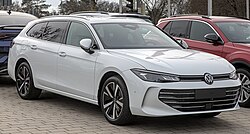
Volkswagen Passat 8th generation (2015–2024)

The D-segment is the 4th category of the European segments for passenger cars, and is described as "large cars".[1][2]

It is equivalent to the Euro NCAP "large family car" size class,[3] and the present-day definition of the mid-size car category used in North America.[4][5] Compact executive cars are part of the D-segment size category.

D-segment sales represented about 7% of the market in the 2010s.[6][7]

Characteristics

[edit]

Most D-segment cars are sedans/saloons or wagons/estates but hatchbacks, and coupes have been common.

Pricing and specification of D-segment cars can vary greatly, from basic low-cost transport to more luxurious and expensive models. As of 2025 the typical D-segment category size ranges from about 4.6 to 5 m (15.1 to 16.4 ft).

Current models

[edit]

D-segment cars in Europe are the Alfa Romeo Giulia (2015), BMW 3 Series, Mercedes-Benz C-Class, Audi A4/S4/RS4, Mazda6, Škoda Superb, Volvo S60/V60, Jaguar XE, Citroën C5, Peugeot 508, Audi A5/S5/RS5, BMW 4 Series, Volkswagen Arteon, Honda Accord, Toyota Camry and Polestar 2. [8]

100,000 – 200,000 sales (Best-Selling)

50,000 – 100,000 sales

10,000 – 50,000 sales

List of current cars produced in 2025

[edit]

Sales figures in Europe

[edit]
2021
rank
Brand Model 2014 2015 2016 2017 2018 2019 2020 2021 % change
(2020–2021)
1 Tesla Model 3 95,168 85,979 140,868 Increase +64%
2 BMW 3 Series 168,275 143,023 144,561 129,053 106,991 124,537 118,369 113,209 Decrease -4%
3 Volkswagen Passat 153,677 226,127 206,813 183,288 154,074 124,650 115,363 82,488 Decrease -28%
4 Audi A4/S4/RS4 124,170 124,466 162,655 146,006 112,484 102,994 77,515 59,251 Decrease -24%
5 Mercedes-Benz C-Class 136,474 173,011 176,038 176,915 150,995 143,293 81,909 56,927 Decrease -30%
6 Volvo S60/V60 54,663 54,354 53,268 45,335 46,945 65,917 58,003 47,054 Decrease -19%
7 Škoda Superb 46,149 50,533 85,879 81,410 74,697 67,488 59,925 46,285 Decrease -23%
8 BMW 4 Series 53,948 72,769 67,983 64,710 52,248 35,908 18,139 33,083 Increase +82%
9 Audi A5/S5/RS5 47,591 45,202 43,686 61,619 49,799 41,812 28,525 26,100 Decrease -9%
10 Peugeot 508 41,797 43,301 37,104 22,842 13,378 41,329 29,011 25,202 Decrease -13%
11 Volkswagen Arteon 9,798 21,495 19,048 13,582 20,994 Increase +55%
12 Polestar Polestar 2 8,746 20,949 Increase +140%
13 Opel/Vauxhall Insignia 92,694 88,544 73,161 72,347 67,424 45,925 21,133 20,384 Decrease -4%
14 Ford Mondeo 45,405 79,673 70,900 56,173 49,596 39,555 21,222 13,481 Decrease -36%
15 Toyota Camry 7,640 9,119 8,222 Decrease -10%
16 Alfa Romeo Giulia 10,475 24,679 17,075 10,932 7,436 6,297 Decrease -15%
17 Subaru Legacy/Outback 6,415 10,806 8,242 7,016 7,460 7,504 3,844 6,045 Increase +57%
18 Renault Talisman 1,824 34,344 32,163 19,784 16,405 8,025 5,608 Decrease -30%
19 Mazda Mazda6 31,032 30,519 29,226 23,090 23,090 22,048 6,950 4,890 Decrease -30%
20 Jaguar XE 16,535 24,461 18,999 10,877 7,978 3,780 2,039 Decrease -46%
21 Kia Stinger 1,143 3,820 3,600 1,387 1,142 Decrease -18%
22 BMW i4 762 New
23 Lexus IS 9,610 7,729 6,234 5,649 5,413 3,282 1,855 551 Decrease -70%
24 Kia Optima 3,409 3,263 9,515 16,152 14,404 12,202 6,086 430 Decrease -93%
25 Subaru Levorg 2,437 4,689 2,865 1,748 1,395 825 417 Decrease -49%
26 Lexus RC 30 526 1,815 1,390 1,334 1,082 710 96 Decrease -86%
27 Genesis G70 96 New
28 Citroën C5 X 63 New
29 Xpeng P5 8 New
Mainstream 527,783 619,474 625,185 542,947 450,035
Premium 613,234 662,738 709,754 694,030 584,091
Segment total 1,046,829 787,815 742,941 Decrease -6%
Source [9][10] [11][12] [13][14] [15][16] [17][18] [6] [7] [19]

Notes:

Jump in segment total sales after 2019. year is because premium cars are included.

From 2014 to 2018 premium cars are not included in total segment sales.

Premium brands and models are marked italic.

Electric cars are included in D-segment from 2019. year.

Market share in Europe

[edit]

2019 - After years of decline, the midsized car segment is actually up 1% in 2019 to 1.05 million sales, maintaining a 6.7% share of the overall car market. [6]

2020 - The midsized car segment is down 25% in 2020 to just under 790,000 sales, as its share of the European car market drops to 6.6%, slightly down from 6.7% last year. And luxury brands have now officially taken over control of this class, improving their share to 62.3% from 60.5% last year and claiming four of the top-5 positions. The top-3 players all gain share, outperforming not only the class but also the overall market. [7]

Historic models

[edit]

Note: this list includes cars from these decades which carried a different nameplate or numeric designation to the modern day equivalent, and in some cases there is no modern day direct equivalent

1910s-1920s

[edit]

1930s

[edit]

1940s

[edit]

1950s

[edit]

1960s

[edit]

1970s

[edit]

1980s

[edit]

1990s

[edit]

2000s

[edit]

2010s

[edit]

2020s

[edit]

See also

[edit]

References

[edit]
Revisions and contributorsEdit on WikipediaRead on Wikipedia
from Grokipedia
The D-segment is a category within the European classification system for passenger cars, denoting upper medium or large family vehicles that provide spacious interiors suitable for five passengers and family travel. These cars are positioned between the compact and the executive , offering a combination of comfort, practicality, and performance for everyday and longer journeys. Typical examples include the and , which exemplify the segment's focus on versatile, mid-sized designs. In market statistics compiled by the (ACEA), the D-segment is officially termed "Upper Medium" and represents a key portion of new passenger car registrations in the . Vehicles in this segment commonly feature body styles such as sedans and station wagons, with dimensions generally ranging from 4.5 to 4.7 meters in length to accommodate greater interior volume compared to smaller segments. The classification, while not formally regulated, aids in standardizing industry reporting and consumer comparisons across . Globally, the D-segment aligns with mid-size cars in North American and other regional taxonomies, emphasizing family-oriented utility and often incorporating advanced safety and features. Notable models like the , , and have historically defined the segment, contributing to its role in supporting diverse mobility needs in urban and suburban settings.

Definition and Classification

Overview and Scope

The D-segment represents a key category in the European automobile classification system, denoting upper medium or compact executive cars designed for comfort, practicality, and versatility. These vehicles are primarily sedans, wagons, or liftbacks, with typical lengths spanning 4.4 to 4.7 meters, offering a balance of spacious interiors and maneuverability suitable for executive and transport. This segment emphasizes vehicles that accommodate five passengers comfortably while providing substantial boot capacities of 400 to 500 liters, enabling efficient cargo handling for everyday and longer journeys. The origins of the D-segment trace back to the late , when the referenced segments A through F in a 1999 merger assessment document for Hyundai and , using size-based categorization to analyze market overlaps without formal regulations. Although not rigidly defined by law, the system drew from industry practices evaluating overall dimensions and , evolving from earlier informal groupings to standardize comparisons across manufacturers. This framework helped delineate the D-segment as distinct from smaller or larger classes, focusing on mid-sized cars that prioritize reliability and moderate luxury features. In scope, the D-segment encompasses family-oriented executive vehicles that bridge the (lower medium cars) and (full executive or luxury models), catering to buyers seeking elevated refinement without entering premium territory. Its evolution includes widespread adoption by European automakers, such as the and (now ), which integrate the into product development and market strategies for consistent segmentation.

Relation to Other Segments

The D-segment sits between the and in the European passenger car classification system, offering a midpoint in size, space, and market positioning for family-oriented vehicles with enhanced comfort. Compared to the , which includes compact models like the and with lengths under 4.4 meters and boot capacities below 400 liters, D-segment cars provide greater interior volume and practicality for larger families while remaining more maneuverable than bigger classes. In contrast, vehicles, such as the and , exceed 4.7 meters in length with boot spaces over 500 liters, focusing on premium executive features, advanced technology, and superior ride quality for business users. In other markets, the D-segment aligns closely with U.S. mid-size sedans like the and , which share similar dimensions and target comparable buyers seeking reliable daily transport. Japanese classifications transition from kei cars (under 3.4 meters) through compact models to mid-size offerings like the , mirroring D-segment roles in providing accessible upscale mobility. In , where segments are defined by and length, the local C-class sedans (typically 4.6-4.9 meters) serve as equivalents, emphasizing rapid growth in mid-size vehicles for urban professionals. In the , as of 2024, the D-segment accounted for about 21% of new private lease registrations due to its optimal blend of passenger space, , and perceived prestige, making it ideal for corporate and long-term use without the higher costs of larger segments.

Characteristics

Physical Dimensions

D-segment are defined by standardized physical dimensions that position them as mid-sized automobiles, offering a between compactness and spaciousness suitable for executive or use. Typical lengths fall within 4.6 to 4.8 , providing sufficient room for rear-seat passengers while maintaining urban drivability. Widths generally range from 1.8 to 1.9 , contributing to handling and a premium interior feel without excessive bulk. Wheelbases measure approximately 2.7 to 2.8 , which supports balanced and enhanced ride comfort. These dimensions directly influence cargo practicality, with boot capacities in standard sedans typically ranging from 450 to 600 liters, sufficient for everyday luggage or grocery loads. In estate or variants, this expands significantly to around 1,500 liters or more when rear seats are folded, enabling versatile use for larger items like bicycles or weekend travel gear. Such capacities underscore the segment's focus on functionality without venturing into full-size territory. Body styles in the D-segment emphasize versatility, with sedans and estates (also known as wagons) forming the core offerings due to their traditional appeal for business professionals and families seeking practicality. Sedans provide a sleek, low-slung profile ideal for highway efficiency, while wagons extend rear overhangs for added cargo volume. In recent years, configurations have gained traction for their hatch-like accessibility combined with sedan aesthetics, and crossover variants—exemplified by the , which blends lines with elevated —have emerged to cater to preferences for higher seating and light off-road capability. The of D-segment dimensions reflects broader automotive trends toward refinement and efficiency. In the , designs were often boxier with more angular profiles to maximize interior volume within similar constraints, prioritizing over . By the , shapes have shifted to aerodynamic contours—featuring smoother lines, lower drag coefficients, and integrated spoilers—to improve fuel economy and high-speed stability, while overall sizes have subtly increased to meet consumer demands for more legroom and .

Performance and Equipment

D-segment vehicles have historically relied on internal combustion engines () with displacements ranging from 2.0 to 3.0 liters, producing 150 to 300 horsepower in both petrol and diesel configurations to balance performance and efficiency. Post-2010s, manufacturers have increasingly adopted electrified powertrains, including mild-hybrid systems utilizing 48V architecture for improved fuel economy and reduced emissions, alongside full hybrids and battery electric vehicles in this segment. As of 2025, battery electric vehicles (BEVs) and plug-in hybrids (PHEVs) constitute a growing share of D-segment offerings. Typical performance metrics for D-segment cars include from 0 to 100 km/h in 7 to 9 seconds, top speeds between 220 and 250 km/h, and consumption of 5 to 7 L/100 km for conventional ICE models under standard testing conditions. These benchmarks reflect a focus on responsive handling suitable for executive use, with electrified variants often enhancing efficiency to below 5 L/100 km equivalent. Standard equipment in D-segment vehicles emphasizes luxury and connectivity, featuring leather upholstery, systems with screens exceeding 10 inches, and advanced driver assistance systems (ADAS) such as as core offerings. Higher trim levels commonly incorporate all-wheel drive for enhanced traction and for superior ride comfort. Safety performance adheres to stringent 5-star criteria, prioritizing structural integrity to mitigate injuries in mid-size offset impacts and side collisions through robust body designs and energy-absorbing materials. This standard is routinely achieved by D-segment models, underscoring their emphasis on occupant protection via integrated crash structures and supplementary restraint systems.

Historical Models

1960s

The marked the emergence of the D-segment in as a category for mid-size vehicles blending family practicality with executive comfort, driven by economic recovery that boosted demand for reliable long-distance travel options. These cars typically featured boxy, aerodynamic shapes influenced by American styling trends, such as tailfins, while incorporating experimental layouts like (FWD) or rear-engine configurations to enhance stability and space efficiency. Emphasis was placed on ride comfort through advanced suspension systems, catering to growing middle-class mobility needs in a market initially confined to European manufacturers. Pioneering models exemplified these innovations, starting with the , introduced in 1955 but peaking in influence through the 1960s with its revolutionary system, developed by engineer Paul Magès, which used and gas spheres for self-leveling and superior ride quality over uneven roads. The DS's FWD layout and aerodynamic design prioritized comfort for extended journeys, positioning it as a luxury family . Production spanned until 1975, totaling 1,456,115 units, reflecting its enduring appeal amid Europe's industrial boom. Mercedes-Benz contributed with the W110 "Fintail" series, produced from 1961 to 1968, which pioneered through extensive crash testing and features like and a rigid passenger cell, innovations led by engineer . Its boxy silhouette with distinctive tailfins housed inline-four and six-cylinder engines, offering refined performance for executive use while emphasizing durability for long-haul travel. Over 628,000 W110 units were built, underscoring its role in elevating standards in the segment. Ford entered the fray with the Taunus P6 (12M/15M), manufactured from 1966 to 1970 as a mass-market D-segment offering, notable for its FWD setup derived from the unlaunched Cardinal project and V4 "Cologne" engines providing efficient power for everyday family needs. The model's angular, boxy design and optional performance variants like the RS appealed to a broader audience, focusing on affordability without sacrificing comfort for continental drives. A total of 668,187 P6 units were produced, highlighting Ford's push to democratize D-segment accessibility in recovering economies.

1970s

The marked a pivotal era for the D-segment, characterized by adaptations to economic pressures and technological refinements that emphasized and practicality. The prompted manufacturers to prioritize smaller, more economical engines typically ranging from 1.6 to 2.5 liters, alongside the introduction of variants to appeal to buyers seeking versatile family vehicles. These changes responded directly to surging fuel prices, with many models achieving improved miles per () ratings compared to their predecessors, fostering a shift toward downsized yet spacious designs. Key models exemplified these trends, including the A, produced from 1970 to 1975 as a rear-wheel-drive economy sedan with inline-four engines starting at 1.6 liters, offering reliable performance for everyday use. The Audi 80, launched in 1972 and built until 1978, introduced front-wheel-drive innovation in the segment, utilizing a layout and front suspension for enhanced handling and space efficiency. Fiat's 132, manufactured from 1972 to 1981, brought distinctive Italian styling with its sleek lines and optional body, powered by engines up to 2.0 liters that balanced elegance and efficiency. Meanwhile, the , available from 1970 to 1978, represented early import success for Japanese brands in , with its compact yet refined design and fuel-sipping 1.6- to 2.0-liter engines gaining traction among cost-conscious consumers. Technological advances further defined the decade, as MacPherson struts became widespread in D-segment vehicles for their simplicity and cost-effectiveness, improving ride quality without sacrificing interior room—building on 1960s innovations. Early electronic ignition systems also emerged, with manufacturers like adopting breakerless designs by 1973 to enhance reliability and fuel economy by eliminating points wear, a trend that spread across European models by the mid-1970s. Market dynamics intensified with rising competition from Japanese imports, which capitalized on superior to challenge established European brands. By 1980, Japanese vehicles had captured over 9% of the European passenger car market, peaking near 10% and pressuring D-segment producers to innovate amid quotas and economic strain.

1980s

The 1980s represented a pivotal era for the D-segment, characterized by a strategic emphasis on elevating performance capabilities and aerodynamic refinement to meet evolving consumer demands for sportier, more efficient executive vehicles. Building briefly on the front-wheel-drive innovations of the , manufacturers shifted focus toward rear-wheel-drive and all-wheel-drive configurations that enhanced handling and traction. This period saw German premium brands consolidate their leadership, introducing models that blended luxury with dynamic driving experiences, setting benchmarks for the segment's future direction. Key models exemplified this performance-oriented evolution. The BMW 3 Series (E30), introduced in 1982 and produced until 1994, emerged as the sporty benchmark with its rear-wheel-drive platform, precise steering, and engine lineup culminating in the iconic M3 variant, which delivered exceptional track-ready agility. The 190E (W201), launched in 1982 and continuing through 1993, prioritized safety and engineering durability, featuring advanced crash structures and the optional Cosworth-tuned 2.3-16 engine for spirited acceleration while maintaining refined ride quality. Meanwhile, the Audi 80 (B2), spanning 1978 to 1986, pioneered the quattro all-wheel-drive system in 1980, offering superior grip on varied surfaces and redefining traction standards for mid-size sedans. Design trends leaned heavily into , with widespread use of wind-tunnel testing to sculpt bodywork for reduced drag, targeting coefficients under 0.35 in high-performance variants to boost highway efficiency and stability. The E30 M3 achieved a Cd of 0.33 through aerodynamic aids like spoilers and underbody panels, while the Mercedes 190E matched this with a Cd of 0.33 via streamlined profiling. Stylistic flair included pop-up headlights on select models for a sleek aesthetic, alongside expanded and options—such as the E30's two-door and cabriolet variants—to attract a broader, enthusiast-driven audience. Technological advancements further underscored the decade's performance push, including turbocharging to deliver potent output from compact engines, as seen in the Mercedes 190D 2.5 Turbo diesel introduced in 1984 for efficient yet responsive motoring. By the late 1980s, anti-lock braking systems (ABS)—first commercialized by in 1978—had become standard equipment on many premium D-segment vehicles, preventing wheel lockup and enhancing control during emergency stops. In the European market, these premium brands dominated proceedings, capturing the majority share amid rising demand for upscale, technology-laden mid-size cars.

1990s

The marked a pivotal era for the D-segment, characterized by the deepening integration of electronic systems and efforts toward global platform standardization, which allowed manufacturers to streamline production and adapt models for diverse markets. European brands dominated with innovative designs that balanced luxury, , and , while Japanese entrants intensified by offering competitive pricing and reliability. This period saw D-segment vehicles evolve from performance-oriented machines to sophisticated daily drivers equipped with emerging digital technologies. Key models exemplified these shifts. The Audi A4 (B5 generation), introduced in 1994 and produced through 2001, was built on the Volkswagen Group's PL45 platform, enabling shared components with models like the VW Passat B5 and promoting cost-effective global manufacturing. It featured aluminum components in the front suspension for reduced weight and improved handling. The BMW 3 Series (E36 generation), spanning 1990 to 2000, utilized a versatile chassis that supported multiple body styles including sedans, coupes, and convertibles, solidifying its reputation for dynamic driving. The Mercedes-Benz C-Class (W202 generation), launched in 1993 and continuing until 2000, positioned itself as an entry-level luxury sedan with enhanced comfort and build quality over its 190-series predecessor, broadening access to Mercedes engineering. Design trends in the emphasized and refined dynamics to meet stricter efficiency standards and consumer demands for comfort. Rounded body shapes became prevalent, leveraging to minimize drag coefficients and boost fuel economy, as seen across mid-size sedans from European marques. Multi-link rear suspensions proliferated, providing superior ride compliance and cornering precision compared to earlier axles. All-wheel drive gained traction, particularly through Audi's quattro system, which was standard on many A4 variants and enhanced stability in varied conditions. Technological advancements focused on safety and diagnostics, integrating electronics more seamlessly into vehicle architecture. Mercedes-Benz debuted the Electronic Stability Program (ESP) in 1995, initially on the S-Class but quickly influencing D-segment applications; this system used sensors to detect skids and selectively brake wheels to maintain control. On-board diagnostics progressed with the OBD-II standard, mandated for U.S.-market vehicles from the 1996 model year, standardizing emissions monitoring and enabling easier fault detection via a universal port—a framework that influenced European designs. Infotainment evolved with multi-disc CD changers becoming common in luxury trims for superior audio quality over cassettes, while early GPS systems appeared in upper D-segment models, such as BMW's 1994 implementation in the 7 Series using CARIN technology. In the European market, the D-segment held a stable share of approximately 8% of total passenger car registrations throughout the decade, reflecting steady demand for premium mid-size vehicles amid economic growth. Japanese models like the 626 challenged this dominance by delivering reliable, value-driven alternatives with spacious interiors and efficient engines, capturing growing segments of budget-conscious buyers in export markets.

2000s

In the , the D-segment faced increasing pressure from stricter emissions regulations and the rising popularity of s, prompting manufacturers to prioritize , , and versatile designs while sales began to decline. European emissions standards evolved with the introduction of Euro 4 in 2005 and Euro 5 in 2009, driving widespread adoption of cleaner diesel technologies to meet limits on nitrogen oxides and particulates. Safety advancements also gained prominence, building on earlier electronic stability programs from the , as consumers demanded better crash avoidance. Meanwhile, the SUV boom eroded traditional sedan and , shifting buyer preferences toward higher-riding vehicles with more cargo flexibility. Key models exemplified these shifts, with the BMW 3 Series (E90 generation, 2005–2013) introducing EfficientDynamics technology in 2007 to enhance fuel economy through features like engine auto start-stop and optimized aerodynamics, achieving up to 20% better efficiency without sacrificing performance. The Mercedes-Benz C-Class (W204, 2007–2014) debuted the PRE-SAFE system, which uses sensors to detect imminent collisions and preemptively tightens seatbelts and closes windows for occupant protection. Audi's A4 (B7 from 2004 and B8 from 2008 to 2015) pioneered LED daytime running lights in production models, improving visibility and energy efficiency over traditional bulbs. Design trends leaned toward greater interior versatility, with higher rooflines providing MPV-like headroom and space for families, as seen in models like the Variant and estate. Wagon variants reached peak popularity in during this decade due to their blend of sedan handling and expanded cargo capacity. Technological innovations focused on emissions reduction and driver assistance, including the proliferation of common-rail diesel engines that enabled multiple injections per cycle for smoother operation and lower fuel use under Euro 4 and 5 norms. Six-speed automatic transmissions became standard in many D-segment vehicles by the mid-2000s, offering improved shift efficiency and acceleration compared to four-speed units. Blind-spot monitoring systems emerged as an early active safety feature, first introduced by in 2005 to alert drivers of vehicles in adjacent lanes. Market dynamics reflected these changes, with D-segment sales in dipping to around 250,000 units annually by the late 2000s from higher volumes earlier in the decade, as SUVs captured over 20% of the overall passenger car market by 2009. Hybrids began to appear as efficiency alternatives, highlighted by the Lexus GS 450h in 2007, which combined a V6 with electric motors for 340 horsepower and superior fuel economy in the luxury subcategory.

2010s

The D-segment in the 2010s adapted to growing demands for connectivity and early electrification, with premium German manufacturers leading innovations in infotainment, powertrains, and driver assistance systems while maintaining the segment's emphasis on refined performance and luxury. The BMW 3 Series F30 generation, introduced in 2011 and produced through 2019, exemplified this shift through its evolved iDrive system, which incorporated a central touchpad for gesture-based controls, voice recognition, and integrated apps, enhancing user interaction and navigation precision in a compact executive package. Similarly, Mercedes-Benz launched the W205 C-Class in 2014, continuing production until 2021, featuring the innovative 9G-Tronic nine-speed automatic transmission that delivered smoother shifts, better fuel efficiency, and quicker response times across its range of inline-four and V6 engines. Audi's A4 B9, debuting in 2015 and extending into the decade, introduced the Virtual Cockpit—a fully digital 12.3-inch instrument display that allowed drivers to toggle between conventional dials and augmented reality overlays for navigation and speed data, redefining cockpit ergonomics. Design trends emphasized aerodynamic efficiency and visual dynamism, with LED matrix headlights emerging as a hallmark technology for adaptive illumination. First commercialized in the A8 in 2013, this system used individually controllable LEDs to adjust beam patterns in real-time, avoiding glare for oncoming traffic while maximizing visibility; by mid-decade, it appeared in D-segment models like the A4 B9 and Mercedes C-Class variants, improving safety during night driving. Coupe-like fastback silhouettes gained traction, offering a sleeker alternative to traditional sedans, as seen in the sloping rooflines of the 4 Series Gran Coupe (2014) and A5 Sportback (2016), which prioritized style and rear headroom without sacrificing trunk space. pilots marked the onset of hybrid integration, with the 330e sedan arriving in 2016 as a D-segment pioneer, pairing a 2.0-liter turbocharged four-cylinder engine with an 88-hp for a combined 252 hp and up to 14 miles of , supported by a 7.6-kWh battery and . Advancements in connectivity and further distinguished the era, as D-segment vehicles incorporated integration and partial to appeal to tech-savvy buyers. Apple CarPlay and became widely available from onward in models like the and Mercedes C-Class, allowing seamless wireless mirroring of phone interfaces for calls, music, and mapping apps directly on the screen. Semi-autonomous driving at SAE Level 2—encompassing with stop-and-go functionality, lane-centering assist, and automatic emergency braking—rolled out in higher trims, such as Mercedes' Distronic Plus in the W205 ( update) and Audi's Jam Assist in the A4 B9, enabling hands-on highway driving relief in congested conditions. Regulatory pressures from the Euro 6 emissions standard, implemented in September 2014, compelled manufacturers to refine diesel and gasoline engines with and direct injection, reducing emissions by up to 80% and CO2 outputs to meet fleet averages under 130 g/km for many variants. Market dynamics reflected a contraction for the D-segment, whose European sales share dwindled to around 7% by 2019 amid surging demand and economic uncertainties, with annual registrations dropping from over 1 million units in to approximately 1.07 million units in 2019. This decline opened opportunities for new entrants, including Chinese brands seeking premium positioning; launched the MG6 in the UK in April 2011 as an affordable D-segment , priced from £16,000 with a 1.8-liter turbo and British-inspired styling, aiming to capture value-conscious buyers in a market dominated by established players.

Current Models

Production Models in 2025

In late 2025, the D-segment continues to feature a diverse array of production models, primarily sedans and related body styles, with an emphasis on across European and global markets. Approximately 15-20 models remain actively produced, reflecting a contraction from previous decades due to the rise of SUVs and crossovers, though core offerings persist in premium and mainstream segments. Among European premium models, the transitioned from the G20 generation, which ended production in July 2025, to the new G50 generation entering production later in the year, offering hybrid powertrains like the 330e , with updates to its and system enhancing efficiency and connectivity. An all-electric version under the Neue Klasse i3 name is slated for production starting in 2026. The is actively manufactured, featuring the advanced MBUX system with AI-driven voice control and mild-hybrid assistance in most variants, positioning it as a benchmark for luxury mid-size sedans. The Audi A4 (B9 facelift) ended production in early 2025 and has been replaced by the new A5 (B10 generation), incorporating updated LED lighting and a 48-volt mild-hybrid setup for improved fuel economy along with quattro all-wheel drive in select variants. The continues production through 2027 with its existing 2.0-liter turbo engine and rear-wheel-drive dynamics, complying with emissions standards while its electric replacement is delayed. Volvo's S60, built on the first-generation SPA platform, remains in production with a focus on safety features; the fully electric EX60, a midsize on the new SPA3 architecture, is slated for launch in 2026. In the mainstream European segment, the (fourth generation, Mk4) is produced with a option delivering over 60 km of electric range, appealing to fleet buyers with its spacious design. The retains its Skyactiv-G petrol engines with mild-hybrid assistance, noted for its driver-focused handling, though production has ended in markets like , continuing in select regions without major updates. Peugeot's 508 emphasizes variants, combining a 1.6-liter engine with an electric motor for up to 50 km electric-only driving, in a body style. The , with its crossover-oriented design, remains in production as a hybrid model blending sedan comfort with elevated ride height. Global variants include the , post its Highland refresh, which fits the D-segment equivalent with its 4.69-meter length and advanced features, produced in high volumes for the European market. The continues exclusively as a hybrid model, powered by the 2.5-liter system, prioritizing refined performance in select markets. Notable discontinuations, such as the ending production in 2024 and the A4 in early 2025, have further streamlined the segment, with the electric entering production in select markets in late 2025. The D-segment is experiencing accelerated , with hybrid and electric vehicles (PHEVs) projected to constitute a significant portion of new sales by 2025, driven by stricter emissions regulations and consumer demand for lower operating costs. In , PHEVs alone captured 9% of new car registrations through August 2025, up 2 percentage points from the prior year, with hybrids and PHEVs together approaching 20-25% across passenger vehicles; this trend is particularly pronounced in mid-size segments like D due to their suitability for electrified powertrains that balance range and efficiency. Full battery electric vehicles (BEVs) are also entering the segment, exemplified by the , a performance-oriented electric launched in the second half of 2025, offering up to 416 miles of range and positioned in the D/E category to challenge traditional sedans with zero-emission . Design evolution in the D-segment reflects broader industry shifts toward versatility and environmental responsibility, incorporating crossover-inspired elements such as raised ride heights to enhance perceived utility and driver confidence without fully abandoning sedan aerodynamics. This "SUV-ification" allows models to appeal to buyers seeking elevated seating and improved visibility, as seen in concepts blending unibody construction with increased ground clearance for urban and light off-road use. Complementing these changes, sustainable materials like recycled plastics are gaining traction, with automakers integrating post-consumer recycled content into interiors and exteriors to reduce reliance on virgin polymers; for instance, mechanically recycled plastics are already used in limited applications, with projections for expanded adoption through 2035 to meet circular economy goals and regulatory mandates on material recyclability. Advancements in are emerging in premium D-segment models, where Level 3 systems enable conditional hands-off driving on highways under specific conditions, such as speeds up to 95 km/h in approved regions. Mercedes-Benz's Drive Pilot, certified for SAE Level 3 operation, is available in upper-mid-size vehicles like the E-Class, allowing drivers to disengage from core driving tasks while remaining ready to intervene, marking a step toward broader semi-autonomous capabilities in this segment by 2025. Despite these innovations, the D-segment faces challenges from declining demand, as consumer preferences shift toward SUVs and crossovers, eroding its from 10% in 2013 to 6% by 2023—a trend expected to persist into 2025 amid the dominance of higher-riding vehicles that now represent over 50% of global sales. To counter this, manufacturers are optimizing D-segment vehicles for fleet and ride-sharing applications, emphasizing modular designs, extended range through , and integration with shared mobility platforms to support high-utilization scenarios like urban ride-hailing, where reduced and on-demand access could sustain viability for mid-size sedans.

Market Analysis

Sales Figures in Europe

The D-segment in reached its peak sales volume in 2019, with approximately 1.2 million units registered across the . Sales subsequently declined due to the , bottoming out in 2020 before a recovery phase from 2021 to 2023 that saw annual volumes rebound to around 735,000 units by 2023. In 2024, D-segment registrations totaled about 771,000 units, marking a decrease amid a broader shift toward SUVs and economic pressures. Year-to-date through October 2025, sales stood at roughly 500,000 units, reflecting continued softening in demand for traditional mid-size sedans and wagons. Among top-selling models, the led with around 100,000 units in 2024, followed closely by the at approximately 90,000 units and the Audi A4 at about 80,000 units. The segment's and hybrid share has grown notably, reaching 20% of total D-segment sales in 2025, driven by updated options in premium models. Regionally, accounted for 40% of D-segment sales in , underscoring its role as the largest market, while the post-COVID recovery period gave way to a slowdown influenced by preferences shifting to larger vehicles. The D-segment's share of the European market has declined steadily over time, reflecting broader shifts in preferences and industry dynamics. In the , it represented approximately 10% of total new registrations, falling to 7% during the amid rising competition from crossovers and SUVs. By -2025, this figure had further decreased to 5%, according to data from the (ACEA). This erosion is primarily driven by the surging popularity of SUVs, which surpassed 50% in , reshaping the competitive landscape for traditional cars. Key factors contributing to the D-segment's reduced prominence include regulatory incentives for that disproportionately benefit larger vehicle classes. CO2 emission standards encourage manufacturers to electrify premium and upper-medium models to offset emissions from heavier SUVs, with D-segment battery-electric vehicles achieving a 28% share within the segment in 2023 compared to 13% for variants. Premium brands such as , , and Mercedes maintain a strong foothold in the D-segment, where it accounts for 60% of premium sales overall and 34-43% of their individual portfolios, underscoring its enduring role in executive and family-oriented premium offerings. Looking ahead, the D-segment's market share could potentially dip to 4% by 2030 absent significant growth in crossover hybrids, as continued SUV expansion and trends favor versatile body styles. Within the segment, body style preferences are evolving, with wagons declining to around 20% of D-segment registrations due to reduced demand for estate variants, while sedans hold steady at approximately 60%, supported by premium model loyalty.

Global Comparisons

In the United States, the D-segment equivalent consists of mid-size sedans, which continue to hold a modest market position amid a strong preference for SUVs and trucks. The dominated this category with 309,876 units sold in 2024, underscoring its enduring appeal as a reliable family sedan. Overall, mid-size sedans captured about 4% of the total U.S. market, a figure lower than Europe's D-segment share of around 6% but reflective of broader consumer shifts toward larger vehicles. In , D-segment dynamics vary by country, with a pronounced emphasis on hybrids and electric vehicles. In , models like the hybrid represent the segment's blend of luxury and efficiency, though sales remain niche at approximately 20,000 units domestically in , prioritizing advanced powertrains over volume. In , local brands such as Hongqi lead with premium offerings like the E-HS9 electric , contributing to the brand's record 439,000 total sales in , including 115,000 new energy vehicles that highlight the region's EV focus and account for about 26% of Hongqi's volume. This EV penetration in China's D-segment equivalents supports a national new energy vehicle exceeding 40%. Globally, D-segment sales reached roughly 4 million units in 2024, with comprising about 60% of the total and around 20%, driven by export-oriented models. The stood out as a , delivering over 600,000 units worldwide and exemplifying the segment's role in premium exports from to emerging markets. Key challenges in the global D-segment include trade tariffs on imports, which disrupt supply chains—such as U.S. duties on Chinese EVs reaching 100% in 2024—and regional preferences for pickups in the Americas that erode sedan demand. Additionally, varying EV mandates, like China's aggressive quotas versus more flexible policies in the U.S. and , create uneven adoption rates and investment pressures across markets.

References

Add your contribution
Related Hubs
User Avatar
No comments yet.