Hubbry Logo
King Abdullah I MosqueKing Abdullah I MosqueMain
Open search
King Abdullah I Mosque
Community hub
King Abdullah I Mosque
logo
8 pages, 0 posts
0 subscribers
Be the first to start a discussion here.
King Abdullah I Mosque
from Wikipedia

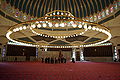
The King Abdullah I Mosque (Arabic: مسجد الملك عبد الله الأول) is a mosque, located in Amman, Jordan. Named in honour of Abdullah I, the mosque was built between 1982 and 1989 and is capped by a blue mosaic dome beneath which 3,000 Muslims may offer prayer.[1] It is in the Abdali area of the city.[2]

Key Information

Tourists are allowed to visit. Men must have long trousers on and women must cover their heads, arms and legs. A hooded gown is provided free of charge for this purpose.

[edit]

See also

[edit]

References

[edit]
[edit]
Revisions and contributorsEdit on WikipediaRead on Wikipedia
from Grokipedia
The King Abdullah I Mosque is a landmark contemporary Islamic structure in Amman's El-Abdali , , commissioned by King Hussein bin Talal between 1982 and 1989 as a memorial to his grandfather, King Abdullah I, the founder of modern . Designed by renowned Jordanian architect Rasem Badran, the mosque features a striking blue mosaic-covered dome measuring 35 meters in diameter, an octagonal prayer hall without supporting pillars, and intricate Quranic inscriptions, blending modern design with traditional Islamic elements. It was Jordan's national mosque from 1989 until 2006 and can accommodate up to 7,000 worshippers in its main hall, with an additional 3,000 in the surrounding courtyard. Completed in 1989, the mosque honors King Abdullah I's legacy as the nation's first ruler and symbolizes Jordanian heritage and faith, welcoming non-Muslim visitors to experience its serene atmosphere and architectural grandeur. The structure includes an on-site Islamic museum displaying personal artifacts of King Abdullah I alongside ancient , coins, and other historical items, providing deeper insight into Jordan's cultural and religious history. Its opulent interior, highlighted by a large decorative and vibrant mosaics, exemplifies Badran's approach to interpreting Islamic heritage through contemporary forms, making it a key site for understanding modern mosque architecture in the region.

History

Commission and construction

The King Abdullah I Mosque was commissioned in 1982 by King Hussein of Jordan as a memorial to his grandfather, King Abdullah I, who founded the modern Hashemite Kingdom of Jordan. The project served as a tribute to Abdullah I's legacy, emphasizing national unity and Islamic heritage in the capital city. Construction spanned from 1982 to 1989, with the mosque completed and ready for use by the end of the decade. The endeavor was primarily funded through resources provided by the Jordanian and state allocations, reflecting the personal patronage of King Hussein. The lead architect, Jan Čejka, was selected through a competitive process, while German Ulrich Müther oversaw the aspects to ensure stability and innovation. The site in Amman's Abdali district was chosen for its central position in the urban core, symbolizing accessibility and prominence as Jordan's national mosque. This location in the heart of the city allowed the structure to serve as a focal point for communal worship and reflection. One key challenge during construction involved harmonizing modern engineering solutions, such as reinforced concrete frameworks, with traditional Islamic aesthetic elements to maintain cultural authenticity. This integration required careful collaboration between the design team and local authorities to balance structural integrity with symbolic forms like the expansive dome.

Inauguration and dedication

The King Abdullah I Mosque was inaugurated in 1989 by as a memorial to his grandfather, King Abdullah I, who served as the emir of Transjordan from 1921 and as king from 1946 until his assassination on July 20, 1951, at in . The dedication ceremony featured speeches that underscored King Abdullah I's foundational role in establishing the modern Hashemite Kingdom of Jordan. The event drew attendance from members of the royal family and prominent dignitaries, marking a significant moment in Jordanian religious and national history. Following the , the functioned as Jordan's official state , hosting early events such as national prayers and commemorations until 2006, when that designation shifted to the King Hussein Bin Talal .

Design influences and style

The King Abdullah I Mosque exemplifies a blend of traditional Islamic architectural influences with modern Jordanian elements, drawing particularly from Ottoman and Umayyad styles to create a contemporary expression of . Ottoman influences are evident in the mosque's use of expansive domes and minarets, while Umayyad elements inspire the geometric precision and harmonious proportions that evoke early Islamic grandeur. This fusion reflects a deliberate effort to root the design in the region's historical legacy, adapting classical motifs to a post-independence Jordanian identity. A key inspiration for the central dome motif comes from the in , symbolizing divine presence and celestial elevation through its prominent, elevated form. The mosque's exterior features white marble cladding, a material long associated with purity and spiritual cleanliness in , enhancing the structure's serene and unadorned aesthetic. Complementing this, the blue tiling on the dome represents the and heavens, a recurring Islamic symbol of , tranquility, and , which infuses the space with a of ethereal peace. Architect Jan Čejka, a Czech designer who won an international competition in , approached the project with an emphasis on simplicity and spirituality, avoiding ornate excess to foster a harmonious environment conducive to . His philosophy integrated with subtle local references, resulting in a non-elaborate form that prioritizes spatial flow and natural light over decorative proliferation. This approach aligns with broader trends in Jordanian architecture during the late , balancing global with cultural authenticity. Overall, the mosque is classified as an example of contemporary Islamic revivalism, reviving traditional forms through innovative materials and engineering while maintaining a focus on spiritual essence over historical replication.

Structural features

The King Abdullah I Mosque's prayer hall is crowned by a central blue dome measuring 35 meters in , supported by a and pendentives that facilitate the transition from the octagonal base to the dome's circular form. The octagonal prayer hall is pillar-free, allowing for an unobstructed space accommodating worshippers. Two minarets flank the main entrance and serve as the vantage points for the , the call to . The prayer hall itself covers approximately 1,615 square meters, with the adjoining extending the available space for congregational prayers. The mosque's walls and floors are clad in white , providing a durable and reflective surface that complements the structure's overall harmony. features include an earthquake-resistant achieved through modern reinforcements embedded within the framework, ensuring stability beneath the traditional architectural elements.

Site and facilities

Location and layout

The King Abdullah I Mosque is situated in the Abdali district of , , specifically in the Jebel Lweibdeh neighborhood, at coordinates 31°57′42″N 35°54′47″E. The mosque occupies a total site area of 18,000 m², selected in 1982 for its central urban position that underscores its national significance. Its layout features a main entrance accessed via a grand staircase from Al Nabulsi Street, leading to an expansive octagonal courtyard that surrounds the central prayer hall, which is precisely oriented toward in accordance with the . The site includes surrounding gardens for serene reflection and dedicated ablution facilities to support , all integrated to facilitate smooth movement for worshippers. In its urban context, the mosque's proximity to a concentration of in Abdali highlights its role as a state-sponsored , accessible primarily via Suleiman Al Nabulsi Street and nearby routes. The grounds incorporate parking areas and wide pathways designed to accommodate large gatherings during religious events, ensuring efficient flow for thousands of visitors.

Capacity and amenities

The King Abdullah I Mosque has a total capacity of 10,000 worshippers, with 7,000 accommodated in the main hall beneath the iconic blue dome and 3,000 in the surrounding open . A dedicated women's area, separate from the main facilities and accessible via its own entrance, can hold up to 500 worshippers to ensure privacy and convenience during services. Key amenities include ablution fountains located in the for washing before prayers, a library that houses books on and related topics, and an on-site Islamic museum. The museum displays personal artifacts, photographs, and historical items related to King Abdullah I and broader Jordanian heritage, such as ancient and coins. The complex also features a royal prayer hall reserved for dignitaries, adorned with Islamic inscriptions, as well as modern audio systems integrated throughout for broadcasting sermons and the call to prayer.

Significance and visitor information

Cultural and religious role

The King Abdullah I Mosque serves as a prominent site for Sunni Muslim worship in and symbolizes the Hashemite monarchy's longstanding patronage of Islamic institutions. Commissioned by King Hussein in 1982 and completed in 1989 as a to his grandfather, King Abdullah I—the founder of modern who unified diverse tribes and established the Hashemite Kingdom—the mosque honors his legacy of national cohesion and religious leadership. This dedication underscores the structure's role in reinforcing the monarchy's commitment to Islamic heritage and state identity. As Jordan's official state mosque from its inauguration in 1989 until 2006, when the King Hussein Bin Talal Mosque assumed that designation, the site hosted significant religious gatherings, including Friday sermons delivered by prominent imams and communal , fostering spiritual unity among Jordanians. Today, it continues to function as a national , welcoming diverse congregations for daily prayers and major observances, while its openness to non-Muslim visitors promotes interfaith tolerance in line with Jordan's broader ethos of coexistence. The plays a key role in advancing Jordan's vision of moderate , exemplified by events such as the 2011 Voices of Religious Tolerance , where lectures on religious were held within its premises to encourage understanding and . Its on-site Islamic Museum further supports educational initiatives by showcasing artifacts and exhibits on Islamic history, helping to educate visitors and locals on the faith's tolerant traditions. Over time, the has evolved from a primarily state-focused religious center into a vital cultural landmark, drawing tourists and reinforcing Jordan's image as a beacon of balanced Islamic practice.

Access for visitors

The King Abdullah I Mosque welcomes non-Muslim visitors outside of prayer times, typically from 8:00 AM to 11:00 AM and 12:30 PM to 2:00 PM, through Thursday, with closures on Fridays during midday prayers to respect worship activities. A small entry fee of 2 Jordanian dinars (as of ) is required for non-Muslims, which often includes access to visitor facilities. The mosque provides a separate entrance for tourists, ensuring a smooth and respectful experience. Visitors must adhere to a strict promoting : men are required to wear long pants and cover their shoulders, while women must cover their arms, legs, and hair, with complimentary abayas and headscarves available at the entrance for those not appropriately attired. Guided tours in English and Arabic are available, often as part of broader city itineraries, and focus on the mosque's historical plaques and the on-site Islamic Museum exhibiting artifacts from King Abdullah I's era. is permitted in common areas for personal use but prohibited during times or in sensitive zones to maintain reverence. The site is accessible, featuring ramps and a designated area for visitors with mobility needs. Reaching the is straightforward via taxi or public bus from , approximately a 10-minute drive or short walk from key areas like Rainbow Street; ample nearby is available for those arriving by car.

References

Add your contribution
Related Hubs
User Avatar
No comments yet.