


Community hub
Recent from talks
Contribute something to knowledge base
Content stats: 0 posts, 0 articles, 1 media, 0 notes
Members stats: 0 subscribers, 0 contributors, 0 moderators, 0 supporters
Subscribers
Supporters
Contributors
Moderators
Hub AI
King cobra AI simulator
(@King cobra_simulator)
Hub AI
King cobra AI simulator
(@King cobra_simulator)
King cobra
The king cobra (Ophiophagus hannah) is a species complex of snakes endemic to Asia. With an average length of 3.18 to 4 m (10.4 to 13.1 ft) and a record length of 5.85 m (19.2 ft), it is the world's longest venomous snake and among the heaviest. Under the genus Ophiophagus, it is not phylogenetically a true cobra despite its common name and some resemblance. Spanning from the Indian Subcontinent through Southeastern Asia to Southern China, the king cobra is widely distributed albeit not commonly seen.
Individuals have diversified colouration across its habitats, from black with white strips to unbroken brownish grey, although after taxonomic re-evaluation, it is no longer the sole member of its genus but is now a species complex; these differences in pattern and other aspects may cause the genus to be split into at least four species, spread across its large geographic range.
It chiefly hunts other snakes, including those of its own kind, although other lizards and rodents are occasional prey items. This is the only ophidian that constructs an above-ground nest for its eggs, which are purposefully and meticulously gathered and protected by the female throughout the incubation period. Typical threat display of this elapid includes neck-flap spreading, head raising, hissing and sometimes charging. Capable of striking at a considerable range and height with an immense venom yield, envenomation from this species may induce rapid onset of neurotoxic and cytotoxic symptoms, requiring prompt antivenom administration. Despite the fearsome reputation, aggression toward humans usually only arises from an individual inadvertently exposing itself or being cornered; encounters happen through chance, including negative interactions.
Threatened by habitat destruction, it has been listed as Vulnerable on the IUCN Red List since 2010. Regarded as the national reptile of India, it has an eminent position in the mythology and folk traditions of India, Bangladesh, Sri Lanka and Myanmar.
The king cobra is also referred to by the common name "hamadryad", especially in older literature. Hamadryas hannah was the scientific name used by Danish naturalist Theodore Edward Cantor in 1836 who described four king cobra specimens, three captured in the Sundarbans and one in the vicinity of Kolkata. The origin of the species name hannah was not specified during description and has long been uncertain, but may potentially refer to Hannah Sarah Wallich, the eldest daughter of Cantor's uncle, botanist Nathaniel Wallich, who hosted Cantor during his studies in India.
The genus Ophiophagus was proposed by Günther in 1864 in place of Hamadryas, as the genus Hamadryas was already used for the cracker butterflies. The name is derived from its propensity to eat snakes. Ophiophagus hannah was accepted as the valid name for the king cobra by Charles Mitchill Bogert in 1945 who argued that it differs significantly from Naja species.
It has been suggested that three more king cobra species exist in addition to O. hannah, namely the Sunda king cobra (O. bungarus), the Western Ghats king cobra (O. kaalinga), and the Luzon king cobra (O. salvatana). These distinct genetic lineages are geographically isolated and adapted to specific ecological regions.
In 1838, Cantor proposed the name Hamadryas ophiophagus for the king cobra and explained that it has dental features intermediate between the genera Naja and Bungarus. Naia vittata proposed by Walter Elliot in 1840 was a king cobra caught offshore near Chennai that was floating in a basket. This provenance is disputed, as wild king cobras have never occurred near Chennai, and an analysis of this specimen has found it to be more similar to the northern king cobra. Hamadryas elaps proposed by Albert Günther in 1858 were king cobra specimens from the Philippines and Borneo. Günther considered both N. bungarus and N. vittata a variety of H. elaps. Naja ingens proposed by Alexander Willem Michiel van Hasselt in 1882 was a king cobra captured near Tebing Tinggi in northern Sumatra.
King cobra
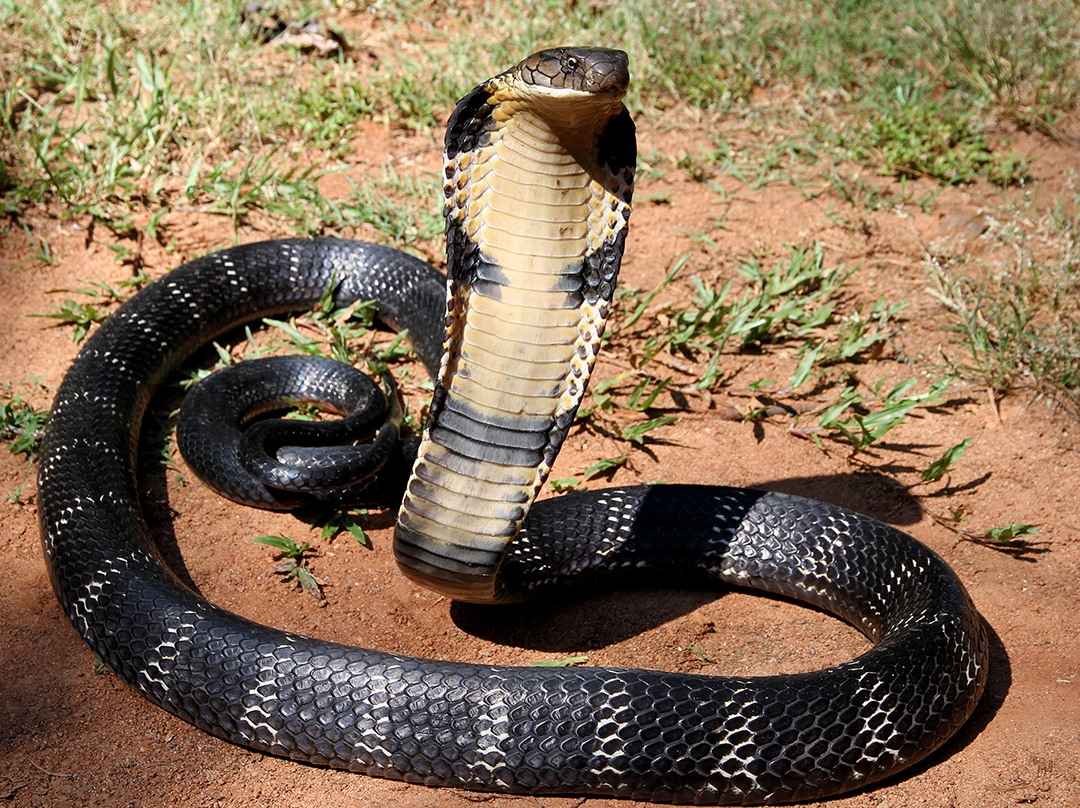
The king cobra (Ophiophagus hannah) is a species complex of snakes endemic to Asia. With an average length of 3.18 to 4 m (10.4 to 13.1 ft) and a record length of 5.85 m (19.2 ft), it is the world's longest venomous snake and among the heaviest. Under the genus Ophiophagus, it is not phylogenetically a true cobra despite its common name and some resemblance. Spanning from the Indian Subcontinent through Southeastern Asia to Southern China, the king cobra is widely distributed albeit not commonly seen.
Individuals have diversified colouration across its habitats, from black with white strips to unbroken brownish grey, although after taxonomic re-evaluation, it is no longer the sole member of its genus but is now a species complex; these differences in pattern and other aspects may cause the genus to be split into at least four species, spread across its large geographic range.
It chiefly hunts other snakes, including those of its own kind, although other lizards and rodents are occasional prey items. This is the only ophidian that constructs an above-ground nest for its eggs, which are purposefully and meticulously gathered and protected by the female throughout the incubation period. Typical threat display of this elapid includes neck-flap spreading, head raising, hissing and sometimes charging. Capable of striking at a considerable range and height with an immense venom yield, envenomation from this species may induce rapid onset of neurotoxic and cytotoxic symptoms, requiring prompt antivenom administration. Despite the fearsome reputation, aggression toward humans usually only arises from an individual inadvertently exposing itself or being cornered; encounters happen through chance, including negative interactions.
Threatened by habitat destruction, it has been listed as Vulnerable on the IUCN Red List since 2010. Regarded as the national reptile of India, it has an eminent position in the mythology and folk traditions of India, Bangladesh, Sri Lanka and Myanmar.
The king cobra is also referred to by the common name "hamadryad", especially in older literature. Hamadryas hannah was the scientific name used by Danish naturalist Theodore Edward Cantor in 1836 who described four king cobra specimens, three captured in the Sundarbans and one in the vicinity of Kolkata. The origin of the species name hannah was not specified during description and has long been uncertain, but may potentially refer to Hannah Sarah Wallich, the eldest daughter of Cantor's uncle, botanist Nathaniel Wallich, who hosted Cantor during his studies in India.
The genus Ophiophagus was proposed by Günther in 1864 in place of Hamadryas, as the genus Hamadryas was already used for the cracker butterflies. The name is derived from its propensity to eat snakes. Ophiophagus hannah was accepted as the valid name for the king cobra by Charles Mitchill Bogert in 1945 who argued that it differs significantly from Naja species.
It has been suggested that three more king cobra species exist in addition to O. hannah, namely the Sunda king cobra (O. bungarus), the Western Ghats king cobra (O. kaalinga), and the Luzon king cobra (O. salvatana). These distinct genetic lineages are geographically isolated and adapted to specific ecological regions.
In 1838, Cantor proposed the name Hamadryas ophiophagus for the king cobra and explained that it has dental features intermediate between the genera Naja and Bungarus. Naia vittata proposed by Walter Elliot in 1840 was a king cobra caught offshore near Chennai that was floating in a basket. This provenance is disputed, as wild king cobras have never occurred near Chennai, and an analysis of this specimen has found it to be more similar to the northern king cobra. Hamadryas elaps proposed by Albert Günther in 1858 were king cobra specimens from the Philippines and Borneo. Günther considered both N. bungarus and N. vittata a variety of H. elaps. Naja ingens proposed by Alexander Willem Michiel van Hasselt in 1882 was a king cobra captured near Tebing Tinggi in northern Sumatra.
Recent media
Recent media