



Community hub
Recent from talks
Contribute something
Nothing was collected or created yet.
King's X
View on Wikipedia
King's X is an American rock band formed in Springfield, Missouri, in 1979. They were first called the Edge and later became Sneak Preview before settling on its current name in 1985.[4] The band's current lineup has remained intact for more than four decades, consisting of vocalist and bassist Doug Pinnick, drummer Jerry Gaskill and guitarist Ty Tabor. Their music combines progressive metal, funk and soul with vocal arrangements influenced by gospel, blues, and British Invasion rock groups. Despite a largely underground reputation as the "musician's musicians", King's X was pivotal in the early development of progressive metal, and produced a series of early records considered essential within the genre.[5][6] The band's lyrics are largely based on the members' struggles with religion and self-acceptance. King's X was ranked No. 83 on VH1's 100 Greatest Artists of Hard Rock.[7]
Key Information


King's X has released thirteen studio albums, two official live albums, and several independent releases. After signing to both Atlantic and Megaforce Records in 1987, they broke into the mainstream with their first six albums, including their only top 100 charting albums Faith Hope Love (1990) and Dogman (1994).[8] The band's most recent studio album, Three Sides of One, was released in 2022 on the InsideOut Music label. Since leaving Atlantic Records, following the release of Ear Candy (1996), King's X has released albums through Metal Blade Records, InsideOut Music and independently, respectively. Each member of the group has recorded several solo albums and has made numerous guest appearances on other artists' albums, as well as participated in numerous compilation projects. Pinnick and Tabor also have many albums released with side bands in which they participate.[7]
The spiritual nature of the band's lyrics, particularly on their first four albums, has often led to them being labeled a Christian rock band, a label that the members have rejected.[9]
History
[edit]Early years (1979–1984)
[edit]The group traces its beginnings to 1979 in Springfield, Missouri, when bassist Doug Pinnick and drummer Jerry Gaskill were brought together to take part in a musical project coordinated by Greg X. Volz of the Christian rock band Petra. Within a month of Pinnick's arrival from Illinois, the project folded and he and Gaskill were left without a band. They soon landed a job as rhythm section for guitarist Phil Keaggy's live band. The two toured the country for several months in support of Keaggy's album Ph'lip Side. During the group's show in Springfield, Gaskill was approached by Ty Tabor who was a member of the opening band that night. The drummer for Tabor's band had quit the night before the show and Tabor had volunteered to take over on drums for the gig. However, seeing as he had no drums, he was forced to ask Gaskill if he could borrow his kit for the show. Gaskill obliged and the show went on.[10]
When the tour ended, Pinnick and Gaskill returned to Springfield and set about looking for more work. Gaskill landed a job doing demo work for the Tracy Zinn Band that happened to include Ty Tabor on guitar. The two became friends and were involved off and on together in different musical projects.
In early 1980, Pinnick attended a music show at Evangel College and watched a set by another of Tabor's bands. Pinnick was impressed with Tabor's skills and the two soon began collaborating musically.[11]
Eventually Gaskill, Pinnick, and Tabor decided to pool their talents into a single outlet. Calling themselves the Edge, they initially were a four-piece with the inclusion of Dan McCollam on rhythm guitar. McCollam quit after only a brief time and was replaced by Kirk Henderson, who was a friend of Tabor's from Jackson, Mississippi. The group performed extensively on the Springfield bar and club circuit specializing in classic rock and Top 40 covers at the time.
By 1983, Henderson had quit the band and Pinnick, Tabor, and Gaskill decided to continue on as a trio. They also decided to change the name of the band, and settled on calling themselves Sneak Preview.
The group had been writing and recording many original songs up to this point. They chose ten of these songs to record for an independently released self-titled album in 1983. After the album's release, the band continued to tour and hone their songwriting skills.
Move to Houston (1985–1987)
[edit]By 1985, the group had made connections at Star Song Records based in Houston, Texas and were encouraged to move the band there. The first order of business for the three was to become part of a touring band for CCM artist Morgan Cryar. Tabor and Pinnick are also credited for co-writing several songs on Cryar's second album Fuel on the Fire in 1986. Tabor also performed some guitar parts on the album and both he and Pinnick are credited with background vocals.
However, when it came to signing Sneak Preview to a recording contract with Star Song, negotiations broke down and the deal came to a halt.
Megaforce era (1988–1991)
[edit]The group released its debut album as King's X, Out of the Silent Planet, in 1988. Despite being hailed by music critics, the album did not fare well commercially, peaking at No. 144 on the Billboard album charts. The songs "King" and "Shot of Love" were released as singles, but failed to garner much attention. The album derives its name from the C. S. Lewis novel Out of the Silent Planet. This appears to be the band's first of multiple references to the British author. King's X promoted Out of the Silent Planet with its first major tour, playing with the likes of Cheap Trick, Blue Öyster Cult, Robert Plant and Hurricane,[12][13] as well as Megaforce labelmates Anthrax, Testament, M.O.D., and Overkill.[14]
In 1989, the band released their second album Gretchen Goes to Nebraska. Considered by many fans to be their landmark album and most creative period, the album fared only slightly better from a commercial standpoint than Out of the Silent Planet. The band played with a wide variety of acts while touring in support of it, including Anthrax, Suicidal Tendencies, M.O.D., Living Colour, Billy Squier and Blue Murder.[14][15][16] The album contains many fan favorites such as "Summerland", "Mission", and "The Burning Down". The song "The Difference (In the Garden of St. Anne's-on-the-Hill)" appears to be another C.S. Lewis reference, this time to a scene in the book That Hideous Strength, third and final installment of the "science-fiction" trilogy begun by Out of the Silent Planet. The song "Pleiades" is credited by Ty Tabor as being the genesis of the King's X sound when he presented the demo to the other band members a few years earlier. Significantly, the song "Over My Head" received moderate airplay on MTV and radio.
The increase in exposure would prove beneficial when the band released their third album, Faith Hope Love, in late 1990. It was the group's first album to crack the U.S. Top 100, with the help of the successful single "It's Love". Another track, the funk-rock "We Were Born to Be Loved", enjoyed a long life on Late Show with David Letterman as a commercial bumper instrumental favorite of Paul Shaffer's CBS Orchestra. King's X was featured in the February 1991 issue of Rolling Stone (RS598).[17] Still, with major mainstream success continuously eluding them, King's X began questioning Sam Taylor's management vision for the group.
The band landed the opening slot for Iron Maiden in Europe on their No Prayer for the Dying tour in late 1990,[18] and AC/DC on their Razors Edge tour in the U.S. and Europe for the first half of 1991.[19] In the middle of that year, their song "Junior's Gone Wild" appeared on the soundtrack to the movie Bill & Ted's Bogus Journey.[20]
Atlantic era (1992–1997)
[edit]The band was moved up to Megaforce's parent label Atlantic Records for the release of their fourth album, King's X, in early 1992. However, rising tensions with Taylor led the band to eschew the upbeat approach of previous albums and turn out a darker, more introspective effort. Unfortunately, despite critical praise, their new style did not translate well among the record-buying public, thus garnering fewer sales than Faith, Hope, Love. "Black Flag", the album's lone single, received only moderate airplay on MTV and radio. Not long after the release of King's X, the band parted ways with Taylor. The details of the split were not made public, but it was believed to be rather bitter. Taylor would admit in 1996 that his company Wilde Silas MusicWorks was growing and, as a result, he was no longer giving King's X, whom he considered "the top dogs", the attention they deserved.[21] In the aftermath, King's X took over a year off to consider their collective future together. The band members followed other, non-musical pursuits; most notably, guitarist Ty Tabor took up semi-professional motocross motorcycle racing.
With grunge at the peak of its popularity, and Pearl Jam's bassist Jeff Ament declaring that "King's X invented grunge"[22] (despite the group's trademark sound being very different from that of the commercially successful grunge acts), the band went looking for a new sound upon their return. They enlisted veteran producer Brendan O'Brien, who had recently produced albums for Stone Temple Pilots and Pearl Jam. The resulting album, 1994's Dogman, showcased a much more muscular and heavy sound from the group, with Pinnick now handling all lead vocals and the lyrics becoming less abstract and spiritual. The record received a heavier promotional push from Atlantic including a compilation promotional CD entitled: Building Blox, as King's X enjoyed a successful tour, capped by an appearance at the Woodstock '94 festival in August. They also toured with bands such as the Scorpions,[23] Pearl Jam,[24] Mötley Crüe[25] and Type O Negative,[26] but despite a return to the Top 100 for King's X, the album failed to sell as well as Atlantic had hoped, and the label's support for the group quickly faded.
The band's third release under Atlantic, 1996's Ear Candy, would also be their last for the label (not including the subsequent Best of King's X compilation album). Although it sold to the band's sizeable core following, it lacked the relative mainstream success of previous efforts. The record was soon out of print, and it seemed that the group's chance for commercial success had come and gone.
Metal Blade era (1998–2004)
[edit]The group moved to Metal Blade Records in 1998. Their first album under the label, Tape Head, signaled a new era for the band. They modified their creative methods by writing and recording the album together in the studio, rather than coming together to record songs that the individual members had written separately. They also elected not to hire an outside producer and recorded the album at Pinnick's Hound Pound and Tabor's Alien Beans Studios, thus cutting production costs. Their next two albums, Please Come Home... Mr. Bulbous (2000) and Manic Moonlight (2001), were more or less created in the same way.
Manic Moonlight featured the band experimenting with electronic drum loops and other sounds for the first time on a record. The new direction, along with the relatively short length of the album, was generally not well received by longtime fans, but did get some positive critical reviews.
For their next album, 2003's Black Like Sunday, the group arranged and recorded an album of original songs that the band had regularly performed during The Edge and Sneak Preview days of the early 1980s. The cover art for this album was selected from artwork submitted by fans in an online contest.
The double-disc set Live All Over the Place (2004) was the band's final album for Metal Blade Records, and their first official live release.
Inside Out era (2005–present)
[edit]
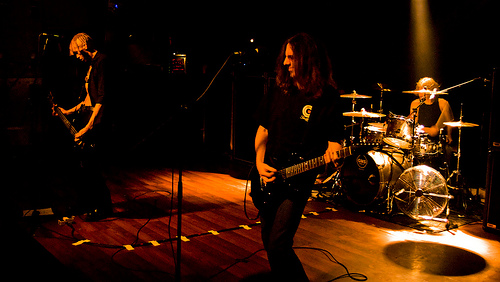
(L to R: Gaskill, Pinnick and Tabor)
In 2005, King's X signed to InsideOut Music, the label that had previously released some of Tabor's side projects. The album Ogre Tones was released in September 2005 and was described by many as a return to a more "classic" King's X sound. It was produced by famed rock producer Michael Wagener (Dokken, Extreme, Stryper, White Lion, Skid Row) and recorded at Wageners WireWorld Studio in Nashville, Tennessee. The tour for Ogre Tones featured the band playing every song from the album during shows.
King's X again worked with Michael Wagener on its second album for InsideOut Music titled XV, released in May 2008. They spent mid-2008 touring with the band Extreme as part of a travelling version of the Rock 'n Roll Fantasy Camp.[27] Live dates in the U.S. in December 2008 were followed by the band's first European tour in several years in early 2009.
Molken Music, an independent label started by Wally Farkas (ex-Galactic Cowboys) in 2005, has released several titles by King's X and its members. Live & Live Some More, a live concert recorded during the Dogman tour, is available there as well as demo compilations, rehearsal tapes, and other items. The label released the band's first live DVD, Gretchen Goes to London in November 2008. It was a live concert filmed in London in 1990.[28] On January 22, 2009, their concert at the Electric Ballroom in Camden, London, was filmed and released as a live DVD and CD entitled Live Love in London.[29]
On February 26, 2012, the 55-year-old Jerry Gaskill suffered a major heart attack, temporarily stopping the band's touring schedule. He was on a ventilator for several days while also suffering from pneumonia.[30] In response, King's X compiled an exclusive live release from their archives entitled Burning Down Boston: Live at The Channel 6.12.91.[31] The proceeds from the release went directly to Gaskill to help him offset his medical expenses. Gaskill posted a video message on Facebook on April 4, 2012, thanking everyone who had supported him during his illness.
The band went back to touring until Gaskill suffered another heart attack while recovering from a "scheduled minor procedure" on September 12, 2014, requiring him to undergo double-bypass surgery. King's X subsequently canceled all scheduled concerts, and announced an indefinite hiatus.[32][non-primary source needed]
In mid-2015, the band was back on tour, playing numerous dates on the east coast. They also played shows for July in Texas. In June 2015, Doug Pinnick announced that King's X were committed to begin work on a new studio album, their first since 2008's XV.[33] The band signed a world-wide record deal on October 8, 2018, with Australian independent record label, Golden Robot Records, who had planned to release their new album in the U.S, Australia and Europe sometime in 2019;[34] however, the project's release had faced myriad delays within the next few years, due to COVID-related manufacturing issues as well as the slow progress of the band working on the album,[35][36][37][38] which had been mastered by April 2022.[39] A month later, it was announced that King's X had signed again to Inside Out/Sony Music and their new album would be released on September 2, 2022.[40] The band revealed Three Sides of One as the album's title on June 24, 2022; released on September 2 of that year, three singles were released to support Three Sides of One: "Let It Rain",[41] "Give It Up",[42] and "All God's Children".[43]
Although Pinnick had initially stated that Three Side of One could be King's X's final studio album,[44] he mentioned in an August 2022 interview that there are numerous songs that did not make the cut and could be used for the band's next album: "Ty came in with four, Jerry came in with three, and I came in with 27." He added, "We would play one of mine, one of Ty's, and one of Jerry's, then do another round. Ty wanted to keep going until they ran out. We needed more songs, so we played more of mine. We recorded ten of my songs, and only some of them got on the record. We knew some of those weren't quite ready, and we had enough songs. Maybe we'll put them on the next record. I still have about 30 songs. I know Ty and Jerry both have some more songs to use on the next record."[45] In an October 2024 interview with Bravewords.com, Pinnick said that he has "submitted a handful of new songs" and "Ty and Jerry have both said they have a bunch of tunes" for the next King's X album, adding, "So, the next thing is to finally figure out when we want to get together and the whole thing you have to go through to make a record – because we live in three different parts of the country. So, sooner or later we'll get serious. We haven't yet really, but we talk about it – so that's a good thing."[46]
An authorized biography by Greg Prato, King's X: The Oral History, via Jawbone Press was released in February 2019.[47] In addition to extensive interviews with all three band members, the book included interviews with such rock musicians as Jeff Ament, Andy Summers, Mick Mars, Billy Corgan, and Eddie Trunk among others, and featured a foreword by Scott Ian.
Legacy
[edit]The band's influence has been described as wide and diverse given "the impossible-to-categorize" nature of the genres and subgenres explored within King X's material, with the American popular culture publication D Magazine remarking in 2013 that "[t]heir fan base today is a mixture of prog-rock nerds and headbangers" while labeling the group itself as both "[f]ringe" and "[l]egends". The band has a particularly positive reputation among professional musicians. For instance, the performer Jeff Ament of groups such as Pearl Jam openly declared King's X as the true inventor of "grunge", as was mentioned above. In a retrospective interview with the news-magazine Billboard, Pinnick described an emotional, face-to-face moment with Dimebag Darrell, then of Pantera, in which the latter performer remarked "[d]ude, you know I love you" and "we love you" after the record industry controversy caused by Pinnick's coming out. Gaskill has stated that "I think I've come to realize that musicians do seem to be drawn to us," with him adding that he's "honored by it" and thinks that "it'll keep us around, because there's always going to be musicians."[48][49] Other bands who have cited King's X as an inspiration or influence include Alice in Chains, Soundgarden, The Smashing Pumpkins, Dream Theater, Skillet, Devin Townsend and Soil.[50][51][52][53][54]
During multiple decades of touring, King's X has performed with a number of prominent hard rock and heavy metal artists. Examples include past live efforts with opening slots for Sammy Hagar as well as a full touring bill with Krokus.[49] They have also opened for bands like Cheap Trick,[55] Iron Maiden, AC/DC, Scorpions, Pearl Jam and Mötley Crüe, and performed the first date of the Woodstock '94 festival.[56]
Solo and side projects
[edit]The members of King's X have been musically prolific since their release from Atlantic in 1997, releasing a number of solo albums and participating in side bands.
Doug Pinnick
[edit]Pinnick recorded two solo albums under the name of Poundhound, Massive Grooves... (1997) and Pineappleskunk (2001), while his subsequent releases Emotional Animal (2005), Strum Sum Up (2007) and Naked (2013) were credited as dUg Pinnick.
He has also been a member of several bands outside of King's X:
- Supershine featuring guitarist Bruce Franklin and drummer Jeff Olson both from the band Trouble. They released one self-titled album in 2000.
- The Mob featuring Reb Beach from Winger, Kelly Keagy from Night Ranger, and keyboardist Timothy Drury. They released a self-titled album in 2006.
- Razr13 is a project with members of the King's X road crew who released the album Reflections in 2009.
- Tres Mtns. with Jeff Ament of Pearl Jam and drummer Richard Stuverud released an album in 2011.
- Pinnick Gales Pridgen with Eric Gales and Thomas Pridgen released their debut album in 2013 and the follow-up album PGP 2 in July 2014.
- 3rd Ear Experience with vocalist/guitarist Robbi Robb released the digital EP Peacock Black in 2013 followed by the full-length album Boi
- KXM featuring guitarist George Lynch and drummer Ray Luzier
- Grinder Blues with Jeff and Scot Bihlman released their self-titled debut album in 2014.
Pinnick has also made numerous guest appearances on albums by bands including Dream Theater, 24-7 Spyz, Steve Stevens, Metal Allegiance and others. Beyond that he has appeared on several tribute albums to the likes of Metallica, AC/DC, Van Halen and more.
In August 2006, Pinnick stood in for lead singer Corey Glover on Living Colour's European tour.
Jerry Gaskill
[edit]Gaskill released a solo album in 2004 titled Come Somewhere which was produced by Ty Tabor.
He released his second solo album, Love and Scars, on October 30, 2015, which was produced by DA Karkos.[57]
He also played drums on the entire Let It Go album by Galactic Cowboys in 2000.
Ty Tabor
[edit]Tabor has released seven solo albums to date: Naomi's Solar Pumpkin (1997), Moonflower Lane (1998), Safety (2002), Rock Garden (2006), Balance (2008), Something's Coming (2010), Trip Magnet EP (2010), Nobody Wins When Nobody Plays (2013), Alien Beans (2018), Angry Monk (2020), and Shades (2022).
Other bands Ty Tabor has been a member of are:
- Platypus, with Rod Morgenstein, Derek Sherinian, and John Myung, released When Pus Comes to Shove in 1998 and Ice Cycles in 2000.
- The Jelly Jam is an ongoing project with Rod Morgenstein and John Myung. They released The Jelly Jam in 2002, The Jelly Jam 2 in 2004, Shall We Descend in 2011, and Profit in May 2016.
- Jughead featuring two-time David Lee Roth drummer Gregg Bissonette, keyboardist Derek Sherinian, and singer and bassist Matt Bissonette released one album in 2004.
- Xenuphobe is an electronic/ambient project with former Galactic Cowboys member Wally Farkas. So far the pair have released the albums 1.0 in 2006, 2.0 Electrolux 2007, and Drone in 2015.
Like Doug Pinnick, Tabor has appeared on several albums as a guest performer by bands such as Ayreon, Lillian Axe, Queensrÿche and others.
Religious views
[edit]All three members of King's X came from a background in Christianity and Christian rock (and, in Pinnick's case, church gospel singing) and have frequently been associated with the genre. This assumption has been reinforced by the Christian associations of the band's name, by the fact that King's X signed to Christian labels early in their career[22] and because the Faith Hope Love CD insert contained an entire chapter of the Bible.[20] However, the band have persistently resisted being identified or pigeonholed as a Christian rock or Christian metal band.[58]
While many of their early lyrics have a clear spiritual influence, this came from the individual faith of the members rather than an explicit attempt to tap into the contemporary Christian music market in the way groups such as Petra did.[20] Initially, many King's X albums were marketed through Christian book stores, but most of these stores refused to sell them following Pinnick's 1998 announcement of his homosexuality. Even at the time, the band welcomed this development as an opportunity to get away from the Christian rock "stigma".[59][60]
A former Protestant, Pinnick has since openly discussed his agnosticism and his belief that Jesus Christ was not truly the Son of God.[61] Gaskill has also disassociated himself from Christianity. During interviews in the early 2000s, Tabor continued to identify as a Christian, but referred to the Christian music industry as "vile".[62][63]
In an interview in late 2021, Pinnick stated "For some reason, King's X [was considered] a Christian band. Maybe because that was our faith at the time; none of us are any more."[64]
Band members
[edit]Current members
- Doug Pinnick – bass, lead vocals (1979–present)
- Jerry Gaskill – drums, percussion, backing vocals (1979–present)
- Ty Tabor – guitars, backing vocals (1980–present)
Former members
- Dan McCollam – rhythm guitar, backing vocals (1980)
- Kirk Henderson – rhythm guitar, backing vocals (1980–1983)
Discography
[edit]Studio albums
[edit]| Year | Album | US [8] |
US Christian | US Indie | UK [65] |
|---|---|---|---|---|---|
| 1983 | Sneak Preview (as Sneak Preview) | — | — | — | — |
| 1988 | Out of the Silent Planet | 144 | — | — | — |
| 1989 | Gretchen Goes to Nebraska | 123 | — | — | 52 |
| 1990 | Faith Hope Love | 85 | 31 | — | 70 |
| 1992 | King's X | 138 | — | — | 46 |
| 1994 | Dogman | 88 | — | — | 49 |
| 1996 | Ear Candy | 105 | 4 | — | — |
| 1998 | Tape Head | — | — | — | — |
| 2000 | Please Come Home... Mr. Bulbous | — | — | — | — |
| 2001 | Manic Moonlight | — | — | 19 | — |
| 2003 | Black Like Sunday | — | — | 13 | — |
| 2005 | Ogre Tones | — | — | 30 | — |
| 2008 | XV | 145 | 167 | 12 | — |
| 2022 | Three Sides of One | — | — | — | — |
Live albums
[edit]| Year | Album |
|---|---|
| 2004 | Live All Over the Place |
| 2007 | Live & Live Some More |
| 2009 | Tales from the Empire[66][67] |
| 2010 | Live Love in London |
| 2012 | Burning Down Boston[31][68] |
Compilation albums
[edit]| Year | Album |
|---|---|
| 1994 | Building Blox |
| 1997 | Best of King's X |
| 2023 | In the New Age: The Atlantic Recordings 1988–1995 |
Singles
[edit]| Year | Song | US Rock [69] |
Album |
|---|---|---|---|
| 1988 | "Goldilox"[70] | – | Out of the Silent Planet |
| "King"[71][deprecated source] | – | ||
| "Shot of Love" | – | ||
| 1989 | "Over My Head"[70] | – | Gretchen Goes to Nebraska |
| "Summerland" | – | ||
| 1990 | "It's Love"[71][deprecated source] | 6 | Faith Hope Love |
| "I'll Never Get Tired of You"[71][deprecated source] | – | ||
| "We Are Finding Who We Are"[72] | – | ||
| 1991 | "Junior's Gone Wild"[70] | – | Bill & Ted's Bogus Journey: Music from the Motion Picture |
| 1992 | "Black Flag"[71][deprecated source] | 17 | King's X |
| "Dream in My Life"[71][deprecated source] | – | ||
| "World Around Me"[70] | – | ||
| 1994 | "Dogman"[71][deprecated source] | 20 | Dogman |
| "Fool You"[73] | – | ||
| "Pillow"[71][deprecated source] | – | ||
| "Pretend" | – | ||
| 1996 | "Sometime"[71][deprecated source] | – | Ear Candy |
| "A Box"[71][deprecated source] | – | ||
| "Looking for Love"[71][deprecated source] | – | ||
| 1998 | "Fade"[71][deprecated source] | – | Tape Head |
| 2000 | "Marsh Mellow Field"[74] | – | Please Come Home... Mr. Bulbous |
| 2001 | "False Alarm"[70] | – | Manic Moonlight |
| 2005 | "If"/"Alone"[71][deprecated source] | 40 | Ogre Tones |
| 2022 | "Let It Rain" | – | Three Sides of One |
| "Give It Up" | – |
DVD
[edit]- Gretchen Goes to London (2008 Molken Music)
- Live Love in London (2010 Inside Out/EMI)
References
[edit]- ^ "KING'S X Drummer In Stable Condition After Suffering Heart Attack". Blabbermouth.Net. Retrieved May 8, 2013.
- ^ "King'S X, Ex-The Mars Volta Members Unite In Pinnick Gales Pridgen". Blabbermouth.Net. Retrieved May 8, 2013.
- ^ Music drives Metro commuters Tunes change with trip's time, task and traffic "Aerosmith's a must. And Cheap Trick and King's X (a new alternative metal group)." Toronto Star, January 16, 1993. Retrieved May 7, 2013. (subscription required)
- ^ "Everynight Charley's Manhattan Beat: King's X, RavenEye, The Bloodshots & More". The Aquarian Weekly. August 2, 2017. Retrieved October 11, 2021.
- ^ Everley, Dave (April 27, 2017). "Coulda, shoulda, didn't: Why did Kings X never make it big?". Classic Rock Magazine. Retrieved May 22, 2019.
- ^ Shteamer, Hank (February 26, 2019). "Offbeat Rock Trailblazers King's X Get a Book Worthy of Their Unique Saga". Rolling Stone. Retrieved May 22, 2019.
- ^ a b "King's X Biography". Starpulse. Archived from the original on June 16, 2013. Retrieved January 22, 2014.
- ^ a b "King's X – Chart History". Billboard.com. Retrieved December 30, 2020.
- ^ "KING'S X Guitarist: We Are 'Absolutely Not' A Christian Rock Band". Blabbermouth. September 19, 2005.
- ^ Prato, Greg (February 26, 2019). King's X: The Oral History. Jawbone Press. pp. 18–21. ISBN 978-1-911036-43-2.
- ^ Mickie, Naughty. "King's X still serves it up hot". DaBelly. Archived from the original on October 24, 2021. Retrieved November 29, 2007.
- ^ Pacenti, John (September 13, 1989). "Majesty Mystery Tour". Phoenix New Times. Retrieved July 19, 2020.
- ^ "King's X: Debut Album 'Out of the Silent Planet' Turns 30". Innocent Words. March 28, 2020. Retrieved July 19, 2020.
- ^ a b "Anthrax Tour Dates". metallipromo.com. Retrieved May 26, 2016.
- ^ "Suicidal Tendencies Tour Dates". metallipromo.com. Retrieved May 26, 2016.
- ^ "King's X tour dates". tourdatesearch.com. Retrieved May 26, 2016.
- ^ "King's X Keeps the Faith". Rolling Stone. February 21, 1991. Retrieved February 9, 2018.
- ^ No Prayer On The Road 1990–91. The Iron Maiden Commentary. Retrieved May 26, 2016.
- ^ "1991 "The Razors Edge" European Tour, Leg 1". Retrieved May 14, 2021.
- ^ a b c Powell, Mark Allan (2002). Encyclopedia of Contemporary Christian Music (First printing ed.). Peabody, Massachusetts: Hendrickson Publishers. pp. 489–493. ISBN 1-56563-679-1.
- ^ Hobart, Rowland The Resurrection of Sam Taylor Houston Press (May 16, 1996). Retrieved January 16, 2011.
- ^ a b Lawson, Steve (October 16, 2007). "Doug Pinnick interview from March 1999". Archived from the original on March 2, 2008. Retrieved January 15, 2008.
- ^ "VK.com". vk.com. Retrieved February 9, 2018.
- ^ "King's X Drummer Remembers Pearl Jam's 'Historic' 1994 Tour - AlternativeNation.net". archive.alternativenation.net. Retrieved February 9, 2018.
- ^ "TourDateSearch.com: Mötley Crüe tour dates". tourdatesearch.com. Retrieved February 9, 2018.
- ^ "TourDateSearch.com: Type O Negative tour dates". tourdatesearch.com. Retrieved February 9, 2018.
- ^ "King's X Enjoys Best Album Chart Debut Since '96". Billboard. Retrieved August 18, 2017.
- ^ "New King's X DVD November 22nd! " www.hardrockhideout.com". Hardrockhideout.wordpress.com. November 3, 2008. Retrieved November 19, 2008.
- ^ "Live Love in London". AllMusic. Retrieved May 14, 2021.
- ^ Gray, Chris "King's X Drummer Jerry Gaskill Has Heart Attack" Archived March 1, 2012, at the Wayback Machine. Houston Press. February 26, 2012. Retrieved February 29, 2012.
- ^ a b "King's X Set Up Donation for Ailing Drummer". Rolling Stone. Retrieved March 13, 2012.
- ^ "Jerry Gaskill Suffers Heart Attack Following Minor Procedure". Facebook. September 12, 2014. Archived from the original on February 26, 2022. Retrieved September 12, 2014.
- ^ "KING'S X FRONTMAN DOUG PINNICK DISCUSSES THE BAND'S SELECT LIVE SHOWS AND POSSIBLE NEW ALBUM". June 24, 2015. Retrieved October 7, 2015.
- ^ "King's X to Release New Album in 2019". October 8, 2018. Retrieved October 14, 2018.
- ^ "DOUG PINNICK On Upcoming KING'S X Album: 'Each Song Is Drastically Different'". Blabbermouth.net. November 2, 2019. Retrieved January 23, 2020.
- ^ "KING'S X Won't Release New Album Until Band Can Tour To Promote It". Blabbermouth.net. April 24, 2021. Retrieved April 25, 2021.
- ^ "KING'S X's New Album To Arrive In 2022: 'We Wanna Do This Right,' Says DOUG PINNICK". Blabbermouth.net. October 11, 2021. Retrieved November 28, 2021.
- ^ "KING'S X Is Working On Artwork For Upcoming Studio Album". Blabbermouth.net. November 29, 2021. Retrieved November 29, 2021.
- ^ "King's X – New Album Ready To Be Released This Autumn". Metal Storm. April 27, 2022. Retrieved April 27, 2022.
- ^ "KING'S X's New Album Gets Official Release Date". Blabbermouth.net. May 5, 2022. Retrieved May 5, 2022.
- ^ "KING'S X Announces First Studio Album In 14 Years, 'Three Sides Of One', Shares 'Let It Rain' Single". Blabbermouth.net. June 24, 2022. Retrieved June 24, 2022.
- ^ "KING'S X Releases New Single 'Give It Up' From 'Three Sides Of One' Album". Blabbermouth.net. July 27, 2022. Retrieved August 1, 2022.
- ^ "KING'S X Releases New Single 'All God's Children' From 'Three Sides Of One' Album". Blabbermouth.net. August 26, 2022.
- ^ "King's X – New Album on Hold".
- ^ "King's X's Doug Pinnick Addresses 14-Year Gap Between 'XV' and 'Three Sides of One', Reveals Plans for Follow-Up Album".
- ^ "DUG PINNICK Discusses New Solo LP – "Musically, I Was Just In This AC/DC, RED HOT CHILI PEPPERS Funk Vibe In My Head"". Bravewords.com. October 28, 2024. Retrieved November 5, 2024.
- ^ Prato, Greg (February 19, 2019). King's X: The Oral History. Jawbone Press. ISBN 978-1911036432.
- ^ "Dug Pinnick on LGBTQ Acceptance in the Hard Rock/Metal Community". Billboard.
- ^ a b "Kings X: Important Enough to be Legends, Fringe Enough to be Forgotten". May 20, 2013.
- ^ "Really Heavy Things: Devin Townsend's Favourite Albums". The Quietus. December 18, 2012. Retrieved April 23, 2020.
- ^ "Authorized Biography Of KING'S X Due In February". Blabbermouth.net. December 17, 2018. Retrieved July 19, 2020.
- ^ "Interview – King's X". musicOMH. August 2, 2005. Retrieved July 19, 2020.
- ^ "Dream Theater – Six Degrees of Inner Turbulence". mikeportnoy.com. Archived from the original on May 23, 2018. Retrieved July 19, 2020.
- ^ "SOiL Guitarist Shaun Glass: "Sometimes We Get Compared To METALLICA Or PANTERA"". Brave Words. July 6, 2006. Retrieved July 19, 2020.
- ^ "dUg in Deep: With Pinnick Gales Pridgen, King's X & Numerous Side Projects Firing on All Cylinders, dUg Pinnick's Star Has Risen at Last". Retrieved November 25, 2018.
- ^ Prato, Greg. "King's X Biography". AllMusic.
- ^ "KING'S X Drummer JERRY GASKILL Releases Love And Scars Track-By-Track Part 1; Video". bravewords.com. October 22, 2015. Retrieved November 14, 2015.
- ^ (September 19, 2005). KING'S X Guitarist: We Are 'Absolutely Not' A Christian Rock Band Archived March 12, 2007, at the Wayback Machine. Blabbermouth.net. Retrieved August 21, 2010.
- ^ Bacote, Vincent (Winter 1999). "While Pinnick Seeks Answers." re:generation Quarterly. Vol. 5, no. 1. Archived from the original on August 30, 2008. Retrieved December 14, 2007.
- ^ Harward, Randy (March 2002). "Say You Want an Evolution: In King's X". Salt Lake City Weekly. Sonic Garden. Archived from the original on October 16, 2007. Retrieved January 15, 2008.
- ^ Doug Pinnick of King's X From Out of Nowhere (2006). Retrieved January 15, 2011.
- ^ "In Music We Trust – INTERVIEW: King's X: Say You Want an Evolution: In King's X, "X" Doesn't Necessarily Mark the Spot". Retrieved May 28, 2016.
- ^ "King's X Guitarist: We Are 'Absolutely Not' A Christian Rock Band - Blabbermouth.net". BLABBERMOUTH.NET. September 19, 2005. Retrieved May 28, 2016.
- ^ Dug Pinnick on Kings X, writing songs using mathematics, and the stigma of Christianity – interview in Loudersound by Dave Sinclair, 30 November 2021
- ^ Roberts, David (2006). British Hit Singles & Albums (19th ed.). London: Guinness World Records Limited. p. 303. ISBN 1-904994-10-5.
- ^ King's X – "Tales from the Empire: Cleveland 6.26.92" MolkenMusic.com. Retrieved March 14, 2012.
- ^ "King's X releases new surprise live CD with DVD to follow!". kingsxrocks.com/news. December 19, 2009. Archived from the original on February 11, 2012. Retrieved March 14, 2012.
- ^ Exclusive King's X Download to Benefit Drummer Jerry Gaskill MetalTalk.net. Retrieved March 11, 2012.
- ^ "King's X – Awards". AllMusic. Retrieved December 14, 2012.
- ^ a b c d e "King's X". discogs. Retrieved May 28, 2016.
- ^ a b c d e f g h i j k l "Albums by King's X: Discography, songs, biography, and listening guide – Rate Your Music". rateyourmusic.com.
- ^ "King's X We Are Finding Who We Are (Single)- Spirit of Metal Webzine (en)". spirit-of-metal.com.
- ^ "King's X Fool You (Single)- Spirit of Metal Webzine (en)". spirit-of-metal.com.
- ^ "Heavy Metal and Hard Rock News 2000". hardradio.com. Archived from the original on August 13, 2014.
External links
[edit]

King's X
View on GrokipediaMusical style and influences
Core characteristics
King's X's distinctive sound centers on intricate three-part vocal harmonies delivered by all three members—Doug Pinnick, Ty Tabor, and Jerry Gaskill—which infuse their heavy, riff-based rock with melodic accessibility and pop sensibility.[6][7] These harmonies, often compared to gospel or British Invasion influences in arrangement, contrast sharply with the band's dense, progressive-leaning guitar layers and rhythmic complexity, creating a signature blend of aggression and tunefulness.[8] Ty Tabor's guitar approach emphasizes layered arrangements and resonant tones, frequently incorporating psychedelic textures through techniques like backwards guitar effects and single-coil clarity amid dropped tunings for fat, powerful riffs.[9][10] This results in a sonic depth that evokes swirling, indebted psychedelic melodies without sacrificing the punch of hard rock foundations.[11] Jerry Gaskill's drumming provides a groove-oriented backbone, characterized by tight synchronization with bass lines and versatile dynamics that enable abrupt shifts and maintain propulsion across the band's evolving structures.[12] The trio's production choices prioritize organic tones and live-recorded energy, favoring analog-inspired clarity over digital processing to capture raw instrumental interplay.[9][13]Key influences and evolution
King's X's sound emerged from a fusion of 1970s hard rock riffing and progressive complexity, with bassist/vocalist Doug Pinnick citing influences like Black Sabbath's heaviness and Jimi Hendrix's guitar style, while guitarist Ty Tabor drew from Hendrix, Rush's Alex Lifeson, and Queen’s Brian May for tonal and riff-based elements.[14][9] Pinnick also acknowledged borrowing his bass tone directly from Yes's Chris Squire, reflecting the band's absorption of progressive rock intricacies from acts like Yes, Rush, Emerson, Lake & Palmer, and Genesis.[15] Harmonies and melodic structures echoed The Beatles' psychedelia, as Pinnick noted the trio's vocal blend often yielded a bright, Beatles-like quality despite intentions for darker tones.[16] Funk grooves from Sly & the Family Stone further underpinned their rhythmic foundation, blending soulful syncopation with heavy riffs to avoid the excesses of 1980s hair metal.[14] The band's early sound, evident in 1988's Out of the Silent Planet, featured raw, demo-like production that captured unpolished energy from their formative years, refined through persistent performances in Houston's local scene after relocating there in 1985.[17] This evolution maintained 1970s hard rock causality—direct, groove-oriented riffs meeting 1980s metal without glam theatrics—while progressive elements like odd time signatures and layered arrangements persisted into albums like 1991's Faith Hope Love.[14] By the mid-1990s, amid grunge's rise, King's X incorporated darker, down-tuned textures on 1996's Ear Candy but resisted full stylistic co-opting, preserving vocal harmonies and funk propulsion despite superficial parallels in heaviness.[18] Over decades, their approach simplified, with Pinnick attributing reduced prog complexity to age—"we’re older and lazier"—shifting from intricate early works to more straightforward structures by the 2022 album Three Sides of One, while retaining core melodic and rhythmic signatures.[15]History
Formation and early years (1979–1984)
King's X originated in Springfield, Missouri, where bassist and vocalist Doug Pinnick and drummer Jerry Gaskill met in 1979 while involved in the local Christian music community, including studies at Evangel College and backing the Christian guitarist Phil Keaggy.[19][20] Both had been approached to join the Christian rock band Petra but declined, instead recruiting guitarist Ty Tabor to form the trio initially known as The Edge.[21] The band focused on original material blending rock, funk, and progressive elements, though early sets often included Top 40 covers to secure gigs in the Missouri bar and club scene. During 1980–1982, The Edge built a modest following through local performances and self-released demos, such as multi-track recordings captured in home studios and live tapes from venues like the Hanger.[22] These efforts provided exposure in Christian coffeehouses and youth-oriented events, aligning with the members' shared evangelical faith, which motivated their music as a form of personal expression and ministry rather than commercial pursuit.[10] Internal dynamics emphasized collaborative songwriting and spiritual camaraderie, though the group experienced limited regional success amid competition from established acts and the challenges of a small-market scene.[23] By 1983, the band rebranded as Sneak Preview to avoid conflicts with another group named The Edge and recorded a self-titled album featuring new wave-influenced tracks with Pinnick's layered vocals and Tabor's intricate guitar work.[24] This release, produced independently and distributed locally, highlighted their evolving sound but yielded no major breakthroughs, sustaining their commitment through persistent gigs and demo refinements into 1984.[25] The period underscored a tension between artistic ambition and faith-based restraint, as the trio prioritized integrity over mainstream appeal in an era dominated by hair metal and pop-rock trends.[26]Relocation to Houston and initial recordings (1985–1987)
In 1985, the band, then known as Sneak Preview, relocated from Springfield, Missouri, to Houston, Texas, enticed by the prospect of a recording contract with the Christian label Star Song Records.[10] The promised deal ultimately failed to materialize, leaving the trio—Doug Pinnick, Jerry Gaskill, and Ty Tabor—to establish themselves in the local scene amid financial hardship.[13] This move positioned them within Houston's burgeoning music community, including connections to producer and manager Sam Taylor, who encouraged a name change to King's X to better reflect their evolving sound and identity.[27] Under Taylor's guidance, King's X focused on refining their material through local rehearsals and recordings, producing key demos that captured their signature blend of progressive rock, funk, and gospel-infused harmonies.[28] A notable "finished demo" was tracked in Houston on February 26, 1987, featuring early versions of songs that would shape their debut album, demonstrating improved production quality via Taylor's engineering networks.[29] These sessions emphasized self-produced efforts without major label backing, prioritizing live energy and vocal layering over polished studio effects. The band built a grassroots following through Houston-area performances, including club gigs at venues like Cardi's, often aligning with the Christian rock circuit to open for or share bills with like-minded acts.[30] This period fostered a dedicated local audience via word-of-mouth and tape trading of demos, laying groundwork for wider exposure while navigating the challenges of independent operation in a competitive market.[31]Megaforce Records breakthrough (1988–1991)
King's X achieved their initial breakthrough with the release of their debut album under the band's name, Out of the Silent Planet, on March 22, 1988, via Megaforce Records, distributed by Atlantic.[32] The album featured the band's signature blend of heavy riffs, intricate harmonies, and psychedelic elements, drawing from influences like Black Sabbath and the Beatles, and was produced by the band alongside manager Sam Taylor.[33] It received praise from metal critics for its originality and technical prowess, with tracks like "In the Kingdom" and "Goldilox, Sane" highlighting bassist/vocalist Doug Pinnick's soulful delivery and guitarist Ty Tabor's innovative tones.[33] To promote the record, the band toured extensively in the U.S., including opening slots for acts like Living Colour, which helped build a dedicated following in the underground metal scene despite limited radio play.[34] The momentum continued with the second album, Gretchen Goes to Nebraska, released on June 27, 1989, also on Megaforce/Atlantic.[35] This concept album, inspired by drummer Jerry Gaskill's short story about a girl's Midwestern upbringing, expanded on the debut's sound with more melodic structures and storytelling, as heard in songs like "Over My Head" and "Summerland."[36] Critics acclaimed its ambitious songwriting and refusal to conform to thrash metal trends, positioning King's X as innovators amid the late-1980s metal landscape.[37] Faith Hope Love, issued in 1990, marked the trilogy's conclusion and the band's commercial peak on Megaforce, approaching gold certification through strong fan support and tour sales.[38] The album refined their progressive hard rock style with accessible hooks and spiritual undertones, earning reviews for its vibrant energy and genre-blending—fusing metal aggression with pop sensibilities—while tracks like "Silent Night" and "We Are Finding Who We Are" showcased evolving lyrical depth.[39] However, the band's overt Christian faith led to pigeonholing as a "Christian metal" act by some industry observers and media, restricting mainstream crossover despite critical endorsements of their broader rock credentials; King's X consistently rejected this narrow label, emphasizing their music's universal themes over doctrinal marketing.[40] This perception, compounded by the era's shifting tastes toward grunge, posed promotional hurdles even as live performances solidified their cult status.[41]Atlantic Records era (1992–1997)
King's X released their self-titled album in 1992 through Atlantic Records, marking a period of intensified major-label promotion aimed at broadening their appeal beyond the underground hard rock circuit. The record maintained the band's signature blend of progressive structures, Beatlesque harmonies, and heavy riffs, but with polished production to align with commercial radio expectations. Sales hovered around 150,000 units, consistent with prior releases yet underscoring limited mainstream penetration compared to Atlantic's more formulaic acts like Winger.[13][42] The band's sound evolved toward a heavier, more aggressive tone on Dogman (1994), produced by Brendan O'Brien, featuring rawer guitar tones and introspective lyrics addressing personal struggles. This shift responded partly to the era's grunge surge, though it retained King's X's melodic core, with tracks like "Shoes" and "Pretend" gaining some alternative rock radio airplay. Touring intensified, including opening slots for Pearl Jam in 1994, which introduced them to younger audiences and fostered mutual respect—Pearl Jam's bassist Jeff Ament later credited King's X with pioneering elements of grunge's heaviness. Label executives, however, exerted pressure for further concessions to hit-driven formats, creating tensions between artistic autonomy and sales demands, as the band resisted simplifying their complex arrangements.[43][44][4] By Ear Candy (1996), King's X leaned into a more accessible, radio-oriented polish while grappling with themes of disillusionment, but the album underperformed relative to expectations, with sales reflecting the broader marginalization of their prog-infused hard rock amid grunge's market saturation. This decline stemmed causally from shifting tastes favoring raw minimalism over layered harmonies and odd time signatures, despite King's X's earlier sonic precedents influencing acts like Pearl Jam and Alice in Chains. Atlantic's final King's X release highlighted these commercial frustrations, paving the way for their label exit, as the trio prioritized creative control over chasing fleeting trends.[13][45][46]Metal Blade transition (1998–2004)
Following the release of Ear Candy in 1996, King's X parted ways with Atlantic Records amid shifting industry priorities for hard rock acts.[13] The band signed with Metal Blade Records in 1998, marking a shift to a more specialized metal label that aligned better with their cult following.[47] This transition allowed greater creative control, though it came with reduced promotional resources compared to major-label support.[28] Metal Blade's first King's X release was the compilation Tape Head on October 20, 1998, featuring previously unreleased demos and outtakes from sessions dating back to the early 1990s, including tracks like "Groove Machine" and "Ono."[47] The album served as a bridge to new material, highlighting the band's archival depth without commercial pressure. In 2000, they issued their first proper studio album for the label, Please Come Home...Mr. Bulbous, released on May 22, which blended psychedelic experimentation with signature harmonies on songs such as "Midnight" and "In the Kingdom."[48] This was followed by Manic Moonlight in 2001, emphasizing shorter, punchier tracks like "I Am" amid producer Randy Staub's involvement.[49] The band maintained touring momentum, supporting these releases with U.S. and European dates that reinforced loyalty among progressive and metal fans, even as mainstream radio access waned.[28] In 2003, Black Like Sunday arrived, showcasing refined songcraft on cuts like "Screaming for Help," further solidifying their output under Metal Blade.[28] The era culminated with the double live album Live All Over the Place on November 2, 2004—their first official concert recording—capturing performances from various tours and signaling the end of this label phase with raw energy on staples like "Dogman" and "Believe."[50] Despite modest sales, the period demonstrated resilience, with the trio—Doug Pinnick, Ty Tabor, and Jerry Gaskill—prioritizing artistic consistency over chart aspirations.[25]Independent phase and Inside Out Records (2005–2022)
Following the end of their tenure with Metal Blade Records, King's X signed a worldwide deal with Inside Out Music in May 2005.[51] Their first release under the label, the album Ogre Tones, arrived on September 27, 2005, marking a return to production by Michael Wagener, who had previously helmed some of their earlier work.[52] This was followed by their twelfth studio album, XV, released on May 20, 2008, also produced by Wagener and recorded in Nashville.[53] After XV, the band experienced an extended hiatus from studio recordings, lasting 14 years until their next release, with activity limited primarily to touring and individual pursuits. Drummer Jerry Gaskill suffered a heart attack in February 2012, leading to tour cancellations and requiring ongoing health management.[54] Gaskill endured additional cardiac issues, including another heart attack and complications that forced the postponement of shows in 2019.[55] These health setbacks, combined with the members' ages and shifting personal motivations, contributed to the delay in new material, as the trio focused on recovery and side projects such as dUg Pinnick's solo efforts and Ty Tabor's collaborations in bands like The Jelly Jam.[28][56] In May 2022, King's X re-signed with Inside Out Music under Sony worldwide, signaling renewed commitment.[57] This culminated in the release of Three Sides of One on September 2, 2022, their thirteenth studio album and first in over a decade, reflecting a resurgence amid the challenges of the intervening years.[58]Recent activities (2023–present)
In 2023, King's X embarked on the Three Sides of One tour to support their 2022 album of the same name, performing a series of U.S. dates that included shows in Austin, Texas, on May 25 and Derry, New Hampshire, on October 28.[59][60] The tour featured sets drawing heavily from their catalog, maintaining their reputation for tight, harmony-driven live performances amid a dedicated fanbase.[61] The band joined the Summerland package tour in 2024, sharing stages with other acts at venues such as the Neighborhood Theatre in Charlotte, North Carolina, on June 19 and 89 North Music Venue in Patchogue, New York, on August 11.[62][63] These appearances underscored their continued activity in the rock festival circuit, appealing to longtime supporters through selections like "Summerland" from their repertoire.[64] Into 2025, King's X scheduled performances including dates at The Vogel in Red Bank, New Jersey, on August 7 and Gramercy Theatre in New York City on August 8, with additional shows listed for October such as Tupelo Music Hall on October 17.[65][66] In June 2025, vocalist and bassist dUg Pinnick appeared on the True Tunes Podcast, discussing over 50 years of his musical career and the band's enduring creative process.[67] As of February 2025, the group had discussed potential new material but made no formal album announcement by October.[68] Their persistent touring reflects a sustained cult following, with consistent venue bookings despite the absence of major label promotion.[66]Band members
Current lineup
Doug Pinnick – bass, lead vocals (1979–present)dUg Pinnick, born September 3, 1950, co-founded King's X in 1979 as bassist and lead vocalist, emerging as the band's primary creative force through songwriting and vocal arrangements influenced by gospel and soul traditions.[20][69] His tenure spans the group's entire discography, contributing to 13 studio albums with a focus on layered harmonies and thematic depth drawn from personal and spiritual experiences.[70] Jerry Gaskill – drums, backing vocals (1979–present)
Jerry Gaskill joined as co-founder and drummer in 1979, providing rhythmic foundation and vocal harmonies essential to King's X's progressive rock style.[69] He endured severe health setbacks, including heart attacks on February 25, 2012, and September 12, 2014, followed by cardiac issues diagnosed October 14, 2019, that prompted tour postponements; by June 2019, he reported improved condition post-recovery, enabling continued performances.[71][72][55][56] Ty Tabor – guitar, backing vocals (1980–present)
Ty Tabor, born September 17, 1961, integrated into the lineup around 1980, delivering intricate guitar work and co-vocals that define the band's fusion of metal, funk, and psychedelia.[73] In July 2022, he faced an unspecified serious illness necessitating vigilant monitoring and treatment, resulting in canceled European dates but no long-term disruption to the trio's activities as of 2025 tours.[74][75]
Former members and touring personnel
In the band's formative years as The Edge, formed in Springfield, Missouri, in 1979, rhythm guitarist Dan McCollam provided additional guitar and backing vocals during 1980.[76][77] McCollam's tenure was brief, preceding a shift toward original material. Kirk Henderson then assumed rhythm guitar and backing vocals duties from 1980 to 1983, contributing to early performances and the transition to the Sneak Preview moniker.[19][78] Henderson departed in 1983, after which the group streamlined to its enduring trio of Doug Pinnick, Ty Tabor, and Jerry Gaskill, with no further core membership changes upon adopting the King's X name in 1985.[79][23] No dedicated touring personnel have been employed, as the band has consistently performed as a trio without supplemental musicians for live dates. Occasional guest appearances, such as producer contributions or one-off collaborations, have not involved recurring roles.[25]Religious views and controversies
Christian influences in music and identity
Doug Pinnick, King's X's bassist and lead vocalist, grew up in a strict Southern Baptist household in Braidwood, Illinois, where he participated in church gospel singing and promoted Christian music events during his formative years in local bands.[19][80] This upbringing instilled a foundational Christian worldview that permeated his songwriting, blending overt scriptural references with abstract explorations of spirituality and human struggle.[81] The band's music integrates Christian motifs empirically through lyrics that draw from biblical language, as seen in tracks like "In the Kingdom" from their 1988 debut album, which invokes imagery of heavenly kingship and redemption—"King of kings, the angels sing / I think the sky has cracked"—reflecting Pinnick's early faith-driven creative process.[40] Other songs employ metaphorical allusions to divine grace and moral introspection, such as pleas for inner peace amid chaos, without adhering to conventional contemporary Christian music (CCM) structures.[82] Guitarist Ty Tabor and drummer Jerry Gaskill, also from evangelical Christian roots, contributed harmonies and rhythms informed by gospel influences, fostering the band's signature layered vocal style rooted in church choir traditions.[40] Early in their trajectory, King's X performed at church venues and events tied to the Christian rock scene, leveraging Pinnick's connections to build an initial audience before relocating to Houston in 1985.[83] However, the trio consciously distanced themselves from CCM circuits by the late 1980s, prioritizing artistic autonomy in mainstream rock over genre-specific marketing, as Tabor emphasized avoiding "the game of using the right words here and there" to fit evangelical expectations.[40] This stance stemmed from a commitment to unfiltered expression, where faith served as personal resilience against industry skepticism rather than a marketable identity.[81] Pinnick has described creativity itself as inherently spiritual, attributing the band's harmonic innovations and thematic depth to a transcendent source beyond doctrinal confines.[80]Doug Pinnick's sexuality revelation and reactions
In a 1998 interview with the Christian publication Regeneration Quarterly, King's X frontman Doug Pinnick publicly disclosed his homosexuality, stating, "I never denied being gay. Nobody asked," and describing lifelong same-sex attraction that he had attempted to suppress through prayer, fasting, and a period of celibacy, which he found "miserable and lonely."[84] He expressed frustration with unfulfilled efforts to change his orientation, noting, "I fasted and prayed, begged God to change me, did everything I could," while critiquing perceived inconsistencies in Christian responses to his struggles.[84] Pinnick reflected on this disclosure in a 2021 interview, attributing his decision to speak openly in a Christian outlet to exhaustion with "the whole hypocrisy" of religious institutions that condemned homosexuality while failing to address personal pain adequately.[85] By then, he had distanced himself from organized Christianity, describing relief after severing ties with its doctrines, though he retained belief in God; he did not reaffirm ongoing celibacy, having previously indicated its unsustainability.[86] Bandmates Ty Tabor and Jerry Gaskill, both practicing Christians, responded supportively without altering their collaboration, affirming their longstanding friendship and shared musical vision amid the revelation.[87] The disclosure prompted alienation from segments of King's X's conservative Christian fanbase, which had previously embraced the band within contemporary Christian music circles, leading to radio bans and accusations of betraying faith-based expectations.[87] Conversely, broader progressive and metal communities offered embrace, viewing Pinnick's candor as authentic rather than contradictory to the band's artistic integrity.[88] The event did not precipitate a band breakup or thematic shift; King's X continued releasing albums such as Faith Hope Love (1998, predating the interview's full impact) and Ogre Tones (2005), maintaining lyrics centered on personal faith, relationships, and existential themes without explicit references to Pinnick's sexuality or alterations in style.[86]Impact on career and fanbase
The association of King's X with Christian rock in the late 1980s and early 1990s restricted their access to mainstream rock radio, as programmers often viewed the band as too overtly spiritual for secular audiences while deeming their sound insufficiently evangelical for contemporary Christian music (CCM) outlets. Despite critical acclaim for albums like Out of the Silent Planet (1988) and Gretchen Goes to Nebraska (1989), which featured explicit biblical references and themes of faith, the band experienced limited airplay; for instance, the single "It's Love" from their 1990 major-label debut received modest video rotation but failed to propel them to broad commercial success, partly due to industry reluctance to cross-promote "Christian" acts into general rotation.[89][40] Doug Pinnick's public revelation of his homosexuality in a 1998 interview with CCM Magazine exacerbated tensions with conservative Christian sectors, leading to the band's albums being pulled from Christian bookstores and the termination of distribution deals with faith-based retailers. This event caused an immediate backlash among some evangelical fans, who disavowed the band overnight, perceiving Pinnick's disclosure as incompatible with their interpretation of biblical teachings on sexuality. However, the causal impact on overall career trajectory was contained: King's X had already distanced themselves from strict CCM affiliation, and the revelation did not precipitate a collapse in secular support or touring viability, as the band continued releasing albums and maintaining a dedicated following through independent and niche labels thereafter.[87][85][90] Within the fanbase, Pinnick's coming out produced a bifurcation: traditionalist listeners rooted in evangelical communities largely withdrew, prioritizing doctrinal conformity, while a core contingent—often drawn to the band's progressive rock ethos and lyrical emphasis on personal redemption over institutional religion—embraced the disclosure as an act of authenticity amid perceived Christian hypocrisy. This split reinforced King's X's cult status, fostering enduring loyalty among fans who valued the musicians' unfiltered realism over orthodoxy, but it yielded no resurgence in mainstream appeal or radio play, as broader cultural shifts toward identity politics did not align with the band's apolitical, introspective style. Pinnick himself noted subsequent acceptance in hard rock and metal circles, where his orientation became secondary to musical output, sustaining niche devotion without translating to wider commercial revival.[88][3][91]Legacy and cultural impact
Influence on grunge and subsequent genres
King's X's heavy, groove-oriented riffs and use of drop-D tuning, pioneered in their 1988 debut Out of the Silent Planet, prefigured elements of grunge's sonic palette, including detuned guitars and rhythmic heft that emphasized feel over speed.[5] Bassist Doug Pinnick attributed this approach to bluegrass influences adapted for rock, noting in a 2025 interview that it contributed to grunge's foundation despite limited acknowledgment.[92] Pearl Jam bassist Jeff Ament explicitly credited the band in an early 1990s MTV appearance, stating that "King's X invented grunge," a claim echoed in subsequent discussions of their proto-grunge grooves.[93] Guitarist Ty Tabor's layered, effects-heavy tone and riffing style drew admiration from Alice in Chains' Jerry Cantrell, who cited King's X as a key influence on his own sound, particularly in harmonic structures and mid-tempo heaviness.[94] King's X supported Pearl Jam on tour legs in the early 1990s, fostering direct exposure that reinforced these connections, with Ament adopting a 12-string bass inspired by Pinnick's techniques, evident in tracks like Pearl Jam's "Jeremy."[95] The band's impact extended to progressive metal, where their fusion of complex harmonies, odd time signatures, and metal grooves informed acts like Dream Theater, who shared stylistic overlaps in technical proficiency and melodic density during the early 1990s scene.[96] Pinnick reiterated in 2022 that King's X's uncredited role in shaping heavier alternative rock persisted, influencing post-grunge and prog-metal hybrids through their emphasis on ensemble interplay over virtuosic solos.[97]Critical reception and commercial challenges
King's X has received consistent praise from rock and metal critics for their innovative blend of progressive elements, intricate harmonies, and genre-defying songcraft, often earning descriptors as a "cult band" with exceptional musicianship despite limited mainstream breakthrough.[21] Reviews frequently highlight albums like Dogman (1994) for its edgier, heavier production and raw energy, which marked a deliberate shift toward grunge-influenced aggression while retaining the band's signature vocal stacks and rhythmic complexity, positioning it as a high point of creative risk-taking.[28] However, some critiques noted the album's "inaccessibility" due to its abrasive tone and departure from earlier melodic accessibility, viewing it as a potential misstep in broadening appeal amid the 1990s grunge explosion.[98] Later works, such as Three Sides of One (2022), continued this acclaim, with outlets lauding the band's enduring instrumental prowess and thematic depth, affirming their status among top-tier acts in progressive and heavy music circles.[99] Commercially, King's X achieved modest peaks in the early 1990s, with Faith Hope Love (1990) reaching No. 85 on the Billboard 200, their highest chart position, followed by Dogman at No. 88, reflecting initial label support from Atlantic Records but failing to translate critical buzz into sustained sales.[100] Subsequent releases saw declining chart performance, such as Out of the Silent Planet (1988) at No. 144 and XV (2008) debuting at No. 145 with just 4,450 first-week U.S. copies sold, signaling a shift to independent distribution and niche markets after major-label drops.[101] Recent efforts like Three Sides of One fared better in specialty sales charts, hitting No. 10 on the U.S. Current Album Sales tally, underscoring steady cult-level demand rather than blockbuster viability. These commercial hurdles stemmed partly from the band's avoidance of mainstream trends and early associations with Christian rock labeling, which managers like Sam Taylor leveraged for initial deals but alienated broader audiences wary of faith-tinged acts during the secular grunge era.[102] King's X's refusal to conform to radio-friendly formulas or explicitly market as a "Christian band"—despite lyrical spiritual undertones—preserved artistic integrity but clashed with industry pressures for trend alignment, contributing to their cult endurance over fleeting popularity.[91] This principled non-conformity, rooted in first-principles commitment to sonic experimentation over commercial pandering, has sustained critical respect and fan loyalty into the 2020s, even as sales remained independent-scale.[103]Enduring appeal and tributes
King's X maintains a dedicated cult following, evidenced by consistent touring and sold-out performances that draw fanatical audiences despite limited mainstream commercial success. In 2025, the band announced multiple U.S. tour dates, including shows at Sellersville Theater on October 14, Space Ballroom in Hamden, Connecticut on October 16, and Tupelo Music Hall in Derry, New Hampshire on October 17, alongside November dates in Florida venues such as Culture Room in Fort Lauderdale on November 13.[104] [75] These events underscore the band's ongoing relevance among niche rock enthusiasts, who value their intricate harmonies and progressive style, often citing King's X as an underappreciated influence in heavy music circles.[25] Fan-driven media further sustains interest, with publications like Greg Prato's 2019 King's X: The Oral History providing in-depth interviews from band members and supporters, chronicling their trajectory and religious underpinnings.[105] Podcasts such as the True Tunes episode featuring Doug Pinnick on June 16, 2025, and The Groove Machine, dedicated to dissecting King's X tracks, reflect sustained discourse within progressive and Christian rock communities.[67] [106] While some observers critique the band's cult status as inflated relative to broader impact—attributing persistent hype to insular fan networks rather than widespread innovation—these platforms highlight genuine appreciation for their songcraft amid evolving rock landscapes.[25] Tributes include cover versions by metal acts and fan performers, such as Tourniquet's rendition of "Dogman" and young guitarist Dustin Tomsen's 2020 take on "Black Like Sunday" as a nod to Pinnick's milestone.[107] [108] Tribute projects like the Dogmen band emulate King's X's sound in live settings, perpetuating their harmonic and riff-driven appeal in underground scenes.[109] This grassroots homage aligns with a revival of vocal layering in contemporary rock, where King's X's blend of Beatles-esque melodies and heavy riffs informs acts seeking textural depth beyond grunge-era minimalism.[21]Solo and side projects
Doug Pinnick
Doug Pinnick, performing under the moniker dUg Pinnick for much of his solo output, initiated his independent recording career with the Poundhound project, releasing Massive Grooves from the Electric Church of Psychofunkadelic Grungelism Rock Music on September 22, 1998, which featured collaborations with King's X bandmates and emphasized funk-infused rock explorations.[110] This was followed by subsequent Poundhound efforts like Emotional Animal in 2006 and Songs from the Closet in 2007, the latter delving into introspective themes of personal struggle and spiritual searching through raw, blues-tinged compositions.[111] Pinnick's solo discography expanded with Naked on July 30, 2013, a stripped-down effort highlighting vulnerability in faith and self-examination, produced with minimal instrumentation to underscore lyrical depth.[112] In supergroup endeavors, Pinnick co-founded KXM in 2012 alongside Korn's George Lynch and ex-Dokken/Whitesnake drummer Mick Foxx, yielding albums such as KXM (2014), Scatterbrain (2017), and Circle of Dolls (2019), which blended heavy riffs with Pinnick's soulful vocals and bass grooves.[110] He also formed Pinnick Gales Pridgen (PGP) in 2013 with guitarist Eric Gales and drummer Anup Sastry, releasing a self-titled debut that year focused on instrumental prowess and jam-oriented progressive rock, followed by live recordings capturing their improvisational energy.[113] Additional collaborations include Grinder Blues, a blues-rock outfit with albums like Grinder Blues emphasizing Pinnick's guest vocal contributions rooted in traditional blues structures.[114] Pinnick has made notable guest appearances, including vocals on Ministry's 1995 track "Reload" from the album Filth Pig, integrating his harmonic style into the industrial metal ensemble's aggressive sound.[115] His solo themes often intertwine Christian faith with explorations of personal identity, as evident in lyrics addressing redemption and inner conflict, reflecting his public reconciliation of spirituality and life experiences without compromising doctrinal convictions.[116] Post-2021 releases under dUg Pinnick include Joy Bomb on October 22, 2021, featuring tracks like "Key Changer" that convey uplifting, reflective messages on perseverance and joy amid adversity, and Thingamajigger on October 25, 2024, which draws from funk and rock influences while maintaining introspective tones on life's uncertainties and faith's role in navigation.[117][118] These works, released via Rat Pak Records, underscore Pinnick's ongoing evolution, prioritizing authentic expression over commercial trends.[119]Jerry Gaskill
Jerry Gaskill released his debut solo album, Come Somewhere, in 2004, highlighting his skills as a drummer, lead vocalist, and songwriter beyond King's X.[120] The record featured original compositions that emphasized his melodic sensibilities and rhythmic precision, drawing from personal experiences.[121] His second solo album, Love and Scars, followed in 2015, again showcasing Gaskill's songwriting and multi-instrumental contributions, with themes rooted in introspection and resilience.[122] [123] Released through independent channels, it reflected a deliberate, low-key production approach amid his commitments to family and recovery from health setbacks.[124] Gaskill has engaged sparingly in session drumming for other artists, including contributions to blues guitarist Jay Hooks' recordings and select side endeavors, prioritizing quality over volume.[125] Multiple heart attacks—in February 2012, which required an induced coma, and September 2014—severely limited his physical capacity and output, forcing cancellations of King's X tours and shifting focus toward recuperation.[72] [126] By 2019, ongoing cardiac concerns further underscored a cautious pace, with Gaskill reporting improved health but emphasizing sustainable balance.[56] Unlike his more prolific bandmates, Gaskill's side pursuits reflect restraint influenced by family priorities and Christian faith, shaped by his early enrollment in biblical studies alongside Doug Pinnick.[19] This approach aligns with a deliberate emphasis on personal stability over expansive collaborations, evident in occasional solo performances, such as live sets in 2005.[127]Ty Tabor
Ty Tabor has maintained a prolific solo career alongside his work with King's X, releasing numerous albums that emphasize his guitar work, often venturing into experimental and instrumental territories. His output includes dozens of recordings, ranging from full-length solo efforts to EPs and demos, many self-produced in his home studio and distributed independently or via niche labels.[128] Early solo releases such as Naomi's Solar Pumpkin (1997, independent) and Moonflower Lane (1998, Metal Blade Records) showcased his songwriting and guitar layering, while later works like Safety (2002) and Rock Garden (2006) highlighted emotionally driven riffs and textures distinct from the band's collaborative dynamic.[129] This volume of material underscores Tabor's relentless creative drive, with projects like Alien Beans (2018, Rat Pak Records) and Shades (2022) featuring raw, guitar-dominated tracks such as "Freight Train" and "Insane," where his signature dropped-D tunings and melodic phrasing take center stage.[130] [131] Tabor's instrumental and experimental endeavors provide a counterpoint to King's X's vocal harmonies and groove-oriented rock, allowing exploration of ambient soundscapes and riff-based meditations. Notable examples include the EP Trip Magnet (2010), which delves into atmospheric guitar loops, and its follow-up Angry Monk (later release), an all-instrumental collection blending cosmic blues with Eastern-influenced modalities.[132] These works complement the band's sound by amplifying Tabor's textural innovations—such as Hendrix-esque phrasing fused with unrelenting low-end drive—without the constraints of group composition, fostering a broader palette of progressive and psychedelic elements.[133] His home-recorded demos, compiled in releases like Tacklebox - The Ty Tabor Demos Vol. I & II, further reveal iterative guitar experimentation, often prioritizing tonal depth over lyrical structure.[134] In July 2022, Tabor was diagnosed with an unspecified illness requiring ongoing monitoring, leading King's X to cancel European tour dates, though he continued solo output amid health challenges.[135] This period did not halt his guitar-focused pursuits, as evidenced by Shades, recorded prior but released shortly before the diagnosis, demonstrating resilience in channeling personal adversity through instrumental expression.[136]Discography
Studio albums
King's X has released thirteen studio albums since their formation, spanning from progressive hard rock influences in their early work to more experimental and introspective sounds in later releases. The band's initial output was issued through Megaforce Records, followed by a major-label deal with Atlantic Records that produced five albums characterized by heavier riffs and broader production, though commercial performance remained modest, with collective sales across their catalog estimated at under one million units by the mid-2000s.[137] Subsequent independent and boutique label releases reflected creative autonomy amid fluctuating lineups and health challenges for members.[25]| Album Title | Release Year | Label |
|---|---|---|
| Out of the Silent Planet | 1988 | Megaforce Records |
| Gretchen Goes to Nebraska | 1989 | Megaforce Records |
| Faith Hope Love | 1990 | Atlantic Records |
| King's X | 1992 | Atlantic Records |
| Dogman | 1994 | Atlantic Records |
| Tape Head | 1995 | Atlantic Records |
| Ear Candy | 1996 | Atlantic Records |
| Please Come Home... Mr. Bulbous | 2000 | Independent |
| Manic Moonlight | 2001 | Metal Blade Records |
| Black Like Sunday | 2003 | Independent |
| Ogre Tones | 2005 | InsideOut Music |
| XV | 2008 | InsideOut Music |
| Three Sides of One | 2022 | InsideOut Music |