Hubbry Logo
Knight RidderKnight RidderMain
Open search
Knight Ridder
Community hub
Knight Ridder
logo
8 pages, 0 posts
0 subscribers
Be the first to start a discussion here.
Knight Ridder
Knight Ridder
from Wikipedia

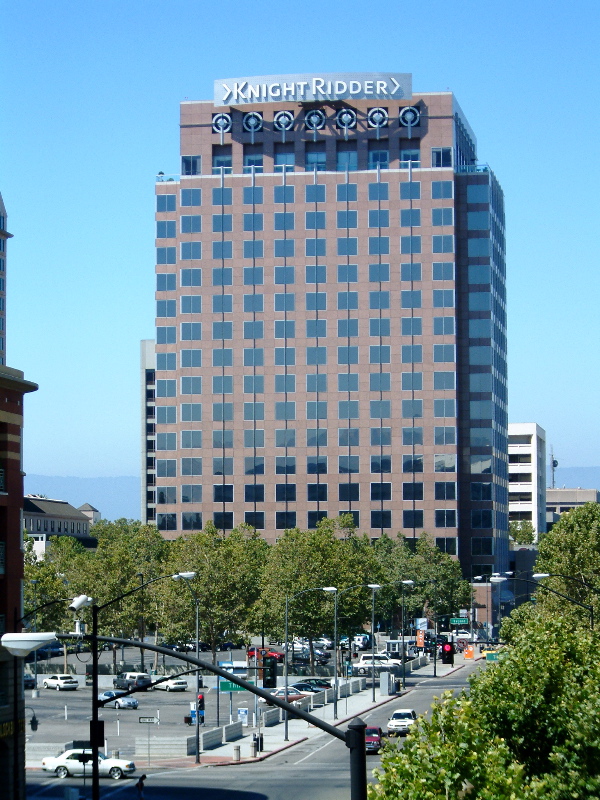
Knight Ridder /ˈrɪdər/ was an American media company, specializing in newspaper and Internet publishing. It was bought by McClatchy on June 27, 2006, allowing the latter to become the second largest newspaper publisher in the United States at the time, with 32 daily newspaper brands sold. Its headquarters were located in San Jose, California.[1]

Key Information

History

[edit]

Origins

[edit]

The corporate ancestors of Knight Ridder were Knight Newspapers, Inc. and Ridder Publications, Inc. The first company was founded by John S. Knight upon inheriting control of the Akron Beacon Journal from his father, Charles Landon Knight, in 1933; the second company was founded by Herman Ridder when he acquired the New Yorker Staats-Zeitung, a German language newspaper, in 1892. As anti-German sentiment increased in the interwar period, Ridder successfully transitioned into English language publishing by acquiring The Journal of Commerce in 1926.

Both companies went public in 1969 and merged on July 11, 1974. For a brief time, the combined company was the largest newspaper publisher in the United States.

At its peak

[edit]

Knight Ridder had a long history of innovation in technology. It was the first newspaper publisher to experiment with videotex when it launched its Viewtron system in 1983. After investing six years of research and $50 million into the service, Knight Ridder shut down Viewtron in 1986 when the service's interactivity features proved more popular than news delivery.[2]

Knight-Ridder purchased Dialog Information Services Inc. from Lockheed Corporation in August 1988. In October 1988, the company placed its eight broadcast television stations up for sale to reduce debt and to pay for the purchase of Dialog.[3]

In 1997, when Tony Ridder was CEO, it bought four newspapers from The Walt Disney Company formerly owned by Capital Cities Communications, after Disney's purchase of Cap Cities mainly for the ABC television network (The Kansas City Star, Fort Worth Star-Telegram, Belleville News-Democrat and (Wilkes-Barre) Times Leader for $1.65 billion. It was, at the time, the most expensive newspaper acquisition in history.

For most of its existence, the company was based in Miami, with headquarters on the top floor of the Miami Herald building. In 1998, Knight Ridder relocated its headquarters from Miami to San Jose, Calif.; there, that city's Mercury News—the first daily newspaper to regularly publish its full content online—was booming along with the rest of Silicon Valley. The internet division had been established there three years earlier. The company rented several floors in a downtown high-rise as its new corporate base.

In November 2005, the company announced plans for "strategic initiatives," which involved the possible sale of the company. This came after three major institutional shareholders publicly urged management to put the company up for sale. At the time, the company had a higher profit margin than many Fortune 500 companies, including ExxonMobil.[4]

Iraq War

[edit]

In the run-up to the 2003 invasion of Iraq, Knight Ridder DC Bureau reporters Jonathan Landay and Warren Strobel wrote a series of articles critical of purported intelligence suggesting links between Saddam Hussein, the obtainment of weapons of mass destruction, and Al-Qaeda, citing anonymous sources.

Landay and Strobel's stories ran counter to reports by The New York Times, The Washington Post and other national publications, resulting in some newspapers within the Knight-Ridder chain refusing to run the two reporters' stories. After the war and the discrediting of many initial news reports written and carried by others, Strobel and Landay received the Raymond Clapper Memorial Award from the Senate Press Gallery on February 5, 2004, for their coverage.[5]

The Huffington Post headlined the two as "the reporting team that got Iraq right".[6] The Columbia Journalism Review described the reporting as "unequaled by the Bigfoots working at higher-visibility outlets such as the New York Times, the Washington Post, the Wall Street Journal and the Los Angeles Times".[7]

Later after the war, their work was featured in Bill Moyers' PBS documentary "Buying The War"[8] and was dramatized in the 2017 film Shock and Awe.

Purchase by McClatchy

[edit]

On March 13, 2006, The McClatchy Company announced its agreement to purchase Knight Ridder for a purchase price of $6.5 billion in cash, stock and debt.[9] The deal gave McClatchy 32 daily newspapers in 29 markets, with a total circulation of 3.3 million. However, for various reasons, McClatchy decided immediately to resell twelve of these papers.[10]

On April 26, 2006, McClatchy announced it was selling the San Jose Mercury News, Contra Costa Times, Monterey Herald, and St. Paul Pioneer Press to MediaNews Group (with backing from the Hearst Corporation) for $1 billion.[11]

List of newspapers

[edit]

Daily newspapers owned by Knight Ridder and its predecessors – listed alphabetically by place of publication – included:

Knight Ridder-owned companies

[edit]

A list of companies that were at one time or another owned by Knight Ridder:

  • Vu/Text: 1982–1996. Merged with PressLink to become MediaStream.
  • PressLink: ??–1996. Merged with Vu/Text to become MediaStream.
  • MediaStream: 1996–2001. Acquired by NewsBank[12]
  • DataStar: Acquired from Radio Schweiz Ltd., merged with Dialog to form Knight Ridder Information
  • Dialog (online database): Merged with DataStar to form Knight Ridder Information
  • Knight Ridder Information: ??–1997, Acquired by MAID, later by Thomson
  • Knight Ridder Financial Inc: 1985–1996. Acquired by Global Financial trading as Bridge Data.
  • RealCities Network:[13] 2004–2006. RealCities was a portal/hub website for Knight-Ridder group. It was absorbed with The McClatchy Company into McClatchy Interactive[14] and sold to Chicago-based Centro[15] in 2008.

Knight Ridder-owned television stations

[edit]

Knight Newspapers entered broadcasting in 1946 via the purchase of minority ownership stakes in WQAM in Miami, WIND in Chicago, and WAKR in Akron; all three stations were in markets served by a Knight newspaper.[16][17][18] The minority stake in WAKR's parent company, Summit Radio, also included the establishment of WAKR-TV (channel 49), as well as WAKR-FM (97.5) and six radio stations purchased in Dayton, Ohio, Dallas, Texas, and Denver, Colorado.[19] WAKR-TV was built and signed on by Summit on July 23, 1953, as the Akron market's ABC affiliate,[20] moving to channel 23 on December 1, 1967.[21] Knight Ridder divested its stake in Summit Radio by 1977;[22] a planned merger between the two entities in 1968 failed to be consummated.[23]

In 1954, Ridder Newspapers launched WDSM-TV in Superior, Wisconsin, serving the Duluth, Minnesota market. Initially a CBS affiliate, it switched to its present NBC affiliation a year and a half after the station's launch. It was spun off after Ridder's merger with Knight Newspapers, Inc.

From 1956 to 1962, Knight and the Cox publishing family jointly operated Biscayne Television, which owned NBC affiliate WCKT in Miami, Florida, as well as WCKR radio, which this entity purchased from Cox;[24] Knight sold off WQAM to a third party as part of Biscayne's formation.[25] Revelations of improper behavior and underhanded tactics by Biscayne[26][27][28] and National Airlines (which signed on WPST-TV, also in Miami[29]) to secure their licenses, along with ethics violations within the FCC itself, resulted in the licenses for both stations being revoked.[30][31] A replacement license for WCKT was granted in 1960 to Sunbeam Television, the lone bidder for the prior license not to have engaged in any unethical behavior;[32][33] Biscayne sold to Sunbeam WCKT's non-license assets: the studios, intellectual property and all off- and on-air personnel for the new station, which took the WCKT name for continuity.[34] Cox repurchased WCKR, reviving that station's prior WIOD call sign.[35]

Following the divestment of their stake in Summit Radio, Knight Ridder acquired Poole Broadcasting, which consisted of WJRT-TV in Flint, Michigan, WTEN in Albany, New York and its satellite WCDC in Adams, Massachusetts, and WPRI-TV in Providence, Rhode Island. Immediately after the acquisition of these stations was finalized, Knight Ridder cut a corporate affiliation deal with ABC, switching then-CBS affiliates WTEN/WCDC and WPRI (the latter of which eventually rejoined CBS) to ABC (WJRT was already affiliated with ABC when the affiliation deal was made). As part of the deal, Poole Broadcasting would eventually become Knight Ridder Broadcasting. Knight Ridder would acquire several television stations in medium-sized markets during the 1980s, including three stations owned by The Detroit News which the Gannett Company—which purchased the newspaper in 1986—could not keep due to Federal Communications Commission regulations on media cross-ownership and/or television duopolies then in effect. (None of Knight Ridder's later acquisitions changed their network affiliations under Knight Ridder ownership; for example, then-NBC affiliate WALA-TV in Mobile, Alabama remained an NBC affiliate when it was owned by Knight Ridder and would switch to Fox several years after Knight Ridder sold the station.)

In early 1989, Knight Ridder announced its exit from broadcasting, selling all of its stations to separate buyers; the sales were finalized in the summer and early fall of that year. This deal was made in order to reduce their debt loads from the proceedings.[36] One of the stations, WALA-TV went to Burnham Broadcasting for $40 million, while WKRN would go to Young Broadcasting for $50 million, KOLD-TV to News-Press & Gazette Company for an undisclosed price, and two television stations WPRI and WTKR to Narragansett Television L.P. for $150 million on February 18, 1989.[37] This was followed by the following month with the sale of KTVY-TV to WHO-TV owner Palmer Communications, for $50 million.[38] WTEN was the next-to-last station to be sold, going to Young Broadcasting for $38 million,[39] and WJRT would eventually becoming the final Knight Ridder station, to be sold to SJL Broadcasting for $39 million.[40]

Stations owned by Knight Ridder and predecessors
Media market State Station Purchased Sold Notes
Mobile Alabama WALA-TV 1986 1989
Tucson Arizona KOLD-TV 1986 1989
Miami Florida WCKT 1956 1962 [a][b]
Adams Massachusetts WCDC-TV 1978 1989 [c]
Flint Michigan WJRT-TV 1978 1989
Albany New York WTEN 1978 1989
AkronCleveland Ohio WAKR-TV 1953 1977 [d]
Oklahoma City Oklahoma KTVY 1986 1989
Providence Rhode Island WPRI-TV 1978 1989
Nashville Tennessee WKRN-TV 1983 1989
Norfolk Virginia WTKR 1981 1989
Superior Wisconsin WDSM-TV 1954 1974 [e]
  1. ^ Co-owned by Knight Newspapers and Cox Newspapers, long before Knight's merger with Ridder Publications.
  2. ^ The license for WCKT under Cox-Knight ownership was revoked by the FCC, with the current license dating back to 1962. However, most contemporary accounts and WSVN itself recognize the history of both WCKTs as one and the same.
  3. ^ Satellite of WTEN.
  4. ^ While this station was owned by Summit Radio from 1953 to 1994, Knight Newspapers held a 45 percent minority stake in Summit that predated this station's establishment, this was fully divested by Knight Ridder in 1977.
  5. ^ Owned by Ridder Publications until the merger between Ridder and Knight forced its divestiture.

Media

[edit]

Shock and Awe, 2018 film about a group of journalists at Knight Ridder's Washington Bureau who investigate the reasons behind the Bush Administration's 2003 invasion of Iraq.

Notable people

[edit]

References

[edit]

Further reading

[edit]
[edit]
Revisions and contributorsEdit on WikipediaRead on Wikipedia
from Grokipedia
Knight Ridder was an American media company specializing in publishing, formed on November 30, 1974, by the merger of Knight Newspapers, Inc.—founded by John S. Knight—and Ridder Publications, Inc.—founded by Herman Ridder—creating the nation's largest group at the time with a focus on quality across its holdings. The conglomerate expanded to own 32 daily newspapers, including prominent titles such as the , Philadelphia Inquirer, and San Jose Mercury News, while pioneering early digital ventures like online news services in the and . Its newspapers garnered widespread acclaim for investigative reporting, securing dozens of Pulitzer Prizes; for instance, the company won seven such awards in 1986 alone, reflecting a sustained emphasis on amid competitive pressures. A defining moment came from its Washington bureau's pre-2003 coverage, where reporters like Jonathan Landay and Warren Strobel systematically questioned administration claims of Iraqi weapons of mass destruction based on intelligence sources, producing stories that withstood postwar scrutiny when no such arsenal materialized—contrasting with much broader media acquiescence to official narratives. Buffeted by industry-wide shifts toward digital media and advertising declines, Knight Ridder resisted aggressive cost-cutting to preserve editorial standards but ultimately agreed to a $4.5 billion acquisition by McClatchy Company in March 2006, marking the end of its independent operations and the divestiture of several properties.

Founding and Early Development

Origins and Initial Operations

Knight Newspapers originated from the acquisition of the Akron Beacon Journal by Charles Landon Knight in 1903, which his sons, John S. Knight and James L. Knight, expanded into a chain emphasizing editorial quality and local coverage. By the mid-20th century, the Knights had grown the group to include prominent dailies such as the Chicago Daily News (acquired 1948, though later sold) and the Miami Herald (purchased 1937), with John S. Knight serving as a influential publisher focused on investigative reporting. The company went public in 1969, positioning it for further consolidation amid rising competition in the newspaper industry. Ridder Publications traced its roots to German immigrant Herman Ridder, who in 1892 acquired the New York Staats-Zeitung, a paper serving New York City's German-speaking community, building on an earlier venture with the Catholic News started in 1875. Under Ridder's sons—, Joseph, and Victor—the firm expanded in the and , acquiring properties like the New York Journal of Commerce and in 1927, and emphasizing business-oriented and ethnic publications. Ridder Publications also went public in 1969, reflecting a strategy of steady acquisition in regional markets while maintaining family control. The formation of Knight Ridder occurred through the merger of Knight Newspapers, Inc., and Ridder Publications, Inc., announced on July 11, 1974, and finalized on November 30, 1974, via a stock exchange valued at approximately $175 million. The resulting Knight-Ridder Newspapers, Inc., became the United States' largest newspaper publisher, combining Knight's 16 dailies with Ridder's roughly 18 to operate 34 daily papers reaching over 11 million readers. Initial operations centered on integrating administrative and financial systems while preserving journalistic autonomy at individual papers, with headquarters established in Miami, Florida, leveraging the Miami Herald's prominence. P.J. Ridder assumed the role of president and chief executive officer, guiding early efforts toward cost efficiencies and technology investments, such as early adoption of computerized typesetting to enhance production speed. The company prioritized high-quality reporting, as evidenced by its newspapers securing multiple Pulitzer Prizes in the late 1970s for investigative work on local governance and corruption.

Key Mergers and Expansion Strategies

Knight Ridder was formed through the merger of Knight Newspapers, Inc. and Ridder Publications, Inc. on November 30, 1974, creating Knight-Ridder Newspapers, Inc. as the largest newspaper publisher in the United States at the time, with 35 dailies across 25 markets, daily circulation of 3.8 million, and Sunday circulation of 4.2 million. The transaction involved a in which Ridder became a wholly owned of Knight, aiming to achieve greater scale, a diversified geographic footprint combining Knight's focus on the and East with Ridder's in the West and Midwest, and a broader revenue base to support further growth. Prior to the merger, Knight Newspapers pursued aggressive expansion through targeted acquisitions, notably purchasing five dailies in 1973: the Lexington Herald and Lexington Leader in , the Columbus Ledger and Columbus Enquirer in Georgia, and the Bradenton Herald in . These moves exemplified an early strategy of entering high-potential markets with populations exceeding 50,000 to capture growing readership and advertising revenue. Ridder Publications similarly built its portfolio through acquisitions of established papers, contributing complementary assets to the combined entity. The company's expansion approach emphasized by acquiring multiple newspapers within the same market to consolidate ownership and reduce competitive pressures, as seen in the paired purchases like the Lexington and Columbus holdings. This tactic, coupled with a focus on at individual papers while centralizing business operations, enabled efficient scaling and positioned Knight-Ridder for dominance in select urban and suburban areas during the 1970s. Both predecessor firms had gone public in , providing capital for such deals and facilitating the merger's financing.

Growth and Diversification

Building the Newspaper Portfolio

Knight Newspapers began building its portfolio with the acquisition of the in 1903 by Charles L. Knight. Expansion accelerated under John S. Knight, who purchased the in 1937 for $2.25 million, followed by the in 1940 and the in 1944 for $3 million. By the 1950s, Knight targeted growing Southern markets, acquiring the in 1955 and the competing Charlotte News in 1959, which allowed consolidation of operations while maintaining separate editorial voices to eliminate direct competition. Ridder Publications, founded by Herman Ridder, similarly grew through acquisitions of ethnic and regional papers, such as Die Staats-Zeitung in New York in 1892, emphasizing profitability in Midwestern and Western markets. Both companies went public in 1969 to fund further growth, with Knight acquiring the Philadelphia Inquirer and Philadelphia Daily News in 1969 for $55 million, and adding papers like the Tallahassee Democrat in 1965. In 1973, Knight secured clusters including the Lexington Herald and Leader in Kentucky, and the Columbus Ledger and Enquirer in Georgia, while Ridder bought the Wichita Eagle and Beacon. The pivotal step in portfolio building occurred on November 30, 1974, with the merger of Newspapers and Ridder Publications into Knight-Ridder Newspapers, Inc., creating the largest U.S. newspaper group at the time with diversified holdings across 20 markets and a combined daily circulation exceeding 4 million. This union combined Knight's high-quality journalism focus in Eastern and Southern papers like the with Ridder's efficient operations in titles such as the San Jose Mercury News, enabling centralized business functions while preserving local editorial independence. Post-merger strategy emphasized acquiring multiple dailies in single markets—targeting cities with populations over 50,000—to dominate local advertising and reduce rivalry, as seen in the 1980 purchase of the Fort Wayne News-Sentinel. Further diversification included the 1986 acquisition of the State-Record Company in South Carolina for $311 million, adding regional depth, and in 1997, purchases from the Walt Disney Company of the Kansas City Star, Fort Worth Star-Telegram, Belleville News-Democrat, and Wilkes-Barre Times Leader, alongside swaps for California papers like the San Luis Obispo Telegram-Tribune. By the early 2000s, this approach yielded a portfolio of 32 daily newspapers in 28 markets, with total circulation reaching 8.7 million, prioritizing high-barrier urban markets for sustained revenue from classifieds and retail ads.

Ventures into Broadcasting and Other Media

Knight Newspapers initiated its broadcasting activities in 1946 through minority ownership stakes in three radio stations: in , in , and WAKR in Akron. In 1969, Ridder Publications expanded into both radio and television by acquiring in , , which operated WCCO-AM, WCCO-FM, and . Following the 1974 merger forming Knight-Ridder Newspapers, Inc., the company pursued further broadcasting acquisitions. In 1981, it established Knight-Ridder Broadcasting Inc. and purchased WTAR-TV (now ) in , for $48.3 million from Landmark Communications. That same year, after divesting its stake in Radio, Knight-Ridder acquired Broadcasting, adding WJRT-TV in , and WTEN in , to its portfolio. By the mid-1980s, the company's television holdings included stations such as (formerly WCKT) in , in Nashville, and in , alongside additional radio properties. Knight-Ridder also ventured into in 1981 through a with , a Denver-based firm, marking its entry into non-broadcast video distribution. The company explored early electronic information services, launching in 1981 as a precursor to platforms. Facing rising debt from newspaper expansions, Knight-Ridder announced in October 1988 the sale of its entire broadcast television division—eight stations, including ABC affiliates WTEN-TV and —to reduce financial pressures, effectively exiting the sector. This divestiture refocused resources on core operations, limiting long-term diversification beyond print media compared to competitors like Gannett.

Operational Peak and Journalistic Influence

Dominant Publications and Market Position

Knight Ridder achieved its operational peak in the late , operating 32 daily s across 28 U.S. markets and ranking as the second-largest publisher by circulation, behind Gannett, with a combined daily readership of 8.7 million and Sunday circulation of 12.6 million. The company had formed as the nation's largest group following the 1974 merger of Knight Newspapers and Ridder Publications, which combined 34 dailies into a portfolio emphasizing quality in major markets. By the , it ranked among the top five U.S. publishers alongside Gannett, Newhouse Newspapers, Times Mirror, and , benefiting from high profitability with operating margins averaging 14.3% in the late 1980s, exceeding the industry average for major media firms. Among its dominant publications, stood out for investigative reporting, having been acquired in 1969 as part of a $55 million deal that included the Philadelphia News; its daily circulation reached 401,968 by 1999. , purchased in 1937, developed strong coverage of and earned multiple Pulitzer Prizes, contributing significantly to the chain's reputation. Other flagship titles included the , acquired in 1940 and noted for prize-winning work, and the San Jose Mercury News, a Ridder legacy paper that pioneered in 1993 with 190,000 daily circulation in the 1990s Bay Area market. These papers anchored Knight Ridder's market strength in key urban centers, driving overall revenue through advertising and subscriptions during an era of industry expansion.

Notable Investigative Achievements

Knight Ridder newspapers earned a reputation for rigorous investigative reporting, collectively securing over 80 Pulitzer Prizes by the early 2000s, many in categories recognizing in-depth scrutiny of public institutions and policy failures. This output reflected a commitment to empirical scrutiny over official narratives, with standout work from outlets like The Philadelphia Inquirer and the Miami Herald exposing systemic abuses and covert programs. A landmark example was The Philadelphia Inquirer's 1987-1988 series by on Pakistan's clandestine nuclear weapons development, which detailed how the U.S. overlooked Islamabad's atomic ambitions amid alliances, earning the 1988 for National Reporting. The reporting, based on declassified documents and interviews with intelligence sources, highlighted proliferation risks ignored for geopolitical expediency, influencing congressional debates on foreign aid. Similarly, the Inquirer's earlier probes into city corruption and prison conditions at Holmesburg, revealing brutal experiments on inmates, secured Pulitzers for local investigative reporting in 1975 and 1978, driving reforms in oversight and accountability. The , another flagship, advanced investigations into Latin American dictatorships and U.S. policy entanglements, contributing to Knight Ridder's 1987 sweep of five Pulitzers, including for editorial and reporting excellence that challenged unchecked power structures. On the national front, Knight Ridder's Washington Bureau, led by reporters like Jonathan Landay and Warren Strobel, produced prescient 2002-2003 stories questioning administration claims of Iraqi weapons of mass destruction, relying on dissenting intelligence assessments rather than consensus views; this work, vindicated post-invasion, won the 2007 Scripps Foundation award for excellence in . These efforts underscored Knight Ridder's emphasis on source verification and causal analysis of policy drivers, often diverging from mainstream deference to officialdom.

Controversies and Challenges

Iraq War Reporting and Skepticism of Official Narratives

In the months preceding the March 20, 2003, U.S.-led invasion of , Knight Ridder's Washington bureau produced reporting that systematically questioned the administration's public assertions regarding Iraq's weapons of mass destruction (WMD) programs and connections to . Led by bureau chief John Walcott and reporters Jonathan S. Landay and Warren P. Strobel, the team emphasized sourcing from mid-level analysts rather than high-ranking officials, revealing internal doubts within U.S. agencies about the quality of . This approach yielded stories such as the October 4, 2002, article "CIA Report Reveals Analysts' Split Over Extent of Iraqi Nuclear Threat," which highlighted divisions among CIA experts on whether Iraq had restarted its nuclear program, based on disputed claims about high-strength aluminum tubes. Knight Ridder articles also cast doubt on purported Iraq-al-Qaeda operational links, reporting on October 11, 2002, that U.S. intelligence agencies found scant evidence of collaboration, contradicting Dick Cheney's public statements. Similarly, in a September 2002 piece, Landay and Strobel detailed how claims from Iraqi defectors—often promoted by administration allies—were viewed skeptically by intelligence professionals due to inconsistencies and lack of corroboration. These reports, distributed to Knight Ridder's 32 dailies including the and San Jose Mercury News, stood apart from contemporaneous coverage in outlets like , which relied more heavily on anonymous senior officials and defectors without equivalent caveats on evidentiary weaknesses. The bureau's persistence stemmed from a commitment to cross-verifying administration narratives against raw intelligence assessments, avoiding the "" prevalent elsewhere that prioritized official briefings. Post-invasion discoveries—or lack thereof—validated key elements of their skepticism: the concluded in 2004 that Saddam Hussein's WMD stockpiles had been exhausted by 1991, and the 2006 Senate Select Committee on Intelligence report affirmed pre-war analytic reservations about and defector reliability that Knight Ridder had publicized. While not predicting the absence of all WMD activity, their work underscored how politicized interpretations overstated ambiguous data, influencing retrospective analyses of media failures in scrutiny.

Accusations of Editorial Bias and Internal Criticisms

In the early 2000s, Knight Ridder faced substantial internal criticisms from journalists, editors, and former executives over an intensifying focus on short-term profitability at the expense of journalistic resources and quality. Under CEO P. Anthony Ridder, the company implemented aggressive cost-control measures, including widespread staff buyouts, layoffs, and reductions across its portfolio, aiming to sustain profit margins around 20% amid declining . These actions sparked backlash, with critics arguing that diminished investigative capacity and editorial depth undermined the chain's reputation for rigorous reporting; for example, , a Pulitzer-winning , underwent multiple rounds of cuts in 2000–2001 that reduced its news staff by over 100 positions, prompting former publisher Maxwell E. King to fault the corporate emphasis on financial metrics over sustained excellence. Similar discontent emerged at the San Jose Mercury News and , where employees contended that profit-driven decisions eroded local coverage and innovation, contributing to a perceived "clash of cultures" between values and headquarters directives in San Jose. Externally, Knight Ridder publications drew accusations of editorial , predominantly from conservative observers who characterized their reporting and opinion pages as reflecting a liberal worldview, consistent with broader indictments of institutions. Outlets like the and Philadelphia Inquirer were cited for coverage deemed sympathetic to progressive causes on issues such as , , and environmental regulation, though such claims often relied on selective examples rather than systematic analysis. In , amid national debates on press credibility, Knight Ridder's senior vice president for news, Larry Jinks, dismissed allegations of inherent liberal as largely "manufactured," attributing them to political rather than of systemic slant. These criticisms persisted into the and , with some attributing the chain's editorial tone to the demographic and ideological makeup of urban newsrooms, yet Knight Ridder's defenders highlighted its Pulitzer-winning investigative work—such as exposés on government corruption—as of commitment to factual accountability over ideology. Internal dissent occasionally intersected with concerns, as some staffers and external watchdogs questioned whether profit pressures exacerbated selective framing in coverage; for instance, resource constraints were blamed for uneven of political narratives, fueling perceptions of imbalance. However, these accusations remained contested, with Knight Ridder maintaining that its standards prioritized empirical verification, and empirical audits of its output, such as those on coverage, showed no disproportionate ideological skew compared to peers. The company's resistance to overt corporate influence on decisions distinguished it from more advertiser-sensitive competitors, though ongoing internal friction underscored the challenges of balancing fiscal demands with independence in a consolidating industry.

Corporate Governance and Shareholder Conflicts

Knight Ridder operated as a publicly traded with a overseeing strategic decisions, including mergers and divestitures, while CEO P. Anthony Ridder, a descendant of the founding , led day-to-day from 1991 until the company's sale in 2006. The board included representatives from and media sectors, reflecting standard practices for large media conglomerates, but faced criticism for insufficient responsiveness to market shifts in the early . In late 2005, significant emerged as Knight Ridder's stock price declined amid broader newspaper industry challenges, underperforming the by over 50% in the prior five years. Private Capital Management (PCM), holding approximately 19% of shares, led the push, with CEO publicly demanding a full sale of the company to maximize , arguing that management had failed to address declining revenues effectively. Southeastern Asset Management, with an 8.9% stake, and Firebrand Partners, holding about 8%, joined PCM in urging the board to consider breakup or asset sales, collectively controlling around 36-37% of voting shares and threatening proxy fights or director nominations if unmet. The board responded by hiring on November 14, 2005, to evaluate strategic alternatives, including a potential company sale, amid the that highlighted tensions between long-term journalistic priorities under Ridder and short-term financial returns sought by investors. This pressure culminated in the 2006 agreement to sell to for $4.5 billion in cash and stock, which the Knight Ridder board unanimously recommended for shareholder approval, effectively resolving the conflict but marking the end of independent operations. Earlier governance measures, such as a 1989 charter amendment requiring approval for certain changes, had aimed to deter hostile takeovers but proved insufficient against coordinated institutional pressure.

Decline and Dissolution

Economic Pressures in the Newspaper Industry

The newspaper industry in the early faced structural economic pressures from the rapid shift of to online platforms, with total U.S. peaking at approximately $60 billion in before declining sharply thereafter. , which historically accounted for a significant portion of newspaper income—often 20-30% in major markets—experienced particularly acute erosion due to free or low-cost digital alternatives like , which entered markets sequentially from the late 1990s and captured substantial volume by offering user-generated listings without intermediaries. Empirical studies quantify this impact: 's entry into a local market led to an average 20.7% drop in newspaper classified ad rates, alongside staff reductions in newsrooms and management as revenues fell. By the mid-, overall industry revenues had contracted by about 6% annually in some quarters, exacerbating a broader trend where stagnated or declined amid rising newsprint and distribution costs. These dynamics disproportionately affected Knight Ridder, whose portfolio of 32 daily newspapers saw circulation drop 17.8% from 1990 to 2000, outpacing the industry's 10% decline, due in part to labor disruptions and competitive fragmentation but amplified by digital substitution. The company's price reflected pessimism over these trends, plummeting from a 2004 high of $80 per share to a 2005 low of $52.58, as questioned newspapers' adaptability to internet-driven revenue losses. Knight Ridder's heavy reliance on print classifieds in key markets like and left it vulnerable, with the broader industry's 50% revenue drop since 2000 underscoring a causal shift from monopoly-like local ad dominance to commoditized competition. Despite operational profitability in some years, these pressures eroded , culminating in activist demands for divestiture by 2005 as traditional models proved unsustainable against unmonetized digital readership growth.

Acquisition by McClatchy and Asset Redistribution

On March 13, 2006, The Company announced an agreement to acquire Knight Ridder Inc. in a transaction valued at approximately $4.5 billion, consisting of $40 per share in cash and 0.5118 shares of McClatchy Class A per Knight Ridder share. The deal, which included assumption of about $2 billion in debt, faced shareholder pressure on Knight Ridder amid declining industry revenues and stock performance, prompting the board to pursue a sale after initial resistance. The acquisition closed on June 27, 2006, integrating Knight Ridder's operations into and positioning the combined entity as the second-largest publisher in the United States by circulation. To finance the purchase and address antitrust concerns raised by the U.S. Department of Justice, McClatchy divested several Knight Ridder properties shortly after the announcement. On April 26, 2006, McClatchy agreed to sell four daily newspapers—the San Jose Mercury News, Contra Costa Times, Monterey Herald, and St. Paul Pioneer Press—to a partnership of MediaNews Group and Hearst Corporation for $1 billion in cash. Additional divestitures included other regional papers to prevent market concentration in specific areas, as mandated by a consent decree requiring the sale of assets in overlapping markets within 180 days of closing. These asset redistributions reduced McClatchy's net acquisition to 20 of Knight Ridder's 32 daily newspapers, allowing reduction while preserving journalistic assets aligned with McClatchy's focus on mid-sized markets. The sales generated significant liquidity, with proceeds primarily used to repay acquisition-related borrowings, though they marked the fragmentation of Knight Ridder's once-cohesive portfolio across multiple owners.

Legacy and Long-Term Impact

Contributions to American Journalism Standards

Knight Ridder's newspapers set benchmarks for investigative depth and accountability journalism, earning a total of over 100 Pulitzer Prizes across its publications from the mid-20th century through the early 2000s, far exceeding many competitors in per-paper recognition. This acclaim stemmed from a corporate prioritizing editorial quality, as evidenced by the 1986 sweep of seven Pulitzers by Knight Ridder outlets, including awards for the Miami Herald's coverage of corruption in and the Philadelphia Inquirer's exposés on local governance failures. Such successes reinforced industry standards for rigorous and source verification, influencing peers to invest in long-form reporting amid rising commercial pressures. The company's leadership, including figures like John S. Knight, championed principles of independence and , embedding these into operational norms that resisted undue advertiser or shareholder influence. Knight Ridder's Washington bureau, for instance, exemplified skeptical inquiry by methodically challenging official claims, a practice that elevated expectations for empirical scrutiny in national reporting. This approach contrasted with profit-driven consolidations elsewhere, preserving a model where resources were allocated to and ethical guidelines over cost-cutting. Internally, executives like James Batten advocated for journalism's role in democratic oversight, fostering training programs and editorial autonomy that became templates for maintaining credibility amid economic shifts. By sustaining high-caliber output—such as the Detroit Free Press's Pulitzer for probes—Knight Ridder demonstrated that commercial viability could align with uncompromising standards, though tensions arose as Wall Street demands intensified in the . Their legacy includes normalizing data-driven analysis and multimedia integration precursors, like early experiments in computerized reporting, which prefigured modern verification tools and contributed to evolving professional norms. Despite later declines, these practices underscored journalism's foundational duty to prioritize evidence over expediency.

Influence on Media Economics and Digital Transition

Knight Ridder pursued early digital initiatives that highlighted both the potential and pitfalls of transitioning newspapers to online platforms. In 1983, the company launched , a service in partnership with , offering news, shopping, and via dedicated terminals; after investing over $50 million and six years of development, it shuttered in due to insufficient subscriber uptake amid high costs and limited consumer demand for proprietary systems. This failure underscored the economic risks of premature digital bets without widespread infrastructure, yet it positioned Knight Ridder as a tester of concepts later echoed in web-based services. Building on these experiments, Knight Ridder's Information Design Laboratory, under Roger Fidler, envisioned portable digital reading devices in the early 1990s, producing a 1994 demonstration video of a "tablet " that anticipated interfaces for consumption. The company advanced practical online presence by launching the Real Cities network in 1999, creating interconnected local websites across more than 100 U.S. markets to aggregate , community information, and , which became one of the earliest large-scale digital hubs for regional content. These efforts, including the first site and a 2000 with for content delivery, demonstrated strategies for leveraging digital aggregation to offset print declines, influencing peers to prioritize web metrics over circulation alone. Economically, Knight Ridder's trajectory exposed structural vulnerabilities in the model amid rising competition. By the early , the company faced eroding ad revenues—down 10.3% in general categories like telecom and dot-coms in some years—and accelerating circulation losses, prompting investor activism that depressed its stock and led to the $4.5 billion sale to . This transaction, absorbing $2 billion in debt, signaled to the industry the unsustainability of standalone print chains, accelerating consolidations and divestitures while highlighting the failure to monetize digital audiences at scale before classifieds migrated to platforms like . Knight Ridder's experience catalyzed broader media economics shifts by exemplifying the tension between journalistic investment and shareholder demands, as internal priorities swung toward cost-cutting under pressure, ultimately eroding the high margins that had funded . Their early digital forays, though not commercially transformative, informed the recognition that free online content eroded print monopolies, prompting industry-wide pivots toward paywalls and native digital revenue—lessons absorbed post-acquisition as integrated Real Cities before its 2008 sale. The company's dissolution underscored causal links between delayed adaptation and value destruction, influencing subsequent strategies to diversify beyond legacy models.

References

Add your contribution
Related Hubs
User Avatar
No comments yet.