Hubbry Logo
KompyangKompyangMain
Open search
Kompyang
Community hub
Kompyang
logo
8 pages, 0 posts
0 subscribers
Be the first to start a discussion here.
Kompyang
Kompyang
from Wikipedia
Not found
Revisions and contributorsEdit on WikipediaRead on Wikipedia
from Grokipedia
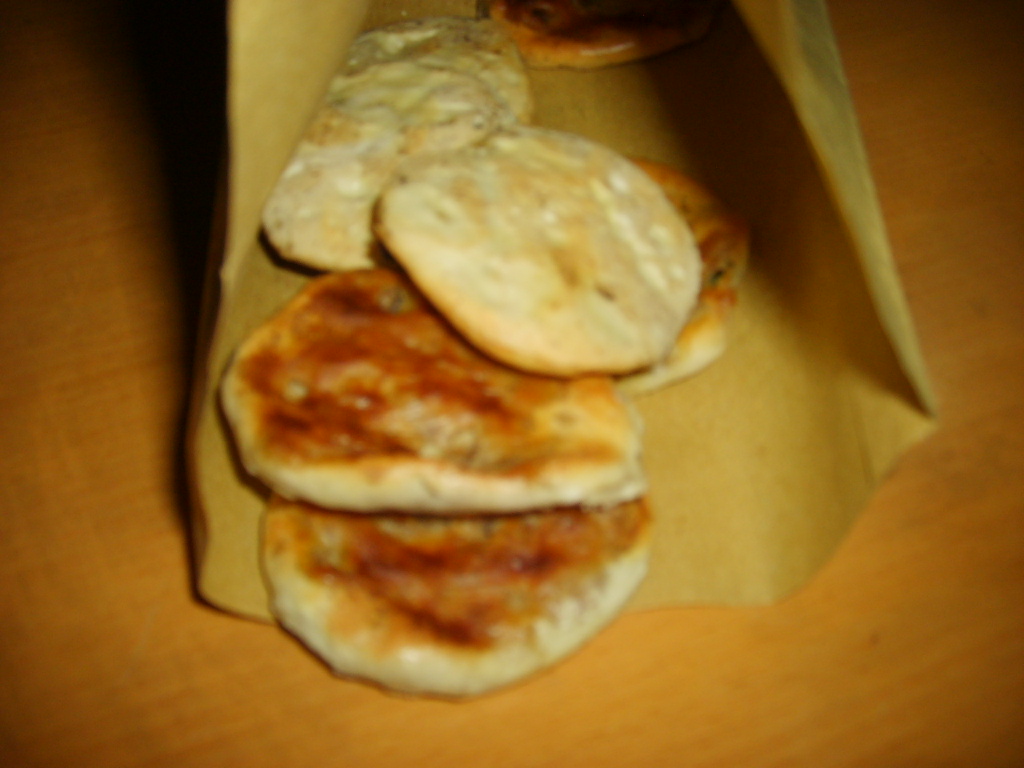
Kompyang, also known as guang bing or kompia, is a traditional product originating from , the capital of Province in , made with , lard, onions, and salt, and featuring a distinctive round shape with a central hole for stringing and portability. Its history dates back to the (1368–1644), when it was developed as a practical ration for soldiers under the command of military general during his campaigns against Japanese pirates in around 1563. The bread's design, including the central hole, was inspired by the portability of the pirates' rice balls (onigiri), allowing troops to string multiple pieces for easy carrying, and designed for baking with minimal smoke to avoid detection, reflecting Qi Jiguang's strategic ingenuity. Named in honor of Qi Jiguang—whose victories over the raiders it commemorates—kompyang has endured as a symbol of local pride and resilience in Fujianese culture for over 400 years. Beyond , kompyang spread through Fujianese migration, particularly among Foochow communities in and . Its simple yet flavorful profile—crispy exterior, chewy interior, and aromatic onion notes—highlights Fujianese culinary traditions emphasizing practicality and bold seasoning. Today, while traditional handmade versions persist, modern adaptations include machine production.

History

Origins in Fujian

Kompyang, known locally as guang bing (光饼), originated in Province, , during the as a practical solution for . In 1563, Qi Jiguang, leading troops against Japanese pirates () in southeastern , had this bread created to address the challenges of transporting provisions during prolonged campaigns. The design featured a central hole, allowing multiple pieces to be strung together on ropes for easy carrying by soldiers, ensuring durability and portability in harsh conditions. The invention stemmed from the need for a non-perishable food that could withstand rain and rough marches, which often spoiled traditional rations. commissioned local bakers in to create a hard, baked using simple ingredients, baked to a crisp finish that preserved it for extended periods. This innovation supported his army's mobility and contributed to successful defenses against pirate raids along the coast. The bread's name, guang bing, derives from 's given name, serving as a tribute to his leadership and victories. Early production centered in , the provincial capital, where artisans used traditional Chinese clay ovens—often wood- or coal-fired—to bake the by adhering to the interior walls for even distribution. This method, honed in the Fuzhou and nearby areas, produced the characteristic golden, resilient crust essential for its military use. Over time, these techniques became embedded in local Fujianese baking traditions, marking guang bing as a staple of the region's culinary heritage.

Spread to Southeast Asia

In the 19th and early 20th centuries, Foochow (Fuzhounese) immigrants from province migrated to seeking economic opportunities amid labor demands in colonial plantations, mining, and agriculture. This wave was part of broader maritime networks that had connected to the region since the , but intensified during the Qing era due to overpopulation, poverty, and colonial recruitment. These migrants introduced Kompyang to key settlements, including and in , ; and in , . In , the first major Foochow group arrived in in 1901 under an agreement with the Brooke administration, establishing agricultural communities that preserved Fujianese culinary traditions. Similarly, became a Foochow hub in 1902, supported by missionary efforts amid anti-Christian persecution in . By the early , Kompyang had evolved into a cherished and household staple within these communities, baked in local ovens and sold by family-run shops that maintained the original Fujianese of unleavened with topping. British colonial policies in Malaya actively encouraged such migrations for rice cultivation and rubber estates, solidifying Foochow presence in places like and . Post-World War II, as communities rebuilt and expanded into and other sectors, Kompyang's role as a portable, durable snack endured, reflecting the resilience of these immigrant networks across .

Ingredients and Preparation

Core Ingredients

The core ingredients of traditional Kompyang are , , spring onions, and salt, which form the foundation of both the and the characteristic filling. serves as the primary base for the , providing structure, chewiness, and a high content that contributes to its role as an energy-dense . is essential for adding richness, tenderness, and flakiness to the texture, while also serving as a key component in the filling to bind and enhance . Spring onions, finely chopped, impart a savory flavor and aromatic depth to the filling, distinguishing Kompyang from plainer breads. Salt is used for throughout, balancing the overall taste and aiding in dough development by strengthening formation. The dough composition typically involves a simple mixture of , water, and salt, kneaded into a smooth ball for elasticity. Some regional versions incorporate fillings such as or , though these are not part of the core traditional recipe. Nutritionally, Kompyang is high in carbohydrates from the , offering quick energy, and fats from the , which provide sustained calories—attributes that historically supported its use as a portable ration in contexts.

Traditional Baking Method

The traditional baking method for Kompyang originates from province and involves a straightforward yet skillful process that yields its characteristic texture and flavor. The dough is prepared by mixing , salt, and to form a stiff, workable consistency. It is then rested for about 30 minutes, allowing the to relax. A separate filling is made by combining chopped spring onions and . Once rested, the dough is divided into equal portions and shaped into small balls. Each ball is stuffed with the onion-lard filling, then flattened into discs approximately 10-15 cm in diameter. A central hole is poked through each disc using a finger or a simple tool, facilitating both even baking and historical portability by stringing multiple pieces together. The discs may be optionally topped with sesame seeds. Baking occurs in a preheated traditional Chinese clay oven, heated to around 200-250°C using or wood for consistent high heat. The shaped discs are slapped directly onto the inner walls of the oven, adhering briefly before for 10-15 minutes until they achieve a golden, crusty exterior. This method, adapted from military field for quick, low-smoke preparation, has evolved for home use while preserving the technique's essence. To finish, the baked Kompyang are carefully removed from the oven walls using a wooden hook or paddle to avoid burns, then allowed to cool slightly on a surface. The result is a chewy interior contrasted by a crispy exterior, with the onion essence providing a subtle, savory aroma throughout. Safety in handling relies on long wooden tools to manage the intense heat without direct contact.

Variants

Classic Chinese Types

The classic Chinese types of kompyang, originating from Fujian province, primarily revolve around variations of guang bing, a flatbread characterized by its central hole and baked in traditional clay ovens. These variants maintain the foundational dough of flour, water, lard, onions, and either salt or sugar, but differ in toppings, fillings, and flavor profiles to suit local tastes and historical contexts. Production remains artisanal, with dough shaped into rings and adhered to the hot oven walls for a crispy exterior and chewy interior, a method unchanged since the . One prominent variant is the plain sesame-topped kompyang, known as 麻饼 (má bǐng) in local contexts, which features no filling and emphasizes a nutty crunch from white seeds sprinkled on the surface after brushing with . This type is baked simply to highlight the bread's inherent savoriness, making it a staple in street markets where it is sold fresh and paired with simple accompaniments like . The sesame adds a subtle aromatic lift without overpowering the dough's mild saltiness, resulting in a lightweight snack ideal for everyday consumption. Zhengdong bing, or 征东饼 (zhēng dōng bǐng), represents a adaptation of kompyang, substituting for salt in the to create a mildly sweetened that evokes historical significance. Named after General Qi Jiguang's eastern expeditions against pirates in the 16th century, this variant was developed as a portable ration for troops. Unlike the savory base, traditional recipes focus on the -infused for a gentle , distinguishing it as a celebratory or offering in culture. Meat-filled kompyang introduces a heartier option, where minced —sometimes fermented or steamed—is mixed with onions and encased in the before , yielding a denser texture and higher caloric content suitable for sustenance during labor or travel. This variant, common in , enhances the bread's portability by integrating protein, with the filling's juices infusing the interior for added moisture and flavor upon each bite. remains the primary meat, reflecting Fujian's coastal culinary influences, though appears less frequently in authentic preparations. All classic types preserve the signature central hole, which facilitates even and historical stringing for storage or sale, while variations in toppings or fillings diverge from the plain base recipe without altering the core oven- process tied to workshops. These distinctions underscore kompyang's adaptability within Chinese tradition, later influencing diaspora versions in .

Regional Adaptations

In , particularly in , , kompyang has adapted to local preferences, often appearing larger and featuring modern fillings such as ground , paste, , or pandan-flavored , while retaining its signature hole and chewy texture. Known locally as the "Foochow ," it is traditionally baked in clay or ovens, which impart a distinctive smoky flavor to the crust. These versions are commonly enjoyed plain or filled, serving as a versatile or snack paired with in Sarawakian cafes. In , such as in , kompyang variants tend to be smaller and bite-sized, ideal for quick snacks, with savory options like or fillings enhancing their portability and appeal as everyday bites. Modern adaptations across have incorporated home cooking techniques, including air-fryers or conventional ovens, which reduce baking time to approximately 13-15 minutes at high heat, making preparation more accessible without traditional equipment. In , particularly in regions like , kompyang incorporates local savory fillings such as pork or beef, alongside sweet alternatives like or coconut, reflecting influences from the Chinese while suiting regional tastes. Adaptations in Flores and other areas of may include diverse fillings such as , , or cheese, sometimes with subtle spicy elements from chili-infused dough or accompaniments, though the core flat, holed design persists. Commercial production has expanded since the early 2000s, with automated machinery enabling factory-scale output of up to 12,000 pieces per hour, preserving the traditional hole while facilitating wider distribution and export to global markets.

Cultural Significance

Role in Chinese Heritage

Kompyang holds a significant place in Chinese heritage as a culinary emblem of resilience and ingenuity, particularly within Province's cultural landscape. It is closely tied to the military legacy of General , a national hero renowned for defending coastal regions against Japanese pirate raids. The bread's name, derived from "Guang Bing" (honoring Qi Jiguang), underscores its role as a tribute to military valor and national defense in Fujianese . In Fujian's culinary tradition, especially Foochow (Fuzhou) cuisine, kompyang serves as an integral staple, reflecting the province's emphasis on simple yet flavorful snacks that blend influences with local maritime history. It is commonly found in Fuzhou's vibrant night markets, where vendors offer it alongside other iconic dishes like omelets and balls, providing a portable, savory option for locals and visitors alike. The bread's crisp exterior and chewy interior, achieved through traditional baking, embody the resourcefulness of Fujianese cooking, which prioritizes and texture in everyday fare. As a everyday yet culturally rooted item, kompyang fosters communal eating experiences. Preservation efforts have elevated its status, with the traditional making technique of Jian'ou guang bing recognized as a provincial item in in 2017. This designation protects artisanal recipes and methods in areas like and , ensuring the bread's transmission as a living testament to 's Ming-era legacy and culinary identity.

Importance in Diaspora Communities

In diaspora communities across , kompyang serves as a vital conduit for social bonding among , particularly the Foochow descendants who brought the tradition from during 19th- and early 20th-century migration waves. In Malaysian Foochow associations, such as those in , it reinforces familial ties and collective heritage. Its round shape symbolizes prosperity and completeness in . For Indonesian Chinese in regions like , kompyang acts as a poignant identity marker, preserving connections to ancestry. In communities around and , it is often enjoyed at family events to bridge generations and affirm ethnic roots in a multicultural society. Economically, kompyang sustains family-owned bakeries in key diaspora hubs like , , and , Indonesia, where artisanal production using traditional clay ovens supports local livelihoods and . These establishments, some operating for decades, contribute to community economies by supplying the bread for daily consumption and events, turning a simple into a cornerstone of small-scale . Today, kompyang embodies immigrant resilience, representing the adaptability of Foochow migrants who carried this portable staple across oceans to build new lives. In multicultural contexts, it has evolved with vegetarian adaptations—using plant-based fillings like mushrooms or instead of —to align with diverse dietary needs, ensuring its continued relevance in inclusive settings.

References

Add your contribution
Related Hubs
User Avatar
No comments yet.