Hubbry Logo
KouxianKouxianMain
Open search
Kouxian
Community hub
Kouxian
logo
8 pages, 0 posts
0 subscribers
Be the first to start a discussion here.
Kouxian
Kouxian
from Wikipedia
Kouxian
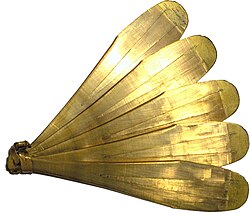
A five-leaf kouxian
Classification Lamellaphone; plucked idiophone
Hornbostel–Sachs classification121.2
(A plucked idiophone in which the lamella is mounted in a small frame; the player's mouth serves as a resonance chamber.)
Related instruments
Đàn môi, gogona, kubing, morsing

Kouxian (Chinese: 口弦; pinyin: kǒuxián; lit. 'mouth string') is a general Chinese term for any variety of jaw harp. The jaw harp is a plucked idiophone in which the lamella is mounted in a small frame, and the player's open mouth serves as a resonance chamber.

Chinese jaw harps may comprise multiple idiophones that are lashed together at one end and spread in a fan formation. They may be made from bamboo or a metal alloy, such as brass.[1] Modern kouxian with three or more idiophones might be tuned to the first few tones of the minor pentatonic scale.

The jaw harp likely originated in Asia. Although played throughout China, it is particularly popular among the non-Han ethnic groups of Southwest China, such as those in Yunnan, Guangxi, and Guizhou. The varieties of Chinese have numerous vernacular names for the instrument; one such name is hoho.

[edit]

References

[edit]
Revisions and contributorsEdit on WikipediaRead on Wikipedia
from Grokipedia
The kouxian (口弦), commonly known as the jaw harp or mouth harp, is a traditional Chinese plucked consisting of a small frame—often made of , metal, or —holding a flexible lamella or reed that vibrates when plucked while held between the lips or teeth, with the player's oral cavity modulating the overtones to produce a range of resonant, ethereal sounds. This compact instrument, typically 8-9 cm long and 1 cm wide in its ancient forms, is played by tapping the lamella with a finger while varying mouth shapes to mimic natural sounds like birdsong or flowing water, and it serves as a foundational element in the oral-resonated music traditions of various ethnic groups. Originating in ancient , the kouxian dates back at least 4,000 years, with archaeological evidence including bone examples unearthed in 2018 at the Shimao ruins in Province, marking it as one of the earliest known mouth-resonated instruments and a "" of musical history. Primarily associated with ethnic minorities in Southwest , such as the Yi, Naxi, , and Qiang peoples in regions like and , the instrument exists in variants including single-reed models and multi-tongued forms, often handmade and tuned to local pentatonic scales. Culturally, it holds deep significance as a "love instrument" used in rituals, storytelling, and mimicking tonal languages—such as Naxi vowels and pitches—to convey whispered messages, and it has influenced broader Asian and even European jaw harp traditions by the 13th century. In contemporary contexts, the kouxian continues to thrive in , festivals, and educational preservation efforts among China's ethnic communities, where sets of multiple reeds (e.g., three or more) allow for melodic complexity, and it is increasingly integrated into modern performances to highlight .

Overview

Description

The kouxian is a plucked idiophone characterized by a flexible lamella, or tongue, mounted within a frame, which is positioned between the player's teeth or lips and activated by plucking to generate sound through resonance in the oral cavity. This instrument falls under the lamellophone category, where the lamella's vibration serves as the primary sound source, distinct from string or wind mechanisms. Physically, the kouxian is compact, typically measuring 6-19 cm in length depending on and variant, with a lightweight frame constructed from materials such as metal or , and it may feature a single lamella or multiple ones tuned to specific pitches for melodic variation. Variants include idioglot designs where the is cut from the same as the frame, often stored in protective cases like tubes for portability. Sound production relies on the lamella's creating a fundamental tone upon plucking, which the player modulates by altering the mouth's shape and volume to emphasize and harmonics, enabling a range of timbres from earthy to resonant. As the Chinese generic term for harps, kouxian highlights regional adaptations, such as multi-reed configurations among ethnic groups like the Yi and Naxi, setting it apart from the typically single-tongued metal Western while sharing the core plucking and oral resonance principle.

Classification

The kouxian is classified within the system as a , specifically under the subcategory of guimbardes or jaw harps (121.21 for idioglot and 121.22 for heteroglot variants), denoting a plucked where a flexible tongue—either cut from (idioglot) or of different material (heteroglot) mounted in—a frame vibrates independently while the player's mouth cavity provides resonance. This placement emphasizes the instrument's idiophonic nature, where sound arises from the vibration of a solid body without enclosed air. However, debates persist regarding its dual categorization, as the kouxian's sound production involves aerodynamic interaction with the oral cavity, leading some researchers to propose reclassification as a free (111.142), akin to free-reed instruments where exhaled or manipulated air excites the lamella. This controversy highlights the instrument's hybrid acoustic profile, bridging and principles. Globally, the kouxian aligns with a family of harps found across and beyond, sharing core mechanics of plucking a lamella to generate a fundamental tone modulated by oral resonance. It exhibits similarities to the Vietnamese đàn môi (dan moi), a lip-held metal variant producing comparable twanging overtones; the Siberian temir komuz (tembir), a harp of Turkic nomadic traditions in the Altai region emphasizing rhythmic pulsations; and the Indian morchang, a or iron instrument used in for drone-based melodies. Unlike these predominantly single-lamella forms, many Chinese kouxian variants feature multi-lamella designs, enabling polyphonic effects through simultaneous plucking of two or more tuned tongues fanned in a frame. In Chinese ethnomusicological terminology, kouxian serves as the overarching designation for jaw harps, incorporating diverse regional iterations tied to ethnic minorities, such as the hoho (or nongo) among the Yi (Nuosu) people of Yunnan, which often comprises three to five lashed lamellae for layered tonal interplay. This nomenclature reflects the instrument's adaptability across China's multicultural landscape, where local names denote subtle variations in form and usage. Acoustically, the kouxian generates a non-harmonic series of from its lamella vibration, producing a of inharmonic partials rather than multiples of a . emerges not from selecting s but from the player's manipulation of vocal tract formants—resonant peaks shaped by , , and positions—to amplify specific overtones, yielding a vocal-like adaptable to scalar patterns. This formant-dependent sound production distinguishes it from harmonic instruments, prioritizing timbral nuance over pitched intonation.

History

Origins and Antiquity

The kouxian, a traditional jaw harp, traces its prehistoric origins to the period in ancient , where it emerged as an indigenous invention among early agrarian societies. Archaeological evidence indicates that the instrument likely dates back to around 2000 BCE, with bone prototypes unearthed at the Shimao site in Province, northwest , representing some of the earliest known examples of this . These artifacts, measuring approximately 8-9 cm in length and 1 cm in width, suggest the kouxian was crafted from locally available materials like , reflecting the resourcefulness of communities in producing simple yet resonant sound tools for ritual or communicative purposes. Theoretical models of the kouxian's spread propose an initial diffusion from its Chinese heartland westward through along ancient trade networks, potentially as early as the or early . This pathway is supported by the instrument's presence in regions like and , where idioglot variants made from or indicate cultural exchanges among nomadic and agrarian groups. Independent developments may have occurred in , but the predominant evidence points to a core Asian origin in , with the kouxian influencing heteroglot forms in adjacent areas through migratory and mercantile interactions. The evolutionary context of the kouxian highlights a transition from organic prototypes—such as and —to more durable metal forms, coinciding with advancements in metallurgy during the in . Early single-piece constructions evolved into framed metal versions with flexible reeds, enabling greater tonal variety and portability, as metallurgical techniques spread from Central Asian influences or local innovations in iron, , and later . This material shift not only enhanced the instrument's acoustic properties but also facilitated its broader adoption in signaling, ritual, and musical practices across prehistoric societies.

Archaeological Evidence

The most significant archaeological evidence for the kouxian comes from the Shimao ruins in Province, a major site dated to approximately 2300–1800 BCE. Excavations in 2011–2018 uncovered more than 20 bone jaw harps, representing the earliest known examples of this instrument in and dating back about 4,000 years. These artifacts, each measuring 8-9 centimeters in length, were discovered within the expansive prehistoric city complex, which includes fortified walls and ceremonial structures, indicating the kouxian's role in early societal contexts. Another key find is a harp from the site in Province, associated with the late (2300–1900 BCE). This artifact provides further validation of the kouxian's antiquity in northern China during the transition to the . The construction of these early examples suggests initial experimentation with organic materials before the adoption of metal in later variants. Artifact analysis has involved metallurgical examination for later metal versions and material studies for specimens, revealing simple craftsmanship consistent with prehistoric technologies. Dating methods, including radiocarbon analysis on associated organic remains and typological comparisons with regional and tools, have confirmed the instruments' placement in the third millennium BCE. These finds were often preserved in dry, soil conditions at the sites, aiding their survival, and appear in contexts suggestive of ceremonial or burial use, though direct shamanic associations remain interpretive. The significance of these discoveries lies in demonstrating the kouxian's presence in northern China during the late Neolithic period, with evidence from sites like Shimao and highlighting its early development and regional variation.

Construction

Materials and Components

The traditional kouxian, a plucked prevalent among ethnic minorities in , features a simple yet acoustically effective centered on and a single lamella. The , typically U-shaped or rectangular in design, is forged from materials such as iron, , or to securely hold the lamella while allowing vibrations to resonate through the player's cavity for amplification. The lamella, or vibrating tongue, consists of a thin strip approximately 5-10 cm in length, fixed rigidly at one end to the frame and free at the other for plucking with the finger. Made from the same materials as the frame—often metal for durability or for a lighter touch—its length and thickness are adjusted during crafting to tune the fundamental pitch, with longer and thinner lamellae producing lower frequencies and softer sustains. variants are typically 13-19 cm long and 1-1.6 cm wide, yielding a warmer, earthier , while metal (often ) versions measure 6.5-8.2 cm long and 1.2-1.6 cm wide, producing brighter tones. Regional variations reflect local resources and traditions, particularly among groups like the Yi, Buyi, and Hmong in province, where bamboo frames and lamellae predominate, yielding a warmer, earthier compared to the brighter, more resonant tones from iron or versions used elsewhere. The frame's enhances the lamella's vibrations, while the material's influences the overall tone quality—denser metals like iron generate sharper, higher harmonics for a piercing .

Variants in Design

The kouxian exhibits significant variation in physical form across ethnic groups in , particularly among the , where designs adapt to regional materials and performance needs. Among the Nuosu Yi, primarily in Province, the multi-lamella hoho (also known as honghuo) features 3 to 5 thin or blades lashed together in a fan-like , each tuned to of a for simultaneous chordal playing and harmonic layering. These blades, typically 7-10 cm long, allow performers to produce polyphonic textures by selectively plucking while modulating the oral cavity, enhancing expressiveness in solo and ensemble contexts. Frame designs further diversify the instrument's portability and acoustic projection. , influenced by Southeast Asian traditions, predominate in portable variants among southern ethnic minorities, with elongated, curved structures (up to 19 cm in length) carved from single pieces for lightweight travel and resonant warmth. In contrast, rigid metal yokes—often forged from or —form compact, U-shaped frames (around 7-8 cm) that amplify volume for performances, their sturdy build enabling sustained plucking under vigorous use. Specialized forms emerge in border regions, such as the four-leaf brass kouxian along Vietnam-influenced areas in , where blades are precisely fanned and tuned for melodic sequences blending Chinese and Vietnamese styles.

Playing Technique

Basic Mechanism

To play the kouxian, a beginner first positions the instrument by holding its frame firmly against the teeth or lips, ensuring the flexible lamella (tongue) remains unobstructed and free to vibrate. The frame is typically gripped with the index and middle fingers on one side and on the other, stabilizing it without pressing too tightly to avoid muting the sound. The core sound production begins with plucking the lamella perpendicularly using the free hand's , typically from below or the side, to displace it briefly and initiate . This pluck generates short pulses as the lamella passes through the frame slot, exciting vibrations at the instrument's , which ranges from approximately 200 to 500 Hz depending on the kouxian's size and material. The mouth cavity then serves as a , amplifying these vibrations and shaping the through its volume and configuration. Basic modulation of the sound occurs by adjusting the oral cavity's volume and shape with the , , or slight opening, which shifts the —resonant peaks that emphasize specific from the lamella's inharmonic . For instance, raising the or widening the increases cavity volume to lower frequencies, producing deeper tones, while a narrower cavity selects higher for brighter sounds. Steady, controlled through the helps sustain the note by enhancing without altering the significantly. Common pitfalls for beginners include over-plucking the lamella, which can cause excessive and rapid decay of the , or insufficient force that fails to excite the adequately. Another frequent issue is improper breath control, such as heavy breathing that introduces unwanted buzzing or , disrupting the clean sustain of notes; practicing with relaxed, even mitigates this. Ensuring a proper seal between the frame and teeth or lips prevents air leaks that weaken .

Advanced Techniques

Advanced kouxian players achieve melodic expression through precise overtonal control, selectively amplifying 5-7 partials from the vibrating lamella by shaping the oral cavity with , , and adjustments. This technique, known as "vowel shifting," involves transitioning between forms such as /u/, /o/, and /a/ to vary and create fluid melodic lines, drawing on the instrument's harmonic series for pitches beyond the fundamental tone. In multi-lamella kouxian variants, such as those with three to five tuned reeds common in Yi traditions, performers alternate plucks across blades to produce polyphonic textures, coordinating finger strikes to sustain independent lines while damping unwanted vibrations by pressing fingers against the frame or adjusting lip contact. This method enhances harmonic complexity, allowing simultaneous melody and accompaniment in a single instrument. Expressive techniques further enrich kouxian performance, including produced by subtle jaw tremors that modulate and pitch, and bends achieved through gradual expansion or contraction of the oral cavity to alter resonance frequencies. Rapid successive plucking of the lamella generates intricate rhythmic patterns, often integrated into folk dances for dynamic . The notation of kouxian music presents significant challenges due to its improvisatory nature and reliance on oral transmission within ethnic communities, where techniques are passed through imitation and aural learning rather than written scores. Approximate systems, based on fundamental pitches and oral cavity positions, have been developed in some educational contexts but remain non-standardized, preserving the instrument's intuitive, embodied practice.

Cultural Significance

Role in Ethnic Traditions

Among the Yi and Nuosu peoples of Province, the kouxian functions as a vital instrument for signaling, where performers use distinct pitch patterns to convey romantic intentions and emotions, closely reflecting the tonal structure of the Yi . This practice allows young individuals, particularly women in Nuosu communities, to express affection subtly during social gatherings, fostering interpersonal connections within ethnic traditions. In communal events such as the Torch Festival, the kouxian integrates into rituals as a symbolic to fire ceremonies, where its resonant tones enhance the festival's themes of renewal and against misfortune. Young women often play the instrument during dances and processions, underscoring its role in collective celebrations that reinforce social bonds and agricultural prayers. Symbolically, the kouxian embodies harmony with nature among these minorities, its bamboo and metal variants representing natural elements and social structures, while serving as a marker of ethnic identity and emotional continuity passed through oral traditions. Preservation initiatives, including ethnomusicological documentation and dialect-integrated educational programs since the 1970s, have revitalized these practices amid cultural challenges. Among the Naxi people, the kouxian is used in storytelling and courtship to mimic tonal languages, conveying whispered messages through pitches that imitate Naxi vowels. The Pumi ethnic group employs it in similar expressive roles within their oral traditions.

Use in Traditional Music

In traditional music of southwest China's ethnic minorities, the kouxian plays a prominent role in expressing emotional and narrative content, particularly among the Yi and Qiang peoples. Among the Yi, it is frequently employed to perform love songs, with the majority of melodies conveying romantic sentiments or longing, often improvised to suit the performer's vocal inflections. These pieces typically draw from pentatonic scales common to Yi folk traditions, allowing the instrument's series to blend seamlessly with sung lyrics during rituals or social gatherings. The kouxian also features in ensemble contexts, where it provides supportive harmonic foundations alongside drums, flutes, and other idiophones, as practiced by the Qiang ethnic group. In these multi-instrumental settings, players alternate between solo lines and collective ostinatos to sustain rhythmic pulses, enhancing the texture of communal performances. Solo improvisations on the kouxian are common in both Yi and Qiang repertoires, enabling storytellers to evoke heroic tales or praise for cultural figures through melodic variations that mimic speech patterns. Regional variations highlight the instrument's adaptability to local aesthetics. In Qiang traditions, ensemble playing emphasizes steady drones for meditative or ritualistic depth, while Yi performers often accelerate tempos during festivals to amplify celebratory energy. Among the Miao, the kouxian appears in festival music, such as at the Tiaopo Festival, where women use it to punctuate dances with vibrant, rhythmic accents. These styles reflect the instrument's oral heritage, transmitted primarily through master-apprentice relationships within communities, preserving a repertoire of documented folk pieces in regional ethnic music collections.

Modern Developments

Contemporary Usage

Following the Cultural Revolution, kouxian experienced a resurgence in the late 1970s and 1980s through state-supported initiatives, including radio broadcasts and cultural policies aimed at preserving ethnic traditions in regions like Yunnan Province. This revival gained momentum in the 1990s with increased documentation and performance opportunities, evolving into formal protection efforts in the 2000s that emphasized its role in ethnic identity among groups such as the . Institutions such as Yunnan University of the Arts have promoted ethnic minority music traditions, including those involving kouxian, through forums and educational events. Educational approaches to kouxian focus on core techniques such as breath control, , dialect-infused melodies, fingering, speed variation, and dynamics, often using audiovisual aids to preserve oral transmission methods specific to Yi dialects. Commercialization has accelerated kouxian's visibility through mass-produced brass variants sold as souvenirs to tourists in , particularly in ethnic markets and cultural sites, where these affordable models replicate traditional designs but prioritize durability for casual use. Since the , online tutorials on platforms like have democratized access, enabling amateur players to learn basic plucking and production, thereby expanding domestic interest beyond ethnic communities. Prominent performers have elevated kouxian in contemporary settings, with Yi artist Ma Guoguo renowned for her virtuoso multi-reed performances that blend traditional with innovative finger-wheel techniques, featured in concerts and exhibitions since the early 2000s. In 2025, Ma Guoguo performed at the "Beginning Sound" exhibit of ancient jaw harps at the Hubei Provincial Museum, showcasing the instrument's enduring musical charm. Annual Yi festivals, such as the Torch Festival in , showcase amplified kouxian ensembles, where electronic enhancements allow the instrument to integrate with larger orchestras and modern sound systems for public celebrations. Despite these advances, challenges persist, including debates over standardization—where uniform production risks diluting the diverse and regional variants central to authenticity—versus efforts to maintain handmade traditions. Urbanization in has further strained traditional makers, as rural migration reduces the number of skilled artisans and disrupts oral , leading to fewer apprentices and potential loss of dialect-specific playing styles.

Global Adaptations

The kouxian has spread beyond through diaspora communities, particularly among Hmong populations who migrated from southern and to the following historical displacements. In these communities, the instrument evolved into the dan moi, a closely related jaw harp variant characterized by its brass construction and lip-played design, which retains the melodic potential of multi-tine kouxian forms while adapting to new cultural contexts. For instance, Hmong musicians in the continue to incorporate dan moi into traditional performances and modern ensembles, blending it with Western influences to preserve ethnic heritage. In Western scenes, the kouxian has been integrated into world fusion genres by artists such as Vladislav Nadishana, a Siberian active since the . Nadishana developed innovative multi-blade kouxian sets, such as a seven-blade version tuned to the Western tempered scale, allowing for chordal playing akin to a mouth kalimba and enabling its use in improvisational compositions. These adaptations expand the instrument's harmonic range, facilitating fusions with elements through extended techniques like overtone manipulation. The kouxian and its variants have gained visibility at global music festivals, including the World Music Expo (WOMEX), where jaw harp traditions from have been showcased since at least 2011 through projects like "The Jew's Harp World," highlighting innovative performances from and . Cross-cultural collaborations, such as those between Chinese kouxian players and Siberian khomus practitioners, further promote exchange, as seen in Nadishana's work bridging Eastern and indigenous techniques. Modern innovations outside China include enhanced durability through experimental materials and digital integration. While traditional bamboo and metal frames persist, some contemporary makers explore composite constructions for robustness in travel and performance, though metal remains dominant. In electronic music, kouxian sounds are digitally sampled, as in libraries of dan moi recordings offering six tuned variants with vowel and overtone articulations for Kontakt software, allowing producers to incorporate its resonant timbres into global tracks while tracing origins to Chinese ethnic traditions.

References

Add your contribution
Related Hubs
User Avatar
No comments yet.