Hubbry Logo
KuemmerlingKuemmerlingMain
Open search
Kuemmerling
Community hub
Kuemmerling
logo
8 pages, 0 posts
0 subscribers
Be the first to start a discussion here.
Contribute something
Kuemmerling
Kuemmerling
from Wikipedia
Kuemmerling Logo

Kuemmerling is the brandname of a type of Kräuterlikör (herb liqueur) from Germany, belonging to the group of Halbbitter (semi bitters).

This 35% by volume alcohol is a type of bitters. It has been in production since 1963 in Bodenheim, near Mainz, using a recipe from 1938. About one million 20 ml bottles are filled every day at the production facility.[citation needed] Kuemmerling was Germany's fourth-largest spirits brand and the second-largest brand in the bitters category in 2000. The family-owned company sold nearly 680,000 cases per year in 2000 and was bought out by Allied Domecq PLC in 2001;[1] the company was acquired by Fortune Brands in the Pernod Ricard - Fortune Brands joint acquisition of Allied Domecq in 2005. Fortune Brands, then sold it to the German company Henkell & Co. (daughter-company of Dr. Oetker) in 2010.[2]

References

[edit]
[edit]
Revisions and contributorsEdit on WikipediaRead on Wikipedia
from Grokipedia
Kuemmerling is a traditional German Kräuterlikör ( liqueur) classified as a semi-bitter, featuring a balanced profile that is neither overly sweet nor excessively bitter, with an alcohol content of 35% by volume. Produced using a unique blend of carefully selected herbs and botanicals, such as and bark, it is commonly enjoyed as a digestif and is often packaged in small 20 ml bottles for convenient, single-serving consumption. Developed nearly a century ago by Hugo Kümmerling, the originated from his experimentation with recipes aimed at creating a harmonious semi-bitter flavor through meticulous refinement over time. Today, it remains a staple among connoisseurs in and beyond, available in various formats including packs of 3, 12, or 25 mini bottles, as well as 500 ml bottles and a 100 ml edition. The brand also offers a peppermint variant, Kuemmerling Pfefferminz, which incorporates English mint alongside other herbs like , gentian, and for a refreshing twist.

History

Origins and Founding

Kuemmerling originated in 1921 when Hugo Kümmerling, a traveling and glassblower, began developing an alcohol-based herbal mixture in Deesbach, , . Working as a , he created the initial formulation as a stomach bitter known as "Boonekamp," designed primarily for medicinal purposes to support digestion and reflect the era's reliance on natural herbal remedies. This endeavor aligned with longstanding German traditions of infusing herbs in alcohol for therapeutic benefits, which persisted into the post-World War I period amid economic challenges and a preference for accessible homegrown elixirs. Kümmerling's early production was modest and focused on refining the blend through , drawing on his pharmaceutical expertise to balance elements for efficacy and palatability. The served as a digestive aid, echoing the semi-bitter styles common in Thuringian practices, where such concoctions were sold locally for health benefits rather than recreational consumption. By the late , after nearly two decades of iteration, Kümmerling achieved the desired equilibrium in flavor and potency. In 1938, the recipe reached its finalized form as a semi-bitter , marking the foundational version that would define the brand's identity. This evolution from a simple medicinal tonic to a structured herbal liqueur highlighted Kümmerling's dedication to precision, preserving the product's core as a digestif rooted in early 20th-century German herbalism. Following , due to the division of , production relocated in 1949 from Deesbach to in under the management of Hugo Kümmerling's son-in-law, Johannes Pesch. The original Deesbach operations laid the groundwork, though production later shifted to Bodenheim near in 1963.

Expansion and Ownership Changes

In 1963, Kuemmerling transitioned to large-scale commercial production at a dedicated facility in Bodenheim, near , , utilizing the original 1938 recipe developed by Hugo Kümmerling. This marked a significant shift from small-batch preparation to industrial manufacturing, enabling widespread distribution across and beyond. By the early 21st century, the Bodenheim plant had scaled operations to fill approximately one million 20 ml bottles daily, supporting the brand's growing domestic market presence. By 2000, Kuemmerling had established itself as Germany's fourth-largest spirits brand overall and the second-largest in the category, reflecting robust sales growth driven by its distinctive herbal profile and traditional appeal. The brand's success during this period underscored its commercial viability, with annual volumes approaching significant scale in a competitive market dominated by both domestic and international players. Kuemmerling remained under family ownership until 2001, when the Kümmerling family sold the company to Allied Domecq PLC for approximately $185 million (DM398 million), integrating it into a global portfolio of premium spirits. Following Pernod Ricard's acquisition of Allied Domecq in 2005, regulatory requirements led to the divestiture of certain assets, including Kuemmerling, which was purchased by Fortune Brands, Inc. for part of a $5.7 billion deal covering Pernod Ricard's spirits and wine businesses. In 2010, Beam Inc.—the spirits division of Fortune Brands—sold Kuemmerling, along with other German brands like Fürst Bismarck and Jacobi 1880, to Henkell & Co., a leading German producer of sparkling wines and spirits. Henkell & Co. subsequently merged into the Henkell Freixenet group, which has continued production at the Bodenheim facility as of 2025.

Production and Composition

Manufacturing Process

The manufacturing process of Kuemmerling, a semi-bitter , begins with the maceration of carefully selected herbs and spices in alcohol to extract their essential flavors. This extraction method, known as cold maceration, allows the natural aromas and compounds from the botanicals to infuse into a neutral spirit base, forming the core herbal concentrate. The process adheres to traditional techniques that emphasize the purity of natural ingredients, ensuring the liqueur's distinctive character without artificial additives. Following maceration, the herbal extracts are blended in precise proportions to create a harmonious mixture, then sweetened with sugar syrup to achieve a content exceeding 100 grams per liter, classifying it as a under German standards. is incorporated during this blending stage to impart the signature hue, enhancing visual appeal while maintaining the product's composition. The entire production occurs under stringent quality controls, with the unchanged secret —developed in 1938—serving as the cornerstone for consistency, involving regular analyses at every step from intake to final blending. This methodical approach ensures compliance with traditional German liqueur standards for Kräuterlikör, prioritizing artisanal craftsmanship and sensory balance. Kuemmerling's production involves maceration, blending, and of natural ingredients, resulting in a 35% ABV product that has earned accolades such as the DLG Gold Award in 2020 for excellence in its category. The secretive nature of the recipe not only preserves proprietary methods but also upholds rigorous , preventing deviations that could alter the liqueur's renowned bitter-sweet equilibrium.

Ingredients and Recipe

Kuemmerling is crafted from a proprietary blend of natural botanicals, emphasizing herbs known for their digestive and aromatic qualities. The core ingredients include root, valued for its warming and aromatic properties that aid ; , which contributes a fresh, minty aroma and soothing effects on the ; bark, providing spicy warmth and benefits; cloves, offering pungent aromatics and properties to relieve ; licorice root, lending natural sweetness and effects for gastrointestinal comfort; calamus root, adding earthy and aromatic notes; and wormwood, imparting a characteristic bitterness that stimulates and . To balance the inherent bitterness of these herbs, the recipe incorporates additional elements such as for subtle sweetness and natural flavor extracts derived from the botanicals themselves. These components ensure a harmonious profile without overpowering the complexity, all while maintaining exclusivity in proportions as part of the guarded developed in 1938. This composition classifies Kuemmerling as a Halbbitter, or semi-bitter, liqueur, where the interplay of sweet and bitter elements from the botanicals creates a balanced, not overly intense character suitable for digestive purposes.

Product Features

Flavor Profile and Alcohol Content

Kuemmerling exhibits a bittersweet flavor profile characteristic of traditional German Kräuterlikörs, balancing complexity with subtle sweetness to appeal as a digestif. The delivers bold notes of herbs and spices, including , cloves, and , intertwined with richer undertones of and licorice for a semi-bitter depth that avoids overwhelming intensity. This composition draws from a secret blend of herbs, roots, and fruits, contributing to its layered sensory experience without dominating any single element. On the nose, Kuemmerling reveals complex aromas of herbs, spices, and a hint of , with hints of mint. The mouthfeel is rich and smooth, with a mild bitterness complemented by sweet nuances that evolve into a long, warming finish. This restrained bitterness distinguishes it from more aggressive counterparts like , positioning Kuemmerling as a versatile, approachable option in the category. With an (ABV) of 35%, Kuemmerling strikes a strong yet balanced potency suitable for sipping, enhancing its role as a semi-bitter that aids digestion without excessive harshness. The moderate strength underscores its herbal equilibrium, where neither sweetness nor bitterness overshadows the intricate spice and herb symphony.

Packaging Formats

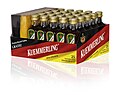
Kuemmerling's signature packaging features distinctive square 20 ml mini-bottles, crafted for easy portability and on-the-go consumption. These compact bottles are typically sold in packs of 3, 12, or 25, allowing consumers to enjoy single servings without needing a larger container. In addition to the mini format, Kuemmerling is available in larger 500 ml bottles, ideal for home storage and extended use, as well as 100 ml hip flasks designed for personal carrying or gifting occasions. The bottles utilize clear glass construction, highlighting the liqueur's deep amber hue, with labeling that embodies traditional German herbal liqueur aesthetics through bold, evocative colors and iconic branding elements.

Variants and Consumption

Available Variants

Kuemmerling's product lineup remains focused on its core herbal tradition, with the original Kräuterlikör serving as the flagship offering since the recipe's development in 1938. This semi-bitter herbal liqueur, produced at 35% ABV, has maintained its unchanged composition of natural herbs, spices, roots, and fruits, emphasizing the brand's commitment to authenticity without significant diversification. In 2020, Kuemmerling introduced Pfefferminz, positioned as the "younger brother" to the original, featuring a infusion for a fresher, mint-forward profile while retaining the square bottle design iconic to the brand. This variant combines English mint, , and gentian notes, resulting in a balanced, bittersweet taste that is less intense than the flagship, bottled at 21% ABV and primarily available in 25-piece 20 ml cube packs. Beyond these two, Kuemmerling has released occasional limited editions, such as the cherry-flavored Kirschgeschmack in 2022 and the spicy Chili-Challenge in 2024, while prioritizing the preservation of its herbal heritage over broader permanent flavor innovations.

Serving Methods and Cultural Role

Kuemmerling is traditionally served as a chilled digestif, typically straight from the mini-bottle or poured into a at temperatures between and 8°C to enhance its refreshing qualities and aid post-meal digestion. This method aligns with its role as a semi-bitter , where the small 20 ml bottles facilitate quick, portable consumption, often straight from the freezer for optimal chill. Beyond neat shots, Kuemmerling features in simple mixed drinks that highlight its versatility. Popular options include the Kuemmerling , prepared by filling a glass with ice, adding 4 cl of Kuemmerling, and topping with for a balanced, effervescent sip. Similarly, mixes with —such as 4 cl Kuemmerling over ice topped with —offer a spicy, refreshing twist, while variations like the Kuemmerling Deluxe incorporate premium soda alongside , , and for a more elaborate . These preparations emphasize its adaptability in casual settings without overpowering its core herbal profile. In German culture, Kuemmerling holds a cherished place as a social lubricant, frequently enjoyed during gatherings, toasts, and festivals like , where it fosters camaraderie among friends and family. Rooted in traditions since its production began in Bodenheim in 1963, it symbolizes regional heritage, with rituals like tapping the bottle on a table before drinking—originally to loosen caps—adding a playful element to shared moments. Its "Chin Up" game, where participants tap, place the cap on the nose, and drink hands-free, further enhances its role in lively northern German celebrations known as "live it up, drink it down." As a piece of enduring German drinking culture, Kuemmerling's popularity has spurred international exports, making it accessible in markets like the and , where it introduces global audiences to its semi-bitter charm while preserving its domestic ritualistic appeal. This expansion underscores its evolution from a local digestif to a worldwide emblem of conviviality.

References

Add your contribution
Related Hubs
Contribute something
User Avatar
No comments yet.