


Community hub
Recent from talks
Contribute something
Nothing was collected or created yet.
LRAC F1
View on WikipediaKey Information


The LRAC F1, officially called Lance-Roquettes AntiChar de 89 mm modèle F1 (89 mm anti-tank rocket launcher model F1), is a French reusable rocket launcher developed by Luchaire Défense SA, and manufactured in cooperation with Manufacture Nationale d'Armes de Saint-Étienne and was, in the 1970s, marketed by Hotchkiss-Brandt.[4]
It replaced the 89 mm M20A1 Super Bazooka in French Army service. Through the use of fiberglass and plastic in the launcher it is over 2 kg (4.4 lb) lighter when loaded than the M20A1, while having a greater effective range. The LRAC F1 is sometimes referred to as the STRIM 89mm antitank rocket launcher from the abbreviations for the private firm Société technique de recherches en industries mécaniques that was contracted in 1964 by the French ministry of defence, to research a replacement for the M20A1 Super Bazooka.
History
[edit]
In the early 1970s, two antitank weapons were placed in production for evaluation by the French Army to replace the M20A1: the 80 mm ACL-APX, a recoilless cannon with a rocket-assisted projectile, and the 89 mm LRAC F1 STRIM rocket launcher. The STRIM design was chosen as the replacement for the M20A1 based on the higher penetration ability of its antitank ammunition and the much lower overall manufacturing costs compared to the 80 mm ACL-APX system.[5][6]
Operation
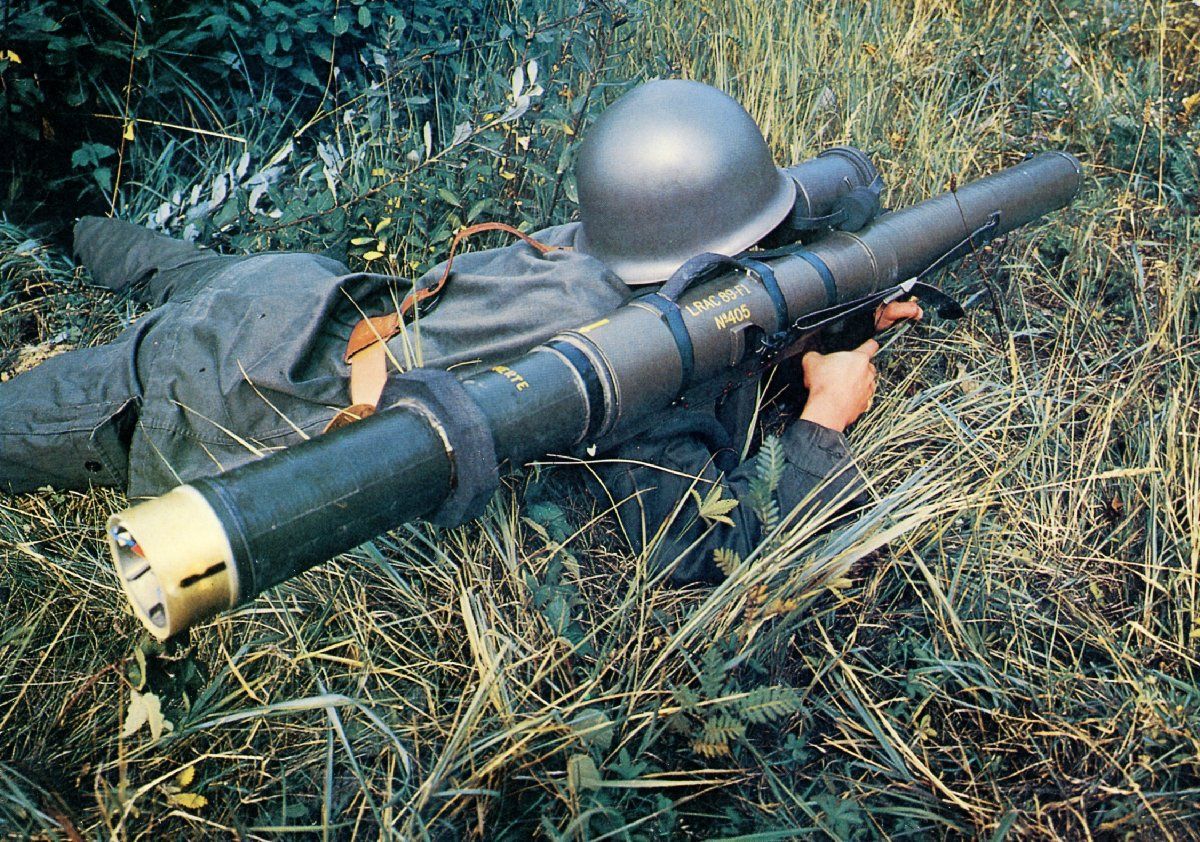
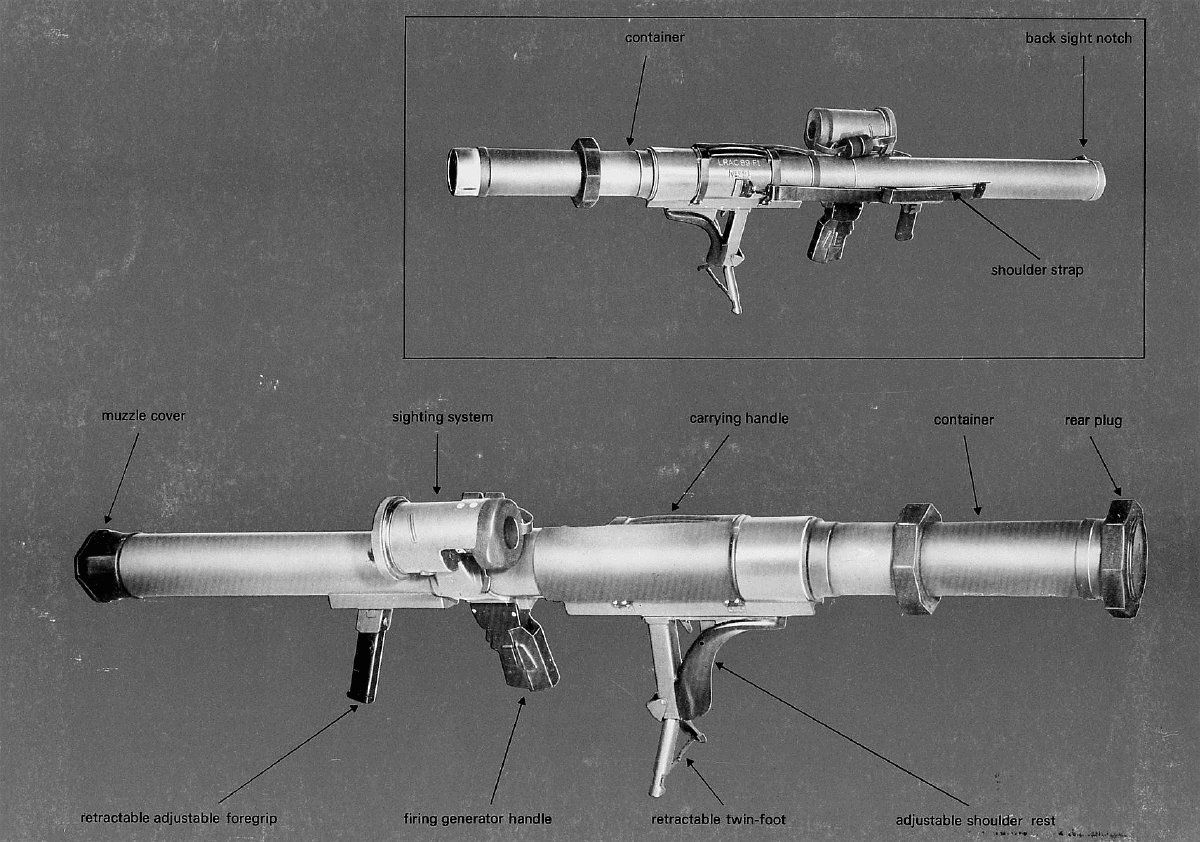
[edit]The launcher is normally operated by a crew of two, a loader and a gunner. The launcher is loaded by attaching a rocket container to the rear of the launcher. When the container is attached, the electrical firing circuit is connected. The rocket container is 626 mm (24.6 in) long and weighs approximately 3.2 kg (7.1 lb). On the left side of the launcher is a 3× APX M 309 optical sight, which is graduated between 100 and 1,000 m (110 and 1,090 yd). The launcher has a shoulder rest and left hand forward grip, both of which may be adjusted to suit the firer. The right hand pistol grip contains a mechanical safety switch and the firing mechanism. When the safety is off, pulling the trigger generates a charge which fires the rocket.

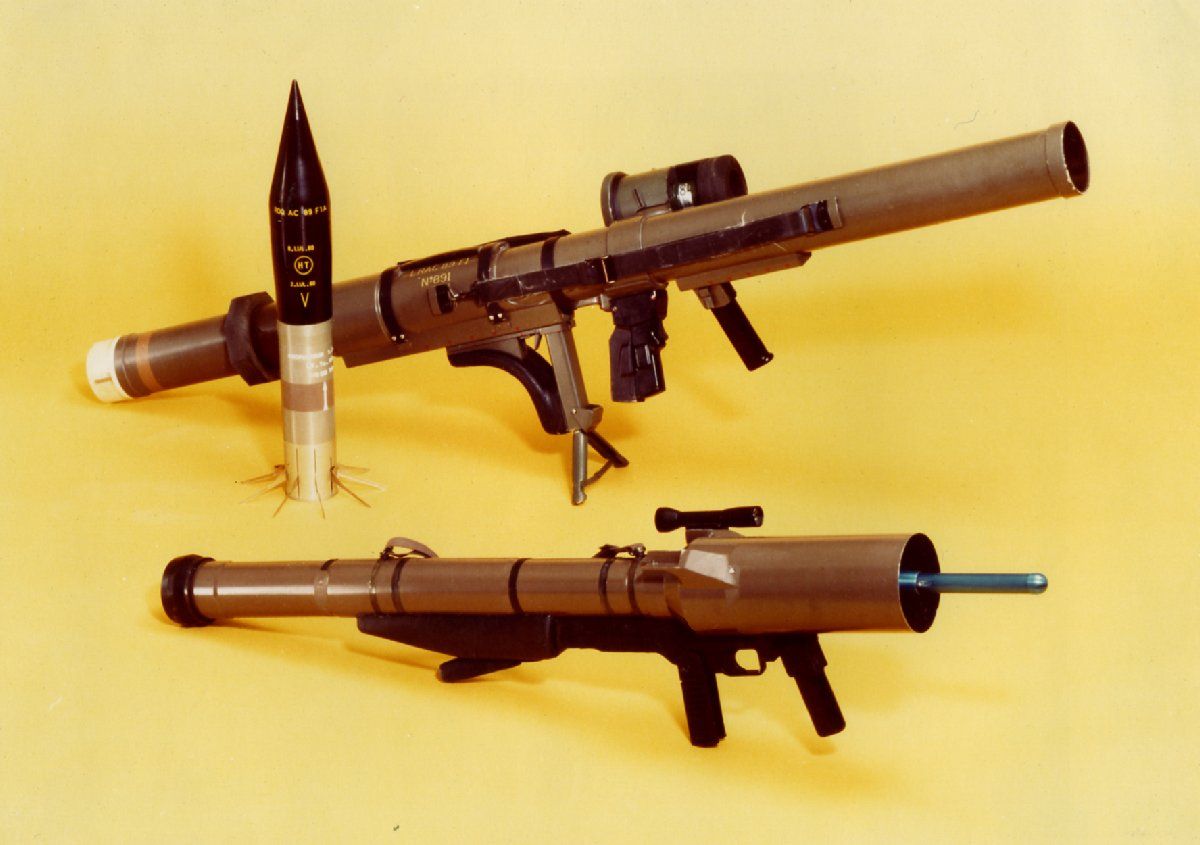
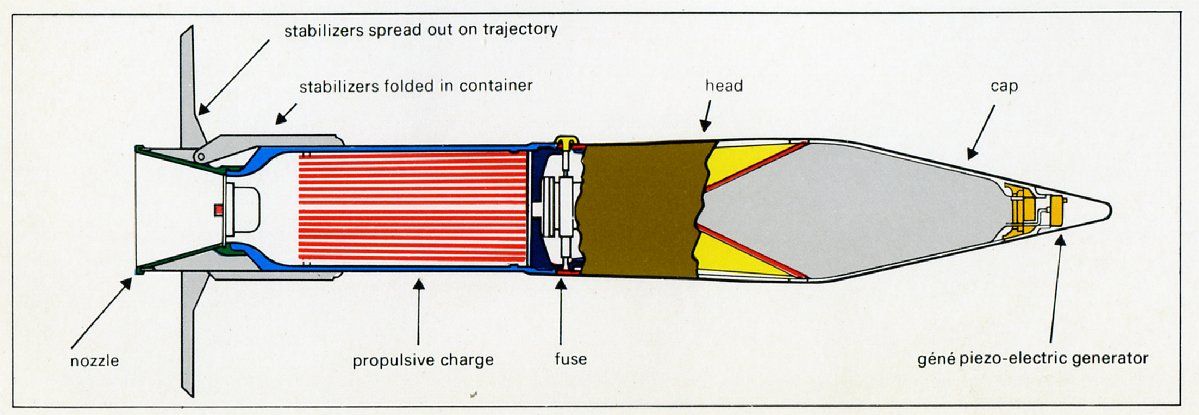
The watertight rear plug of the rocket container is removed just before firing, which closes the firing circuit and allows the rocket to be fired. The rocket is propelled by a large number of long sticks of tubular propellant that produce a constant pressure while burning, providing constant acceleration. The engine burns out before the rocket leaves the launcher at a velocity of approximately 300 m/s (980 ft/s). As soon as the rocket leaves the launcher, nine fins fold backwards from the rear. These fins provide stability for the rocket while it is in flight. There are two safeties. The first is a bore-riding pin located mid-body of the projectile that blocks the warhead firing circuit. After the projectile leaves the tube, the bore-riding pin falls out releasing the second safety which prevents detonation until the rocket has traveled at least 10 m (11 yd) from the launcher. The rocket reaches a range of 330 m (360 yd) in about 1.25 seconds, and 360 m (390 yd) in 1.36 seconds.
The rocket itself weighs 2.2 kg (4.9 lb) and has an 89 mm (3.5 in) diameter shaped charge warhead.[7] The warhead can penetrate 400 mm (16 in) of armour or one metre of concrete at 0 angle impact of the armour plating,[2] and is capable of penetrating NATO single heavy, double medium and double heavy targets while still having enough energy to penetrate multiple 10 mm (0.011 yd) thick steel witness plates.[8][9]

After firing, the rocket container is removed, and a fresh one is inserted. The launcher has a life of approximately 130 firings, after which the optical sight is removed and the launcher is discarded. The optical sight can then be fitted to a fresh launcher.
A number of other rockets were developed for the launcher, including a dual purpose anti-personnel-anti-vehicle rocket with a warhead containing 1,600 steel balls along with a smaller HEAT antiarmour warhead. The steel balls have a lethal radius of approximately 20 m (22 yd) and the shaped charge is capable of penetrating up to 100 mm (3.9 in) of steel plating. A smoke round was developed, that produces smoke for approximately 35 seconds; and an illumination round that produces 300,000 candela for 30 seconds.
Service Use
[edit]Besides the French Army and the Hellenic Army, numerous other armies have the LRAC F1 in service, especially former French colonies in Africa. During the French intervention in Lebanon in 1982-83, many journalists in error reported the LRAC F1 as being the MILAN wire guided antitank missile.
Since 2008, the Swedish AT4-CS (confined space) individual antitank weapon and the 600 m range Eryx wire-guided anti-tank missile have been replacing the LRAC F1 as the standard French military's short range and ultra-short range anti-tank and assault weapon. However, a few LRACs were used during Operation Serval in 2013.[10]
Users
[edit] Benin[11]
 Burkina Faso[11]
 Cameroon[11]
 Cape Verde[11]
 Chad[12][11]
 Central African Republic:[11] 100 received in 1981-1983[13]
 Djibouti[11]
 Gabon[11]
 Greece
 Indonesia[14]
 Ivory Coast[11]
 France
 Kurdistan[15]
 Madagascar[11]
 Morocco[16][11]
 Niger[17]
 Nigeria[11]
 Senegal[11]
 Togo[11]
 Tunisia[11]
 Zaire[11]



References
[edit]- ^ "De 1945 à 1958 : La création de l'industrie missilière". Archived from the original on December 5, 2013.
- ^ a b c d TTA 150 Archived 2010-10-11 at the Wayback Machine, p. 63
- ^ note - AC300 Jupiter was a mid 1980s development of MBB of Germany and Luchaire of France where a MILAN 2 warhead was mounted to an Armbrust launcher, but never placed in production
- ^ Luchaire produces the different rocket projectiles for the LRAC F1 and Manufacture Nationale-d'Armes de Saint Etienne the launcher - both firms are now part of GIAT Industries
- ^ Archer, Denis H R, ed. (1976). Jane's Infantry Weapons (Second Edition) 1976. London: Macdonald and Jane's. pp. 576–578. ISBN 978-0354005319.
- ^ The sight developed for the ACL-APX was adopted for the LRAC F1.
- ^ "LRAC". Weaponsystems.net.
- ^ Jane's Infantry Weapons 1991–1992 gives detail of the penetration as a single heavy target at 65 degrees from the horizontal followed by seven 10 millimetre witness plates, a double heavy target followed by four witness plates, and a double medium target followed by eight witness plates.
- ^ Luchaire, in the mid-1980s, developed a new antitank rocket that had the astonishing penetration of 600 mm (24 in) of armour plating. However, it was not placed in production, as that was still insufficient to defeat the Russian T-62/T-72 main battle tanks in a frontal engagement
- ^ Capdeville, Thibault (Spring 2014). "Infantry units fires during OP Serval" (PDF). Fantassins. No. 32. pp. 55–58.
- ^ a b c d e f g h i j k l m n o p Shea, Dan (February 2010). "LRAC F1: 89mm Shoulder Fired Launcher". Small Arms Review. Vol. 13, no. 5. Archived from the original on 2019-10-18. Retrieved 2018-12-12.
- ^ Allam-Mi, Ahmad (April 2014). Autour du Tchad en guerre: Tractations politiques et diplomatiques 1975 - 1990 (in French). L'Harmattan. pp. 328, 367. ISBN 978-2-343-03157-6.
- ^ Small Arms Survey (2005). "The Central African Republic: A Case Study of Small Arms and Conflict". Small Arms Survey 2005: Weapons at War. Oxford University Press. p. 315. ISBN 978-0-19-928085-8. Archived from the original (PDF) on November 9, 2010.
- ^ Conboy, Kenneth (24 Jan 1991). South-East Asian Special Forces. Elite 33. Osprey Publishing. p. 24. ISBN 9781855321069.
- ^ "France sends new military aid shipments to Kurdistan". Kurdistan24. 15 June 2016. Retrieved 17 August 2017.
- ^ Anthony Cordesman (2016). After The Storm: The Changing Military Balance in the Middle East. Bloomsbury Publishing. p. 112. ISBN 978-1-4742-9257-3.
- ^ "World Infantry Weapons: Niger". 2007–2014. Archived from the original on 24 November 2016.
Bibliography
[edit]- Suermondt, Jan (2004). Illustrated Guide to Combat Weapons. Kent: Grange Books. p. 10.
- Hogg, Ian (1991). Jane's Infantry Weapons 1991–1992. Jane's Information Group. pp. 370–372.

LRAC F1
View on GrokipediaDevelopment and production
Background and requirements
Following World War II, the French Army sought a modern, lightweight, man-portable anti-tank weapon to replace the American M20A1 Super Bazooka, which weighed approximately 6.5 kg unloaded and had an effective range limited to about 300 meters against armored targets.[4][1] This need arose amid the escalating Cold War tensions in Europe, where French infantry required enhanced mobility and firepower to counter the growing threat of Soviet armored formations, emphasizing portable systems that could be carried and operated by a single soldier without compromising tactical flexibility.[1][2] The initial requirements specified a reusable launcher weighing under 5.5 kg, an 89 mm caliber for improved armor penetration over earlier systems like the 73 mm LRAC, and an effective range of at least 300 meters.[1][2] The shaped-charge warhead was designed to penetrate at least 400 mm of rolled homogeneous armor, addressing the limitations of post-war anti-tank munitions against increasingly thicker Soviet tank plating.[2][5] These specifications prioritized infantry portability while ensuring sufficient lethality, with the launcher's fiberglass construction contributing to the reduced weight target.[1][3] In the evaluation process, the 89 mm LRAC design was selected over the competing 80 mm ACL-APX recoilless rifle, which used rocket-assisted projectiles but proved more expensive to produce and offered marginally less penetration efficiency against contemporary armor.[3][6] The choice of 89 mm caliber balanced improved armor defeat capabilities with cost-effectiveness, making it suitable for widespread infantry deployment in NATO-aligned forces.[1][2] Development began in 1964 under the French Ministry of Defence, with research led by the STRIM technical institute, leading to the weapon's adoption in the 1970s.[1][3]Design process
The development of the LRAC F1 was initiated in 1964 when the Société technique de recherches en industries mécaniques (STRIM) received a contract from the French Ministry of Defence to research and develop a lightweight anti-tank rocket launcher as a replacement for the aging M20A1 Super Bazooka.[1] This effort aimed to address the need for a portable, effective infantry weapon capable of engaging modern armored threats.[1] A key innovation in the design was the adoption of fiberglass and plastic composites for the launch tube construction, which reduced the overall weight to 5 kg—approximately 1.5 kg lighter than the Super Bazooka—while ensuring sufficient durability for repeated use.[2][3] The launcher featured an aluminum bore liner within the composite tube to withstand the stresses of firing, and it was engineered for reusability, with a service life of up to 100 shots per tube.[1] These material choices prioritized mobility for a single operator without compromising structural integrity.[3] In the early 1970s, the French Army conducted comparative trials between the STRIM's 89 mm LRAC F1 rocket launcher and the competing 80 mm ACL-APX recoilless rifle design.[1] Testing against armor plates confirmed the LRAC F1's shaped-charge warhead could penetrate 400 mm of rolled homogeneous armor (RHA), establishing its effectiveness against contemporary tanks.[2] The system achieved a muzzle velocity of 295 m/s, contributing to its flat trajectory and accuracy up to 500 m.[2] The LRAC F1 was ultimately selected over the ACL-APX due to its superior penetration performance, higher velocity, reusability, and lower production costs, marking the culmination of iterative prototyping to refine rocket stability and backblast safety protocols.[1] Following these successful evaluations, the weapon entered French Army service in the mid-1970s.[1]Manufacturers and production history
The LRAC F1 launcher was primarily manufactured by the Manufacture Nationale d'Armes de Saint-Étienne, France's national arms factory, while the rockets and ammunition were produced by Luchaire Défense SA.[1][3] The Société technique de recherches en industries mécaniques (STRIM) contributed significantly to the initial development and early production phases through its expertise in mechanical research and prototyping.[1] These entities collaborated closely under French government contracts to meet military specifications for a lightweight, reusable anti-tank system. Production of the LRAC F1 commenced in the early 1970s following its selection over competing designs like the 80 mm ACL-APX recoilless rifle, with initial output focused on equipping French Army infantry and paratrooper units to replace aging M20A1 Super Bazooka stocks.[1][2] Manufacturing peaked during the 1980s to fulfill domestic demands and international orders, leveraging the launcher's durable fiberglass construction for cost-effective scalability.[5] By the late 1980s, production began to wind down as advancements in guided anti-tank missiles reduced the need for unguided rocket systems, leading to full cessation in the early 1990s.[1][2] The LRAC F1 saw extensive export production, distributed to over a dozen nations with historical ties to France, particularly in Africa, including Benin, Burkina Faso, Cameroon, Cape Verde, Central African Republic, Chad, Djibouti, Gabon, Ivory Coast, Madagascar, Morocco, Niger, Nigeria, Senegal, Togo, Tunisia, and Zaire.[5] These exports supported local defense needs in post-colonial contexts, though exact production volumes remain classified and are estimated in the tens of thousands of units combined for launchers and rockets.[2] Licensed manufacturing was limited, with no widespread foreign production lines established beyond French oversight.[1]Design and specifications
Launcher construction
The LRAC F1 launcher features a lightweight construction centered around a fiberglass-reinforced plastic tube, which provides structural strength while enabling reusability for up to 100 shots per unit. This tube incorporates a metal firing mechanism and sights for enhanced precision and longevity, with the overall caliber measuring 89 mm. The launcher's dimensions include a length of 1.17 m and an empty weight of 5 kg, facilitating easy transport by infantry.[2][3][5] Key components of the launcher include the APX M309 optical sight calibrated for ranging targets up to 500 m, a pistol grip for stable handling, an adjustable shoulder stock to accommodate the firer, and a venturi nozzle that directs backblast safely rearward. These elements are integrated into the fiberglass framework, with metal reinforcements where necessary to withstand operational stresses.[5] Ergonomically, the design supports one-man carry through foldable and compact features, yet it is optimized for two-person firing teams to enable efficient positioning and support during engagement. The quick-assembly configuration allows for straightforward rocket integration without complex tools, prioritizing mobility in combat scenarios.[5][1] The launcher's durability is tailored for rugged field conditions, resisting environmental wear while limiting sustained fire to 3-4 rounds per minute to manage heat buildup in the tube. This balance ensures reliability across multiple uses without risking structural failure.[1]Ammunition and rocket
The LRAC F1 is designed to fire 89 mm rockets housed in disposable transport and launch containers that insert directly into the reusable fiberglass launch tube. These rockets feature a high-explosive anti-tank (HEAT) shaped-charge warhead as the standard munition, optimized for penetrating armored vehicles. The warhead employs a metallic liner to form a focused jet upon detonation, capable of defeating up to 400 mm of rolled homogeneous armor (RHA) at 0° obliquity.[5][2] The rocket itself weighs 2.2 kg and utilizes a solid-fuel rocket motor for propulsion, which fully combusts within the launch tube to minimize backblast hazards. This propellant configuration imparts a muzzle velocity of 295 m/s (967 ft/s) to the projectile. The motor's design ensures reliable ignition and acceleration in a closed-breech system, enhancing operator safety during firing.[3][5] While the primary variant in French service was limited to the HEAT round for anti-armor roles, additional types such as multi-purpose (with fragmentation effects), smoke, and illumination were developed and made available, particularly for export markets. These variants maintain compatibility with the standard container packaging, which seals the rocket for transport and storage. No dedicated practice rounds were issued in standard configurations.[2][5]Performance characteristics
The LRAC F1 rocket launcher demonstrates effective engagement ranges of 300 to 500 meters against point and area targets, respectively, with a theoretical maximum range of 2,300 meters for uncontrolled flight.[2][1] This performance positions it as a short-to-medium-range anti-armor system suitable for infantry support in defensive or ambush scenarios, though the unguided nature limits precision at extended distances.[5] Penetration capabilities are provided by its high-explosive anti-tank (HEAT) warhead, which can defeat more than 400 mm of rolled homogeneous armor (RHA) at perpendicular impact or up to 1 meter of reinforced concrete, making it viable against light armored vehicles, bunkers, and fortifications.[5][2] However, effectiveness diminishes against modern main battle tanks equipped with composite armors, ceramics, or reactive armor, as the system's lack of guidance and standoff defeat mechanisms renders it vulnerable to countermeasures.[1] The rate of fire is constrained to 3-4 rounds per minute, primarily due to the 15-20 second reload time required for inserting a new rocket canister into the reusable tube.[2][1] Accuracy is supported by the integrated 3x APX M309 optical sight, which includes range estimation markings from 100 to 1,000 meters and lead adjustments for moving targets at speeds up to 30 km/h, achieving a typical dispersion suitable for static targets within 300 meters; an optional passive night sight extends low-light utility.[5][2] A critical operational limitation is the backblast danger zone extending approximately 10 meters to the rear, necessitating a clear firing position to avoid injury to nearby personnel or equipment.[5]Operation
Crew roles and procedures
The LRAC F1 is operated by a standard two-person crew consisting of a gunner, who is responsible for aiming and firing the weapon, and a loader or assistant, who carries additional rockets and handles reloading during sustained engagements.[3][6] To maintain mobility in mechanized infantry operations, the gunner typically carries the empty launcher, which weighs 5.5 kg including the sight, while the assistant transports 2 to 3 rockets in their sealed fiberglass containers, each weighing 3.2 kg, resulting in a total crew load of under 15 kg.[2][7] Training for LRAC F1 crews emphasizes basic infantry skills, with focused instruction on backblast hazards to ensure clear firing zones and precise sight alignment for effective target engagement.[1] The setup procedure is straightforward and requires no complex arming steps: the gunner extends the flip-up iron sights, the assistant inserts a rocket container into the rear breech, and the gunner then shoulders the launcher to acquire the target.[8][9] In French Army doctrine, LRAC F1 teams were integrated into mechanized infantry platoons as platoon-level assets to provide close-range anti-tank defense.[1]Firing mechanism
The LRAC F1 employs a rear-loading mechanism for its 89 mm rocket, which is housed in a disposable transport and launch container. To load, the assistant gunner inserts the rocket module into the rear breech of the fiberglass launch tube, decaps the forward end, pushes it forward until seated, and rotates it clockwise to engage locking lugs, thereby completing part of the electrical firing circuit. The assistant then removes the moisture-proof back cap from the module to finalize the circuit connection.[5][2] Aiming is facilitated by the detachable APX M290 optical sight, mounted above the pistol grip and offering 3x magnification with adjustable range stadia lines calibrated for targets from 100 to 1,000 meters, though optimal use is between 300 and 500 meters for anti-tank engagements. The sight includes lead marks for moving targets at speeds of 10 to 30 km/h. Elevation and traverse adjustments are performed manually by the operator. Backup iron sights provide a fixed 300-meter zero for emergency use.[5][2] Firing is initiated electrically via a battery-powered system. The operator squeezes the pistol grip to close the initial circuit, then pulls the trigger to activate the striker, igniting the rocket's propellant and launching it from the tube at a muzzle velocity of 295 m/s. The assistant gunner must confirm a clear backblast area behind the launcher before firing to avoid injury from exhaust gases and overpressure. The rocket motor burns out within the tube, minimizing recoil.[5][2] Reloading involves removing the spent launch container from the rear breech after firing, then inserting a new rocket module following the same loading steps. The system supports a maximum rate of fire of 3 to 4 rounds per minute, corresponding to a cycle time of approximately 15 to 20 seconds per shot with a trained crew.[5][2]Safety and maintenance
The LRAC F1 requires strict safety measures to mitigate risks associated with its backblast and firing process. A mandatory 10 m clear rear zone must be established behind the launcher to protect personnel and equipment from the high-velocity exhaust gases and overpressure generated upon firing. Firing from enclosed spaces is prohibited to prevent dangerous pressure buildup and potential structural failure or injury to the crew. The rocket is armed only after complete loading into the tube, ensuring it remains inert during handling and transport.[10][5] Field maintenance for the LRAC F1 focuses on preserving the reusability of the fiberglass tube and associated components. The tube must be cleaned after firings using appropriate solvents to remove propellant residue, which can otherwise accumulate and lead to firing malfunctions. Sights and the battery pack are inspected periodically for alignment, corrosion, and charge levels to maintain accuracy and reliability during operations.[10][1] Storage protocols emphasize environmental protection to extend component longevity. The launcher is stored in dry, temperature-controlled conditions to avoid degradation of the fiberglass structure and electrical contacts, while rockets are kept in sealed, moisture-proof containers positioned away from heat sources or ignition risks. The tube itself is rated for up to 100 firings before requiring replacement.[10][1] Common issues with the LRAC F1 primarily involve propellant residue buildup in the tube, which can cause misfires or incomplete ignition; this is effectively resolved through routine solvent wipes during cleaning. No major recalls or systemic defects have been recorded for the weapon in French military service.[10][5] Crew training underscores the importance of safety compliance. These sessions reinforce protocols briefly referencing reloading steps from operational procedures, ensuring crews maintain proficiency without risking accidents.[10][5]Operational history
French military service
The LRAC F1 entered service with the French Army in the 1970s as a standard-issue light anti-tank weapon for infantry and paratrooper units, replacing the aging M20A1 Super Bazooka.[11][1] This adoption marked a shift toward lighter, more portable shoulder-fired systems suitable for rapid deployment in diverse terrains.[3] It saw early combat use by French paratroopers in the Battle of Kolwezi in Zaire in 1978.[5] During the 1980s, the LRAC F1 became a mainstay in French ground forces, equipping frontline units for anti-armor engagements and general support roles.[5] It saw deployment during the French intervention in Lebanon in 1982–1983 as part of multinational peacekeeping efforts, though often misidentified in reports as the MILAN missile.[12] The weapon was also employed by French Foreign Legion troops in Chad in 1986 and the 1991 Gulf War, where it provided light anti-armor capability against Iraqi vehicles during ground operations in Operation Daguet.[13] In service, the LRAC F1 was praised for its portability and ease of use by individual soldiers or small teams, enabling quick setup in infantry maneuvers.[5] However, it faced criticism for its unguided nature, which limited effectiveness against advanced armored threats like T-72 tanks, and its visible smoke trail that exposed firers to counterfire.[1] Training regimens focused on direct-fire tactics in both urban and open environments to mitigate these limitations.[14] The LRAC F1 began to be gradually phased out from active French Army units starting in the 1990s and 2000s, supplanted by guided systems like the Eryx missile for precision anti-tank roles and the AT4 for disposable launchers, with limited use continuing into the 2010s including Operation Serval in Mali in 2013.[8] Replacement continued gradually, with the French Foreign Legion retiring it in the late 2010s in favor of the AT4 CS.[11]Export users and conflicts
The LRAC F1 was exported to numerous countries, particularly those with historical ties to France, including Benin, Burkina Faso, Cameroon, Cape Verde, Central African Republic, Chad, Djibouti, Gabon, Greece, Indonesia, Ivory Coast, Madagascar, Morocco, Niger, Nigeria, Senegal, Togo, Tunisia, and Zaire (now Democratic Republic of the Congo).[5] These sales occurred primarily during the 1970s and 1980s, with the weapon adopted by infantry and special forces units for anti-tank roles. In Greece, the Hellenic Army integrated the LRAC F1 into its arsenal, with evidence of continued training use by special forces as late as 2016.[15] Indonesia's special forces, including Kopassus and Kostrad, employed the launcher for its portability in counter-insurgency operations, such as in West Papua.[16][3] African operators such as the armed forces of Senegal, Ivory Coast, and Madagascar maintained it as a lightweight shoulder-fired option suitable for their security needs.[5] The LRAC F1 proved battle-tested in international service, demonstrating effectiveness against light armored vehicles in asymmetric engagements by export users.[5] While specific combat instances are limited in public records, its deployment by Indonesian forces in regional operations highlighted its utility in rugged terrains. In Africa, it saw use in conflicts such as the South African Border War, Angolan Civil War, and various low-intensity border security operations. Many export nations retain limited reserve stocks today, with no ongoing production; it was also supplied to Kurdish forces in 2016.[5]Replacement and legacy
Successor systems
The French Army began transitioning away from the LRAC F1 in the 1980s with the adoption of the APILAS (Anti-Personnel Infantry Light Atomic System) 112 mm rocket launcher as an interim solution, selected in 1984 for its superior armor penetration capabilities against emerging threats like composite armor.[17] This reusable system addressed the LRAC F1's limitations in penetrating modern tank armor while serving as a bridge to more advanced weapons.[18] By the mid-1980s, the disposable 84 mm AT4 entered French service for light anti-armor roles, offering simplicity and reduced logistical demands compared to the maintenance-intensive reusable LRAC F1.[11] The AT4's single-use design eliminated the need for reloading and cleaning, making it ideal for infantry units, though initial variants were later upgraded to the confined-space (CS) model in the 1990s for indoor firing capability.[19] Concurrently, the Eryx wire-guided anti-tank missile was developed in the late 1970s specifically to replace the LRAC F1's short-range unguided role, entering service in 1994 with a 600 m effective range and improved guidance for engaging moving targets.[20] These successors provided enhanced lethality—Eryx with precision wire-guided SACLOS options and AT4 with reliable penetration up to 400 mm of rolled homogeneous armor—over the LRAC F1's unguided 400 mm penetration, while reducing operator training and sustainment burdens.[21] The transition culminated in the phased withdrawal of the LRAC F1 by the late 1990s, with AT4 CS and Eryx fully integrating into infantry sections for complementary roles: AT4 for rapid, close-range engagements and Eryx for deliberate anti-tank strikes.[1] Among export users, parallels emerged as Greece, a former LRAC F1 operator, shifted to Rafael's Spike missile family in 2023 for multi-role guided anti-armor capabilities up to 2.5 km.[22] [23] In contrast, many African nations, including Benin, Burkina Faso, and Chad, retained the LRAC F1 into the 21st century due to its low cost and availability of surplus ammunition, avoiding the expense of guided systems.[3] The LRAC F1's lightweight, shoulder-fired design influenced subsequent portable launchers, notably the Yugoslav M79 Osa 90 mm rocket launcher developed in the 1970s, which adopted similar fiberglass construction and sighting mechanics for enhanced portability and accuracy in infantry use.[24]Current status and evaluations
The LRAC F1 has been fully retired from active service in the French Army, with replacement by the AT4-CS and Eryx systems beginning in the 1990s and completing by the late 1990s.[2][3] Globally, residual stocks remain in use for training or reserves in over ten countries, primarily former French colonies in Africa and allies such as Greece, with no new production or procurements reported since the 1990s.[2][1] Modern evaluations assess the LRAC F1 as effective against armored threats typical of the 1970s, such as lightly protected vehicles, but inadequate for contemporary main battle tanks equipped with explosive reactive armor (ERA), due to its high-explosive anti-tank (HEAT) warhead's penetration limited to approximately 400 mm of rolled homogeneous armor (RHA).[5][25] It retains value in low-intensity conflicts for its relatively low cost and simplicity, making it suitable for irregular forces or resource-constrained militaries.[9] Since 2016, no major conflicts involving the LRAC F1 have been documented, though occasional reports note its presence in surplus markets and among insurgents, including in regions like West Papua where Indonesian special forces have employed it.[16] The system's strengths, including high portability at around 5 kg when loaded and reusability of the fiberglass launcher, continue to be highlighted in historical analyses, contrasted with weaknesses such as its unguided ballistic trajectory and insufficient penetration against modern defenses.[5][9] In 2024, the French Army announced plans to replace the Eryx with the Swedish NLAW (Next generation Light Anti-tank Weapon) by 2025-2026, further evolving the anti-tank capabilities that succeeded the LRAC F1.[26][27] Examples of the LRAC F1 are preserved for archival and educational purposes in various military museums, underscoring its role in Cold War-era infantry anti-tank doctrine.[1]References
- https://commons.wikimedia.org/wiki/File:LRAC_Lebanon.jpg
- https://commons.wikimedia.org/wiki/File:LracF1greeksfsea.jpg