Hubbry Logo
Lac operonLac operonMain
Open search
Lac operon
Community hub
Lac operon
logo
8 pages, 0 posts
0 subscribers
Be the first to start a discussion here.
Lac operon
Lac operon
from Wikipedia

The lactose operon (lac operon) is an operon required for the transport and metabolism of lactose in E. coli and many other enteric bacteria. Although glucose is the preferred carbon source for most enteric bacteria, the lac operon allows for the effective digestion of lactose when glucose is not available through the activity of β-galactosidase.[1] Gene regulation of the lac operon was the first genetic regulatory mechanism to be understood clearly, so it has become a foremost example of prokaryotic gene regulation. It is often discussed in introductory molecular and cellular biology classes for this reason. This lactose metabolism system was used by François Jacob and Jacques Monod to determine how a biological cell knows which enzyme to synthesize. Their work on the lac operon won them the Nobel Prize in Physiology in 1965.[1]

Most bacterial cells including E. coli lack introns in their genome. They also lack a nuclear membrane. Hence the gene regulation by lac operon occurs at the transcriptional level, by controlling transcription of DNA.

Bacterial operons are polycistronic transcripts that are able to produce multiple proteins from one mRNA transcript. In this case, when lactose is required as a sugar source for the bacterium, the three genes of the lac operon can be transcribed and their subsequent proteins translated: lacZ, lacY, and lacA. The gene product of lacZ is β-galactosidase which cleaves lactose, a disaccharide, into glucose and galactose. lacY encodes β-galactoside permease, a membrane protein which becomes embedded in the Plasma membrane to enable the cellular transport of lactose into the cell. Finally, lacA encodes β-galactoside transacetylase.

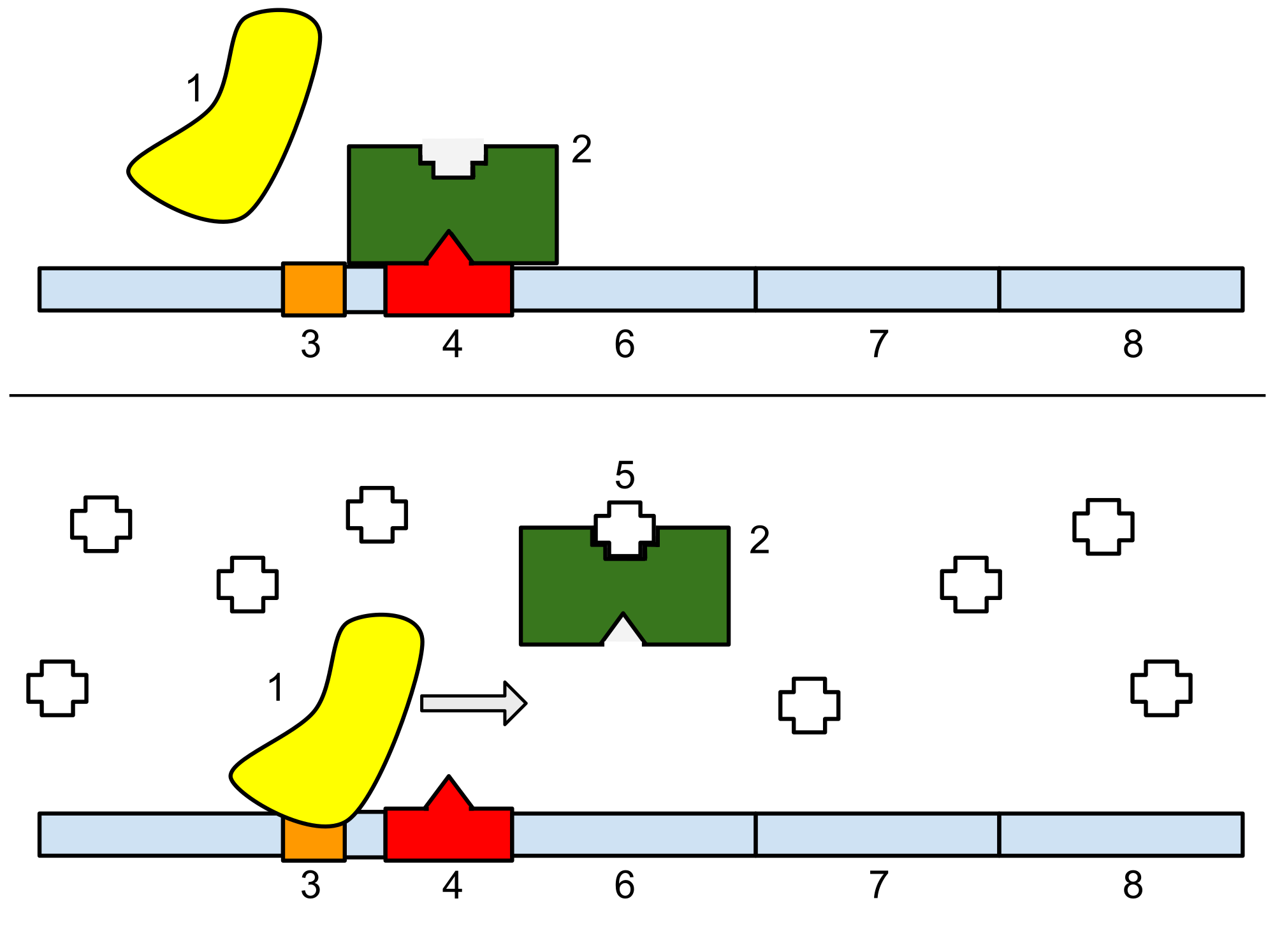
Layout of the lac operon.

The lac operon. Top: Repressed, Bottom: Active.
1: RNA polymerase, 2: Repressor, 3: Promoter, 4: Operator, 5: Lactose, 6: lacZ, 7: lacY, 8: lacA.

Note that the number of base pairs in diagram given above are not to scale. There are in fact over 5300 base pairs in the lac operon.[2]

It would be wasteful to produce enzymes when no lactose is available or if a preferable energy source such as glucose were available. The lac operon uses a two-part control mechanism to ensure that the cell expends energy producing the enzymes encoded by the lac operon only when necessary.[3]

In the absence of lactose, the lac repressor, encoded by lacI, halts production of the enzymes and transport proteins encoded by the lac operon.[4] It does so by blocking the DNA dependent RNA polymerase. This blocking/ halting is not perfect, and a minimal amount of gene expression does take place all the time. The repressor protein is always expressed, but the lac operon (i.e. enzymes and transport proteins) are almost completely repressed, allowing for a small level of background expression. If this weren't the case, there would be no lacY transporter protein in the cellular membrane; consequently, the lac operon would not be able to detect the presence of lactose.

When lactose is available but not glucose, then some lactose enters the cell using pre-existing transport protein encoded by lacY. This lactose then combines with the repressor and inactivates it, hence allowing the lac operon to be expressed. Then more β-galactoside permease is synthesized allowing even more lactose to enter and the enzymes encoded by lacZ and lacA can digest it.

However, in the presence of glucose, regardless of the presence of lactose, the operon will be repressed. This is because the catabolite activator protein (CAP), required for production of the enzymes, remains inactive, and EIIAGlc shuts down lactose permease to prevent transport of lactose into the cell. This dual control mechanism causes the sequential utilization of glucose and lactose in two distinct growth phases, known as diauxie.

Structure

[edit]
Structure of lactose and the products of its cleavage.

Only lacZ and lacY appear to be necessary for lactose catabolic pathway.

By numbers, lacI has 1100 bps, lacZ has 3000 bps, lacY has 800 bps, lacA has 800 bps, with 3 bps corresponding to 1 amino acid.[5]

Genetic nomenclature

[edit]

Three-letter abbreviations are used to describe phenotypes in bacteria including E. coli.

Examples include:

  • Lac (the ability to use lactose),
  • His (the ability to synthesize the amino acid histidine)
  • Mot (swimming motility)
  • SmR (resistance to the antibiotic streptomycin)

In the case of Lac, wild type cells are Lac+ and are able to use lactose as a carbon and energy source, while Lac mutant derivatives cannot use lactose. The same three letters are typically used (lower-case, italicized) to label the genes involved in a particular phenotype, where each different gene is additionally distinguished by an extra letter. The lac genes encoding enzymes are lacZ, lacY, and lacA. The fourth lac gene is lacI, encoding the lactose repressor—"I" stands for inducibility.

One may distinguish between structural genes encoding enzymes, and regulatory genes encoding proteins that affect gene expression. Current usage expands the phenotypic nomenclature to apply to proteins: thus, LacZ is the protein product of the lacZ gene, β-galactosidase. Various short sequences that are not genes also affect gene expression, including the lac promoter, lac p, and the lac operator, lac o. Although it is not strictly standard usage, mutations affecting lac o are referred to as lac oc, for historical reasons.

Regulation

[edit]

Specific control of the lac genes depends on the availability of the substrate lactose to the bacterium. The proteins are not produced by the bacterium when lactose is unavailable as a carbon source. The lac genes are organized into an operon; that is, they are oriented in the same direction immediately adjacent on the chromosome and are co-transcribed into a single polycistronic mRNA molecule. Transcription of all genes starts with the binding of the enzyme RNA polymerase (RNAP), a DNA-binding protein, which binds to a specific DNA binding site, the promoter, immediately upstream of the genes. Binding of RNA polymerase to the promoter is aided by the cAMP-bound catabolite activator protein (CAP, also known as the cAMP receptor protein).[6] However, the lacI gene (regulatory gene for lac operon) produces a protein that blocks RNAP from binding to the operator of the operon. This protein can only be removed when allolactose binds to it, and inactivates it. The protein that is formed by the lacI gene is known as the lac repressor. The type of regulation that the lac operon undergoes is referred to as negative inducible, meaning that the gene is turned off by the regulatory factor (lac repressor) unless some molecule (lactose) is added. Once the repressor is removed, RNAP then proceeds to transcribe all three genes (lacZYA) into mRNA. Each of the three genes on the mRNA strand has its own Shine-Dalgarno sequence, so the genes are independently translated.[7] The DNA sequence of the E. coli lac operon, the lacZYA mRNA, and the lacI genes are available from GenBank (view).

The first control mechanism is the regulatory response to lactose, which uses an intracellular regulatory protein called the lactose repressor to hinder production of β-galactosidase in the absence of lactose. The lacI gene coding for the repressor lies nearby the lac operon and is always expressed (constitutive). If lactose is missing from the growth medium, the repressor binds very tightly to a short DNA sequence just downstream of the promoter near the beginning of lacZ called the lac operator. The repressor binding to the operator interferes with binding of RNAP to the promoter, and therefore mRNA encoding LacZ and LacY is only made at very low levels. When cells are grown in the presence of lactose, however, a lactose metabolite called allolactose, made from lactose by the product of the lacZ gene, binds to the repressor, causing an allosteric shift. Thus altered, the repressor is unable to bind to the operator, allowing RNAP to transcribe the lac genes and thereby leading to higher levels of the encoded proteins.

The second control mechanism is a response to glucose, which uses the catabolite activator protein (CAP) homodimer to greatly increase production of β-galactosidase in the absence of glucose. Cyclic adenosine monophosphate (cAMP) is a signal molecule whose prevalence is inversely proportional to that of glucose. It binds to the CAP, which in turn allows the CAP to bind to the CAP binding site (a 16 bp DNA sequence upstream of the promoter on the left in the diagram below, about 60 bp upstream of the transcription start site),[8] which assists the RNAP in binding to the DNA. In the absence of glucose, the cAMP concentration is high and binding of CAP-cAMP to the DNA significantly increases the production of β-galactosidase, enabling the cell to hydrolyse lactose and release galactose and glucose.

More recently inducer exclusion was shown to block expression of the lac operon when glucose is present. Glucose is transported into the cell by the PEP-dependent phosphotransferase system. The phosphate group of phosphoenolpyruvate is transferred via a phosphorylation cascade consisting of the general PTS (phosphotransferase system) proteins HPr and EIA and the glucose-specific PTS proteins EIIAGlc and EIIBGlc, the cytoplasmic domain of the EII glucose transporter. Transport of glucose is accompanied by its phosphorylation by EIIBGlc, draining the phosphate group from the other PTS proteins, including EIIAGlc. The unphosphorylated form of EIIAGlc binds to the lac permease and prevents it from bringing lactose into the cell. Therefore, if both glucose and lactose are present, the transport of glucose blocks the transport of the inducer of the lac operon.[9]

Repressor structure

[edit]
Tetrameric LacI binds two operator sequences and induces DNA looping. Two dimeric LacI functional subunits (red+blue and green+orange) each bind a DNA operator sequence (labeled). These two functional subunits are coupled at the tetramerization region (labeled); thus, tetrameric LacI binds two operator sequences. This allows tetrameric LacI to induce DNA looping.

The lac repressor is a four-part protein, a tetramer, with identical subunits. Each subunit contains a helix-turn-helix (HTH) motif capable of binding to DNA. The operator site where repressor binds is a DNA sequence with inverted repeat symmetry. The two DNA half-sites of the operator together bind to two of the subunits of the repressor. Although the other two subunits of repressor are not doing anything in this model, this property was not understood for many years.

Eventually it was discovered that two additional operators are involved in lac regulation.[10] One (O3) lies about −90 bp upstream of O1 in the end of the lacI gene, and the other (O2) is about +410 bp downstream of O1 in the early part of lacZ. These two sites were not found in the early work because they have redundant functions and individual mutations do not affect repression very much. Single mutations to either O2 or O3 have only 2 to 3-fold effects. However, their importance is demonstrated by the fact that a double mutant defective in both O2 and O3 is dramatically de-repressed (by about 70-fold).

In the current model, lac repressor is bound simultaneously to both the main operator O1 and to either O2 or O3. The intervening DNA loops out from the complex. The redundant nature of the two minor operators suggests that it is not a specific looped complex that is important. One idea is that the system works through tethering; if bound repressor releases from O1 momentarily, binding to a minor operator keeps it in the vicinity, so that it may rebind quickly. This would increase the affinity of repressor for O1.

Mechanism of induction

[edit]
1: RNA Polymerase, 2: Repressor, 3: Promoter, 4: Operator, 5: Lactose, 6: lacZ, 7: lacY, 8: lacA. Top: The gene is essentially turned off. There is no allolactose to inhibit the lac repressor, so the repressor binds tightly to the operator, which obstructs the RNA polymerase from binding to the promoter, resulting in no laczya mRNA transcripts. Bottom: The gene is turned on. Allolactose inhibits the repressor, allowing the RNA polymerase to bind to the promoter and express the genes, resulting in production of LacZYA. Eventually, the enzymes will digest all of the lactose, until there is no allolactose that can bind to the repressor. The repressor will then bind to the operator, stopping the transcription of the LacZYA genes.

The repressor is an allosteric protein, i.e. it can assume either one of two slightly different shapes, which are in equilibrium with each other. In one form the repressor will bind to the operator DNA with high specificity, and in the other form it has lost its specificity. According to the classical model of induction, binding of the inducer, either allolactose or IPTG, to the repressor affects the distribution of repressor between the two shapes. Thus, repressor with inducer bound is stabilized in the non-DNA-binding conformation. However, this simple model cannot be the whole story, because repressor is bound quite stably to DNA, yet it is released rapidly by addition of inducer. Therefore, it seems clear that an inducer can also bind to the repressor when the repressor is already bound to DNA. It is still not entirely known what the exact mechanism of binding is.[11]

Role of non-specific binding

[edit]

Non-specific binding of the repressor to DNA plays a crucial role in the repression and induction of the Lac-operon. The specific binding site for the Lac-repressor protein is the operator. The non-specific interaction is mediated mainly by charge-charge interactions while binding to the operator is reinforced by hydrophobic interactions. Additionally, there is an abundance of non-specific DNA sequences to which the repressor can bind. Essentially, any sequence that is not the operator, is considered non-specific. Studies have shown, that without the presence of non-specific binding, induction (or unrepression) of the Lac-operon could not occur even with saturated levels of inducer. It had been demonstrated that, without non-specific binding, the basal level of induction is ten thousand times smaller than observed normally. This is because the non-specific DNA acts as sort of a "sink" for the repressor proteins, distracting them from the operator. The non-specific sequences decrease the amount of available repressor in the cell. This in turn reduces the amount of inducer required to unrepress the system.[12]

Lactose analogs

[edit]
IPTG
ONPG
X-gal
allolactose

A number of lactose derivatives or analogs have been described that are useful for work with the lac operon. These compounds are mainly substituted galactosides, where the glucose moiety of lactose is replaced by another chemical group.

  • Isopropyl-β-D-thiogalactopyranoside (IPTG) is frequently used as an inducer of the lac operon for physiological work.[1] IPTG binds to repressor and inactivates it, but is not a substrate for β-galactosidase. One advantage of IPTG for in vivo studies is that since it cannot be metabolized by E. coli. Its concentration remains constant and the rate of expression of lac p/o-controlled genes is not a variable in the experiment. IPTG intake is dependent on the action of lactose permease in P. fluorescens, but not in E. coli.[13]
  • Phenyl-β-D-galactose (phenyl-Gal) is a substrate for β-galactosidase, but does not inactivate repressor and so is not an inducer. Since wild type cells produce very little β-galactosidase, they cannot grow on phenyl-Gal as a carbon and energy source. Mutants lacking repressor are able to grow on phenyl-Gal. Thus, minimal medium containing only phenyl-Gal as a source of carbon and energy is selective for repressor mutants and operator mutants. If 108 cells of a wild type strain are plated on agar plates containing phenyl-Gal, the rare colonies which grow are mainly spontaneous mutants affecting the repressor. The relative distribution of repressor and operator mutants is affected by the target size. Since the lacI gene encoding repressor is about 50 times larger than the operator, repressor mutants predominate in the selection.
  • Thiomethyl galactoside [TMG] is another lactose analog. These inhibit the lacI repressor. At low inducer concentrations, both TMG and IPTG can enter the cell through the lactose permease. However at high inducer concentrations, both analogs can enter the cell independently. TMG can reduce growth rates at high extracellular concentrations.[14]
  • Other compounds serve as colorful indicators of β-galactosidase activity.
    • ONPG is cleaved to produce the intensely yellow compound, orthonitrophenol and galactose, and is commonly used as a substrate for assay of β-galactosidase in vitro.[15]
    • Colonies that produce β-galactosidase are turned blue by X-gal (5-bromo-4-chloro-3-indolyl-β-D-galactoside) which is an artificial substrate for B-galactosidase whose cleavage results in galactose and 4-Cl,3-Br indigo thus producing a deep blue color.[16]
  • Allolactose is an isomer of lactose and is the inducer of the lac operon. Lactose is galactose-β(1→4)-glucose, whereas allolactose is galactose-β(1→6)-glucose. Lactose is converted to allolactose by β-galactosidase in an alternative reaction to the hydrolytic one. A physiological experiment which demonstrates the role of LacZ in production of the "true" inducer in E. coli cells is the observation that a null mutant of lacZ can still produce LacY permease when grown with IPTG, a non-hydrolyzable analog of allolactose, but not when grown with lactose. The explanation is that processing of lactose to allolactose (catalyzed by β-galactosidase) is needed to produce the inducer inside the cell.

Development of the classic model

[edit]

The experimental microorganism used by François Jacob and Jacques Monod was the common laboratory bacterium, E. coli, but many of the basic regulatory concepts that were discovered by Jacob and Monod are fundamental to cellular regulation in all organisms.[17] The key idea is that proteins are not synthesized when they are not needed—E. coli conserves cellular resources and energy by not making the three Lac proteins when there is no need to metabolize lactose, such as when other sugars like glucose are available. The following section discusses how E. coli controls certain genes in response to metabolic needs.

During World War II, Monod was testing the effects of combinations of sugars as nutrient sources for E. coli and B. subtilis. Monod was following up on similar studies that had been conducted by other scientists with bacteria and yeast. He found that bacteria grown with two different sugars often displayed two phases of growth. For example, if glucose and lactose were both provided, glucose was metabolized first (growth phase I, see Figure 2) and then lactose (growth phase II). Lactose was not metabolized during the first part of the diauxic growth curve because β-galactosidase was not made when both glucose and lactose were present in the medium. Monod named this phenomenon diauxie.[18]

Figure 2: Monod's "bi-phasic" growth curve

Monod then focused his attention on the induction of β-galactosidase formation that occurred when lactose was the sole sugar in the culture medium.[19]

Classification of regulatory mutants

[edit]

A conceptual breakthrough of Jacob and Monod[20] was to recognize the distinction between regulatory substances and sites where they act to change gene expression. A former soldier, Jacob used the analogy of a bomber that would release its lethal cargo upon receipt of a special radio transmission or signal. A working system requires both a ground transmitter and a receiver in the airplane. Now, suppose that the usual transmitter is broken. This system can be made to work by introduction of a second, functional transmitter. In contrast, he said, consider a bomber with a defective receiver. The behavior of this bomber cannot be changed by introduction of a second, functional aeroplane.

To analyze regulatory mutants of the lac operon, Jacob developed a system by which a second copy of the lac genes (lacI with its promoter, and lacZYA with promoter and operator) could be introduced into a single cell. A culture of such bacteria, which are diploid for the lac genes but otherwise normal, is then tested for the regulatory phenotype. In particular, it is determined whether LacZ and LacY are made even in the absence of IPTG (due to the lactose repressor produced by the mutant gene being non-functional). This experiment, in which genes or gene clusters are tested pairwise, is called a complementation test.

This test is illustrated in the figure (lacA is omitted for simplicity). First, certain haploid states are shown (i.e. the cell carries only a single copy of the lac genes). Panel (a) shows repression, (b) shows induction by IPTG, and (c) and (d) show the effect of a mutation to the lacI gene or to the operator, respectively. In panel (e) the complementation test for repressor is shown. If one copy of the lac genes carries a mutation in lacI, but the second copy is wild type for lacI, the resulting phenotype is normal—but lacZ is expressed when exposed to inducer IPTG. Mutations affecting repressor are said to be recessive to wild type (and that wild type is dominant), and this is explained by the fact that repressor is a small protein which can diffuse in the cell. The copy of the lac operon adjacent to the defective lacI gene is effectively shut off by protein produced from the second copy of lacI.

If the same experiment is carried out using an operator mutation, a different result is obtained (panel (f)). The phenotype of a cell carrying one mutant and one wild type operator site is that LacZ and LacY are produced even in the absence of the inducer IPTG; because the damaged operator site, does not permit binding of the repressor to inhibit transcription of the structural genes. The operator mutation is dominant. When the operator site where repressor must bind is damaged by mutation, the presence of a second functional site in the same cell makes no difference to expression of genes controlled by the mutant site.

A more sophisticated version of this experiment uses marked operons to distinguish between the two copies of the lac genes and show that the unregulated structural gene(s) is(are) the one(s) next to the mutant operator (panel (g). For example, suppose that one copy is marked by a mutation inactivating lacZ so that it can only produce the LacY protein, while the second copy carries a mutation affecting lacY and can only produce LacZ. In this version, only the copy of the lac operon that is adjacent to the mutant operator is expressed without IPTG. We say that the operator mutation is cis-dominant, it is dominant to wild type but affects only the copy of the operon which is immediately adjacent to it.

This explanation is misleading in an important sense, because it proceeds from a description of the experiment and then explains the results in terms of a model. But in fact, it is often true that the model comes first, and an experiment is fashioned specifically to test the model. Jacob and Monod first imagined that there must be a site in DNA with the properties of the operator, and then designed their complementation tests to show this.

The dominance of operator mutants also suggests a procedure to select them specifically. If regulatory mutants are selected from a culture of wild type using phenyl-Gal, as described above, operator mutations are rare compared to repressor mutants because the target-size is so small. But if instead we start with a strain which carries two copies of the whole lac region (that is diploid for lac), the repressor mutations (which still occur) are not recovered because complementation by the second, wild type lacI gene confers a wild type phenotype. In contrast, mutation of one copy of the operator confers a mutant phenotype because it is dominant to the second, wild type copy.

Regulation by cyclic AMP

[edit]

Source:[21]

Explanation of diauxie depended on the characterization of additional mutations affecting the lac genes other than those explained by the classical model. Two other genes, cya and crp, subsequently were identified that mapped far from lac, and that, when mutated, result in a decreased level of expression in the presence of IPTG and even in strains of the bacterium lacking the repressor or operator. The discovery of cAMP in E. coli led to the demonstration that mutants defective the cya gene but not the crp gene could be restored to full activity by the addition of cAMP to the medium.

The cya gene encodes adenylate cyclase, which produces cAMP. In a cya mutant, the absence of cAMP makes the expression of the lacZYA genes more than ten times lower than normal. Addition of cAMP corrects the low Lac expression characteristic of cya mutants. The second gene, crp, encodes a protein called catabolite activator protein (CAP) or cAMP receptor protein (CRP).[22]

However the lactose metabolism enzymes are made in small quantities in the presence of both glucose and lactose (sometimes called leaky expression) due to the fact that the RNAP can still sometimes bind and initiate transcription even in the absence of CAP. Leaky expression is necessary in order to allow for metabolism of some lactose after the glucose source is expended, but before lac expression is fully activated.

In summary:

  • When lactose is absent then there is very little Lac enzyme production (the operator has Lac repressor bound to it).
  • When lactose is present but a preferred carbon source (like glucose) is also present then a small amount of enzyme is produced (Lac repressor is not bound to the operator).
  • When glucose is absent, CAP-cAMP binds to a specific DNA site upstream of the promoter and makes a direct protein-protein interaction with RNAP that facilitates the binding of RNAP to the promoter.

The delay between growth phases reflects the time needed to produce sufficient quantities of lactose-metabolizing enzymes. First, the CAP regulatory protein has to assemble on the lac promoter, resulting in an increase in the production of lac mRNA. More available copies of the lac mRNA results in the production (see translation) of significantly more copies of LacZ (β-galactosidase, for lactose metabolism) and LacY (lactose permease to transport lactose into the cell). After a delay needed to increase the level of the lactose metabolizing enzymes, the bacteria enter into a new rapid phase of cell growth.

lac operon in detail

Two puzzles of catabolite repression relate to how cAMP levels are coupled to the presence of glucose, and secondly, why the cells should even bother. After lactose is cleaved it actually forms glucose and galactose (easily converted to glucose). In metabolic terms, lactose is just as good a carbon and energy source as glucose. The cAMP level is related not to intracellular glucose concentration but to the rate of glucose transport, which influences the activity of adenylate cyclase. (In addition, glucose transport also leads to direct inhibition of the lactose permease.) As to why E. coli works this way, one can only speculate. All enteric bacteria ferment glucose, which suggests they encounter it frequently. It is possible that a small difference in efficiency of transport or metabolism of glucose v. lactose makes it advantageous for cells to regulate the lac operon in this way.[23]

Use in molecular biology

[edit]

The lac gene and its derivatives are amenable to use as a reporter gene in a number of bacterial-based selection techniques such as two hybrid analysis, in which the successful binding of a transcriptional activator to a specific promoter sequence must be determined.[16] In LB plates containing X-gal, the colour change from white colonies to a shade of blue corresponds to about 20–100 β-galactosidase units, while tetrazolium lactose and MacConkey lactose media have a range of 100–1000 units, being most sensitive in the high and low parts of this range respectively.[16] Since MacConkey lactose and tetrazolium lactose media both rely on the products of lactose breakdown, they require the presence of both lacZ and lacY genes. The many lac fusion techniques which include only the lacZ gene are thus suited to X-gal plates[16] or ONPG liquid broths.[24]

See also

[edit]

References

[edit]
[edit]
Revisions and contributorsEdit on WikipediaRead on Wikipedia
from Grokipedia
The lac operon is a genetic regulatory in the bacterium that controls the coordinated expression of genes required for metabolism, enabling the cell to utilize as a carbon source only when it is available and preferred glucose is absent. This inducible exemplifies negative and positive in prokaryotes, where transcription is repressed under default conditions but activated in response to environmental signals. Discovered through studies on diauxic growth—the preferential use of glucose over lactose—by François Jacob and Jacques Monod in the early 1960s, the lac operon model revolutionized understanding of gene regulation. Their 1961 paper proposed the operon as a functional unit of DNA comprising an operator, promoter, and linked structural genes transcribed into a single polycistronic mRNA, with a separate regulator gene producing a diffusible repressor. This framework, which earned Jacob, Monod, and André Lwoff the 1965 Nobel Prize in Physiology or Medicine, demonstrated how bacteria adapt enzyme synthesis to nutritional needs without altering DNA sequence. Structurally, the lac operon spans approximately 5,300 base pairs and includes three structural genes: lacZ, encoding (an that hydrolyzes into glucose and ); lacY, encoding lactose permease (a transporter that facilitates lactose uptake); and lacA, encoding thiogalactoside transacetylase (an whose precise biological role is uncertain but is thought to detoxify non-metabolizable galactosides by acetylation). Upstream lie the promoter region (where binds) and the operator (a DNA sequence overlapping the transcription start site), while the protein is encoded by the adjacent lacI gene. The binds the primary operator (O1) and auxiliary sites (O2 and O3) to form a DNA loop that blocks transcription initiation in the absence of inducer. Regulation involves both negative control by the and positive control via the (CAP). In the presence of , it is converted to , which binds the as an inducer, causing a conformational change that releases it from the operator and allows transcription. Concurrently, low glucose levels increase cyclic AMP (cAMP), which binds CAP to form a complex that enhances recruitment at the promoter, ensuring full induction only under lactose-rich, glucose-poor conditions. This dual mechanism prevents wasteful enzyme production, with basal expression levels sufficient for initial lactose entry via .

Genetic Structure

Operon Components and Organization

The lac operon in Escherichia coli consists of three adjacent structural genes—lacZ, lacY, and lacA—that are cotranscribed into a single polycistronic mRNA under the control of a shared promoter and operator, enabling coordinated expression of proteins for lactose metabolism. The lacZ gene encodes β-galactosidase, an enzyme that hydrolyzes lactose into glucose and galactose. The lacY gene encodes lactose permease, a membrane transporter that facilitates the symport of lactose and H⁺ into the cytoplasm using the proton motive force. The lacA gene encodes thiogalactoside transacetylase, which acetylates nonmetabolizable galactosides to detoxify potentially harmful analogs. The operon's regulatory architecture features the P_lac promoter, which includes consensus -35 (TTGACA) and -10 (TATAAT) boxes recognized by the σ⁷⁰ subunit of for transcription initiation, and the operator (O), a DNA overlapping the transcription start site that serves as the binding site for the . Upon induction, transcribes the ~5.3 kb polycistronic mRNA encompassing lacZ (~3 kb), lacY (~0.8 kb), lacA (~0.6 kb), and intergenic regions, terminating downstream of lacA via a ρ-independent terminator with a G+C-rich . The upstream lacI gene (~1.1 kb), transcribed from its own promoter, encodes the protein that binds the operator to repress transcription in the absence of inducer. This genetic unit is positioned at approximately 8 min on the E. coli chromosome map (coordinates ~360–380 kb), with the full region including lacI spanning roughly 5.4 kb. As a classic example of prokaryotic organization, the lac operon illustrates gene clustering for stoichiometric and temporal coordination of metabolic enzymes, likely arising through of coregulated modules to enhance adaptive fitness in variable nutrient environments.

Genetic Nomenclature and Mapping

The genetic for the lac operon was established by and Monod based on their of mutants affecting metabolism in . The three structural genes are named lacZ, encoding β-galactosidase; lacY, encoding galactoside permease; and lacA, encoding galactoside transacetylase. The regulatory gene is designated lacI, which specifies the protein, while lacO denotes the operator site and lacP the promoter region. Mutations in these elements are denoted using superscript symbols or dashes following the gene name, such as lacZ^- for nonfunctional alleles, lacI^- for mutants lacking activity leading to constitutive expression, lacI^s for superrepressor alleles that produce inducer-insensitive s, and lacO^c for constitutive operator mutations resistant to binding. These notations allow precise classification of phenotypes in genetic analyses. A key distinction in the nomenclature reflects the functional properties of the elements: the operator (lacO) and promoter (lacP) are cis-acting, exerting control only over adjacent on the same , as demonstrated by their dominance in cis configurations in partial diploids. In contrast, the encoded by lacI is , capable of diffusing and regulating operons on separate DNA molecules. Early genetic mapping of the lac operon relied on Hfr conjugation experiments, where high-frequency recombination strains transferred the lac region into recipient cells, allowing measurement of entry times to approximate relative positions. Deletion mapping further refined boundaries by identifying overlapping deletions that abolished specific functions, while three-point crosses involving selected markers determined recombination frequencies and gene order. These methods established the linear arrangement with lacI proximal to lacO, followed closely by lacZ, lacY, and lacA. Mutants such as lacI^- (inducible due to absent ) and lacO^c (constitutive regardless of ) were instrumental in resolving the positions of regulatory sites relative to structural through complementation and dominance tests. Subsequent genome sequencing of E. coli K-12 MG1655 ( accession NC_000913.3) has confirmed the operon's location at approximately 366 kb on the chromosome, with lacI spanning positions 364,958–365,878, the regulatory elements immediately upstream of lacZ (starting at 365,879), and the full structural cluster ending at 370,328. This integration validates the historical mapping, showing the promoter-operator region as a compact ~100 sequence upstream of lacZ, including the CAP-binding site, -35 and -10 promoter boxes, and operator overlap.

Regulatory Mechanisms

The Lac Repressor and Operator Interaction

The lac repressor, encoded by the lacI gene, is a tetrameric protein composed of four identical monomers, each comprising 360 amino acids. Each monomer features distinct structural domains: an N-terminal DNA-binding domain (residues 1–49) containing a helix-turn-helix motif that recognizes specific DNA sequences; a core domain (residues 60–330) responsible for inducer binding and allosteric regulation; and a C-terminal domain (residues 341–360) that mediates tetramerization through a short alpha-helix, enabling the protein to bind two operator sites simultaneously. The tetrameric structure, with a molecular weight of approximately 155 kDa, allows for high-affinity, cooperative binding to the operator DNA, ensuring tight control over operon expression in the absence of inducers. The primary operator site, O1, is a palindromic DNA sequence of 21 base pairs (5'-AATTGTGAGCGGATAACAATT-3'), located immediately downstream of the lac promoter and overlapping the transcription start site. The lac operon contains three operator sequences: the high-affinity main operator O1 and two auxiliary operators, O2 (downstream within the lacZ gene) and O3 (upstream near lacI). The tetramer binds specifically to O1 with an equilibrium dissociation constant (K_d) of approximately 10^{-13} M, while affinities for O2 and O3 are about 10- to 20-fold lower. This binding sterically hinders progression, preventing transcription initiation and establishing basal repression. Repression is further enhanced by DNA looping, where the tetrameric simultaneously binds O1 and either auxiliary operator O2 (~401 bp downstream) or O3 (~93 bp upstream), forming stable loops that increase repression efficiency approximately 50-fold compared to O1 binding alone. This auxiliary interaction stabilizes the -operator complex, reducing the off-rate and contributing to the overall repression ratio of about 10^3 between uninduced and induced states. In the absence of inducers, the also engages in non-specific binding to DNA, sliding along the genome via across roughly 10^6 non-specific sites, which accelerates the search for and encounter with the operator by orders of magnitude compared to three-dimensional alone.

Induction by Allolactose and Analogs

In the presence of lactose, the lac operon is induced through the formation of , a natural of produced by the basal activity of . This enzyme, present at low levels even in uninduced cells, catalyzes the transgalactosylation of lactose to yield allolactose at a rate of approximately 5-10% relative to lactose . Allolactose then binds to the inducer-binding sites in the core domains of the tetramer, triggering an allosteric conformational shift that diminishes the repressor's affinity for the operator DNA by about 1,000-fold, from a dissociation constant of ~10^{-13} M to ~10^{-10} M. This derepression allows to initiate transcription of the lac genes. The kinetics of inducer binding and operon activation are rapid, reflecting the need for quick metabolic adaptation. The dissociation constant (K_d) for allolactose binding to the repressor is approximately 6 \times 10^{-7} M, enabling efficient induction at physiological concentrations. Upon addition of inducer, mRNA synthesis begins within seconds, and full expression of and other operon proteins is achieved in 2-3 minutes, as measured by activity assays during time-course experiments. This swift response is facilitated by the allosteric mechanism, where inducer binding stabilizes an open conformation of the repressor, preventing operator association. Synthetic lactose analogs serve as powerful tools for studying induction, bypassing the need for metabolic conversion. Isopropyl β-D-1-thiogalactopyranoside (IPTG) acts as a gratuitous inducer, binding the with a K_d of ~10^{-6} M without being hydrolyzed or further metabolized by β-galactosidase, allowing sustained derepression. Similarly, methyl-β-D-thiogalactopyranoside (TMG) induces the but with lower affinity (K_d ~10^{-3} M), making it particularly useful for investigating lac permease function, as TMG uptake depends on the permease itself. These analogs mimic allolactose's allosteric effects but enable precise control in experimental settings. Induction is amplified by involving the lacY-encoded permease. As the operon is derepressed, increased permease synthesis enhances lactose influx into the cell, raising intracellular concentrations and further promoting formation, which sustains high expression levels. This loop ensures robust activation once initiated. Physiologically, the system maintains repression in the absence of to conserve resources, with half-maximal induction occurring at an external threshold of ~0.2 mM, corresponding to intracellular levels sufficient for repressor inactivation.

Catabolite Repression via cAMP-CAP

Catabolite repression in the lac operon occurs when glucose is present, overriding the potential induction by lactose through a mechanism involving reduced intracellular levels of cyclic adenosine monophosphate (cAMP). Glucose transport into Escherichia coli via the phosphotransferase system (PTS) leads to dephosphorylation of the PTS component enzyme IIAGlc, which in its dephosphorylated form inhibits adenylate cyclase activity. This inhibition lowers cAMP synthesis, preventing the formation of the active cAMP-catabolite activator protein (CAP) complex. The CAP binding site, located upstream of the -35 promoter box at approximately position -61.5, remains unoccupied without this complex, resulting in minimal transcription of the lac operon genes even if the repressor is inactivated by an inducer. CAP is a dimeric protein, with each subunit featuring a C-terminal helix-turn-helix motif that facilitates specific DNA binding upon activation by cAMP. Binding of cAMP to CAP occurs with a dissociation constant (KdK_d) of approximately 10610^{-6} M, inducing a conformational change that exposes the DNA-binding domain. The cAMP-CAP complex then binds to the symmetric 22-base-pair CAP site, bending the DNA by about 90 degrees to facilitate recruitment of RNA polymerase to the promoter, thereby enhancing transcription initiation up to 50-fold. In the absence of glucose, intracellular cAMP levels rise to around 10410^{-4} M, enabling full CAP activation and relief from repression. This positive activation by cAMP-CAP integrates with the negative regulation by the lac repressor, requiring both derepression (via inducer binding to the repressor) and CAP-mediated enhancement for maximal lac operon expression. The resulting hierarchy prioritizes glucose utilization, as evidenced by diauxic growth patterns where E. coli exhausts glucose before metabolizing lactose, leading to a temporary growth lag. Post-2000 studies have elucidated the PTS's role in fine-tuning cAMP levels through dynamic phosphorylation states of IIAGlc, which not only modulates adenylate cyclase but also influences inducer uptake to reinforce repression. Engineered CAP variants, such as those with altered cAMP affinity or DNA-binding specificity, have been developed to create tunable promoters for controlled in applications.

Historical Development

Discovery and Early Models

In the 1940s, Jacques Monod at the Pasteur Institute began investigating enzyme induction in bacteria, focusing on the adaptive synthesis of β-galactosidase, an enzyme in Escherichia coli that hydrolyzes lactose into glucose and galactose. Monod's early studies revealed that β-galactosidase levels increased dramatically in the presence of lactose, suggesting a regulatory mechanism linking substrate availability to enzyme production. This work built on observations of diauxic growth, where E. coli preferentially utilized glucose over lactose in mixed media, halting lactose metabolism until glucose was depleted—a phenomenon Monod first described in his 1941 doctoral dissertation and elaborated in subsequent publications. These findings highlighted glucose-mediated repression of lactose-utilizing enzymes, setting the stage for genetic analyses of regulation. A pivotal experiment, known as the PaJaMo experiment, was conducted between 1957 and 1959 by Arthur Pardee, François Jacob, and Jacques Monod. Using partial diploid strains of E. coli created via conjugation, they demonstrated zygotic induction: when a chromosome carrying a wild-type lacI gene (encoding a repressor) entered a cell with a constitutive lacZ mutation (leading to constant β-galactosidase production), enzyme synthesis was rapidly repressed. This showed that the repressor was a diffusible cytoplasmic product, not directly coupled to the structural genes, providing key evidence for a trans-acting regulatory factor. β-Galactosidase assays, measuring enzymatic activity via colorimetric substrates like o-nitrophenyl-β-D-galactoside, were central to quantifying induction and repression in these strains. In 1961, and Monod proposed the operon model to explain coordinated of metabolism genes. They hypothesized a "coordinator" gene (lacI) producing a that binds a cis-acting operator site, blocking transcription of adjacent structural genes (lacZ, lacY, lacA) unless inactivated by an inducer like . The model predicted that these genes form a functional unit transcribed as a single polycistronic mRNA, a concept later confirmed through hybridization and sequencing studies in the early 1960s. Early supporting evidence came from constitutive mutants, which lacked functional repressors and expressed constitutively, as assayed in wild-type versus mutant strains. Their contributions to genetic earned , Monod, and Lwoff the 1965 in or . The initial operon model emphasized negative control via the but overlooked positive regulation, particularly the role of (CAP) and cyclic AMP (cAMP) in relieving glucose repression. This gap, evident in incomplete explanations of diauxie, was addressed in the 1970s with discoveries showing CAP-cAMP binding enhances transcription under low glucose conditions. Modern refinements incorporate these elements, providing a more complete view of operon dynamics.

Isolation and Classification of Mutants

The isolation of lac operon mutants in the 1960s relied on chemical and physical mutagenesis followed by selective screening to identify defects in gene regulation and expression. Mutagenesis was typically induced using ultraviolet (UV) light to generate point mutations or proflavin, an acridine dye that promotes frameshift mutations, applied to Escherichia coli strains grown in liquid culture. Following mutagenesis, survivors were plated on indicator media such as MacConkey lactose agar, where Lac⁺ colonies appeared red due to acid production from lactose metabolism, while Lac⁻ mutants formed white colonies, allowing visual distinction of β-galactosidase-deficient strains. Mutants were classified based on their phenotypic effects on lac operon expression, primarily through enzymatic assays measuring and permease activities. The i⁻ class comprised repressor-deficient mutants leading to constitutive expression of the operon genes, as the absence of functional LacI allowed continuous transcription even without inducer; these were recessive and . In contrast, iˢ (superrepressor) mutants produced an altered insensitive to inducers like , resulting in non-inducible, dominant repression of the operon. Operator constitutive (oᶜ) mutants involved cis-dominant alterations in the operator sequence, preventing binding and leading to constitutive expression only of genes on the same DNA molecule. Structural gene mutants, such as z⁻, disrupted function, yielding non-functional enzyme protein often detectable by CRM (cross-reacting material) assays, while y⁻ affected permease. To distinguish cis- from trans-acting effects, partial diploid analysis was performed using F' plasmids carrying lac region segments, creating stable merozygotes. For example, in an i⁺ z⁻ / F' i⁻ z⁺ strain, the wild-type (i⁺) acted in to repress the F' , confirming diffusible repressor nature; conversely, oᶜ mutations affected only the cis-linked genes. Such diploids quantified dominance and complementation, with i⁺ dominating over i⁻ in configurations. Mutants related to catabolite repression included crp⁻ (defective in cAMP receptor protein, ) and cya⁻ (adenylate cyclase deficient, lacking cAMP synthesis), isolated in the late ; these exhibited poor lac induction on non-glucose media despite inducer presence, confirming the cAMP-CAP pathway's role in positive activation. Zubay and colleagues used and selection on indicator media to map these, showing they relieved glucose-mediated repression when exogenous cAMP was added. These mutants enabled precise quantification of regulatory dynamics, revealing a ~1000-fold in wild-type cells under non-inducing conditions, validated through diploid complementation and enzymatic assays. By 1970, approximately 100 lac mutants had been genetically mapped, solidifying the model and distinguishing regulatory elements from structural genes.

Applications in Molecular Biology

Role in Recombinant DNA Techniques

The lac operon's promoter has been instrumental in techniques since the 1970s, enabling controlled cloning and expression of foreign s in bacterial hosts. Foundational experiments by and colleagues in 1973 constructed the first biologically functional recombinant plasmids, demonstrating joining of DNA fragments to create chimeric molecules that could replicate in , paving the way for gene libraries under regulated control like that of the lac system. Subsequent developments in the mid-1970s incorporated the lac promoter for inducible expression, allowing precise manipulation of inserted genes and facilitating the revolution. A key application is the use of the lac promoter in high-copy-number vectors such as the pUC series, developed in the early , which feature the lacZα fragment encoding the α-peptide of for α-complementation-based screening. In these plasmids, a (MCS) is engineered within the lacZα , positioned downstream of the lac promoter. Insertion of foreign DNA into the MCS disrupts the α-peptide sequence, leading to insertional inactivation; this prevents functional formation when complemented by the host's ω-peptide. Recombinant clones thus fail to hydrolyze (5-bromo-4-chloro-3-indolyl-β-D-galactopyranoside), a chromogenic substrate, resulting in white colonies on indicator plates supplemented with IPTG, while non-recombinant plasmids produce blue colonies. IPTG, a non-metabolizable analog of , induces the lac promoter to drive lacZα expression. This blue-white screening method streamlines identification of successful ligations, enhancing efficiency. For protein production, the lac promoter powers advanced expression systems like the pET vectors, which employ a hybrid T7-lac promoter where the strong T7 promoter is repressed by the lac operator until induction. Developed based on T7 technology, these vectors allow IPTG-inducible expression of target genes fused to the T7 promoter in E. coli strains lysogenized with a DE3 encoding T7 under lacUV5 control. This setup yields high-level protein accumulation, often comprising up to 50% of total cellular protein in optimized strains, due to the polymerase's selectivity and the lac system's tight regulation, minimizing basal leakage. The approach's advantages include low uninduced expression levels for toxic proteins, ease of scalability in fermenters, and compatibility with affinity purification tags; however, its prokaryotic bias limits direct use in eukaryotic systems, where alternatives like viral promoters are preferred.

Use in Gene Expression Studies and Synthetic Biology

The lac operon has been instrumental in developing quantitative models for , particularly through thermodynamic frameworks that predict transcriptional output based on repressor-operator binding affinities and activator contributions. These models incorporate binding probabilities for the LacI repressor and CAP protein, enabling precise forecasting of induction levels in response to inducers like IPTG. For instance, thermodynamic analyses have reconciled kinetic rate equations with equilibrium binding energies, demonstrating how LacI occupancy modulates promoter activity across a range of inducer concentrations, which enhances predictability in engineered systems. Such models have been validated , showing close agreement between predicted and measured repression strengths for LacI mutants, thereby supporting their use in for designing reliable genetic circuits. Tunable variants of lac components have expanded their utility in fine-tuned gene regulation. The lacUV5 promoter, featuring a mutated -10 box that increases affinity, serves as a stronger, IPTG-inducible alternative to the wild-type lac promoter, facilitating higher expression levels in glucose-containing media. Orthogonal LacI variants, such as chimeric fusions with GalR DNA-binding domains, enable independent regulation of multiple promoters without cross-talk, allowing multi-input logic gates in complex circuits. These modifications improve and , making them valuable for applications requiring precise control over . In , lac elements form the basis of foundational genetic circuits, including bistable toggle switches and oscillators. The lac-ara hybrid toggle switch, combining LacI repression with AraC activation, maintains stable memory states that toggle via chemical inducers, as demonstrated in early implementations. Similarly, the repressilator circuit incorporates LacI alongside and λ cI repressors to generate sustained oscillations in protein levels, providing a model for temporal control in cellular networks. Since , iGEM competitions have leveraged these lac-based circuits in diverse projects, from biosensors to metabolic pathways, fostering standardized parts libraries that promote . LacZ and lacY reporter fusions remain standard for quantifying promoter strength and metabolic flux in engineering contexts. By integrating lacZ upstream of target promoters, β-galactosidase activity assays enable high-throughput measurement of transcriptional output, while lacY fusions track permease-mediated transport rates to assess pathway bottlenecks. In , these reporters have optimized flux through utilization pathways, such as in ljungdahlii for production, by correlating levels with product yields. Recent advances in the integrate lac regulation with emerging technologies for enhanced control. CRISPR-Cas9 systems under lacUV5 promoters enable inducible in E. coli, allowing temporal activation of knock-ins like T7 for on-demand expression. Optogenetic variants, such as OptoLAC and OptoLacI, replace IPTG with light-responsive domains in LacI, achieving blue-light-inducible derepression for spatiotemporal and chemical , with up to 10-fold improvements over chemical induction.

References

Add your contribution
Related Hubs
User Avatar
No comments yet.