Hubbry Logo
Lars Magnus EricssonLars Magnus EricssonMain
Open search
Lars Magnus Ericsson
Community hub
Lars Magnus Ericsson
logo
8 pages, 0 posts
0 subscribers
Be the first to start a discussion here.
Lars Magnus Ericsson
from Wikipedia
Bust of L. M. Ericsson at Telefonplan in Stockholm

Key Information

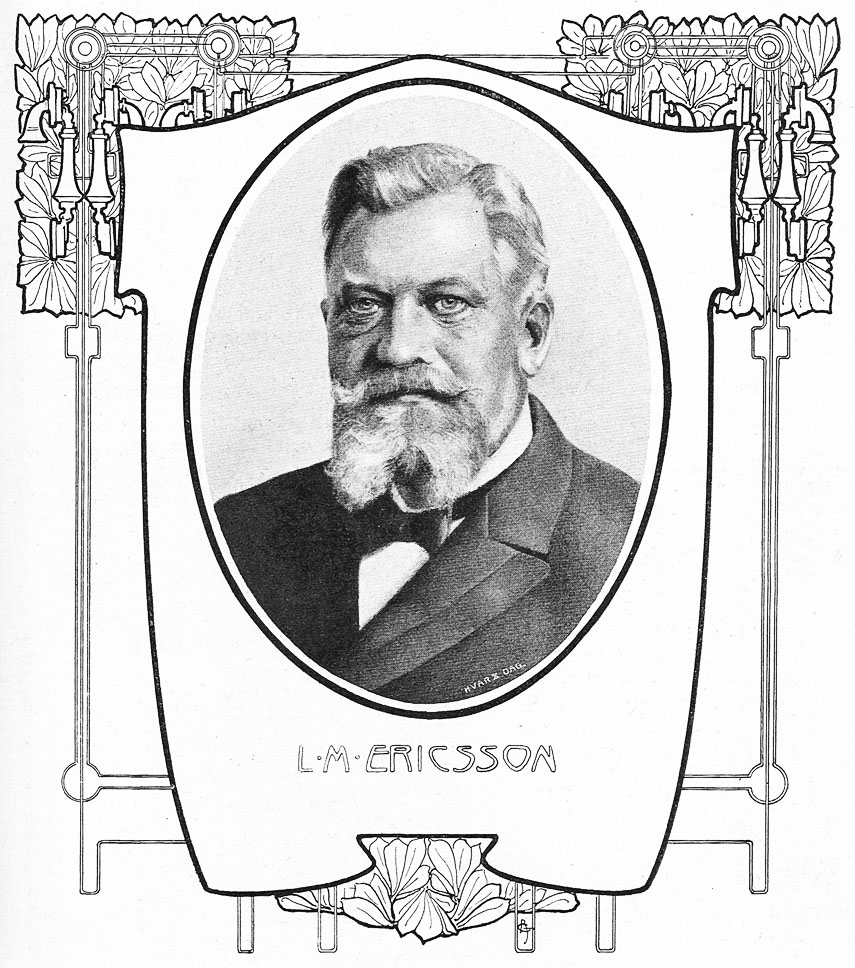
Lars Magnus Ericsson (Swedish pronunciation: [lɑːʂ ˈmǎŋːnɵs ˈêːrɪkˌsɔn] ; 5 May 1846 – 17 December 1926) was a Swedish inventor, entrepreneur and founder of telephone equipment manufacturer Ericsson (incorporated as Telefonaktiebolaget LM Ericsson).

Early life

[edit]

Lars Magnus was born in Värmskog, Värmland, and grew up in the small village of Vegerbol located between Karlstad and Arvika. At the age of 12, Ericsson's father died forcing him to seek work as a miner. He worked until he had enough money to leave the village and move to Stockholm in 1867. He then worked for six years for an instrument maker named Öllers & Co. who mainly created telegraph equipment. Because of his skills, he was given two state scholarships to study instrument making abroad between 1872 and 1875. One of the companies he worked at was Siemens & Halske.

Career

[edit]

Upon his return to Sweden in 1876, he founded a small mechanical workshop together with his friend Carl Johan Andersson who had also worked at Öllers & Co.. This workshop was actually a former kitchen of some 13 m2 situated at Drottninggatan 15 in the most central part of Stockholm. Here, he started a telephone company by analyzing Bell company and Siemens telephones and creating his own copies in their image. It was not until they started cooperating with Henrik Tore Cedergren in 1883 that the company would start to grow into the Ericsson corporation.

In the year 1900 Lars Magnus retired from Ericsson at the age of 54.[1] He kept his shares in the company until 1905 and then sold them all.

He is said to have been a demanding person, and disliked any direct publicity about his personality and did not wish to be idolized. He was, however, deeply respected by his employees. He was always a skeptic and cautious in business. He was also somewhat opposed to patents, as many of the products he made would not have been possible to do if the patent legislation had been overly effective. When his phones were copied by Norwegian companies he did not care, as his phones had in turn been largely copied from Siemens. He initially did not believe in a mass market for telephones, and saw it as a toy for the leisure class.

Personal life

[edit]

Ericsson married Hilda Simonsson in 1878. They had four children together: Johan (1879–1881), Gustaf (1880–1965), Anna (1881–1967) and Lars Magnus Jr. "Lalle" (1892–1921). When their daughter Anna was only six weeks old, their eldest son Johan died from pulmonary oedema. The couple also lost their son Lalle at a young age to tuberculosis.[2]

Death

[edit]

After his death in 1926, he was buried at Hågelby gård in Botkyrka. At his explicit request, there is no headstone marking his grave.

See also

[edit]

References

[edit]
Revisions and contributorsEdit on WikipediaRead on Wikipedia
from Grokipedia
Lars Magnus Ericsson (1846–1926) was a Swedish inventor and entrepreneur best known as the founder of the manufacturer , which he established in and which grew into a major global player in under his leadership. Born on May 5, 1846, in , , to a farming family, Ericsson experienced hardship early when his father died around age 11, prompting him to work as a from age 14 on nearby farms and later in and railway construction. After limited formal education at a village school, he apprenticed as an ironmonger and engraver, honing skills that led him to in 1867, where he joined the telegraph equipment firm Oller & Co. as an instrument maker. Supported by government scholarships from 1872 to 1875, he studied advanced instrument-making techniques abroad at firms like in and , gaining expertise in . In April 1876, Ericsson launched his own mechanical workshop in a small space with partner Carl Johan Andersson and initial capital of 1,000 kronor, initially focusing on repairing telegraph instruments before shifting to telephone production following Alexander Graham Bell's invention in 1876. By November 1878, the firm produced its first , and Ericsson innovated with designs such as the spiral in 1880. He later developed the world's first widely used combined integrating receiver and transmitter in 1892, which improved usability and became a hallmark of early . His company secured a pivotal 1881 contract with Sweden's state telegraph authority (Telegrafverket), enabling connections across 64 of Sweden's 93 towns and cities by 1886, and he developed Europe's first "multiple desk" in 1884 for efficient switching. Under Ericsson's direction, the business expanded rapidly: from 10 employees in 1880 to 500 by the mid-1890s, incorporating as Aktiebolaget L.M. Ericsson & Co. in 1896 with 1 million kronor in capital, and establishing international factories in , New York, and St. Petersburg, plus sales offices in and by the early 1900s. Ericsson emphasized worker welfare, providing free medical care and training, and partnered with figures like Henrik Thor Cedergen to form the Stockholms Allmänna Telefonaktiebolag (SAT) in 1883, which became Sweden's largest telephone operator. He married Hilda Simonsson in 1878, who assisted in the business, and the couple had several children. Ericsson retired as managing director in 1900 and sold his shares in 1905, thereafter focusing on developing mechanized, electrified farms like Alby and Hågelby outside until his death on December 17, 1926, in Botkyrka, . His legacy endures through 's enduring role in innovation, from early telephones to modern networks.

Early Life and Education

Childhood in Värmland

Lars Magnus Ericsson was born on 5 May 1846 at the Nordtomta farm in , , into a as the sixth of nine children to Erik Ersson, a smallholder and occasional mine worker, and Maria Jonsdotter. Four of his siblings died in infancy, leaving a household that included two older brothers who had already left home by his early teens, his mother, and two younger sisters. In 1858, when Ericsson was 12 years old, his father died suddenly at age 53 from a fever, plunging the family into financial hardship and forcing Ericsson to assume responsibility for supporting his mother and sisters. With the family unable to sustain itself on the small farm alone, he began working immediately after his father's death, initially at the nearby Borgvik ironworks where he performed manual labor for low wages, though he found the conditions harsh and unfulfilling. Ericsson's early experiences as a child involved grueling tasks on local farms and in the surrounding forests of , including assisting with woodcutting and other woodland work that demanded physical endurance and practical problem-solving. These labors, starting as young as 12, honed his mechanical aptitude through hands-on activities like constructing simple wooden tools and mechanisms, such as game tokens and a rudimentary waterwheel-powered hammer. By age 14, he took on seasonal farm work at Borgvik, earning a meager 0.50 SEK per day, all of which he sent home to aid his family's survival. His formal education was limited to five years at local village schools in Vegerbol, Björnebol, and Karlsbol, where he learned basic , achieving good marks except in tidiness and conduct. Much of this schooling occurred through the church-based system common in rural at the time, emphasizing religious instruction alongside rudimentary ; after his father's death, Ericsson had to abandon further studies to focus on labor, relying instead on self-taught knowledge from books and observations in his work environment.

Apprenticeship and Move to Stockholm

At the age of 21, in 1867, Lars Magnus Ericsson left his rural home in and moved to to pursue opportunities in the burgeoning field of , driven by his interest in mechanical and electrical work. Upon arrival, he quickly found employment at Öller & Co., a prominent telegraph repair shop specializing in the maintenance and production of electrical instruments. Over the next five years, Ericsson served as an apprentice, honing his skills in instrument repair, assembly, and electrical mechanics under the guidance of experienced craftsmen. His diligence and aptitude earned him recognition, as he not only mastered the intricacies of telegraph equipment but also studied draftsmanship, German, and English in his spare time to prepare for advanced training. In 1872, Ericsson's growing expertise led to a significant opportunity: a Swedish state scholarship for studies abroad, supported by recommendations from Öller & Co. and other contacts. This grant enabled him to embark on a three-and-a-half-year journey from early 1872 until the autumn of 1875, during which he worked and studied in several European industrial centers. Primarily based in and , he apprenticed at in for nearly two years, where he delved into and , including the design and production of wire-based communication devices. He also spent time in assisting at a technical institute, in developing meteorological instruments at Hassler & Escher, in studying under clockmaker Matthias Hipp, in supporting railway telegraph installations, and in observing precision manufacturing processes. These experiences exposed him to cutting-edge advancements in telegraph technology and the emerging principles of , as well as efficient industrial manufacturing methods. Upon his return to Sweden in 1875, Ericsson possessed markedly enhanced proficiency in wire , along with practical knowledge of electromechanical assembly and large-scale production techniques gained from his international placements. This period of structured apprenticeship and overseas study solidified his foundation as a skilled , bridging his early self-taught mechanical interests with professional expertise in .

Professional Career

Founding the Workshop

In 1876, Lars Magnus Ericsson, leveraging his technical expertise gained from prior apprenticeships in , partnered with his former colleague Carl Johan Andersson to establish a small workshop at 15 Drottninggatan in central . The venture, initially trading as Firma L.M. Ericsson & C.J. Andersson, operated out of a modest rented kitchen space of about 13 square meters and focused primarily on repairing telegraph instruments while also undertaking small manufacturing jobs for electro-mechanical devices. The workshop's early operations centered on producing and repairing telegraphs for key clients, including the , which placed an initial order for two pointer telegraphs in 1876 valued at SEK 860. In 1877, the business secured its first major contract with Televerket, Sweden's state-owned postal and telegraph administration, enabling it to compete directly with larger firms in the supply of telegraph equipment and marking a pivotal step toward sustainable operations. This contract, along with subsequent small orders, allowed the workshop to expand its production capabilities beyond repairs, though output remained limited to a handful of skilled workers, including an errand boy named Gabriel Bildsten. As demand for telegraph instruments grew, the workshop outgrew its initial space, prompting multiple relocations: first to Jakobsbergsgatan 23B late in 1876, then to the Oxtorget courtyard in 1877, and finally to larger premises at Biblioteksgatan 5 in 1880. This 1880 move signified a clear transition from predominantly repair work to more substantial , accommodating up to ten employees by that time and supporting increased production of telegraphs and related electrical instruments. The early years were marked by financial challenges, with the business relying heavily on Ericsson's personal savings of SEK 1,000 as startup capital and occasional small loans to cover operations. The first fiscal year's profit was modest at SEK 298.29, reflecting the precarious nature of the venture amid competition from established telegraph manufacturers and the need to build a through repairs and custom designs. Despite these hurdles, the workshop's focus on precision telegraph laid the groundwork for future growth in the sector.

Growth of the Telephone Enterprise

In 1878, Lars Magnus Ericsson entered the telephony market by beginning production of early telephones, drawing inspiration from Alexander Graham Bell's patented design, which had not been registered in Sweden and thus allowed for local adaptations and improvements. This initial foray gained momentum through a strategic partnership formed in 1883 with Henrik Tore Cedergren, who had just established Stockholms Allmänna Telefonaktiebolag (SAT), Sweden's first independent telephone company. The alliance between Ericsson's workshop and SAT provided essential distribution networks across Stockholm and beyond, enabling Ericsson to supply equipment for expanding urban telephone systems while SAT handled operations and subscriptions. The partnership fueled rapid business expansion throughout the and 1890s, as demand for telephones surged in and internationally. Exports began modestly to neighboring and in the early , then accelerated dramatically in the 1890s to markets across , , , New Zealand, and Russia, where Ericsson's reliable, locally adapted devices met growing infrastructure needs. By the 1890s, the workforce had grown to over 100 employees, reflecting the company's shift from a small repair shop to a dedicated operation. Starting with just 10 workers in 1880, neared 100 by 1884, supporting scaled production amid rising orders.

Key Innovations and Challenges

One of Lars Magnus Ericsson's key innovations was the development of an improved wall in 1882, featuring a magnetic and polarized bell that enabled reliable ringing without batteries, marking a significant advancement in telephone signaling technology. This design integrated all components into a compact wooden box, earning it the nickname "Swedish pattern" and facilitating widespread adoption across for its durability and efficiency in magneto-based systems. In 1884, Ericsson introduced the hand-microtelephone, a pioneering that combined the mouthpiece and earpiece into a single portable unit, greatly improving user convenience and freeing both hands during calls. This innovation, inspired by ideas from collaborators Anton Avén and Leonard Lundqvist, addressed the clumsiness of separate components in earlier models and set a standard for future designs, despite initial resistance from established firms like the Bell Company. Ericsson's approach to presented notable challenges, as he harbored skepticism toward patents and applied for only a few, preferring to rely on product superiority to outpace competitors. This reluctance allowed copycats in , such as Elektrisk Bureau in , Emil Møller in , and Daniel Wadén in , to replicate his designs without legal repercussions, diluting market exclusivity in the late and early . Additionally, during a 1885 study trip to the with partner H.T. Cedergren, Ericsson encountered fierce competition from , the manufacturing arm of the , whose stringent patent enforcement created monopolistic barriers and restricted access to their facilities, underscoring the risks of operating in patent-heavy markets. During the 1890s, Ericsson advanced telephone infrastructure by contributing to early automatic exchange technologies, including selector-based systems that reduced reliance on manual operators and were tested in Swedish installations to handle growing subscriber demands. These efforts built on his prior switchboard innovations, such as the multiple-position boards, but faced hurdles from the era's mechanical limitations and the dominance of manual systems, delaying full commercialization until the early 1900s.

Retirement from Business

In 1900, at the age of 54, Lars Magnus Ericsson retired from the presidency of the company due to deteriorating health and the challenges of overseeing its rapid expansion, which made it impossible for him to maintain the hands-on supervision he preferred. He proposed Axel Boström, his former office manager, as his successor, who took over leadership at age 36, allowing Ericsson to step back from daily operations while initially retaining influence as board chairman. Following his retirement, Ericsson gradually divested his holdings in the company, resigning from the board in and selling his remaining shares by 1905 to a group of investors, which provided him substantial financial security but resulted in the loss of his amid tensions over strategic directions, including reservations about partnerships lacking practical expertise. This disengagement marked the end of his direct involvement, as the influx of external capital shifted the company's focus toward broader commercialization. Ericsson's business philosophy emphasized craftsmanship and quality over speculative ventures, reflecting his aversion to risky financial deals and preference for practical, detail-oriented rooted in personal oversight rather than mass-market opportunism. He distrusted lawyers and higher education in favor of , viewing the company's early success as stemming from elegant, durable designs that prioritized electrotechnical excellence.

Personal Life

Marriage and Immediate Family

Lars Magnus Ericsson married Carolina Simonsson on April 6, 1878, when he was 31 years old and she was 17; the couple had met the previous year (1877) when Ericsson repaired an organ at her family's home in . , the of a court saddler, became an active partner in Ericsson's early business endeavors, assisting with tasks such as winding coils for equipment and tracking payments from clients, which helped manage the family's finances during the precarious startup years of L.M. & Co. The couple initially shared a modest home in central , where they raised their children amid the demands of Ericsson's growing workshop. In 1895, seeking greater stability for the family as the business expanded, they purchased Alby Gård, a property outside , which served as their residence until later moves. played a key role in maintaining Ericsson's work-life balance, accompanying him on business trips—such as to in 1881 and New York—and handling social engagements to allow him to focus on . Despite the increasing prosperity of the telephone enterprise, the Ericsson household remained characterized by practicality and restraint in expenditures, reflecting the couple's shared commitment to reinvesting resources into the business and family well-being. Their , enduring until Ericsson's in 1926, was marked by mutual support, with letters revealing an affectionate partnership.

Children and Family Losses

Lars Magnus Ericsson and his wife Hilda Carolina Simonsson had four children together. Their first child, Johan Ericsson, was born on January 11, 1879, but tragically died at the age of two on October 25, 1881, bringing early grief to the young family during their initial years of marriage. The couple's second son, Gustaf Ericsson, was born in 1880 and grew to play a significant role in the family enterprise; he took over management of the Alby estate in 1916, continuing his father's agricultural and innovative pursuits there. Their daughter, Anna Ericsson, born in 1881, later married and contributed to family life, passing away in 1967. The youngest, Lars Magnus Ericsson Jr. (often called "Lalle"), was born on June 19, 1892, and pursued engineering like his father before his untimely death in 1921 at age 29 from pulmonary tuberculosis while undergoing treatment at Romanäs sanatorium. This loss occurred during Ericsson's semi-retirement, compounding the family's earlier bereavement from Johan's passing. Hilda died in 1941, and there were no additional branches to the . Gustaf's at Alby exemplified the surviving children's ties to their parents' legacy in and estate management.

Later Years and Legacy

Post-Retirement Activities

Following his sale of shares in the company in 1905, Lars Magnus Ericsson enjoyed that supported a shift toward personal pursuits and rural living. In 1903, Ericsson and his family relocated to the countryside estate at Alby Gård (also known as Ahlby) outside in Botkyrka, a property he had acquired in 1895. There, he immersed himself in estate management, transforming the farm into a model of and to enhance agricultural efficiency, including extensive and crop cultivation efforts reflective of his rural upbringing in . Ericsson maintained an active interest in technical matters, occasionally offering informal advice to the company on engineering challenges until around 1910, while steadfastly declining any formal involvement. In 1916, he moved to the nearby Hagelby estate, continuing his focus on farming innovations and hosting friends with characteristic hospitality, though declining eyesight gradually limited his hands-on designing and woodworking activities. Throughout his later years, Ericsson traveled occasionally within , nurturing personal interests in and as diversions from estate duties.

Death and Burial

Lars Magnus Ericsson passed away on 17 December 1926 at the age of 80 from natural causes at his home, Hågelby gård in Botkyrka, . His death came peacefully following years of retirement spent in seclusion on the estate he had acquired in 1916. In keeping with his lifelong preference for , Ericsson's was a simple family affair held five days later on 22 December, with no public ceremony, eulogies, or elaborate rites. Attendance was limited to his immediate survivors, including his wife Hilda Carolina Ericsson and their surviving children, Gustaf and Anna. He was buried in the nearby Botkyrka churchyard at Hågelby gård, where, per his explicit request, no headstone or monument marks the grave. Ericsson's estate was primarily distributed to his wife Hilda, who outlived him until her death on 3 January 1941, and to their surviving children Gustaf and Anna. was later buried beside him in Botkyrka cemetery.

Enduring Impact on Telecommunications

Lars Magnus Ericsson's establishment of a small in laid the foundation for what evolved into Telefonaktiebolaget LM Ericsson, a multinational giant by the early , with operations spanning , , and beyond by 1904. His early designs in telephone apparatus and exchanges influenced the development of mobile and network technologies throughout the , including the company's pioneering of the first car-mounted in 1956 and the launch of the world's first commercial network in 2009. This evolution positioned Ericsson as a key player in global connectivity, exporting equipment to markets in , the British Commonwealth, and , where sales abroad accounted for 70-85% of total invoicing by the mid-1890s. Ericsson's innovations in telephone components, particularly magneto systems, contributed to the of early worldwide. His magneto-ringing s and switchboards, introduced in the and , were widely adopted for their reliability and design efficiency, becoming key suppliers in regions like and standardized by the British Post Office for rural and manual exchanges. These systems set benchmarks for magneto-based signaling in networks, influencing telecom practices that persisted into the mid-20th century and remain referenced in historical analyses of analog development. The economic ramifications of Ericsson's enterprise were profound, fostering industrial growth in through the creation of thousands of jobs; by the turn of the , the company employed over 1,000 workers, establishing it as Stockholm's largest employer and a leader in exports. This export dominance in early equipment not only bolstered Sweden's economy but also propelled the nation into a position of technological prominence in international trade. In 2025, the modern upholds the innovation ethos initiated by its founder, leading advancements in networks that drive global through coordinated R&D in radio access technologies and spectrum efficiency. With over 40% population coverage of Standalone networks in key markets and ongoing preparations for integration, the company continues to shape infrastructure, echoing Ericsson's foundational commitment to scalable, high-performance systems.

References

Add your contribution
Related Hubs
User Avatar
No comments yet.