Hubbry Logo
Lava ButteLava ButteMain
Open search
Lava Butte
Community hub
Lava Butte
logo
8 pages, 0 posts
0 subscribers
Be the first to start a discussion here.
Lava Butte
Lava Butte
from Wikipedia

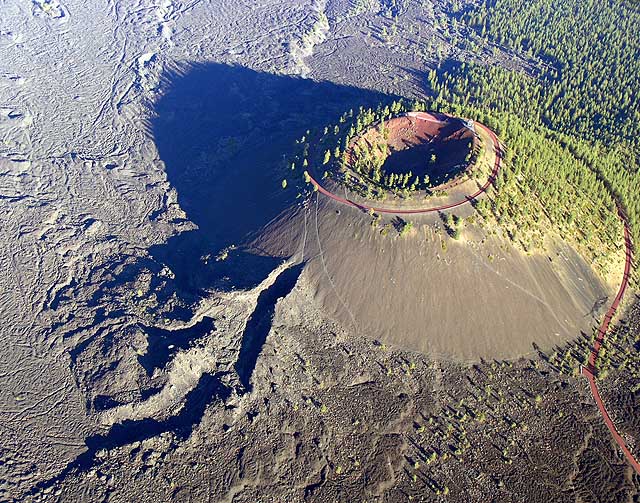
Lava Butte is a cinder cone in central Oregon, United States, just west of U.S. Route 97 between the towns of Bend, and Sunriver in Deschutes County. It is part of a system of small cinder cones on the northwest flank of Newberry Volcano, a massive shield volcano which rises to the southeast. The cinder cone is capped by a crater which extends about 60 feet (20 m) deep beneath its south rim, and 160 feet (50 m) deep from the 5,020-foot (1,530 m) summit on its north side. Lava Butte is part of the Newberry National Volcanic Monument.

Key Information

Volcanic history

[edit]
Visible from the top of Lava Butte is the black lava flow leading to Route 97.

Like the other cinder cones in the area, Lava Butte only experienced a single eruption, dated by geologists in 1977 to 6,150 carbon-14 years, equivalent to about 7,000 years ago. The eruption began with a fissure spewing hot cinders to form the cone. In the next phase, a river of hot basalt flowed from the base of the small volcano to cover a large area to the west with a lava flow which remains largely free of vegetation. The lava flows reached the Deschutes River about 2.5 miles (4.0 km) to the west of the cone, burying its former channel under over 100 feet (30 m) of lava and damming the river to form a lake, known as Lake Benham. The river eventually overflowed the lava dam and eroded down into it, draining the lake and forming Benham Falls. Geologists estimate that 90% of the magma erupted as lava flows, 9% as scoria which forms the cone, and 1% as volcanic ash which forms a thin layer extending to the north.

Human history

[edit]
Lava Butte from the south

The early history of Lava Butte is not known, but it is assumed that Native Americans observed the eruptions and later ascended the prominent new landmark. White settlers arriving in the 1800s also noted the landmark. In 1903, I.C. Russell was the first geologist to study the butte and speculated that it erupted as recently as 150 years ago.[3] Dr. Howel Williams estimated it to be much older, but incorrectly at 1,000 years old.[3] In September 1914, Lava Butte "erupted" when the Bend Chamber of Commerce simulated an eruption to surprise a visiting Portland group. In 1925, USGS geologist Harold Stearns studied the Newberry area and recognized the fissure system which extends from Lava Butte to East Lake within Newberry Caldera.

Sometime after 1901, the Great Northern Railway was extended south through the area. The construction crew built the rail line directly through the ʻAʻā lava flow of Lava Butte.[3]

Sign at the summit of the butte

The cinder cone was also exploited to some extent for its economic value. In June 1926, a quarry was developed in the fault scarp east of Lava Butte as a source for paving material for the first The Dalles-California Highway (later U.S. Route 97). In November 1929, cinders from Lava Butte were shipped to Longview, Washington, to be used in construction of Longview Bridge across Columbia River.

A United States Forest Service fire lookout tower was built on the summit in 1931, and in early 1933 a steep, single-lane road was constructed spiraling up to the summit. In February of that year, the local Skyliners ski club proposed a ski jump on Lava Butte, but it was never built. In June 1946, widening of the road up Lava Butte to two lanes was completed, along with constructing two small parking lots at the summit. The road was later paved in July 1950. The original lookout was replaced with a larger one in 1957, which was subsequently enlarged in 1962 to accommodate a small visitor center and museum on the first floor. In 1998 this was replaced with a new lookout built in the original L-4 style of 1931.

In July 1966, twenty-two astronauts trained in Central Oregon for the upcoming Moon landings, at sites including Lava Butte, Lava River Cave, and Newberry Crater. In May 1967 the U.S. Forest Service created the 8,983 acres (3,635 ha) Lava Butte Geological Area to protect the cinder cone, with plans for recreational and interpretive development. Construction of the Lava Lands Visitor Center located just south of the cone began in April 1969 and it was finally dedicated in September 1975. In November 1990, Newberry National Volcanic Monument was created encompassing Newberry Crater, Lava Cast Forest Geological Area, Lava River Cave, and the Lava Butte Geological Area.

From early May to mid October, a shuttle transports visitors up Red Cinder Road from the Lava Lands Visitor Center to the lookout on Lava Butte. Hiking up Red Cinder Road is a year-round option. A scenic rim trail around the top of Lava Butte is 0.35 miles (0.56 km) long.[4]

References

[edit]
[edit]
Revisions and contributorsEdit on WikipediaRead on Wikipedia
from Grokipedia
Lava Butte is a prominent in , , situated within the in Deschutes National Forest, approximately 13 miles south of Bend and 7 miles northeast of Sunriver. Rising about 500 feet (150 meters) above its base to an elevation of roughly 5,020 feet (1,530 meters), it formed approximately 7,000 years ago during a monogenetic eruption along the northwest of the larger Newberry Volcano shield. The eruption produced an estimated 380 million cubic yards of material, with about 10% ejected as gas-charged cinders and ash that built the steep-sided cone, shaped asymmetrically by prevailing southwest winds, and the remaining 90% flowing as basaltic lava. This lava flow extended westward over 9 square miles (23 square kilometers), reaching the and temporarily damming it to form a lake that persisted for around 4,000 years, while also creating features like Benham Falls and diverting the river's course permanently. The cone's crater, measuring up to 180 feet (55 meters) deep on its windward side, is capped by a historic built in the 1930s, offering expansive views of the , including , the Newberry Caldera, and surrounding lava fields. As part of the High Cascades volcanic province, Lava Butte exemplifies monogenetic volcanism typical of the region's rift zones, where short-lived eruptions produce cinder cones and associated flows without subsequent activity. The site, designated a geological area in 1967 and incorporated into the in 1990, serves educational and recreational purposes, with a paved road (open seasonally) and shuttle access to the summit, a rim trail, and interpretive exhibits highlighting its role in shaping the local landscape and ecosystems. Black cinders on the cone have oxidized to red due to repeated atmospheric exposure, contrasting with the dark pahoehoe and aa lava flows below.

Geography and Location

Site Description

Lava Butte is a well-preserved rising approximately 500 feet (150 meters) above its base in . The summit's elevation stands at 5,023 feet (1,531 meters), providing a prominent landmark amid the high desert landscape. This monogenetic exemplifies typical cinder cone morphology, with its slopes built from ejected pyroclastic material that accumulated around the vent. The cone's base measures about 0.7 km (0.4 mi) in and consists primarily of loose and dark volcanic cinders, forming steep slopes at the angle of repose near 33 degrees. Internal exposures reveal layers of moderately welded agglutinate interspersed with highly vesicular (sideromelane) and less vesicular fragments, with sparse phenocrysts. At the summit, a roughly circular spans approximately 300 feet (91 meters) in width and reaches depths of up to 160 feet (50 meters) from the higher northeastern rim, influenced by prevailing during formation. Encircling the base, the terrain transitions into extensive rough lava fields dominated by pahoehoe and blocky aa flows, remnants of the eruptive episode that spread outward from the cone. These flows create a rugged, undulating expanse that underscores Lava Butte's role as a key feature within the broader Newberry Volcanic National Monument.

Regional Context

Lava Butte is situated in Deschutes County, central Oregon, approximately 11 miles (18 km) south of Bend and about 2 miles (3 km) west of U.S. Route 97. It lies between the communities of Bend to the north and Sunriver to the south, providing a strategic position along the major transportation corridor through the region. To the west, the butte is proximate to the Deschutes River, whose course was temporarily blocked and permanently altered by ancient lava flows originating from the site, redirecting the waterway in multiple locations. The butte forms part of the High Desert region in the foothills of the , a transitional zone characterized by expansive lava fields interspersed with open ponderosa pine forests. This semi-arid landscape experiences a with hot, dry summers and cold winters, receiving an average annual of around 12 inches (30 cm), primarily as winter snow and occasional summer thunderstorms. The ponderosa pine-dominated woodlands and scattered lava expanses create a mosaic of habitats that reflect the area's volcanic legacy and arid conditions. Lava Butte is included within the , managed by the U.S. Forest Service. Elevations in the surrounding terrain range from 4,000 to 5,000 feet (1,200 to 1,500 meters), contributing to a varied that includes resilient forests, , and specialized adapted to the rocky, nutrient-poor soils. This altitudinal gradient supports a mix of coniferous trees, shrubs, and wildlife such as and pikas, which thrive in the fragmented lava environments and forested pockets.

Geology

Formation and Eruptive History

Lava Butte is a monogenetic cinder cone that formed through a Strombolian-style eruption approximately 7,000 calendar years ago. The initial radiocarbon dating of charcoal samples from beneath the eruption deposits yielded an age of 6,169 ± 65 years B.P., establishing the chronology of this event. More recent analyses, incorporating 11 calibrated radiocarbon dates, refine this to an average of 6,927 calendar years B.P., confirming the eruption's timing within the Holocene epoch. This volcanic feature emerged as part of the northwest rift zone of Newberry Volcano, a shield volcano situated in the rear-arc portion of the Cascade volcanic arc. The Cascade arc's activity is driven by the subduction of the Juan de Fuca plate beneath the North American plate, facilitating magma generation and ascent through crustal weaknesses. Lava Butte represents the northernmost Holocene vent along Newberry's 20-km-long northwest rift, highlighting localized flank volcanism within this broader tectonic setting. The eruption initiated along a 2.4-km-long , involving the explosive ejection of gas-charged basaltic that produced , bombs, and , before localizing at the site to construct the cone. Over a duration estimated at several months to a few years, successive pyroclastic accumulations built the 150-m-high cone to the natural of approximately 30–35 degrees. Prior to the eruption, the regional landscape had been shaped by the climactic eruption of around 7,650 years B.P., which deposited widespread ash layers that were subsequently buried by Lava Butte's materials. The event also generated extensive 'a'ā lava flows covering more than 23 km².

Lava Flows and Geological Features

The lava flows from Lava Butte consist primarily of basaltic 'a'ā, characterized by its rough, clinkery surface formed from more viscous or turbulent flow conditions, with patches of pahoehoe in some areas. The main flow has an estimated volume of approximately 0.3 cubic kilometers (0.07 cubic miles), covering an area of about 23 square kilometers and extending roughly 11 kilometers (7 miles) westward to reach the . These flows, erupted around 7,000 years ago as part of the broader activity along Newberry Volcano's northwest , demonstrate the effusive nature of the event, with fluid advancing as lobes and inflating to create expansive sheets. Upon reaching the Deschutes River, the Lava Butte flows temporarily dammed the channel, forming a barrier up to 15 meters (50 feet) high at Benham Falls and creating Lake Benham, an upstream pond that persisted for about 4,000 years. This impoundment led to deposition and eventual breaching, resulting in a permanent southward diversion of the river's course through a new, incised channel. The interaction highlights the geomorphic impact of such basaltic eruptions in the Cascades, altering fluvial dynamics on a regional scale. Associated geomorphic features of the flows include kipukas, which are isolated remnants of pre-eruption and surrounded by younger lava, such as the forested island visible along the Hoffman Island Trail. During emplacement and cooling, the flows developed pressure ridges—elongated compressional folds from internal flow stresses—and tumuli, which are small, dome-like mounds formed by localized inflation of underlying tubes. These structures are typical of basaltic flows and provide evidence of the dynamic, tube-fed advance of the lava. The composition of the lava aligns closely with basalts from Newberry Volcano, reflecting a common magma source in the beneath the .

Human History

Prehistoric and Indigenous Use

Archaeological investigations in the broader Newberry area have revealed evidence of human occupation dating back over 7,000 years, with the primary site at Lava Butte designated as 35DS33 showing activity following the eruption approximately 7,700 years ago. This site, located on a small forested knoll adjacent to a faultline in , contains subsurface artifacts embedded in sediments derived from the eruption. Excavations conducted in 1961 by recovered 1,742 chipped and ground stone artifacts, indicating initial occupation likely influenced by the Mazama ashfall but resuming thereafter. Following the Lava Butte eruption approximately 7,000 years ago, the area saw renewed human activity during the Middle and Late Archaic periods, extending possibly until 500 B.P. Artifacts suggest use by peoples of the cultural tradition, including Northern Paiute and Klamath-Modoc groups, who utilized the region for seasonal foraging camps focused on deer and foods such as roots. Artifacts from 35DS33 include 176 projectile points—predominantly Elko series dart points for the Middle Archaic (7,000–2,000 B.P.) and Rosegate and Desert Side-notched arrow points for the Late Archaic—along with bifaces, unifaces, hopper-base mortars, a bone awl, and lithic caches sourced from nearby . These tools suggest adaptation to the post-volcanic landscape, including the use of nearby kipukas—islands of older vegetation amid lava flows—for big game trails and resource gathering. The site's role as a base camp highlights its integration into traditional territories of Northern groups, who maintained semi-nomadic patterns in the basin. Evidence of and hearths points to repeated seasonal occupations from spring through fall, reflecting technological shifts from atlatls to bows during the Archaic transition. While specific oral histories referencing the Lava Butte eruption are not documented, Klamath and related groups maintain traditions of volcanic events in the Cascades, such as the creation of from .

Settlement and Modern Development

European-American exploration of the Lava Butte area began in the early , with fur trappers, including , active in the Deschutes Basin during the 1820s as they exploited the region's beaver populations and mapped waterways. Permanent settlement in the surrounding Deschutes County lagged behind western , with the first Euro-American ranchers arriving in the 1870s following initial visits by emigrants in the 1850s and a gradual influx drawn by grazing lands and timber potential in the 1860s and 1870s. In 1913, the Deschutes Valley Fire Patrol Association established the first on Lava Butte, employing E.T. Gerrish who camped at the base and used a to access the , connected by a private phone line for reporting. The U.S. Forest Service adopted the site in 1924, constructing an L-4 cab in 1931 for $617.93 and completing a summit road by 1933 to facilitate staffing and supply transport. The tower has undergone multiple upgrades, including a two-story R-6 cab in 1957, reconstruction as an information center in 1962, and a replica L-4 structure in 1998 after dismantling the deteriorated prior building; it remains staffed seasonally for detection. Throughout the , the lands encircling Lava Butte within the Deschutes National Forest supported extensive logging and ranching operations, with companies like Shevlin-Hixon acquiring over 200,000 acres by 1915 and operating mills that produced billions of board feet of timber between 1916 and 1950, employing up to 1,500 workers each at peak. Lava Butte's elevated position provided a critical vantage point for early spotting amid these activities, aiding protection of the ponderosa forests that fueled Bend's economy as a major hub. Following increased geological study in that highlighted its volcanic features, Lava Butte gained formal recognition for its scientific value, culminating in its designation as part of the in November 1990 under the U.S. Forest Service to preserve the area's eruptive legacy within Deschutes National Forest.

Recreation and Management

Visitor Access and Trails

Public access to Lava Butte is primarily through the Lava Lands Visitor Center, located approximately 13 miles south of Bend on U.S. Highway 97 via Exit 151. From the visitor center, Red Cinder Road provides the route to the summit, though private vehicle access is prohibited during shuttle season to minimize impact on the . A seasonal shuttle service operates from June 14 to September 2, 2025, with additional service on weekend (May 24-26), transporting visitors up the 1.7-mile road for a $5 round-trip fee, with departures every 20 minutes between 10 a.m. and 4:30 p.m. during summer months. The summit features a 0.6-mile (1 km) loop path around the crater rim with minimal elevation change, and interpretive signs explaining volcanic features such as the formation and surrounding lava flows. Hikers can also access the summit via a non-motorized from the , which follows the road for about 3.4 miles round-trip with a total elevation gain of 520 feet (160 m). Vehicle access to the summit has been limited since the to preserve the fragile cone structure, with shuttle services introduced in later years to accommodate growing visitation while reducing . Outside shuttle season, access may be limited by and conditions. Non-motorized access remains available year-round from dawn to dusk, permitting, though the road and trails may close seasonally due to snow accumulation, typically from to . Safety protocols emphasize caution on the unstable cinder slopes, which can be slippery and loose underfoot, and preparation for exposure to , including sudden high winds and temperature drops at the 5,020-foot summit elevation. Visitors are recommended to wear sturdy, closed-toe shoes, carry sufficient water, and check forecasts; the site sees approximately 50,000 visitors annually as of the early 2010s, with the broader attracting around 250,000 yearly. For broader exploration within the , Forest Road 9720 (also known as Lava Cast Forest Road) offers a 5-mile (8 km) route branching east from U.S. 97, about 3 miles south of the ; this seasonally maintained , passable for high-clearance vehicles when dry and free of snow, leads to additional interpretive trails amid ancient lava casts.

Conservation and Protection Status

Lava Butte is protected as part of the , designated on November 5, 1990, by an act of Congress and signed into law by President , encompassing approximately 54,822 acres within the Deschutes National Forest and managed by the U.S. Forest Service. This designation aims to preserve the area's volcanic landscapes, including Lava Butte's and associated lava flows, from development and resource extraction while allowing for scientific study and public education. Ecologically, Lava Butte and its surrounding lava fields provide critical habitat for wildlife adapted to volcanic terrains, notably serving as a key migration corridor and foraging area for mule deer (Odocoileus hemionus), which utilize the open, rocky landscapes for winter range and movement between seasonal habitats. The young, nutrient-poor lava soils support specialized vegetation communities, including shrubs like oceanspray (Holodiscus discolor) and rabbitbrush (Ericameria spp.), which stabilize the terrain and facilitate gradual ecological succession in this post-volcanic environment. Management efforts by the U.S. Forest Service address challenges such as connectivity for wildlife and potential threats from human infrastructure. In 2011, Oregon's first wildlife underpasses were installed along U.S. Highway 97 near Lava Butte to reduce vehicle collisions, particularly for , with structures designed to guide animals safely across the busy corridor. Broader conservation includes ongoing mitigation of wildfire risks through prescribed burns and fuel reduction in the surrounding Deschutes National Forest, as well as monitoring for that could disrupt native plant recovery on lava substrates, though specific invasive control at Lava Butte focuses on preventing establishment in disturbed areas. The site holds significant research value in due to its association with the Newberry Volcano system, where the U.S. Geological Survey (USGS) conducts continuous seismic monitoring using seismometers and GPS to track potential movement and ground deformation. This monitoring is part of a broader effort to assess hazards from the volcano, which last experienced major activity about 1,300 years ago with the eruption of the Big Obsidian Flow, while Lava Butte itself formed during an eruption approximately 7,000 years ago. Data from these efforts contribute to understanding and inform protection strategies for the monument.

References

Add your contribution
Related Hubs
User Avatar
No comments yet.