


Community hub
Recent from talks
Contribute something
Nothing was collected or created yet.
Slip (cricket)
View on Wikipedia | This article relies largely or entirely on a single source. (November 2014) |

.jpg)
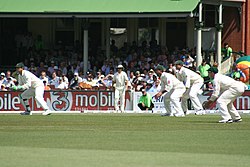
In cricket, a slip fielder (collectively, a slip cordon or the slips) is placed behind the batsman on the off side of the field. They are placed with the aim of catching an edged ball which is beyond the wicket-keeper's reach. Many teams employ two or three slips (numbered from the slip fielder closest to the wicket-keeper: first slip, second slip, etc.). A floating slip is sometimes employed, usually in limited over games, who patrols an area in the slip cordon that would ordinarily be occupied by more than one fielder. The slip cordon's distance from the batsman increases with the pace of the bowler; generally they will be marginally further away from the batsman than the wicket-keeper is. Because of the resulting geometry, spin bowlers generally have fewer slips in the cordon than a fast bowler would in an equivalent game situation. As fielding in the slips requires quick reflexes and sure hands, usually the most adept catchers in the team will make up the slip cordon. Most slip fielders are top order batsmen. Specialist slip fielders are sometimes called "slippers".[1]
The term slips is also used to refer to the area of the field where the slip cordon stands, or nth slip used specifically to refer to one slip fielder's position—e.g., a ball may be described as being edged through third slip if it goes where a third slip would otherwise have been.
Famous slip fielders
[edit]With the most catches in test cricket, England cricketer Joe Root is the most prolific slip fielder of all time.[2] Root took his 211th catch (the vast majority of which were taken in the slips) at Lord's during the Third Test Match in the series between England and India - a spectacular diving effort to remove Kurun Nair off the bowling of Ben Stokes.[3] This record was previously held by former Indian captain Rahul Dravid, who was also known for his ability in the slips. While not the most prolific, Mark Waugh is frequently noted to be amongst the most technically gifted slip catcher of all time, with other brilliant exponents of the craft including Wally Hammond, Brian Lara, Mohammad Azharuddin, Sunil Gavaskar, Shane Warne, Michael Clarke, Sir Garfield Sobers, Bobby Simpson, Ian Chappell, Jacques Kallis, Brian McMillan, Mark Taylor, Ricky Ponting, VVS Laxman, Mahela Jayawardene, Stephen Fleming, Younis Khan, Matthew Hayden, Sir Ian Botham and Steve Smith.
Gully
[edit]
The gully fielder is an extension of the line of slips and fields almost square to the batsman; gully is also the name given to that area of the field. A fielder standing at gully would be standing on the imaginary straight line that extends from the on-side corner of batsman's popping crease to middle stump towards the slip cordon. The position of gully was invented in the 1880s by Arthur Jones, who later became England captain, at Bedford Modern School in Bedford. It was quickly adopted by EHD Sewell at Bedford School and then gained in popularity thereafter.
Off theory
[edit]Enticing the batsman to edge and hit a catch to the wicket-keeper or slips is the standard wicket-taking tactic in off theory. To do so, the bowler tries to make the ball deviate off its expected line away from the batsman's body on the off-side. Outswingers or leg cutters, or the standard leg spinner are delivery types that have this effect. Unsurprisingly, bowlers bowling these deliveries effectively generally have larger slip cordons than those who are not.
On occasion, four or five slips are called for. England used seven slips in the first Test against West Indies in Jamaica in 2004; Australia went further and used the maximum of nine slips against Zimbabwe's lower order batsmen in a One Day International in 2001 (the two non-slips fieldsmen in this example were the wicket-keeper and the bowler).
Leg slip
[edit]A fielder in the equivalent position on the on side of the wicket-keeper is known as a leg slip; this is considerably less common than the off-side slip, and for a team to employ more than one leg slip is highly unusual. It is illegal, under Law 41.5, to have more than two fielders in the area between square leg and long stop, to prevent the fielding team from making use of bodyline tactics.
Writing in The Cricketers of My Time (1833), John Nyren of Hambledon hints at the origin of the word "slips" when he describes the function of a long stop as a fielder who is required to cover any slips from the bat, both to the leg and the off-side.
References
[edit]- The Cricket Captains of England by Alan Gibson, ISBN 1-85145-395-4
- ^ Lynch, Steven (19 January 2004). "The worst bowling average, and mystery injuries". ESPNcricinfo. Archived from the original on 1 July 2018. Retrieved 1 July 2018.
- ^ "Test matches | Fielding records | Most catches in career | ESPNcricinfo".
- ^ "Joe Root: England batter breaks world record for most Test catches". 11 July 2025.
Slip (cricket)
View on GrokipediaDefinition and Role
Overview
In cricket, a slip is a close-in fielding position located behind the batsman on the off side, typically 5 to 15 feet (1.5 to 4.6 meters) from the batsman, designed to catch deliveries that edge off the bat.[5][6] These fielders stand slightly behind the line of the stumps to intercept glancing deflections that might otherwise go to the boundary or be missed by the wicketkeeper. The term "slip" originates from early 19th-century cricket terminology, where it referred to balls that "slipped" or glanced off the edge of the bat, with early writers describing positions to cover such "slips from the bat."[7] Initially, there were references to a "short-slip" (similar to modern first or second slip) and a "long-slip" (akin to short third man), evolving into the standardized slip cordon by the late 19th century as part of off-side attacking strategies. In a typical setup, multiple slip fielders—designated as first slip, second slip, third slip, and so on—form a cordon in a slight arc or straight line behind the wicketkeeper, angled toward the off side to cover varying trajectories of edged shots.[5] The first slip stands closest to the wicketkeeper, with subsequent slips positioned progressively wider and sometimes deeper, depending on the bowler's pace and the batsman's stance. Visually, imagine the pitch running north-south, with the batsman facing south at the southern end; the wicketkeeper crouches directly behind the stumps, while the slip cordon extends diagonally to the right (off side) from the keeper's position, forming a protective arc about 5 to 15 feet (1.5 to 4.6 meters) behind and to the side of the batsman to snag low or flying edges.[6][7]Strategic Importance
Slip fielders play a pivotal role in attacking cricket strategies, particularly for pace bowlers aiming to exploit the corridor of uncertainty—a narrow channel outside the off stump where the ball can induce uncertain defensive shots from the batsman, often resulting in edges. By stationing fielders in the slips, captains enable bowlers to target this line confidently, as any deviation by the batsman is likely to produce a catchable edge rather than safe runs. This setup transforms potential boundaries or singles into wicket opportunities, forming the backbone of seam bowling tactics in conditions favoring movement off the pitch.[8] Caught by fielders account for about 42% of all Test cricket wickets overall, with slips taking a substantial portion of these, particularly in seam-friendly conditions—for example, 42.4% in South Africa and around 41% in England (as of 2013), where edges to slips are more frequent due to lateral movement. In contrast, spin-dominated venues like India see a rate of 41.4% (as of 2013), underscoring slips' greater impact in pace-assisting environments. These catches represent a core element of wicket-taking, often comprising the majority of fielded caught dismissals.[9][10] The deployment of slips varies by format and batsman handedness to optimize pressure and coverage. In Test matches, teams commonly use 3-4 slips to support prolonged attacking spells, maximizing edge chances over five days; in ODIs, this reduces to 1-2 slips to balance boundary protection amid quicker scoring. Against right-handed batsmen, slips cluster on the off side to snaffle conventional edges, while for left-handers, the cordon may shift or include leg slips to target the corresponding corridor.[1] Psychologically, a dense slip cordon compels batsmen to adopt a more defensive mindset, wary of nicking to close fielders, which curtails aggressive shot-making and limits run accumulation—effectively slowing the game's tempo and tilting momentum toward the bowling side.[10]Positioning
Standard Slip Positions
In cricket, the standard slip positions form the core of the off-side cordon, positioned behind the wicketkeeper to intercept edged shots from the batsman. These fielders are numbered sequentially starting from the one closest to the wicketkeeper: first slip, second slip, third slip, and occasionally fourth slip, with the arrangement typically creating a slight curve angled toward the batsman to optimize coverage of varying edge trajectories.[1][11] Fielders in these positions stand approximately an arm's length apart, with the first slip positioned about one meter behind the wicketkeeper to allow the keeper space to collect the ball, the second slip roughly level with the keeper, and the third slip potentially a meter ahead depending on pitch conditions.[12][11] They adopt an athletic stance with knees flexed for quick reaction, feet shoulder-width apart for balance, hands held low and loose rather than resting on the knees, and eyes focused on the point of contact between bat and ball.[13][12] For left-handed batsmen, the entire slip cordon mirrors the setup for right-handers, shifting to the opposite side of the wicket relative to the bowler's perspective while maintaining the same relative spacing and curve to align with the batsman's off-side.[1] Common configurations include two to three slips for pace bowling, providing balanced coverage without overly aggressive placement; setups with five or more slips are rare and reserved for highly attacking strategies against vulnerable batsmen.[11][1]Factors Affecting Placement
The placement of slip fielders is significantly influenced by pitch conditions and weather, as these elements dictate ball behavior and potential deviation. On seaming pitches, such as those with green grass cover typical in England, slips are positioned tighter to the batsman to capitalize on lateral movement that induces edges closer to the body.[14] In contrast, on flat tracks with minimal seam or bounce, slips are set wider to cover potential deflections from straighter deliveries. Weather factors like wind direction further adjust positioning; crosswinds can enhance swing, prompting slips to shift slightly wider to intercept balls deviating away from the batsman.[15] Bowler attributes play a key role in determining the number and depth of slips. Pace bowlers, who generate extra bounce, typically employ deeper slips to account for the heightened carry of edged shots.[11] For spinners, fewer slips—often just one or two, positioned shallower—suffice, as their deliveries produce less sharp deviation and lower trajectory edges.[11] The batsman's style also shapes slip placement to exploit weaknesses. Against aggressive players who play expansive drives, captains opt for more slips to pressure for mistimed edges.[16] Conversely, defensive setups against cautious batsmen reduce slip numbers, prioritizing boundary protection over wicket-taking opportunities.[17] Match phase dictates adjustments in slip configuration for strategic balance. Early in the innings with a new ball, when swing and seam are pronounced, more slips are deployed to maximize early breakthroughs.[14] In later overs, as the ball wears, slips are fewer to adopt a defensive posture and contain scoring.[11]Techniques and Skills
Catching Methods
Slip fielders employ a reactive process to anticipate and secure edges from the bat, primarily relying on visual cues from the bowler's delivery or the bat's edge. This anticipation allows the fielder to position their body proactively, focusing on the trajectory rather than premeditating the exact path. To absorb the ball's pace effectively, slip fielders use "soft hands," where the fingers are relaxed and pointing downward upon impact, creating a cushioning effect that prevents the ball from popping out.[18] Body positioning is crucial for optimal reaction time and stability, with fielders maintaining a low center of gravity through bent knees and weight distributed on the balls of their feet. This athletic stance enables quick lateral movement, either by stepping or diving toward the ball, particularly for low or hard-hit edges that may require extending the body forward. For dives, the head and shoulders lead to ensure the hands reach the ball first, while steps are preferred on slower pitches to conserve energy without losing balance.[18][19] Catches in the slips vary by the edge's nature and height. Low snicks, often from thin deflections, are typically secured with a palm-up scoop motion, where the hands form a shallow basket to lift the ball gently off the turf or just above it. High edges, resulting from thicker contacts, demand an overhead cup technique, with hands forming an inverted 'V' to encircle the ball descending at speed. Distinguishing between thick and thin edges influences the fielder's approach, as thicker ones travel faster and straighter, requiring heightened alertness, while thinner ones demand precise hand placement to avoid deflections.[18] Practice drills emphasize replicating match conditions to hone these techniques. Ramp catching involves feeding balls off a sloped ramp to produce unpredictable deflections, forcing fielders to react without anticipation and typically requiring 50-60 repetitions per session. Reaction ball machines, programmed to simulate nicks or using softer projectiles like rubber dog balls, enhance speed and focus by delivering edges at varying velocities and angles.[18][20]Required Attributes
Effective slip fielding demands a combination of physical traits that enable rapid and precise reactions to the ball. Quick reflexes are essential to intercept fast-moving edges from the bat, often traveling at high speeds close to the wicketkeeper. Strong, soft hands—characterized by relaxed forearms—allow fielders to absorb the ball's impact without grasping it rigidly, reducing the risk of spills. Agility facilitates lateral movement to adjust positioning, while balance is crucial for maintaining a stable stance on the balls of the feet, enabling quick dives or shifts without losing poise; notably, height plays a minimal role in this position compared to outfield roles, as the emphasis lies on reaction speed rather than reach.[12][11] Mentally, slip fielders must sustain high levels of concentration over extended periods, such as the up to 90 overs in a Test innings, where opportunities may arise suddenly after long lulls. This requires the ability to remain relaxed between deliveries to avoid fatigue, yet instantly alert during the bowler's run-up, anticipating potential edges with unwavering focus akin to that of a wicketkeeper. Temperament is equally vital, as fielders need resilience to recover from rare dropped catches without losing confidence, fostering a mindset of expecting every ball to come their way.[11][12] Experientially, slip positions are frequently assigned to top-order batsmen, who possess innate familiarity with off-side defensive shots and edges due to their batting roles, enhancing their predictive instincts for such dismissals. This selection leverages their developed hand-eye coordination from facing similar trajectories in the crease.[12] Training for slip fielding emphasizes rigorous, consistent practice to hone these qualities, including daily sessions in a slip cordon setup with multiple fielders to simulate match pressure and fatigue. Visualization techniques are integral, where fielders mentally rehearse edge trajectories and catching scenarios during the bowler's approach, building conviction and reaction readiness; experts recommend one-handed catching drills without gloves to toughen hands and boost assurance.[11][12]Variations
Leg Slip
The leg slip is a fielding position on the leg side of the wicket, positioned behind the batsman and serving as a mirror to the standard slip on the off side, primarily to catch deflections or edges from glances off the bat or pads.[21][22] This position targets balls that deviate towards the leg side, often resulting from the batsman's attempts to play shots towards fine leg or square leg.[23] Typically, one or two leg slips are employed, placed closer to the wicketkeeper than their off-side counterparts, usually within 15 yards of the stumps and parallel to the line of the wickets.[22][3] The position is rarer than standard slips due to the relative infrequency of leg-side edges compared to off-side deflections, as well as cricket laws limiting fielders behind the popping crease on the leg side to no more than two (often shared with short leg).[23][3] Leg slips are most commonly deployed against off-spinners who turn the ball sharply away from the batsman or inswing bowlers targeting the right-hander's pads, where edges or uncontrolled nudges are more likely.[21][3] Their use has declined in modern professional cricket, overshadowed by the dominance of off-theory tactics that prioritize attacking the off side and minimizing leg-side risks.[3] Fielding at leg slip presents challenges, including the elusiveness of catches from subtle deflections and the proximity to the batsman, which increases the risk of injury from close-range action.[3][22] For batsmen, it demands precise footwork to avoid nicking balls towards this position, particularly against inswing or spin that exploits leg-stump lines.[3]Fly Slip
The fly slip is a specialized fielding position in cricket, positioned deeper than the conventional slips on the off side to intercept edges or mishits that carry beyond the close-in cordon. This role targets looping or aerial deflections, such as top-edged drives, slashes, or upper-cuts, which travel higher and further than typical low snicks. Unlike standard slips that prioritize quick reactions to ground-level edges, the fly slip emphasizes judgment of the ball's flight and trajectory to secure catches in the air.[22] Placement for the fly slip typically situates the fielder diagonally behind the slips, between the slip cordon and the third man area, often around 25-30 yards from the batsman and slightly forward of a pure third man to cover lofted shots more squarely. The position may involve a crouched or semi-upright stance to facilitate quick upward movement, and it can be adjusted forward or backward based on the bowler's length and the batsman's shot selection. This setup is particularly effective against aggressive play where the ball is likely to loop rather than skim along the ground.[24][25] In professional cricket, the fly slip is a rare deployment, reserved for scenarios involving tail-enders attempting expansive shots or top-order batsmen playing lofted off-side strokes under pressure, as seen in Test matches where captains like Kane Williamson have utilized it to counter defensive accumulations. It appears more frequently in amateur or club-level games, where variable pitches and less precise bowling increase the chances of high edges. The position's scarcity stems from the trade-off in fielding balance, as it sacrifices a close catcher for boundary protection.[26][22] Key distinctions of the fly slip lie in its focus on vertical rather than horizontal movement; fielders must possess strong leaping ability, soft hands for high catches, and anticipation to track balls descending from height, contrasting with the rapid dives required in closer slip roles. Unlike the leg slip, which targets leg-side deflections, the fly slip operates exclusively on the off side for elevated mishits. Effective fly slippers combine the aerial awareness of an outfielder with the precision of an infielder.[25][27]Related Positions
Gully
The gully is a fielding position in cricket located on the off side, positioned between the third slip and point, serving as a wider and deeper extension beyond the slip cordon to intercept thicker edges or deflections from the bat.[7][28] This placement typically situates the fielder approximately 10-15 meters from the batsman, slightly squarer to the line of the stumps compared to the slips, and it is commonly deployed in conjunction with the slip fielders to form an attacking cordon against edges.[6][29] The primary role of the gully fielder is to catch balls that evade the closer slips, particularly thicker edges off wide deliveries or intentional cut shots directed through that channel.[28] This position is especially vital in scenarios involving seam or swing bowling aimed outside off stump, where batsmen may play away from their body, increasing the likelihood of deflections passing the slips.[22] The gully position emerged in the second half of the 19th century, deriving its name from the narrow channel or gorge-like gap between point and slips, and gained prominence in the 20th century alongside the evolution of faster pitches and bowling speeds that produced harder-hit edges.[7][31] Effective gully fielding demands exceptional agility and quick reactions, often requiring dives to secure low or fast-moving chances that travel with greater velocity than those to the slips.[32][33]Backward Point
The backward point is a fielding position on the off side in cricket, situated behind and slightly finer than the standard point position, designed to intercept late cuts, full slashes, and other square-driven shots that evade closer fielders.[34] This placement positions the fielder approximately 20-25 yards (18-23 meters) from the batsman, at an angle roughly 45 degrees behind square of the wicket, deeper than gully but finer than traditional point to cover wider trajectories when slips are deployed for edge-catching.[28] It is particularly employed in scenarios involving wide deliveries or attacking off-side play, allowing the fielder to patrol a zone between point and third man.[35] The primary role of the backward point fielder is to prevent boundaries from wide edges or mistimed aggressive shots, often by diving stops or quick ground fielding followed by accurate throws to restrict runs.[34] This position is especially prevalent in limited-overs formats like One Day Internationals and T20s, where rapid scoring pressures demand proactive boundary protection alongside slips to balance attack and defense.[21] Unlike closer off-side roles, backward point emphasizes anticipation of the batsman's intent—such as reading the bowler's line from release—to position dynamically, saving singles or turning potential fours into twos.[35] In contrast to slip fielders, who focus on reflexive catches from thick edges close to the wicket, the backward point demands greater emphasis on agile ground fielding, longer throws, and run-saving rather than high-pressure snicks, making it a more anticipatory and athletic outpost in off-side setups.[34] While related to gully as an extension of slip cordons, it operates deeper to handle lofted or sliced play beyond reactive catching range.[28]Theory and Strategy
Off Theory
Off theory is a bowling tactic in cricket that focuses on directing deliveries primarily outside the off stump to exploit the batsman's uncertainty, aiming to induce edges that can be caught by fielders positioned in the slips. This strategy targets the "corridor of uncertainty," a narrow zone approximately 10-15 cm outside the off stump where the batsman struggles to decide whether to play the shot or leave the ball, often leading to defensive prods or nicks. By concentrating attacks in this area, bowlers encourage the batsman to play at deliveries that might otherwise be safely left alone, thereby increasing the likelihood of dismissals via catches in the slip cordon.[5][36] The tactic emerged in the late 19th century as an alternative to the more aggressive leg theory, which emphasized bowling on or around the leg stump to force batsmen into awkward defensive positions or edges to the leg side. Popularized by English bowler William Attewell in the 1890s, off theory involved pitching the ball wide of the off stump to a packed off-side field, frustrating batsmen and inducing errors through repetition rather than outright pace or swing. Its development was further encouraged by rule changes in the 1930s, particularly the 1935 amendment to the leg before wicket (LBW) law, which allowed dismissals for balls pitching outside off stump if they would have hit the wickets, thereby rewarding bowlers for attacking the off side and discouraging defensive leg-side play following the controversies of bodyline bowling. These changes shifted the balance toward more balanced, attacking cricket, with off theory becoming a staple for seam bowlers seeking to dismantle batting lineups.[37][38][39] In practice, off theory requires bowlers to maintain precise lines, aiming deliveries to land outside the off stump on a good length, allowing for natural seam movement or swing to bring the ball into the batsman. Field placements are adjusted accordingly, with multiple slips (often four or more) and a gully positioned to capitalize on edges, creating a web of close catchers that pressures the batsman psychologically as well as technically. This setup demands accuracy from the bowler to avoid wide calls or easy scoring opportunities, but when executed well, it forces the batsman to commit to off-side shots prematurely.[40] The adoption of off theory has significantly boosted slip dismissals in Test cricket, as it directly targets the batsman's edge-prone zone, transforming potential leaves into catchable opportunities. This tactic has been central to successful teams employing precise seam bowling to break batting partnerships. By prioritizing this tactic, teams have elevated slip fielding from a supportive role to a central element of wicket-taking strategies in modern formats.[41]Evolution of Slip Fielding
Slip fielding positions emerged in the 19th century alongside the evolution of bowling techniques, initially during the era of underarm bowling when edges off the bat were less pronounced but still occurred due to rudimentary batting styles. As cricket transitioned to roundarm and then overarm delivery—legalized in 1864 and becoming standard by the 1870s—slips became more formalized to capitalize on the increased likelihood of deflections from faster, angled balls. These positions, placed behind the batsman on the off side to catch glancing edges beyond the wicketkeeper's reach, were essential for fast bowlers aiming to exploit seam movement and swing, marking a shift from defensive to attacking fielding strategies.[42][43] The 20th century saw significant shifts in slip usage following the controversial 1932-33 Bodyline series, where England's fast leg theory tactic packed the leg side with multiple fielders, including leg slips, to target batsmen with short-pitched deliveries. This approach, which nearly caused a diplomatic incident, prompted the Marylebone Cricket Club (MCC) to amend the laws in 1934, limiting fielders behind the popping crease on the leg side to no more than five, with no more than two behind square—effectively curbing extreme leg-side cordons and diminishing leg theory's dominance. In response, off theory gained prominence, emphasizing attacks on the off stump and encouraging more slips on the off side to snare edges from seam and swing bowling. By the 1950s, multiple off-side slips had become a standard attacking setup in Test cricket, as evidenced in period manuals and match reports, reflecting a broader tactical pivot toward balanced, bowler-friendly fields.[42][44][45] In the 2000s, slip positions adapted to modern bowling nuances, with wider and staggered arrangements gaining favor to cover broader areas affected by variable seam movement, particularly in conditions favoring lateral deviation. This evolution allowed fielders to anticipate unpredictable edges from bowlers who exploited pitch wear and atmospheric conditions. Data analytics further refined placements, with tools like Hawk-Eye providing trajectory insights to optimize the cordon based on batsman tendencies and bowler release points, enhancing strategic depth beyond traditional observation. In the 2020s, the integration of DRS and predictive analytics has continued to influence slip positioning, allowing real-time adjustments based on ball-tracking data to counter evolving batting techniques, as seen in high-profile series up to 2025.[11][46][47] Across formats, slips remain central in Test cricket, where they contribute significantly to dismissals through catches, underscoring their importance in longer games; in contrast, T20s feature hybrid fields with fewer dedicated slips—often just one or two—prioritizing boundary protection over close-in risks.[48]Notable Fielders
Famous Slip Fielders
Rahul Dravid of India stands as one of the most renowned slip fielders in cricket history, renowned for his meticulous preparation and reliability in the cordon. Trained intensively by Australian coaching legend Bob Simpson during a 1998-99 stint with the Indian team, Dravid transformed from a competent fielder into a specialist, emphasizing drills that honed his anticipation and soft hands. His breakthrough came during India's historic 2001 tour of Australia, where his sharp slip catches, including key dismissals off Harbhajan Singh's bowling, played a pivotal role in unsettling the hosts and contributing to the series victory. Dravid amassed over 200 Test catches, a milestone achieved through disciplined focus rather than innate flair, exemplifying the trained specialist approach. Mark Waugh, Australia's elegant right-hander from the 1990s, represented the natural talent archetype in slip fielding, with an acrobatic style that made seemingly impossible chances routine. Known for his lightning reflexes and ability to dive full-length, Waugh held the Test catches record at 181 for non-wicketkeepers until surpassed, many taken at second slip during Australia's dominant era. His contributions in high-pressure series, such as the 1990s Ashes, underscored his dominance, where he often turned matches with spectacular pouches that complemented his batting prowess. Mahela Jayawardene of Sri Lanka brought consistency and composure to the slips across two decades, fielding primarily at first or second slip with unerring accuracy. Accumulating 205 Test catches as a non-wicketkeeper—the second-highest tally—Jayawardene's subtle movements and calm demeanor made him a fixture in Sri Lanka's cordon, supporting their rise in the 2000s. His style blended elegance with reliability, often partnering with Kumar Sangakkara to form one of the most effective slip partnerships. These fielders highlight the position's evolution, drawing from diverse nations and eras—Dravid's post-1998 dedication, Waugh's instinctive brilliance in the 1990s, and Jayawardene's steady excellence into the 2010s—demonstrating how slips often doubled as top-order batsmen who elevated team fielding standards globally.Records and Achievements
In Test cricket, Joe Root holds the record for the most catches by a non-wicketkeeper, with 211 as of July 2025, many taken in the slips position during his career as a specialist slip fielder.[49] Rahul Dravid previously held this mark with 210 catches, predominantly from the slips cordon, underscoring his reputation as one of the format's premier close catchers.[50] Other notable slip specialists include Mahela Jayawardene with 205 and Steve Smith with 201 and Jacques Kallis with 200 each as of July 2025, reflecting the position's centrality to outfield dismissals in Tests.[51][52] The highest number of catches by a single fielder in a Test innings stands at 5, achieved by multiple players including Victor Richardson (Australia vs. South Africa, 1931-32) and Mohammad Azharuddin (India vs. Pakistan, 1989).[53] These feats often occurred in slip, where bowlers target edges from off-side deliveries, amplifying the position's high-pressure demands. In One Day Internationals (ODIs), Mahela Jayawardene leads with 218 catches as a non-wicketkeeper, largely from slips against pace and spin, as of March 2025.[54] Virat Kohli follows with 164 as of October 2025, having surpassed Mohammad Azharuddin's Indian record of 156 in February 2025, with Kohli's slip work contributing significantly to India's fielding prowess.[55] ODI slip records emphasize quicker reflexes due to the format's faster pace, contrasting Test cricket's endurance focus.| Format | All-Time Leader | Total Catches | Source |
|---|---|---|---|
| Tests | Joe Root (ENG) | 211 | BBC Sport |
| Tests | Rahul Dravid (IND) | 210 | ESPNcricinfo |
| ODIs | Mahela Jayawardene (SL) | 218 | Jagran Josh |
| ODIs | Virat Kohli (IND) | 164 | Crictoday |
References
- https://en.wiktionary.org/wiki/fly_slip
- http://news.[bbc](/page/BBC).co.uk/sport2/hi/cricket/rules_and_equipment/4179900.stm