Hubbry Logo
LeineLeineMain
Open search
Leine
Community hub
Leine
logo
8 pages, 0 posts
0 subscribers
Be the first to start a discussion here.
Leine
Leine
from Wikipedia
Leine
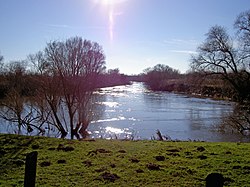
The Leine near Sarstedt-Ruthe
Course of the Leine
Map
Location
CountryGermany
StatesThuringia and Lower Saxony
Reference no.DE: 488
Physical characteristics
Source 
 • locationIn Leinefelde in the Eichsfeld
 • elevation340 m above sea level (NN)
Mouth 
 • location
Near Schwarmstedt into the Aller at km 52.26[1]
 • coordinates
52°43′22″N 9°35′38″E / 52.72278°N 9.59389°E / 52.72278; 9.59389
 • elevation
25 m above sea level (NN)
Length281 km (175 mi)
Basin size6,517 km2 (2,516 sq mi) [2]
Discharge 
 • locationat Göttingen gauge
 • average5.3 m3/s (190 cu ft/s)
Discharge 
 • locationGreene
 • average32.0 m3/s (1,130 cu ft/s)
Discharge 
 • locationHerrenhausen
 • average52.3 m3/s (1,850 cu ft/s)
Discharge 
 • locationSchwarmstedt
 • average61.7 m3/s (2,180 cu ft/s)
Basin features
ProgressionAllerWeserNorth Sea
Landmarks
Tributaries 
 • leftEspolde, Ilme, Saale, Haller, Westaue
 • rightGarte, Rhume, Aue, Gande, Innerste, Auter

The Leine (German: [ˈlaɪnə] ; Old Saxon Lagina) is a river in Thuringia and Lower Saxony, Germany. It is a left tributary of the Aller and the Weser and is 281 km (175 mi) long.

Leine near Nordstemmen

The river's source is located close to the town of Leinefelde in Thuringia. About 40 km (25 mi) downriver, the river enters Lower Saxony and runs northwards.

Important towns along its course, from upstream to downstream, are Göttingen, Einbeck, Freden, Alfeld, and Gronau, before the river enters Hanover, the largest city on its banks. Downstream some 40 km (25 mi) north of Hanover, near Schwarmstedt, the river joins the Aller and reaches the North Sea via the Weser. Its northern (lower) reaches are only navigable today by the smallest commercial carriers, though in the past, it served as an important pre-railway barge transport artery as far upriver as Göttingen.

The river is somewhat polluted by industry, so the water is not used for drinking, but the pollution has never been severe enough to prevent fish from living in it. Like many western rivers since the 1960s, it has enjoyed increasingly cleaner waters since the implementation of environmental controls. Sport fishing is enjoyed from small boats and along the banks, although yields are normally low.

At least one point of the river (Göttingen) is partially diverted into a canal that runs more or less parallel to the river.

Serial killer Fritz Haarmann disposed of most of his victims' remains in the Leine river.[3]

In fiction

[edit]

In his 1986 bestseller Red Storm Rising, author Tom Clancy uses the Leine as a major obstacle to the Soviet Union's Red Army drive to the Rhine and the North Sea ports of the Netherlands and Belgium through West Germany. In reality, the river is a rather minor one, and, for most of its length, is quite narrow with a small flow volume. As such, it would not provide a significant barrier to an advancing army.

See also

[edit]

References

[edit]

Further reading

[edit]
[edit]
Revisions and contributorsEdit on WikipediaRead on Wikipedia
from Grokipedia
The Leine is a 281-kilometer-long river in central Germany, originating near Leinefelde in the Eichsfeld region of Thuringia and flowing generally northward through Lower Saxony before joining the Aller River near Schwarmstedt as a left tributary within the Weser river basin. Along its winding course, the Leine traverses diverse landscapes, from the hilly terrains of southern Lower Saxony to the flat northern lowlands, passing through several historic towns and cities that have shaped its cultural and economic significance. Notable settlements include Göttingen, a university city known for its medieval architecture and academic heritage; Hannover (Hanover), the state capital of Lower Saxony where the river bisects the urban center and connects to the Leine Canal for navigation and recreation; and smaller locales like Einbeck, famous for its brewing tradition, and Northeim. The river plays a vital role in the region's and , supporting in the fertile Leine Valley, providing habitats for diverse and fauna, and serving as a corridor for recreational activities such as along the Leine-Radweg and in designated sections. Historically, the Leine has influenced settlement patterns and trade since , with canals and weirs developed for milling and transport, while modern efforts focus on flood management and environmental restoration to mitigate past industrialization impacts.

Geography

Course

The Leine River originates at the Zehnsberg hill near the town of Leinefelde in , at an elevation of 340 meters above . The source consists of multiple springs emerging in a depression between the Dün and Ohmgebirge ranges on the watershed dividing the and drainage systems. From there, the river flows generally northward over a total length of about 281 kilometers through and , descending to an elevation of 25 meters at its mouth. As a left-bank of the Aller River—which itself belongs to the larger river system—the Leine contributes to the northward drainage pattern toward the . The upper course of the Leine traverses the Eichsfeld region, a hilly landscape in northern characterized by forested uplands and narrow valleys, passing through Leinefelde as its first major settlement. After approximately 40 kilometers, it crosses into and enters the middle course, winding through the Leinebergland with its rolling hills and broader valleys, where it flows past significant towns such as , Einbeck, Alfeld, and Gronau. This segment features a mix of agricultural plains and urban areas, with the river meandering alongside transportation corridors and supporting local ecosystems in meadows. In its lower course, the Leine continues northward through the flat lowlands of , entering the city of and traversing districts like Limmer, Herrenhausen, and Ricklingen before proceeding via Garbsen, Seelze, Wunstorf, and Neustadt am Rübenberge. The river reaches its mouth at Gilten near Schwarmstedt in the Heidekreis district, where it joins the Aller after an overall elevation drop of approximately 315 meters. Throughout its path, the Leine maintains a relatively gentle , shaping diverse riparian habitats while influencing settlement patterns in the regions it crosses.

Basin and Tributaries

The drainage basin of the Leine River encompasses approximately 6,517 km², primarily within but also extending into in its upper reaches. This catchment area supports a hydrological system where the river collects water from diverse sub-basins, contributing to its overall flow dynamics. Major left-bank tributaries include the Espolde, joining upstream near ; the Ilme, a roughly 30 km originating in the Solling that confluences at Volksen on the southern edge of ; and the , which enters the Leine at Elze, east of . On the right bank, key inflows are the Garte in the upper basin east of Weißenborn, the Rhume—a 48 km river with a karstic source at Rhume Spring that merges at river kilometer 192.9 downstream of —and the Innerste, a 101 km tributary with a 1,235 km² catchment that significantly augments flow upon joining near Sarstedt in the middle-lower section. The sub-basins are characterized predominantly by agricultural land use, particularly in the lowlands, interspersed with forested areas in the hilly upper regions like the Eichsfeld and foothills, while urban development exerts influence around in the lower basin. These tributaries play a crucial role in expanding the Leine's width and enhancing discharge, especially in the middle and lower segments, where inflows from the Rhume (1,193 km² catchment) and Innerste collectively boost the main channel's volume and variability.

Hydrology

Discharge and Flow Regime

The Leine River exhibits a characteristic discharge profile influenced by its basin's patterns and , with mean annual discharge increasing downstream as tributaries contribute to the flow. At the Schwarmstedt gauging station near the mouth, the long-term average discharge (MQ) is 60.6 m³/s, based on historical records spanning multiple decades. Representative measurements from key upstream stations illustrate this progression: 5.3 m³/s at , 32.0 m³/s at Greene, 52.3 m³/s at Herrenhausen, and 61.7 m³/s at Schwarmstedt, reflecting cumulative drainage from a basin area of approximately 6,500 km². The Leine's flow regime is classified as pluvial-nival, a mixed type common in central European mid-latitude rivers, where discharge is driven primarily by rainfall but augmented by snowmelt in higher elevations. Peak flows typically occur in winter and spring due to increased precipitation and melting snow, while summer months experience low flows owing to higher evapotranspiration and reduced rainfall. This regime has shown shifts over the 20th and 21st centuries, with trends toward higher winter discharges and lower summer values linked to climate variability. Recent extreme events, such as the Christmas flood of 2023/2024, which reached 6.15 m at the Neustadt gauging station, underscore ongoing increases in flood risks due to climate change. Extreme flood events punctuate the Leine's hydrology, with historical high discharges (HHQ) reaching up to 1,200 m³/s at Schwarmstedt during severe 20th-century floods, such as the record event on February 11, 1946. Historical floods have influenced river management efforts, including straightening initiatives to enhance flood control and agricultural usability by altering natural meanders to accelerate flow and reduce overflow risks. The Leine has historically served as a key waterway for transportation in , facilitating the movement of timber, agricultural , and industrial materials from inland regions to the via the Aller and rivers until the early . Prior to the widespread adoption of rail networks, the river supported flat-bottomed s capable of carrying up to 180 tons, with extending upstream to Hannover through a series of dams and locks designed for both power generation and passage. Key infrastructure included the Herrenhausen Dam and lock at approximately km 153 from the source, which maintained a minimum depth of 2.5 meters at middle water levels, and the Neustadt Dam at km 110, creating a 7.5 km backwater to regulate flow for reliable transport. A branch canal with descending locks connected the Leine to the near Hannover, allowing larger 600-ton vessels to access the river system and enhancing its role as a regional . The navigable portion of the Leine spans approximately 100 km from its confluence with the Aller near Schwarmstedt upstream to Hannover, though depths and capacities vary with seasonal flow, limiting operations to middle and high water conditions. Additional structures, such as weirs for flow control and an aqueduct crossing near Lind (km 136), supported this infrastructure but also posed challenges like ice blockages in winter, suspending navigation for up to 35 days annually in the mid-20th century. The Leine Canal in Göttingen, originally constructed in the 14th century as a diversion from the main river to power mills and manage urban water supply, includes weirs and sluices that occasionally allow for small-scale navigation during organized events. In the , commercial navigation on the Leine has significantly declined due to the expansion of rail and networks following the , shifting freight to more efficient land-based systems and rendering the river's largely obsolete by the mid-20th century. Today, the waterway supports only limited small-scale commercial activity with vessels under 160 tons during favorable conditions, while its primary use is recreational, including guided and kayak tours. A popular 17 km stretch from Sarstedt to Hannover offers beginner-friendly paddling through urban and green landscapes, with outfitters providing stable for safe exploration of the river's meanders. Annual events on the Leine Canal in further promote non-motorized boating, emphasizing the river's shift toward leisure and environmental tourism.

Geology and Environment

Geological Formation

The Leine River flows through the Leinegraben, a tectonic depression in the southern part of the Central European Basin in , , which originated during the through downbuilding or rafting of lower Buntsandstein blocks over mobile Zechstein salt layers, forming a proto-graben with associated salt diapirs and depocenters. This depression was further shaped by halokinetic processes, where the Zechstein salt (Upper Permian evaporites) acted as a decoupling horizon for faults, preventing their into underlying strata and facilitating differential along the graben's borders. During the to Early Tertiary inversion, these salt structures experienced collapse along steep, planar faults detaching within the salt layer, contributing to the graben's current elongated form that guides the river's path. The Leinetal-Achse represents a prominent geological axis within the , characterized by a series of salt diapirs that exert control over the river's meandering patterns and induce localized through ongoing halokinesis. These diapirs, rooted in the Zechstein salt, rose during extension and influenced sediment thickness variations, creating structural highs and lows that the Leine follows in its middle reaches. along the axis further modified the graben's evolution, with sinistral faults parallel to the river contributing to lateral displacements and the alignment of tectonic features. The underlying strata of the Leinegraben consist primarily of sediments, including Buntsandstein (lower continental ), Muschelkalk (middle marine limestones and dolomites), and Keuper (upper evaporitic and terrestrial deposits), overlain by Lias formations in the graben interior. These strata, reaching depths of up to 1200 meters, are exposed along the river's course due to tectonic uplift and erosion, with the shoulders of the featuring thicker Buntsandstein and Muschelkalk sequences. In the upper sections of the Leine, particularly where Muschelkalk limestones dominate, features such as sinkholes and underground drainage develop from the dissolution of soluble carbonates, influencing local hydrology and valley incision. The modern valley morphology of the Leine was profoundly shaped during the Pleistocene, when Saalian (Middle Pleistocene) glaciations advanced from the north, depositing ice-marginal and fluvioglacial sediments that filled and incised the pre-existing tectonic basin. Periglacial processes, including frost wedging and solifluction, further modified the landscape during glacial-interglacial cycles, while the formation of Leine—reaching a highstand of approximately 200 meters above —eroded broad terraces and facilitated sediment redistribution along the valley floor. This glacial legacy results in narrow gorges in the upper reaches, where the river cuts through resistant and outcrops, contrasting with broader, sediment-filled floodplains downstream, where from salt movement and glacial create expansive lowlands.

Ecology and Water Quality

The Leine River supports a diverse , with over 29 species recorded in its middle reaches around , including common carp (Cyprinus carpio), (Esox lucius), and salmonids such as (Salmo trutta). These contribute to a viable sport fishing industry, particularly for anglers targeting pike and trout in the river's varied flow regimes. The river's habitats also foster riparian , with floodplain forests known as Auwälder dominated by black alder (), common ash (), and willows (Salix spp.), alongside wet meadows (Feuchtwiesen) and extensive riparian zones that provide essential corridors for and . Terrestrial wildlife in the Leine valley includes reintroduced European beavers (Castor fiber), which have established populations and created wetland habitats through dam-building activities, and Eurasian otters (Lutra lutra), benefiting from improved connectivity in floodplain areas. The native Leineschaf sheep breed, adapted to the riverine floodplains and meadows of the Leine valley between and Hannover, supports traditional grazing that maintains open habitats and prevents overgrowth. Water quality in the Leine is challenged by elevated nitrate levels primarily from agricultural runoff in the intensively farmed basin, rendering it unsuitable for direct extraction in affected sections. Diffuse , including nitrates and from historical in the Harz Mountains, impacts downstream ecosystems, though overall physico-chemical status has improved since the 1990s due to regulatory measures under the EU Water Framework Directive. Conservation initiatives focus on restoring connectivity and reducing , with protected areas like the Leine-Heide Nature Park encompassing riparian forests and wetlands to enhance biodiversity. Projects such as the LIFE Floodplain Amphibians initiative have created 70 new ponds and acquired land for extensive grazing along the Leine and its tributaries, supporting species like beavers, otters, and amphibians while addressing nutrient inputs through habitat management.

History

Etymology and Early Records

The name "Leine" originates from the Old Saxon form *, a reflecting prehistoric Germanic naming conventions for . This form is linked to the Indo-European root *lakú-, denoting a or , as seen in Latin lacus ("lake") and suggesting connotations of flowing or standing water. The term's evolution into Leyne and modern German Leine preserves this ancient aquatic association, common in early Germanic river names. The earliest historical reference to the Leine appears indirectly through the "Leinegau," a medieval encompassing the upper Leine valley, mentioned in a 954 AD issued by Emperor Otto I of the . This document, part of the Ottonian chancery records, delineates land grants and jurisdictions in , highlighting the region's integration into the empire's feudal structure. The Leinegau, also spelled Lochne-gau in some variants, represented a key Saxon gau (district) formed amid the consolidation of Saxon territories following Charlemagne's conquests. In the early medieval context, the Leine region was closely tied to the Saxon tribes, who settled the area north of the Mountains during the and established it as part of the by the 9th century. Administrative divisions like the Leinegau facilitated royal oversight, taxation, and military levies under the Carolingian and Ottonian dynasties, reflecting the ' transition from tribal confederations to imperial subjects. Latin texts from the 9th and 10th centuries occasionally render the river's name as Lena or Lagina, adapting the Old Saxon form for ecclesiastical and imperial documents, such as those from Abbey or Ottonian charters. These variations underscore the river's role in early medieval geography, marking boundaries between Saxon and Thuringian influences.

Historical Utilization

Timber rafting on the Leine River was a key economic activity, documented since 1592, when wood from the eastern forests was floated downstream to supply markets in . This practice expanded after 1680 with the completion of the Lakenteich reservoir, facilitating larger-scale transport of timber for construction and fuel, continuing until the early when railroads largely replaced it. The Leine also powered numerous mills and factories along its course during the 18th and 19th centuries, harnessing water flow for grinding grain, , and early textile processing. For instance, the Hahnemühle in Dassel, established in 1584 and expanded in the industrial era, relied on the river's energy for production. The river's role extended to supporting regional linen production, as the Leine served as a flax-processing area, with the aiding of raw fibers and finished goods in Lower Saxony's countryside economy from the onward. Post-World War II modifications focused on flood control and agricultural enhancement, involving river straightening and channelization to reduce flood risks and reclaim land for farming. Major projects from the 1960s to 1980s shortened meanders, improving drainage while altering the river's natural morphology. These efforts were part of broader basin initiatives, prioritizing in flood-prone areas.

Cultural Significance

In Literature and Media

The Leine River features prominently in 1986 techno-thriller novel , where it serves as a key strategic obstacle during a fictional NATO-Warsaw Pact conflict in . In the story, Soviet forces encounter significant resistance while attempting to cross the Leine near Alfeld as part of their advance toward the , highlighting the river's role in delaying enemy movements and shaping battlefield tactics. Documentaries have also captured the Leine's scenic and natural appeal, such as the 2023 production Romantic River: The Beautiful Leine Valley, which explores the river's valley south of Hannover. The film depicts a diverse of fields, meadows, ponds, and forests along the waterway, featuring wildlife like breeding kestrels, courting mute swans, hunting , spawning fire salamanders, and families in Hannover, while showcasing opportunities for scenic amid the region's unspoiled nature. In 19th-century German regional , the Leine appears in accounts and descriptive works portraying everyday life along its banks in Hannover, such as Thomas Hodgskin's Travels in the North of Germany (1820), which vividly describes the river dividing the city and its integration into urban scenery and commerce. Such writings evoke the riverside's role in local society, from built-over channels to bridges connecting bustling districts, reflecting the era's growing industrialization and daily rhythms in . Modern media often portrays the Leine through promotions and recreational guides that emphasize its accessibility for activities. Official regional resources highlight the river's paths for and paddling, including the Leinewelle artificial wave opened in 2023 for near Hannover, promoting it as a vibrant spot for water sports and family outings. Running route guides further underscore its recreational value, mapping multi-use paths along the Leine and adjacent Ihme River through parks like Maschsee, offering 5-8 km loops suitable for urban joggers amid green spaces and historic sites.

References

Add your contribution
Related Hubs
User Avatar
No comments yet.