Hubbry Logo
St. John's water dogSt. John's water dogMain
Open search
St. John's water dog
Community hub
St. John's water dog
logo
8 pages, 0 posts
0 subscribers
Be the first to start a discussion here.
St. John's water dog
from Wikipedia

St. John's water dog
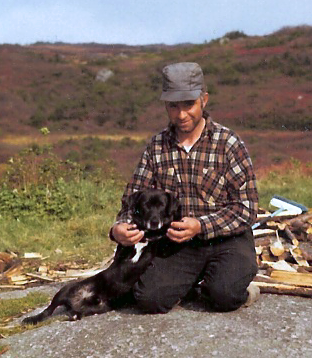
A Newfoundland outport fisherman with his young St. John's water dog, photographed 1971 in La Poile, Newfoundland
Other namesLesser Newfoundland
OriginNewfoundland
Variety statusExtinct. Not recognized as a breed by any major kennel club.
Traits
Height Males 22-24 inches (55-61 cm)[1]
Females 21-23 inches (54-59 cm)[1]
Weight Males 40-90 pounds (18-40 kg)[1]
Females 35-84 pounds (16-38 kg)[1]
Colour Black with white tuxedo markings
NotesThe St. John's water dog first developed on the island of Newfoundland sometime between 1494-1790 as European fishing dogs were brought to the region. During its development, Newfoundland was being colonized by Europeans; while contested, Newfoundland was primarily a British colony until Canada was formed in 1867 and Newfoundland voted to join the country 1949. The dog went extinct in the 1980s.
Dog (domestic dog)
Modern-day Labrador Retriever mixes, such as this one from Atlantic Canada, may show their genetic ancestry through the manifestation of the tuxedo coat pattern of the St. John's water dog.

The St. John's water dog, also known as the St. John's dog or the lesser Newfoundland, is an extinct landrace of domestic dog from Newfoundland. Little is known of the types that went into its genetic makeup, although it was probably a random-bred mix of old English, Irish and Portuguese working dogs.[2] They were favourite dogs of fishermen because they had extraordinary qualities like good temperament and working behaviour. The number of St. John's water dogs started declining by the beginning of the 20th century. By the early 1980s, the landrace was extinct.

During the 19th and early 20th centuries, St. John's water dogs were exported from Newfoundland to England. These dogs were crossbred with other dogs to create the retrievers. It was the ancestor of the modern retrievers, including the Flat-Coated Retriever, Curly-Coated Retriever, the Chesapeake Bay Retriever, the Golden Retriever, and the Labrador Retriever. The St. John's water dog was also an ancestor to the large and gentle Newfoundland, probably through breeding with Rafeiro do Alentejos brought to the island by the generations of Portuguese fishermen who had been fishing offshore since the 15th century.

Appearance

[edit]

The St. John's breed were called "water dogs" because of their love for water and their coat, which was water-resistant.[3] St. John's water dogs were medium-sized, strong, and stocky – more closely resembling modern Show Labradors than Field Labradors. They had characteristic white patches on the chest, chin, feet, and muzzle. This colouration occasionally manifests in modern Labs as a small white chest patch – known as a "medallion" – or as a few stray white hairs on the feet. The classic tuxedo markings of the St. John's water dog commonly manifest in Labrador Retriever mixes.

Writings as early as the 17th century mention hardy medium-sized black dogs that accompanied Newfoundland fishermen in their boats, and retrieved distant lines or nets of fish, hauling them back to the boat. The dogs were described as having a short thick coat, rudder-like tail, high endurance, and a great love of swimming.

History

[edit]
Year (AD) Event
<1790 Although people had been living on Newfoundland for several centuries, there were no recorded instances of dogs.
1790
Bewick's "Newfoundland" was based on a single dog in Eslington. It may have been a St. John's dog or Newfoundland interbred with other dogs before coming to England; it may also have been an accurate representation of the Newfoundland landrace. Some debate what the naturally occurring colours of the Newfoundlands were on the island and how well early accounts differentiated the two breeds.

Thomas Bewick, a woodcarver, creates the earliest depiction of a “Newfoundland dog” (possibly not a modern-day Newfoundland). If the dog is indeed from Newfoundland, it indicates that the St. John's breed had formed by this point (as Newfoundlands are thought to be descendants of the St. John’s dog).[4][5]

The description reads: "The drawing of this dog was taken for a very fine one at Eslington, in the county of Northumberland. Its dimensions were as follow: From its nose to the end of its tail, it measured six feet two inches; the length of its tail, one foot ten inches; girt behind the shoulder, three feet two inches; round its head over its ears, two feet; round the upper part of his fore leg, nine inches and a half. It was web-footed, could swim extremely fast, dive with great ease, and bring up any thing from the bottom of the water. It was naturally fond of fish and ate raw trouts, or other small fish, out of the nets.

This breed of dogs was originally brought from the country of which they bear the name, where their great strength and docility render them extremely useful to the settlers on those coasts, who use them in bringing down wood from the interior parts of the country to the sea side. Three or four of them, yoked to a sledge, will draw two or three hundred weight of wood piled upon it, for several miles, with great ease. They are not attended with a driver, nor any person to guide them; but after having delivered their loading, they return immediately to the woods, where they are accustomed to be fed with dried fish, &c.”

1803 William Taplin’s The Sportsman’s Cabinet depicts what appears to be a Newfoundland dog (thought to be descended from St. John's dogs).[4]
1809 An English ship carrying two St. John's puppies shipwrecks off the coast of Maryland. There is a black female and a red male who mix with local dogs. These later form the Chesapeake Bay Retriever.
1814 Col. Peter Hawker publishes Instructions to Young Sportsmen. Hawker divides dogs from Newfoundland into three categories: a giant "Labrador" breed; what he calls the "true Newfoundland" (St. John's breed); and a big, shaggy breed sold as a pet. St. John's is described as a medium-large dog that is smooth-coated. He describes the giant Labrador as long-haired. Hawker was one of the first to refer to a Newfoundland dog as a retriever.[4]
1822 Explorer W.E. Cormack crossed the island of Newfoundland by foot. In his journal, he wrote "The dogs are admirably trained as retrievers in fowling, and are otherwise useful.....The smooth or short haired dog is preferred because in frosty weather the long haired kind become encumbered with ice on coming out of the water."[6]
1830 An early report by a Colonel Hawker described the dog as "by far the best for any kind of shooting. He is generally black and no bigger than a Pointer, very fine in legs, with short, smooth hair and does not carry his tail so much curled as the other; is extremely quick, running, swimming and fighting....and their sense of smell is hardly to be credited...."[6]
1839-1840 In his book, Excursions In and About Newfoundland During the Years 1839 and 1840 Vol. 1,[7] the geologist Joseph Beete Jukes describes the St. John's water dog with both bemusement and admiration: "A thin, short-haired, black dog came off-shore to us to-day. The animal was of a breed very different from what we understand by the term Newfoundland dog in England. He had a thin, tapering snout, a long thin tail, and rather thin, but powerful legs, with a lank body, – the hair short and smooth." wrote Jukes. "These are the most abundant dogs in the country...They are no means handsome, but are generally more intelligent and useful than the others... I observed he once or twice put his foot in the water and paddled it about. This foot was white, and Harvey said he did it to 'toil' or entice the fish. The whole proceeding struck me as remarkable, more especially as they said he had never been taught anything of the kind."
1842 Sir Richard Henry Bonnycastle publishes Newfoundland in 1842. "They are of two kinds; the short, wiry-haired Labrador dog, and the long, curly-haired Newfoundland species, generally black, with a white cross upon the breast. The common dogs used in the catamarans are of every possible cross with these, and are of every variety of colour and fur".[4]
1867 Modern Canada is founded.
1872 Stonehenge publishes The Dogs of the British Islands, Being a Series of Articles and Letters by Various Contributors, Reprinted from the “Field” Newspaper.

"We have seen first-class dogs smooth-coated, wavy-coated, and curly. One smooth dog, two flat-coated or small Labrador, two curly-coated dogs and one bitch, all belonging to personal friends, we have never seen excelled; and a dog by a Clumber spaniel out of a Labrador bitch is one of the very best dogs to find and bring game or wildfowl that we have ever seen (pg. 91)."

"THE ST. JOHN’S, SMALL LABRADOR, OR LESSER NEWFOUNDLAND. This dog is known by his smooth, though slightly wavy and glossy coat, being the foundation of the wavy-coated retriever already alluded to (page 89). He is much smaller than the Newfoundland proper, seldom exceeding 25in. or 26in. in height. In other respects there is little difference (pg 171)".[4]

1847 Irish dog expert, H.D. Richardson, describes three types of Newfoundland dogs in Dogs: Their Origin and Varieties. This includes the Labrador spaniel/Lesser Labrador dog: "This dog presents an appearance intermediate between the Newfoundland dog and the Land Spaniel; he is generally called by the above name, but whether or not he is fully entitled to it, is in my judgment at least questionable. These dogs are remarkable for their diving powers. I saw one some years ago with an officer, who was quartered at Portobello Barracks, Dublin, which dived repeatedly to the bottom of the canal, between the lochs, when full of water, and fetched up such stones, &c., as were thrown in."
1869 British colony of Newfoundland votes against joining Canada
1885 UK introduces long-term quarantine on all imported animals, especially dogs, to combat rabies.
1949 Newfoundland votes to join Canada.
1980s Last surviving St. John's dogs photographed.

Extinction

[edit]

The St. John's water dog was made extinct in its homeland by a combination of two factors. In an attempt to encourage sheep raising, heavy restrictions and taxes were placed on dog ownership during the 19th century. Their main overseas destination, the UK, imposed a rigorous long-term quarantine on all imported animals, especially dogs (1885) as part of the eradication of rabies. However, in both Newfoundland and the Maritime provinces, there are still large black mixed-breed dogs with many characteristics of the original St. John's water dog.

The last two known St. John's water dogs were photographed in the early 1980s (in old age) having survived in a "very remote area",[8] but both were male, bringing the era of the St. John's water dog to an end.

In the 1970s, Canadian author Farley Mowat had tried to save them by crossing his St. John's water dog, named "Albert", with a Labrador Retriever. Four puppies resulted, and all had the distinctive white markings of their sire. Two puppies died, the other two were given away. One was given to Canadian prime minister Pierre Trudeau and the other to Soviet Premier Alexei Kosygin.[9] In 1970, Mowat and Albert appeared in an episode of the CBC series Telescope. The episode includes Mowat telling a bedtime story to his dog.[10]

References

[edit]
Revisions and contributorsEdit on WikipediaRead on Wikipedia
from Grokipedia
The St. John's water dog was an extinct breed of medium-sized, stocky developed in Newfoundland, Canada, during the 16th and 17th centuries from European fishing and breeds, renowned for its exceptional swimming abilities and role in assisting fishermen by retrieving fish from nets and lines in the cold Atlantic waters. Physically, the breed featured a dense, oily, waterproof coat—typically short and smooth, though some individuals had longer, feathered fur—that repelled water and ice; webbed feet for propulsion; a broad, otter-like tail for ruddering; and a gentle mouth suited for carrying game without damage, with common colors including black, sometimes with white chest patches. These adaptations made it ideal for the harsh maritime environment, where it not only hauled nets and lines but also retrieved shot birds like ptarmigan and seals, and occasionally served as a watchdog or sled dog in rural Newfoundland communities. Historically, the St. John's water dog, also known as the lesser Newfoundland or lesser water dog, emerged from crosses of English, Irish, and Portuguese working dogs brought by European explorers and settlers to aid in the Grand Banks fishery, with early accounts from the 1800s praising its diving prowess and endurance in frigid waters. Larger specimens contributed to the development of the breed, while smaller ones were exported to in the , forming the foundation for modern retrievers including the through breeding programs like those at and Buccleuch estates between 1809 and the 1880s, as well as influencing the golden and flat-coated retrievers via their long-coated variants. The breed's decline began in the late 19th century due to Newfoundland's imposition of heavy dog ownership taxes to protect emerging sheep farming interests, which forced many fishing families to cull or abandon their dogs, and the broader collapse of traditional outport fishing culture in the 20th century. By the early 20th century, purebred examples had largely vanished from Newfoundland, with the last known pair—two elderly males—dying of old age in the remote community of Grand Bruit on the island's south coast in the early 1980s, marking the breed's official extinction.

Physical characteristics

Appearance

The St. John's water dog exhibited a medium-sized, stocky build that closely resembled the modern show , characterized by a broad head, deep chest, and muscular limbs adapted for efficient swimming. Historical records indicate these dogs were approximately the size of an English Pointer, with males typically measuring 22-24 inches (55-61 cm) at the shoulder and females 21-23 inches (54-59 cm). The breed possessed a short, thick, dense, and water-resistant double coat that repelled water effectively, allowing ice to slide off without accumulating during cold-water work; the oily texture was prized by fishermen for its practicality. Some exported lines featured longer, rougher coats, potentially resulting from crosses with other breeds, though the smooth, short-haired variety predominated in Newfoundland. Coloration was predominantly solid black, often accented by white markings on the chest, chin, feet, and muzzle in a distinctive tuxedo pattern. Rare yellow variants appear in early records, though black remained the most common hue among working populations. Distinctive features included an otter-like tail—broad at the base, tapering to a flat tip, and functioning as a to aid propulsion and balance during —as well as webbed feet that enhanced their endurance and agility in water. These adaptations supported their roles in retrieving and lines from icy waters.

Temperament

The St. John's water dog was renowned among historical observers for its friendly and loyal disposition, forming strong bonds with owners and handlers through unwavering devotion and a keen eagerness to please. Accounts from 19th-century fishermen and breeders highlighted the breed's gentle nature toward humans, including children, with whom they played affectionately, as well as toward other animals, showing no signs of aggression or territoriality. This outgoing and happy demeanor made them versatile companions in rugged Newfoundland outports, where they balanced work duties with family life without excessive barking or nervousness. Exhibiting high , or "sagacity" as described by contemporary writers, the St. John's water dog demonstrated exceptional trainability and a willing attitude toward tasks, performing retrievals and other labors with precision and without resistance. Rev. Thomas Pearce noted in 1872 their strong and , qualities that endeared them to handlers and contributed to their role as reliable partners in demanding environments. Their affectionate extended beyond utility, positioning them as beloved family members who thrived on human interaction. While energetic in pursuit of water-based activities and retrieval, the breed remained calm and composed during downtime, reflecting a balanced suited to both labor and companionship. This drive for work, combined with their gentle and non-aggressive approach, underscored their value as multifaceted workers who integrated seamlessly into household settings.

History

Origins

The St. John's water dog emerged as a in Newfoundland through the interbreeding of European fishing dogs brought by settlers, a process that began with John Cabot's arrival in 1497 and continued over subsequent centuries. These dogs were introduced by fishermen from various European nations, leading to a distinct type adapted to the island's harsh coastal conditions and the demands of the cod fishery. By the 16th and 17th centuries, this interbreeding had solidified the breed's characteristics, with locals selectively maintaining dogs that excelled in swimming and retrieving. The ancestral foundation consisted primarily of English, Irish, and water dogs, breeds known for their affinity for water and utility in tasks, with possible influences from and that had been adapted for coastal work. These European imports were crossed repeatedly in the isolated Newfoundland environment, resulting in a versatile prized for its endurance and loyalty among fishermen. These dogs served as integral companions to fishermen, assisting in hauling lines in the treacherous waters of the North Atlantic. The earliest known visual depiction of the St. John's water dog appears in an painting by Clifton Tomson, illustrating a black-coated engaged in activities alongside rural inhabitants. This artwork captures the breed's role in before systematic export and breeding altered its form elsewhere. Larger specimens of the St. John's water dog contributed to the development of the breed as a heavy draft animal for hauling loads on land and water, while smaller ones remained more agile, focused on retrieval and assistance in operations.

Breeding and export

In the 19th century, Newfoundland fishermen systematically bred St. John's water dogs to enhance their retrieving abilities and swimming prowess, selecting for traits that excelled in the demanding cod fishery environment. These dogs were prized for hauling nets ashore and retrieving fish from icy waters, with favoring their webbed feet, oily double coats, and strong, otter-like tails that propelled them efficiently. This breeding focused on hardy, versatile workers that demonstrated eager temperaments suited to repetitive water tasks. Exports of St. John's water dogs to began in the early 1800s, primarily through the port of , where returning fishermen showcased their retrieving skills to British sportsmen. Notable importers included the second , who acquired dogs as early as 1809 for use in duck shooting at his Heron Court estate, and the Dukes of Buccleuch, who established kennels in during the 1880s with stock gifted from Malmesbury's lines, such as the foundational sires "Ned" and "Avon." These shipments were aimed at developing superior gun dogs, leading to widespread adoption on British estates by the mid-1800s. A key event occurred in , when a ship carrying St. John's water dogs bound for British estates wrecked off Maryland's coast; the survivors, a male named "Sailor" and a female "Canton," were bred locally and contributed to the origins of the . In , by aristocrats like and Buccleuch emphasized shorter, denser coats for better water repellency and refined retrieving instincts, distinguishing these dogs from the longer-coated, larger Newfoundland variants. This refinement involved controlled matings and exchanges between estates to maintain pure lines while enhancing utility, resulting in smoother-coated progenitors of modern retrievers.

Working roles

In Newfoundland fisheries

The St. John's water dog served as a vital working partner in Newfoundland's commercial from the 17th to the 19th centuries, assisting fishermen in the demanding North Atlantic environment where survival depended on efficient fish retrieval and gear management. These dogs were particularly adept at leaping from small dories to retrieve fish that escaped from nets, lines, and hooks amid the icy waters, a task essential to maximizing catches in the region's subsistence and commercial operations. Their strength and swimming prowess also enabled them to haul heavily laden nets and fishing lines back to boats, often paddling through frigid conditions to support the labor-intensive process. Beyond surface retrieval, the breed's diving ability made it invaluable for recovering sunken gear or lost fish, as evidenced by 19th-century accounts of the dogs plunging into canals to fetch weighted objects like stones, demonstrating their capacity for underwater tasks in cold seas. Physical adaptations such as webbed feet and oily, water-repellent coats allowed them to endure these harsh conditions without fatigue, ensuring reliability during extended fishing expeditions. These dogs were fully integrated into the daily routines of Newfoundland fishermen, routinely accompanying crews on boats and living aboard small vessels to facilitate round-the-clock operations in remote coastal areas. In the isolation of outport settlements and during prolonged voyages, they offered companionship to solitary workers while providing protection as alert watchdogs against potential dangers at sea or ashore.

Development as gun dogs

Following their export from Newfoundland to England in the early 19th century, St. John's water dogs were quickly adapted for use as retrievers in waterfowl and upland game hunting by British sportsmen. These dogs demonstrated exceptional skills in marking fallen game and performing soft-mouthed retrievals, delivering birds without damage due to their gentle grip and innate drive. Historical accounts from the period highlight their eagerness to enter cold water and retrieve from challenging environments, making them invaluable companions during shoots. The breed's steady temperament and bold water entry were particularly prized by the English , who incorporated them into early organized practices on estates. Figures such as the 2nd began breeding programs in the 1810s specifically for retrieving shot game, influencing the development of standards among the . Their calm demeanor under gunfire and reliability in trials of the hunt contributed to the breed's reputation as a foundational in Britain's sporting culture. By the mid-19th century, St. John's water dogs were selectively crossed with setters and pointers to enhance their land-working abilities and establish foundation stock for specialized breeds. These crosses, often aimed at producing longer coats for better protection in varied terrains, resulted in early lines of the flat-coated and Labrador s, with notable programs led by the 5th in . The integration helped formalize characteristics during the , as rising popularity of organized hunting sports demanded versatile gun dogs. Their versatility shone in practical applications, where they retrieved , geese, and hares from or dense cover with minimal disturbance to the game. This adaptability played a pivotal role in shaping the breeds that dominated Victorian-era , solidifying the St. John's water dog's legacy in European traditions.

Decline and extinction

Regulatory factors

In the 19th century, the colonial government of Newfoundland implemented stringent laws to curb the growing population, which was seen as a threat to through predation and the spread of . A in 1780 limited households to owning no more than one dog, while the 1885 Sheep Act imposed taxes on dog ownership, with higher rates on females that often resulted in the of female puppies to avoid costs. These measures drastically reduced breeding opportunities and overall numbers of working dogs, including the St. John's water dog, as families prioritized economic survival over maintaining multiple animals. Concurrent British import regulations further hampered the breed's viability by discouraging exports from Newfoundland. Late 19th-century quarantine rules, originating in the 1800s to prevent , required imported dogs to undergo six months of isolation upon arrival in , making the costly and lengthy process unappealing for breeders and importers who had previously relied on regular shipments of St. John's water dogs. This effectively slowed the flow of purebred stock to , where the dogs were valued for developing breeds, while local populations in Newfoundland faced mounting pressures. Economic transformations in Newfoundland's fisheries exacerbated these regulatory impacts, diminishing the demand for the breed's specialized working roles. The shift from labor-intensive, small-scale cod fishing—where St. John's water dogs retrieved lines and hauled nets—to mechanized operations in the early rendered traditional dog assistance obsolete, leading to fewer purposeful breedings. Additionally, efforts to preserve dwindling local dog populations through informal export restrictions in the late came too late, as genetic bottlenecks had already formed from prior heavy exports. The combination of these factors prompted widespread crossbreeding among remaining St. John's water dogs in Newfoundland with other local and imported breeds, diluting the distinctive oily-coated, water-retrieving traits by the early 1900s. Fishermen, constrained by ownership limits and economic hardship, interbred dogs for practicality rather than purity, accelerating the loss of the landrace's uniform characteristics.

Last populations

As the 20th century progressed, sporadic sightings of St. John's water dogs were reported in remote areas of Newfoundland into the 1970s, often among isolated fishing communities where traditional practices lingered. These observations dwindled as outport resettlements disrupted local habitats and reduced the need for the breed's specialized working roles. The last confirmed individuals, a pair of elderly males, were photographed in the early in the remote southwest coast community of Grand Bruit, marking the terminal phase of the landrace's existence. In the 1970s, Canadian author attempted to preserve the breed through a breeding program, crossing his own St. John's water dog named Albert with a to produce offspring that might retain key traits. Mowat presented two of the surviving puppies to . The effort yielded a litter of four puppies, two of which survived, but the resulting dogs lacked the distinctive characteristics and did not establish viable lines for revival. Regulatory restrictions on dog ownership and export, imposed earlier in the century, had already accelerated the scarcity of breeding stock by this point. While some speculated on the survival of St. John's water dog traits in mixed forms among Labrador Retrievers or strays in Newfoundland, no verified pure specimens were documented after the . The breed was effectively declared extinct by the early , owing to the absence of sufficient breeding pairs and ongoing habitat alterations from community relocations and modernized fishing methods. Anecdotal accounts of "black water dogs" resembling the breed persisted briefly in isolated coastal villages into the mid-, though these remained unconfirmed and likely represented crossbreeds.

Legacy

Genetic influence

The St. John's water dog served as a direct ancestor to the , contributing essential traits such as innate retrieving instincts, a dense water-repellent , and a sturdy, agile body structure optimized for aquatic work. These characteristics were preserved through in 19th-century , where exported St. John's dogs formed the foundational stock for the breed's development under figures like the and the . Genetic analyses and historical records confirm that the Labrador's signature temperament for game retrieval and cold-water endurance trace back to this extinct , distinguishing it from other lines. The breed also exerted influence on the Golden Retriever indirectly through its descendants, the wavy-coated or , which were crossed with in 19th-century . This interbreeding, initiated around 1865 with dogs like the yellow "Nous" and the "Belle," integrated traits from the St. John's lineage, such as water resistance and trainability, into the Golden's ancestry. Such contributions helped establish the Golden Retriever's balanced gundog profile, with the St. John's traits providing a core for its soft mouth and enthusiasm in fieldwork. As the foundational genetic source for the Chesapeake Bay Retriever, the St. John's water dog played a pivotal role via two survivors from a 1807 shipwreck off Maryland's coast— the male "Sailor" and female "Canton"—who were exported pups from Newfoundland fisheries. These dogs were bred with local water spaniels and setters, infusing the Chesapeake with the St. John's hallmark of oily, protective fur and relentless swimming ability suited to icy Chesapeake Bay conditions. The resulting breed standard reflects this heritage, emphasizing endurance and protective instincts derived directly from the St. John's lineage. Through shared retrieving ancestry, the St. John's water dog contributed to the Flat-Coated Retriever's development in mid-19th-century , where it was crossed with , setters, and pointers to produce a versatile wavy-coated gundog. Similarly, the may have inherited elements of this lineage, with historical breeding possibly incorporating St. John's stock alongside Water Dogs to refine its distinctive curly, waterproof coat and retrieving aptitude. These influences underscore the St. John's role in shaping early retriever diversity. The St. John's water dog holds a partial genetic role in the modern Newfoundland dog, representing the smaller, water-focused variant that diverged from larger land-oriented types through selective breeding on Newfoundland island. While the contemporary Newfoundland emphasizes draft and rescue work with a more massive build, traces of the St. John's agile swimming prowess and compact frame persist in its dual-purpose capabilities. This distinction highlights how the St. John's genetics helped bifurcate the Newfoundland landrace into specialized subtypes. Modern genetic studies, as of the 2020s, have confirmed the presence of St. John's water dog DNA in contemporary retriever breeds, reinforcing its foundational legacy.

Cultural depictions

The St. John's water dog features in 19th-century as an emblem of colonial exploration and sporting utility, with Rev. Thomas Pearce's 1872 treatise on canine breeds extolling its diving prowess and loyalty as a foundational influence on modern retrievers. In visual , the breed appears in early 19th-century works capturing Newfoundland life, such as Clifton Tomson's 1808 depicting a water dog assisting in rural activities, underscoring its everyday integration into outport society. These depictions extend to scientific illustrations, like those in Geoffroy Saint-Hilaire and Frédéric Cuvier's 1819 Histoire Naturelle des Mammifères, which document the dog's distinctive curly coat and webbed feet as adaptations for maritime labor. As an enduring icon of Newfoundland's fishing identity, the St. John's water dog permeates local folklore as a faithful companion to fishermen, evoking tales of against the North Atlantic's perils. In contemporary media, the dog appears in documentaries exploring extinct breeds and Canadian heritage, including CBC programs tracing its evolution into modern retrievers and its cultural resonance. Annual commemorations and memorials in St. John's, like the bronze statues of the and —descendants of the St. John's water dog—in Harbourside Park, honor its legacy while emphasizing the poignant loss of this once-vital part of Newfoundland identity.

References

Add your contribution
Related Hubs
User Avatar
No comments yet.