


Community hub
Recent from talks
Contribute something
Nothing was collected or created yet.
Retriever
View on Wikipedia | This article may need to be rewritten to comply with Wikipedia's quality standards. (January 2022) |

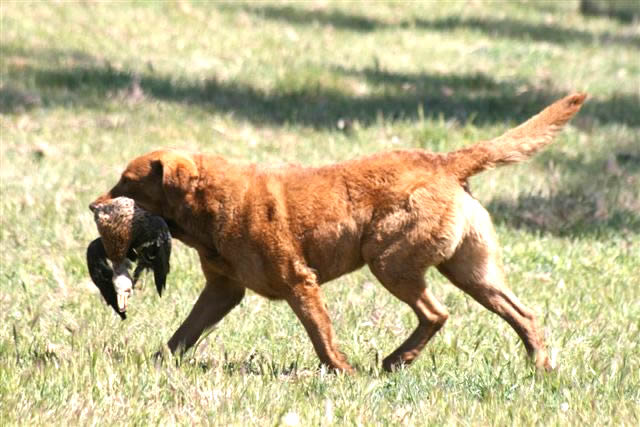
A retriever is a type of gun dog that retrieves game for a hunter. Generally gun dogs are divided into three major classifications: retrievers, flushing spaniels, and pointing breeds. Retrievers were bred primarily to retrieve birds or other prey and return them to the hunter without damage; retrievers are distinguished in that nonslip retrieval is their primary function. As a result, retriever breeds are bred for soft mouths and a great willingness to please, learn, and obey. A soft mouth refers to the willingness of the dog to carry game in its mouth without biting into it. "Hard mouth" is a serious fault in a hunting dog and is very difficult to correct. A hard-mouthed dog renders game unpresentable or at worst inedible.
The retriever's willingness to please, patient nature and trainability have made breeds such as the Labrador retriever and Golden retriever popular as a disability assistance dog. The outstanding reputation of the retriever has landed both the Labrador and the Golden retriever among the top 10 best dogs for children and families around the world.[1]
Skills
[edit] | This section needs additional citations for verification. (February 2021) |


To carry out the duties of a gun dog, a retriever should be trained to perform these tasks:
- Remain under control: Retrievers are typically used for waterfowl hunting. Since a majority of waterfowl hunting employs the use of small boats in winter conditions, retrievers are trained to remain under control sitting calmly and quietly until sent to retrieve.[2] This is often referred to as "steadiness". Steadiness helps to avoid an accidental capsizing, disrupting the hunter's aim or the possible accidental discharge of a firearm which could cause serious harm or death to others in the hunting party or to the dog itself. A steady dog is also better able to “mark” downed game.
- Mark downed game: Marking is the process of watching for a falling bird or multiple birds. When the command "mark" is given, the dog should look up for incoming birds and remember where each bird falls. Well-trained retrievers are taught to follow the direction the gun barrel is pointing to mark where the birds fall. Once the game is downed, the handler will command the dog to retrieve the game. The dog's ability to remember multiple “marks” is extremely important, and trainers use techniques to improve a dog's marking and memory ability.
- Perform a blind retrieve: When hunting waterfowl, a retriever's primary job is to retrieve downed birds. At times, a dog will not see the game fall, so retrievers are trained to take hand, voice, and whistle commands from the handler directing the dog to the downed game for retrieval. This is called a “blind retrieve”. Precision between the dog and handler is extremely useful and desired so as to minimize retrieval time and limit the disturbance of surrounding cover. The majority of blind retrieves in the field are made within 30-80 yards of the gun, but a good retriever/handler team can perform precise blind retrieves out to 100+ yards and more.
- Retrieve to hand: Although some hunters prefer to have a bird dropped at their feet, the majority of handlers require the dog to deliver the game to hand, meaning once the dog has completed the retrieve, it will gently but firmly hold the bird until commanded to release it to the handler's hand. Delivery to hand reduces the risk of a crippled bird escaping, as the bird remains in the dog's mouth until the handler takes hold of it.
- Honoring: When hunting with multiple dogs, a retriever should remain under control while other dogs work, and wait its turn. This is important because having multiple dogs retrieving game simultaneously can cause confusion. This is one reason why many handlers use the dog's name as the command to retrieve.
- Shake on command: Following a retrieve, a well-trained dog will not shake off excess water from its fur until after the delivery is complete. A dog shaking water from its fur in a small boat at worst risks capsizing the craft in cold winter conditions and at best will most likely shower hunters and equipment. Also, a dog shaking while still holding the game in its mouth could damage the bird to the point of making it unfit for the table. To avoid these mishaps, trainers use a distinct command releasing a dog to shake.
- Quarter: Retrievers are often used in a secondary role as an upland flushing dog. Dogs must work in a pattern in front of the hunter seeking upland game birds. The retriever must be taught to stay within gun range to avoid flushing a bird outside of shooting distance.
- Remain steady to wing and shot: When hunting upland birds, the flushing dog should be steady to wing and shot, meaning it sits when a bird rises or a gun is fired. It does this to mark the fall and to avoid flushing other birds by unnecessarily pursuing a missed bird.
Although most individual retrievers have the raw capacity to be trained to perform as a gun dog, a significant amount of thought and effort is given to breeding in specific desired traits into dogs from field bred lines that greatly enhance the training process. When breeding retrievers for field work, extensive consideration is given to:
- Biddableness: Because producing a well-trained retriever capable of performing the tasks outlined above requires a significant amount of time and effort, an intelligent, controllable, and open-to-learning (biddable) retriever is of utmost importance.
- Desire and drive: These traits covers a broad range of behaviors exhibited by the “good retriever”. Most notably, they demonstrate the desire to retrieve almost to the point of manic behavior and take on significant obstacles to make a retrieve. They also demonstrate an exceptional interest in birds, bird feathers, and bird scent, which is termed “birdiness”.
- Marking and memory: Eyesight and depth perception are of paramount importance to a dog's ability to mark downed game. Remembering each fall is also critical. While retriever trainers use special techniques to help a dog to mark and remember downed game, a good retriever is born with these “raw tools”.
- Nose: Dogs are led primarily by their nose. A good retriever uses its nose to find downed game in heavy cover and while quartering a field to locate and flush upland game birds.
- Soft mouth: A soft-mouthed dog is needed to ensure retrieved game is fit for the table. A soft-mouthed dog picks up and holds game softly but firmly on the retrieve. Dogs that unnecessarily drop birds, crunch on, chew, or even eat the bird before delivery to the handler are considered “hard-mouthed” or are described as having “mouth problems”. While training can overcome most “mouth problems”, a dog with an inherently soft mouth is more desirable when starting the training process.
- Hardiness: Waterfowl hunting is a cold-weather sport undertaken across a wide variety of locations and conditions, from thick, flooded timber in the south US, to icy and ice-covered ponds in the Midwest to frigid seas along upper the New England coast. A good retriever willingly re-enters the water and makes multiple retrieves under these and other extreme conditions.
Lifespan
[edit]The average lifespan of a retriever is about 10–12 years. Some may live up to 15 years.[3]
Retriever breeds
[edit]- Chesapeake Bay Retriever
- Curly Coated Retriever
- Flat Coated Retriever
- Golden Retriever
- Labrador Retriever
- Nova Scotia Duck Tolling Retriever
- Murray River Retriever
Other dogs with retrieving skill
[edit]

- American Cocker Spaniel
- American Water Spaniel
- Barbet
- Boykin Spaniel
- Blackmouth Cur
- Blue Lacy
- Brittany
- Clumber Spaniel
- Dutch Partridge Dog
- English Cocker Spaniel
- English Setter
- English Springer Spaniel
- Épagneul Bleu de Picardie
- Epagneul Pont-Audemer
- Frisian Pointer (stabyhoun/stabij)
- German Longhaired Pointer
- German Shorthaired Pointer
- German Wirehaired Pointer
- German Water Spaniel
- Gordon Setter
- Hungarian Vizsla
- Hungarian Wirehaired Vizsla
- Italian Spinone
- Irish Setter
- Irish Water Spaniel
- Newfoundland
- Pointer
- Poodle
- Portuguese Water Dog
- Spanish Water Dog
- Sussex Spaniel
- Tibetan Terrier
- Weimaraner
- Welsh Springer Spaniel
- Wire-haired Pointing Griffon
See also
[edit]- Dogs portal
- List of dog breeds
- Field trial
- Hunt test
- St. John's water dog, also known as the Lesser Newfoundland, an extinct precursor of the Newfoundland dog and ancestor of the modern Retrievers, including Flat-coated, Chesapeake Bay, Golden, and Labrador.
References
[edit]- ^ "The 10 Best Dogs for Kids and Families". petMD. Retrieved 2018-12-31.
- ^ "Golden Retriever Dog ==> +10.000 Free Articles, Videos & Pictures". Golden Retriever Dog And Puppies Information. Retrieved 2016-09-22.
- ^ "Learn About the Enthusiastic Golden Retriever".
- Fergus, Charles. Gun Dog Breeds: A Guide to Spaniels, Retrievers, and Pointing Dogs, The Lyons Press, 2002. ISBN 1-58574-618-5
- Smith, Steve (2002). The Encyclopedia of North American Sporting Dogs: Written by Sportsmen for Sportsmen. Willow Creek Press. pp. 107–125. ISBN 1572235012.


Retriever
View on Grokipedia- Labrador Retriever: One of the most popular breeds in the United States, ranked #1 by the AKC from 1991 to 2023, originating from Newfoundland fishermen in the early 1800s and refined in England; medium-large size (21.5–24.5 inches, 55–80 pounds), friendly, outgoing, and highly trainable, excelling in service roles.[3][4]
- Golden Retriever: Developed in Scotland in the mid-19th century by crossing yellow retrievers with spaniels; similar size (21.5–24 inches, 55–75 pounds), intelligent, gentle, and playful, renowned for their loyalty and ease with children.[3][5]
- Chesapeake Bay Retriever: Bred in the United States along the Chesapeake Bay in the early 19th century for harsh water conditions; sturdy build (21–26 inches, 55–80 pounds), protective, energetic, and affectionate with family.[3][6]
- Flat-Coated Retriever: Originated in England in the mid-19th century as a versatile gun dog; elegant frame (22–24.5 inches, 55–70 pounds), outgoing, enthusiastic, and optimistic, with a silky black or liver coat.[3]
- Curly-Coated Retriever: The oldest retriever breed, developed in England in the late 18th century possibly with poodle influences; robust (23–27 inches, 65–100 pounds), alert, confident, and independent, with a distinctive waterproof curly coat.[3]
- Nova Scotia Duck Tolling Retriever: The smallest retriever, bred in Nova Scotia, Canada, in the 19th century to lure and retrieve ducks; compact (17–21 inches, 35–50 pounds), intelligent, sensitive, and high-energy, with a red coat and fox-like appearance.[3]
History
Origins as Hunting Dogs
Retrievers originated as specialized hunting dogs in Europe during the 17th century, evolving from earlier working breeds to meet the demands of wing shooting with newly developed flintlock firearms. Prior to widespread gun use, dogs like spaniels and setters were employed primarily for flushing and pointing game, but the transition to shooting flying birds necessitated dogs capable of retrieving downed prey from difficult terrains, particularly waterfowl in marshes and wetlands. These early "water dogs" or "retrieving spaniels" were valued for their ability to swim and fetch game without damaging it, marking the beginning of their role in organized hunts across England and Scotland.[7][8] In North America, European settlers introduced similar dogs in the 17th and 18th centuries, adapting them for the continent's abundant waterfowl populations and challenging environments. Colonial hunters in regions like the Chesapeake Bay and the Atlantic coast relied on these imported spaniels and setters for retrieving ducks and geese shot over tidal marshes, where thick cover and cold waters posed significant obstacles. This period saw initial efforts to select for traits suited to American conditions, though systematic breeding remained limited until the 19th century.[2] Selective breeding in the 18th and 19th centuries emphasized key attributes such as "soft mouths"—a gentle grip to avoid injuring game—and water-resistant coats to withstand prolonged exposure in marshy terrains. British sportsmen, influenced by the shift from cumbersome matchlock guns to more reliable flintlocks and later breech-loading shotguns, prioritized these qualities to maximize efficiency in large-scale hunts. The introduction of improved firearms from the early 1600s onward dramatically increased the volume of shot game, heightening the demand for reliable retrievers and spurring aristocratic estates to maintain dedicated kennels of 30 to 60 dogs for shooting parties. By the mid-19th century, estates like those in Scotland and England became centers for refining these working lines, laying the groundwork for more specialized development.[8][2][7]Breed Development and Recognition
The development of modern retriever breeds in the 19th century built upon the foundational St. John's water dog, a hardy fishing dog from Newfoundland that served as a key ancestor for several retriever lines. Originating from European imports and local strains, these dogs were selectively bred in the 1800s by British sportsmen for improved retrieving abilities in water and on land, with exports to England beginning around the 1820s leading to refined lineages that emphasized endurance and soft mouths.[9][10] A pivotal figure in this era was Dudley Marjoribanks, Lord Tweedmouth, who systematically bred the Golden Retriever starting in 1868 at his Guisachan estate in Scotland. He crossed a yellow wavy-coated retriever named Nous with a Tweed water spaniel named Belle, followed by line-breeding and outcrosses to black retrievers and other spaniels over the next two decades to establish the breed's signature temperament and retrieving prowess. This effort marked one of the earliest documented programs to create a specialized golden-colored retriever for upland and water game.[11][12] Official recognition by kennel clubs formalized these breeding advancements, beginning with the Labrador Retriever's acceptance by The Kennel Club in England in 1903 as a distinct breed. The American Kennel Club (AKC) followed suit in 1917, registering its first Labrador, a Scottish import named Brocklehirst Nell, which spurred wider adoption in North America. For the Golden Retriever, The Kennel Club granted recognition in 1913, while the AKC did so in 1925, enabling standardized breeding and shows; by the mid-20th century, both breeds achieved international status through organizations like the Fédération Cynologique Internationale, with ongoing milestones including their consistent top rankings in global popularity surveys through 2025.[9][13][14]Physical Characteristics
Body Structure and Size
Retrievers possess an athletic build optimized for the demands of retrieving game, particularly from water, with a sturdy frame that balances strength and agility. Their strong hindquarters provide powerful propulsion for swimming and launching into retrieves, while broad, deep chests accommodate expansive lung capacity for sustained endurance during long hunts. Webbed feet, compact yet padded, enhance paddling efficiency and traction on slippery surfaces, making them adept swimmers capable of carrying heavy loads without fatigue.[4][5][6] This functional structure underscores their origins as working gun dogs, where soundness and proportion are prioritized to support rigorous field performance over mere aesthetics.[15][16] Size characteristics vary across retriever breeds, with most falling into the medium-to-large category; males are typically taller and heavier than females, and breeding lines influence build—field-oriented dogs often emphasize leaner physiques for endurance, while show lines align with conformation ideals that maintain functionality. Representative examples include:| Breed | Height (Shoulder, Inches) - Males | Height (Shoulder, Inches) - Females | Weight (Pounds) - Males | Weight (Pounds) - Females |
|---|---|---|---|---|
| Labrador Retriever | 22.5–24.5 | 21.5–23.5 | 65–80 | 55–70 |
| Golden Retriever | 23–24 | 21.5–22.5 | 65–75 | 55–65 |
| Chesapeake Bay Retriever | 23–26 | 21–24 | 65–80 | 55–70 |
| Flat-Coated Retriever | 23–24.5 | 22–23.5 | 60–70 | 60–70 |
| Curly-Coated Retriever | 25–27 | 23–25 | 60–95 | 60–95 |
| Nova Scotia Duck Tolling Retriever | 18–21 | 17–20 | 35–50 | 35–50 |