Hubbry Logo
Nanhui New CityNanhui New CityMain
Open search
Nanhui New City
Community hub
Nanhui New City
logo
8 pages, 0 posts
0 subscribers
Be the first to start a discussion here.
Nanhui New City
Nanhui New City
from Wikipedia

30°54′00″N 121°56′12″E / 30.90000°N 121.93667°E / 30.90000; 121.93667

Nanhui New City (simplified Chinese: 南汇新城; traditional Chinese: 南匯新城) is a planned city located in the southeasternmost tip of Pudong New Area in Shanghai, China. It was formerly called Lingang New City (simplified Chinese: 临港新城; traditional Chinese: 臨港新城, It means "new city near the port") until it was renamed in April 2012.[1]

Construction began in 2003 and is scheduled to be completed in 2020,[needs update] with the German architecture company Gerkan, Marg and Partners leading the project. The project is estimated to have cost $4.5 billion. The city is aimed to house 450,000 to 800,000 residents while attracting 10 million annual tourists.[2][3]

Key Information

Climate

[edit]
Nanhui New City

Nanhui New City has a humid subtropical climate (Köppen: Cfa), with an average annual temperature of 17.1 °C (62.8 °F). The highest temperature record since 1951 was 40.1 °C (104 °F) on 8 August 2013.

Climate data for Xiaoyangshan Island, elevation 54 m (177 ft), (1991–2020 normals)
Month Jan Feb Mar Apr May Jun Jul Aug Sep Oct Nov Dec Year
Mean daily maximum °C (°F) 8.0
(46.4)
9.4
(48.9)
13.2
(55.8)
17.8
(64.0)
22.8
(73.0)
25.6
(78.1)
30.6
(87.1)
31.0
(87.8)
27.0
(80.6)
22.6
(72.7)
17.5
(63.5)
11.1
(52.0)
19.7
(67.5)
Daily mean °C (°F) 5.9
(42.6)
6.9
(44.4)
10.2
(50.4)
14.7
(58.5)
19.8
(67.6)
23.1
(73.6)
27.6
(81.7)
28.2
(82.8)
24.7
(76.5)
20.5
(68.9)
15.3
(59.5)
8.8
(47.8)
17.1
(62.9)
Mean daily minimum °C (°F) 4.2
(39.6)
4.9
(40.8)
8.0
(46.4)
12.4
(54.3)
17.6
(63.7)
21.3
(70.3)
25.5
(77.9)
26.2
(79.2)
23.0
(73.4)
18.9
(66.0)
13.6
(56.5)
7.0
(44.6)
15.2
(59.4)
Average precipitation mm (inches) 64.1
(2.52)
77.2
(3.04)
104.1
(4.10)
90.8
(3.57)
95.5
(3.76)
251.0
(9.88)
106.6
(4.20)
118.2
(4.65)
129.5
(5.10)
95.8
(3.77)
69.7
(2.74)
60.5
(2.38)
1,263
(49.71)
Average precipitation days (≥ 0.1 mm) 11.1 11.3 13.0 10.5 11.0 15.3 9.5 9.1 10.5 6.3 10.3 9.2 127.1
Average snowy days 2.1 1.5 0.3 0.1 0 0 0 0 0 0 0 1.0 5
Average relative humidity (%) 74 77 76 77 79 87 82 81 78 71 72 70 77
Mean monthly sunshine hours 114.4 110.7 152.7 174.4 183.3 122.5 230.6 247.2 174.8 172.0 131.7 141.4 1,955.7
Percentage possible sunshine 36 35 41 45 43 29 54 61 48 49 42 45 44
Source: China Meteorological Administration[4][5]
Climate data for Huinan Town, elevation 5 m (16 ft), (1991–2020 normals, extremes 1981–2013)
Month Jan Feb Mar Apr May Jun Jul Aug Sep Oct Nov Dec Year
Record high °C (°F) 22.1
(71.8)
25.6
(78.1)
27.4
(81.3)
31.7
(89.1)
34.3
(93.7)
35.5
(95.9)
39.0
(102.2)
40.1
(104.2)
36.6
(97.9)
32.2
(90.0)
27.6
(81.7)
23.5
(74.3)
40.1
(104.2)
Mean daily maximum °C (°F) 8.6
(47.5)
10.2
(50.4)
13.9
(57.0)
19.3
(66.7)
24.2
(75.6)
27.1
(80.8)
31.6
(88.9)
31.3
(88.3)
27.6
(81.7)
23.0
(73.4)
17.8
(64.0)
11.5
(52.7)
20.5
(68.9)
Daily mean °C (°F) 4.8
(40.6)
6.2
(43.2)
9.8
(49.6)
14.9
(58.8)
20.0
(68.0)
23.7
(74.7)
28.0
(82.4)
27.9
(82.2)
24.2
(75.6)
19.1
(66.4)
13.6
(56.5)
7.3
(45.1)
16.6
(61.9)
Mean daily minimum °C (°F) 1.8
(35.2)
3.0
(37.4)
6.4
(43.5)
11.2
(52.2)
16.5
(61.7)
21.0
(69.8)
25.3
(77.5)
25.4
(77.7)
21.4
(70.5)
15.7
(60.3)
10.1
(50.2)
4.0
(39.2)
13.5
(56.3)
Record low °C (°F) −7.9
(17.8)
−6.0
(21.2)
−4.2
(24.4)
−0.7
(30.7)
7.1
(44.8)
12.7
(54.9)
18.7
(65.7)
18.8
(65.8)
11.5
(52.7)
1.9
(35.4)
−1.7
(28.9)
−7.8
(18.0)
−7.9
(17.8)
Average precipitation mm (inches) 72.2
(2.84)
67.9
(2.67)
97.5
(3.84)
85.2
(3.35)
94.0
(3.70)
211.2
(8.31)
135.7
(5.34)
187.8
(7.39)
126.0
(4.96)
73.8
(2.91)
63.7
(2.51)
54.6
(2.15)
1,269.6
(49.97)
Average precipitation days (≥ 0.1 mm) 10.9 10.1 13.4 12.0 11.8 15.0 11.6 11.9 10.2 7.8 9.4 8.8 132.9
Average snowy days 1.8 1.5 0.5 0 0 0 0 0 0 0 0 0.8 4.6
Average relative humidity (%) 77 78 78 77 78 85 82 83 81 78 78 75 79
Mean monthly sunshine hours 112.4 117.0 140.7 164.3 172.6 123.8 207.4 202.1 170.4 164.3 131.9 130.1 1,837
Percentage possible sunshine 35 37 38 42 41 29 48 50 46 47 42 42 41
Source: China Meteorological Administration[4][6]

Location

[edit]

The site is located at the tip of the peninsula between the Yangtze and the Qiantang rivers on Hangzhou Bay. It is approximately 60 kilometers southeast of downtown Shanghai. A major portion of the site was reclaimed from the sea.[7]

The city was slated to become a "mini-Hong Kong". However, despite real estate developments being sold quickly, people have been reluctant to move in. To help revitalize the city, eight university campuses have been built on the west side of Nanhui New City, bringing in more than 100,000 students.[8][9] In August 2019, it was announced that the area will be included in the Shanghai Free-Trade Zone.[10]

Southeast of Shanghai is an area of major land change where this planned city is being built. Nanhui New City covers about 74 square kilometers and is intended to provide space for 800,000 people. It was formerly called Lingang New City and was renamed in April 2012.

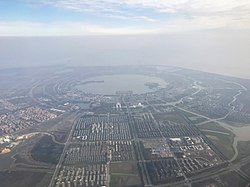
The main feature of the new city is a circular artificial lake, visible in this series of images starting in 2004. Dishui Lake is 2.5 kilometers across and includes three artificial islands. The concentric structure of the city resembles a compass rose. The streets radiate out from the center. Waterways extend all over the city to support its theme of "waterside living."

Off the coast is Yangshan Deep-Water Port, one of the largest shipping ports in the world. The huge port opened in 2005 and can handle the world’s largest container vessels. More than half of Yangshan Port was built on reclaimed land.

The port connects to Nanhui New City by the Donghai Bridge. Construction of the bridge is visible in the 2004 image. It opened to general traffic in 2005. The 32.5-kilometer-long bridge carries six lanes of traffic and is one of the longest bridges in the world.[11]

Attractions

[edit]

See also

[edit]

References

[edit]
[edit]
Revisions and contributorsEdit on WikipediaRead on Wikipedia
from Grokipedia
Nanhui New City is a master-planned urban development situated at the southeastern extremity of Shanghai's New Area, spanning roughly 74 square kilometers and engineered to support a population of up to 800,000 residents with integrated residential, commercial, and industrial zones centered on the artificial Dishui Lake. Originally designated as Lingang New City, it underwent a to Nanhui New City in April 2012 after the administrative merger of the former Nanhui District into New Area in 2009, reflecting Shanghai's strategic eastward expansion to bolster economic capacity beyond the urban core. Conceived in the early as part of China's aggressive drive, initiated in 2003 under the master plan by German firm gmp Architekten, led by Meinhard von Gerkan, which incorporated a radial "" street pattern, extensive green spaces, and waterfront-oriented to foster a harmonious blend of and ecology, including designation as one of China's 30 "sponge cities" for advanced . Initial phases prioritized infrastructure for the adjacent , aiming for completion by 2020, though full occupancy lagged due to phased population influx typical of large-scale greenfield . Early development drew scrutiny for substantial underutilization, with expansive high-rises and public facilities standing vacant in the mid-2010s, exemplifying patterns in China's new city initiatives where upfront precedes demand, often termed "ghost cities" in Western analyses despite deliberate sequencing to preempt shortages. By , however, Nanhui has transitioned into a focal point for innovation within the Lin-gang Special Area, hosting emerging clusters in , , and advanced manufacturing along Dishui Lake, with accelerating settlement driven by policy incentives and proximity to coastal hubs. This evolution underscores causal dynamics of state-directed yielding lagged but substantive growth in peripheral urban nodes.

Geography and Environment

Location and Administrative Integration

Nanhui New City is situated at the southeastern tip of Pudong New Area in , , on the northern shore of . It spans approximately 74 square kilometers and serves as a key node connecting Shanghai's and seaport along the coastal corridor. The area borders the to the east and is positioned southeast of Shanghai's urban center. Administratively, Nanhui New City was originally part of Nanhui District, which was abolished on May 6, 2009, following approval by China's State Council to merge it into New Area. This integration expanded 's jurisdiction southward, enhancing its role as an economic powerhouse by incorporating Nanhui's coastal lands for development. Post-merger, the city falls under New Area's governance and forms the core urban zone of the Lin-gang Special Area, a pilot established to drive innovation and reform. The administrative shift facilitated coordinated planning, transforming the former district's rural and reclaimed lands into a unified functional structure for industry-city integration. Today, it operates as Nanhuixincheng Town within this framework, emphasizing high-tech and financial development while maintaining ties to Shanghai's broader municipal administration.

Climate and Topography

Nanhui New City occupies low-lying coastal terrain on the southeastern tip of Shanghai's peninsula, adjacent to , with an average elevation of approximately 2 meters above and predominantly flat characterized by minimal gradients. The landscape consists largely of reclaimed mudflats and tidal plains, where seaward extensions feature very low topographic slopes over distances up to 20 kilometers. Between 2002 and 2006, roughly 133 square kilometers of land were reclaimed from these intertidal zones as part of initial development phases, expanding usable area but resulting in unconsolidated soils prone to and . This artificial lacks significant natural hills or drainage features, relying on engineered seawalls and polders for stability against tidal influences and storm events. The region experiences a influenced by the East Asian monsoon, with hot, oppressive summers and cool, damp winters, alongside periodic impacts from the Pacific. Annual average temperatures hover around 17°C, with extremes ranging from winter lows near 2°C to summer highs exceeding 32°C, and relative humidity often surpassing 75% year-round, exacerbating discomfort during the June-to-September rainy season. Precipitation totals approximately 1,405 millimeters annually, concentrated in summer months when rains and s contribute to flooding risks on the low-elevation terrain. Siberian high-pressure systems drive occasional cold snaps in winter, while easterly winds from the bay moderate coastal temperatures but heighten vulnerability to saline intrusion and sea-level rise effects.

Key Physical Features

Nanhui New City occupies a low-lying in the southeastern District of , with an average elevation of about 2 meters above . The terrain is predominantly flat, characteristic of reclaimed alluvial soils from , where former tidal flats have been converted into developable land through extensive and construction. Geologically, the subsurface features alluvial deposits up to 100 meters thick, overlying bedrock buried at depths of 240 to 320 meters. The city's defining physical landmark is Dishui Lake, a centrally located artificial reservoir with a of 2.5 kilometers, engineered as a focal point for . This circular lake incorporates three artificial islands and serves as the hub for radial street patterns evoking a , integrating waterside residential and infrastructural zones. Surrounding the lake, the landscape blends engineered water features with coastal buffers, mitigating flood risks in this vulnerable seaside position. Land reclamation has expanded the usable area significantly, with over half of adjacent facilities like constructed on filled seabed, underscoring the region's reliance on marine expansion for growth. These interventions have reshaped the natural coastline, creating a hybrid environment of artificial landforms and preserved bay proximity, though subject to ongoing and challenges typical of such deltaic settings.

Historical Development

Origins as Nanhui District

The territory of Nanhui District originated from silt deposition in the River delta, where southward-flowing river waters met tidal influences from the and , forming coastal land approximately 2,000 years ago. Nanhui County, the predecessor to the district, was transferred to Shanghai municipality from Province in 1958 as part of a major expansion that incorporated ten peripheral counties to bolster the city's agricultural and resource base. At that time, the area functioned primarily as a rural outpost, dominated by paddy fields, salt production, , and small-scale fishing villages, with limited and vulnerability to and storm surges due to its flat, low-elevation . In the early , amid 's push for suburban modernization, Nanhui was upgraded to status to enable targeted governance for emerging development needs. The then covered roughly 810 km², including a 59.5 km coastline, and supported a of 975,017 as of August 2006, still largely agrarian despite initial planning signals for industrialization. This phase laid the administrative groundwork for subsequent transformations, culminating in the 's dissolution and merger into New Area in May 2009 to unify oversight of expansive eastern coastal projects.

Initiation of New City Planning (Early 2000s)

The planning for Nanhui New City, initially designated as Lingang New City, emerged in the early as a component of 's broader urban decentralization strategy, following the State Council's approval of the city's Master Urban Plan (1999–2020) on May 11, 2001. This framework sought to reorganize Greater into a polycentric network, incorporating satellite developments to manage and demands beyond the central districts. The municipality formally launched Lingang's development in , distinguishing it from contemporaneous "One City, Nine Towns" initiatives by prioritizing integration with maritime rather than themed suburban replicas. Central to the initiation was alignment with the construction of the Yangshan Deep-water Port, which broke ground in December 2002 to establish as an international shipping hub, necessitating adjacent urban support for logistics, industry, and workforce housing. commenced in 2002 to expand the site's footprint, yielding approximately 133.3 square kilometers by 2006 through infilling , providing the artificial terrain essential for the projected 74-square-kilometer capable of accommodating up to 800,000 residents. This phase underscored a state-driven approach, elevating the project to national significance for economic rescaling and port-city synergy. The conceptual master plan, commissioned to the German firm gmp Architekten von Gerkan, Marg and Partners, adopted a radial-circular layout inspired by Ebenezer Howard's garden city model, featuring a central artificial lake as the urban core flanked by zoned rings for residential, commercial, and green spaces. Initial phases targeted completion for 80,000 inhabitants by 2006, with overall construction slated to begin in 2003, reflecting ambitions for sustainable density amid coastal constraints. These elements positioned Lingang as a forward-oriented experiment in planned , though early execution faced challenges from environmental sensitivities and phased funding dependencies.

Major Construction Phases (2003–2020)

Construction of Nanhui New City, initially known as Lingang New City, began in 2003 following the approval of its master plan (2003–2020) by the Municipal Government in January 2004. The plan, designed by the German architecture firm gmp Architekten von Gerkan, Marg und Partner, envisioned a circular urban layout centered on Dishui Lake, with concentric rings for business, parks, and residential areas, expanding across 74 km² to accommodate up to 800,000 residents. Initial land reclamation efforts, starting as early as 2002, created approximately 133.3 km² of new terrain from by 2006 to support the city's foundation. The first phase (2003–2006) concentrated on the existing mainland portion, prioritizing basic such as roads, utilities, and initial housing to support inhabitants by completion. This period established core connectivity, including radial streets emanating from the planned Dishui Lake—a 2.5 km-diameter artificial with an 8 km lakeside promenade for cultural and leisure facilities—and laid groundwork for glass structures symbolizing the city's identity. By 2006, foundational elements like water management systems and preliminary residential blocks were in place, though occupancy remained low amid broader economic shifts. Subsequent phases (2006–2020) shifted to expansive reclamation and vertical development, integrating high-rise residential towers, commercial districts, and public amenities around Dishui Lake to reach the full population target of 450,000–800,000. Key advancements included the completion of the lake's islands for , expansion of the ring with complexes, and integration with regional links like extensions. By the mid-2010s, thousands of apartment units and superblocks had been erected, but momentum revealed overbuilding relative to demand, with estimates of around 200,000 residents by 2012 despite plans for rapid . The final push toward 2020 emphasized infrastructural completion, including advanced utilities and green spaces, though the city transitioned toward high-tech zoning over pure residential focus.

Urban Planning and Design

Master Plan Overview

The master plan for Nanhui New City, initially developed as Lingang New City in the early under the Lingang Area Development Authority, covers approximately 74 square kilometers and targets a capacity of 800,000 residents. Central to the design is Dishui Lake, an artificial body of water 2.5 kilometers in diameter featuring three islands, which serves as the urban core promoting "waterside living." The layout employs a radial street pattern emanating from the lake, integrated with extensive internal waterways to facilitate flood resilience and environmental harmony in the coastal setting. German architecture firm gmp Architekten, led by , crafted the plan with a conceptual vision of a water drop merging into the sea, prioritizing low-density development over high-rise concentration to suit the reclaimed terrain. This approach incorporates principles for water management, including permeable surfaces and adaptive to coexist with tidal influences and reduce flood risks. The design draws on traditional European urban forms while emphasizing green spaces and connectivity, distinguishing it from denser mainland developments. As a sub-center within Shanghai's Main City Zone, the plan fits into a five-level spatial that includes central activity zones for global functions, suburban circles, and regional linkages, supporting innovation hubs and integration with the nearby Yangshan Deep-Water Port via the 32.5-kilometer , completed in 2005. Construction phases emphasize phased rollout, with the core urban area linking to broader Lin-gang Special Area goals for openness and high-tech industry.

Architectural and Infrastructural Elements

The master plan for Nanhui New City, originally conceived as Lingang New City, features a concentric urban structure centered on the artificial Dishui Lake, which spans 2.5 kilometers in diameter and incorporates three islands designed to enhance ecological and recreational functions. This layout draws inspiration from traditional European urban forms but emphasizes low-density development with an extensive network of parks, watercourses, and green spaces to promote livability and environmental integration. German architecture firm gmp (von Gerkan, Marg and Partners) overlaid a radial system resembling a , with streets and pathways radiating outward from the lake to facilitate efficient connectivity across the 74-square-kilometer area. As one of China's 30 designated Sponge Cities, the development incorporates adaptive water management infrastructure, including wetlands, bioswales, and permeable surfaces to mitigate flooding and coexist with coastal conditions, reflecting a shift toward resilient amid rising sea levels. Architectural elements prioritize modular and sustainable features, such as the Dishui Lake Convention Centre's twin-tower configuration with a horizontal podium, providing flexible event spaces while serving as a . Similarly, the Lingang International Conference Center employs simple core placements at building ends to maximize open interior layouts for conferences and exhibitions. Key infrastructural components include the , a 32.5-kilometer sea-crossing structure completed in 2005, linking Nanhui New City to the Yangshan Deepwater Port and enabling efficient freight and passenger transport integration with Shanghai's broader network. The city's transportation framework supports high-tech industrial zones through planned roadways and public transit linkages, though rail extensions like Line 16 terminate at Dishui Lake Station to bolster accessibility. Surrounding Dishui Lake, linear green belts and waterfront paths, including sports and discovery trails, enhance pedestrian infrastructure and urban vitality. Recent additions, such as Pier One's multi-level platforms and ramps blending landscape with pier functions, further exemplify innovative public space design.

Land Reclamation and Expansion

Nanhui New City's development relied heavily on land reclamation from the East China Sea, with Shanghai authorities enclosing tidal flats to facilitate sediment deposition and create new territory. Between 2002 and 2006, approximately 133.3 square kilometers of land were reclaimed in the initial phase, forming the primary base for the planned urban area. This effort marked one of the largest single reclamation projects in Shanghai's history, transforming marshy coastal zones into developable land through barriers that accelerated natural accretion processes. The reclaimed land constitutes about 45 percent of the city's 133 square kilometers, underscoring the artificial origins of much of its terrain. Core urban development focused on a 74-square-kilometer area around features like Dishui Lake, an artificial reservoir central to the city's layout. Reclamation extended to supporting infrastructure, including over half of the adjacent Yangshan Deep-Water Port, which enhanced connectivity and economic viability of the southeastern extension. Further expansion integrated with broader coastal projects, contributing to the city's addition of over 580 square kilometers of new land since 1985, though Nanhui-specific efforts peaked in the early 2000s. These activities reshaped the coastline, creating a protruding that anchors Nanhui as a self-contained urban node.

Economic and Industrial Focus

Shift from Residential to High-Tech Emphasis

Initially conceived in the early as a primarily residential to alleviate Shanghai's , Nanhui New City was designed to accommodate up to 800,000 residents through expansive housing developments and supporting infrastructure, with construction emphasizing Western-style gated communities and eco-friendly urban planning by German firm . The project, budgeted at approximately $4.5 billion and targeted for completion by 2020, prioritized population relocation and suburban-style living over immediate industrial activity, leading to rapid building of residential towers and amenities but minimal early economic anchoring. By the mid-2010s, severe underutilization—earning it the label of a "ghost city"—exposed the limitations of this residential-first approach, with vast empty apartments and low occupancy rates failing to attract residents without sufficient job opportunities, prompting a reevaluation of the master plan to integrate economic drivers. This pivot accelerated in August 2019 with the establishment of the Lingang Special Area within Shanghai's Pilot , which incorporated Nanhui New City (previously known as Lingang New City) and redirected development toward "industry-city integration," emphasizing high-tech sectors to generate employment and sustain . Under the 14th Five-Year Plan (2021–2025), Nanhui's strategy explicitly shifted to fostering advanced , , and strategic emerging industries, including new-generation and high-end equipment , with policies offering incentives for frontier tech projects totaling over 420 billion yuan in investments by 2022. This included creating clusters along Dishui Lake for AI innovation hubs, financial centers, and wide-bandgap semiconductor production, aiming to position the area as China's leading base for such technologies while balancing residual residential elements with job-creating industries. As part of Shanghai's broader "five new cities" initiative launched in 2021, Nanhui was assigned niche high-tech segments to avoid competition and drive self-sustaining growth, marking a causal departure from speculative toward innovation-led .

Development of Financial and AI Hubs

Nanhui New Town, integrated into the Lin-gang Special Area, has prioritized the establishment of a financial center as part of a broader modern industrial cluster forming along Dishui Lake. In September 2024, Shanghai introduced policies to accelerate two-way opening-up in the financial sector within Lin-gang, aiming to construct a development pattern integrating onshore and offshore finance. This includes expanding financial leasing services in the Lin-gang to cover new energy equipment, batteries, intelligent manufacturing tools, and devices, effective as of July 2025. These initiatives support 's strategy to position the area as a high-tech financial hub, leveraging proximity to international trade routes and special economic policies. Parallel efforts focus on developing an innovation hub within the same cluster. The Lin-gang Sci-Tech Innovation City introduced rent-free incentives and up to CNY 800,000 in supporting resources for AI startups in August 2025, targeting high-value tech enterprises. To further foster high-tech innovation, incubators provide zero-rent or subsidized office spaces for eligible entrepreneurs, including one-person companies and micro-teams, for initial years; conditions include local registration in Lingang, focus on targeted industries such as AI and technology, or participation in talent attraction programs. China Telecom established a hub in Lin-gang to bolster Shanghai's AI ecosystem, emphasizing advanced infrastructure for AI applications. These developments align with Lin-gang's goal to quadruple GDP by 2025 compared to 2018 levels, driven by sectors including integrated circuits and AI-related technologies. The area's master plan envisions it as a hub for AI research alongside advanced manufacturing and , transitioning from initial residential focus to high-tech industrialization.

Role in Shanghai's Broader Urban Strategy

Nanhui New City serves as a southern in Shanghai's multi-center urban development framework, designed to decentralize population and economic activities from the overburdened central . As part of a 2021 initiative to elevate five suburban areas—Jiading, Qingpu, Songjiang, Fengxian, and Nanhui—into autonomous "new cities," it aims to accommodate up to 800,000 residents across 74 square kilometers, thereby mitigating congestion in core while fostering specialized sub-centers. This aligns with Shanghai's overarching of sustainable expansion, integrating Nanhui's coastal to relieve demographic pressures and support port-adjacent without overstraining inland . Within New Area's broader trajectory as 's primary growth engine since 1990, Nanhui extends the innovation corridor southward from Lujiazui's financial hub, emphasizing high-tech industries like wide-bandgap semiconductors, , and clustered around Dishui Lake. 's 2025 development plan positions Nanhui as one of eight targeted zones, promoting "industry-city integration" to drive global commerce and advanced , complementing 's role in the River Delta megaregion. This integration leverages Nanhui's designation under the Zone's Lingang Special Area, facilitating and through enhanced connectivity via metro extensions and proximity to . The city's role underscores Shanghai's causal emphasis on spatial coordination to achieve status, prioritizing empirical urban load-balancing over centralized density; official plans designate it a "comprehensive " in the metropolitan spatial framework, with targeted actions for openness and internationalization through 2025. By 2023, industrial clusters had begun forming, signaling progress in embedding Nanhui as a high-value node in Shanghai's adaptive strategy against over-reliance on traditional urban cores.

Population Dynamics

Planned Capacity vs. Actual Occupancy

Nanhui New City was designed with a planned residential capacity of approximately 800,000 people across its 74 square kilometers, with completion targeted for 2020 as part of 's coastal urban expansion strategy. This figure encompassed residential, commercial, and infrastructural developments aimed at accommodating a mix of permanent residents and transient populations, including provisions for 10 million annual tourists. In practice, occupancy has lagged significantly behind projections. As of the end of 2022, the permanent across Lin-gang's four constituent towns—encompassing Nanhui New City—slightly exceeded 450,000, supported by an average annual increase of about 46,000 residents in preceding years, driven partly by inflows and initial industrial relocations. Earlier assessments, such as those from urban studies, estimated around 200,000 residents prior to 2020, with a substantial portion consisting of temporary populations rather than stable households. Achieving the revised 2025 target of 800,000 permanent residents would require a net annual inflow of roughly 116,000 from 2023 onward, a rate more than double recent trends and contingent on intensified talent attraction in high-tech sectors. This gap underscores structural challenges, including the area's remoteness from Shanghai's core (approximately 60 km southeast) and a pivot toward industrial and AI-focused development over mass residential settlement, which has prioritized enterprise zones over broad housing uptake. Despite investments exceeding $5 billion since , utilization rates remain below capacity, with vast residential and public spaces underoccupied relative to design intentions.

Population Attraction Measures

To address slow population growth in Nanhui New City, also known as Lingang New City, authorities have implemented targeted incentives primarily aimed at attracting skilled professionals, young innovators, and entrepreneurs rather than broad residential migration. These measures emphasize financial subsidies, housing support, and regulatory relaxations to foster a high-tech , aligning with the area's shift toward hubs. In May 2025, Lin-gang Special Area introduced 12 specific policies for young talent, including settlement subsidies of 10,000 yuan (approximately USD1,390) for holders and 20,000 yuan for holders, alongside up to 300,000 yuan to encourage startup formation and relocation. Housing incentives form a core component, with provisions for rent subsidies covering up to three years for eligible talents and rent-free access to 100,000 square meters of , , and residential space for sci-tech startups and young professionals in the first year, tapering thereafter. These offerings, disbursing over 60.85 million yuan (about USD8.47 million) in subsidies to 24,600 talents by mid-2025, aim to lower in an underutilized area planned for 800,000 residents. Additionally, a reduced 15% individual rate for high-end foreign and domestic talents serves as a fiscal draw, complementing Shanghai's broader relaxation of (household registration) rules since July 2022 to facilitate permanent settlement for qualified migrants. Such policies reflect a strategy prioritizing quality over quantity in population influx, leveraging Lin-gang's integration into Shanghai's to draw global expertise in AI, , and advanced . While effective in boosting talent acquisition—evidenced by over 100 initiatives launched by 2025—critics note that these incentives have yet to achieve the targeted 800,000 permanent residents by 2025, with actual figures remaining lower due to the area's peripheral location and incomplete amenities. Official evaluations attribute partial success to these measures' focus on economic contributors, though sustained occupancy depends on complementary infrastructure like enhanced transport links to central . The permanent population of Lingang New City (also known as Nanhui New City) grew slowly in its early phases, reaching approximately 200,000 residents by 2012 after starting from near zero in 2003, reflecting the typical "ghost city" pattern of outpacing occupancy in China's planned urban extensions. By the end of 2022, this had increased to over 450,000 across its four main towns, with an average annual growth of 46,000 people from 2020 to 2022, driven by industrial investments like the Tesla and base, which attracted young workers and migrants. This uptick aligns with broader momentum from Shanghai's integration since 2019, including talent importation exceeding 110,000 by May 2024, predominantly young professionals from other Chinese provinces. Demographically, the city skews youthful due to universities and tech hubs drawing students and entry-level talent, temporarily boosting density but contributing to transient rather than rooted communities, as many residents commute or plan returns to central . Growth has accelerated post-2020, yet projections require a net annual inflow of 116,000 people from 2023 to 2025 to meet the 800,000-resident target, a rate over twice the recent pace, amid 's overall aging trends and low fertility rates. Key challenges include the city's remoteness—75 km from Shanghai's center, entailing 1.5-hour commutes—and delayed transport links like the Lianggang Express Line (postponed to 2026), deterring families and long-term settlement. issues persist, with unfinished developments and quality concerns from coastal reclamation soils exacerbating underutilization, while limited service-sector jobs and amenities hinder diverse demographic attraction beyond industrial transients. Reliance on subsidies, reduced residency thresholds (3–5 years for talents), and tax incentives risks unsustainable demographics if organic appeal falters against established urban cores.

Controversies and Criticisms

Ghost City Phenomenon and Underutilization

Nanhui New City exemplifies China's ghost city phenomenon, where large-scale urban developments feature modern infrastructure but suffer from low occupancy due to construction outpacing population influx. Planned to accommodate up to 800,000 residents by 2020, the city—centered on the artificial Dishui Lake—saw extensive building of residential towers, roads, and public facilities starting in the early , yet experienced minimal habitation in its initial phases. By , four years after the lake's completion, the surrounding areas attracted few residents or businesses, leaving vast expanses underused. Early assessments in the portrayed Nanhui as a prototypical ghost city, with empty high-rises, silent boulevards, and idle amenities 60 kilometers southeast of Shanghai's core. A 2014 field report noted the eerie absence of human activity amid completed districts, attributing it to the site's remoteness and lack of immediate economic drivers. Similarly, listings of infamous underoccupied developments highlighted Nanhui's wide avenues carrying almost no traffic and a then estimated at roughly against its target. Despite subsequent growth, underutilization persists in core zones. The broader Lingang Special Area, encompassing Nanhui, reached a of 590,000 by , below projections, with four constituent towns surpassing 450,000 only by late 2022 after averaging 46,000 annual gains. Dishui Lake's vicinity remains characterized by empty plots and construction sites, with 2025 accounts describing sparse daily use and ongoing buildup rather than full vibrancy. This reflects a development strategy emphasizing upfront investment in physical assets over demand signals, fostering high residential vacancies and critiqued for resource inefficiency.

Fiscal and Economic Critiques

The development of Nanhui New City, initially known as Lingang New City, has involved substantial public investments, with an initial budget of approximately $5.6 billion allocated since began in 2003 to accommodate up to 800,000 residents. Additional funding commitments, including $2.7 billion announced in 2016 and $750 million the prior year, have pushed total expenditures beyond $8.6 billion, primarily directed toward , , and strategic industrial zones. These outlays reflect a debt-financed model reliant on bank loans secured against government-guaranteed land assets, with reimbursements tied to special tax-retention policies that redirect corporate taxes back to municipal funds. Critics argue that this approach has yielded low short-term economic returns relative to costs, rendering projects unprofitable when evaluated on conventional input-output metrics, particularly given the site's remote location—60 to 75 kilometers from Shanghai's central business district—which hampers immediate land sales and occupancy. For instance, the Lingang Group's initial 3 billion yuan ($450 million) capital infusion and annual infrastructure spending of around 2 billion yuan have been subsidized through cross-financing from state-owned enterprises (SOEs), yet approximately 80% of these entities reported operating deficits as of 2011 assessments. Similarly, the Gangcheng Group's 5.675 billion yuan ($850 million) commitment, backed by reclaimed land and joint ventures for fixed-price housing, underscores a pattern of heavy upfront leverage against uncertain future revenues from property development and taxation. Economic analyses highlight inefficiencies in this state-led financing, including prolonged gestation periods—often 15 to 20 years—for achieving viability, during which maintenance costs accrue without proportional GDP contributions or inflows, as evidenced by occupancy rates hovering near 50,000 residents in 2013 despite completed high-capacity . The model's dependence on ongoing subsidies (10-30% of investments) and incentives, such as credits up to $3 million for priority industries, has drawn scrutiny for distorting market signals and fostering over-reliance on support rather than organic economic activity. While proponents justify persistence through alignment with national priorities like "," detractors, including urban economists, contend that such mega-projects exemplify broader risks of fiscal strain from speculative land and delayed returns, potentially exacerbating local debt burdens amid slower-than-expected industrialization.

Environmental and Sustainability Issues

The construction of Nanhui New City, initiated in 2003 on reclaimed land from the , has significantly altered coastal ecosystems, particularly the Nanhui East Tidal Flat, China's largest marginal shoal in the River , leading to and reduced due to deposition, , and human activities. Environmental groups, including the Biodiversity Conservation and Green Development Foundation, have criticized initiatives like the River shelter forest project for destroying native reed wetlands in favor of , arguing that such efforts prioritize over preserving natural marshlands essential for migratory birds and mitigation, without adequate environmental impact assessments. Reclaimed soils in the area are prone to ground settlement, exacerbating risks of structural damage and from unconsolidated substrates. To address flooding vulnerabilities in this low-lying coastal zone, Nanhui was designated one of China's 30 sponge cities around 2015, incorporating permeable pavements, rain gardens, and wetlands to absorb stormwater and enhance resilience against typhoons and heavy rains, with plans aiming for once-in-50-year flood control standards by enhancing infiltration rates. measures also include blue-green infrastructure for water management and low-carbon , positioning the city as a demonstration area for ecological civilization along Shanghai's waterfront, though empirical data on long-term efficacy remains limited. Despite these initiatives, challenges persist, including low forest coverage of 11.5% in the Nanhui administrative region as of 2019—well below Shanghai's citywide average—and heightened urban heat island effects amplified by climate change, making new towns like Nanhui more susceptible to extreme temperatures than central Shanghai. Rapid urbanization has contributed to broader ecological strains, such as altered microclimates and potential pollution from construction and future industrial activities, underscoring tensions between development goals and verifiable environmental preservation. Critics, including analyses from outlets like Reuters, contend that China's eco-city projects, including Nanhui, often fail to deliver promised ecological benefits amid large-scale reclamation and underutilization phases.

Recent Progress and Future Outlook

Post-2020 Advancements

Following the establishment of the Lin-gang Special Area within Shanghai's in 2019, Nanhui New City experienced accelerated development post-2020, particularly in high-tech industries and financial services. In 2023, the area's total industrial output value reached 433.3 billion yuan (approximately $59.71 billion), reflecting a 22.5 percent year-on-year increase driven by sectors such as new energy vehicles and integrated circuits. The financial sector expanded significantly, with its value doubling between 2020 and 2024, supported by nearly 700 established firms and annual growth rates of 20 percent in deposits and loans. Key infrastructure and innovation hubs emerged along Dishui Lake, including the nearing-completion Dishui Lake Financial Bay, positioned as Shanghai's third major financial center. The Dishui Lake AI Innovation Hub attracted over 3,000 artificial intelligence professionals, fostering advancements in cross-border financial services and wide-bandgap semiconductors. In the integrated circuit industry, output value is projected to surpass 20 billion yuan in 2024. Leading enterprises like Tesla and SAIC Motor bolstered the new energy vehicle sector through expanded production and testing facilities. Under the 14th Five-Year Plan (2021-2025), over 700 projects were signed with investments exceeding 430 billion yuan, emphasizing high-quality industries and five new municipal-level industrial parks. Infrastructure enhancements included the Y4 Road project, launched in January 2024 at a cost of 580 million yuan to improve internal transportation networks. In August 2024, 44 key projects valued at USD 4.8 billion commenced, spanning comprehensive bonded zones, industrial production, real estate, and municipal infrastructure. Transportation innovations featured autonomous vehicle trials on highways and planned driverless taxi routes to Pudong Airport. These initiatives, alongside at least 87 systematic institutional innovations since the area's launch, aimed to enhance openness and global competitiveness.

Integration into Shanghai's Five New Cities Initiative

In 2021, Shanghai designated Nanhui New City as one of five new cities under its urban development initiative during the 14th Five-Year Plan (2021-2025), alongside Jiading, Qingpu, Songjiang, and Fengxian districts, to create independent node cities encircling the urban core and reduce central density by accommodating up to 1 million residents per city by 2035. This integration builds on Nanhui's prior establishment as Lingang New City in 2003, repositioning it within the Lin'gang Special Area of the China (Shanghai) Pilot Free Trade Zone to prioritize advanced industries including integrated circuits, artificial intelligence, biomedicine, and civil aerospace. Policies emphasize coordinated growth in industry, public services, transportation, and ecology, with supportive measures like talent incentives, land use reforms, and tax benefits to attract investment and population. In July 2024, Shanghai released 16 targeted measures to accelerate high-quality development, for Nanhui specifically advancing the Dishui Lake Financial Bay as a hub for cross-border, offshore, technology-driven, and digital finance, including pioneering the removal of special renminbi deposit requirements for foreign direct investment in equity markets and completing interconnected underground spaces by 2025. Additional initiatives include pilots for high-level autonomous driving using V2X technology in vehicles like taxis and buses, low-altitude economy applications in logistics and tourism, and rapid rail transit enabling 45-minute connections to downtown Shanghai. The April 2025 action plan refines this by assigning niche industrial segments to each city to minimize competition, integrating innovation with waterscapes, heritage, and self-sufficiency to form vibrant, comprehensive urban clusters by 2035. Nanhui's coastal positioning, linked to Yangshan Deepwater Port via sea bridges, further enhances its logistics and trade integration within the Yangtze River Delta framework.

Ongoing Challenges and Projections

Despite achieving a permanent population of approximately 590,000 in the broader Lin-gang Special Area by 2025, Nanhui New City continues to face slow demographic growth relative to its planned capacity of 800,000 residents, with the core urban area hovering around 450,000 as of 2022 and struggling to meet 2025 targets due to competition from Shanghai's established districts like and limited appeal for high-skilled workers. Underutilization of infrastructure persists, including vacant commercial spaces and underused public facilities, exacerbated by heavy dependence on government subsidies and policy-driven industrial anchors such as Tesla's , which have boosted employment but not yet translated into organic urban vitality or reduced reliance on state incentives. This fiscal strain is compounded by the city's initial $5.6 billion development cost and ongoing needs for targeted investments to avoid stagnation amid broader Chinese market corrections. Projections indicate potential acceleration through niche high-tech sectors, with Nanhui positioned to lead Shanghai's industry and emerge as a cross-border financial hub via Dishui Lake Financial Bay, supported by output exceeding 20 billion yuan in 2023 and total industrial value reaching 433.3 billion yuan that year—a 22.5% year-on-year increase. As part of Shanghai's five new cities initiative, future plans emphasize avoiding inter-city competition by focusing on specialized industries like AI and , with infrastructure enhancements such as driverless taxi routes to Pudong Airport aimed at enhancing connectivity and livability by 2030. However, sustained progress hinges on diversifying beyond policy reliance, as independent analyses warn that without broader economic dynamism, the city risks prolonged underoccupancy akin to earlier "ghost city" phases.

References

Add your contribution
Related Hubs
User Avatar
No comments yet.