


Community hub
Recent from talks
Contribute something
Nothing was collected or created yet.
Lip Pike
View on Wikipedia
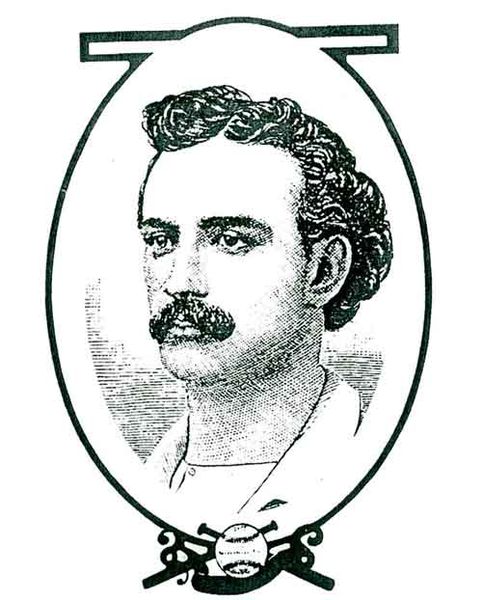
Lipman Emanuel "Lip" Pike (May 25, 1845 – October 10, 1893) the "Iron Batter",[2] was an American star of 19th-century baseball in the United States.[2][3] His brother, Israel Pike, played briefly for the Hartford Dark Blues during the 1877 season.
Key Information


Pike was one of professional baseball's first great sluggers, leading early professional leagues in home runs four times.[1] Pike possessed "great speed, a powerful, if erratic, throwing arm, and enormous power."[4]
Pike was also the first Jewish baseball star and manager in America.[5][4]
Early and personal life
[edit]Pike was Jewish and was born in New York into a Jewish Dutch family, and grew up in Brooklyn.[6][2] His father Emanuel was a haberdasher.[7] His mother was Jane, his brothers were Boaz, Israel, and Jacob, and he had a sister Julia.[5] His family moved to Brooklyn when he was very young.[5] Several of Pike's ancestors were Jewish rabbis who emigrated from Portugal to the Netherlands.
Baseball career
[edit]Pike began in baseball when he was 13.[8] Pike first rose to prominence playing for the Philadelphia Athletics, whom he joined in 1866.[3] He brought an impressive blend of power and speed to the team, hitting many home runs as well as being one of the fastest players around. On one occasion he hit five home runs in one game.[2]
However, it was soon brought to light that he and two other Philadelphia players were being given $20 ($430 in current dollar terms) a week to play.[3][9] Since all baseball players were ostensibly amateurs (though many were, like Pike, accepting money under the table), a hearing was set up by the sport's governing body, the National Association of Base Ball Players. In the end, no one showed up to the hearing, and the matter was dropped. By 1869, the Cincinnati Red Stockings became the first openly professional team, and Pike's hearing, farcical as it seems to have been, paved the way for Harry Wright's professionalization of baseball. The Athletics were very successful, but Pike was dropped from the team in 1867, because he was from New York, and thus a 'foreigner,' calling his loyalty into question.
He moved on to the Irvington, New Jersey club and later in 1867 to the New York Mutuals, always a leading team, where he returned for 1868, having caught the eye of Boss Tweed. In 1869 he moved to the Brooklyn Atlantics, another perennial leader, where he hit .610. In 1870, the Atlantics, with Pike manning second base, finally ended Cincinnati's 93-game winning streak.
National Association
[edit]In 1871, the National Association was formed as the first professional baseball league, and Pike joined the Troy Haymakers for its inaugural season. He was their star and for 4 games was the captain and manager,[3] batting .377 (6th best in the league) and hitting a league-leading 4 home runs.[1] He also led the league in extra base hits (21), and was 2nd in slugging percentage (.654) and doubles (10), 4th in RBIs (39), 5th in triples (7), 6th in on-base percentage (.400), 9th in hits (49), and 10th in runs (43).[1] The Haymakers only finished 6th, though, and the team's captaincy switched to Bill Craver.
The Haymakers revamped their roster for the 1872 season, and Pike headed for Baltimore, where he played for the Baltimore Canaries. Pike had another excellent season, leading the league in home runs again (with 6), RBIs (60), and games (56), and coming in 2nd in total bases (127) and extra base hits (26), 3rd in at bats (288), 5th in doubles (15) and triples (5), 9th in slugging percentage (.441) and stolen bases (8), and 10th in hits (84).[1]
In 1873, Pike led the league in home runs for the 3rd consecutive season, hitting 4, and was 2nd in triples (8), 4th in total bases (132), stolen bases (8), and extra base hits (26), 7th in slugging percentage (.462), 8th in doubles (14), RBIs (50), and at bats (286), 9th in hits (90), and 10th in games (56).[1]
Pike was also one of the fastest players in the league. He would occasionally race any challenger for a cash prize, routinely coming out the winner.[10] On August 16, 1873, he raced a fast trotting horse named "Clarence" in a 100-yard sprint at Baltimore's Newington Park, and won by four yards with a time of 10 seconds flat, earning $250 ($6,600 today).[3]
Baltimore went bankrupt after the season, so Pike headed off to captain the Hartford Dark Blues for the 1874 season. The Dark Blues were a poor team, but Pike had another fine season, slugging .574 to lead the league, and coming in 2nd with an on-base percentage of .368.[1]
Pike abandoned the weak Hartford team after a single season, switching to the St. Louis Brown Stockings.[1] For the first time in his professional career, Pike failed to hit a home run, although he stole 25 bases.[1] He also hit 12 triples and 22 doubles (leading the league) in what was probably his finest offensive season.[1]
In all, Lip Pike has the National Association career home run (15) and extra base hits (135) records.
National League
[edit]
In 1876, when the National League replaced the National Association, Pike stuck with St. Louis. The Brown Stockings turned in a very good season, finishing a solid 2nd to the Chicago White Stockings. Pike continued to produce offensively, notching totals of 133 total bases (5th in the league) and 34 extra-base hits (2nd).[1]
Seemingly never content to stay with a team very long, Pike headed to the Cincinnati Reds for the 1877 season. The Reds finished last. Pike was still a top-quality player, leading the league in home runs for the 4th time in the 1870s.[8] However, age was starting to catch up with the 32-year-old Pike. He began the season as the 8th-oldest player in the league, and was the 4th-oldest player of the 1878 season. The 1878 Reds played very well, though. They finished 2nd, but Pike was replaced by Buttercup Dickerson halfway through the season and forced to look elsewhere for a team. He ended up playing a few games for the Providence Grays, and spent the next two years playing for minor league teams.
Sporting Life subsequently named him an outfielder on its 1870–1880 All-Star team.[2]
Pike got a brief call-up in 1881 to play for the Worcester Worcesters,[11] but the 36-year-old Pike could no longer play effectively, hitting .111 and not managing a single extra base hit in 18 at-bats over 5 games.[1] His play was so poor as to arouse suspicions, and Pike found himself banned from the National League that September. He was added to the National League blacklist in 1881. He turned to haberdashery,[11] the vocation of his father, and spent another 6 years playing only amateur baseball. He was reinstated in 1883.
American Association
[edit]In 1887, the New York Metropolitans of the American Association gave Pike another chance. At 42, he was the oldest player in baseball. The only game he played was more of a sending off than a new start, though, and Pike headed back to his haberdashery once more.
Death
[edit]Pike died suddenly of heart disease at the age of 48 in 1893.[2] The Brooklyn Eagle reported that "Many wealthy Hebrews and men high in political and old time baseball circles attended the funeral service."[12] He was interred in the Salem Fields Cemetery in Brooklyn, New York.
Legacy
[edit]In 1936, decades after he died, Pike received one vote in the veterans election for the 1936 Baseball Hall of Fame balloting. He was not included on any further ballots.[2]
Pike was inducted into the International Jewish Sports Hall of Fame in 1985.[5]
Pike was inducted into the New York State Baseball Hall of Fame in the Class of 2016.[citation needed]
Pike was inducted into the National Jewish Sports Hall of Fame in 2024.
Pike was the first Jewish manager in major league history and one of only seven all-time.[13]
See also
[edit]

References
[edit]- ^ a b c d e f g h i j k l m n o "Lip Pike Stats, Height, Weight, Position, Rookie Status & More". Baseball-Reference.com. Retrieved October 6, 2024.
- ^ a b c d e f g Boxerman, Burton A.; Boxerman, Benita W. (December 27, 2006). Jews and Baseball: Entering the American mainstream, 1871–1948. McFarland, Incorporated, Publishers. ISBN 9780786428281. Retrieved February 1, 2011.
- ^ a b c d e Siegman, Joseph (2000). Jewish sports legends: the International Jewish Hall of Fame. Brassey's. ISBN 9781574882841. Retrieved February 1, 2011.
- ^ a b Kerr, Roy (January 10, 2014). Buck Ewing: A Baseball Biography. McFarland. p. 19. ISBN 978-0-7864-9011-0. Retrieved July 4, 2022.
- ^ a b c d Robert H. Schaefer, Lip Pike | Society for American Baseball Research
- ^ "Big League Jews". Jewish Sports Review. 12 (137): 20. January–February 2020.
- ^ Eisenbath, Mike (1999). Cardinals Encyclopedia. Temple University Press. ISBN 9781566397032. Retrieved February 1, 2011.
- ^ a b Ribowsky, Mark (2003). The Complete History of the Home Run. Citadel Press. ISBN 9780806524337. Retrieved February 1, 2011.
- ^ Siegman, Joseph M. (1992). The International Jewish Sports Hall of Fame. SP Books. ISBN 9781561710287. Retrieved February 1, 2011.
- ^ Arcidiacono, David (December 3, 2009). Major League Baseball in Gilded Age Connecticut: The Rise and Fall of the Middletown, New Haven and Hartford Clubs. McFarland. ISBN 9780786436774. Retrieved February 1, 2011.
- ^ a b Brody, Seymour (2004). Jewish heroes & heroines of America: 151 true stories of Jewish American heroism. Frederick Fell Publishers. ISBN 9780883910269. Retrieved February 1, 2011.
- ^ Terry, James L. (2002). Long before the Dodgers: baseball in Brooklyn, 1855–1884. McFarland. ISBN 9780786412297. Retrieved February 1, 2011.
- ^ Lawrence, Ryan (October 31, 2017). "Who is Gabe Kapler? A dozen fun facts about the new Phillies manager". PhillyVoice. Retrieved October 6, 2024.
External links
[edit]
- Career statistics from Baseball Reference · Fangraphs · Baseball Reference (Minors) · Retrosheet · Baseball Almanac
- Lip Pike at the SABR Baseball Biography Project
- Lip Pike at Find a Grave
- Lipman Pike at the International Jewish Sports Hall of Fame
| International | |
|---|---|
| National | |
Lip Pike
View on GrokipediaEarly life and family
Jewish heritage and family background
Lipman Emanuel Pike was born on May 25, 1845, in New York City to Emanuel Pike, a Dutch Jewish immigrant and haberdasher, and his wife Jane Pike.[1][6] The Pike family traced its Jewish roots to the Netherlands, where Emanuel had been born before emigrating to the United States in the early 19th century, reflecting the broader migration patterns of Dutch Jews seeking new opportunities in America.[7][1] Pike grew up in a close-knit Jewish household as the second of five children, with an older brother named Boaz and three younger siblings: brothers Israel and Jacob, and sister Julia.[1][8] His brother Israel briefly entered professional baseball in 1877, appearing in one game for the Hartford Dark Blues.[9] The family's observance of Jewish traditions was evident in Pike's bar mitzvah around age 13 in 1858, a rite of passage that marked his formal entry into Jewish adulthood.[1][7] The Pikes relocated from Manhattan to Brooklyn during Lipman's early childhood, a move that strengthened their ties to the burgeoning Jewish community in the borough and shaped his formative years.[1] Later in life, Pike followed in his father's footsteps by working as a haberdasher after retiring from baseball.[1][6]Youth and early interests in Brooklyn
Lipman Emanuel Pike, born on May 25, 1845, in New York City to Dutch Jewish immigrants Emanuel and Jane Pike, relocated with his family to Brooklyn at a very young age.[1] The Pike family settled in a neighborhood where Brooklyn's Jewish population remained relatively small during the early 19th century, immersing young Lip in a close-knit community shaped by his parents' traditions from Holland.[10] This environment, including religious observances, fostered his Jewish identity from childhood.[7] Details on Pike's formal education are scarce, reflecting the era's limited schooling opportunities for immigrant families, but he contributed early to the household by working in his father's haberdashery business, a shop selling men's clothing and accessories in Brooklyn.[1] Alongside his older brother Boaz, Pike assisted with tasks such as fetching supplies, which honed his sense of responsibility and physical activity from a young age.[11] Pike's early athletic interests centered on baseball, though he also enjoyed running as a youth.[12] Following his bar mitzvah in 1858, he engaged in his first organized baseball involvement, playing amateur games with local junior clubs that included his brother Boaz. One week after the ceremony, Pike appeared in his debut recorded amateur match at first base while Boaz played shortstop, marking the beginning of his exposure to the sport in Brooklyn's burgeoning baseball scene in 1858.[13]Professional baseball career
Amateur and early professional years (1866–1870)
Lipman Pike, at the age of 21, debuted with the Philadelphia Athletics in 1866, becoming one of the earliest documented paid players in baseball history by receiving $20 per week under the table—a compensation that violated the era's strict amateur ideals and sparked backlash from purists who viewed professionalism as a corruption of the sport.[1][14] Despite his Jewish heritage occasionally serving as a subtle barrier to full acceptance in the predominantly Protestant baseball community of the 1860s, Pike quickly proved his value on the field with his powerful hitting.[7] Pike's slugging prowess was immediately evident in a remarkable performance on July 16, 1866, when, playing for the Athletics against the Alert Club of Philadelphia, he hit five consecutive home runs in a single game, powering his team to a lopsided 67–25 victory and cementing his reputation as a premier power hitter at a time when home runs were rare and celebrated feats.[3] This outburst, played under hot summer conditions at a Philadelphia ballpark, highlighted his ability to dominate amateur competition and drew widespread attention to the young outfielder's talents. Following his stint with the Athletics, Pike moved to the Irvington club of New Jersey in 1867 before joining the New York Mutuals later that year, where he remained through the 1868 season amid the growing tensions of semi-professional play.[14] In 1869, he signed with the Brooklyn Atlantics, batting an extraordinary .610 over 48 games with a slugging percentage of .883, though such inflated averages were common due to rules allowing batters to call fair or foul on bunts.[1] He continued with the Atlantics into 1870, renowned for prodigious long-distance hits, including a legendary drive at New York's Union Grounds that struck and bent an iron rod atop the pagoda structure, estimated at around 360 feet from home plate.[1] At 5 feet 8 inches tall and weighing approximately 160 pounds, Pike was compact yet explosive, batting and throwing left-handed while demonstrating versatility across outfield positions, second base, and shortstop, though he primarily patrolled the outfield during these years.[2][1] His physical style—combining speed, a strong arm, and raw power—made him a standout in the transition from amateur sandlot games to organized professional baseball.National Association (1871–1875)
Lip Pike began his professional baseball career in the inaugural season of the National Association (NA), the first professional league, debuting with the Troy Haymakers on May 5, 1871, in a game against the New York Mutuals where he recorded six hits in a 25-10 victory.[1][2] As captain of the Haymakers, Pike batted .377 that year, tying for the league lead with four home runs while finishing second in slugging percentage (.654) and fourth in RBIs (39).[2][15] In 1872, Pike joined the Baltimore Canaries, where he led the NA in home runs with seven and in RBIs with 60, batting .298 and ranking second in total bases.[2] He remained with Baltimore in 1873, again leading the league in home runs with four while hitting .316 and contributing 51 RBIs.[2] Pike moved to the Hartford Dark Blues in 1874, posting a .355 batting average and leading the NA in doubles (22) and slugging percentage (.504).[2] His final NA season came in 1875 with the St. Louis Brown Stockings, where he batted .346, finished second in slugging (.494), and topped the league in adjusted OPS+ (203).[2][16] Over his five NA seasons, Pike maintained a .346 batting average, hit 16 home runs (leading the league in 1871–1873), and amassed 244 RBIs, establishing himself as the era's premier power hitter.[2][1] Pike's playing style combined raw power with exceptional speed, allowing him to excel as an outfielder and infielder while covering vast center field territory; he often raced fans or animals for wagers, including a 1873 exhibition at Newington Park in Baltimore where he outran a horse named Clarence over 75 yards in 10 seconds flat.[1] Despite his success, Pike endured the rigors of early professional travel, including long train journeys and inconsistent scheduling across the nine-team league.[1] By the end of the NA era, his 16 home runs represented over two-thirds of his career total of 21 in professional play.[2] His older brother, Israel Pike, later made a brief appearance with the Hartford Dark Blues in the National League in 1877, though the siblings never played together professionally.[1]| Year | Team | G | BA | HR | RBI | 2B |
|---|---|---|---|---|---|---|
| 1871 | Troy Haymakers | 28 | .377 | 4 | 39 | 10 |
| 1872 | Baltimore Canaries | 56 | .298 | 7 | 60 | 15 |
| 1873 | Baltimore Canaries | 56 | .316 | 4 | 51 | 15 |
| 1874 | Hartford Dark Blues | 52 | .355 | 1 | 50 | 22 |
| 1875 | St. Louis Brown Stockings | 70 | .346 | 0 | 44 | 22 |