Hubbry Logo
Johnny MizeJohnny MizeMain
Open search
Johnny Mize
Community hub
Johnny Mize
logo
8 pages, 0 posts
0 subscribers
Be the first to start a discussion here.
Johnny Mize
Johnny Mize
from Wikipedia

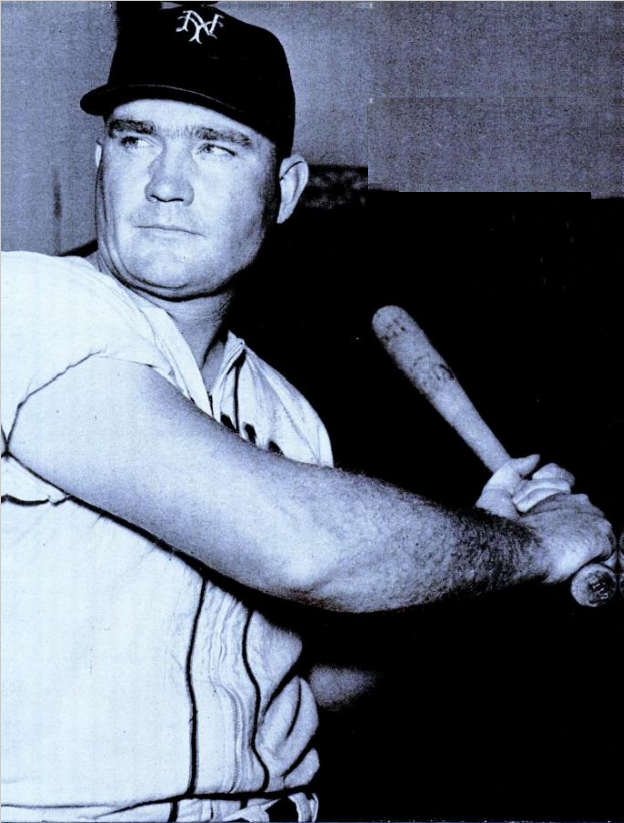
John Robert Mize (January 7, 1913 – June 2, 1993), nicknamed "Big Jawn" and "the Big Cat", was an American professional baseball player, coach and scout. He played as a first baseman in Major League Baseball (MLB) for 15 seasons between 1936 and 1953, losing three seasons to military service during World War II. Mize was a ten-time All-Star who played for the St. Louis Cardinals, New York Giants, and the New York Yankees. During his tenure with the Yankees, the team won five consecutive World Series.

Key Information

Mize retired in 1953 with 359 career home runs and a .312 batting average along with 1,118 runs, 2,011 hits, 367 doubles, 83 triples, 1,337 RBI and 856 bases on balls. Defensively, he recorded a .992 fielding percentage as a first baseman.[1] He served as a radio commentator, scout and coach in the major leagues after he retired as a player. He was selected for induction to the Baseball Hall of Fame by the Veterans Committee in 1981. In 2014, he was inducted into the St. Louis Cardinals Hall of Fame Museum.

Early life and career

[edit]

Mize was born in Demorest, Georgia to Edward and Emma Loudermilk Mize. After his parents separated, his mother went to Atlanta for work, but Mize remained in Demorest with his grandmother.[2] He excelled in tennis as a child and played on his high school baseball team.[3] He later played baseball for Piedmont College.[4][5] Mize was a cousin of Ty Cobb and his second cousin was the second wife of Babe Ruth.[2]

Mize came up through the St. Louis Cardinals minor league system but was traded to the Cincinnati Reds in 1934.[6] However, he suffered a groin injury and the Reds nullified the trade. In 1935, while struggling with one bad leg, he injured the other leg. Mize retired from baseball and returned home until the Cardinals asked him to see a physician in St. Louis. He had surgery for bone spurs.[7]

He was kept with the Cardinals in St. Louis after surgery, as he would not have been able to play regularly that season in the minor leagues anyway. The organization thought that he might get some opportunities to pinch hit with the major league team. Mize made his major league debut for the Cardinals in 1936. In 126 games, Mize hit for a .329 batting average, 19 home runs and 93 runs batted in (RBI). He later said, "I'm the only guy who played in the major leagues because I couldn't play in the minors."[7]

Early MLB career

[edit]
Mize with the Cardinals

Mize was known as both "Big Jawn" and "The Big Cat" for his smooth fielding at first base. In 1937 he batted .364, but Cardinals teammate Joe Medwick took the title with a .374 average. He led the league in triples and OPS in 1938. In 1939, Mize finished second in the league's Most Valuable Player (MVP) voting after leading the league with a .349 average and 28 home runs.[1] Mize's 43 home runs in 1940 set a Cardinals team record that stood for nearly 60 years. At the end of the 1941 season, however, Cardinals general manager Branch Rickey, who believed in trading players before their skills began to decline, traded Mize to the New York Giants. In exchange for Mize, the Cardinals received Bill Lohrman, Johnny McCarthy, Ken O'Dea, and $50,000.[1]

Mize was involved in a 1941 lawsuit against Gum Products Inc. The company manufactured a set of baseball cards called Double Play. Mize sued because he argued that the company did not have his consent to use his image in the card set. Gum Products Inc. won the lawsuit, but the company stopped producing its Double Play series because of the expenses it incurred during the legal proceedings with Mize.[8]

The Giants pursued Mize after learning that their first baseman, Babe Young, was going to be forced into military service. In 1942, Mize hit for his lowest batting average to that point in his career (.305), but he hit 26 home runs and led the NL with 110 RBI.[9]

Military service and later career

[edit]
Mize with the Yankees

Mize spent 1943 through 1945 in military service during World War II. During his service he played for the Great Lakes Naval Station baseball team for service members and new personnel in training. Mize hit 17 home runs in 51 games and batted over .475 while manning first base for the Bluejackets. Other team members included: Phil Rizzuto who belonged to the Yankees; outfielders Sam Chapman, Dom DiMaggio and Barney McCosky; Frankie Pytlak; and Brooklyn shortstop Pee Wee Reese, and Johnny Lipon. The team was considered one of the best WWII era teams assembled.

Returning to the Giants in 1946, a broken toe caused him to fall one short of the home run title, won by Ralph Kiner of the Pittsburgh Pirates. In 1947 he rebounded to hit 51 home runs and tie Kiner for the league lead. He also led in runs and RBI, and became the only player to strike out fewer than fifty times while hitting fifty home runs.[10] Mize's 1947 totals in runs, home runs and RBI were all career highs.[1] In 1948, Mize and Kiner again tied for the league home run championship with 40 each. Mize was traded to the New York Yankees late in the 1949 season after expressing discontent with his playing time.

Mize spent the last five years of his career with the Yankees, mostly as a part-time player, ending in 1953. He was, however, considered a valuable contributor to their winning five consecutive American League pennants and World Series titles. Despite spending part of the 1950 season on minor league rehab,[11] he hit 25 home runs to become the second player to have a 25-home run season in both leagues. In the 1952 World Series against the Brooklyn Dodgers, he hit three home runs, one as a pinch-hitter, and was robbed of a fourth by Dodger right fielder Carl Furillo, who made a leaping catch above the fence in the 11th inning to preserve a win for the Dodgers.

In October 1953, Mize announced his retirement. He said that he would rather retire while he was still popular with fans than to "hang around until they start to boo."[12] Mize holds the major league record for the most times hitting three homers in one game, a feat he performed six times. He also was one of a handful of players (including Babe Ruth) to do it in both leagues — five times in the National League and once in the American. He was the first player to hit three home runs in a game twice in one season in 1938 and did it twice again in 1940. He finished his career with 359 home runs.

Mize still holds Cardinals team records for most home runs in a season by a left-handed batter, most season RBI by a left hander, and most games with three or more home runs with 6.[6] He and Carl Yastrzemski are the only players to have three seasons of hitting 40 or more home runs, without a season of hitting between 30 and 39 home runs.

Mize was a strong pinch hitter in his MLB career, posting a .292 batting average (52-for-178) with 7 home runs and 56 RBI in 215 pinch-hitting appearances.[13]

Later life

[edit]

After his 1953 retirement, Mize worked as a radio commentator, scout and a hitting coach for the New York / San Francisco Giants (1955–60).[14] He coached the Kansas City Athletics in 1961.

In the 1970s, Mize made his home in St. Augustine, Florida, working for a development by the Deltona Corporation called St. Augustine Shores. A picture of his house is included in David Nolan's book The Houses of St. Augustine. He was chosen by the Veterans Committee of the Baseball Hall of Fame in 1981. He had appeared on the regular Hall of Fame ballot in the 1960s and 1970s, where his highest vote percentage had been 43% in 1971.[1]

Mize spent the last few years of his life at his home in Demorest, Georgia. He underwent heart surgery in 1982 but returned to good health. He died in his sleep of cardiac arrest in 1993.[3]

Legacy

[edit]

Upon Mize's death, Ralph Kiner described him as "kind of an irascible guy" on the field, but "a very affable guy and a great storyteller" off the field.[15] Mize's batting statistics were overshadowed by those of bigger stars of his era such as Ted Williams, Joe DiMaggio, Stan Musial, and Jackie Robinson. Mize's lifetime on-base percentage of .397 has become more appreciated in the light of sabermetric analysis.

In 2013, the Bob Feller Act of Valor Award honored Mize as one of 37 Baseball Hall of Fame members for his service in the United States Navy during World War II.[16]

In January 2014, the Cardinals announced Mize among 22 former players and personnel to be inducted into the St. Louis Cardinals Hall of Fame Museum for the inaugural class of 2014.[17] The Johnny Mize Baseball Museum is located at Piedmont College.[18] The college also honors the slugger with the Johnny Mize Athletic Center, a sports complex that houses the school's basketball arena.[19]

See also

[edit]

References

[edit]

Further reading

[edit]
[edit]
Revisions and contributorsEdit on WikipediaRead on Wikipedia
from Grokipedia
John L. Mize, known as the "," was an American who played 15 seasons in from 1936 to 1953, primarily for the St. Louis Cardinals, , and New York Yankees. Born on January 7, 1913, in , and passing away on June 2, 1993, in the same town, Mize compiled a career of .312 with 2,011 hits, 359 home runs, and 1,337 runs batted in over 1,884 games, establishing himself as one of the premier power hitters of his era. Mize's career began with the Cardinals in 1936, where he quickly emerged as a star, earning his first selection in 1937 and leading the National League in home runs in 1939 (28) and 1940 (43), as well as in 1947 (51) and 1948 (40). He captured the NL batting title in 1939 with a .349 average and topped the league in RBIs twice, in 1940 and 1942, while also leading in (OPS) three times from 1938 to 1940. His tenure with St. Louis was interrupted by military service during from 1943 to 1945, after which he returned to hit 51 home runs for the Giants in 1947—a career high—and 40 in 1948, leading the NL in homers both years. Traded to the Yankees in 1949, Mize transitioned to a role and pinch-hitting duties, contributing to five consecutive championships from 1949 to 1953, including a .286 average with three home runs in postseason play. Renowned for his consistency and power, Mize shares the major league record for the most three-home-run games with six (tied with and ), a mark he first reached in 1950. He was selected to 10 Games across both leagues and received the Babe Ruth Award in 1952 for his postseason performance. Despite missing prime years to wartime service, Mize's 70.6 Wins Above Replacement (WAR) underscores his value, and his induction into the National Baseball Hall of Fame in 1981 by the Veterans Committee cemented his legacy as an underrated slugger who combined plate discipline with prodigious home run production.

Early life

Family background and childhood

John Robert Mize was born on January 7, 1913, in Demorest, a small town in , nestled in the Appalachian foothills. He was the second son of William Edward "Eddie" Mize, a local , merchant, and traveling salesman, and Emma May Loudermilk Mize, a homemaker who later worked in a . Mize's older brother, William Pope Mize (born 1910), completed the immediate family unit, though the household faced early disruptions when his parents separated around 1920 due to his father's struggles with deafness and alcoholism. Following the separation, young Mize lived primarily with his maternal grandmother, Sarah Loudermilk, and aunt at the family home known as Diamond Acre on the outskirts of Demorest, a property tied to the area's rural farming traditions. The family was not wealthy and depended on home gardens and support from relatives' farms for sustenance, reflecting the modest circumstances of many in rural . Mize showed early athletic promise in , winning a , and was a distant cousin to baseball legend . Mize's early childhood unfolded in this tight-knit, small-town environment, where daily life revolved around community and simple rural routines. His formal education began in local elementary schools, though opportunities were limited by the era's economic constraints and family instability. As the deepened in the 1930s, financial pressures intensified; his mother relocated to for steady employment at J.M. High Company, leaving Mize to navigate his formative years amid these hardships.

Entry into baseball

During his high school years at Piedmont Academy in , Johnny Mize excelled in multiple sports, including , , and football, where his athletic prowess first drew local attention. While still a student there, Mize joined the nearby at age 15, batting over .400 across two seasons due to lax eligibility rules at the time, which highlighted his emerging talent as a left-handed hitter with exceptional power. After graduating in 1930, Mize transitioned to semi-professional in Georgia, playing for teams in Toccoa alongside future major leaguer , where he showcased his raw hitting ability in local leagues. That summer, while competing in Toccoa, he caught the eye of St. Louis Cardinals scout Frank Rickey, brother of general manager , who signed the 17-year-old Mize as an amateur free agent to the organization's minor league system. Initially assigned to the Class C Greensboro Patriots in 1930, Mize began his professional career in the outfield but struggled with fielding, prompting a shift to first base in subsequent seasons to capitalize on his hitting strengths. By 1935, following a brief trade to the and a return to the Cardinals, he joined the Nashville Vols of the Southern Association, where he batted .340 with 17 home runs in 161 games, demonstrating his power potential despite ongoing defensive challenges that limited his positional versatility.

Major League career

St. Louis Cardinals tenure

Johnny Mize made his major league debut with the St. Louis Cardinals on April 16, 1936, entering as a against the Chicago Cubs and going hitless in his only at-bat. Over the course of his rookie season, he appeared in 126 games, splitting time between first base (108 games) and right field (13 games), where he committed a total of 10 errors while posting a .987 at first base—solid but indicative of adjustment challenges for a newcomer to the majors. Offensively, however, Mize established himself as a formidable power hitter, batting .329 with 19 home runs and 93 RBIs, contributing significantly to the Cardinals' second-place finish in the National League. By 1937, Mize had secured the everyday first base role, playing 145 games and delivering a breakout performance with a .364 batting average, 25 home runs, and 113 RBIs, helping the Cardinals to a third-place standing. His transition to full-time duty at the position showcased improved fielding reliability, as he handled 1,200 putouts with just nine errors for a .993 fielding percentage. In 1938, Mize continued his ascent, batting .337 with 27 home runs and 102 RBIs while leading the National League in triples (16) and slugging percentage (.614), underscoring his emerging status as one of the league's premier sluggers. Mize captured his first National League home run crown in 1939, belting 28 while batting .349—a league-best mark—and leading in (353) and (.626), as the Cardinals finished fourth. He repeated as the NL's top home run hitter in 1940 with a franchise-record 43, also pacing the circuit in RBIs (137) and helping secure second place with a .314 average and 111 runs scored. These back-to-back titles highlighted Mize's disciplined approach at the plate, where he combined patience with power, striking out just 49 times in 1940 despite his prodigious output. The 1941 season brought challenges for Mize, including a late-summer arm injury that sidelined him for the final month, limiting him to 126 games where he still hit .317 with 16 home runs and 100 RBIs. Contract tensions had simmered throughout his Cardinals tenure, with Mize engaging in holdouts over salary—most notably after his breakout—and clashing with management over compensation, earning him a reputation as a vocal for players' rights. These disputes culminated in his trade to the on December 11, 1941, in exchange for $50,000, catcher Ken O'Dea, pitcher Bill Lohrman, and first baseman Johnny McCarthy, ending his six-year stint in after 849 games, 158 home runs, and a .340 .

New York Giants period

Mize was traded from the St. Louis Cardinals to the New York Giants on December 11, 1941, in exchange for pitcher Bill Lohrman, first baseman Johnny McCarthy, catcher Ken O'Dea, and $50,000, amid tensions stemming from his salary holdout after the 1940 season. In his first full season with the Giants in 1942, Mize adapted quickly to the Polo Grounds, batting .305 with 26 home runs and a league-leading 110 RBI over 142 games, helping the team to a third-place finish. His time with New York was soon interrupted by World War II, as he enlisted in the U.S. Navy on March 25, 1943, missing the next three seasons and affecting his mid-career momentum. Mize returned in 1946, demonstrating resilience with a .337 batting average, 22 home runs, and 70 RBI in 101 games, as he readjusted to major league play following his military absence. The 1947 season marked a peak of productivity for Mize in New York, where he led the National League with 51 home runs and 138 RBI while hitting .302 over 154 games, finishing third in MVP voting despite the Giants' third-place standing. He continued his power surge in 1948, topping the NL with 40 home runs and adding 125 RBI at a .289 clip in 152 games, though the Giants faltered to fifth place amid broader team inconsistencies. By mid-1949, however, the 36-year-old Mize slumped, batting .263 with 18 home runs and 62 RBI in 106 games with the Giants, prompting the team to trade him to the New York Yankees on August 22 for $40,000 and ending his Giants tenure.

New York Yankees years

On August 22, 1949, the New York Yankees purchased the contract of 36-year-old first baseman Johnny Mize from the for $40,000, bringing in a proven power hitter amid a tight pennant race. Mize, who had hit 18 s for the Giants that season despite limited playing time, debuted with the Yankees on August 24 and appeared in 13 games down the stretch, batting .261 with a .393 and one . His arrival bolstered the lineup as the Yankees clinched the pennant by a single game over the Boston Red Sox, marking Mize's first taste of postseason play in the against the , which New York won in five games. Mize became a key contributor to the Yankees' dynasty, helping secure championships in 1949, 1950, 1951, 1952, and 1953, with standout performances in the postseason. In 1950, he enjoyed a full-time role at first base, slashing .277/.351/.509 with 25 home runs and 72 RBIs over 90 games, aiding another pennant and a five-game Series victory over the Phillies. By 1951, emerging talent Joe Collins had assumed primary duties at first base, shifting Mize to a and pinch-hitting role; he still appeared in 113 games, batting .259 with a .339 and 10 home runs. His value shone brightest in the against the Dodgers, where he batted .400 with three home runs—including a crucial fourth-inning solo shot in Game 7 that gave the Yankees a lead they never relinquished—driving in six runs across five games to secure the title. In 1953, limited mostly to pinch-hitting duties, Mize played 81 games, batting .250 with a .339 , four home runs, and 27 RBIs, while contributing to yet another pennant and sweep of the Dodgers. At age 40, Mize announced his retirement the day after the victory, preferring to step away while still beloved by fans rather than linger as a diminished player. The Yankees officially released him on November 25, 1953, ending a that concluded triumphantly in pinstripes after five seasons and five championships. Sportswriter Dan Parker penned a poignant , noting Mize's enduring grace despite the toll of age: "Your arm is gone, your legs likewise... but your eye is as keen as ever." Mize later reflected on his Yankees tenure as the fulfillment of a long-held ambition, having finally experienced the success that eluded him earlier in his .

Military service

World War II enlistment and duties

Following the 1942 Major League Baseball season, Johnny Mize enlisted in the United States Navy on March 25, 1943, after passing his physical examination at Jefferson Barracks, Missouri. His entry into service came after playing the 1942 season with the New York Giants, to whom he had been traded from the St. Louis Cardinals in December 1941. Assigned the rating of Athletic Specialist Second Class, Mize's primary duties centered on promoting physical fitness and morale among sailors through organized athletics, with a focus on baseball exhibitions. He began his training at the Great Lakes Naval Training Station in Illinois, where he quickly joined the base's renowned Bluejackets baseball team under manager Mickey Cochrane. In 1943, while stationed at , Mize excelled with the Bluejackets, batting .418 over 251 at-bats and contributing to their dominance in service games against professional and military opponents, including a notable performance in an exhibition against a major league squad. The following year, he transferred to Kaneohe in , serving with the Third Fleet and playing for the Kaneohe Klippers in local service leagues. There, Mize participated in morale-boosting contests, such as a May 1944 game where he hit two home runs to lead the Klippers to a 6-2 victory over the Aiea Naval Barracks team, helping to entertain and uplift troops amid the Pacific Theater campaigns. His efforts extended to the 1944 Army-Navy in , further showcasing his role in wartime recreation. By 1945, Mize joined a combined Third and Fifth Fleet touring team for exhibitions across liberated Pacific islands, including stops at the , , Saipan, , and , where games against other military units provided essential relief from combat duties. Notable highlights included a 425-foot against the Seventh Army in . Rising to the rank of Specialist during his tenure, Mize's service emphasized non-combat contributions to welfare through . He received an honorable discharge in October 1945, concluding nearly three years of active duty.

Career interruption effects

Johnny Mize's during resulted in the loss of three prime seasons from 1943 to 1945, when he was ages 30 to 32, depriving him of approximately 100 or more home runs based on his pre-war pace of 30 to 43 homers per season. Prior to the war, Mize had established himself as one of baseball's premier power hitters, and projections suggest he could have approached 500 career home runs without the interruption, elevating his legacy among the era's elite sluggers. Mize had pre-existing injuries, including knee issues from earlier in his career, that affected his mobility, along with additional setbacks after his return such as a broken hand and in 1946. Upon rejoining the in 1946, he posted a .337 in 101 games despite these challenges. These issues shifted his approach toward greater consistency in contact hitting rather than relying on peak power, as evidenced by his adjusted swing mechanics to compensate for reduced explosiveness. Pre-war statistics from to showcased Mize's dominance with a .330 and a maximum of 43 home runs in , reflecting his ability to combine average and power at an elite level. In contrast, post-1946 performance through 1953 saw his average dip to .280 with a high of 51 home runs in 1947, though subsequent seasons trended toward fewer long balls and more emphasis on run production amid declining physical condition. This trajectory mirrored the broader effects of on players like , who also lost prime years to service and returned to adjusted roles, highlighting how the war accelerated career declines for many stars through lost development time and bodily wear.

Post-playing life

Business ventures and broadcasting

After retiring from playing in 1953, Johnny Mize pursued several business interests in , where he settled with his family. He operated a and managed an orange grove adjacent to his twelve-acre homestead, supplementing these with projects in the region. These ventures provided financial stability during his transition from , allowing family involvement in daily operations while Mize balanced them with occasional baseball-related work. In addition to his business activities, Mize contributed to broadcasting as a radio commentator following his playing days, drawing on his expertise as a prolific hitter to provide insights for listeners. He also served in coaching roles, including as a hitting instructor for the from 1955 to 1960 and the Kansas City Athletics in 1961, where he mentored young players during and regular seasons. Later, he worked briefly as a special batting instructor for the Bradenton Braves of the Florida Winter League. Mize's post-career hobbies intersected with promotional opportunities; he frequently played golf in and attended baseball card shows, where he signed autographs and donated proceeds to local Boy Scout troops, enhancing his public profile without formal endorsements.

Family and later years

Mize married his first wife, Jene Adams, on August 8, 1937, in , . They had two children together before her death on July 14, 1957, from burns sustained in a house fire in . Three months later, on October 23, 1957, Mize wed Marjorie Pope, a radio news writer from , in a ceremony that marked the beginning of their shared life until his passing. Mize adopted Marjorie's two children from her previous marriage, son Jim and daughter Judi, integrating them into the family. After retiring from baseball, Mize and Marjorie initially resided in Florida, where they managed orange groves for several years. In 1974, the couple relocated to Demorest, Georgia, settling into Mize's childhood home across from Piedmont College, embracing a quiet, low-profile lifestyle rooted in his hometown. There, Mize remained active in the community, offering guidance to local Little League players and supporting Boy Scout fundraising efforts through autograph sessions, reflecting his commitment to youth and local causes without seeking the spotlight. Mize's health declined in his later years due to ongoing heart problems; he underwent successful triple-bypass surgery in December 1982 but continued to face cardiac issues. On June 2, 1993, he died of in his sleep at his Demorest home at the age of 80. His funeral services were held privately, and he was buried at Yonah Gardens in Demorest.

Playing style and records

Batting technique and strengths

Johnny Mize employed a balanced batting stance that contributed to his graceful and controlled approach at the plate, earning him the "The " for his poised demeanor. His swing was characterized as picture-perfect and smooth, allowing him to make consistent line-drive contact with power to all fields while maintaining excellent bat control. This level swing generated significant pull power without an pronounced , enabling him to drive balls effectively to left field. Standing at 6 feet 2 inches and weighing 215 pounds, Mize's imposing physical build provided natural leverage for opposite-field power, particularly as a left-handed batter who could handle pitches away with precision. His elite contact skills were evident in a career of .397, reflecting strong plate discipline and an ability to avoid chasing bad pitches. Mize's low rate of 7.1 per 100 plate appearances underscored his selectivity and composure, as he struck out just 42 times while hitting 51 home runs in 1947. Mize demonstrated notable adaptability to opposing pitchers, often adjusting the weight of his —ranging from 34 to 40 ounces—based on the pitcher's to optimize his swing timing. As a left-handed hitter, he particularly excelled against right-handers, leveraging his quick hands to handle a variety of pitches in situations, such as late-inning at-bats or pinch-hitting opportunities. While his limited speed affected his baserunning and defensive range at first base, where he posted a career fielding percentage of .992, it did not hinder his offensive prowess and instead highlighted his reliance on superior hitting mechanics.

Key statistics and milestones

Johnny Mize played 15 seasons in from 1936 to 1953, compiling a career of .312 with 359 home runs and 1,337 runs batted in over 1,884 games. His stood at .397, reflecting his consistent ability to reach base. Advanced metrics highlight his value, with a Wins Above Replacement (fWAR) of 65.7, underscoring his offensive contributions despite missing three prime years to . Mize earned four National League home run titles, leading or tying for the league lead in 1939 (28), 1940 (43), 1947 (51), and 1948 (40, tied with ). He captured three RBI crowns, topping the NL in 1940 (137), 1942 (110), and 1947 (138). Additionally, he won the 1939 NL batting title with a .349 average. Mize was selected to 10 All-Star Games, appearing in 1937, 1939–1942, 1946–1949, and 1953. Although sidelined by military duty in 1943, he participated in service team exhibitions, including starting at first base for a Navy all-stars squad in wartime contests. Key milestones include hitting his 300th career on May 5, 1949, against the at the , a solo shot off Murry Dickson in the bottom of the 10th inning. Mize set the major league record with six three-home-run games, most recently on September 15, 1950, a mark later tied by others. At the time of his retirement, Mize's 359 home runs ranked him sixth all-time, a testament to his power despite the career interruption.

Legacy

Hall of Fame induction

Johnny Mize retired from at the end of the 1953 season following the New York Yankees' victory, becoming eligible for Hall of Fame consideration by the (BBWAA) five years later in 1958. His first appearance on the BBWAA ballot came in 1960, where he garnered 16.7% of the vote, and he remained on the ballot through 1973 without ever reaching the 75% threshold required for election, peaking at 43.6% in 1971. In 1981, the Special Veterans Committee selected Mize for induction, announcing the decision on March 11 alongside Negro Leagues pioneer . The committee recognized Mize's career achievements, including 1,337 runs batted in, four National League home run titles, and three RBI crowns, despite his military service interrupting his prime years. In 2014, Mize was posthumously inducted into the St. Louis Cardinals Hall of Fame. The induction ceremony took place on August 2, 1981, in , where Mize was enshrined with Foster and BBWAA electee before a crowd of about 3,000 fans and 21 living Hall of Famers. In his acceptance speech, Mize emphasized the importance of teamwork throughout his career, crediting his success to the support of teammates and coaches, particularly during his formative years with the St. Louis Cardinals. He also humorously defended his Veterans Committee path, remarking, "Some people have asked me if going in through the veterans' committee was like going in the back door... No, it's the front door, the side door, the roof, the cellar—any way you can get in is the right way." Mize's Hall of Fame plaque immortalizes him as "The Big Cat," a nickname earned for his graceful fielding and powerful batting stance, and highlights his 1939 National League batting title with a .349 average, leadership in home runs (28 in 1939, 43 in , 51 in 1947, and 40 in 1948 tied), RBI (137 in , 110 in 1942, and 138 in 1947), and his role in five consecutive titles with the Yankees from 1949 to 1953, including three home runs in the 1952 Fall Classic.

Influence on baseball

Johnny Mize's influence on baseball transcended his on-field achievements, particularly through his guidance of younger players and dissemination of hitting knowledge. As a seasoned veteran with the New York Yankees from 1949 to 1953, Mize served as an informal mentor to rookies like , imparting wisdom on batting fundamentals during team sessions and clubhouse discussions. Mantle, in his early career, drew inspiration from Mize's instructional book How to Hit, co-authored with Murray Kaufman in 1953, which emphasized disciplined approaches to power hitting, including the mechanics of pulling the ball for maximum distance. This guidance helped shape Mantle's switch-hitting prowess, contributing to his emergence as one of the game's elite sluggers. Mize's career embodied the resilience of World War II-era players, serving as a model for the post-war generation navigating personal and professional disruptions. Enlisting in the U.S. Navy in 1943, he spent three years in service, including time with the Great Lakes Naval Training Station team under coach , before returning to the majors in 1946. Despite the physical demands of military duty, Mize posted a .337 with 22 home runs and 70 RBIs in just 101 games that year, demonstrating a swift and strong comeback that motivated returning veterans and young players alike to prioritize endurance and adaptability in . His story highlighted the sport's ability to rebound amid global conflict, inspiring a renewed emphasis on player fortitude in the late 1940s and 1950s. At the position of first base, Mize helped pioneer the archetype of the pure power hitter, blending elite contact skills with extraordinary slugging ability during an era when the role often favored defense over offense. Leading the National League in home runs three times and slugging percentage four times between 1939 and 1948, his 51-homer season in 1947—while striking out only 42 times—set a standard for offensive dominance at the corner infield spot. This approach influenced the evolution of first basemen as offensive threats, paving the way for later stars who prioritized home run production over traditional fielding duties. Mize's techniques, detailed in his writings and shared through Yankees instructorships, further embedded pull-power strategies into the positional playbook. Mize's enduring legacy is evident in contemporary assessments, where he ranks among the elite first basemen despite the interruption from wartime service. By the JAWS metric, which combines and peak performance value, Mize places 9th all-time with a score of 59.5, reflecting his .312 average, 359 home runs, and five titles. Often viewed as underappreciated due to those lost prime years—potentially elevating him to 400-plus homers—his contributions remain a benchmark for balanced hitting excellence. His Hall of Fame plaque succinctly captures this impact, noting his status as a "great hitter" and contributor.

References

Add your contribution
Related Hubs
User Avatar
No comments yet.