Hubbry Logo
search
logo
2235593

Liquid Paper

logo
Community Hub0 Subscribers
Read side by side
from Wikipedia
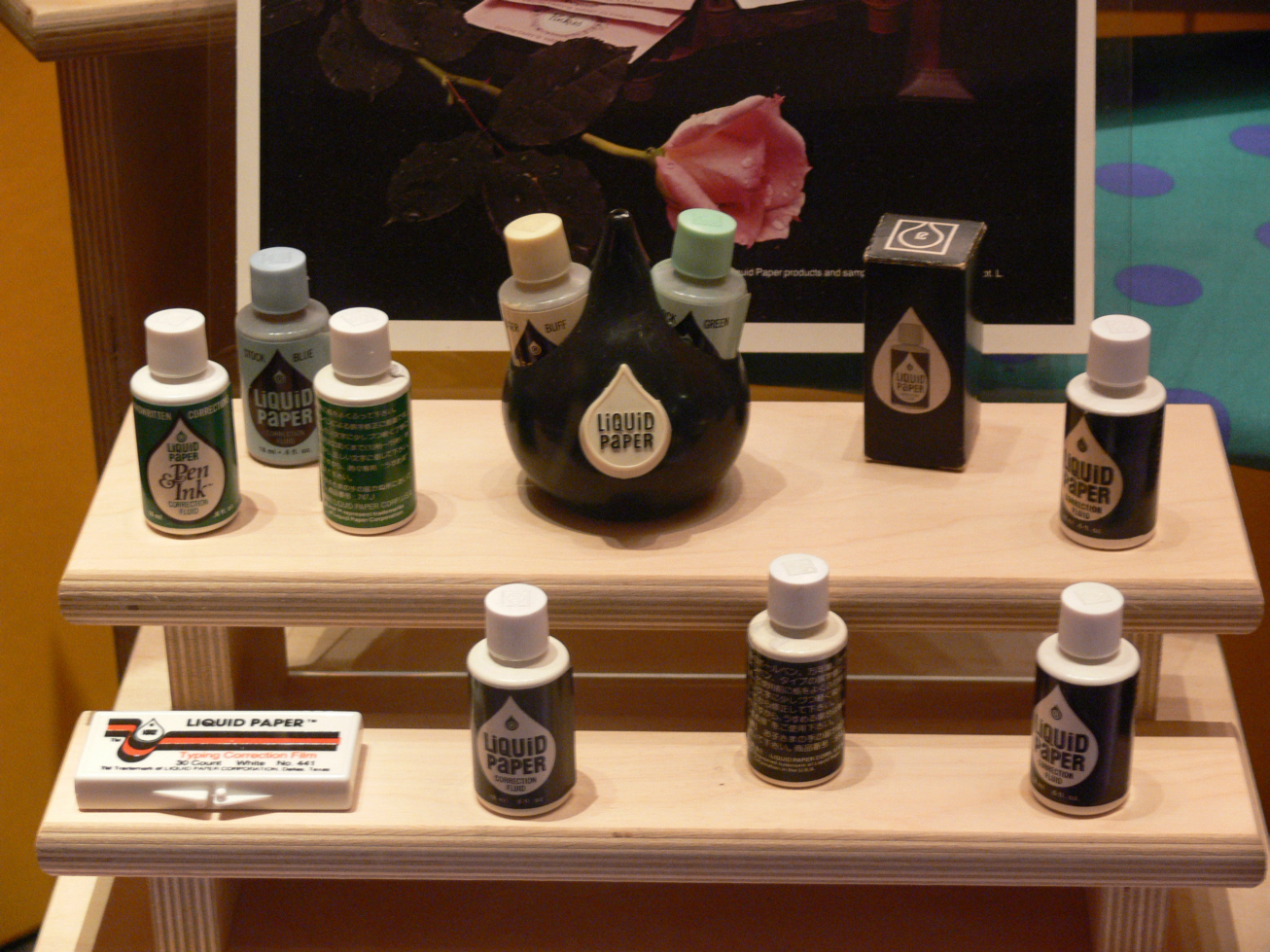
Liquid Paper products at The Women's Museum in Dallas, Texas

Liquid Paper is an American brand of the Newell Brands company marketed internationally that sells correction fluid, correction pens, and correction tape.

Product history

[edit]
Liquid Paper

In 1956, Bette Nesmith Graham (mother of future Monkees guitarist Michael Nesmith) invented the first correction fluid in her kitchen. Working as a typist, she used to make many mistakes and always strove for a way to correct them. Starting on a basis of tempera paint she mixed with a common kitchen blender, she called the fluid "Mistake Out" and started to provide her co-workers with small bottles on which the brand's name was displayed.[1]

Graham formed the Mistake Out Company in 1956.[2] [3] She developed alternative formulas for quicker drying times and better application brushes. Sales were about 100 bottles per month in 1957; however, they increased fivefold when the correctional liquid appeared in The Office magazine, which led to a large corporate order from General Electric.[4]

Graham was fired from her typist job after she accidentally put her own company’s name on a sheet of her employer’s company letterhead. She subsequently decided to devote all her time to Mistake Out.[5] In 1958, Graham renamed her business the Liquid Paper Company and applied for a patent and trademark.[6] By 1968, the company "had become a multimillion-dollar organization, breaking ground on a huge business and manufacturing facility in Dallas, Texas. LPC scaled internationally and eventually opened offices and manufacturing plants in Canada, England, Belgium and Australia".[2] By 1975, "Liquid Paper was producing 25 million bottles a year and holding a vast share of a multimillion-dollar market that had spawned several competitors, like Wite-Out".[6]

Graham sold Liquid Paper to Gillette Corporation in 1979.[6][a]

Acquisition

[edit]

In 2000, the Liquid Paper product and brand name was acquired by Newell Rubbermaid (later Newell Brands). In some regions of the world, Liquid Paper is endorsed by Papermate, a widely known writing instruments brand also owned by Newell.[citation needed]

Ingredients

[edit]
A traditionally shaped bottle of Liquid Paper

As of 2009, MSDSs list Liquid Paper as containing titanium dioxide, solvent naphtha, mineral spirits, resins, dispersant, and fragrances.[8]

Liquid Paper came under scrutiny in the 1980s due to concerns over recreational sniffing. The organic solvent 1,1,1-trichloroethane (TCA) was used as a thinner in the product.[9] Liquid Paper containing TCA was thought to be toxic and carcinogenic, but later studies showed that although the thinner was toxic there was no evidence of carcinogenicity.[10] There were several studies linking fatalities[11][12] to the TCA contained in correction fluids, including Liquid Paper.

In 1989, Gillette reformulated Liquid Paper without TCA in response to a complaint under California Proposition 65.[13][14]

See also

[edit]

Notes

[edit]

References

[edit]
[edit]
Revisions and contributorsEdit on WikipediaRead on Wikipedia
from Grokipedia
Liquid Paper is a brand of correction fluid, an opaque white liquid designed to cover errors on paper surfaces, initially for masking typewriter typos and later adapted for handwriting and printing corrections.[1][2]
Invented in 1951 by Bette Nesmith Graham, a single mother employed as an executive secretary at a Texas bank, the product originated from her observation of sign painters who corrected mistakes by overlaying rather than erasing.[3][1]
Graham initially produced small batches in her kitchen blender using water-based paints matched to paper color, marketing it under names like "Mistake Out" before trademarking "Liquid Paper" in 1956.[4][2]
She founded the Liquid Paper Corporation, which by 1967 sold over one million units annually and peaked at 25 million bottles per year in the mid-1970s, leading to its sale to Gillette in 1979 for $47.5 million while Graham retained formula rights.[5][2]
The formula typically includes titanium dioxide for opacity and volatile solvents for quick drying, enabling smooth application over inks from ballpoint pens, markers, and typewriters without cracking.[1][2]

Invention and Early Development

Background and Inspiration

Bette Nesmith Graham, born on March 23, 1924, in Fort Worth, Texas, developed an early interest in art, learning oil painting techniques from her mother, which later influenced her inventive approach to everyday problems.[2] After divorcing her first husband in 1946, Graham became a single mother supporting her son, Michael Nesmith, by working various jobs, including as a secretary during the post-World War II economic challenges that emphasized clerical efficiency in expanding offices.[6] By the early 1950s, she secured a position as an executive secretary at Texas Bank and Trust in Dallas, where she operated a typewriter amid the era's manual typing demands, which produced frequent errors difficult to correct without smudging or damaging paper.[7] The limitations of typewriter correction methods, such as using erasers that often left visible residue or required retyping entire pages, frustrated Graham, who sought a non-destructive alternative to maintain professional document quality.[8] Drawing from her artistic background, where mistakes in painting were routinely covered rather than erased, she recognized the potential for a similar opaque covering agent adapted for office use.[9] Graham's key inspiration came from observing sign painters decorating the bank's windows for holidays; these professionals corrected errors by applying a layer of matching paint over imperfections instead of scraping them away, preserving the underlying surface.[2] This observation, combined with her familiarity with commercial white tempera paint used in signage, prompted her to experiment in her kitchen blender around 1951, mixing the paint with a diluent and a brush to create a fast-drying, paper-matching fluid initially dubbed "Mistake Out."[1] Colleagues at the bank soon requested samples, validating the practicality of her homemade solution for hiding typewriter typos without altering text alignment or requiring specialized equipment.[6]

Initial Creation and Testing

In 1951, Bette Nesmith Graham, a single mother employed as an executive secretary at Texas Bank & Trust in Dallas, Texas, created the precursor to Liquid Paper amid frustrations with correcting errors on early electric typewriters, which lacked the correction keys of later models. Inspired by her background as a freelance commercial artist, Graham observed that painters rectified canvas mistakes by overpainting with tempera without visible brush strokes or underlying marks, prompting her to experiment with white, water-based tempera paint thinned for typewriter application. She formulated the initial batch in her home kitchen using a blender to mix the paint with additives, such as a quick-drying chemical, to reduce smudging and drying time while maintaining opacity over ink. This mixture, dubbed "Mistake Out," was decanted into repurposed nail polish bottles for portability.[10][2][6] Graham conducted initial testing covertly at her office desk, applying the fluid with a fine brush to cover typing mistakes only when her supervisor was absent, to avoid detection of unapproved methods. The product effectively masked errors on bond paper without tearing, feathering the surrounding text, or repelling fresh ink once dried, addressing common issues with manual erasers that often damaged documents or left residue. Successful personal trials led her to distribute small quantities to fellow secretaries, who corroborated its reliability through their own use, noting seamless integration with office workflows and no interference with carbon copies or subsequent overtyping. This grassroots validation confirmed the formula's viability before broader production, though early versions required manual stirring to prevent settling.[11][12][3] In 1958, Bette Nesmith Graham renamed her correction fluid product from "Mistake Out" to "Liquid Paper" and filed applications for both a U.S. patent on the formulation and a trademark for the name.[1] The patent process faced initial financial hurdles, as Graham had been unable to afford the $400 application fee as early as 1956 when she began small-scale production under the Mistake Out Company.[1] Despite these delays, the patent was ultimately secured, protecting the product's unique composition of tempera paint, solvents, and other chemicals designed for quick-drying typewriter error correction.[9] A significant professional setback occurred that same year when Graham was terminated from her executive secretary position at Texas Bank & Trust after inadvertently signing official correspondence with "The Mistake Out Company" instead of the bank's name.[13] This incident, stemming from her divided attention between employment and side business, highlighted tensions between her invention activities and employer policies but ultimately freed her to dedicate full time to Liquid Paper operations.[6] No formal lawsuits arose from the termination, though it underscored early risks of commercializing an invention while employed. No major patent infringement disputes or opposition proceedings are documented during Graham's ownership of the Liquid Paper Corporation, founded in 1958 to manufacture and distribute the product.[14] The trademark for "Liquid Paper" was successfully registered, enabling market expansion without noted legal interference until the company's sale to Gillette in 1979.[4] Post-acquisition, ownership of intellectual property rights shifted, with later efforts by Graham to pursue additional registrations blocked by the assignee to maintain control.[15]

Business History and Expansion

Founding the Liquid Paper Corporation

Bette Nesmith Graham, a single mother and executive secretary at Texas Bank and Trust, initially developed and sold her correction fluid under the name Mistake Out starting in the mid-1950s, mixing batches in her kitchen blender and packaging them with her young son's assistance in their garage.[2][1] By 1958, as demand grew from office supply sales and word-of-mouth among typists, Graham formalized her venture by renaming the product Liquid Paper and establishing the Liquid Paper Company, marking the official founding of the corporation without external capital or investors.[11][16] The corporation was incorporated in Dallas, Texas, where Graham handled production, bottling, and distribution single-handedly at first, relying on a rented garage space before expanding to a small facility.[6] She secured a trademark for Liquid Paper that year and applied for a patent on the formula, which was granted in 1961 after refinements to improve drying time and opacity.[1] Early marketing targeted secretaries and office managers through direct sales and demonstrations, capitalizing on the product's superiority over erasers for electric typewriters, which were becoming widespread in the late 1950s.[17] Graham's hands-on approach extended to quality control and innovation, such as experimenting with pigments and solvents to match paper tones, all funded from initial profits that reached modest but steady volumes by the late 1950s.[9] The founding reflected her bootstrapped entrepreneurship, transitioning from informal side hustle to structured business amid challenges like recipe secrecy and competition from typewriter manufacturers resistant to correction aids.[16] By 1962, her marriage to Robert Graham brought additional sales expertise, aiding the corporation's initial stabilization.[6]

Growth and Market Penetration

Following the establishment of the Liquid Paper Corporation in 1962, production scaled rapidly through direct marketing efforts, including road trips across the southern and western United States to pitch the product to businesses. By 1964, output had increased tenfold to 5,000 bottles per week from earlier handmade batches.[14][12] Sales reached $1 million in 1967, coinciding with a 137% year-over-year revenue increase and annual production of over 1 million bottles, marking the company's entry into multimillion-dollar operations. That year, Graham relocated to an automated plant and headquarters in Dallas, boosting daily output from 500 bottles per week to 10,000 bottles per day by 1968. Annual sales growth stabilized at around 34% by 1970, reflecting sustained demand in office environments reliant on typewriters.[1][16][10][18] By the mid-1970s, Liquid Paper achieved peak production of 25 million bottles annually, dominating the correction fluid sector amid emerging competitors like Wite-Out, which entered the market later but failed to erode its lead due to superior formulation and brand recognition. This positioned Liquid Paper as the standard for error correction in pre-digital offices, culminating in the company's $47.5 million sale to Gillette in 1979, equivalent to over $180 million in today's dollars, underscoring its entrenched market position.[13][2][19][20]

Operational Challenges and Innovations

As Liquid Paper Corporation expanded in the 1960s, Bette Nesmith Graham faced significant challenges in scaling production from rudimentary home-based operations to industrial levels. Initially mixed in her kitchen using a blender, with bottling and labeling handled by her son and friends, the process relied on manual labor and limited space, constraining output to small batches.[3] By 1964, production had increased to 500 bottles per week, but profitability remained elusive until that year, exacerbated by the lack of initial capital and reliance on a modest $600 family loan for equipment.[1][16] Relocation progressed from a backyard setup to a trailer and then a four-room house, yet these facilities proved inadequate for surging demand, which grew 137% in 1967 to over one million units annually.[10][1] To address these bottlenecks, the company opened a dedicated manufacturing plant in Dallas in 1968, employing 19 workers and enabling output to reach 5,000 bottles per week by that year.[10][1] Further innovation came in 1975 with the establishment of a 35,000-square-foot automated production facility and international headquarters in Dallas, capable of producing 25 million bottles per year and supporting exports to 31 countries.[10][3] Product formulation advancements, developed in collaboration with a polymer chemist, enhanced drying time and opacity, making the water-based tempera paint mixture a trade secret that secured a market share rise from 30% in 1971 to 75% by 1979.[1] Workforce management posed additional operational hurdles, as rapid growth to 300 employees by the late 1970s required innovative retention strategies uncommon for the era, including 15% retirement contributions, onsite childcare, and 75% tuition reimbursement.[16] Internal conflicts, such as attempts by Graham's ex-husband to alter the formula post-1975 divorce, threatened production consistency until she regained 49% control.[1][3] These measures, alongside organizational innovations like a circular reporting structure and executive council, facilitated sustained annual sales growth of 34% through the 1970s despite the shift from manual to mechanized processes.[16]

Corporate Acquisition and Evolution

Sale to Gillette Corporation

In 1979, Bette Nesmith Graham sold the Liquid Paper Corporation to the Gillette Corporation for $47.5 million plus ongoing royalties.[13][17] The transaction resolved prior internal disagreements within the company, including disputes over ownership stakes that had reduced Graham's direct control to 49 percent through earlier partnerships.[6] By the time of the sale, Liquid Paper had achieved annual sales exceeding $3 million and employed around 200 people at its Texas headquarters, reflecting substantial market penetration in office correction products.[11] The acquisition aligned with Gillette's strategy to diversify into consumer office supplies, leveraging Liquid Paper's established brand and distribution network.[13] Graham, who had founded and scaled the business from a home-based operation, received the bulk of the proceeds personally, enabling philanthropic initiatives such as the Bette Clair McMurray Foundation focused on support for women and children.[6] The deal marked the end of Graham's direct involvement, as she passed away from stroke complications just six months later in May 1980.[13] Gillette integrated the product line into its portfolio without immediate major changes to formulation or branding, maintaining its core utility for typewriter and handwriting corrections.[17]

Post-Acquisition Developments

Following the 1979 acquisition, Gillette integrated Liquid Paper into its consumer products portfolio, maintaining production and distribution of the correction fluid while leveraging its established manufacturing capabilities. The brand continued to serve office and home users amid growing competition from alternative correction methods and the gradual shift toward digital word processing in the 1980s.[1] In the late 1980s, Gillette faced regulatory pressure over the product's solvent content, particularly trichloroethylene (TCE), a chemical associated with cancer risks. On September 28, 1989, the company reached an out-of-court settlement in a California Superior Court case brought under Proposition 65, agreeing to remove TCE from Liquid Paper formulations by February 1, 1990, to avoid penalties up to $5,000 per day per violation.[21] This reformulation addressed environmental and health complaints filed by activist groups, replacing the hazardous thinner with safer alternatives while preserving the fluid's quick-drying and opacity properties.[22][23] The changes reflected broader industry trends toward reducing volatile organic compounds (VOCs) in consumer goods, though they did not immediately alter the core market positioning of Liquid Paper as a typewriter and ink error corrector. By the 1990s, as personal computers proliferated, demand for traditional fluid began to wane, prompting Gillette to emphasize applications for handwritten and photocopied corrections.[24]

Current Ownership and Status

The Liquid Paper brand and associated products were acquired by Newell Rubbermaid from Gillette in August 2000 as part of a $500 million deal encompassing Gillette's stationery division, including writing instruments and correction fluids.[25] Newell Rubbermaid, which rebranded to Newell Brands in 2016, has retained ownership since the transaction, with the trademark registered under its Sanford, L.P. subsidiary.[4] Newell Brands integrates Liquid Paper into its broader writing and correction products portfolio, alongside brands like Paper Mate and Sharpie, focusing on office supplies for error correction in printing and handwriting.[26] The brand maintains international distribution, with products manufactured and sold in regions including North America, Europe, and Asia, though specific production facilities are not publicly detailed beyond Newell’s global supply chain.[27] As of October 2025, Liquid Paper continues as a commercially viable line, featuring variants such as fast-drying correction fluid in spill-resistant bottles with foam applicators, correction tape for precise application, and pens for targeted fixes, all marketed for use on paper-based media despite digital alternatives.[28] No divestitures or rebranding efforts have altered its status under Newell Brands, reflecting sustained demand in administrative and educational sectors.[29]

Product Composition and Variants

Core Ingredients and Formulation

Liquid Paper correction fluid is formulated as a suspension of opaque pigments in volatile solvents with a binding resin to enable application over ink errors on paper, forming a dry, writable film upon evaporation. The primary opacifying agent is titanium dioxide (TiO₂), an inorganic pigment derived from titanium ores, comprising approximately 40-60% of the mixture to provide high covering power and whiteness without yellowing over time.[30][31] The binder component typically includes synthetic resins, such as acrylate polymers or latex-based film formers, which adhere the pigment to the paper surface and create a smooth, ink-accepting layer after drying.[30] Volatile solvents, including solvent naphtha (CAS 64742-89-8) and mineral spirits, serve as carriers for even dispersion and rapid evaporation, allowing quick drying within seconds to minutes.[32][33] Minor additives encompass dispersants to prevent pigment settling, fragrances for odor masking, and occasional colorants or silicones for improved flow and anti-caking properties, though exact proportions remain proprietary to maintain competitive formulations.[32] Early versions developed in the 1950s by Bette Nesmith Graham drew from latex paints, evolving commercially to balance opacity, viscosity (around 100-500 centipoise for brush application), and compatibility with ballpoint inks.[34] Modern safety data sheets confirm the absence of once-common solvents like trichloroethylene, replaced by less hazardous petroleum distillates to mitigate inhalation risks while preserving efficacy.[33]

Types and Evolutions Over Time

The original formulation of Liquid Paper, invented in 1951 by Bette Nesmith Graham, was a water-based mixture of white tempera paint and a drying agent, designed primarily for correcting typewriter errors on standard paper.[35] This early version dried slowly and was applied using a small bottle with a brush applicator, reflecting its roots in Graham's kitchen experiments to mimic artists' overpainting techniques.[36] By the late 1950s and into the 1960s, as production scaled under the Liquid Paper brand (renamed in 1958), formulations shifted toward solvent-based compositions incorporating synthetic resins, volatile organic solvents such as aromatic hydrocarbons and ketones, and titanium dioxide pigment for opacity and quick drying.[30] These changes improved usability for office environments, enabling faster corrections on typed documents, though early solvent recipes included inhalants like 1,1,1-trichloroethane, which raised health concerns and were phased out in the 1980s amid regulatory pressures.[24] Post-acquisition by Gillette in 1979, the product line expanded to include specialized variants, such as colored correction fluids to match tinted paper or inks, and formulas optimized for ballpoint pens, gel inks, and markers, which resisted cracking and allowed immediate rewriting.[37] Correction pens with integrated applicators emerged as a convenient alternative to brush bottles, while dry correction tape was introduced in later decades to address demands for mess-free, instant-dry options amid declining typewriter use.[24] Contemporary Liquid Paper products maintain solvent-based fluids with mineral spirits and naphtha for broad compatibility, alongside amphibious hybrids blending water and organic solvents to reduce volatility while preserving drying speed.[30] These evolutions reflect adaptations to diverse writing surfaces, environmental regulations, and the transition from analog to digital workflows, with annual production reaching 25 million units by 1976 before diversifying into tapes and pens.[4]

Applications, Usage, and Societal Impact

Primary Uses in Office and Daily Life

Liquid Paper correction fluid serves primarily to mask typographical and ink-based errors on paper documents in office environments, enabling precise overwriting once dried without smudging or reprinting entire sheets.[38] It effectively covers mistakes from ballpoint pens, markers, typewriters, photocopies, faxes, and computer printouts, facilitating quick amendments in professional settings where paper records persist alongside digital systems.[39] Before the widespread adoption of word processors in the late 20th century, it revolutionized secretarial workflows by eliminating the need to retype full pages for minor corrections, thereby boosting efficiency in typewriter-dependent offices.[36] In daily life, the fluid corrects errors in handwritten notes, personal labels, and educational materials, offering a simple method to salvage paper without erasure artifacts or waste.[3] Home users apply it to fix inaccuracies on calendars, lists, or crafts, where digital alternatives are impractical.[40] Even in an era dominated by computing, its utility endures for tasks involving physical media, such as annotating receipts or modifying forms, underscoring paper's ongoing role in routine activities.[41]

Technological and Cultural Significance

Liquid Paper marked a pivotal technological innovation in mid-20th-century office practices by providing a rapid, non-destructive method for correcting typewriter errors. Before its widespread adoption, typists faced labor-intensive options like manual erasure, which risked smudging ink and damaging paper, or retyping entire documents, severely limiting productivity in document-heavy environments. The product's opaque, quick-drying emulsion enabled seamless overwriting, reducing correction time from minutes or hours to seconds and facilitating neater, more professional outputs during the typewriter-dominated era from the 1950s to the 1970s.[37][42][24] Even after the advent of word processors and personal computers in the late 1970s and 1980s, which introduced digital backspace functions, Liquid Paper retained technological relevance for non-digital media such as printed forms, labels, and handwritten notes, where physical alterations remained necessary. Its persistence underscores a practical adaptation to hybrid workflows, with annual sales exceeding millions of units into the 21st century, demonstrating enduring utility over purely electronic alternatives for certain tactile and archival applications.[41][43] Culturally, Liquid Paper's invention by Bette Nesmith Graham, a single mother working as a secretary in 1951, exemplified grassroots innovation and female agency in a field dominated by male engineers and executives. Graham's trajectory from producing small batches in her kitchen to building a company generating $2 million in annual sales by 1968 highlighted entrepreneurial resilience, culminating in the 1979 sale of her firm to Gillette for nearly $50 million, which funded philanthropy in arts and education.[1][11] The product permeated office culture as a symbol of imperfection's manageability, influencing idioms around "whitewashing" errors and appearing in media depictions of clerical life, while Graham's story inspired generations of women in invention and business.[37][13]

Economic Contributions

The commercialization of Liquid Paper by Bette Nesmith Graham transformed a simple invention into a profitable enterprise, initially operating as the Mistake Out Company before rebranding. By 1967, annual sales exceeded 1 million units, marking the product's transition from a homemade remedy to a mass-market office supply.[44] Production scaled dramatically thereafter, reaching 25 million bottles annually by 1975, which secured Liquid Paper's dominance in the correction fluid sector and fueled a multimillion-dollar market for error-correction products.[13][14] This expansion included the establishment of an automated manufacturing plant, enabling efficient distribution through office supply channels and generating substantial revenue that elevated Graham to multimillionaire status.[16] In September 1979, Graham sold the Liquid Paper Corporation to Gillette for $47.5 million, plus future royalties estimated to yield an additional $1.25 million annually, underscoring the brand's proven economic viability and cash flow potential.[45] The deal diversified Gillette's portfolio beyond shaving products, integrating correction fluids into its consumer goods lineup and contributing to the conglomerate's stationery revenue streams. Liquid Paper's market leadership spurred competitors and standardized correction tools in clerical workflows, indirectly supporting productivity gains in pre-digital typing and administrative sectors during the mid-20th century.[13] Following Gillette's 2005 acquisition by Procter & Gamble, the brand's stationery assets, including Liquid Paper, were divested to Newell Rubbermaid in 2001 for an undisclosed sum as part of broader portfolio streamlining, preserving its role in a niche but persistent office supplies market valued at over $1 billion globally by the early 21st century.[46]

Criticisms, Health, and Environmental Concerns

Health and Safety Risks

Liquid Paper correction fluid, like other solvent-based correction products, is highly flammable, presenting risks of fire or explosion when exposed to open flames, sparks, or high temperatures due to its volatile organic compound content.[47] [48] Direct skin contact can cause irritation, with potential for allergic reactions in sensitized individuals, necessitating thorough washing with soap and water post-exposure.[47] [49] Eye contact may result in irritation, requiring immediate rinsing with water for at least 15 minutes.[33] Inhalation of vapors from normal use can lead to respiratory irritation, headaches, dizziness, or drowsiness, particularly in poorly ventilated areas.[47] [50] Deliberate misuse through huffing or sniffing, documented in adolescent abuse cases since the 1980s, carries severe acute risks including cardiac arrhythmias, central nervous system depression, and sudden death, with multiple fatalities reported from solvent-induced asphyxiation or "sudden sniffing death" syndrome.[51] [52] [53] Certain formulations include solvents suspected of reproductive toxicity, such as potential fertility impairment, though exposure levels under typical handling are considered low and not posing significant risk.[49] [54] Ingestion is toxic, potentially causing gastrointestinal distress, aspiration hazards, or central nervous system effects, and requires immediate medical attention.[50] Precautions in safety data sheets emphasize use in well-ventilated spaces, avoidance of ignition sources, and protective gloves to mitigate these hazards, with manufacturers asserting compliance with federal standards for consumer safety under intended application.[48] [21] Historical concerns over carcinogenic solvents like trichloroethylene in older recipes prompted reformulation by 1989, reducing long-term toxicity profiles in modern variants.[21]

Environmental and Sustainability Issues

Liquid Paper correction fluid formulations traditionally contain volatile organic compounds (VOCs) such as solvents, which evaporate during application and contribute to indoor air pollution by reacting with other atmospheric components to form ground-level ozone and smog precursors.[55] These emissions occur both in production and end-use, exacerbating urban air quality degradation where office environments see frequent application.[56] The product's solvent base, historically including trichloroethylene (TCE) until phased out by Gillette in 1989 following regulatory pressure, poses risks to aquatic ecosystems upon improper disposal, as residues are toxic to aquatic life with potential for long-term adverse effects.[22][57] Safety data sheets classify modern variants as hazardous to the environment, prohibiting discharge into sewers or waterways to prevent bioaccumulation and ecosystem disruption. Packaging in plastic applicators generates non-biodegradable waste, complicating recycling due to chemical residues that contaminate streams; landfilled containers leach solvents over time, while incineration releases additional VOCs and particulates.[49] Production relies on petroleum-derived ingredients, tying sustainability to finite fossil fuel extraction and associated upstream emissions, without documented company offsets or circular economy practices as of recent assessments.[48] Overall, the reliance on synthetic, non-renewable solvents underscores broader sustainability challenges, prompting development of water-based alternatives to mitigate VOC emissions and disposal hazards, though traditional Liquid Paper persists in markets favoring quick-drying performance over ecological criteria.[58]

Alternatives and Market Decline

Correction tapes emerged as a key physical alternative to liquid correction fluids, providing a dry, instant-application film that avoids the mess, drying time, and potential smudging associated with liquids like Liquid Paper. Introduced in the late 20th century, these tapes gained popularity for their precision and convenience in office and educational settings where manual writing persists.[59] The most transformative alternatives, however, arose from digital technologies, including personal computers and word processing software such as WordStar (1978) and Microsoft Word (1983), which allowed users to delete and revise text electronically via backspace keys and editing functions, obviating the need for physical corrections.[41] This shift accelerated with the widespread adoption of IBM's personal computer in 1981, reducing typewriter usage and associated errors in professional and clerical work.[1] The market for liquid correction fluid experienced contraction as digital tools proliferated, with overall paper consumption and manual typing declining amid a transition to electronic document creation. A Pew Research Center survey indicates that about 80% of U.S. adults now use digital technology for work tasks, correlating with diminished demand for traditional correction products.[60] Liquid Paper's competitive landscape intensified, with the number of correction fluid manufacturers rising from three in 1968 to thirty by 1979, eroding its dominant position amid peaking sales of $38 million annually just before Gillette's acquisition for $47.5 million that year.[1][61] Despite these pressures, the broader correction products market has shown resilience in niches like education and manual paperwork, where digital alternatives are less feasible; for instance, Wite-Out brand sales rose 10% in 2017 even as general paper usage fell. Liquid Paper, rebranded under Newell Brands after Gillette's divestiture in 2000, continues limited production but faces ongoing substitution by tapes and software in an era of reduced physical media.[62][14]

References

User Avatar
No comments yet.