Hubbry Logo
Tipp-ExTipp-ExMain
Open search
Tipp-Ex
Community hub
Tipp-Ex
logo
8 pages, 0 posts
0 subscribers
Be the first to start a discussion here.
Tipp-Ex
Tipp-Ex
from Wikipedia

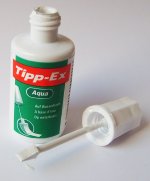
A bottle of the Tipp-ex aqua

Tipp-Ex is a brand of correction fluid and other related products that is popular throughout Europe. It was also the name of the German company (Tipp-Ex GmbH & Co. KG) that produced the products in the Tipp-Ex line. While Tipp-Ex is a trademark name for correction products, in some countries it has become a genericised trademark:[1] to tippex or to tippex out means to erase, either generally or with correction fluid.

History

[edit]
Tipp-Ex correction paper

Tipp-Ex correction paper was invented by Wolfgang Dabisch from Eltville, West Germany, who filed a patent in 1958[2] on Colored film for the correction of typing errors (German: Tippfehler). He subsequently founded a company of the same name. Shortly after that a Tipp-Ex Sales & Distribution company (Tipp-Ex Vertrieb GmbH & Co. KG) was founded in Frankfurt by Otto Carls. This company still exists under the name of Tipp-Ex GmbH & Co. KG close to Frankfurt. Tipp-Ex became a registered trademark with the German patent office in 1987.[3]

Earlier, in 1951,[citation needed] Bette Nesmith Graham invented the first correction fluid in her kitchen and began marketing the product in 1956 as Mistake Out.[4] Tipp-Ex GmbH only started to produce white correction fluid in 1965 under the brand Tipp-Ex, but also as C-fluid.

As a result of the invention of Tipp-Ex, it became possible to erase a typographical error made on a typewriter. The typewriter would be backspaced to the letter that was to be changed, the correction paper would be placed behind the ribbon, and the mistyped letter would be re-typed. The system only worked if the typewriter repositioned the re-typed letter in exactly the same place as originally typed, which could be problematic if returning to a previous line.

Demand for this correction paper grew very quickly and brought interest from German and international distributors.

In 1992 Tipp-Ex introduced its first correction tape, followed in 1995 by the successful Pocket Mouse which worked as a best seller. In 1998, the correction pen was launched. The range was extended to erasers, and in 2000, the new foam applicator was adapted to all the correction fluid bottles.[citation needed]

In 1997, Société Bic acquired Tipp-Ex.[5]

Usage

[edit]
Tipp-Ex can often be written on after it has dried.

Tipp-Ex correction fluid is a white liquid. It is used for painting over mistakes in a piece of writing. A brush (which was later replaced by a foam applicator) is attached to the cap, so when the bottle is closed, the brush is immersed in the fluid. When unscrewed, the brush is covered in liquid Tipp-Ex which is then painted over the mistake. However, it is still possible to see that the product has been used, and also the original content if the paper is held up to a light.

If the contents of a Tipp-Ex bottle have been exposed to too much air (for example, if the cap has been unscrewed too long or if the bottle is half-full and there is air filling the space), the fluid becomes thicker, and sometimes even solidifies. To help prevent this, Tipp-Ex released a product called "Tipp-Ex thinner", a few drops of which are mixed with the contents of a bottle of partially dried Tipp-Ex to thin it. This extends the lifetime of a bottle.[citation needed]

One must write with a ball point pen on top of Tipp-Ex, as a liquid ink pen will smudge. Gel ink will require a few seconds to fully dry, but can be used if no ball point pen is available.[citation needed]

Toxicology

[edit]

The organic solvent 1,1,1-trichloroethane was originally used as a thinner in the product. This solvent is readily absorbed by the lungs via inhalation. It passes readily through the blood–brain barrier and may be lethal following acute exposure.[6] 1,1,1-trichloroethane is also an 'ozone depleter', being one of the substances responsible for causing damage to the Earth's ozone layer.[7] For both reasons, it has not been added to Tipp-Ex since 2000, and it has been replaced by aliphatic hydrocarbons.[8]

See also

[edit]

References

[edit]
[edit]
Revisions and contributorsEdit on WikipediaRead on Wikipedia
from Grokipedia
Tipp-Ex is a of and related products, such as correction tapes and paper, designed to cover errors in , , and printing on paper surfaces. Originally developed in as a solution for corrections, it has become one of the leading correction brands in , known for its quick-drying, opaque white formula that allows rewriting over the covered area. The name "Tipp-Ex" derives from the German word tipp (related to ) and the Latin ex (meaning "out" or "former"), symbolizing the removal of typing mistakes. The company behind Tipp-Ex was founded in 1959 by Wolfgang Dabisch in , initially focusing on correction paper for typewriters before expanding to in 1965. This came amid a growing need for efficient error correction in office environments, building on earlier concepts like those pioneered by in the United States with her Mistake Out fluid in the . By the 1970s and 1980s, Tipp-Ex had established itself as a market leader in , with products adapted for ballpoint pens, photocopies, and faxes as evolved. In 1997, the French multinational corporation Société BIC acquired the Tipp-Ex brand, integrating it into its portfolio of writing and correction instruments and expanding its global distribution. Under BIC's ownership, Tipp-Ex has continued to innovate, introducing eco-friendly formulations and precision applicators while maintaining its reputation for reliability in both professional and educational settings. Despite the digital shift reducing paper-based errors, the brand remains relevant, with correction fluid sales showing resilience in niche markets like arts, crafts, and archival work.

History

Invention and Early Development

The correction paper that would become the foundation of the Tipp-Ex brand was invented in 1958 by Wolfgang Dabisch from , , who developed it as a solution for correcting typographical errors on typewriters without the need to retype entire documents. Dabisch filed a for the product that year, describing a thin film coated with white pigment that could be placed over mistakes and overstruck to blend seamlessly with the page. This innovation addressed a common frustration in office work during the typewriter era, where errors previously required manual erasure or complete page restarts, and it marked a significant advancement in document correction efficiency. Shortly after the , production began in a small garage in , with Dabisch collaborating with Otto W. Carls, who recognized the product's commercial potential after meeting him at a trade fair in the late ; Dabisch later withdrew from the venture, leaving Carls to lead development. In , Carls founded Tipp-Ex Vertriebs & Co. KG in to handle sales and distribution, enabling rapid market expansion across and beyond. The brand name "Tipp-Ex" derives from the German "tippen," meaning "to type," combined with the Latin prefix "ex," signifying "out" or "removal," directly reflecting its purpose as a tool for eliminating typing errors. By 1965, Tipp-Ex introduced its , a that provided a versatile alternative to the paper strips, allowing corrections on handwritten documents and non-typewriter surfaces while maintaining the quick-drying, opaque properties essential for professional use. This development broadened the product's applicability, transitioning it from a typewriter-specific aid to a general essential and solidifying Tipp-Ex's role in the evolving landscape of clerical tools during the mid-20th century.

Company Evolution and Acquisitions

Tipp-Ex Vertriebs & Co. KG was established in in , , by entrepreneur Otto W. Carls, who built upon the recent invention of correction paper to launch production of innovative correction tools under the Tipp-Ex name. The company's early growth centered on distributing and manufacturing correction products, capitalizing on the demand for error-correction solutions in office environments across . In March 1997, French multinational Société Bic acquired the Tipp-Ex brand and its associated German operations, marking a significant expansion of Bic's portfolio to include Europe's leading correction products line. This acquisition integrated Tipp-Ex into Bic's global network, enhancing distribution and innovation in writing and correction tools while preserving the brand's European focus. Post-acquisition, Tipp-Ex's headquarters and production facilities relocated to Liederbach, a suburb near , where operations continue as part of Bic's European division, supporting ongoing development and supply of correction products. This structure has enabled sustained production efficiency and market presence in the sector.

Products

Correction Fluid

Tipp-Ex is an opaque, white liquid specifically designed to cover mistakes on paper, providing a smooth, blemish-free surface for rewriting. First introduced in 1965 by the German company Tipp-Ex & Co. KG, it marked a significant advancement in everyday error correction for and . The is applied directly from the bottle using an integrated applicator, which evolved from a traditional to a foam wedge design introduced around 2000, offering greater precision and even coverage without clumping. Standard packaging features compact 20 ml bottles with the applicator built into the cap, facilitating easy, mess-free use in office, school, or home settings. To maintain usability, Tipp-Ex provides a specialized thinner that revives dried or thickened , extending the product's when a few drops are added and shaken. A hallmark of the product is its fast-drying formula, which typically sets within seconds to a minute, allowing users to overwrite corrections almost immediately without bleeding or lifting. This quick-dry property, combined with strong adherence to paper, ensures durable results suitable for ballpoint, ink, and marker errors.

Other Correction Tools

Tipp-Ex expanded its product line beyond correction fluid to include dry correction methods, introducing correction tape in 1992 as a solvent-free alternative that applies a thin, opaque adhesive strip for immediate error coverage without drying time. This innovation addressed user demands for quicker, mess-free corrections, allowing immediate rewriting over the applied tape. In 1995, Tipp-Ex launched the Pocket Mouse, a compact, mouse-shaped dispenser containing 6 meters of 5 mm-wide tear-resistant plastic-based tape, designed for portability and ease of use in or settings. The ergonomic design accommodates both right- and left-handed users, with the tape gliding smoothly to provide uniform opacity on paper. The brand further diversified in 1998 with the correction pen, a pen-shaped applicator featuring a fine tip for precise application of , ideal for on-the-go scenarios and detailed work. This tool combines the convenience of a writing instrument with dry correction capabilities, minimizing bulk while ensuring clean, instant fixes. Tipp-Ex also offers erasers and refillable options to promote , such as the Easy Refill ECOlutions correction tape introduced in 2010, which includes a replaceable 14-meter cartridge to reduce waste and extend product life. These refillable dispensers feature a simple snap-in mechanism for cartridge replacement, supporting eco-friendly practices in everyday correction tasks.

Composition and Manufacturing

Ingredients

Tipp-Ex correction fluid primarily consists of as the white pigment, which provides the necessary opacity to cover errors on paper. This , typically comprising less than 50% of the formulation by weight, scatters light effectively to create a smooth, white surface that mimics the appearance of blank paper. In its original formulation, the fluid used as the main solvent, accounting for a significant portion of the liquid components to ensure low for easy application and rapid for quick drying. This chlorinated , often present in concentrations around 40-60% by weight in similar correction fluids, dissolved the other ingredients and evaporated without leaving residue. Binders and resins in original formulations, such as film-forming polymers, were incorporated at levels of 10-20% to promote strong to paper surfaces and prevent cracking or flaking once the fluid dries. These polymers formed a flexible, durable that bound the particles together. Modern formulations use derivatives like dimers reacted with propanediamines at lower levels of 0.5-1%. Modern formulations of Tipp-Ex have shifted to safer aliphatic hydrocarbons, including C7 n-alkanes, isoalkanes, and cyclics (30-40%) along with C7-C9 isoalkanes (5-10%), as alternatives that maintain liquidity and evaporation properties while reducing environmental and risks associated with chlorinated solvents. These hydrocarbons dissolve the resins and pigments effectively without compromising the fluid's performance. Other minor ingredients include 1-methoxy-2-propanol (<0.5%), Stoddard (<0.5%), and 2-butanone (<0.1%).

Production Changes Over Time

In the late and early , Tipp-Ex production processes for were significantly altered to comply with international environmental regulations, particularly the on Substances that Deplete the . This treaty, adopted in 1987 and entering into force in 1989, targeted ozone-depleting substances including , a chlorinated previously used as a thinner in Tipp-Ex formulations for its quick-drying properties. By 1996, production and consumption of in developed countries, including where Tipp-Ex originated, were required to reach zero, with full phase-out extended to 2002 globally; Tipp-Ex completed the removal of this substance from its products by 2000 to align with these mandates and avoid damage. Following the phase-out, Tipp-Ex transitioned to hydrocarbon-based solvents, such as alkanes, in its formulations. This shift ensured continued effective performance while meeting stricter environmental standards and reducing potential health risks associated with chlorinated solvents, as hydrocarbons are less volatile and non-ozone-depleting. The change maintained the fluid's opacity and coverage, primarily relying on as the , but prioritized lower and across European markets. In parallel with solvent reforms, Tipp-Ex introduced innovations in applicator design around 2000 to enhance and efficiency. The foam applicator replaced traditional styles, offering greater precision for small corrections, reduced mess from drips or uneven application, and a smoother finish that minimized visible residue on . More recently, under BIC's ownership since 1997, Tipp-Ex has adapted production toward , incorporating refillable s and bottles to minimize plastic waste. These efforts align with broader BIC initiatives, such as using approximately 8% recycled content in products and 65% in as of 2024, and shifting to optimize use, as seen in the relocation of Tipp-Ex Pocket Mouse production to an eco-efficient facility in , , in 2024.

Usage and Applications

Application Methods

Tipp-Ex correction fluid is applied by first shaking the bottle vigorously for about 30 seconds to ensure even mixing of the contents. The cap is then removed, and any excess fluid is tapped off the or applicator to prevent drips. A thin layer is gently brushed or dabbed over the error on the paper, covering it completely without excess buildup, which could lead to bubbling or extended drying times. The fluid typically dries in 10 to 60 seconds, after which new text can be written or typed over the corrected area. Correction tape products, such as the Tipp-Ex Easy Correct dispenser, are used by positioning the applicator head directly over the mistake and pressing down firmly while pulling or sliding it across the error in a smooth, straight motion. This dispenses a thin, dry strip of white material that adheres instantly to the , allowing immediate overwriting without waiting for drying. The tape is particularly effective for linear corrections and provides a matte finish suitable for most writing instruments. Tipp-Ex correction pens, like the Shake'n Squeeze model, offer a portable alternative to bottled ; the pen is shaken with the cap on for approximately 30 seconds, the cap is removed, and the flexible tip is pressed onto the paper while squeezing the barrel to release the in controlled amounts. For small errors, a quick dot suffices, while broader strokes require sustained pressure. These pens are designed for precision and quick fixes, with drying times similar to the standard , around 10 to 60 seconds. The Tipp-Ex Pocket Mouse is a compact correction tape applicator shaped for easy handling on the go. To use it, the user aligns the roller tip over the , presses down lightly, and rolls it forward to apply the tape strip, which sets immediately for instant rewriting. Its ergonomic, pocket-sized design makes it ideal for portable corrections without the mess of products. General best practices for all Tipp-Ex application methods include working in well-ventilated areas to minimize exposure to vapors and applying material in thin layers to avoid issues like bubbling, cracking, or prolonged drying. Thick applications should be avoided, as they can take longer to set and may not accept evenly.

Compatible Surfaces and Instruments

Tipp-Ex correction fluid is primarily designed for use on porous paper surfaces, such as those found in handwritten notes, typed documents, and printed materials including photocopies and faxes. It adheres effectively to standard office paper, allowing for clean masking of errors from pen, marker, or typewritten text. Historically, Tipp-Ex products, including early correction paper variants, were developed specifically for typewriter use in the mid-20th century to enable quick fixes without retyping entire pages. Modern formulations extend compatibility to inkjet and laser-printed documents, though caution is advised with fresh inkjet prints to prevent potential bleeding from the fluid's solvents interacting with uncured ink. The fluid performs less effectively on glossy or non-porous surfaces, where adhesion may be compromised due to poor and bonding properties of the opaque mixture. On such materials, the correction layer can flake or fail to form a smooth, durable surface for rewriting. It is not suitable for digital screens, as the solvents can damage coatings or pixels, nor for fabrics, where removal is challenging and often persists despite the fluid's intended temporary application on . For optimal results when overwriting corrections, ballpoint pens are recommended, as their oil-based provides smooth adhesion without feathering or smearing on the dried fluid surface. Fountain pens should be avoided, as their water-based inks are prone to bleeding into the uneven texture of the correction layer. Permanent markers also work well for bold corrections but may produce a less precise line compared to ballpoints. The fluid typically dries in 10-30 seconds, creating a writable surface shortly after application.

Health and Safety

Toxicological Concerns

Historically, Tipp-Ex correction fluid contained (TCA) as a primary until its phase-out around 2000 due to regulatory concerns. TCA acts as a , with acute exposure via causing symptoms such as , , headaches, and , while prolonged exposure can lead to liver damage. In high doses, TCA has been classified as probably carcinogenic to humans (), based on sufficient evidence from animal studies showing increased incidences of splenic lymphomas and lung tumors in rodents. Inhalation of vapors from Tipp-Ex, particularly in historical formulations, posed significant hazards, including and potential , with extreme cases linked to cardiac arrhythmias and sudden death in adolescents abusing the product. contact with the fluid can result in or allergic reactions, manifesting as or redness upon direct exposure. Ingestion risks include gastrointestinal distress, such as , , and , potentially complicated by aspiration leading to if occurs. Modern Tipp-Ex formulations have replaced TCA with less toxic solvents, such as C7-C9 isoalkanes and , significantly reducing overall toxicity profiles. However, these solvents still present hazards, with vapors capable of causing drowsiness, , and respiratory irritation, and intentional (huffing) remains dangerous, potentially leading to acute neurotoxic effects or long-term organ damage. Skin contact may still provoke irritation or allergic responses, while ingestion can cause similar gastrointestinal symptoms as before, though at lower severity.

Safety Guidelines and Precautions

When using Tipp-Ex correction fluid, it is essential to work in a well-ventilated area to prevent the buildup of vapors, which can lead to risks. Users with sensitive skin should wear protective gloves, such as those made from , to minimize irritation during application. The product must be kept out of reach of children, as it is not intended for or intentional , and immediate attention should be sought in cases of accidental exposure. For storage, keep containers in a cool, dry place away from heat sources, sparks, open flames, and strong oxidizing agents to avoid pressure buildup or flammability hazards. In emergency situations, if the fluid contacts the skin, rinse thoroughly with soap and water while removing contaminated clothing; for eye exposure, flush with plenty of water for several minutes and consult a medical professional if irritation persists. If occurs, move the affected person to fresh air immediately and seek medical help if symptoms like or drowsiness develop. For ingestion, do not induce vomiting and contact poison control or a doctor without delay.

Cultural Impact

Genericization of the Brand

Tipp-Ex has undergone significant genericization, becoming a common term for and related products across various regions, often overshadowing the generic category name. In and other parts of , the brand name is frequently used as a , such as "to Tipp-Ex out," meaning to correct or erase errors with white-out fluid, derived from the German word tipp (related to ) and the Latin ex (meaning "out" or "former"). This linguistic integration reflects the product's deep embedding in everyday language for and writing corrections. The has achieved genericized status in countries including the and , where "Tipp-Ex" is commonly employed to refer to any or tape, akin to how "Hoover" denotes vacuum cleaning. This phenomenon, known as , arose from the brand's dominance in and settings, where it became synonymous with error correction tools. Despite this widespread generic use, Société Bic, which acquired the Tipp-Ex brand in 1997, actively enforces its rights to protect official products from unauthorized imitation, as demonstrated in legal actions such as disputes. The cultural spread of this genericization can be traced to the brand's popularity since the , when it became a staple in European workplaces and educational environments, leading the product name to eclipse the broader category. Tipp-Ex has appeared in office-themed media as a common tool for comedic error corrections. In the British version of , the pilot episode "Downsize" (2001) features a prank where character encases Keenan's stapler in jelly; identifies it by the name written on it in Tipp-Ex, highlighting the product's everyday utility in workplace humor. This moment underscores Tipp-Ex's role as a staple in bureaucratic settings, often symbolizing minor mishaps in professional environments. The product has also been referenced in films, sometimes inadvertently drawing attention to historical inaccuracies. In the 2014 biographical drama , set during , a detective character uses Tipp-Ex to correct documents, an since the product was not invented until 1958; this error sparked discussions among viewers and critics about the film's attention to period detail. Tipp-Ex's advertising campaigns have significantly influenced pop culture through innovative, interactive formats. The 2010 Bic campaign "A Hunter Shoots a Bear" became a viral sensation, amassing millions of views on YouTube by allowing viewers to type commands to alter the narrative outcome, effectively demonstrating the product's correction capabilities in a humorous, choose-your-own-adventure style that inspired memes about rewriting mistakes. This ad ranked among the top viral videos of 2010 and won a Bronze Lion at the Cannes Lions International Festival of Creativity. In 2014, musician revived the concept for a collaborative "social book" project, extending its cultural footprint by blending advertising with artistic expression on imperfection and revision. Symbolically, Tipp-Ex has been employed in to represent concealment and alteration. During the 2020 lockdown, artist titled a blog series "The Future is Tipp-Ex'd," using the product as a for obscuring uncertain futures amid global , evoking themes of erasure and in personal and societal narratives. This usage aligns with broader artistic explorations of Tipp-Ex as a medium for covering errors, appearing in installations and mixed-media works that play on its literal and figurative properties.

References

  1. https://en.wiktionary.org/wiki/Tippex
Add your contribution
Related Hubs
User Avatar
No comments yet.