Hubbry Logo
Localization (commutative algebra)Localization (commutative algebra)Main
Open search
Localization (commutative algebra)
Community hub
Localization (commutative algebra)
logo
7 pages, 0 posts
0 subscribers
Be the first to start a discussion here.
Localization (commutative algebra)
from Wikipedia

In commutative algebra and algebraic geometry, localization is a formal way to introduce the "denominators" to a given ring or module. That is, it introduces a new ring/module out of an existing ring/module R, so that it consists of fractions such that the denominator s belongs to a given subset S of R. If S is the set of the non-zero elements of an integral domain, then the localization is the field of fractions: this case generalizes the construction of the field of rational numbers from the ring of integers.

The technique has become fundamental, particularly in algebraic geometry, as it provides a natural link to sheaf theory. In fact, the term localization originated in algebraic geometry: if R is a ring of functions defined on some geometric object (algebraic variety) V, and one wants to study this variety "locally" near a point p, then one considers the set S of all functions that are not zero at p and localizes R with respect to S. The resulting ring contains information about the behavior of V near p, and excludes information that is not "local", such as the zeros of functions that are outside V (cf. the example given at local ring).

Localization of a ring

[edit]

The localization of a commutative ring R by a multiplicatively closed set S is a new ring whose elements are fractions with numerators in R and denominators in S.

If the ring is an integral domain the construction generalizes and follows closely that of the field of fractions, and, in particular, that of the rational numbers as the field of fractions of the integers. For rings that have zero divisors, the construction is similar but requires more care.

Multiplicative set

[edit]

Localization is commonly done with respect to a multiplicatively closed set S (also called a multiplicative set or a multiplicative system) of elements of a ring R, that is a subset of R that is closed under multiplication, and contains 1.

The requirement that S must be a multiplicative set is natural, since it implies that all denominators introduced by the localization belong to S. The localization by a set U that is not multiplicatively closed can also be defined, by taking as possible denominators all products of elements of U. However, the same localization is obtained by using the multiplicatively closed set S of all products of elements of U. As this often makes reasoning and notation simpler, it is standard practice to consider only localizations by multiplicative sets.

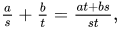
For example, the localization by a single element s introduces fractions of the form but also products of such fractions, such as So, the denominators will belong to the multiplicative set of the powers of s. Therefore, one generally talks of "the localization by the powers of an element" rather than of "the localization by an element".

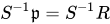
The localization of a ring R by a multiplicative set S is generally denoted but other notations are commonly used in some special cases: if consists of the powers of a single element, is often denoted if is the complement of a prime ideal , then is denoted


In the remainder of this article, only localizations by a multiplicative set are considered.

Integral domains

[edit]

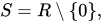
When the ring R is an integral domain and S does not contain 0, the ring is a subring of the field of fractions of R. As such, the localization of a domain is a domain.

More precisely, it is the subring of the field of fractions of R, that consists of the fractions such that This is a subring since the sum and the product of two elements of are in This results from the defining property of a multiplicative set, which implies also that In this case, R is a subring of It is shown below that this is no longer true in general, typically when S contains zero divisors.

For example, the decimal fractions are the localization of the ring of integers by the multiplicative set of the powers of ten. In this case, consists of the rational numbers that can be written as where n is an integer, and k is a nonnegative integer.

General construction

[edit]

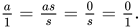
In the general case, a problem arises with zero divisors. Let S be a multiplicative set in a commutative ring R. Suppose that and is a zero divisor with Then is the image in of and one has Thus some nonzero elements of R must be zero in The construction that follows is designed for taking this into account.

Given R and S as above, one considers the equivalence relation on that is defined by if there exists a such that


The localization is defined as the set of the equivalence classes for this relation. The class of (r, s) is denoted as or So, one has if and only if there is a such that The reason for the is to handle cases such as the above where is nonzero even though the fractions should be regarded as equal.

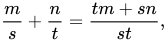
The localization is a commutative ring with addition

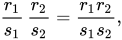
multiplication
additive identity and multiplicative identity

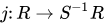
The function

defines a ring homomorphism from into which is injective if and only if S does not contain any zero divisors.

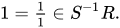
If then is the zero ring that has only one unique element 0.

If S is the set of all regular elements of R (that is the elements that are not zero divisors), is called the total ring of fractions of R.

Universal property

[edit]

The (above defined) ring homomorphism satisfies a universal property that is described below. This characterizes up to an isomorphism. So all properties of localizations can be deduced from the universal property, independently from the way they have been constructed. Moreover, many important properties of localization are easily deduced from the general properties of universal properties, while their direct proof may be more technical.
The universal property satisfied by is the following:

If is a ring homomorphism that maps every element of S to a unit (invertible element) in T, there exists a unique ring homomorphism such that

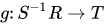
Using category theory, this can be expressed by saying that localization is a functor that is left adjoint to a forgetful functor. More precisely, let and be the categories whose objects are pairs of a commutative ring and a submonoid of, respectively, the multiplicative monoid or the group of units of the ring. The morphisms of these categories are the ring homomorphisms that map the submonoid of the first object into the submonoid of the second one. Finally, let be the forgetful functor that forgets that the elements of the second element of the pair are invertible.

Then the factorization of the universal property defines a bijection

This may seem a rather tricky way of expressing the universal property, but it is useful for showing easily many properties, by using the fact that the composition of two left adjoint functors is a left adjoint functor.

Examples

[edit]
  • If is the ring of integers, and then is the field of the rational numbers.
  • If R is an integral domain, and then is the field of fractions of R. The preceding example is a special case of this one.
  • If R is a commutative ring, and if S is the subset of its elements that are not zero divisors, then is the total ring of fractions of R. In this case, S is the largest multiplicative set such that the homomorphism is injective. The preceding example is a special case of this one.
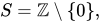
  • If is an element of a commutative ring R and then can be identified (is canonically isomorphic to) (The proof consists of showing that this ring satisfies the above universal property.) The ring is generally denoted .[1] This sort of localization plays a fundamental role in the definition of an affine scheme.
  • If is a prime ideal of a commutative ring R, the set complement of in R is a multiplicative set (by the definition of a prime ideal). The ring is a local ring that is generally denoted and called the local ring of R at This sort of localization is fundamental in commutative algebra, because many properties of a commutative ring can be read on its local rings. Such a property is often called a local property. For example, a ring is regular if and only if all its local rings are regular.

Ring properties

[edit]

Localization is a rich construction that has many useful properties. In this section, only the properties relative to rings and to a single localization are considered. Properties concerning ideals, modules, or several multiplicative sets are considered in other sections.

  • if and only if contains .
  • The ring homomorphism is injective if and only if does not contain any zero divisors.
  • The ring homomorphism is an epimorphism in the category of rings, that is not surjective in general.
  • The ring is a flat R-module (see § Localization of a module for details).
  • If is the complement of a prime ideal , then denoted is a local ring; that is, it has only one maximal ideal.
  • Localization commutes with formations of finite sums, products, intersections and radicals;[2] e.g., if denote the radical of an ideal in , then
In particular, is reduced if and only if its total ring of fractions is reduced.[3]
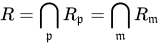
  • Let be an integral domain with the field of fractions . Then its localization at a prime ideal can be viewed as a subring of . Moreover,
where the first intersection is over all prime ideals and the second over the maximal ideals.[4]
  • There is a bijection between the set of prime ideals of and the set of prime ideals of that are disjoint from . This bijection is induced by the given homomorphism .

Saturation of a multiplicative set

[edit]

Let be a multiplicative set. The saturation of is the set

The multiplicative set S is saturated if it equals its saturation, that is, if , or equivalently, if implies that r and s are in S.

If S is not saturated, and then is a multiplicative inverse of the image of r in So, the images of the elements of are all invertible in and the universal property implies that and are canonically isomorphic, that is, there is a unique isomorphism between them that fixes the images of the elements of R.

If S and T are two multiplicative sets, then and are isomorphic if and only if they have the same saturation, or, equivalently, if s belongs to one of the multiplicative sets, then there exists such that st belongs to the other.

Saturated multiplicative sets are not widely used explicitly, since, for verifying that a set is saturated, one must know all units of the ring.

Terminology explained by the context

[edit]

The term localization originates in the general trend of modern mathematics to study geometrical and topological objects locally, that is in terms of their behavior near each point. Examples of this trend are the fundamental concepts of manifolds, germs and sheafs. In algebraic geometry, an affine algebraic set can be identified with a quotient ring of a polynomial ring in such a way that the points of the algebraic set correspond to the maximal ideals of the ring (this is Hilbert's Nullstellensatz). This correspondence has been generalized for making the set of the prime ideals of a commutative ring a topological space equipped with the Zariski topology; this topological space is called the spectrum of the ring.

In this context, a localization by a multiplicative set may be viewed as the restriction of the spectrum of a ring to the subspace of the prime ideals (viewed as points) that do not intersect the multiplicative set.

Two classes of localizations are more commonly considered:

  • The multiplicative set is the complement of a prime ideal of a ring R. In this case, one speaks of the "localization at ", or "localization at a point". The resulting ring, denoted is a local ring, and is the algebraic analog of a ring of germs.
  • The multiplicative set consists of all powers of an element t of a ring R. The resulting ring is commonly denoted and its spectrum is the Zariski open set of the prime ideals that do not contain t. Thus the localization is the analog of the restriction of a topological space to a neighborhood of a point (every prime ideal has a neighborhood basis consisting of Zariski open sets of this form).

In number theory and algebraic topology, when working over the ring of integers, one refers to a property relative to an integer n as a property true at n or away from n, depending on the localization that is considered. "Away from n" means that the property is considered after localization by the powers of n, and, if p is a prime number, "at p" means that the property is considered after localization at the prime ideal . This terminology can be explained by the fact that, if p is prime, the nonzero prime ideals of the localization of are either the singleton set {p} or its complement in the set of prime numbers.

Localization and saturation of ideals

[edit]

Let S be a multiplicative set in a commutative ring R, and be the canonical ring homomorphism. Given an ideal I in R, let the set of the fractions in whose numerator is in I. This is an ideal of which is generated by j(I), and called the localization of I by S.

The saturation of I by S is it is an ideal of R, which can also defined as the set of the elements such that there exists with

Many properties of ideals are either preserved by saturation and localization, or can be characterized by simpler properties of localization and saturation. In what follows, S is a multiplicative set in a ring R, and I and J are ideals of R; the saturation of an ideal I by a multiplicative set S is denoted or, when the multiplicative set S is clear from the context,


  • (this is not always true for strict inclusions)
  • If is a prime ideal such that then is a prime ideal and ; if the intersection is nonempty, then and


Localization of a module

[edit]

Let be a commutative ring, be a multiplicative set in , and be an -module. The localization of the module by , denoted , is an -module that is constructed exactly as the localization of , except that the numerators of the fractions belong to . That is, as a set, it consists of equivalence classes, denoted , of pairs , where and and two pairs and are equivalent if there is an element in such that

Addition and scalar multiplication are defined as for usual fractions (in the following formula, and ):

Moreover, is also an -module with scalar multiplication
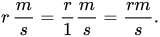
It is straightforward to check that these operations are well-defined, that is, they give the same result for different choices of representatives of fractions.

The localization of a module can be equivalently defined by using tensor products:

The proof of equivalence (up to a canonical isomorphism) can be done by showing that the two definitions satisfy the same universal property.

Module properties

[edit]

If M is a submodule of an R-module N, and S is a multiplicative set in R, one has This implies that, if is an injective module homomorphism, then

is also an injective homomorphism.

Since the tensor product is a right exact functor, this implies that localization by S maps exact sequences of R-modules to exact sequences of -modules. In other words, localization is an exact functor, and is a flat R-module.

This flatness and the fact that localization solves a universal property make that localization preserves many properties of modules and rings, and is compatible with solutions of other universal properties. For example, the natural map

is an isomorphism. If is a finitely presented module, the natural map

is also an isomorphism.[5]

If a module M is a finitely generated over R, one has

where denotes annihilator, that is the ideal of the elements of the ring that map to zero all elements of the module.[6] In particular,


that is, if for some [7]

Localization at primes

[edit]

The definition of a prime ideal implies immediately that the complement of a prime ideal in a commutative ring R is a multiplicative set. In this case, the localization is commonly denoted The ring is a local ring, that is called the local ring of R at This means that is the unique maximal ideal of the ring Analogously one can define the localization of a module M at a prime ideal of R. Again, the localization is commonly denoted .

Such localizations are fundamental for commutative algebra and algebraic geometry for several reasons. One is that local rings are often easier to study than general commutative rings, in particular because of Nakayama lemma. However, the main reason is that many properties are true for a ring if and only if they are true for all its local rings. For example, a ring is regular if and only if all its local rings are regular local rings.

Properties of a ring that can be characterized on its local rings are called local properties, and are often the algebraic counterpart of geometric local properties of algebraic varieties, which are properties that can be studied by restriction to a small neighborhood of each point of the variety. (There is another concept of local property that refers to localization to Zariski open sets; see § Localization to Zariski open sets, below.)

Many local properties are a consequence of the fact that the module

is a faithfully flat module when the direct sum is taken over all prime ideals (or over all maximal ideals of R). See also Faithfully flat descent.

Examples of local properties

[edit]

A property P of an R-module M is a local property if the following conditions are equivalent:

  • P holds for M.
  • P holds for all where is a prime ideal of R.
  • P holds for all where is a maximal ideal of R.

The following are local properties:

  • M is zero.
  • M is torsion-free (in the case where R is a commutative domain).
  • M is a flat module.
  • M is an invertible module (in the case where R is a commutative domain, and M is a submodule of the field of fractions of R).
  • is injective (resp. surjective), where N is another R-module.

On the other hand, some properties are not local properties. For example, an infinite direct product of fields is not an integral domain nor a Noetherian ring, while all its local rings are fields, and therefore Noetherian integral domains.

Non-commutative case

[edit]

Localizing non-commutative rings is more difficult. While the localization exists for every set S of prospective units, it might take a different form to the one described above. One condition which ensures that the localization is well behaved is the Ore condition.

One case for non-commutative rings where localization has a clear interest is for rings of differential operators. It has the interpretation, for example, of adjoining a formal inverse D−1 for a differentiation operator D. This is done in many contexts in methods for differential equations. There is now a large mathematical theory about it, named microlocalization, connecting with numerous other branches. The micro- tag is to do with connections with Fourier theory, in particular.

See also

[edit]

References

[edit]
[edit]
Revisions and contributorsEdit on WikipediaRead on Wikipedia
from Grokipedia
In , localization is a fundamental construction that produces a new ring S1AS^{-1}A from a commutative ring AA and a multiplicative subset SAS \subseteq A, by formally inverting the elements of SS to make them units, thereby enabling the study of local algebraic properties such as behavior at prime ideals or specific subsets of elements. This process generalizes the formation of the field of fractions for integral domains and extends naturally to modules over the ring, preserving structures while focusing on "local" phenomena isolated from the global ring. The ring S1AS^{-1}A is formally defined as the set of equivalence classes of pairs (a,s)(a, s) with aAa \in A and sSs \in S, where (a,s)(b,t)(a, s) \sim (b, t) if there exists uSu \in S such that u(atbs)=0u(at - bs) = 0; and are given by (a/s)+(b/t)=(at+bs)/(st)(a/s) + (b/t) = (at + bs)/(st) and (a/s)(b/t)=(ab)/(st)(a/s) \cdot (b/t) = (ab)/(st), respectively. The canonical ι:AS1A\iota: A \to S^{-1}A sends aa/1a \mapsto a/1, and it is injective if SS contains no zero divisors. For S=ApS = A \setminus \mathfrak{p} where p\mathfrak{p} is a , the resulting ApA_{\mathfrak{p}} has pAp\mathfrak{p} A_{\mathfrak{p}} and serves as a key tool for analyzing ideals and modules near p\mathfrak{p}. A defining feature of localization is its universal property: given any ring homomorphism f:ABf: A \to B such that f(s)f(s) is a unit in BB for all sSs \in S, there exists a unique ring homomorphism g:S1ABg: S^{-1}A \to B making the diagram AS1ABA \to S^{-1}A \to B and ABA \to B commute, with g(a/s)=f(a)f(s)1g(a/s) = f(a) f(s)^{-1}. This property ensures that S1AS^{-1}A is unique up to unique isomorphism and characterizes it as the "universal" ring inverting SS. Localization also interacts well with ideals: for an ideal IAI \subseteq A with IS=I \cap S = \emptyset, the extended ideal Ie=IS1AI^e = I \cdot S^{-1}A and contracted ideal Ic={aAa/1Ie}I^c = \{ a \in A \mid a/1 \in I^e \} preserve properties like primality. In broader applications, localization underpins the local-global principle in , where global properties of rings (such as being Noetherian or integrally closed) can be verified by checking localizations at maximal or prime ideals. For instance, in Dedekind domains—integrally closed Noetherian domains of dimension at most 1—localization at nonzero prime ideals yields discrete valuation rings, facilitating the study of ideal class groups and unique of ideals. This technique is indispensable in , where it corresponds to local rings of points on varieties, and in for examining rings of integers localized at primes.

Localization of Rings

Multiplicative Sets

In a RR, a multiplicative set SS is a of RR that contains the multiplicative identity 11, does not contain the 00, and is closed under the ring —that is, if s,tSs, t \in S, then stSst \in S. This structure ensures SS forms a sub of the multiplicative monoid of RR excluding zero, allowing it to serve as a suitable collection of elements to "invert" without introducing inconsistencies like zero divisors from zero. Multiplicative sets are multiplicatively closed by definition, meaning the product of any two elements remains in the set. A key distinction arises between saturated and non-saturated multiplicative sets: a saturated set satisfies the additional that if a product xySxy \in S for x,yRx, y \in R, then both xSx \in S and ySy \in S, making it the complement of a union of prime ideals; non-saturated sets lack this divisor-inclusion , though further details on saturation are addressed elsewhere. Common examples of multiplicative sets include the powers of a single nonzero element fRf \in R, namely S={1,f,f2,f3,}S = \{1, f, f^2, f^3, \dots \}, which corresponds to the principal open set D(f)D(f) in the spectrum Spec(R)\operatorname{Spec}(R). Another example is the complement of a prime ideal pR\mathfrak{p} \subset R, S=RpS = R \setminus \mathfrak{p}, which is multiplicative since primes are proper ideals excluding 11 and closed under multiplication outside the ideal. These examples highlight how multiplicative sets often arise from geometric or ideal-theoretic structures in commutative algebra. In the context of localization, a multiplicative set SS determines the elements that become units in the resulting localized ring, serving as the domain of the unique from RR to any ring where images of SS are invertible.

Construction of the Localization

The localization of a RR at a multiplicative set SRS \subseteq R is constructed explicitly as a . Elements of S1RS^{-1}R are equivalence classes of pairs (r,s)(r, s) with rRr \in R and sSs \in S, where the equivalence relation is defined by (r,s)(r,s)(r, s) \sim (r', s') there exists tSt \in S such that t(srsr)=0t(s' r - s r') = 0. The addition and multiplication operations on these classes are given by (r,s)+(r,s)=(sr+sr,ss),(r,s)(r,s)=(rr,ss),(r, s) + (r', s') = (s' r + s r', s s'), \quad (r, s) \cdot (r', s') = (r r', s s'), which are well-defined on the quotient and endow S1RS^{-1}R with the structure of a with identity [(1,1)][ (1, 1) ]. There is a canonical ring homomorphism ϕ:RS1R\phi: R \to S^{-1}R defined by ϕ(r)=(r,1)\phi(r) = (r, 1), which makes every element of SS invertible in the image: the inverse of ϕ(s)\phi(s) is (1,s)(1, s). The kernel of ϕ\phi consists precisely of those elements rRr \in R such that there exists sSs \in S with sr=0s r = 0. If RR is an integral domain and S=R{0}S = R \setminus \{0\}, then S1RS^{-1}R is the field of fractions of RR, as every nonzero element becomes invertible. More generally, if RR is an integral domain and SS is the complement of a prime ideal p\mathfrak{p}, then S1RS^{-1}R is a field precisely when p=(0)\mathfrak{p} = (0).

Universal Property

The localization S1RS^{-1}R of a RR at a multiplicative SS is characterized up to unique by the following : given any AA and any f ⁣:RAf \colon R \to A such that f(s)f(s) is a unit in AA for every sSs \in S, there exists a unique g ⁣:S1RAg \colon S^{-1}R \to A satisfying gϕ=fg \circ \phi = f, where ϕ ⁣:RS1R\phi \colon R \to S^{-1}R denotes the canonical homomorphism sending rr/1r \mapsto r/1. This property establishes S1RS^{-1}R as the "universal" ring adjoining inverses for elements of SS, ensuring that any further extension inverting SS factors uniquely through it. To see this, define gg on equivalence classes by g(r/s)=f(r)[f(s)]1g(r/s) = f(r) [f(s)]^{-1}, where elements of S1RS^{-1}R are represented as fractions r/sr/s with rRr \in R, sSs \in S, and equality r/s=r/sr/s = r'/s' if there exists tSt \in S such that t(srsr)=0t(s' r - s r') = 0. This map is well-defined because if r/s=r/sr/s = r'/s', then f(t)(f(s)f(r)f(s)f(r))=0f(t) (f(s') f(r) - f(s) f(r')) = 0 implies f(r)[f(s)]1=f(r)[f(s)]1f(r) [f(s)]^{-1} = f(r') [f(s')]^{-1} since f(t)f(t) is a unit; it preserves and by direct computation, and sends 1/11/1 to 11. For , suppose g ⁣:S1RAg' \colon S^{-1}R \to A also satisfies gϕ=fg' \circ \phi = f; then g(r/s)=g(r/11/s)=g(r/1)[g(1/s)]=f(r)[g(s/1)]1=f(r)[f(s)]1=g(r/s)g'(r/s) = g'(r/1 \cdot 1/s) = g'(r/1) [g'(1/s)] = f(r) [g'(s/1)]^{-1} = f(r) [f(s)]^{-1} = g(r/s), since every element of S1RS^{-1}R is generated by images under ϕ\phi and their "inverses." The universal property extends naturally to an adjunction in the category of modules. Specifically, the localization functor MMRS1RM \mapsto M \otimes_R S^{-1}R from RR-modules to S1RS^{-1}R-modules is left adjoint to the from S1RS^{-1}R-modules to RR-modules, with the unit of the adjunction given by mm/1m \mapsto m/1 and the counit by n/snf(s)1n/s \mapsto n f(s)^{-1} for suitable ff inverting SS. This adjunction follows from applying the ring-level universal property to homomorphisms into endomorphism rings or directly verifying the \HomS1R(MRS1R,N)\HomR(M,N)\Hom_{S^{-1}R}(M \otimes_R S^{-1}R, N) \cong \Hom_R(M, N). This characterizing property has key implications in and . It enables the gluing of data across localizations: if compatible module structures are given over localizations at elements of SS, the universal property yields a unique global structure over RR extending them. In the context of the prime spectrum \Spec(R)\Spec(R), it facilitates the construction of the structure sheaf, where sections over the basic open D(s)={p\Spec(R)sp}D(s) = \{ \mathfrak{p} \in \Spec(R) \mid s \notin \mathfrak{p} \} are precisely RsR_s, and gluing via the universal property defines global sections over affine schemes.

Basic Examples

One of the simplest examples of localization arises in the Z\mathbb{Z}, localized at a (p)(p) for a pp. The multiplicative set S=Z(p)S = \mathbb{Z} \setminus (p) consists of all integers not divisible by pp, and the localization S1ZS^{-1}\mathbb{Z}, denoted Z(p)\mathbb{Z}_{(p)}, comprises equivalence classes of fractions a/ba/b where aZa \in \mathbb{Z}, bSb \in S, with (a/b)(c/d)(a/b) \sim (c/d) if ad=bcad = bc. This ring is a subring of the rational numbers Q\mathbb{Q}, specifically {a/bQpb}\{a/b \in \mathbb{Q} \mid p \nmid b\}, and its unique maximal ideal is pZ(p)p \mathbb{Z}_{(p)}, making it a local ring. Furthermore, Z(p)\mathbb{Z}_{(p)} is a discrete valuation ring (DVR) with uniformizer pp, where every nonzero element admits a unique factorization into units and powers of pp. Another basic example involves inverting a single nonzero element ff in the kk over a field kk. Here, the multiplicative set S={fnn0}S = \{f^n \mid n \geq 0\}, and the localization kf=S1kk_f = S^{-1} k consists of fractions g/hg/h with g,hkg, h \in k and hSh \in S, or equivalently, rational functions regular outside the zero set V(f)V(f). This ring can be viewed as k[1/f]k[1/f], where ff becomes a unit, and its prime ideals correspond to those in kk not containing ff. The Spec(kf)\operatorname{Spec}(k_f) is the affine line minus the points where ff vanishes, illustrating how localization "removes" the variety defined by ff. For an RR, the field of fractions arises as the localization at the multiplicative set S=R{0}S = R \setminus \{0\} of all nonzero (regular) elements. The resulting ring S1RS^{-1}R is the smallest field containing RR as a , consisting of fractions a/ba/b with a,bRa, b \in R, b0b \neq 0, and equivalence (a/b)(c/d)(a/b) \sim (c/d) if ad=bcad = bc. In this case, every nonzero element is invertible, and S1RS^{-1}R embeds RR densely; for instance, localizing Z\mathbb{Z} yields Q\mathbb{Q}, and localizing kk yields the rational function field k(x)k(x). This construction satisfies the universal property of making any RR-algebra homomorphism to a field extend uniquely to S1RS^{-1}R. Localization of polynomial rings can also produce rings of Laurent polynomials or rational function fields. For example, localizing kk at S={xnn0}S = \{x^n \mid n \geq 0\} yields kx=k[x,x1]k_x = k[x, x^{-1}], the ring of Laurent polynomials i=mnaixi\sum_{i=-m}^n a_i x^i with finitely many negative powers, where xx is invertible. More generally, for a multivariate polynomial ring k[x1,,xn]k[x_1, \dots, x_n], localizing at the set of all nonzero elements gives the rational function field k(x1,,xn)k(x_1, \dots, x_n), the field of fractions comprising ratios of polynomials. These examples highlight how localization inverts specific sets, extending the ring while preserving its algebraic structure.

Properties of Localizations

One fundamental property of the localization S1RS^{-1}R of a RR at a multiplicative set SS is that it is flat as an RR-module. This means that the RS1R-\otimes_R S^{-1}R is , preserving exact sequences of RR-modules. Flatness follows from the explicit of localization as a colimit of free modules or from the fact that localization can be viewed as a directed colimit of flat modules, ensuring that tensor products with S1RS^{-1}R do not introduce new relations. The prime ideals of S1RS^{-1}R are in bijective correspondence with the s of RR that are disjoint from SS. Specifically, if p\mathfrak{p} is a of RR with pS=\mathfrak{p} \cap S = \emptyset, then S1pS^{-1}\mathfrak{p} is a of S1RS^{-1}R, and every of S1RS^{-1}R arises this way. The inverse map is given by contraction: for a prime q\mathfrak{q} of S1RS^{-1}R, the preimage under the ϕ:RS1R\phi: R \to S^{-1}R yields a prime of RR disjoint from SS. This correspondence preserves inclusions and is crucial for studying the of the localized ring. Localization also satisfies the going-down property with respect to the canonical map RS1RR \to S^{-1}R. For any chain of prime ideals p1p2pn\mathfrak{p}_1 \subseteq \mathfrak{p}_2 \subseteq \cdots \subseteq \mathfrak{p}_n in RR with pnS=\mathfrak{p}_n \cap S = \emptyset, there exists a chain q1q2qn\mathfrak{q}_1 \subseteq \mathfrak{q}_2 \subseteq \cdots \subseteq \mathfrak{q}_n in S1RS^{-1}R such that qi=S1pi\mathfrak{q}_i = S^{-1}\mathfrak{p}_i for each ii, and the contractions yield the original chain. This holds because the map is flat, and flat ring homomorphisms preserve chains of primes in this manner, even without assuming integrality. If RR is a Noetherian ring, then S1RS^{-1}R is also Noetherian for any multiplicative set SS. Every ideal in S1RS^{-1}R is of the form S1IS^{-1}I for some ideal II in RR, and since RR has the ascending chain condition on ideals, so does S1RS^{-1}R by the correspondence of ideals under localization. This property ensures that localizations preserve the Noetherian condition without requiring SS to be finitely generated.

Saturation and Ore Conditions

A multiplicative subset SS of a commutative ring RR is said to be saturated if whenever abSab \in S for some a,bRa, b \in R, then both aSa \in S and bSb \in S. Equivalently, saturated sets are precisely the complements in RR of arbitrary unions of prime ideals of RR. The saturation of a multiplicative set SS, denoted sat(S)\operatorname{sat}(S), is the smallest saturated multiplicative subset containing SS; it consists of all elements rRr \in R such that rr divides some sSs \in S, meaning there exist tRt \in R with s=rts = rt. An alternative characterization is sat(S)={rRr/1\operatorname{sat}(S) = \{ r \in R \mid r/1 is a unit in the localization S1R}S^{-1}R \}. A fundamental property is that the localization S1RS^{-1}R is canonically isomorphic to sat(S)1R\operatorname{sat}(S)^{-1}R, via the universal property of localization, since the natural map from SS to sat(S)1R\operatorname{sat}(S)^{-1}R inverts all elements of sat(S)\operatorname{sat}(S) and hence of SS. This allows one to normalize multiplicative sets by passing to their saturations without changing the resulting localization. Moreover, sat(S)\operatorname{sat}(S) is the unique maximal saturated multiplicative set properly containing SS, providing a canonical way to extend SS while preserving the of the localization. In commutative rings, every multiplicative set SS automatically satisfies the Ore condition, which in this setting requires that for all rRr \in R and sSs \in S, there exist rRr' \in R and sSs' \in S such that rs=srrs = s'r'. Commutativity ensures this holds trivially by taking r=rr' = r and s=ss' = s, since rs=srrs = sr. This condition guarantees that the on R×SR \times S defining the localization is well-behaved, allowing the standard construction without denominators becoming zero divisors in a problematic way. The Ore condition thus bridges to non-commutative settings but imposes no restrictions in the commutative case. For a concrete example, consider R=ZR = \mathbb{Z} and S={2kk0}S = \{2^k \mid k \geq 0\}. Then sat(S)\operatorname{sat}(S) includes all ±2k\pm 2^k for k0k \geq 0, and the localization S1Zsat(S)1ZZ[1/2]S^{-1}\mathbb{Z} \cong \operatorname{sat}(S)^{-1}\mathbb{Z} \cong \mathbb{Z}[1/2], the ring of dyadic rationals. In contrast, the set of all odd integers in Z\mathbb{Z} is already saturated, as its complement is the prime ideal (2)(2), and localizing at it yields the rationals Q\mathbb{Q}.

Localization of Modules

Construction for Modules

The localization of a module extends the construction for rings to modules over a . Let RR be a , SRS \subset R a multiplicative subset, and MM an RR-module. The localization S1MS^{-1}M is defined as the quotient of the set M×SM \times S by the equivalence relation \sim, where (m,s)(m,s)(m, s) \sim (m', s') if and only if there exists tSt \in S such that t(smsm)=0t(s' m - s m') = 0. The equivalence classes are denoted m/sm/s, and S1MS^{-1}M is equipped with an abelian group structure via ms+ms=sm+smss,\frac{m}{s} + \frac{m'}{s'} = \frac{s' m + s m'}{s s'}, and a scalar multiplication by elements of the localized ring S1RS^{-1}R via rsms=rmss,\frac{r}{s} \cdot \frac{m}{s'} = \frac{r m}{s s'}, making S1MS^{-1}M into an S1RS^{-1}R-module. There is a canonical RR-module homomorphism ψ:MS1M\psi: M \to S^{-1}M defined by ψ(m)=m/1\psi(m) = m/1. The kernel of ψ\psi consists of all mMm \in M such that m/1=0m/1 = 0 in S1MS^{-1}M, which occurs precisely when there exists sSs \in S with sm=0s m = 0. Thus, ψ\psi is injective if and only if MM is SS-torsion-free, meaning that no nonzero element of MM is annihilated by any element of SS. This condition generalizes the injectivity of the corresponding map for the ring localization RS1RR \to S^{-1}R, which holds when SS contains no zero divisors. An alternative realization of the localization arises via the : there is a of S1RS^{-1}R-modules S1MS1RRMS^{-1}M \cong S^{-1}R \otimes_R M, given explicitly by (r/s)m(rm)/s(r/s) \otimes m \mapsto (r m)/s. This identifies the localization as the unique S1RS^{-1}R-module satisfying the appropriate for extending RR-linear maps from MM to modules over S1RS^{-1}R where elements of SS act invertibly. In the special case where M=R/IM = R/I is a quotient module for an ideal IRI \subset R, the localization satisfies S1MS1R/S1IS^{-1}M \cong S^{-1}R / S^{-1}I, where S1I={r/srI,sS}S^{-1}I = \{ r/s \mid r \in I, s \in S \} is the extension of the ideal to the localized ring. This isomorphism follows from the exactness of localization applied to the short exact sequence 0IRR/I00 \to I \to R \to R/I \to 0, yielding 0S1IS1RS1(R/I)00 \to S^{-1}I \to S^{-1}R \to S^{-1}(R/I) \to 0.

Properties of Module Localizations

The localization S1MS^{-1}M of an RR-module MM at a multiplicative set SRS \subseteq R vanishes if and only if there exists an element sSs \in S such that sM=0sM = 0, or equivalently, if SAnnR(M)S \cap \operatorname{Ann}_R(M) \neq \emptyset. In this case, every element of MM becomes torsion with respect to SS in the sense that it is annihilated by some power of ss, and the canonical map MS1MM \to S^{-1}M is the zero map. This property highlights how localization detects global torsion behavior relative to SS, distinguishing modules that are "supported away from SS" from those that are not. For instance, if MM is a torsion module over R=ZR = \mathbb{Z} with S=Z{0}S = \mathbb{Z} \setminus \{0\}, then S1M=0S^{-1}M = 0, reflecting that all elements are annihilated by nonzero integers. The support of the localized module S1MS^{-1}M, viewed as a of Spec(R)\operatorname{Spec}(R), is given by Supp(S1M)=Supp(M)D(S)\operatorname{Supp}(S^{-1}M) = \operatorname{Supp}(M) \cap D(S), where D(S)={pSpec(R)Sp=}D(S) = \{ \mathfrak{p} \in \operatorname{Spec}(R) \mid S \cap \mathfrak{p} = \emptyset \} is the basic open set associated to SS. This follows from the fact that the of the localized ring S1RS^{-1}R is homeomorphic to D(S)D(S), and the support in Spec(S1R)\operatorname{Spec}(S^{-1}R) corresponds to primes containing the annihilator ideal S1AnnR(M)S^{-1} \operatorname{Ann}_R(M), pulling back to the primes in D(S)D(S) that contain AnnR(M)\operatorname{Ann}_R(M). Consequently, localization restricts the support of MM to the region where SS consists of units, effectively removing components of the support intersecting the variety V(S)={pSpec(R)Sp}V(S) = \{ \mathfrak{p} \in \operatorname{Spec}(R) \mid S \cap \mathfrak{p} \neq \emptyset \}. For example, if S=RpS = R \setminus \mathfrak{p} for a p\mathfrak{p}, then Supp(S1M)\operatorname{Supp}(S^{-1}M) consists of the primes in Supp(M)\operatorname{Supp}(M) contained in p\mathfrak{p}. Nakayama's lemma provides key insights into the structure of localized modules over local rings. Specifically, if (R,m)(R, \mathfrak{m}) is a local ring and MM is a finitely generated RR-module such that mM=M\mathfrak{m}M = M, then M=0M = 0. This applies directly to localizations at maximal ideals, where S=RmS = R \setminus \mathfrak{m} yields a local ring S1RS^{-1}R with maximal ideal S1mS^{-1}\mathfrak{m}, and the localized module S1MS^{-1}M inherits finite generation from MM. The lemma implies that if the "fiber" M/mMM / \mathfrak{m}M vanishes, then MM itself vanishes, which is particularly useful for analyzing generators and relations in localized settings. For instance, in the local ring R=k[[x,y]]R = k[[x,y]] at the maximal ideal (x,y)(x,y), if a finitely generated module MM satisfies (x,y)M=M(x,y)M = M, it must be zero, preventing nontrivial modules supported only at the origin. Over a RR, localization preserves finite generation of modules: if MM is a finitely generated RR-module, then S1MS^{-1}M is finitely generated as an S1RS^{-1}R-module. This holds because Noetherian rings ensure that finitely generated modules are finitely presented (i.e., admit a finite resolution by free modules), and localization is an exact that preserves finite presentations. Thus, the images of the finite set of generators of MM generate S1MS^{-1}M, with relations localizing accordingly. An example is the module of differentials ΩR/k\Omega_{R/k} over a finitely generated kk-algebra RR, which remains finitely generated after localization at any multiplicative set.

Flatness and Exactness

In commutative algebra, the localization S1RS^{-1}R of a ring RR at a multiplicative set SS is always a flat RR-module. This flatness follows from the fact that the canonical map RS1RR \to S^{-1}R induces an isomorphism S1RRMS1MS^{-1}R \otimes_R M \cong S^{-1}M for any RR-module MM, and the functor S1()S^{-1}(-) preserves colimits, ensuring no torsion issues arise in the tensor product. A key consequence of this flatness is the vanishing of Tor groups: for any RR-module NN and i>0i > 0, \ToriR(S1R,N)=0\Tor_i^R(S^{-1}R, N) = 0. This implies that tensoring with S1RS^{-1}R over RR is exact, reflecting the absence of higher homological obstructions in the localization process. The localization functor S1():\ModR\ModS1RS^{-1}(-): \Mod_R \to \Mod_{S^{-1}R} is exact, meaning it preserves s. Specifically, if 0MMM00 \to M' \to M \to M'' \to 0 is a short of RR-modules, then 0S1MS1MS1M00 \to S^{-1}M' \to S^{-1}M \to S^{-1}M'' \to 0 is also short exact. This exactness holds because localization can be constructed via tensoring with the S1RS^{-1}R, combined with the universal property ensuring compatibility with homomorphisms. When S=RpS = R \setminus \mathfrak{p} for a prime ideal p\mathfrak{p}, localization at p\mathfrak{p} preserves the Auslander-Buchsbaum formula relating projective dimension and depth. For a finitely generated module MM over a local (R,m)(R, \mathfrak{m}), the formula \pdRM+\depthRM=\depthRR\pd_R M + \depth_R M = \depth_R R extends to the localized ring RpR_\mathfrak{p}, where \pdRpMp+\depthRpMp=\depthRpRp\pd_{R_\mathfrak{p}} M_\mathfrak{p} + \depth_{R_\mathfrak{p}} M_\mathfrak{p} = \depth_{R_\mathfrak{p}} R_\mathfrak{p}, as the depth and projective dimension behave compatibly under localization at primes. In the non-commutative setting, however, localizations need not be flat; for instance, certain universal localizations of non-commutative rings fail to be flat over the original ring, as shown by explicit constructions involving Ore extensions or matrix rings where Tor groups do not vanish.

Localization at Prime Ideals

Local Rings and Maximal Ideals

In commutative algebra, the localization of a ring RR at a prime ideal p\mathfrak{p} is constructed by taking the multiplicative set S=RpS = R \setminus \mathfrak{p} and forming Rp=S1RR_{\mathfrak{p}} = S^{-1}R. This process inverts all elements outside p\mathfrak{p}, yielding a ring that "zooms in" on the behavior near p\mathfrak{p}. The ring RpR_{\mathfrak{p}} is a local ring, meaning it has a unique maximal ideal, which is pRp={a/sap,sS}\mathfrak{p} R_{\mathfrak{p}} = \{ a/s \mid a \in \mathfrak{p}, s \in S \}. A is defined as a commutative ring with exactly one ; in this case, every proper ideal of RpR_{\mathfrak{p}} is contained in pRp\mathfrak{p} R_{\mathfrak{p}}. The of RpR_{\mathfrak{p}} is the quotient Rp/pRpR_{\mathfrak{p}} / \mathfrak{p} R_{\mathfrak{p}}, which is isomorphic to the field of fractions of the residue ring R/pR / \mathfrak{p}, denoted Frac(R/p)\operatorname{Frac}(R / \mathfrak{p}). This isomorphism arises because elements in RpR_{\mathfrak{p}} modulo pRp\mathfrak{p} R_{\mathfrak{p}} correspond to fractions modulo p\mathfrak{p}, with denominators outside p\mathfrak{p} becoming units. A key property of RpR_{\mathfrak{p}} as a is the dichotomy for its elements: every xRpx \in R_{\mathfrak{p}} is either a unit or belongs to the pRp\mathfrak{p} R_{\mathfrak{p}}. Specifically, an element a/sRpa/s \in R_{\mathfrak{p}} (with aRa \in R, sSs \in S) is a unit apa \notin \mathfrak{p}, since a \notin \mathfrak{p}, so a/1 \notin \mathfrak{p} R_{\mathfrak{p}} and thus is a unit in the local ring RpR_{\mathfrak{p}}. This property simplifies many arguments in by distinguishing units clearly from non-units.

Local Properties and Their Preservation

In commutative algebra, many properties of elements, ideals, and modules in a ring RR are local with respect to the spectrum Spec(R)\operatorname{Spec}(R), meaning they hold globally they hold after localization at every prime ideal pSpec(R)p \in \operatorname{Spec}(R). For instance, an element fRf \in R is a unit its image in RpR_p is a unit for every prime pp. Similarly, ff is a zero-divisor in RR there exists some prime pp such that the image of ff is a zero-divisor in RpR_p. These properties reflect the geometric intuition that Spec(R)\operatorname{Spec}(R) glues local behaviors at points corresponding to primes. Integrality is another local preserved under localization. If an element α\alpha is over RR, then its image in RpR_p is over RpR_p for every prime pp. More generally, if BB is over RR, the induced map Spec(Bp)Spec(Rp)\operatorname{Spec}(B_p) \to \operatorname{Spec}(R_p) satisfies the lying-over and going-up theorems locally, preserving the integral structure. This preservation extends to the integrally closed : a domain RR is integrally closed if and only if RpR_p is integrally closed for every prime pp. For modules, flatness is a local property: an RR-module MM is flat if and only if MpM_p is flat over RpR_p for every prime pp. Localization itself is a flat functor, ensuring that tensor products and exact sequences behave well under this operation. Projectivity for finitely generated modules is characterized globally by local freeness: a finitely generated RR-module MM is projective if and only if MpM_p is free over RpR_p for every prime pp. Over local rings, finitely generated projective modules are free, which underpins this criterion. A prominent example of a local-global for ring properties is Serre's criterion for normality. For a RR, RR is normal (i.e., integrally closed in its fraction field) if and only if RpR_p is normal for all prime ideals pp of height at most 1. Equivalently, RR satisfies Serre's conditions (R1)(R_1) and (S2)(S_2): RpR_p is regular for all pp with ht(p)1\operatorname{ht}(p) \leq 1, and the depth of RpR_p is at least min(2,ht(p))\min(2, \operatorname{ht}(p)) for all primes pp. This reduces the verification of normality to local conditions at low-dimensional primes.

Examples of Local Global Principles

One prominent example of a local-global principle in commutative algebra is the characterization of regular rings. A commutative ring RR is regular if and only if its localization RpR_{\mathfrak{p}} at every prime ideal p\mathfrak{p} is a regular local ring. This equivalence holds because the property of being regular is preserved under localization, and conversely, the global regularity can be detected by examining the local behavior at all primes. In particular, for Noetherian rings, it suffices to check this condition at maximal ideals, as further localizations at primes contained in maximals inherit the regularity. This principle connects to the Hilbert syzygy theorem, which implies finite projective dimension for modules over polynomial rings, and locally, regular local rings exhibit finite global dimension equal to their Krull dimension. Another key example involves Cohen-Macaulay rings. For a RR, being Cohen-Macaulay is equivalent to RpR_{\mathfrak{p}} being a Cohen-Macaulay for every p\mathfrak{p}, meaning the depth equals the dimension at each such localization. However, if RR is equidimensional—meaning all minimal prime ideals have the same height—and locally Cohen-Macaulay at maximal ideals, then RR itself satisfies the global condition that its depth equals its , as the minimal local depths match the uniform local dimensions. This ensures the ring behaves homologically as if it were "smooth" in a depth-theoretic sense across its . Geometrically, these principles manifest in the study of . Consider an XX over an , with coordinate ring A=k[X]A = k[X]. The variety XX is smooth (nonsingular) if and only if the localizations of AA at maximal ideals—corresponding to points of XX—are regular local rings. This local regularity at all points implies the global smoothness of XX, reflecting how singularities are detected and resolved locally via localization, without global obstructions in the affine setting. While many algebraic properties adhere to local-global principles, especially for Noetherian rings (such as being Noetherian, having finite dimension, or being integrally closed under normality criteria), counterexamples exist outside this framework. For instance, in , the Hausdorff property does not localize: a space may have Hausdorff local neighborhoods but fail to be Hausdorff globally due to separated points requiring global separation. In contrast, for Noetherian commutative rings, most standard properties like regularity or Cohen-Macaulayness do localize effectively, underscoring the robustness of these principles in algebraic contexts.

Advanced Topics

Localization of Ideals

In commutative algebra, the localization of an ideal II in a ring RR at a multiplicative set SS is defined through the extension and contraction operations relative to the canonical homomorphism ϕ:RS1R\phi: R \to S^{-1}R. The extension of II, denoted IeI^e or S1IS^{-1}I, is the ideal in S1RS^{-1}R generated by the image of II under ϕ\phi, explicitly consisting of elements of the form a/sa/s where aIa \in I and sSs \in S. This construction embeds II into the localized ring while inverting elements of SS, preserving the ideal structure provided IS=I \cap S = \emptyset; otherwise, Ie=S1RI^e = S^{-1}R. The contraction of an ideal JJ in S1RS^{-1}R, denoted JcJ^c, is the preimage ϕ1(J)={rRϕ(r)J}\phi^{-1}(J) = \{ r \in R \mid \phi(r) \in J \}, which returns an ideal in RR. These operations satisfy (Ie)c=I(I^e)^c = I if IS=I \cap S = \emptyset, ensuring that extension and contraction are inverse on such ideals. The extension and contraction maps establish a bijection between the set of all ideals of S1RS^{-1}R and the set of ideals of RR that are stable under these operations, meaning ideals II of RR such that I=(Ie)cI = (I^e)^c. In particular, for prime ideals, there is a lattice-preserving between prime ideals of S1RS^{-1}R and prime ideals of RR disjoint from SS, given by qqcq \mapsto q^c and ppep \mapsto p^e for pS=p \cap S = \emptyset. This correspondence extends to primary ideals and preserves properties like primality and radicality. A key property concerns radical ideals: the radical of the extended ideal equals the extension of the radical, i.e., S1I=S1I\sqrt{S^{-1}I} = S^{-1}\sqrt{I}
Add your contribution
Related Hubs
User Avatar
No comments yet.