


Community hub
Recent from talks
Contribute something
Nothing was collected or created yet.
Logan Square branch
View on Wikipedia
| Logan Square branch | ||||||||||||||||||||||||||||||||||||||||||||||||||||||||||||||||||||||||||||||||||||||||||||||||||||||||||||||||||||||||||||||||||||||||||||||||||||||||||||||||||||||||||||||||
|---|---|---|---|---|---|---|---|---|---|---|---|---|---|---|---|---|---|---|---|---|---|---|---|---|---|---|---|---|---|---|---|---|---|---|---|---|---|---|---|---|---|---|---|---|---|---|---|---|---|---|---|---|---|---|---|---|---|---|---|---|---|---|---|---|---|---|---|---|---|---|---|---|---|---|---|---|---|---|---|---|---|---|---|---|---|---|---|---|---|---|---|---|---|---|---|---|---|---|---|---|---|---|---|---|---|---|---|---|---|---|---|---|---|---|---|---|---|---|---|---|---|---|---|---|---|---|---|---|---|---|---|---|---|---|---|---|---|---|---|---|---|---|---|---|---|---|---|---|---|---|---|---|---|---|---|---|---|---|---|---|---|---|---|---|---|---|---|---|---|---|---|---|---|---|---|---|
 The Logan Square terminal in 1969 | ||||||||||||||||||||||||||||||||||||||||||||||||||||||||||||||||||||||||||||||||||||||||||||||||||||||||||||||||||||||||||||||||||||||||||||||||||||||||||||||||||||||||||||||||
| Overview | ||||||||||||||||||||||||||||||||||||||||||||||||||||||||||||||||||||||||||||||||||||||||||||||||||||||||||||||||||||||||||||||||||||||||||||||||||||||||||||||||||||||||||||||||
| Status | Partially replaced | |||||||||||||||||||||||||||||||||||||||||||||||||||||||||||||||||||||||||||||||||||||||||||||||||||||||||||||||||||||||||||||||||||||||||||||||||||||||||||||||||||||||||||||||
| Owner | Chicago Transit Authority (1947–present) Chicago Rapid Transit Company (1924–1947) Metropolitan West Side Elevated Railroad (1895–1924) | |||||||||||||||||||||||||||||||||||||||||||||||||||||||||||||||||||||||||||||||||||||||||||||||||||||||||||||||||||||||||||||||||||||||||||||||||||||||||||||||||||||||||||||||
| Stations | 9 (pre-1951, not including Marshfield) 3 (surviving as of 2022[update], not including the post-1970 Logan Square station) | |||||||||||||||||||||||||||||||||||||||||||||||||||||||||||||||||||||||||||||||||||||||||||||||||||||||||||||||||||||||||||||||||||||||||||||||||||||||||||||||||||||||||||||||
| Service | ||||||||||||||||||||||||||||||||||||||||||||||||||||||||||||||||||||||||||||||||||||||||||||||||||||||||||||||||||||||||||||||||||||||||||||||||||||||||||||||||||||||||||||||||
| Type | Rapid transit | |||||||||||||||||||||||||||||||||||||||||||||||||||||||||||||||||||||||||||||||||||||||||||||||||||||||||||||||||||||||||||||||||||||||||||||||||||||||||||||||||||||||||||||||
| System | Chicago 'L' | |||||||||||||||||||||||||||||||||||||||||||||||||||||||||||||||||||||||||||||||||||||||||||||||||||||||||||||||||||||||||||||||||||||||||||||||||||||||||||||||||||||||||||||||
| Services | Blue Pink | |||||||||||||||||||||||||||||||||||||||||||||||||||||||||||||||||||||||||||||||||||||||||||||||||||||||||||||||||||||||||||||||||||||||||||||||||||||||||||||||||||||||||||||||
| History | ||||||||||||||||||||||||||||||||||||||||||||||||||||||||||||||||||||||||||||||||||||||||||||||||||||||||||||||||||||||||||||||||||||||||||||||||||||||||||||||||||||||||||||||||
| Opened | May 6, 1895 | |||||||||||||||||||||||||||||||||||||||||||||||||||||||||||||||||||||||||||||||||||||||||||||||||||||||||||||||||||||||||||||||||||||||||||||||||||||||||||||||||||||||||||||||
| Paulina Connector closed[a] | February 25, 1951 | |||||||||||||||||||||||||||||||||||||||||||||||||||||||||||||||||||||||||||||||||||||||||||||||||||||||||||||||||||||||||||||||||||||||||||||||||||||||||||||||||||||||||||||||
| Technical | ||||||||||||||||||||||||||||||||||||||||||||||||||||||||||||||||||||||||||||||||||||||||||||||||||||||||||||||||||||||||||||||||||||||||||||||||||||||||||||||||||||||||||||||||
| Number of tracks | 2 | |||||||||||||||||||||||||||||||||||||||||||||||||||||||||||||||||||||||||||||||||||||||||||||||||||||||||||||||||||||||||||||||||||||||||||||||||||||||||||||||||||||||||||||||
| Character | Elevated | |||||||||||||||||||||||||||||||||||||||||||||||||||||||||||||||||||||||||||||||||||||||||||||||||||||||||||||||||||||||||||||||||||||||||||||||||||||||||||||||||||||||||||||||
| Track gauge | 4 ft 8+1⁄2 in (1,435 mm) | |||||||||||||||||||||||||||||||||||||||||||||||||||||||||||||||||||||||||||||||||||||||||||||||||||||||||||||||||||||||||||||||||||||||||||||||||||||||||||||||||||||||||||||||
| Electrification | Third rail, 600 V DC | |||||||||||||||||||||||||||||||||||||||||||||||||||||||||||||||||||||||||||||||||||||||||||||||||||||||||||||||||||||||||||||||||||||||||||||||||||||||||||||||||||||||||||||||
| Operating speed | 16 mph (26 km/h) (1895) | |||||||||||||||||||||||||||||||||||||||||||||||||||||||||||||||||||||||||||||||||||||||||||||||||||||||||||||||||||||||||||||||||||||||||||||||||||||||||||||||||||||||||||||||
| ||||||||||||||||||||||||||||||||||||||||||||||||||||||||||||||||||||||||||||||||||||||||||||||||||||||||||||||||||||||||||||||||||||||||||||||||||||||||||||||||||||||||||||||||


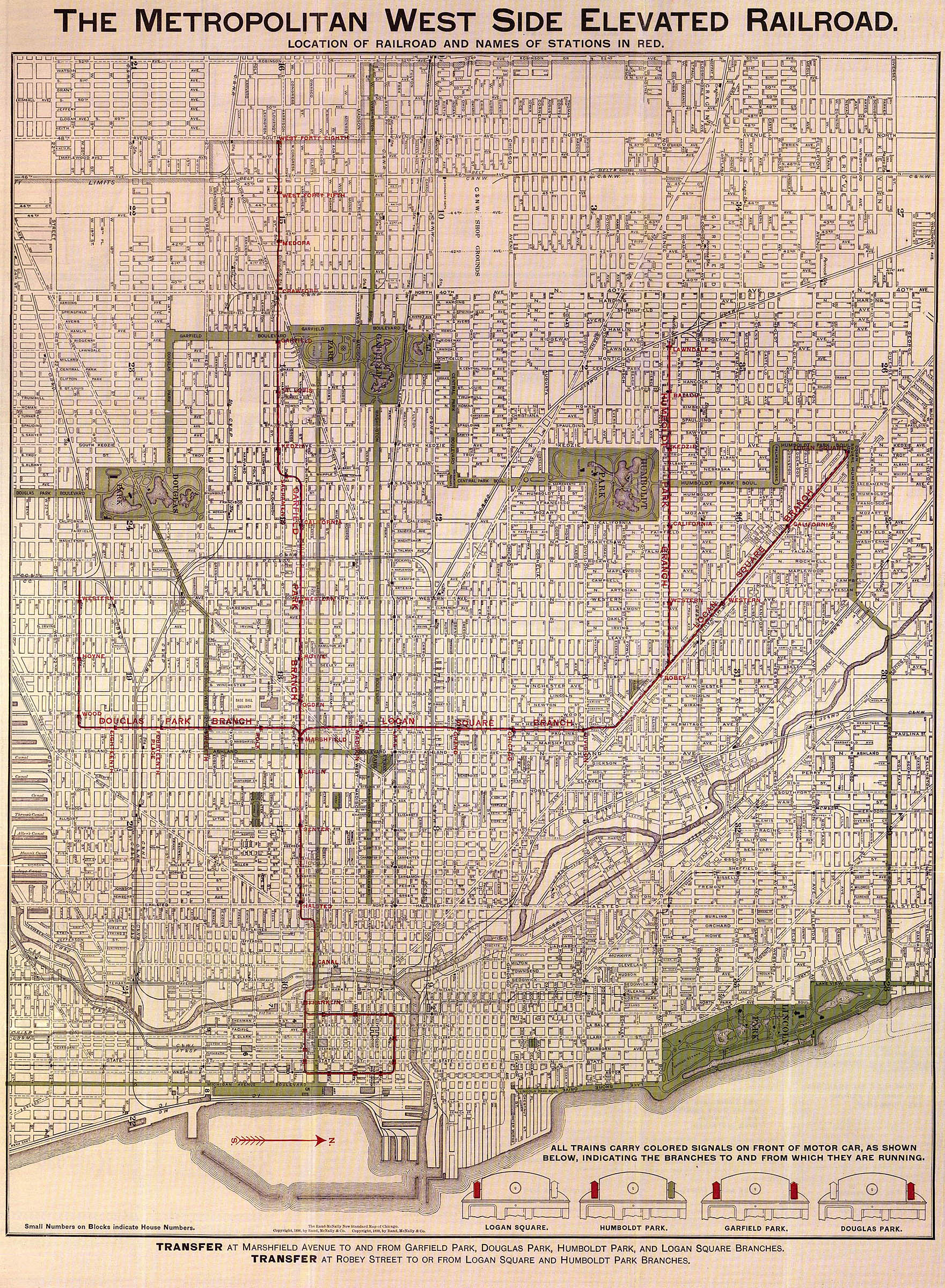
The Logan Square branch is an elevated rapid transit line of the Chicago "L", where it was one of the branches of the Metropolitan West Side Elevated Railroad. Diverging north from the Metropolitan's main line west of Marshfield station, it opened in 1895 and served Chicago's Logan Square and West Town neighborhoods. North of Damen station, the Humboldt Park branch diverged from the Logan Square branch, going west to serve Humboldt Park. The original Logan Square branch was separated into several sections in 1951, some of which remain in revenue service today.
What history remembers as the "Logan Square branch" was actually the combination of two routes. Diverging from Marshfield was the Metropolitan's Northwest branch, proceeding northward and northwestward to Damen. The Northwest branch then split into the Humboldt Park branch and the Logan Square branch proper. As early as 1898, however, even the Metropolitan itself considered the Northwest branch as part of the "Logan Square branch", although ridership statistics continued to separate them.
The Northwest branch and main line were the first Metropolitan lines to open, entering service on May 6, 1895; combined, they were the first revenue electric elevated railroad in the United States. The Logan Square branch proper followed on May 25, and the Humboldt Park branch opened on July 29. The Metropolitan continued to operate its lines, with some interruptions and difficulties, until it handed control over to the Chicago Elevated Railways (CER) trust in 1911 and formally merged into the Chicago Rapid Transit Company (CRT) in 1924. The Milwaukee-Dearborn Subway was proposed in the late 1930s to provide more direct service from Logan Square to downtown. The old elevated lines were originally intended to continue revenue operation alongside this subway. The publicly-owned Chicago Transit Authority (CTA), which had assumed control of the "L" in 1947, decided to instead discontinue service on the elevated lines with the opening of the subway.
The subway opened in 1951, splitting the original branch into two sections. The branch north of the subway's entrance continued in revenue service as the "Milwaukee branch" and, after the closure of the Humboldt Park branch and extensions in 1970 and the early 1980s, currently serves as the O'Hare branch of the Blue Line; the 1970 extension entailed the replacement of the original Logan Square terminal with a new subway through-station. Damen, Western, and California are the last remaining stations of the Logan Square branch. The branch south of the subway, having been rendered obsolete, nevertheless served as the only link of the surviving branch to the rest of the "L" system and was kept in non-revenue operation as the Paulina Connector. After half a century, and the demolition of its northern half, the Connector re-entered revenue service in 2006 as part of the Pink Line.
History
[edit]
The Metropolitan West Side Elevated Railroad Company was granted a 50-year franchise by the Chicago City Council on April 7, 1892,[1] and began securing right of way shortly thereafter.[2] As designed, the Metropolitan's operations would comprise a main line that went west from downtown to Marshfield, where three branches – one going northwest, one going due west to Garfield Park, and one going southwest to Douglas Park – would diverge and serve various parts of Chicago's west side.[3] The formally titled "Northwest branch" would continue to Robey station, where it would split into the "Logan Square branch" going further northwest and the Humboldt Park branch going due west.[4] However, as early as 1898, the Metropolitan itself was referring to the Northwest branch as part of the "Logan Square branch".[5] The Northwest branch's tracks were finished by October 1894 and powered on in April 1895 for test runs;[4] service on the branch and the main line commenced on May 6 between Robey and Canal.[6] Service was provided to Logan Square on May 25, and the Humboldt Park branch opened on July 29.[4]
The Metropolitan's lines were originally operated by the West Side Construction Company, which had been responsible for constructing them, and would be transferred to the Metropolitan on October 6, 1896.[7] The backers and officers of the two companies were largely identical, however, so this transfer of ownership was nominal.[3][7] The expenses incurred in constructing the Metropolitan's vast trackage would come back to haunt the company, which entered receivership in 1897; the similarly-named Metropolitan West Side Elevated Railway Company was organized in January 1899 and assumed operations on February 3 of that year.[8] The new Metropolitan, along with the other companies operating "L" lines in Chicago, became a part of the Chicago Elevated Railways (CER) trust on July 1, 1911.[9] CER acted as a de facto holding company for the "L" – unifying its operations, instituting the same management across the companies, and instituting free transfers between the lines starting in 1913 – but kept the underlying companies intact.[10] This continued until the companies were formally merged into the single Chicago Rapid Transit Company (CRT) in 1924, which assumed operations on January 9; the former Metropolitan was designated the Metropolitan Division of the CRT for administrative purposes.[11] Although municipal ownership of transit had been a hotly-contested issue for half a century, the publicly-owned Chicago Transit Authority (CTA) would not be created until 1945,[12] or assume operation of the "L" until October 1, 1947.[13]
Opening of the Milwaukee–Dearborn subway
[edit]Plans for Chicago to have a subway system to relieve the severe congestion of, if not replace, its elevated trackage dated back to the early 20th century, but the city lagged in building subways.[14] Chicago petitioned the Public Works Administration (PWA) for construction funds for a subway on State Street in 1937.[15] The petition originally included a proposal for two downtown east-west streetcar tunnels.[16] Harold L. Ickes, the administrator of the PWA and a longtime Chicagoan, vetoed the streetcar tunnel plan and insisted instead on a second subway that would go under Dearborn Street and Milwaukee Avenue, which would provide a more direct route from Logan Square to downtown.[16] Although this idea engendered considerable local opposition, especially from mayor Edward Joseph Kelly, Ickes's influence in the federal government led to the Dearborn plan being adopted in 1938.[16] A 1939 plan also introduced the idea of replacing the Metropolitan's main line and Garfield Park branch with a section of rapid transit operating through a proposed superhighway on Congress Street (the eventual Interstate 290).[17] These sections of transit would be connected, allowing for the area's rapid transit to be routed through downtown rather than adhere to a trunk-and-branch model.[18]
The subway's approval did not immediately imply the end of the old Logan Square branch; plans in 1939 included another proposed subway to connect the branch with the Ravenswood branch to the north and through-routing it with the Douglas Park branch to the south into a subway on Ashland Avenue to form a crosstown route.[19] Damen Tower serving the Humboldt Park branch divergence was rebuilt with the expectation that it also would switch trains between the subway and the elevated, much like the State Street subway connects with the earlier elevated North Side main line that remained standing after its construction,[20] and as late as 1949 commuters were promised such a setup that would have preserved the old Logan Square trackage.[21] However, the CTA had no interest in operating either the old Logan Square elevated or the Humboldt Park branch; the new Damen Tower would never be installed with switching equipment, and the Logan Square branch south of Damen would be closed after the Dearborn subway opened.[20]
World War II interrupted the construction of the Dearborn Street subway; although the federal government allowed the continued construction of the State Street subway, it did not do so for the Dearborn Street subway even though it was 82 percent completed by 1942.[22] After the war ended, work resumed on the Dearborn Street subway and it opened at the midnight beginning Sunday, February 25, 1951; at the same time, the Humboldt Park branch was restricted to a shuttle service to and from Damen on the Logan Square branch.[22] Having been rendered obsolete by the subway, the Lake Street Transfer station was closed and the Lake Street's Ashland station reopened.[23] The subway was predicted to reduce the travel time between Logan Square and downtown from 28 minutes to 15.[22] Since construction had not started on the Congress Line, trains in the Dearborn subway stopped at its southern terminus at LaSalle and turned back.[22] Despite its incomplete state, and complaints from riders no longer given a direct trip to the Near West Side,[24][25] the new subway had over 60 percent higher ridership than the old Logan Square branch by the end of the year.[26]
After 1951
[edit]
After the replacement of the southern half of the branch in 1951, the two sections of transit had different histories.
Closure of Humboldt Park branch, O'Hare branch
[edit]The Humboldt Park branch had been targeted for closure as early as early 1950,[27] and closed in 1952. The surviving portion of the Logan Square branch was extended to Jefferson Park in 1970, Rosemont in 1983, and O'Hare in 1984.
Paulina Connector
[edit]
The portion between the junction northwest of the subway portal and the other Metropolitan West Side branches was retained as the Paulina Connector, a non-revenue connecting track, as the other Met branches were rerouted from the Loop into the south end of the Milwaukee–Dearborn subway, meaning there was no other connection to the rest of the "L" system. As part of the replacement of the Garfield Park branch with the Congress branch, a new junction between the Paulina Connector and the Lake Street branch was constructed, allowing trains from the Douglas branch to continue to reach the Loop while construction was ongoing. After construction was complete, Douglas branch trains resumed using the Milwaukee–Dearborn subway, and the connector was returned to non-revenue use only. The portion north of the Lake Street branch was demolished in 1964, as the junction with the Lake Street branch rendered it superfluous.
By 2003, the Paulina Connector was in need of renovation, as it remained the only connection between the Blue Line and the rest of the system. As part of a renovation of the Cermak (formerly Douglas) branch, the connector was rebuilt. Following the reconstruction, in 2006, the CTA introduced a new service pattern in which trains from the Cermak branch use the Paulina Connector to travel to the Loop via the junction with the Lake Street branch. This service is the current Pink Line.[28]
Besides the Paulina Connector and the section of the Blue Line between Damen and Logan Square, one other extant section remains at Paulina and Kinzie Streets, where a truss bridge that carried trains over the Metra rail lines (former Chicago & Northwestern and Milwaukee Road lines) has been re-used as a signal bridge.
Operations
[edit]Infrastructure and rolling stock
[edit]Prior to the 1894 decision to electrify its tracks, the Metropolitan had placed an order from the Baldwin Locomotive Works of Philadelphia for steam locomotives. After the decision, however, the order was modified to instead provide for electric "motor cars" and unpowered "trailers". Electric traction in the late 19th century and early 20th centuries was such that one motor car generally pulled multiple trailers. Humboldt Park trains were unusual in that their motor cars instead pushed their trailers onto Logan Square trains to be coupled for the trip downtown, except during rush hours when Humboldt Park trains went directly downtown or night hours when the trains were only one car each.[29] The Metropolitan adopted multiple-unit control during 1904–1905, eliminating the need for Humboldt Park trains to push trailers onto Logan Square trains, although combining Logan Square and Humboldt Park trains at Damen continued in some form or another until 1950.[29]
.jpg)
In common with the other companies building what would become the Chicago "L", the Metropolitan provided wooden cars for its lines. The first trailers were built by the Pullman Car Company, whereas the first motor cars were built by Barney and Smith. Subsequent orders for trailers were built by Pullman, Harlan and Hollingsworth, and American Car and Foundry Company (ACF), and further motor car orders were fulfilled by Barney and Smith, Jewett, ACF, and Pullman. Wooden cars remained dominant in the "L" fleet throughout the first half of the 20th century.[30] After the CER assumed operations, it placed two orders for steel-bodied cars from the Cincinnati Car Company in 1914 and 1924, known collectively as the "4000-series"; however, as late as 1949, only wooden cars were assigned to the Logan Square branch.[31] When the first 6000-series were delivered in August 1950, they were placed on the Logan Square and Humboldt Park branches for trials in anticipation of the subway's opening.[32] Given that only metal cars were allowed in the subways, most 6000-series were put into service on the branches.[33]
Schedules and fares
[edit]As originally opened, the Metropolitan's trains ran every six minutes between 6 a.m. and 6:30 p.m., and every ten minutes during the night. The average speed was 16 mph (26 km/h), and trains took 22 minutes to go from Robey to Canal.[6] Plans to eliminate owl service on the branch had been raised by early 1950, but was deferred until the opening of the subway.[27]
The fare across the "L" was legally mandated to be a nickel (5 cents, $1.37 in 2021) in the late 19th and early 20th centuries. The nickel fare continued until temporarily increased by a cent to 6 cents in 1917 ($1.27 in 2021) before stabilizing to a dime in 1920 (10 cents, $1.35 in 2021).[34] Starting in 1922, fares were usually marketed in packs of three rides for 25 cents, or 8+1⁄3 cents per ride ($1.35 per ride in 2021), but individual fares remained 10 cents each.[35] At the same time, a weekly pass was introduced, the first in a major American city, for $1.25 ($20.24 in 2021) for rides outside of Evanston and Wilmette.[35]
Unlike other elevated railroads at the time, the Metropolitan did not sell tickets for passengers to present to staff; instead customers gave their nickel to the station agent to record in a registry, a practice similar to streetcars at the time. This practice was ultimately adopted by the other elevateds.[7] As late as 1960, after the original Logan Square branch was supplanted, there was no fare control at Damen besides the station agent.[36] Originally, station agents were on duty 24 hours a day; conductors were introduced on the Logan Square, Humboldt Park, and Northwest branches to instead collect fares on trains during night and off-peak hours in 1931 and remained in use through 1937, although the Northwest branch regained 24-hour station agents in 1935.[37]
Ridership
[edit]From 1900 through 1903, Robey was the highest-ridership station both on the Northwest branch and the entire Logan Square branch; in that same time, Western was the busiest station on the Logan Square branch proper in 1900 before being surpassed by the Logan Square terminal from 1901. Starting in 1904 the Logan Square terminal would surpass Robey to be the busiest station on the combined branch every year, but Robey would continue to lead the Northwest branch every year through 1945 and again in 1948, being beaten by Chicago for 1946 and 1947. The Northwest branch's ridership peaked in 1900 at 4,844,510 riders, compared to a 1926 peak of the Logan Square branch proper at 5,514,791 passengers.[38] Prior to 1937, ridership figures for the Lake Street Transfer were counted separately between the Metropolitan and Lake Street Divisions, while afterwards they were all recorded under the Metropolitan. Including only the Metropolitan's riders prior to that year, the station at Lake Street would be the lowest-ridership station on the Northwest and combined branches every year through 1936; however, combining its figures with that of the Lake Street's portion of the Transfer after 1913, the least-patronized station on the Northwest and combined branches becomes Madison in 1913 and Grand every year thereafter, including after 1937.[39] The lowest-ridership station on the Logan Square branch proper was the Logan Square terminal in 1900 and Western in all subsequent years.[38]
Stations
[edit]| Station | Location | Opened[4] | Closed | Points of interest and notes |
|---|---|---|---|---|
| Logan Square | Kedzie Boulevard and Linden Place | May 25, 1895 | 1970; demolished | Replaced by the Logan Square subway station |
| California | California Avenue and Lyndale Street | |||
| Western | Western Avenue, Cortland Street and Milwaukee Avenue | |||
| Damen | Damen Avenue, North Avenue and Milwaukee Avenue | May 6, 1895 | Opened as "Robey" | Transfer to Humboldt Park Branch |
| Division | Division Street and Paulina Street | February 25, 1951 | ||
| Chicago | Chicago Avenue and Paulina Street | |||
| Grand | Grand Avenue and Paulina Street | |||
| Lake Street Transfer | Lake Street and Paulina Street | Opened as "Lake." Transfer to Lake Street. | ||
| Madison | 1720 W. Madison Street |
Notes
[edit]- ^ The connector between the Lake Street Elevated and the Douglas (Cermak) branch reopened in 2006 as part of the Pink Line (CTA).
References
[edit]- ^ Moffat 1995, p. 123
- ^ 1895 Review, p. 263
- ^ a b 1895 Review, p. 264
- ^ a b c d Moffat 1995, p. 130
- ^ "The Metropolitan West Side Elevated Railroad". Metropolitan West Side Elevated Railroad. 1898. Retrieved November 12, 2022.
- ^ a b "New "L" Road Opens". Chicago Tribune. Vol. 54, no. 127. May 7, 1895. p. 12. Retrieved November 12, 2022 – via Newspapers.com.
- ^ a b c Moffat 1995, p. 134
- ^ Moffat 1995, p. 139
- ^ Moffat 1995, p. 237
- ^ Moffat 1995, pp. 240–242
- ^ Moffat 1995, p. 261
- ^ Moffat 1995, p. 260
- ^ Chicago Transit Authority (October 1, 1947). "Today – they're all yours!". Chicago Tribune. Vol. 106, no. 235. p. 8. Retrieved October 29, 2022 – via Newspapers.com.
- ^ Borzo 2007, p. 91
- ^ Borzo 2007, p. 92
- ^ a b c "Entries in Loop at Every Block; Begin Work Dec. 15". Chicago Tribune. Vol. 97, no. 245. October 13, 1938. pp. 1–2. Retrieved November 17, 2022 – via Newspapers.com.
- ^ CTA 1967, p. 9
- ^ CTA 1967, p. 5
- ^ CTA 1939, p. 16
- ^ a b Garfield, Graham. "Damen Tower". Chicago-L.org. Retrieved November 18, 2022.
- ^ "Work Speeds on Building New Subway". Chicago Tribune. Vol. 108, no. 34. August 21, 1949. pp. 3–1. Retrieved November 20, 2022 – via Newspapers.com.
- ^ a b c d Buck, Thomas (February 18, 1951). "1st Trains Run in New Subway Saturday Night". Chicago Tribune. Vol. 110, no. 7, Part 1. p. 21. Retrieved October 16, 2022 – via Newspapers.com.
- ^ CTA 1951, p. 15
- ^ Nedella, Carola (March 5, 1951). "Results of Eliminating the Logan Square "L"". Chicago Tribune. Vol. 110, no. 62. pp. 1–20. Retrieved November 22, 2022 – via Newspapers.com.
- ^ Serpico, Lillian (May 15, 1951). "Inconvenienced Riders". Chicago Tribune. Vol. 110, no. 116. pp. 1–14. Retrieved November 19, 2022 – via Newspapers.com.
- ^ CTA 1951, p. 1
- ^ a b "CTA Proposes Humboldt Park 'L' Elimination". Chicago Tribune. Vol. 109, no. 29. February 3, 1950. p. 3–10. Retrieved February 9, 2023 – via Newspapers.com.
- ^ "Paulina Connector". chicago-l.org. Retrieved June 1, 2020.
- ^ a b Moffat 1995, p. 131
- ^ Garfield, Graham. "Wooden Rolling Stock". Chicago-L.org. Retrieved February 9, 2023.
- ^ Vandervoort, Bill. "CTA CAR ASSIGNMENTS". ChicagoRailfan.com. Retrieved February 9, 2023.
- ^ "Guests to Ride New Subway 'L' Cars for Trial". Chicago Tribune. Vol. 109, no. 191. August 11, 1950. p. 1–6. Retrieved February 9, 2023 – via Newspapers.com.
- ^ "4 New 'L' Cars Roll; Only Loud Noise is Praise". Chicago Tribune. Vol. 109, no. 196. August 17, 1950. p. 2–4. Retrieved February 9, 2023 – via Newspapers.com.
- ^ Moffat 1995, pp. 254–255
- ^ a b Moffat 1995, p. 255
- ^ Garfield, Graham. "Damen". Chicago-L.org. Retrieved January 4, 2023.
- ^ CTA 1979, pp. 13&21
- ^ a b CTA 1979, pp. 10–14
- ^ CTA 1979, pp. 10–14 and 26–28
Works cited
[edit]- Borzo, Greg (2007). The Chicago "L". Arcadia. ISBN 9780738551005 – via Google Books.
- Department of Subways and Traction (1939). A Comprehensive Plan for the Extension of the Subway System of the City of Chicago. Chicago: City of Chicago – via Internet Archive.
- Chicago Transit Authority (1951). Seventh Annual Report of Chicago Transit Board for the Fiscal Year ended December 31, 1951 – via Archive.org.
- Chicago Transit Board (1954). Tenth Annual Report for the Fiscal Year ended December 31, 1954 – via Archive.org.
- Public Information Department (1967). Congress Rapid Transit. Chicago: Chicago Transit Authority.
- CTA Rail Entrance, Annual Traffic, 1900–1979 (Report). Chicago: Chicago Transit Authority. October 1, 1979.
- Moffat, Bruce G. (1995). The "L": The Development of Chicago's Rapid Transit System, 1888–1932. Chicago: Central Electric Railfans' Association. ISBN 0-915348-30-6.
- "The Metropolitan West Side Elevated Railroad of Chicago". The Street Railway Review. 5: 263–274. January 15, 1895.
Logan Square branch
View on GrokipediaHistory
Origins in the Metropolitan West Side Elevated
The Metropolitan West Side Elevated Railroad Company was incorporated on March 9, 1892, to construct and operate an elevated rapid transit line serving Chicago's West Side neighborhoods.[1] On April 7, 1892, the company received a 50-year franchise authorizing a four-track main line from downtown Chicago to Marshfield Avenue, with four two-track branches extending to Garfield Park, Douglas Park, Humboldt Park, and the northwest side toward Logan Square.[1] This structure positioned the Logan Square branch—initially designated as the Northwest branch—as one of the system's core extensions, diverging northward from the main line west of Marshfield station and following a route generally aligned with Milwaukee Avenue.[1] Unlike earlier steam-powered elevated lines, the Metropolitan adopted electric third-rail propulsion from inception, marking it as the first Chicago 'L' company to implement this technology for revenue service.[5] Construction of the main line and branches progressed concurrently after the franchise award, with elevated steel structures erected to minimize street-level disruption in densely populated areas.[1] For the Northwest branch, work advanced rapidly, completing the segment to Robey Street (present-day Damen Avenue) by mid-October 1894.[1] Third-rail power systems were energized in April 1895 for testing and crew training, using initial consists of one motor car pulling four trailers for inspection runs starting April 17.[1] Revenue service on the branch commenced on May 6, 1895, operating between Canal Street terminal downtown and Robey Street, providing the first electric elevated service to the northwest corridor.[1] The line reached its initial terminus at Logan Square on May 25, 1895, with extension service entering operation and establishing the neighborhood as a key destination for commuters from the Loop.[1] This 4.5-mile branch featured closely spaced stations to serve working-class residential and industrial areas, including stops at Chicago Avenue, Division Street, and others en route to the three-platform terminal at Milwaukee and Logan Boulevards.[2] Early operations relied on wooden elevated cars designed for third-rail collection, with headways adjusted to demand on this lightly loaded extension compared to the busier main line.[5] The branch's development reflected broader ambitions to link West Side suburbs to central business district employment hubs, though ridership growth was gradual amid competition from streetcars.[1]Transition to Milwaukee-Dearborn Subway in 1951
The Milwaukee-Dearborn Subway opened for revenue service on February 25, 1951, providing an underground connection from the Logan Square and Humboldt Park branches directly into downtown Chicago's Loop via Dearborn Street, with southern terminus at LaSalle/Congress station.[6][7] This 3.85-mile (6.20 km) subway replaced the circuitous elevated routing previously used by Logan Square trains, which had entered the Loop via the Metropolitan West Side Elevated's Marshfield and Lake Street junctions after traveling south along Paulina and Milwaukee Avenues.[6] The new alignment followed Milwaukee Avenue northwest from Logan Square before descending into the subway portal near Division Street and Chicago Avenue, enabling shorter travel times and higher speeds by avoiding street-level and elevated congestion.[6] Prior to 1951, Logan Square branch service had operated over the 1895-opened Metropolitan West Side Elevated infrastructure, sharing trackage with other northwest lines and requiring transfers or complex routings downtown.[7] The subway's completion, part of Chicago's broader post-World War II transit modernization under the Chicago Transit Authority (CTA), was intended initially to supplement rather than supplant the elevated lines, but the publicly owned CTA prioritized operational simplification and cost savings by fully rerouting Logan Square trains through the new subway immediately upon opening.[6] This transition eliminated redundant elevated segments south of the subway portal, reducing maintenance burdens on aging wooden structures and streamlining service patterns amid declining ridership postwar.[7] The rerouting integrated Logan Square into what became the core of the modern Blue Line, with trains now bypassing the old elevated Loop entry points like Marshfield and Wells Street, though some elevated trackage north of the portal remained in use.[6] Service frequencies were adjusted to leverage the subway's capacity, with headways tightened during peak hours to handle combined Logan Square and Humboldt Park demand, reflecting empirical data on travel demand shifts from surface routes to rapid transit.[7] No major disruptions were reported during the switchover, as the CTA coordinated overnight preparations following a ceremonial first run from Logan Square.[8]Branch Reroutings and Closures Post-1951
Following the opening of the Milwaukee-Dearborn subway on February 25, 1951, Logan Square branch trains were rerouted southward from the new portal near Division Street directly into downtown, bypassing the prior elevated alignment to Marshfield junction. This shift rendered obsolete approximately 1.5 miles of trackage connecting the portal area southward along Paulina Street to the old Metropolitan main line, which was subsequently abandoned as redundant. The change improved travel times by avoiding the congested West Side elevated network and the circuitous path through Marshfield, though it required adjustments to signaling and power integration at the portal.[9] The sole branch closure post-1951 occurred on May 4, 1952, when the CTA discontinued service on the 1.5-mile Humboldt Park spur. This short line, which had diverged westward from the Logan Square branch northwest of Damen station along North Avenue to Sacramento Boulevard since July 29, 1895, carried dwindling ridership amid competition from parallel North Avenue bus and trolley bus routes operating just 200 feet south. The CTA justified the shutdown on economic grounds, projecting minimal impact given the branch's average daily ridership of under 1,000 by 1950 and the availability of substitute surface transit; however, local residents and 26th Ward Alderman Frank Keenan sued to block the move, arguing inadequate replacement service for Humboldt Park commuters. The courts upheld the CTA's authority, and structures were demolished soon after, with remnants like support columns persisting into the 1960s.[9][3] Temporary operational reroutings utilized Logan Square branch infrastructure during systemwide disruptions. On April 4, 1954, amid reconstruction of the South Side elevated following the Garfield Park main line's relocation, Douglas branch trains were diverted northward via the Logan Square connector—a curving elevated linkage at Paulina and Lake streets—to access the Lake Street "L" and reach the Loop, maintaining service continuity for over a year until June 1955. Similar ad hoc uses occurred sporadically in the late 1950s for maintenance on adjacent lines, underscoring the branch's residual connectivity value before further modernization.[9] No additional permanent closures or structural reroutings impacted the Logan Square branch through the 1960s, as focus shifted to capacity enhancements and planning for westward extension amid rising suburban demand.[9]Paulina Connector Implementation and Later Adjustments
The Chicago Transit Authority reactivated the Paulina Connector on April 4, 1954, linking the Lake Street Elevated (now part of the Green Line) to the subway system south of Paulina Junction, restoring connectivity disrupted by the 1951 rerouting of the Logan Square branch into the Milwaukee-Dearborn Subway.[10] This single-track elevated segment, originally built in 1895 as part of the Metropolitan West Side Elevated's infrastructure, enabled non-revenue movements for rolling stock transfers between northern branches like Logan Square and southern/western lines, compensating for the abandonment of direct elevated paths post-subway.[11] Paulina Junction, the interlocking at Lake and Paulina streets, entered service with this reactivation and transitioned to automatic block signaling operation on August 20, 1954, improving efficiency for maintenance trains.[10] From 1958 onward, the connector functioned exclusively as non-revenue trackage, facilitating equipment shuttles across the Congress (Eisenhower) Expressway divide without passenger service, as Logan Square branch trains operated fully via the subway to the Loop.[11] This preserved operational flexibility for the Blue Line's Logan Square segment amid broader system abandonments, such as the 1973 closure of the Humboldt Park spur.[12] Anticipating expanded use, the CTA initiated reconstruction of the 107-year-old connector in March 2003, securing $33.875 million in federal and state funding to upgrade tracks, signals, and structures for potential revenue service.[13] The project addressed deterioration from decades of limited non-revenue activity. On November 4, 2006, following testing, the connector entered regular passenger service as part of the reconfigured Pink Line routing, allowing Cermak branch trains to bypass the subway and connect directly to Lake Street tracks, though this primarily benefited western corridors rather than Logan Square operations.[14] Subsequent minor adjustments have included periodic trackwork to maintain interoperability for Blue Line maintenance access to Green Line facilities.[10]Infrastructure and Equipment
Track Layout, Elevation, and Signaling
The Logan Square branch comprises a 2.2-mile double-track elevated structure, originally built in 1895 as part of the Metropolitan West Side Elevated Railroad's northwest extension.[15] This steel viaduct connects the Logan Square subway station to the Evergreen portal south of Damen station, facilitating continuous rapid transit service on the Blue Line's O'Hare branch.[16] The configuration includes two parallel tracks with side platforms at stations, enabling bidirectional operation without crossovers in this segment, though crossovers exist at nearby junctions like Evergreen for maintenance routing.[17] Stations along the branch include California, Western, and Damen, all served by elevated side platforms approximately 30 to 50 feet above street level, consistent with standard Chicago "L" viaduct heights for urban clearance and grade separation.[18] The former Chicago station, positioned between Damen and Division, operated from 1895 until its closure on September 7, 1970, following the opening of the Milwaukee-Dearborn subway connection that bypassed portions of the original alignment. Track renewals completed in 2018 addressed structural wear on this 1895-era viaduct, eliminating slow zones through rail replacement and tie upgrades north of Damen.[15][19] Signaling on the branch utilizes a wayside automatic block system, dividing the line into fixed blocks enforced by color-light signals to maintain safe train separation and speeds up to 55 mph where geometry permits.[20] Modernization efforts under the Your New Blue program, initiated in 2018 and advancing through 2022, replaced outdated signal relay houses, cabling, and switch machines across approximately eight miles including this segment, aiming to increase capacity by enabling shorter headways and reducing failure-induced delays.[18][21] These upgrades addressed limitations of the pre-1980s signaling inherited from the line's extension era, improving reliability without transitioning to full communications-based train control.[22]Power Supply and Maintenance Facilities
The Logan Square branch of the Chicago 'L' system receives electrical power via a third rail delivering 600 volts direct current (DC), a standard configuration for the CTA's rapid transit network that enables gravity-fed collection through contact shoes on the rail cars.[23] This third rail is positioned adjacent to the running rails, with power sourced from multiple traction substations distributed along the route to maintain consistent voltage and minimize voltage drop over distance.[23] Substation upgrades have been prioritized for the branch to address pre-pandemic capacity limits, including a proposed new facility in Avondale to boost traction power and support higher train frequencies on the Blue Line's O'Hare segment, which encompasses the former Logan Square alignment.[24] Historically, maintenance for the branch was handled at the Logan Square Yard and Shops, established in 1895 adjacent to the original terminal station as part of the Metropolitan West Side Elevated Railroad's infrastructure.[25] The complex featured a prominent multi-story shop building for heavy repairs, inspections, and overhauls of wooden elevated cars, alongside a storage yard that could accommodate multiple trains for daily servicing and layover.[25] These facilities supported the branch's operations through the early 20th century, including car rebuilding and wheel truing, until the terminal's reconfiguration following subway integration in the 1970s. In the modern era, following the branch's absorption into the Blue Line and the implementation of the Paulina Connector in 1970—which linked it to the Dearborn subway—no dedicated maintenance yard remains at Logan Square itself.[25] Rolling stock serving the Logan Square branch, including 5000-series and newer cars, is instead maintained at the Desplaines Yard and Shops on the Blue Line's Forest Park terminus, which provides heavy maintenance, component testing, and storage for up to 122 cars excluding shop loops.[26] This centralized facility, upgraded periodically for state-of-good-repair initiatives, handles wheel and brake inspections, electrical system overhauls, and fleet-wide reliability work, with Blue Line cars rotating through from both O'Hare and Forest Park ends to ensure operational continuity.[27] Desplaines' capacity constraints, accommodating only about 30% of the Blue Line fleet at a time, have prompted discussions on expansions to better support branch-specific demands.[28]Rolling Stock Utilization
The Logan Square branch, integrated into the CTA Blue Line's O'Hare service since the 1951 subway connection, employs the agency's 7000-series railcars for operations. These cars, manufactured by CRRC Sifang America, entered revenue service on the Blue Line on April 21, 2021, marking the introduction of the most advanced rolling stock in the U.S. rapid transit fleet at that time.[29] Key features include AC propulsion systems for improved energy efficiency, LED lighting throughout interiors, enhanced suspension for reduced vibration, and digital passenger information displays, all designed to boost reliability on high-volume routes like the O'Hare branch.[30] Prior to the 7000-series rollout, the branch primarily utilized 2600-series and 3200-series cars, which remain in limited service for compatibility with the line's third-rail electrification and high-platform stations. These older series, dating from the 1980s and 1990s respectively, feature DC propulsion and have undergone mid-life overhauls to extend usability amid fleet transition delays. The shift to 7000-series aims to phase out these cars by addressing capacity needs on the 14-mile O'Hare segment, where Logan Square serves as a key intermediate station with peak-hour demands exceeding 30,000 daily boardings.[29] Train consists on the branch vary by time and demand: 8-car formations predominate during weekday rush hours (5:00 a.m. to 10:00 p.m.) to maximize throughput toward O'Hare International Airport, while 4-car or 6-car sets handle off-peak and overnight "Owl" service. This flexible utilization optimizes the fleet's approximately 500 active Blue Line-assigned cars, drawing from yards at Rosemont and Des Plaines for maintenance and staging. Power draw remains standardized at 600 volts DC via third rail, with occasional coupled mixed-series operations during transitions to maintain schedule adherence.[31]Operational Characteristics
Daily Service Patterns and Headways
The Logan Square branch receives full Blue Line service at all times, with all inbound and outbound trains stopping at Logan Square station as part of the O'Hare-to-Forest Park route, which operates continuously without dedicated branch-specific patterns or skip-stop operations.[32] Service frequencies, measured as headways between trains, are scheduled line-wide but apply uniformly to the Logan Square segment, reflecting the branch's integration into the subway-elevated corridor post-1951 rerouting.[31] On weekdays, peak-period headways (approximately 5:00–9:00 a.m. and 3:00–7:00 p.m.) range from 3 to 8 minutes on the O'Hare branch, including Logan Square, accommodating commuter demand toward downtown and O'Hare Airport; off-peak daytime intervals extend to 6–12 minutes, with recent adjustments in April 2025 adding two extra trips to enhance morning and afternoon reliability on this segment.[32][33] Overnight owl service maintains 15-minute headways throughout the branch.[32] Weekend service features broader intervals of 6–15 minutes on Saturdays and Sundays, with April 2025 updates introducing six additional Saturday trips and five on Sundays to reduce early morning waits on the O'Hare branch; evening frequencies post-6:30 p.m. align closer to 7.5–10 minutes where possible, though actual performance can vary due to operational constraints.[32][33]| Time Period | Weekday Headway (minutes) | Weekend Headway (minutes) |
|---|---|---|
| Peak (AM/PM Rush) | 3–8 | N/A |
| Off-Peak Daytime | 6–12 | 6–15 |
| Evenings (post-6:30 p.m.) | 7.5–12 | 7.5–15 |
| Overnight | 15 | 15 |
Fare Structure and Integration
The Logan Square branch operates under the Chicago Transit Authority's (CTA) uniform fare structure for 'L' rail services, with a standard full fare of $2.50 per ride as of October 2025.[34] Riders access the system via Ventra Cards, disposable Ventra Tickets, contactless bank cards or mobile payments at station turnstiles, enabling pay-as-you-go transit value deductions for each boarding.[35] Reduced fares apply at $1.25 for eligible seniors, people with disabilities, and students via registered Ventra accounts, while children under 7 ride free with a paying adult, limited to three per guardian.[34] Cash payments are not accepted at rail stations, directing users to vending machines for ticket purchases or value loading.[36] Unlimited-ride passes provide cost-saving options for frequent users, valid across all CTA 'L' lines including the Logan Square branch: a 1-day pass costs $5, a 3-day pass $15, a 7-day pass $30, and a 30-day pass $105, all loadable onto Ventra media and usable until 3 a.m. the day after expiration except for the 1-day pass which extends 24 hours.[37] These passes cover unlimited boardings without additional fees for intra-system transfers between 'L' lines, such as from the Blue Line's Logan Square segment to the Loop or other branches.[34] Transfers to CTA buses are facilitated within a 2-hour window from initial payment via Ventra-enabled methods, avoiding extra charges for connecting local routes serving Logan Square neighborhoods.[36] Integration extends regionally through the Ventra platform, which unifies payments across CTA, Pace buses, and select Metra services via options like the Regional Connect Pass ($30 weekly or $120 monthly for unlimited access to all three agencies). This enables seamless travel from Logan Square stations to suburban Pace or Metra connections without separate ticketing, though premium Pace express routes incur surcharges not covered by standard passes. A special $5 fare applies specifically to Blue Line boardings at O'Hare Airport, but outbound or Logan Square-originating trips follow standard rates.[38] Fare evasion remains a noted issue, with CTA audits indicating variable enforcement at unmanned stations along the branch.[34]Capacity and Throughput Constraints
The Logan Square branch of the Chicago Transit Authority's Blue Line operates under capacity constraints stemming from its legacy elevated infrastructure, originally constructed in the 1890s as part of the Metropolitan West Side Elevated. Tight curves and structural wear necessitate speed restrictions, often as low as 15-35 mph in affected segments, contributing to slow zones that degrade average train speeds and overall throughput. These zones, prevalent along the Milwaukee Avenue alignment from Division to Logan Square, arise from track geometry issues and deferred maintenance, limiting the branch's ability to handle peak demand without delays.[39][40][41] Operational throughput is further restricted by fixed-block signaling, which enforces minimum headways of around 90 seconds but results in practical peak-hour intervals of 4-6 minutes due to dwell times, terminal turnaround constraints at O'Hare, and junction merges with the subway trunk. Power supply limitations prevent denser service frequencies, as existing substations lack the capacity for additional trains or accelerated acceleration, prompting CTA plans for upgrades including a new facility in Avondale. Pre-pandemic assessments indicated the Blue Line, including this branch, had reached systemic capacity, with trains frequently operating near or at crush loads where passengers occupy less than 5.4 square feet per person.[42][18][24] Station-level bottlenecks amplify these issues, particularly at high-volume stops like California and Logan Square, where morning rush-hour boardings surged by over 2,500 daily since 2002, extending door-open times and reducing effective passenger throughput. An active Blue Line Capacity Study, initiated to address these factors, evaluates short-term track and power enhancements alongside long-term options like signaling modernization to accommodate projected growth, though implementation remains dependent on funding amid fiscal pressures.[43][44]Ridership and Economic Analysis
Historical Usage Patterns
The Logan Square branch of the Chicago "L", opened on May 25, 1895, as part of the Metropolitan West Side Elevated Railroad, initially facilitated commuter and local travel to developing neighborhoods in West Town and Logan Square, with service patterns emphasizing frequent short-haul trips diverging from the main line west of Marshfield station.[45] Early operations reflected the era's rapid transit growth, aligning with systemwide ridership expansion from 505.9 million passenger journeys in 1906 to peaks exceeding 1 billion annually by the 1920s, driven by industrial employment and residential sprawl.[46] However, branch-specific data from this period is limited, though the line's extension demands and station developments indicate sustained demand tied to Milwaukee Avenue corridor traffic. Post-World War II automobile adoption contributed to a broader decline in elevated rail usage, with overall CTA ridership falling from 1,147.6 million journeys in 1946 to 833.1 million by 1950, reflecting suburban flight and competing highway investments that reduced dense urban ridership patterns on peripheral branches like Logan Square.[46] The branch's integration via the Milwaukee-Dearborn Subway, operational from February 25, 1951, shifted patterns toward through-service to downtown, replacing cumbersome transfers at Wells Street Terminal and enabling more efficient peak-hour operations, which stabilized local boardings amid system contraction.[47] Extensions in the late 20th century markedly altered usage, with northwestward growth to Jefferson Park in the 1970s and O'Hare Airport by 1984 converting the stub-end branch into a high-volume express corridor, prioritizing airport commuters and fostering bidirectional rush-hour peaks that elevated its role beyond neighborhood service.[5] By the early 21st century, morning rush-hour boardings on Blue Line stations, incorporating the former Logan Square segment, rose 13 percent from 2002 levels, outpacing other lines due to gentrification, job centers, and airport demand, though evening reverse commutes remained lower.[43] Annual system rail boardings hovered around 200-220 million pre-2020, with the O'Hare branch (encompassing Logan Square infrastructure) accounting for a disproportionate share via concentrated airport and suburban flows.[48]Post-Pandemic Declines and Causal Factors
Following the onset of the COVID-19 pandemic in March 2020, ridership on the CTA Blue Line, which includes the Logan Square branch, plummeted by over 80 percent systemwide within weeks, reflecting a broader collapse in urban transit usage driven by lockdowns and remote work shifts. By 2023, CTA rail ridership, encompassing the Blue Line, had recovered to approximately 60 percent of 2019 levels, with total annual rides at 273.5 million compared to 455.8 million pre-pandemic. In 2024, rail boardings reached 127.5 million, marking a 9 percent year-over-year increase but still lagging at roughly 65-70 percent recovery, as persistent structural changes in work patterns limited rebound. The Logan Square branch, serving residential and gentrifying areas northwest of downtown, mirrored these trends, with station-level data indicating sustained drops in peak-hour inbound travel tied to reduced Loop-bound commuting.[49][50][51] The primary causal factor for these ongoing declines is the enduring shift to work-from-home and hybrid office models, which disproportionately eroded commuter ridership; stations proximate to major job centers, such as those along the Blue Line's downtown segments, lost up to 70 percent of pre-pandemic volume as white-collar employment in finance, tech, and professional services adopted flexible arrangements. Quantitative analyses of CTA data attribute 18-21 percent of rail losses to perceived infection risks early in the pandemic, but post-2022 persistence stems more from normalized remote work, with high-income riders—key Blue Line users—opting for alternatives like personal vehicles or rideshares amid incomplete office returns. Pre-existing trends, including rideshare competition since the mid-2010s, amplified this, as Uber and Lyft captured market share from transit-dependent short trips, though the pandemic accelerated modal shifts by embedding WFH as a default for 20-30 percent of Chicago's workforce.[52][53][54] Secondary factors include heightened safety concerns, particularly on the Blue Line, where violent crime rates surged over 30 percent year-over-year through late 2024, encompassing incidents like stabbings and assaults that deterred discretionary and evening ridership. Reluctance to ride amid strangers, rooted in lingering pandemic hygiene fears and compounded by visible disorder, further suppressed usage, with surveys linking 10-15 percent of non-recovery to perceived risks beyond health. While CTA officials emphasize service reliability improvements, empirical data from peer agencies show similar WFH-driven stagnation globally, underscoring that crime's role, though real and under-addressed in mainstream reporting, acts as an exacerbator rather than root cause in a low-density post-pandemic commuting landscape.[55][56][57]Cost-Benefit Evaluation and Subsidies
The operation of the Logan Square branch of the Chicago Transit Authority's Blue Line relies heavily on public subsidies to cover shortfalls between fare revenues and operating costs, with the regional transit system's farebox recovery ratio—fares as a percentage of operating expenses—dropping to the low 20s percent in recent years, well below the state-mandated 50 percent threshold established to limit dependency on taxpayer funding.[58][59] This low recovery reflects post-pandemic ridership declines, where Blue Line usage, including the Logan Square segment serving dense residential and commercial areas, has not fully rebounded, contributing to projected system-wide deficits exceeding $700 million annually by fiscal year 2026 without additional state support.[60][61] Capital improvements to the branch, such as track and station upgrades integral to the O'Hare extension, draw substantial federal subsidies, exemplified by a $111 million Reconnecting Communities grant awarded in March 2024 for replacing over 10,000 feet of track in adjacent segments, though direct allocation to Logan Square stations remains unspecified in project breakdowns.[62][63] Additional federal funding, including $118.5 million from the All Stations Accessibility Program in December 2022, supports accessibility enhancements at nearby Blue Line stops like Irving Park, indirectly benefiting Logan Square connectivity.[64] These subsidies enable maintenance of service frequencies, but line-specific cost-benefit analyses are scarce; broader evaluations of Blue Line projects estimate economic impacts like $292 million in total activity from renovations, including 1,100 jobs generated, though these figures derive from proponent projections without independent verification of net returns against full lifecycle costs.[39] Regional studies provide indirect insights into benefits, with Argonne National Laboratory research in 2024 quantifying Chicago-area transit, including the Blue Line, as yielding over $35 billion annually in household avoided costs—such as time savings and reduced congestion—and projecting 13-fold returns on investments in service enhancements, encompassing access to employment and healthcare for users along branches like Logan Square.[65] However, partial analyses, such as a 2025 assessment of averting service cuts, yield benefit-cost ratios as low as 0.86 when isolating impacts like healthcare access, suggesting that operational subsidies may not always exceed quantified societal gains when excluding optimistic assumptions about induced ridership or spillover effects.[66] Critics argue that such evaluations often undervalue alternatives like expanded bus rapid transit or private vehicle incentives, given the branch's fixed infrastructure costs amid fluctuating demand.[67]Safety, Security, and Reliability
Crime Trends and Specific Incidents
Violent crime rates on the CTA Blue Line, encompassing the Logan Square branch from Belmont to the Logan Square terminal, surged over 30% in 2024 compared to the prior year, reflecting a post-pandemic escalation that has persisted despite increased security measures.[55][68] Although absolute incidents declined modestly in early 2024 per official reports, rates per million rides remained elevated above pre-2019 baselines, with batteries comprising the most frequent violent offenses system-wide on the line.[69][70] Armed robberies and assaults, often involving groups targeting passengers on platforms or trains, contributed to the uptick, exacerbated by reduced ridership amplifying per-passenger risk.[68] Specific incidents on the Logan Square branch highlight vulnerabilities at stations like Logan Square and California. On May 10, 2025, a 28-year-old man fell onto the tracks at the Logan Square station in the 2600 block of North Milwaukee Avenue around 8:15 p.m. and was fatally struck by an inbound train, underscoring recurring track intrusion risks that have led to delays and safety probes.[71][72] On October 22, 2025, four men engaged in a physical altercation on the Logan Square platform without weapons, prompting police response but no arrests reported immediately.[73] Additional disturbances include a man threatening staff and customers at the station while wearing a black and blue hoodie, illustrating ongoing issues with disorderly conduct and potential for escalation into battery or robbery.[74] These events align with broader Blue Line patterns, where gun-related crimes, including 39 armed robberies through late August 2024, have strained enforcement, with arrest rates hovering around 45% for station incidents.[68][75] Chicago Police data portals track such offenses but reveal limited branch-specific granularity, complicating precise attribution; however, neighborhood-level increases in Logan Square correlate with transit-adjacent violence.[76][77]Maintenance Challenges and Delays
The Logan Square branch of the Chicago Transit Authority's Blue Line has faced ongoing challenges from aging elevated and subway infrastructure, particularly track deterioration leading to slow zones where trains must operate at reduced speeds of 10 to 25 miles per hour due to defects in rail ties, plates, and alignments.[41] These conditions, common across the O'Hare branch encompassing Logan Square, stem from deferred maintenance on structures dating back decades, resulting in frequent speed restrictions between stations like Western and Logan Square.[78] In response, the CTA undertook rail tie replacements in this segment as part of early slow zone mitigation efforts completed by 2015.[78] Major renewal projects continue to address these issues, including a $91 million contract awarded to eliminate slow zones along the O'Hare branch from O'Hare to Addison, which includes the Logan Square corridor; work involves comprehensive track repairs and has periodically disrupted service through single-tracking and shuttle substitutions.[79] [80] Such interventions have caused temporary delays, as seen in phased shutdowns and rerouting during track renewal phases.[80] Equipment failures exacerbate operational unreliability, exemplified by a malfunctioning track heater near Logan Square that ignited rail ties and supports, generating smoke and halting O'Hare branch service overnight.[81] Signal system vulnerabilities have historically compounded delays on the branch, with extensions of cab signaling in the Logan Square elevated segment implemented after repeated failures in fixed-block systems post-Jefferson Park extension.[82] These maintenance demands contribute to broader service variability, including minor delays from track inspections and emergency repairs, though the CTA reports incremental progress in slow zone reductions system-wide as of April 2025.[83] Despite these efforts, the branch's high ridership amplifies the impact of even brief disruptions on commute times.[31]Policy Responses and Effectiveness Critiques
In response to escalating violent crime on the CTA Blue Line, including incidents near Logan Square stations, the Chicago Transit Authority (CTA) and Chicago Police Department (CPD) implemented enhanced security measures starting in 2023, such as deploying additional CPD officers for targeted patrols on high-crime lines like the Blue Line and installing over 15,000 security cameras system-wide by mid-2024.[84][68] These efforts included a 2024 initiative to double camera coverage on rail platforms and trains, alongside anti-harassment campaigns encouraging riders to report incidents via dedicated apps and hotlines.[85][86] For reliability issues, such as frequent delays from aging infrastructure on the Blue Line's O'Hare branch serving Logan Square, the CTA launched the "Your New Blue" project in 2023, renovating tracks, signals, and switches from Grand Avenue to O'Hare Airport to eliminate slow zones that had reduced speeds by up to 20% in affected segments.[18][87] Complementary to this, the broader "Meeting the Moment" plan targeted a 65.7% reduction in excessive service gaps on the Blue Line by addressing maintenance backlogs exacerbated by post-pandemic staffing shortages.[88] Critiques of these policies highlight limited effectiveness in curbing crime, with violent incidents on the Blue Line surging over 30% year-over-year through December 2024, including multiple fatal shootings that prompted public outcry despite increased patrols.[55] Independent analyses indicate that while security spending rose by 20% from 2023 to 2024, the violent crime rate per million trips remained 15-20% above pre-pandemic levels, attributing persistence to insufficient enforcement of fare evasion and loitering rules amid broader urban violence spillover.[68][89] Labor unions representing CTA workers have faulted the Second Chance hiring program—intended to address staffing shortages—for prioritizing underqualified hires without adequate training, leading to safety lapses in maintenance yards and on tracks near Logan Square, where derailment risks persisted despite claims of five-fold reductions.[90][91] On reliability, while the Your New Blue upgrades mitigated some slow zones by late 2024, critics argue that incomplete signal modernizations and deferred maintenance on the Logan Square-to-Division segment continue to cause 10-15% on-time performance shortfalls during peak hours, undermining ridership recovery and economic analyses showing each persistent delay costing $50-100 million annually in lost productivity. Proposed reforms, including mandatory 24/7 patrols and stricter fare enforcement discussed in 2025 legislative sessions, face funding hurdles, with advocates noting that without sustained state subsidies—projected at $500 million shortfalls—measures remain reactive rather than preventive, failing to address root causes like under-policing tied to citywide progressive prosecutorial policies.[94][95] Rider satisfaction surveys reflect this, dropping to 70% for Blue Line operations in 2025 from 85% pre-pandemic, with Logan Square commuters citing inconsistent enforcement as eroding trust in system-wide policies.[96]Stations
Terminal and Key Intermediate Stops
The Logan Square station functions as the primary northern terminus for the subway segment of the CTA Blue Line's Logan Square branch, located at 2620 N. Milwaukee Avenue in Chicago's Logan Square neighborhood. This underground station opened on February 1, 1970, as part of a reconstruction that shifted service from the prior elevated terminal structure dating to 1895, enabling continued extension northward to O'Hare while improving capacity along Milwaukee Avenue.[18][97] It features full accessibility via elevators, two tracks with an island platform, and connections to multiple bus routes, with indoor and sheltered bike parking available to support multimodal access.[98] Among key intermediate stops, Damen station, situated at 1158 N. Damen Avenue, marks the southern gateway to the branch's subway alignment and serves the Wicker Park and Bucktown areas with high commercial and residential density. Originally established as Robey station on May 6, 1895, along the Metropolitan West Side Elevated's northwest extension, it underwent major rehabilitation in 2004 to add full accessibility, including elevators and renovated platforms, while preserving elements of its historic frame. The station handles significant inbound and outbound traffic, with auxiliary entrances and proximity to the 606 Trail enhancing pedestrian integration.[99] Western station, at 1900 N. Western Avenue, provides essential service between Damen and California, anchoring the transition zone near Bucktown's boundaries. Dating to the line's 1895 opening as part of the same Metropolitan extension, it was substantially rebuilt in 2000–2001, incorporating an accessible island platform, restored Art Deco facade elements, and improved lighting for safety.[100] The stop facilitates transfers to buses and local retail corridors, though its elevated structure reflects pre-subway era design constraints.[31] California station, located at 2211 N. California Avenue, represents a critical elevated intermediate point just south of the subway portal, serving Humboldt Park and Logan Square edges with direct access to medical facilities and community hubs. Opened on May 25, 1895, it received full accessibility upgrades and canopy replacements during the 2014 rehabilitation under the CTA's Blue Line modernization efforts, addressing aging infrastructure while maintaining two side platforms.[101][102] Daily operations include sheltered bike parking and bus linkages, underscoring its role in freight-parallel routing challenges inherited from the original Metropolitan line.[18]Design Features and Accessibility Upgrades
The Logan Square station, serving as a key terminal on the Blue Line's O'Hare branch, features a modern subway design executed by the architecture firm Skidmore, Owings & Merrill (SOM) during the 1970s extension project that replaced the original 1895 elevated structure.[18][2] This design incorporates functional elements such as tiled platforms and direct subway access, aligning with the Milwaukee-Dearborn Subway's infrastructure to facilitate efficient passenger flow from northwestern neighborhoods into downtown Chicago.[103] Intermediate stations on the branch, including California and Western, retain elevated structures with steel-frame platforms typical of early 20th-century 'L' construction, featuring open-air boarding areas and basic canopies for weather protection.[102] Renovations under the CTA's Your New Blue initiative have introduced brighter lighting, updated signage, and corrosion-resistant materials to enhance durability and user experience across these stops.[18] Accessibility upgrades began in earnest at Logan Square in 2000 with the installation of elevators connecting street level to the mezzanine and platforms, enabling compliance with ADA standards for wheelchair users and those with mobility impairments.[103] Similar improvements at California station included two new elevators, modified egress stairs, and additional exit paths, completed as part of targeted rehabilitation efforts to address longstanding barriers in elevated sections.[102] The CTA's All Stations Accessibility Program (ASAP) outlines ongoing commitments to full system accessibility, with Logan Square slated for further enhancements like refurbished elevators and electrical upgrades, while 2023 renderings propose an expanded entry under a large undulating canopy to improve pedestrian access and integration with surrounding bus stops.[104][105] These modifications prioritize practical functionality over aesthetic flourishes, reflecting fiscal constraints and engineering necessities in a high-ridership corridor.[18]Impact and Controversies
Neighborhood Development Effects
The Logan Square branch of the Chicago Transit Authority (CTA) Blue Line, serving the neighborhood since its extension in the late 19th century, has facilitated substantial economic and residential development by improving connectivity to downtown Chicago and O'Hare International Airport. Empirical analyses indicate that proximity to CTA stations, including Logan Square, correlates with elevated residential property values, with single-family homes near rail stops appreciating due to reduced commuting costs and enhanced accessibility for workers and businesses.[106] This transit advantage has drawn investment, evidenced by Logan Square's designation as one of Chicago's fastest-growing real estate markets, where station adjacency has spurred multifamily housing construction and commercial expansions, such as new retail corridors along Milwaukee Avenue.[107] Business growth around the station has been pronounced, with transit access enabling higher foot traffic and supporting a shift from industrial uses to mixed-use developments, including breweries, restaurants, and tech startups that leverage the Blue Line's ridership of over 40,000 daily passengers on the O'Hare branch.[18] Local planning documents highlight how this infrastructure has catalyzed job creation and property tax revenue increases, funding neighborhood improvements while attracting higher-income demographics.[108] However, these dynamics have intensified gentrification pressures, with median home values and rents rising sharply—outpacing citywide averages—and contributing to the displacement of longstanding lower-income households, particularly from the predominantly Latino community that comprised over 60% of residents as of the 2010s.[109][110] In response to these effects, community-led efforts have emphasized equitable transit-oriented development (ETOD) to balance growth with affordability, including the 2023 Logan Square Blue Line ETOD Action Plan, which prioritizes inclusionary zoning, community land trusts, and anti-displacement measures to retain existing residents amid ongoing development.[111] This plan, developed through collaboration between the Chicago Metropolitan Agency for Planning (CMAP) and local stakeholders, seeks to direct transit-induced benefits toward sustainable business retention and housing cooperatives, countering unchecked property value escalation that has reduced affordable units by promoting resident ownership models.[112] While such policies aim to mitigate causal links between transit access and socioeconomic exclusion, their long-term efficacy remains under evaluation, as property tax hikes tied to station-driven appreciation continue to strain vulnerable populations.[113]Criticisms of Efficiency and Alternatives
The Logan Square branch of the Chicago Transit Authority's Blue Line has been criticized for inefficiencies arising from aging elevated infrastructure dating to the late 19th century, which contributes to frequent slow zones. These zones, resulting from worn track ties, plates, and exposure to weather, restrict train speeds to 15-35 mph rather than the standard 55 mph on straight sections, prolonging end-to-end travel times and reducing overall system throughput.[41][19] The Chicago Transit Authority's ongoing track renewal efforts have mitigated some zones but not eliminated them entirely, with maintenance disruptions further impacting reliability.[114] Service delivery on the branch has also drawn scrutiny for inconsistent headways and low on-time performance, particularly amid rising ridership; for example, daily boardings at Logan Square station grew 64% from 2003 to 2018, straining capacity on older 2000- and 2600-series cars with limited standing configurations that exacerbate boarding delays from mechanical issues like stuck doors.[115] In 2023, following schedule optimizations that cut weekday rush-hour trains by 50% to as few as 10 per hour (with actual delivery often at 6-8), riders experienced gaps of 15-45 minutes, undermining the line's role as a key corridor for over 86,000 daily users.[116][115] Alternatives proposed include express rail options bypassing local stops on the branch, such as a privately developed high-speed link from O'Hare to downtown, which could reduce trip times by avoiding the Milwaukee Avenue elevated segment while leveraging public funds for supporting infrastructure.[115] Enhanced bus services along parallel routes like Milwaukee Avenue have been used as temporary shuttles during disruptions, offering greater flexibility for shorter trips but lacking the branch's capacity for peak loads.[117] The CTA's "Your New Blue" modernization, intended to shave up to 10 minutes from O'Hare-to-downtown runs through track and signal upgrades, represents an internal reform rather than a full alternative, though delays in its rollout have fueled debates over prioritizing maintenance versus new competing modes.[115]Debates on Funding and Privatization Options
The Chicago Transit Authority (CTA) has faced persistent funding shortfalls, exacerbated by the expiration of federal COVID-19 relief funds in 2025, leading to projected deficits of $202 million in mid-2026 escalating to $789 million by 2027 across regional agencies including the CTA.[118][119] These gaps have prompted debates in the Illinois General Assembly over revenue sources, with proposals including a 1% regional sales tax increase, higher rideshare fees, and toll adjustments to generate over $1 billion annually, though suburban lawmakers have criticized the measures as disproportionately burdening non-urban areas.[120][121] Critics, including fiscal watchdogs, argue that structural inefficiencies—such as rising labor costs from union contracts and pension obligations—necessitate reforms beyond new taxes, pointing to the CTA's operating expenses increasing 8.1% to $2.16 billion in fiscal year 2025 despite ridership recovery lagging pre-pandemic levels.[122][123] Proponents of increased public funding emphasize maintaining service on lines like the Blue Line's Logan Square branch, which serves dense neighborhoods and has benefited from targeted grants, such as $111 million in 2024 for track replacements and accessibility upgrades between Logan Square and Division stations.[124] However, opponents contend that without accountability measures, additional subsidies enable fiscal irresponsibility, as evidenced by the CTA's reliance on one-time federal aid that masked underlying deficits averaging hundreds of millions annually since 2020.[125] Privatization options have resurfaced in these discussions, though limited to partial measures rather than full divestiture. In 1995, Regional Transportation Authority Chairman Thomas McCracken Jr. advocated contracting out portions of the CTA's bus system to reduce costs, sparking debates over potential service quality declines and union job losses.[126] More recently, the CTA has solicited private-sector proposals for operational improvements, including public-private partnerships (P3s) for expansions and maintenance, as explored in analyses by the Federal Reserve Bank of Chicago, which highlighted successful P3 models in other cities for funding infrastructure without full taxpayer burden.[127][128] Advocates for such approaches, including some economists, argue they introduce competition and efficiency, citing the 2013 Ventra fare system contract with private firm Cubic Corporation as a precedent that modernized collection despite initial rider backlash.[129] Skeptics, however, warn that privatization risks prioritizing profits over equity, potentially exacerbating disparities in service to branches like Logan Square, where ridership depends on consistent public subsidies.[130] No comprehensive privatization bill has advanced in recent legislative sessions, with focus remaining on governance consolidation under a new Northern Illinois Transit Authority to oversee budgets and fares.[131]References
- https://www.sciencedirect.com/[science](/page/Science)/article/abs/pii/S0965856416000410
- https://www.transitchicago.com/[performance](/page/Performance)/