Hubbry Logo
Berkshire DownsBerkshire DownsMain
Open search
Berkshire Downs
Community hub
Berkshire Downs
logo
8 pages, 0 posts
0 subscribers
Be the first to start a discussion here.
Berkshire Downs
Berkshire Downs
from Wikipedia

The Berkshire Downs are a range of chalk downland hills in southern England, part of the North Wessex Downs Area of Outstanding Natural Beauty. The Berkshire Downs are wholly within the traditional county of Berkshire, although split between the current ceremonial counties of Berkshire and Oxfordshire. The western parts of the downs are also known as the Lambourn Downs.

Key Information

Geography

[edit]

The Berkshire Downs run east–west, with their scarp slope facing north into the Vale of White Horse and their dip slope bounded by the course of the River Kennet. Geologically they are continuous with the Marlborough Downs to the west and the Chilterns to the east. In the east they are divided from the Chilterns by Goring Gap on the River Thames. In the west their boundary is generally taken to be the border between Berkshire and Wiltshire, although the downs in Wiltshire between the Berkshire border and the valley of the River Og are sometimes considered to be part of the Berkshire Downs. The Berkshire and Marlborough Downs together form one of Natural England's National Character Areas.[1]

History

[edit]

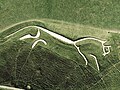
English downland has attracted human habitation since prehistoric times. The ancient track known as the Ridgeway runs along the Berkshire Downs. Prehistoric sites in the Downs include Wayland's Smithy (Neolithic), numerous tumuli (Neolithic or Bronze Age), Uffington White Horse (Bronze Age), Liddington Castle and Uffington Castle (Bronze Age and Iron Age), and Segsbury Camp and Grim's Ditch (Iron Age).

It is generally thought that in Anglo-Saxon times the downs were known as Æscesdūn or Ashdown, and that it was here that the Battle of Ashdown was fought in 871.[2]

By the middle ages, the downs were famous for their huge flocks of sheep, providing wool and fertiliser for the lower-lying arable land with their manure to support the local corn production. From the 15th and 16th centuries, the downs saw the rise of a new type of large-scale, capitalist farming. Farmers began to expand their landholdings by taking over large institutional estates and absorbing smaller farms, leading to the creation of some of the country's largest farms. This trend of farm enlargement continued from the late 18th century and again after 1950, resulting in some exceptionally large farmsteads that stand out even in a national context. The average farm size in this area is now larger than in other chalk downland landscapes.[3]

In 1915, after a brief stint as a hospital orderly at the British hospital for French soldiers in Haute-Marne, John Masefield moved to his country retreat at Lollingdon Farm. The setting at the foot of the Downs - Masefield's "Lollingdon Downs" would inspire a number of poems and sonnets.

Economy

[edit]

Downland pasture is firm and well drained, suited to grazing sheep and grazing and training horses. Starting in the 19th century, horse racing became a major business in the area, with much of the downs covered with training areas, and stables centred on the village of Lambourn.

[edit]

The Berkshire Downs can be accessed from various cities via the Great Western Main Line and its current single operator runs localised stopping trains as well as the high-speed trains along the Vale of White Horse calling at major stops Swindon and Didcot Parkway. From Reading to Newbury trains run along the Reading to Taunton Line in the River Kennet Valley to reach Devon on the quickest route from London. From Reading there are the scenic Thames Valley stations of Pangbourne, Goring & Streatley and Cholsey (linked to the Cholsey and Wallingford Railway).

Conservation

[edit]

Due to its natural beauty and special scenic qualities, the majority of the Berkshire Downs (97%) is included in the North Wessex Downs Area of Outstanding Natural Beauty.

[edit]

References

[edit]
[edit]
Revisions and contributorsEdit on WikipediaRead on Wikipedia
from Grokipedia
The Berkshire Downs are a range of rolling downland hills in , primarily located in the historic county of with extensions into , , and , forming the core of the North Wessex Downs National Landscape. This landscape features a prominent north-facing overlooking the , with a gentler dip slope to the south, dissected by dry valleys known as combes and rivers such as the Kennet, , and Pang. Underlain by the Upper , including formations like the Seaford Chalk and Newhaven Chalk, the downs exhibit features, stones, and fossil-rich beds, with elevations rising to a maximum of 297 metres at near Inkpen. The area, part of a larger 1,730 km² protected landscape designated in , supports extensive arable farming, remnant grasslands, and sparse settlement patterns of farmsteads and valley-bottom villages built from local flint, brick, and thatch. Historically, the Berkshire Downs hold immense archaeological value, with over 440 Scheduled Monuments including long barrows, round barrows, hillforts like , and the nearby , reflecting continuous human occupation from prehistoric times through Roman, Saxon, and medieval periods. The region has inspired literary and artistic works, such as those by and , and features ancient routeways like National Trail, which traverses the escarpment crest. Ecologically, the downs sustain species-rich grasslands hosting rare plants, birds like the skylark, and mammals such as the brown , alongside rivers and wet woodlands that contribute to and , though arable intensification poses ongoing challenges to these habitats. Today, the landscape balances agriculture—including the famous Lambourn Valley racehorse training grounds—with recreation, heritage conservation, and ecosystem services like carbon storage and flood regulation.

Geography

Location and Extent

The Berkshire Downs form a prominent chalk downland region in , oriented east to west and spanning approximately 30 miles (48 km) from the River Thames near Goring to the River Kennet near Marlborough. Centered around coordinates 51°30′N 1°25′W, the area covers about 200 square miles (520 km²), encompassing rolling hills and open landscapes characteristic of the region's . The northern boundary features a steep scarp edge overlooking the Vale of White Horse in Oxfordshire, creating a distinct escarpment that defines the downs' dramatic profile against the lower-lying vale. To the south, the gentler dip slope merges seamlessly into the North Wessex Downs, contributing to a continuous chalk upland. The region incorporates sub-areas like the Lambourn Downs and extends across the county boundary into Oxfordshire, particularly along its northern fringes. Administratively, the Berkshire Downs lie mainly within the historic county of , now administered as part of unitary authorities including , with portions extending into . This placement situates the downs within the broader Chilterns and North Downs landscape, linking it briefly to adjacent formations such as the Marlborough Downs.

Physical Characteristics

The Berkshire Downs are underlain primarily by the Upper of age, which reaches thicknesses of up to 200 meters and forms the core of the downland landscape. Beneath this lies the Clay Formation (up to 70 meters thick) and the Upper Formation (10-50 meters thick), both of Lower age, creating a sequence that influences and drainage patterns. over geological time has sculpted the into prominent escarpments and dry valleys, with the northern edge marked by a steep scarp resulting from differential of the against underlying impermeable clays. Topographically, the Downs exhibit a classic dip-slope morphology, with the northern scarp slope rising abruptly by up to 180 meters from the surrounding , with relief of around 150 meters in the central sections. The southern dip slope descends more gently at angles of 0.5-1 degree, incised by valleys that create a rolling plateau. The highest in the area is at 297 meters (974 feet) above , while features like Blowingstone Hill reach approximately 226 meters (741 feet). This undulating terrain includes combes—steep, narrow valleys formed by periglacial processes—and flat-topped platforms that historically supported hill forts. Hydrologically, the porous chalk aquifer results in limited across the Downs, promoting the development of dry valleys that only flow during high conditions. Notable examples include the dry valley of Letcombe Brook, which emerges as a chalk from springs at the scarp base near Letcombe Regis. Springs are common along the contact between the chalk and underlying Gault Clay, feeding tributaries such as those of the River Ock, whose headwaters arise from similar discharges in the northern . The soils are characteristically thin, rendzinas derived from weathered , typically less than 30 centimeters deep with high lime content and flint inclusions, which favor short, unimproved vegetation over arable use in many areas. These soils contribute to the open, expansive landforms, including ancient trackways like , a prehistoric route that follows the crest of the scarp for much of its length across the Downs, utilizing the relatively stable, elevated ridges.

History

Prehistoric and Ancient Periods

The Berkshire Downs, a chalk upland region in southern England, preserve significant evidence of human activity from the Neolithic period onward, reflecting early agricultural and ceremonial practices. During the Neolithic era (c. 4000–2500 BCE), communities constructed long barrows such as Wayland's Smithy, a two-phase chambered tomb located along the Ridgeway trackway on the northern scarp of the Downs. The initial phase, dating to 3590–3550 BCE, consisted of a timber and stone mortuary structure used for a short period to inter at least 14 individuals, while the later phase around 3460–3400 BCE featured a larger earthen mound with a monumental façade, possibly emulating older monuments to honor ancestors. Causewayed enclosures, early Neolithic ceremonial sites characterized by interrupted ditches and banks, are also attested on the Downs, serving as gathering places for rituals and feasting within a landscape of emerging farming communities. Prehistoric field systems, including small rectilinear plots indicative of early land management, began to appear in the Late Neolithic and persisted into the Bronze Age, suggesting organized agriculture on the chalk soils. The (c. 2500–800 BCE) saw intensified settlement and burial practices, with prominent barrow cemeteries like the Lambourn Seven Barrows, a group of around 40 round barrows dating to approximately 2400–1500 BCE, used for communal inhumations and cremations. These monuments, clustered near the head of the Lambourn Valley, highlight the Downs as a ritual landscape connected to broader traditions. , an ancient prehistoric route traversing the Downs, facilitated trade and movement, linking the region to distant sites like and for the exchange of materials such as flint and ceramics during this period. A key artifact is the , a carved around 1000 BCE in the Late , its stylized form created by cutting trenches filled with crushed , possibly symbolizing a cultic or territorial marker near contemporary settlements. In the (c. 800 BCE–43 CE), the Downs hosted defensive s on prominent hilltops, adapting the landscape for protection amid social changes. , a large univallate enclosing about 3.2 hectares (8 acres) on Whitehorse Hill, dates to the 7th–8th century BCE and features earthen banks and ditches, with evidence of internal settlements and enclosures indicating prolonged occupation. Similarly, Segsbury Camp (also known as Letcombe Castle), another substantial Iron Age spanning about 11 hectares (27 acres) on the Downs crest near , includes multiple ramparts and was likely a regional center for and defense. Roman occupation from the 1st to 4th centuries CE transformed the Downs through agricultural expansion and infrastructure. Villas like that at Barton Court Farm near Abingdon, where an early Roman farmstead from the late 1st century CE developed into a modest villa estate with outbuildings by the 3rd–4th centuries CE, reveal intensive farming practices including crop cultivation and animal husbandry on surrounding fields. Roman roads, such as trackways branching from the upper Thames Valley network, facilitated transport and linked rural estates to military garrisons, with evidence of field systems overlying earlier prehistoric layouts to support villa-based economies. Military use is suggested by the adaptation of hilltop sites, potentially including signaling stations for communication along these routes, though direct evidence remains limited.

Medieval and Early Modern Eras

During the Anglo-Saxon period, the Berkshire Downs featured prominently in military conflicts, most notably as the site of the in 871 CE, where the forces of , led by King and his brother Alfred, defeated a Viking army invading from Reading. This victory marked a significant early resistance against Danish incursions and helped secure the region's strategic uplands for West Saxon control. Early charters and place names further illustrate the area's integration into Anglo-Saxon administrative structures; for instance, documents from the 9th and 10th centuries reference royal estates around sites like Compton and , with names such as Æscesdun (Ashdown) deriving from elements denoting ash trees and hills, indicating settled landscapes managed by . In the medieval era, agricultural practices on the Berkshire Downs transitioned from communal open-field systems, where arable strips were rotated among villagers under manorial oversight, to more extensive sheep runs that capitalized on the grasslands' suitability for . This shift was driven by the lucrative wool trade, with the Downs' fine-wooled sheep contributing significantly to England's export economy; , founded in 1121, amassed vast estates across the region and facilitated wool production and marketing, exporting fleeces to continental markets by the 13th century. Manorial estates, such as those at Wittenham and Uffington, enforced these systems through lords who controlled lands and commons, where tenants held rights, fostering a of arable farming and until demographic upheavals altered the balance. The of 1348–1349 devastated local populations, reducing labor availability and prompting lords to convert arable fields to pasture, as required fewer workers and yielded higher profits, a trend evident in post-plague manorial records showing increased flock sizes. The early modern period brought further transformations through the Dissolution of the Monasteries in the 1530s, which redistributed abbey lands—including those of Reading Abbey, encompassing thousands of acres on the Downs—to secular gentry and crown favorites, enabling more flexible management and accelerating the conversion of arable to enclosed pasture for sheep rearing. Parliamentary enclosures from the 16th to 18th centuries consolidated these open fields and commons into hedged fields, often prioritizing pastoral use; by the late 1700s, acts in parishes like Lambourn and East Hendred had fenced off downland for large-scale grazing, boosting wool output but displacing smallholders. The region also saw military activity during the English Civil War, with skirmishes around Newbury in 1643–1644, including the First and Second Battles of Newbury, where Royalist and Parliamentarian forces clashed over control of the Downs' routes, leaving lasting marks on local estates through foraging and fortification.

Modern Developments

In the 19th century, the Berkshire Downs underwent significant agricultural improvements, including the adoption of new crop rotations and drainage systems on chalk soils, which enhanced productivity for arable farming and sheep grazing. The arrival of the Great Western Railway in the 1840s revolutionized transport, enabling efficient movement of produce like wool and grain to markets in London and beyond, while stimulating the growth of large estates as landowners consolidated holdings to capitalize on these opportunities. This period also saw the opening of Newbury Racecourse in 1905, marking a key development in the area's rural infrastructure. The 20th century brought profound changes through global conflicts, with the Berkshire Downs serving as military training grounds and airfields during both World Wars; notable examples include and , established in the early 1940s for bomber operations and logistics support. Post-World War II mechanization, including the widespread use of tractors and combine harvesters, drastically reduced labor requirements, leading to farm amalgamations and a shift toward intensive arable cultivation that diminished traditional lands. The rural remained relatively stable, reflecting the area's enduring agricultural character and limited industrialization. From the late onward, the Berkshire Downs, as part of the North Downs, faced increasing pressures from urban expansion linked to growth in nearby cities like Reading and , resulting in commuter settlements and elevated housing demand that threatened the open landscape. In response, the area was designated an (now known as a National Landscape) in 1972 to safeguard its natural and cultural features against such development. In 2023, the designation was rebranded nationally as a National Landscape, with the North Wessex Downs adopting a new Management Plan for 2025–2030 to guide future conservation. Recent sustainable farming initiatives, such as the Farming in Protected Landscapes programme (2021–2024) and Partnerships for Nature project funded by Defra's Species Survival Fund, promote regenerative practices like enhanced grassland management and restoration across over 40,000 hectares, countering intensification's impacts while supporting viable agriculture.

Ecology and Conservation

Flora and Fauna

The flora of the Berkshire Downs is predominantly characterized by calcareous grasslands, a habitat formed on thin, lime-rich chalk soils that support short, hardy grasses and herbs adapted to dry, nutrient-poor conditions. Dominant grasses include upright brome (Bromus erectus) and sheep's-fescue (Festuca ovina), alongside characteristic flowering plants such as horseshoe vetch (Hippocrepis comosa), which provides nectar for insects, and chalk milkwort (Polygala calcarea), a nationally scarce species indicative of high-quality turf. These grasslands can host over 40 species of flowering plants per square meter in optimal patches, contributing to a vibrant mosaic of herbs like knapweed (Centaurea spp.), scabious (Knautia spp.), and orchids including burnt-tip (Neotinea ustulata) and early gentian (Gentianella anglica), the latter being endemic to southern England chalk escarpments. Scrub elements, such as hawthorn (Crataegus monogyna) and juniper (Juniperus communis), occur along edges and slopes, forming transitional habitats, while ancient woodlands are scarce, limited to occasional yew (Taxus baccata) groves on steeper chalk outcrops. The fauna reflects the open, species-rich downland environment, with birds such as the skylark (Alauda arvensis), a ground-nesting species that thrives in short turf, and the (Falco tinnunculus), a raptor hunting over grasslands. Mammals include the brown hare (Lepus europaeus), which favors the arable margins and pastures, alongside (Capreolus capreolus) and Eurasian badger (Meles meles), both utilizing scrub and woodland fringes for shelter. Reptiles are represented by the European adder (Vipera berus), which basks on south-facing slopes and preys on small mammals and insects. Insects are particularly diverse, with butterflies like the (Melanargia galathea), feeding on grasses such as red fescue, and the (Polyommatus coridon), whose caterpillars rely on horseshoe vetch as a larval host plant; other notables include the wart-biter bush-cricket (Decticus verrucivorus), a rare orthopteran in relict grasslands. These species assemblages highlight the downs' importance for , including pollinators drawn to the floral abundance. Habitat variations across the downs influence patterns, with the northern scarp slopes—steep and exposed—supporting the most diverse herbaceous communities due to better drainage and microclimatic shelter, fostering herbs like clustered bellflower () and pyramidal orchid (). In contrast, the gentler dip slopes feature more extensive arable fields with margins that enhance connectivity for mobile , though these areas show reduced floral intensity compared to scarps. Threats from invasive scrub encroachment, driven by reduced grazing, particularly by hawthorn and blackthorn (), fragment open habitats and shade out , exacerbating declines in specialist and . Biodiversity hotspots are concentrated in remnant unimproved pastures, which comprise approximately 1,500 hectares of chalk grassland primarily on scarp slopes and dry valleys, representing key refugia for rare plants and invertebrates. These areas, often around archaeological features, sustain high pollinator diversity through their profusion of nectar-rich flowers, supporting bees, hoverflies, and butterflies essential for regional ecosystem services.

Protected Areas and Efforts

The Berkshire Downs are predominantly encompassed by the North Wessex Downs National Landscape (formerly or AONB), designated in to conserve the region's distinctive landscapes and biodiversity, with approximately 97% of the area falling within this protected status. Specific sites of high ecological value include Sites of Special Scientific Interest (SSSIs) such as Hackpen, Warren & Gramp's Hill Downs, a 71.4-hectare expanse of unimproved supporting diverse plant communities. Additionally, segments of National Trail, a 139 km long-distance path established in , cross the Downs, safeguarding ancient routeways while facilitating public access to conserved habitats. Management of these protections is led by the North Wessex Downs National Landscape Partnership, which coordinates habitat restoration projects across the landscape, including initiatives like Partnerships for Nature to enhance connectivity for vulnerable species through targeted interventions. Agri-environment schemes, including Countryside Stewardship (extended through 2025) and the ongoing transition to the Environmental Land Management scheme (ELMS) with options like the Sustainable Farming Incentive, incentivize farmers to maintain lowland grasslands via and other practices to prevent scrub encroachment and support open downland characteristics. These efforts emphasize sustainable to align agricultural practices with conservation goals. Ongoing challenges include the impacts of on chalk streams, where reduced winter recharge and warmer temperatures threaten water flow and aquatic s, prompting adaptive measures like the Sparkling Streams project to improve river health in the Kennet catchment. control forms another priority, with targeted removal of non-native plants such as and scrub from former areas to restore native vegetation, as seen in restoration work at sites like Bucklebury Common. Community involvement is facilitated through volunteer programs run by the , Buckinghamshire & Wildlife Trust (BBOWT), which mobilizes local groups for hands-on management and monitoring across the Downs. Recent developments include the integration of post-2020 biodiversity net gain policies under the UK's Environment Act 2021, requiring a minimum 10% measurable increase in biodiversity for new developments, which the National Landscape Partnership incorporates into its Nature Recovery Plan to guide landscape-scale enhancements. In 2025, the North Wessex Downs National Landscape adopted a new Management Plan for 2025-2030, building on previous efforts with increased emphasis on landscape-scale nature recovery and sustainable farming. Monitoring efforts, such as those under the UK Butterfly Monitoring Scheme, track indicator species to evaluate conservation effectiveness, contributing to adaptive strategies that benefit protected flora and fauna.

Economy

Agriculture and Land Use

The Berkshire Downs have undergone significant shifts in agricultural practices since the medieval period, transitioning from a mixed system of arable cultivation and to a more focus following . In , the open downs supported large sheep flocks that provided and for corn production, particularly , through folding practices that enriched thin soils. By the 15th and 16th centuries, capitalist farmers enlarged holdings by engrossing estates, fostering larger mixed farms averaging around 1,000 acres that integrated arable fields with grazing. The movement from the late 18th century onward converted much into enclosed pastures, emphasizing sheep rearing over intensive arable use, as the poor soils favored grassland for livestock. Contemporary land use on the Berkshire Downs reflects this historical pastoral emphasis, with as of 2024 approximately 53% of farmland under arable cultivation—primarily wheat and barley—and the remainder dominated by grassland for grazing, within the broader North Wessex Downs area where farmland comprises 84% of the landscape and woodland cover remains low at 6.5%. This mix supports a rural landscape where 97% of the region remains open country, allowing for expansive fields suited to both crop rotation and livestock. Sheep farming remains a cornerstone, utilizing traditional Downs breeds such as the Berkshire Knot (or Nott), a hardy, black-faced variety historically valued for its agility in folding on arable land to improve fertility and now contributing to meat and wool production. Grazing by these sheep helps maintain biodiversity by controlling scrub encroachment and promoting diverse grassland habitats. Modern farming practices increasingly incorporate sustainable methods, including organic approaches exemplified by operations like Sheepdrove Organic Farm, a Soil Association-certified mixed enterprise on the Downs that raises native breeds on pasture while conserving biodiversity through rotational grazing and margin planting. Following , legacy payments continued until 2023/2024, with the UK's Environmental Land Management schemes (ELMs)—including the Sustainable Farming Incentive (SFI)—rolling out progressively; as of 2025, these schemes incentivize environmental outcomes such as improvement and habitat creation on chalk downlands, with funding increasing to £2 billion by 2028/29 and new SFI revisions planned. These schemes aim to balance food production with ecosystem services, mitigating the impacts of climate variability on the region's thin soils. Land ownership is characterized by large estates and tenant farms, with significant consolidation since the leading to exceptionally large holdings by national standards; average sizes range from 300 to 500 acres, enabling efficient management of the expansive terrain. This structure, rooted in historical engrossment, continues to dominate, with many operations run as family or estate tenancies focused on both and arable outputs.

Horse Racing and Equine Industry

The Berkshire Downs, particularly the Valley, emerged as a significant center for in the , when William Craven, the 3rd , initiated regular race meetings on his estate near Ashdown House from 1731 to 1803. By the , trainers began relocating operations from Newmarket to due to the latter's softer, more forgiving ground that reduced horse injuries, marking the valley's rise as a premier training hub. This development accelerated in the late , with stables proliferating along the downs, especially around , establishing the area as the "Valley of the Racehorse" and a key site for . Today, Lambourn hosts approximately 30 licensed trainers operating from over 30 establishments, managing around 1,500 horses in training at any given time, making it England's second-largest center after Newmarket. Nearby , located on the edge of the downs, serves as a vital facility, hosting major events such as the Coral Gold Cup—formerly the Gold Cup—a premier handicap steeplechase run annually in late November. The region's downland pastures also support several breeding studs, including Fawley House Stud and Highclere Valley Stud Farm, which utilize the area's soils for producing thoroughbreds suited to racing. The springy, firm turf of the downs provides an ideal surface for gallops, offering natural cushioning that promotes balance and minimizes stress on horses during training. Specialized services, such as the Equine Hospital and networks, are concentrated here to support the industry's needs. The equine sector drives substantial economic activity in the Berkshire Downs, employing over 1,000 people directly and indirectly in alone, accounting for about one-third of local jobs. A 2019 economic impact study estimated that contributes £22.6 million annually to the Lambourn Valley's gross added value, bolstering related businesses like veterinary care and equine transport. This industry has cultivated a global reputation for excellence in National Hunt training, with Lambourn yards producing champions that compete internationally and reinforcing the downs' status as a cornerstone of British racing heritage.

Tourism and Recreation

The Berkshire Downs attract visitors seeking outdoor pursuits amid its rolling chalk landscapes, with National Trail serving as a premier attraction for walking and . This 87-mile (140 km) ancient path traverses the North Wessex Downs National Landscape, which encompasses the Berkshire Downs, offering expansive views, archaeological sites, and diverse terrain suitable for multi-day hikes or shorter loops. Cyclists can utilize designated sections, including circular routes and e-bike options, while the trail's broad tracks accommodate both activities year-round. The updated North Wessex Downs National Landscape Management Plan 2025-30, launched in November 2025, continues to emphasize and landscape conservation. Aerial sports add thrill to recreational offerings, with gliding opportunities available at nearby sites such as those operated by the Thames Valley Hang Gliding Club on the and Marlborough Downs, providing scenic flights over the undulating hills. and launches from hilltops like Rivar Hill near allow participants to soar above the countryside, drawing adventure enthusiasts to the area's reliable thermals and open spaces. Events and facilities enhance the visitor experience, including horse racing meets at , which host up to 30 fixtures annually and serve as a hub for spectators enjoying the Downs' heritage. The annual North Wessex Downs Walking Festival in June features guided walks exploring the landscape, promoting community engagement and trail appreciation over 14 events. Accommodations in picturesque villages like , known as the "Valley of the Racehorse," include cozy bed-and-breakfasts such as The George Hotel and self-catering options like , providing convenient bases for exploring the surrounding downs. Tourism plays a vital economic role, supporting approximately 2,200 full-time jobs across the North Wessex Downs (as of 2019) through visitor-related activities like hospitality and guiding services. Annual visitor spending contributes significantly to the local economy, with UK day-trippers averaging £27 in additional expenditure per visit on accommodations, , and transport, bolstering rural businesses. Promotion efforts by organizations such as Visit Thames, which highlights the Downs' integration with the and broader valley attractions, help sustain this influx. Supporting infrastructure includes an extensive network of 2,858 km of public rights of way, with waymarked paths along and other trails featuring clear signage for navigation. Parking facilities at trailheads, such as those near Streatley and East Ilsley, provide easy access points, often with interpretive boards and picnic areas to facilitate day visits. peaks seasonally in summer, when warmer weather draws crowds for and festivals, alongside spikes on race days that increase activity around Newbury. Historic sites along these paths, like ancient hill forts, further entice heritage tourists in a single integrated experience.

Cultural Significance

Literature and Folklore

The Berkshire Downs have inspired numerous literary works that capture the region's rolling landscapes, rural traditions, and dramatic terrain. In Thomas Hardy's novel Jude the Obscure (1895), the fictional village of Marygreen is modeled after Fawley in Berkshire, with the Downs serving as a backdrop for the protagonist's early life and struggles, evoking the area's isolation and ancient charm. Similarly, Richard Adams's Watership Down (1972), a seminal work of modern fantasy, is set on the Berkshire Downs near Newbury, where the story's anthropomorphic rabbits navigate the hills' perils, drawing directly from the author's observations of the local countryside. John Masefield's narrative poem Reynard the Fox (1919) evokes the fox hunts across the English downs, including those in Berkshire, celebrating the pre-war rural life and equestrian pursuits emblematic of the region. Folklore of the Berkshire Downs is rich with ancient myths tied to its prehistoric sites. Legends surrounding center on the in 871 AD, fought against Viking invaders on the Downs; folklore claims Alfred used the Blowing Stone near White Horse Hill to summon his troops with a horn-like blast, a tale preserved in local traditions. The , a prehistoric chalk figure on the Downs, features in stories as a symbol of St. George slaying a dragon on nearby Dragon Hill, where the beast's blood supposedly scorched the earth, preventing grass from growing—a motif blending Christian and pagan elements. , a mythical blacksmith from Germanic lore, is linked to , a on the Downs; according to the legend, Wayland forged magical swords and shod horses left overnight at the site for a silver penny, with the structure believed to be his forge. The Downs' folklore has influenced Romantic-era writings on rural , notably William Cobbett's Rural Rides (1830), a series of essays documenting his horseback journeys through southern counties, including , where he praised the downs' fertile yet threatened landscapes as emblems of traditional agrarian life. This cultural resonance persists in annual events like the White Horse Folk Festival, held near Uffington since the 1970s, which features Morris dancing on Dragon Hill and to celebrate the area's myths and music. In the 20th and 21st centuries, the region has appeared in media, such as the 1976 film The Eagle Has Landed, directed by , which used villages like Mapledurham in to depict a fictional WWII German invasion, capturing the Downs' strategic and picturesque terrain.

Archaeological and Historic Sites

The Berkshire Downs are renowned for their prehistoric monuments, which provide significant insights into and societies. The , a chalk-cut measuring approximately 110 meters in length, is the oldest known example in Britain, dating to the late or early (between 1380 and 550 BC). In 2024, the underwent restoration, including new soil sampling for improved dating analysis. Adjacent to it on White Horse Hill stands , an early univallate enclosing about 3.2 hectares, featuring earthen ramparts and ditches that served defensive purposes and possibly ceremonial functions. The Seven Barrows cemetery near , a cemetery comprising 42 mounds dispersed over a wide area, including a core group of around 10 arranged in two linear rows, reflects communal funerary practices of the period. Dragon Hill, a natural chalk mound roughly 10 meters high below the White Horse, likely formed by glacial erosion, though its primary archaeological value lies in its association with the broader hillfort landscape. Historic structures on the Downs include medieval churches and later estate features that highlight post-Roman development. St. Mary the Virgin Church in Lambourn, dating primarily to the 12th and 13th centuries with later additions, features Norman arcades and Early English Gothic elements, serving as a central parish church in a historically agricultural community. The Lockinge Estate, encompassing over 2,400 hectares at the foot of the Downs, includes 18th-century landscape elements integrated into its broader development, such as follies and parkland designed to enhance the estate's aesthetic and functional role in local land management. Notable among these is Grimsbury Castle, an 18th-century folly built atop an Iron Age hillfort near Hermitage, constructed as a romantic ruin to evoke historical grandeur while reusing prehistoric earthworks. Visitor access to these sites is facilitated through managed interpretation at key locations. White Horse Hill features on-site information panels and guided access provided by and , offering educational resources on the monuments' construction, maintenance, and cultural context without a dedicated standalone center. Many sites, including and the Seven Barrows, are designated as scheduled ancient monuments under , ensuring public footpaths like provide non-intrusive viewing while protecting subsurface archaeology. for Uffington Castle; https://historicengland.org.uk/listing/the-list/list-entry/1009703 for Seven Barrows Preservation efforts have identified over 50 scheduled ancient monuments across the Berkshire Downs, concentrating on prehistoric barrows, field systems, and hillforts to safeguard them from development and erosion.

Transportation

The primary rail infrastructure serving the Berkshire Downs is the Great Western Main Line (GWML), which traverses the region from London Paddington westward, with the section reaching Newbury opened in 1847 as part of the Berks and Hants Railway extension from Reading. This line connects to Swindon further west and, via a branch from Didcot Parkway near Newbury, provides links to Oxford, facilitating access across the Downs' chalk landscape. Historically, the railway played a crucial role in 19th-century agricultural transport, enabling efficient movement of produce and livestock from rural Berkshire farms to urban markets like London. Key stations include Newbury, the principal hub for the area, offering direct services to London Paddington that take approximately one hour; smaller stops such as and provide vital rural access along the line between Newbury and Reading. The now-defunct Lambourn Valley Railway, a from Newbury opened in 1898, once extended service deeper into the Downs to , supporting local and the equine industry before closing to passengers in 1960 and freight in 1973; it retains heritage interest through preserved structures and local campaigns for potential revival as a sustainable route. Electrification of the GWML reached Newbury in 2019 as part of the broader completed by 2020, enabling faster electric services and reducing journey times. Currently, services operate at 2-4 trains per hour to during peak times, with integration via Reading allowing connections to the for direct access to . These links have notably benefited , aiding the movement of racehorses from training centers in the Downs to major events.

Road and Path Networks

The Berkshire Downs are traversed by a network of major roads that facilitate connectivity while respecting the area's rural character. The A34 serves as the primary north-south artery, running from Newbury to and maintained by as a . This route parallels ancient tracks, including sections with Roman origins near Newbury, such as alignments linked to the Roman road known as the Portway. Secondary roads like the A338 connect the Downs to surrounding valleys, passing through and to link with the A420. The B4494 provides a rural east-west link from across the Downs to Newbury, offering scenic access amid low-traffic conditions typical of the area's unclassified and B-roads. Overall, traffic volumes remain low due to the predominantly agricultural and protected landscape, minimizing congestion on these routes. Ancient paths form a foundational layer of the Downs' network, predating modern roads and preserving prehistoric mobility. , recognized as Britain's oldest road, is a prehistoric trackway used for at least 5,000 years by travelers, herdsmen, and soldiers; it spans 87 miles as a National Trail from to Ivinghoe Beacon, crossing the Berkshire Downs' chalk ridges. Paralleling the northern scarp, the follows an ancient chalk escarpment route from to , incorporating bridleways and byways through the Downs for multi-user access. Modern pathways expand accessibility for non-motorized travel, integrating with the rural terrain. National Cycle Route 5 traverses nearby areas, connecting Reading through the to via segments along quiet lanes and off-road paths adjacent to the Downs' edges. A dense web of bridleways supports horse riders, with designated routes like those in the North Downs enabling equestrian access across open . Within the (AONB), traffic management strategies, including signage and low-key rural road designs, aim to reduce noise, lighting, and clutter from vehicles, preserving tranquility. Recent developments emphasize sustainable transport to enhance connectivity without compromising the landscape. In the 2020s, has introduced electric bus trials, including West's rollout of 55 zero-emission buses in 2025 and a 159-bus fleet launched in 2024, serving routes near the Downs' northern boundary. Trailheads along paths like feature improved parking at access points, such as those near and Compton, alongside clear signage for walkers, cyclists, and riders to guide safe navigation. These roads and paths complement rail links, enabling combined journeys from stations like Newbury and .

References

Add your contribution
Related Hubs
User Avatar
No comments yet.