Hubbry Logo
LucaniansLucaniansMain
Open search
Lucanians
Community hub
Lucanians
logo
8 pages, 0 posts
0 subscribers
Be the first to start a discussion here.
Lucanians
Lucanians
from Wikipedia
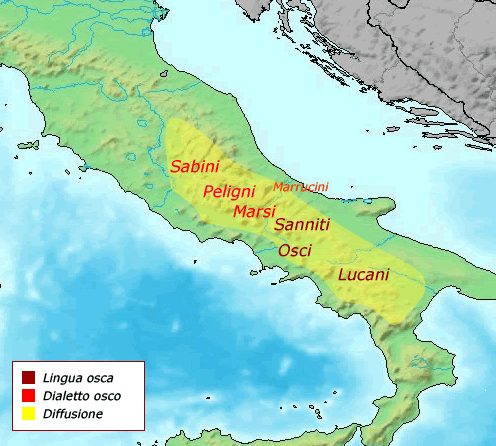
The Oscan language in the 5th century BC.

The Lucanians (Latin: Lucani) were an Italic tribe living in Lucania, in what is now southern Italy, who spoke the Oscan language, a member of the Italic languages. Today, the inhabitants of the Basilicata region are still called Lucani, and so is their dialect.[1]

Language and writing

[edit]
A Gold coin from Lucania dated between 620 and 294 BC

The Lucani spoke the Oscan language.[2] There are a few inscriptions and coins in the area that survive from the 4th or 3rd century BC; they use the Greek alphabet.[3][4]

History

[edit]
A mounted Lucani warrior, fresco from a tomb of Paestum, Italy, c. 360 BC

Around the middle of the 5th century BC, the Lucani moved south into Oenotria, driving the indigenous tribes, known to the Greeks as Oenotrians, Chones, and Lauternoi, into the mountainous interior.[5][6]

The Lucanians were engaged in hostilities with the Greek colony of Taras/Tarentum and with Alexander, king of Epirus who was called in by the Tarentine people to their assistance in 334 BC. In 331, treacherous Lucanian exiles killed Alexander of Epirus.

In 298 they made alliance with Rome,[citation needed] and Roman influence was extended by the colonies of Venusia (291), Paestum (Greek Posidonia, refounded in 273), and above all Roman Tarentum (refounded in 272). Subsequently, however, the Lucanians suffered by choosing the losing side in the various wars on the peninsula in which Rome took part. During the Samnite Wars they were sometimes in alliance with Rome but more frequently engaged in hostilities.

The Lucanians and Bruttians laid siege to Thurii in 282 BC and a Roman army sent to its relief under Gaius Fabricius Luscinus defeated them.[7]

When Pyrrhus of Epirus landed in Italy in 281, they were among the first to declare in his favour and after his abrupt departure they were reduced to subjection in a ten-year campaign (272). Enmity continued to run deep; they espoused the cause of Hannibal during the Second Punic War (216), and Lucania was ravaged by both armies during several campaigns. The region never recovered from these disasters and under the Roman government fell into decay to which the Social War, in which the Lucanians took part with the Samnites against Rome (91 - 88 BC), gave the finishing stroke.[citation needed]

In the time of Strabo (63 BC – 24 AD) the Greek cities on the coast had fallen into insignificance[citation needed] and, owing to the decrease of population and cultivation, malaria began to obtain the upper hand. The few towns of the interior were of no importance. A large part of the province was given up to pasture, and the mountains were covered with forests, which abounded in wild boars, bears and wolves.

Art

[edit]
Duel of Lucanian warriors, fresco from a tomb of the 4th century BC.

Lucanian art mainly survives in Lucanian vase painting and paintings from tombs, which the elite commissioned in rather large numbers, like the Etruscans but unlike their Roman and Greek neighbours. There is a good display in the museum at Paestum. A high proportion feature horses, often racing.[8] Vase painting was practiced between about 420 BC and 335 BC, and at its height vases were exported to all Apulia. The painters, some of whom have been assigned notnames, were probably Greek emigres, or trained in Greece - probably Athens to judge by their styles.[original research?]

See also

[edit]

Notes

[edit]

Further reading

[edit]
[edit]
Revisions and contributorsEdit on WikipediaRead on Wikipedia
from Grokipedia
The Lucanians (Latin: Lucani) were an ancient Italic tribe of Oscan linguistic stock who inhabited the rugged interior of , particularly the region known as (modern and parts of and ), from the BCE until their gradual assimilation into the Roman world. Speaking a dialect of Oscan, an Indo-European related to Latin and Umbrian, they emerged as a distinct ethnic group during a period of Italic expansion and interacted extensively with Greek colonial settlements along the Tyrrhenian and Ionian coasts. Known for their culture, as depicted in tomb frescoes showing armed duels and processions, the Lucanians maintained a tribal society centered on fortified hilltop settlements, , , and . Scholars trace the Lucanians' origins to migrations of Oscan-speaking peoples from , likely descending from or closely related to the , with ancient writers such as describing them as a that overran Greek territories in the 5th and 4th centuries BCE. By the mid-4th century BCE, they had consolidated their through social restructuring and settlement expansion, establishing a network of sanctuaries and elite burials that reflect a hierarchical society with aristocratic warriors and emerging urban centers like Potentia and Grumentum. Their blended indigenous Italic traditions with Hellenic influences, evident in produced in Lucanian workshops and the adoption of Greek script for inscriptions and coinage from the 4th century BCE onward. Historically, the Lucanians expanded aggressively in the BCE, capturing the Greek colony of Poseidonia (modern ) in the late 5th century BCE (c. 410 BCE) and defeating around 390 BCE, thereby gaining control over fertile coastal plains and integrating some Greek populations while preserving their Italic identity. They formed alliances with other Italic groups against external threats, including wars against the Greek king (334–331 BCE) and initial resistance to Roman incursions during the (343–290 BCE), where records their brief alliance with in 298 BCE before renewed hostilities. In the (280–275 BCE), they sided with King against , suffering defeats that led to partial subjugation by 272 BCE, though some autonomy persisted until the Second Punic War (218–201 BCE), when many communities supported and faced severe reprisals. By the Social War (91–88 BCE), Lucanian cities sought , marking their full incorporation into the Roman provincial system and the decline of distinct ethnic institutions, though remained a backwater region known for its brigandage and rural traditions into the Imperial era.

Origins and Identity

Ethnic Background

The Lucanians were an Italic people who spoke a dialect of Oscan, a Sabellic closely related to that of the , positioning them within the broader Oscan-speaking branch of ancient Italic groups that emerged in around the . Their ethnic formation is tied to the southward expansion of Samnite-related populations—though scholars debate the precise timing, with dates ranging from the 8th to the end of the —forming a distinct group in the region known as , which encompassed modern and parts of northern and . Linguistically and culturally, the Lucanians shared strong ties with central Italian Sabellic groups, such as the Samnites, evidenced by their use of South Oscan inscriptions in the Tarentine-Ionic alphabet from the 4th to 2nd centuries BC. Archaeological continuity supports this connection, with pottery styles like red-figure vases depicting warriors—featuring regional motifs such as starbursts resembling Macedonian shields—persisting from the late 5th to 3rd centuries BC across Lucanian and related Sabellic sites. Burial practices further illustrate these links, as warrior tombs containing triple-disc cuirasses, bronze belts, spears, and javelins show consistent Italic traditions from the 5th century BC onward, with examples from sites like Paestum and Lavello reflecting elite social structures shared with Samnite customs. In contrast to the Greeks of , the Lucanians maintained distinct Italic identities through their , warrior equipment like the triple-disc , and dress including the wide Samnite belt, despite cultural exchanges evident in hybrid architectural and artistic elements. They also differed from neighboring indigenous tribes such as the Bruttii, another Oscan-stock group that initially operated under Lucanian influence before achieving autonomy in the mid-4th century BC and adopting more pronounced through bilingualism and a structure, while both shared core Italic warrior traditions like armed burials and deliberative assemblies.

Name and Etymology

The name of the Lucanians derives from the Latin Lucani, which is an adaptation of the Oscan Lukanoi, attested in inscriptions from the region. This form reflects their identity as an Italic people speaking an Oscan dialect, with the name likely originating in the BCE during their expansion into . The etymology of Lukanoi/Lucani is linked to Italic linguistic roots, possibly meaning "sacred wood" or "grove," paralleling the Latin term for a sacred woodland clearing, a concept tied to forested landscapes in ancient Italic and nomenclature. Alternative derivations suggest connections to words denoting brightness or openness in Proto-Italic, though the "sacred grove" interpretation aligns with the region's topography and cultural practices. The earliest external reference to the group appears in Greek sources as Leukanoi, recorded by the historian Antiochus of Syracuse in the late 5th century BCE; Strabo preserves this account, noting that Antiochus described the Leukanoi as a Samnite offshoot who overran earlier inhabitants without distinguishing them from the neighboring Brettii. Roman authors, including Livy and Pliny the Elder, subsequently standardized the name as Lucani in historical and geographical contexts from the 3rd century BCE onward. In contemporary usage, the term Lucani denotes the residents of —the modern region encompassing ancient —evoking their Italic heritage through cultural projects and regional identity initiatives.

Geography and Settlements

Territory and Environment

The territory of the ancient Lucanians primarily encompassed the region of modern in , stretching from the on the west to the on the east, forming a roughly triangular inland area amid the southern Apennines. This core domain, known as Leucania in classical sources, measured approximately 300 stadia (about 55 kilometers) across at its narrowest point near the isthmus between Thurii and Cerilli, with coastal stretches totaling around 650 stadia along the Tyrrhenian side from the Silarus River to the Laüs River. The landscape was characterized by rugged mountainous terrain, with the Apennine chain running through the interior and terminating at promontories like Leucopetra, interspersed with narrow fertile valleys and basins that supported limited alluvial agriculture. To the north, Lucania bordered Samnium and Campania, delimited by the Silarus River, while its southern frontier adjoined Bruttium, and Greek colonial settlements dotted the western and eastern coasts, limiting direct Lucanian access to the sea. Major rivers, including the Bradanus (modern Bradano), Agri, and Sinni, traversed the region from the Apennines toward the coasts, providing essential water for and while fostering wet environments in their valleys that enhanced in lowland areas. Elevations ranged from coastal plains at around 8 meters above to highland plateaus exceeding 900 meters, such as near Torre di Satriano, creating a diverse of hills, shrubby grasslands, and mixed forests. The environment presented significant challenges due to its predominantly mountainous and hilly character, where steep slopes and erosion-prone soils restricted intensive crop cultivation to select , promoting instead transhumant with sheep and goats in the uplands and open shrublands. Forests of oaks (Quercus spp.) and Mediterranean maquis, though sparse, yielded valuable resources like timber and pitch, while mineral deposits, including ores near Temesa on the southern edge, supported limited metallurgical activity, though many such sites were depleted by the Roman period. Seismic activity and volcanic influences from nearby regions further shaped the dynamic landscape, contributing to flooding that enriched soils but also posed risks to stability. This varied terrain influenced Lucanian settlements, often positioned in defensible highland sites overlooking valleys for access to resources.

Major Cities and Sites

The Lucanians established several prominent inland settlements during their expansion in the fourth century BC, with emerging as a major center around 400 BC, strategically located in the Apennine foothills to control key routes between and the Ionian coast. Archaeological surveys reveal a fortified urban core with defensive walls and extramural sanctuaries, reflecting its role in Lucanian and later Roman colonization in 291 BC, which overlaid but did not erase the pre-existing Oscanized settlement evidenced by pottery and burial practices. Potentia, in the modern area of , developed as another key Lucanian hub in the fourth century BC, initially centered at Serra di Vaglio with evidence of urban expansion, hellenizing influences in ceramics, and fortified enclosures that underscore its defensive and economic importance amid regional migrations. Excavations at Serra di Vaglio have uncovered distinctive supine burials and from the fourth century BC, indicating , while the site's shift toward the nearby Potentia by around 200 BC highlights continuity into the Roman period as a flourishing with administrative inscriptions. Grumentum, located in the Val d'Agri along the Agri River, emerged as a significant Lucanian settlement in the second half of the fourth century BC, serving as a strategic urban center with fortifications, temples, and evidence of elite residences that reflect its role in regional control and cultural development. Archaeological findings, including and inscriptions, indicate its importance during Lucanian expansion and its later incorporation as a Roman , with remains of a theater and thermal baths attesting to its prosperity. On the Tyrrhenian coast, the Lucanians exerted influence over the Greek colony of (originally ), conquering it around 400 BC and renaming it Paistom, which integrated Oscan elements into the city's and cultural fabric without fully displacing Greek institutions. Archaeological evidence from the site includes Lucanian-style tomb paintings and inscriptions from the fourth to third centuries BC, illustrating a hybrid society, though Roman intervention in 273 BC ended direct Lucanian control and renamed it . Hilltop sanctuaries and fortifications provide critical archaeological insights into Lucanian religious and defensive practices, exemplified by Rossano di Vaglio, a monumental complex dedicated to the goddess founded in the second half of the fourth century BC. The site features a large staircase, open-air altar of arenaceous blocks, and areas for votive offerings, with over 50 Oscan inscriptions attesting to communal rituals; its location at the intersection of ancient tracks highlights its role in fostering Lucanian identity, though geological instability led to partial abandonment by the first century AD. While the Lucanians maintained limited direct control over coastal areas, their alliances shaped interactions with sites like Tarentum (ancient Taras), including a in 303 BC that facilitated trade and military cooperation against common foes, influencing the broader Hellenistic dynamics in without establishing permanent settlements there.

Language and Writing

Oscan Language Features

The , spoken by the Lucanians, belongs to the Sabellic branch of the within the Indo-European family, sharing common phonological and morphological traits with other Sabellic tongues such as Umbrian and the minor dialects of . Key grammatical features include a robust case system with seven cases—nominative, vocative, accusative, genitive, dative, ablative, and locative—distinguishing it from Latin's more streamlined structure. Notably, the genitive singular for consonant-stem nouns ends in -fís (e.g., Hereklefís "of "), while o-stem genitives often use -eis (e.g., medikeis "of the Meddix"), reflecting an archaic Indo-European inheritance adapted in Sabellic contexts. The dative plural frequently appears as -uid or -úis (e.g., deiveis "to the gods"), used for indirect objects, possession, or ethical datives, as seen in dedications. Prepositional usage in Oscan often involves postposition in certain constructions, a Sabellic innovation where prepositions follow their governed nouns, contrasting with Latin's predominant prepositional placement; for instance, forms like pusti kastruvuf ("for each head of livestock") illustrate pusti (from post) in a postposed-like relational role with the dative. Vocabulary reflects the Lucanians' pastoral and agrarian lifestyle, with terms such as pecuo or castruo denoting livestock heads, kabru for "goat," and abrof for "boar," embedded in legal and dedicatory texts concerning rural property and offerings. These lexical items underscore a semantic focus on herding and land use, integral to Sabellic economic expressions. The Lucanian dialect of Oscan exhibits variations from the central Samnite variety, including phonological shifts like the development of from *-u- after coronals (e.g., written as <υ> or <ου> in Greek-script inscriptions), and a preference for the Greek alphabet in southern regions due to cultural contacts. Evidence of these differences appears in 4th-century BC inscriptions, such as those from the sanctuary at Rossano di Vaglio, which feature local and formulaic phrasing distinct from Samnite norms, like extended dative constructions in votive contexts. By the 1st century AD, Oscan in had become extinct, supplanted by Latin through Roman administrative integration and urbanization, with the latest attestations in bilingual or Latin-influenced texts.

Inscriptions and Scripts

The Lucanians, speakers of the , employed various scripts for their inscriptions, reflecting regional influences from neighboring cultures. Early evidence suggests possible use of an Etruscan-derived alphabet in northern , akin to the Central Oscan script adapted from Etruscan models around the , though surviving examples are scarce and primarily tied to broader Italic traditions. From the 4th to 3rd centuries BC, the Greek alphabet became predominant for writing Oscan in and Bruttium, adapted to accommodate Oscan phonemes such as /f/ (often via a modified or ) and /w/ (via a distinct character resembling the Oscan "v"). This adaptation occurred in southern regions adjacent to Greek colonies, with inscriptions written left-to-right, unlike the earlier right-to-left Italic scripts. Examples appear on coins, where Oscan legends in Greek letters denote ethnic names like "Loukanōn" (), and on bronze tablets listing gentilicia or personal names, such as those from sites in (e.g., Italia 2/Lu 56). These artifacts highlight the practical integration of Greek writing for local administrative and identificatory purposes. Key surviving texts include the Tabula Bantina, a tablet from Bantia (modern Banzi) in dating to the , which records a in Oscan using the Latin alphabet, reflecting later Roman influence on script choice. Votive inscriptions from sanctuaries, such as the extensive series at Rossano di Vaglio dedicated to deities like , employ the Greek-adapted alphabet and date primarily to the 3rd–2nd centuries BC; these stone slabs and blocks often feature dedicatory formulas, such as "kvaísstur" (whosoever), illustrating ritual language alongside Oscan grammatical features like case endings. In coastal areas of Lucania, such as near and , bilingualism between Greek and Oscan is evident in inscriptions from the 4th–1st centuries BC, where texts mix scripts or languages to reflect cultural exchanges with Greek settlers, including in dedications and public notices. This phenomenon underscores the Lucanians' adaptation of writing systems amid Hellenistic interactions, without fully supplanting Oscan linguistic elements.

Society and Economy

Social Structure

Lucanian society was organized into a tribal framework comprising multiple independent communities, potentially united in a loose league similar to those of neighboring Oscan-speaking groups like the Campanians and . These communities were governed by elected leaders known as meddices, high officials responsible for local administration and decision-making, reflecting a system of rotational authority common among Oscan peoples. In times of conflict, a supreme leader or could be selected, indicating elements of a military democracy where leadership emphasized prowess. At the apex of this hierarchy stood warrior elites and aristocratic families, who controlled significant land holdings and maintained networks of clients through patronage and alliances. These elites are evidenced by lavish "princely" tombs containing weapons, imported luxury goods, and depictions of armed warriors, such as those in frescoes from Paestum and Armento, underscoring their dominance in both warfare and social prestige. Family-based clans formed the core social units, with necropoleis organized around central tombs representing kinship groups, which facilitated pastoral mobility through seasonal transhumance of livestock across mountainous terrains. This clan structure also fostered guest-host relations, essential for maintaining alliances during migrations and trade in a rugged landscape. Women primarily managed household affairs, as indicated by tomb goods like weights and domestic votives from sites such as Armento, but females held elevated roles within family units. Sympotic artifacts in high-status female burials, including kraters from Montemurro, suggest their involvement in communal rituals and possible positions of influence, inferred from the richness of grave offerings that parallel male interments. These social roles intertwined with economic activities, where networks supported and .

Economic Activities

The Lucanians' economy was predominantly , centered on sheep and herding, with practices indicative of involving seasonal movements along mountain routes to exploit varied pastures. Archaeological evidence from Lucanian sites suggests mobile communities managed flocks for wool production, a key resource supplemented by and , as inferred from faunal remains and settlement patterns in the 5th–4th centuries BC. This system adapted to the rugged Apennine terrain, enabling surplus for local use and exchange, though direct evidence of remains limited due to perishable materials. Agriculture complemented pastoralism, primarily through grain cultivation in fertile valleys such as those of the Agri and Sinni rivers, where emmer wheat and barley were grown to support both subsistence and trade. These valley farmlands, less suited to large-scale herding, provided staple crops that sustained settled communities and offset the seasonal variability of pastoral yields, with ancient sources noting the integration of such farming in Lucanian territories from the 5th century BC onward. Trade networks linked the Lucanians to Greek colonies along the Ionian and Tyrrhenian coasts, facilitating exchanges of local wool and grains for imported , , and metals, as evidenced by Greek imports at Lucanian sanctuaries and settlements like . Control over riverine trade routes enhanced this commerce, allowing access to coastal emporia by the . Local ironworking, utilizing ores from mountainous regions like the Lucanian Apennines, produced tools and weapons, with slag and forge residues at sites such as Grumentum indicating small-scale operations integrated into the broader economy. The introduction of coinage in the late marked a shift toward monetized regional exchange, with Lucanian issues—often struck at cities like Heraclea and —imitating Greek styles such as heads and bull motifs to facilitate trade with colonial partners. These silver nomoi and bronzes, beginning around 350 BC, reflected growing while asserting local identity through Oscan inscriptions on some pieces.

Religion and Culture

Religious Practices

The Lucanians practiced a polytheistic centered on Italic deities, with prominent worship of , a goddess associated with healing, prophecy, and chthonic forces, as evidenced by Oscan inscriptions from the sanctuary at Rossano di Vaglio dating to the 4th-3rd centuries BCE. , revered as a protector and warrior figure, was also venerated, particularly in sanctuaries like Armento where offerings linked to and martial activities have been found. In regions bordering Greek colonies in , such as around and Heraclea, occurred, blending Italic gods with Greek equivalents in votive terracottas and bilingual dedicatory practices. Rituals emphasized communal and propitiatory acts, including animal sacrifices documented through faunal remains at sites like Torre di Satriano, where dog bones indicate specialized offerings possibly for purification or rites, and Chiaromonte, with general animal bones near ritual hearths. Votive offerings were central, deposited at natural sacred sites such as springs and groves; excavations at Rossano di Vaglio reveal terracotta figurines of deities, weapons, and pomegranates symbolizing , while Timmari and Colla di Rivello yielded miniature and fibulae as ex-votos for divine favor. These practices often involved fumigations and shared meals using specialized ritual tools, fostering social cohesion in spaces. Festivals aligned with agricultural cycles, invoking deities for bountiful harvests and , as seen in the broader Italic of seasonal rites at rural sanctuaries. Weapon votives dedicated to at highland sites such as Armento reflect the importance of warrior culture in religious practices.

Cultural Influences

The Lucanians adopted Greek red-figure pottery techniques, establishing workshops in areas like and Heraklea that produced vases featuring mythological motifs such as scenes from epic tales and divine narratives. This integration of Attic-style painting with local Italic forms reflected broader cultural exchanges in , where Greek colonists influenced indigenous artistic practices. Etruscan influences appeared in Lucanian metalwork, particularly bronze artifacts from fortified sites like Roccagloriosa, which exhibit high-quality craftsmanship suggestive of techniques transmitted through networks in northern . Contacts with Etruscan-dominated regions, such as , facilitated the adoption of advanced bronzework methods, enhancing the decorative and functional aspects of Lucanian beyond purely Italic styles. Alliances with the Greek colony of Tarentum promoted among Lucanian elites, introducing elements of culture through the widespread use of Greek-inspired banquet for social rituals and convivial gatherings. This , often depicting scenes and revelry, extended to the and symbolized the blending of Greek with local customs, fostering a hybrid elite identity. Despite these external influences, Lucanian resistance to pre-Roman pressures helped maintain their core Italic identity, with full Latin assimilation occurring only after , allowing persistence of indigenous traditions like Oscan linguistic elements amid Greek borrowings. As explored in the Oscan Language Features section, such borrowings included terms for cultural practices. Roman integration eventually overlaid Latin administrative and social norms, yet Lucanian society retained distinctive markers of their heritage in regional customs and artifacts.

History

Early Migration and Expansion

The Lucanians, an Oscan-speaking Italic people originating from Samnium in central Italy, undertook a significant migration southward during the mid-5th century BC, approximately between 450 and 400 BC. This movement, documented in ancient sources such as Strabo's Geography (VI.1.3), involved groups of Samnite stock expanding into the regions of Oenotria, displacing indigenous populations including the Chones, Oenotri, and Opici. Archaeological evidence from warrior tombs and Oscan inscriptions in sites like Lavello and Alfedena supports this ethnic and cultural continuity with Samnite migrants, indicating a gradual influx rather than a single mass event. As they advanced, the Lucanians established firm control over the inland mountainous areas of what is now and northern , transforming these territories into their core domain through settlement and fortification. By the late , this consolidation was marked by the appearance of fortified hilltop sites and burial evidence of elite warriors equipped with triple-disc cuirasses and bronze belts, reflecting military dominance and . Their expansion displaced local groups, assimilating some while pushing others toward the coasts, as inferred from shifts in at sites like and Roccagloriosa. This inland mastery provided a stable base for further incursions, prioritizing defensible terrain over immediate coastal access. The Lucanians' early expansions increasingly encroached on Greek-influenced zones along the Tyrrhenian and Ionian coasts, including the defeat of the Greek colony of around 390 BCE and culminating in the seizure of the city of Poseidonia (modern ) around 400 BC, as recorded by (Library of History 14.91–92). This conquest, achieved through siege and alliance with other Italic tribes, exemplified their strategic push into Hellenized territories, where they adapted elements of Greek armor and while asserting dominance. In the northern frontier, they established control over Venusia as a strategic outpost to secure inland routes and monitor movements of neighboring Italics, leveraging its position near the Apulian border for defense and trade. Concurrently, the Lucanians engaged in initial alliances and skirmishes with the Bruttii, a group of Lucanian origin who had settled as shepherds in the southern extremities and later revolted for independence around the mid-4th century BC. (VI.1.4) describes the Bruttii as runaways from Lucanian overseers, whose uprising during the turmoil of II's wars in (ca. 357 BC) led to territorial disputes and fluid alliances among . These early interactions, including joint raids on Greek colonies like in 356 BC, highlighted the Lucanians' role in forging loose coalitions with other Italics while contending for control over Calabria's rugged landscapes.

Conflicts with Greeks and Romans

The Lucanians engaged in a series of conflicts with Greek city-states in southern Italy during the fourth century BCE, driven by their territorial expansion southward into Lucania and beyond. As Italic tribes, they formed alliances with neighboring groups such as the Samnites and Bruttians to challenge Greek dominance in Magna Graecia, targeting prosperous colonies like Tarentum (modern Taranto) and its allies. These hostilities intensified around 334 BCE when the Greek city of Tarentum invited Alexander I of Epirus to intervene against Lucanian incursions; Alexander's forces clashed with the Lucanians and their allies in battles across the region, including a notable engagement near Paestum (ancient Posidonia), where the Lucanians sought to consolidate control over recently acquired territories. During the (280–275 BCE), the Lucanians allied with King and other against , providing auxiliaries to his army. After Pyrrhus withdrew to in 278 BCE, the Lucanians faced Roman forces alone, suffering defeats by generals such as , leading to partial subjugation by 272 BCE, though some autonomy remained. Shifting alliances characterized Lucanian relations with during the . In 326 BCE, amid the Second Samnite War, Lucanian communities concluded a with , aligning against their mutual Samnite rivals and securing Roman protection in exchange for military support. This pact was reaffirmed in 298 BCE at the outset of the Third Samnite War (298–290 BCE), when the Lucanians resisted Samnite overtures to join their coalition and instead contributed troops to Roman-led campaigns, helping to secure victories that expanded Roman influence southward. During the Second Punic War (218–201 BCE), however, many Lucanian cities defected to the Carthaginian general following his devastating victory over at the in 216 BCE. This shift provided with crucial local support, including supplies and levies from Lucanian territories, as communities in the region saw an opportunity to weaken Roman amid the war's chaos. Not all Lucanians defected uniformly—some remained loyal to —but the widespread revolt strained Roman resources and prolonged 's presence in . Roman reprisals against the defecting Lucanians were severe after 212 BCE, as Roman forces under commanders like Quintus Fulvius Flaccus reconquered the region and imposed harsh penalties to deter future disloyalty, including widespread enslavement of captives and confiscation of land for redistribution to veterans and allies, fundamentally altering the region's social and economic structure as punishment for the alliance with .

Decline and Roman Integration

The Lucanians, having allied with other during the Social War (91–88 BC), faced severe repercussions following Rome's victory, including massacres that accelerated their decline as a distinct political entity. Rebellions in Lucanian territories were suppressed by Roman forces, leading to the loss of local as the region underwent extensive Roman colonization; settlements such as Venusia (founded 291 BC) and (refounded 273 BC) facilitated the influx of Roman settlers and the establishment of large estates worked by slaves, which marginalized indigenous land ownership. Integration into the advanced through the extension of citizenship to the Lucanians and other Italians after the Social War. The of 90 BC granted full to loyal allies, while the Lex Plautia Papiria of 89 BC extended it to former rebels, including the Lucani, who registered within 60 days, effectively incorporating southern Italian communities like those in by the war's end. This legal assimilation was complemented by administrative Latinization, as local elites adopted Roman governance structures, such as the system, evident in inscriptions from colonies like by the late . By the 1st century AD, had been fully absorbed into the Roman administrative framework as part of Augustus's Regio III ( et Bruttii), marking the province's enduring role in the empire with a Latinized that overshadowed previous Italic institutions. The legacy of this integration persists in the retention of Italic place names, such as (ancient Potentia), which reflect the Lucanians' cultural imprint amid Roman dominance.

Art and Material Culture

Vase Painting

Lucanian red-figure pottery emerged around 450–440 BC and flourished until approximately 325–300 BC, marking a distinct regional style within South Italian vase painting. This development occurred primarily in workshops at Greek colonial centers like and later inland sites in , where potters and painters, often trained in traditions, adapted the red-figure technique to local contexts. The style blended Greek influences from Athenian prototypes with emerging Apulian elements, such as bolder compositions and indigenous motifs, reflecting the cultural synthesis in following the decline of imports after the . Characteristic motifs on Lucanian vases included elaborate mythological scenes drawn from Greek tragedies and epics, such as depictions from Euripides' plays or heroic narratives involving figures like Orpheus; dynamic representations of warriors on horseback, often equipped with local-style weapons and shields; and vignettes of daily life, including ritual or domestic activities. Artists enhanced these compositions using the red-figure method, where figures were reserved in the clay's natural color against a black-gloss background, and incorporated techniques like added white pigment for highlighting details such as female garments, jewelry, or architectural features in naiskos scenes. These elements contributed to a more polychrome and expressive aesthetic compared to earlier Attic wares. As valuable commodities, Lucanian vases functioned as export goods, circulating widely across and frequently unearthed in burial contexts from to , underscoring their role in regional trade networks and cultural exchange with Italic communities. Their prevalence in such discoveries highlights the pottery's integration into broader socio-economic patterns tied to Greek colonial influences.

Tomb Art and Architecture

Lucanian tomb art and architecture primarily survive through the painted slab unearthed in the north of , dating to the during the period of Lucanian dominance in the region. These structures represent a fusion of Greek colonial influences and indigenous Italic traditions, serving as elite burial sites that emphasized and the journey to the . Over 200 such have been documented, with interiors adorned with vibrant frescoes that capture scenes of banquets, processions, and athletic contests, providing rare insights into Lucanian funerary customs. Architecturally, the tombs typically consist of local slabs arranged into compact, rectangular chambers, often single-burial units measuring about 1-2 meters in length, closed by a lid slab sometimes shaped with a gabled to evoke a miniature temple or . While lacking the extensive rock-cut chambers and dromos entrances seen in Etruscan or earlier Greek sites, these designs draw from Poseidonian (Greek) models but incorporate Italic warrior motifs, such as armed figures in processions, to assert local identity. A few examples evolve into half-chamber or full chamber forms, as in the Spinazzo , where larger spaces accommodate life-size painted figures on the walls. The frescoes, executed in a limited palette of pigments including Egyptian blue for skies and robes, red ochre for flesh tones, and white for highlights, depict dynamic compositions that exalt male virtues like horsemanship and combat alongside female roles in lamentation or domesticity. Common motifs include funeral banquets with reclining diners attended by servants, chariot races symbolizing elite prowess, and processions featuring warriors on horseback followed by attendants, as seen in Tomb 86 from the Andriuolo necropolis around 330-320 BC. These paintings, analyzed through XRF and Raman spectroscopy in studies of 33 tombs spanning the late 5th to early 3rd centuries BC, reveal detailed fauna like roosters and horses—emblems of vigilance and status—rendered with greater precision than floral elements, underscoring their role in evoking the deceased's eternal feast. Associated artifacts, such as terracotta friezes and s depicting s and deities, occasionally appear in Lucanian contexts across , highlighting equestrian and divine themes central to warrior ideology. For instance, a terracotta of a winged from the area, preserved in the National Archaeological Museum of Metapontum, illustrates the mythological motifs that complemented frescoes, now displayed alongside Paestum's painted slabs in regional museums. These elements, while not ubiquitous in every , reinforce the symbolic links to religious beliefs in heroic transitions.

References

Add your contribution
Related Hubs
User Avatar
No comments yet.