Recent from talks
Nothing was collected or created yet.
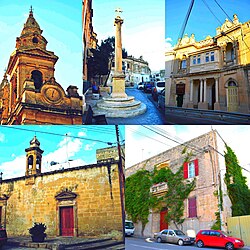
Luqa (Maltese: Ħal Luqa [ħɐl ˈluːʔɐ], lit. 'poplar') is a town located in the Southern Region of Malta, 4.3 km away from the capital Valletta. With a population of 5,945 as of March 2014,[1] it is a small but densely populated settlement which is typical of Malta's older towns and villages. Luqa is centered around a main square which contains a church dedicated to St. Andrew.[2] The patron saint's traditional feast is celebrated on the first Sunday of July, with the liturgical feast being celebrated on 30 November.[3] The Malta International Airport is located in Luqa.
Key Information
Notable residents of the town included Michelangelo Sapiano (1826–1912), a well-known clockmaker and inventor whose work includes the clock in the parish church's belfry. The house where he lived is located on Pawlu Magri Street.[4]
History
[edit]In 1592 the village of Luqa was hit by a plague epidemic, which hit all the population of Malta and caused many deaths. A sign of this sad episode is the cemetery found in Carmel Street, Alley 4 where people were buried in a field changed into a cemetery. The village of Luqa originally formed part of the parish of Gudja until it was established as a separate parish by a decree issued by Pope Urban VIII on 15 May 1634.[citation needed]
Another tragedy for Luqa was the cholera epidemic of 1850 where 13 people died. A cemetery is still present in Valletta Road as a reminder of this tragedy.[citation needed]
During the early 20th century Luqa took prominence because of the airport. The Royal Air Force established RAF Station Luqa, an airfield with runways which later on evolved as a civilian airport. The RAF established military and civilian buildings in the area close to the airfield/airport and in Ħal Farruġ. They used the airfield until it closed on 31 March 1979 when it was transferred to the Maltese Government to be transformed into a civilian airport. However they still used the domestic site for their own military force.[citation needed]
Many people died during the Second World War in Luqa, and many buildings destroyed due to heavy bombardment. A tragedy which is still remembered happened on 9 April 1942 when a bomb hit a wartime shelter and a well and the people inside the shelter were buried alive. The Local Council still remembers the people who died during WWII with a ceremony of the laying of bay wreaths together with the other local organisations and clubs.
The patron Saint of Luqa is St. Andrew (Sant' Andrija). A local niche dedicated to him is found in Luqa, which is two storeys high.[5]
Governance
[edit]Citizens of Luqa vote for their local council every three years, which council consists of seven members, one of them being the mayor. The Mayor of Luqa is John Schembri.[6]
Economy
[edit]Air Malta and Medavia have their head offices at Malta International Airport in Luqa.[7][8]
Zones in Ħal Luqa
[edit]- Għammieri
- Ħal Farruġ
- Ħal Luqa Industrial Estate
- Ta' Ħal Saflieni
- Taċ-Ċagħki
- Taċ-Ċawla
- Tal-Bandieri
- Wied Betti
- Wied il-Knejjes
- Xagħra tas-Simar
Geography and climate
[edit]As other parts of Malta, Luqa has a Mediterranean climate (Köppen Csa),[9][10] with mild winters and hot summers. The annual average temperature is 19.3 °C (66.7 °F).
| Climate data for Malta (Luqa in the south-east part of main island, 1981–2010) | |||||||||||||
|---|---|---|---|---|---|---|---|---|---|---|---|---|---|
| Month | Jan | Feb | Mar | Apr | May | Jun | Jul | Aug | Sep | Oct | Nov | Dec | Year |
| Mean daily maximum °C (°F) | 15.6 (60.1) |
15.6 (60.1) |
17.3 (63.1) |
19.8 (67.6) |
24.1 (75.4) |
28.6 (83.5) |
31.5 (88.7) |
31.8 (89.2) |
28.5 (83.3) |
25.0 (77.0) |
20.7 (69.3) |
17.1 (62.8) |
23.0 (73.4) |
| Daily mean °C (°F) | 12.8 (55.0) |
12.5 (54.5) |
13.9 (57.0) |
16.1 (61.0) |
19.8 (67.6) |
23.9 (75.0) |
26.6 (79.9) |
27.2 (81.0) |
24.7 (76.5) |
21.5 (70.7) |
17.7 (63.9) |
14.4 (57.9) |
19.3 (66.7) |
| Mean daily minimum °C (°F) | 9.9 (49.8) |
9.4 (48.9) |
10.6 (51.1) |
12.4 (54.3) |
15.5 (59.9) |
19.1 (66.4) |
21.7 (71.1) |
22.6 (72.7) |
20.8 (69.4) |
18.1 (64.6) |
14.6 (58.3) |
11.6 (52.9) |
15.5 (59.9) |
| Average precipitation mm (inches) | 98.5 (3.88) |
60.1 (2.37) |
44.2 (1.74) |
20.7 (0.81) |
16.0 (0.63) |
4.6 (0.18) |
0.3 (0.01) |
12.8 (0.50) |
58.6 (2.31) |
82.9 (3.26) |
92.3 (3.63) |
109.2 (4.30) |
595.8 (23.46) |
| Average precipitation days (≥ 1.0 mm) | 10 | 7 | 5 | 4 | 1 | 1 | 0 | 1 | 4 | 6 | 9 | 10 | 58 |
| Mean monthly sunshine hours | 159.0 | 171.0 | 224.0 | 247.0 | 300.0 | 328.0 | 365.0 | 338.0 | 260.0 | 221.0 | 185.0 | 156.0 | 2,954 |
| Source: Meteo Climate (1981–2010 Data),[11] German Meteorological Service (sunshine duration 1961-1990)[12] | |||||||||||||
Demographics
[edit]Notable people
[edit]Ċettina Darmenia Brincat (1931–2023), businesswoman and politician
See also
[edit]References
[edit]- ^ "Estimated Population by Locality 31st March, 2014". Government of Malta. 16 May 2014. Archived from the original on 21 June 2015.
- ^ Mahoney, Leonardo (1996). 5,000 years of Architecture in Malta. Malta: Valletta Publishing. Format. p. 154. ISBN 9990958157. ISBN 9789990958157.
- ^ Malta Annual Festivals Retrieved on 18 March 2010.
- ^ No Man is an Island Archived 2013-05-10 at the Wayback Machine Cuckoo Clock Information. Retrieved on 18 March 2010.
- ^ "New Page 1". Archived from the original on 4 August 2016. Retrieved 22 March 2016.
- ^ Official website
- ^ "Contact Us Archived 2013-05-02 at the Wayback Machine." Air Malta. Retrieved on 23 April 2013. "Air Malta plc Level 2, Skyparks Business Centre Malta International Airport Luqa, Malta. LQA 9020"
- ^ "Contact Us Archived 2012-07-29 at the Wayback Machine." Medavia. Retrieved on April 23, 2013. "P.O. Box 48, Malta International Airport Luqa LQA 4000"
- ^ Central Intelligence Agency (CIA) (22 September 2022). "Malta". The World Factbook.
- ^ The Maltese Islands, Department of Information – Malta.
- ^ "Luqa Weather Averages 1981–2010". Meteo-climat-bzh.dyndns.org. Retrieved 4 April 2020.
- ^ "Climate Table of Luqa (Airport)" (PDF). Deutscher Wetterdienst. Retrieved 4 April 2020.
External links
[edit]General
[edit]- Saint Andrew's Parish (A.D. 1634)
- Ħal Luqa Youth Centre (A.D. 2003)
- Luqa St. Andrew's FC (A.D. 1934)
Band Clubs
[edit]Geography and Climate
Location and Topography
Luqa is situated in the Southern Region of Malta, approximately 5 km southwest of the capital Valletta, and lies within the Southern Harbour District.[4] Its geographic coordinates are 35°51′35″N 14°29′21″E.[5] The locality encompasses an area of 6.72 km² and exhibits a population density of 1,079 inhabitants per km², based on 2021 census data. As of 2023 estimates, the population density is approximately 1,092 inhabitants per km².[6][7] Luqa's topography consists of flat to gently undulating terrain, typical of Maltese peri-urban landscapes, with features including open fields in zones like Għammieri and extensive industrial estates.[8] The area's proximity to the Mediterranean Sea shapes its local environmental conditions. It shares boundaries with neighboring localities such as Qormi to the west, Marsa to the north, Ħamrun nearby to the north, and Gudja to the southeast, while airport runways extend into adjacent areas.[4] Malta International Airport stands as a prominent landmark influencing Luqa's spatial development.[4]Climate
Luqa experiences a Mediterranean climate, classified as Csa under the Köppen-Geiger system, featuring hot, dry summers and mild, wet winters.[9] This classification reflects the locality's subtropical influences, with distinct seasonal shifts driven by its position in the central Mediterranean.[10] The annual average temperature in Luqa is 19.0°C, based on long-term observations from 1991 to 2020 at the nearby Malta International Airport meteorological station.[11] Summer months see average highs of 32.0°C in August, while winter lows average 9.6°C in February, with extremes rarely exceeding 34°C or dropping below 7°C.[11] These patterns underscore the mild variability typical of coastal Mediterranean settings. Annual precipitation amounts to 543.4 mm, concentrated primarily from October to March, with November recording the highest monthly average at 89.1 mm and July the lowest at 0.2 mm.[11] Relative humidity is notably low during summer, averaging around 60-70%, contributing to the dry conditions.[11] The flat topography of Luqa enhances wind exposure, occasionally amplifying the effects of seasonal breezes. Luqa's proximity to the airport and urban sprawl moderates temperature extremes compared to inland Malta, as the open coastal terrain promotes sea breezes that temper heat.[12] However, recent studies have identified an urban heat island effect in Maltese urban areas, including Luqa, with temperature differentials of up to 1.5°C higher in built-up zones during nights.[13] Summers typically offer 8 to 11 hours of daily sunshine, peaking at 11.9 hours in July, while occasional sirocco winds from North Africa introduce hot, dry spells, particularly in spring and autumn.[11][14]History
Origins and Early Development
The area of Luqa exhibits traces of ancient habitation, particularly from the Roman period, where catacombs uncovered in 1912 attest to burial practices and settlement activity; some of these underground structures were subsequently damaged during later infrastructure projects.[4] During the Phoenician and Roman eras, spanning from around 700 BC to the 4th century AD, the region served mainly as agricultural land, consistent with Malta's role as a Mediterranean outpost supporting cultivation and trade.[15] In the medieval period, Luqa remained a rural hamlet within the ecclesiastical jurisdiction of Mdina, Malta's fortified capital, before aligning more closely with the nearby parish of Gudja under the Knights of St. John. A wayside chapel dedicated to St. James, constructed in 1550 at nearby Ħal Saflieni, was relocated to Luqa in 1613 and served as an early religious focal point until its last public use.[4] Luqa's formal establishment as an independent parish occurred on 15 May 1634, by decree of Pope Urban VIII, separating it from Gudja and dedicating it to St. Andrew as patron saint; an initial church from the mid-16th century was soon deemed inadequate, leading to plans for a new structure completed in the late 17th century.[16][17] This development marked the village's transition from a dependent settlement to a self-governing community, with the parish church becoming its central landmark. The name Luqa derives from the Latin Lucas, via Sicilian Luca, referring to the biblical figure St. Luke.[18] By the early 20th century, under British colonial administration, Luqa experienced gradual urbanization, including expansions to the parish church between 1901 and 1910 to accommodate a growing population, alongside improvements in local roads and infrastructure that facilitated connectivity to Valletta.[17]World War II and Modern Era
During World War II, Luqa emerged as a critical strategic asset for the Allies, with the Royal Air Force establishing RAF Luqa in the early 1940s as a primary airfield for heavy bomber and reconnaissance operations in the Mediterranean theater.[19] The base endured intense Axis bombing campaigns, particularly during the 1942 Malta Blitz, when Luftwaffe and Italian aircraft targeted the airfield repeatedly to disrupt Allied supply lines to North Africa.[20] One of the most tragic incidents occurred on 9 April 1942, when a bomb struck an air-raid shelter in Luqa, causing its collapse and killing 23 civilians while injuring several others, highlighting the severe civilian toll of the conflict on the locality.[21] Following the war, Luqa's airfield transitioned gradually toward civilian use, culminating in its full handover from military control on 31 March 1979, when RAF operations ceased entirely and the facility came under Maltese civil aviation authority.[22] Malta's achievement of independence from Britain on 21 September 1964 marked a pivotal moment, fostering post-colonial economic diversification and spurring infrastructural growth in Luqa, including enhancements to the airport that supported emerging tourism and trade sectors.[23] In the late 20th century, the area experienced notable industrial expansion during the 1980s and 1990s, driven by foreign investments in manufacturing—particularly electronics and textiles—and the establishment of free-trade zones adjacent to the airport, which capitalized on Luqa's logistical advantages.[24] Malta's accession to the European Union on 1 May 2004 further accelerated aviation development, liberalizing air transport regulations and enabling low-cost carriers to establish routes, thereby increasing passenger traffic through Luqa and reinforcing its role as a regional hub.[25] In the 21st century, Luqa has seen ongoing infrastructural modernization, exemplified by the Malta International Airport's Terminal Expansion Project, which received planning approval in 2023 for a 6,000-square-meter extension to accommodate growing demand, including additional check-in desks and gates.[26] A significant shift in the aviation landscape occurred on 30 March 2024, when the state-owned Air Malta ceased operations after decades of financial challenges, immediately succeeded by the government-backed KM Malta Airlines, which assumed key routes with a leaner fleet of Airbus A320neo aircraft.[27] The COVID-19 pandemic temporarily disrupted this progress, causing a sharp decline in airport activity from 2020 to 2021 due to global travel restrictions and border closures, but recovery was robust by 2023, with passenger numbers reaching 7.8 million—surpassing pre-pandemic levels and signaling renewed vitality. In 2024, passenger numbers rose further to nearly 9 million, marking a 15% increase from 2023.[28][29] More recently, in November 2025, a major social housing initiative in Luqa's Ħal Farruġ area—encompassing 267 apartments managed by state-owned Malita Investments plc—halted construction amid severe liquidity constraints at the company, delaying completion beyond the original 2026 target and underscoring fiscal pressures on public development projects.[30]Demographics
Population Statistics
According to the 2021 Census of Population and Housing conducted by the National Statistics Office (NSO) of Malta, Ħal Luqa had a usual resident population of 7,249.[2] The population of Luqa has shown variable growth over recent decades. In the 2011 census, it stood at 5,911, reflecting a 22.6% increase to 2021. Estimates indicate 5,945 residents in 2014 and 6,162 in 2019, suggesting an average annual growth rate of approximately 0.5-1% during that inter-census period, primarily from urban migration.[7][2] As of 2023, the estimated population reached 7,335, continuing a modest upward trend.[7] Luqa's population density in 2021 was approximately 1,079 persons per square kilometer, calculated over its land area of 6.72 km²; this is lower than Malta's national average of 1,649 persons per square kilometer, influenced by industrial zones including the adjacent airport.[2][7][31]| Year | Population | Source |
|---|---|---|
| 1985 | 5,585 | NSO Census[7] |
| 1995 | 6,150 | NSO Census[7] |
| 2005 | 6,072 | NSO Census[7] |
| 2011 | 5,911 | NSO Census[2] |
| 2014 | 5,945 (est.) | NSO-based estimate[7] |
| 2019 | 6,162 (est.) | NSO-based estimate[32] |
| 2021 | 7,249 | NSO Census[2] |
| 2023 | 7,335 (est.) | NSO-based estimate[7] |
Demographic Composition
The residents of Luqa are known by the demonyms Ħalluqi for males, Ħalluqija for females, and Ħalluqin in the plural.[33] According to the 2021 census, Luqa's population exhibits an aging structure typical of broader Maltese trends, with an average age of 48.3 years. About 12% of residents are aged 0-17 years old, while 31% are aged 65 or older, underscoring a demographic shift toward older age groups influenced by low birth rates and longer life expectancies nationwide.[2][7] Citizenship in Luqa is predominantly Maltese at 85.5% (6,197 individuals), though the foreign community has grown to 14.5% (1,052), largely driven by employment opportunities at the nearby Malta International Airport. The main foreign groups include nationals from EU countries (such as the UK and Italy) and South Asia (such as India and Pakistan), contributing to increased cultural and linguistic diversity in the locality.[2][7] Household composition in Luqa aligns closely with national patterns, featuring an average size of 2.6 persons and a high homeownership rate of around 75%. Social indicators reflect a balanced gender distribution near 50/50. The aviation sector's multinational workforce enhances employment diversity in the locality.[34][6]Government and Administration
Local Council
The Local Council of Luqa consists of seven members elected every five years through the single transferable vote system, a form of proportional representation used in Maltese local elections.[35] This structure ensures representation proportional to voter preferences within the locality. John Schembri of the Labour Party (PL) serves as the current mayor, having been re-elected following the June 2024 elections.[36] The council's composition includes five PL members and two from the Nationalist Party (PN).[36] The council holds authority over local services, including waste management, road upkeep, and the organization of community events.[37] Its operations are supported by an annual budget, with total income recorded at approximately €574,000 for 2023, primarily from government allocations.[38] The Labour Party has maintained dominance in Luqa's local council elections since their introduction in 1993.[39] In the 2024 elections, the national voter turnout for local councils reached 59.47%.[40] Recent council initiatives emphasize sustainable development and efforts to mitigate aircraft noise from the adjacent Malta International Airport, aligning with national environmental action plans.[41]Administrative Zones
Luqa is administratively subdivided into several distinct zones as outlined in the South Malta Local Plan, managed by the Planning Authority to guide land use and development. These zones encompass residential, industrial, and infrastructural areas, reflecting the locality's evolution from a traditional village to a key aviation and industrial hub.[42] The core residential zone, known as Ħal Luqa proper, forms the historic heart of the locality with its organic street patterns and landmarks such as the 17th-century St. Andrew's Parish Church, serving as the primary inhabited area for much of the population. Adjacent to this is Għammieri, a locality characterized by mixed agricultural and residential uses, situated in the western part of Luqa and featuring lower-density development amid open fields.[4][43] In the southeast, Ħal Farruġ operates as a semi-rural hamlet within Luqa's boundaries, encompassing approximately 24 streets and expanding residential areas that blend with surrounding countryside, while maintaining a quieter, less urbanized profile compared to the central village. The airport zone, dominated by Malta International Airport, includes essential infrastructure such as runways, terminals, and related facilities, which were established in 1937 and have shaped much of Luqa's modern layout.[4][44] Industrial zones play a significant role in Luqa's spatial organization, with the Ħal Luqa Industrial Estate functioning as a dedicated manufacturing and warehousing hub adjacent to the airport, comprising nearly 100,000 square meters of space primarily for small and medium enterprises. Complementing this is Qasam Industrijali ta' Ħal Luqa, an area focused on logistics and light industrial operations, supporting connectivity to the airport and broader transport networks.[45][46] These zones are delineated and regulated by the Planning Authority under the South Malta Local Plan to ensure balanced development, with recent initiatives including planned expansions for open spaces in Ħal Luqa as part of the 2025 national budget allocations. The local council provides oversight for zone-specific development projects, coordinating with the authority to address community needs.[42][47]Economy
Aviation Sector
Malta International Airport, located in Luqa, serves as the primary gateway for air travel to and from Malta, handling a record 8.96 million passengers in 2024, marking nearly 15% growth over the previous year.[48] In 2025, passenger numbers continued to grow, with strong monthly increases reported.[49] The airport features two runways: the main runway 13/31 measuring 3,544 meters in length and 60 meters wide, and the secondary runway 05/23 at 2,377 meters long and 45 meters wide, enabling operations for a wide range of aircraft types.[50] Ongoing expansions include the development of SkyParks Business Centre 2, an extension of the existing business district adjacent to the airport, aimed at accommodating additional office and logistics facilities to support aviation-related enterprises.[51] The airport's aviation operations transitioned from military to fully civilian control on April 1, 1979, following the departure of the Royal Air Force, which had utilized the facility since the 1940s.[19] Air Malta, headquartered at Luqa, operated as Malta's flag carrier until its closure on March 30, 2024, due to ongoing financial losses and the European Commission's rejection of further state aid.[27] It was immediately succeeded by KM Malta Airlines, a new state-owned entity based at the same location, operating a fleet of eight Airbus A320neo aircraft in a two-class configuration.[52] The aviation sector at Luqa generates approximately 8,100 direct jobs nationally (as of 2023), with significant employment in ground handling, aircraft maintenance, and related services at the airport, including roles provided by companies like Medavia, which continues to conduct cargo flights and maintenance operations from its base in the vicinity.[53] Medavia supports cargo logistics, particularly for routes connecting Europe to North Africa, utilizing facilities at Safi Aviation Park near Luqa.[54] The sector contributes around 4% directly to Malta's GDP through aviation activities (as of 2023), with broader economic impacts from tourism—supported by over 7 million air passengers in 2019 pre-COVID—estimated at €600 million annually in the late 2010s.[53][55] Key challenges include managing noise pollution, addressed through Malta's Noise Action Plan under the EU Environmental Noise Directive, which mandates mapping, public consultation, and mitigation measures for aircraft operations around the airport agglomeration.[41] The 2024 transition from Air Malta to KM Malta Airlines proceeded with minimal disruptions, facilitated by European Union oversight on state aid compliance, allowing the seamless transfer of aircraft and routes without violating competition rules.[27]Industrial and Other Sectors
The Ħal Luqa Industrial Estate, situated adjacent to Malta International Airport, spans approximately 100,000 square meters and primarily hosts small and medium-sized enterprises (SMEs) and micro-enterprises engaged in manufacturing and related activities.[56] Numerous such businesses operate in the area (117 as of 2021), focusing on sectors including engineering, mechanical services, metal fabrication, printing, and furniture production.[57] Representative examples include Kencar Ltd., which specializes in HVAC, plumbing, and electrical systems, and Construct Furniture, a long-established firm producing bespoke interiors and doors.[58][59] Logistics and trade form a cornerstone of Luqa's non-aviation economy, leveraging the estate's strategic location to facilitate freight handling, import, and export operations. Key firms such as BAS Ltd., World Express Logistics, and Eurofreight Services Ltd. provide comprehensive services including air and sea freight forwarding, warehousing, and customs clearance, supporting international trade flows.[60][61][62] This proximity enables synergies with aviation logistics, enhancing efficiency for cargo-dependent businesses without direct involvement in air operations. In the services sector, the town center sustains retail outlets and small enterprises, such as Computer Bargains for electronics sales, alongside tourism-related spillover effects like car rental agencies (e.g., Enterprise Rent-A-Car) and nearby accommodations catering to airport visitors.[63][64] Malta's overall unemployment rate stood at approximately 3% in 2024, reflecting a robust labor market that benefits Luqa's industrial and service activities, with the locality's rate aligning closely to this national figure below the EU average.[65] EU funds under the 2021-2027 programming period support green initiatives in Luqa's industrial base, including sustainability grants for SMEs to invest in resource efficiency, waste reduction, and renewable energy upgrades, promoting circular economy practices.[66] Following the cessation of Air Malta's operations in March 2024 and its replacement by KM Malta Airlines, Luqa's logistics sector experienced a heightened emphasis on cargo services, with renewed contracts expanding global freight capacity on multiple routes.[67][68] The 2025 national budget allocates resources for industrial enhancements, including AI-integrated manufacturing and infrastructure improvements, to foster sustainable growth across Malta.[69]Culture and Heritage
Religious Sites and Feasts
The Parish Church of St. Andrew, dedicated to the town's patron saint, was constructed in 1670 following Luqa's establishment as a parish and features late Renaissance and Baroque architectural elements.[4][70] The church serves as the focal point of Luqa's religious life, hosting solemn masses and community gatherings that underscore its enduring role in fostering social cohesion among residents.[71] Luqa's primary religious celebration is the annual feast of St. Andrew, held on the first Sunday of July, which combines religious observances with vibrant civil festivities including processions, band marches, fireworks displays, and concerts.[72] The liturgical feast occurs on November 30, St. Andrew's official saint's day, observed with more subdued solemnity through masses and prayers at the parish church.[73] These events were restricted in 2020 due to COVID-19 measures but resumed in 2022, marking a return to traditional scale.[74][75] Among other religious sites, the Tal-Madonna tal-Ftajjar Chapel, dedicated to St. Mary and dating back to 1575, stands as one of Luqa's oldest surviving structures and occasionally hosts exhibitions and local events.[76] The Dejma Cross, a historical wayside cross from the 15th century associated with Malta's medieval militia system for island defense, represents an enduring symbol of communal vigilance and faith in the town's landscape.[77] The church and its feasts play a central role in Luqa's social fabric, with organizations like St. Andrew's Band Club actively participating through musical performances during processions and celebrations, reinforcing cultural ties and community identity.[78]Notable Landmarks and Traditions
Luqa is home to several notable landmarks that reflect its historical, architectural, and modern significance. The Parish Church of St. Andrew, constructed in 1670 and rebuilt between 1945 and 1954 following severe damage during World War II before being consecrated in 1962, stands as the locality's central religious and cultural edifice. This Baroque-style church features a titular painting by the renowned artist Mattia Preti from 1687, showcasing intricate Mannerist and Baroque elements that highlight Malta's artistic heritage.[4][79] Another prominent site is the Colonna Mediterranea, a 10-foot-tall abstract obelisk installed in 2006 on a roundabout near Malta International Airport. Designed by Maltese artist Paul Vella Critien, the colorful sculpture draws inspiration from ancient Egyptian obelisks and represents the vibrant hues of the Mediterranean Sea, though it has sparked controversy for its phallic shape and unconventional design.[80][81] The Malta International Airport itself serves as a key landmark, established in 1937 as the Royal Air Force's Luqa airfield and pivotal during World War II as Malta's only surviving airstrip amid heavy bombings. Its development has shaped Luqa's identity, leading to the discovery and subsequent inaccessibility of ancient sites like the Roman catacombs unearthed in 1912 and the Debdieba megalithic temple dating to around 3000–2500 BC, which was largely destroyed during runway expansions in the 20th century.[4][82] Additional historical structures include the St. James Wayside Chapel, originally built in 1550 and relocated in 1613, which was last used for public worship during World War II, and the St. Vincent de Paul home, constructed in 1862 to accommodate up to 600 elderly residents and featuring a notable Sacred Heart Chapel.[4] Luqa's traditions are deeply rooted in Maltese village culture, particularly through its vibrant religious feasts and musical societies. The annual Feast of St. Andrew, honoring the locality's patron saint, is celebrated on the first Sunday of July with elaborate processions carrying the saint's statue through the streets, accompanied by fireworks displays, band marches, and communal gatherings that unite residents in devotion and festivity. This tradition, which dates back centuries, was temporarily prohibited during World War II for security reasons but has since been revived as a cornerstone of local identity.[83][79] Central to these celebrations are Luqa's two historic band clubs: the Union Philharmonic Society (L’Unione San Andrea), founded in 1880 by Mro Vincenzo Camilleri, and the Saint Andrew's Band Club (Banda Sant' Andrija), founded in 1883. These societies not only provide music education and performances during feasts and processions but also foster community events, acting as social hubs that preserve Malta's wind band tradition originating from medieval practices. Their rivalry and collaboration, such as joint spectacles during the St. Andrew Feast, exemplify the spirited cultural life of Luqa.[84][85][86][87]References
- https://en.wiktionary.org/wiki/Luqa


